towing CHEVROLET SILVERADO 1500 2018 Owner's Guide
[x] Cancel search | Manufacturer: CHEVROLET, Model Year: 2018, Model line: SILVERADO 1500, Model: CHEVROLET SILVERADO 1500 2018Pages: 501, PDF Size: 6.69 MB
Page 300 of 501
Chevrolet Silverado Owner Manual (GMNA-Localizing-U.S./Canada/Mexico-
11349200) - 2018 - CRC - 2/27/18
Driving and Operating 299
When towing a trailer, the arrows on
the instrument cluster flash for turns
even if the bulbs on the trailer are
burned out.
Check occasionally to be sure the
trailer bulbs are still working.
Driving on Grades
Reduce speed and shift to a lower
gearbefore starting down a long or
steep downgrade. If the
transmission is not shifted down, the
brakes might get hot and no longer
work well.
Vehicles can tow in D (Drive). Shift
the transmission to a lower gear if
the transmission shifts too often
under heavy loads and/or hilly
conditions.
The Tow/Haul Mode may be used if
the transmission shifts too often.
See Tow/Haul Mode 0262.
When towing at high altitude on
steep uphill grades, consider the
following: Engine coolant will boil at
a lower temperature than at normal
altitudes. If the engine is turned off
immediately after towing at high altitude on steep uphill grades, the
vehicle may show signs similar to
engine overheating. To avoid this,
let the engine run while parked,
preferably on level ground, with the
transmission in P (Park) for a few
minutes before turning the engine
off. If the overheat warning comes
on, see
Engine Overheating 0356.
Parking on Hills
{Warning
Parking the vehicle on a hill with
the trailer attached can be
dangerous. If something goes
wrong, the rig could start to move.
People can be injured, and both
the vehicle and the trailer can be
damaged. When possible, always
park the rig on a flat surface.
If parking the rig on a hill: 1. Press the brake pedal, but do not shift into P (Park) yet. Turn
the wheels into the curb if
facing downhill or into traffic if
facing uphill. 2. Have someone place chocks
under the trailer wheels.
3. When the wheel chocks are in place, release the regular
brakes until the chocks absorb
the load.
4. Reapply the brake pedal. Then apply the parking brake and
shift into P (Park).
5. Release the brake pedal.
For vehicles with a manual
transmission, move the shift lever
into R (Reverse) if parking on a
downhill slope, use 1 (First) gear if
parking on an uphill slope.
Leaving After Parking on a Hill
1. Apply and hold the brake pedal.
.Start the engine.
. Shift into a gear.
. Release the parking brake.
2. Let up on the brake pedal.
3. Drive slowly until the trailer is clear of the chocks.
Page 301 of 501
Chevrolet Silverado Owner Manual (GMNA-Localizing-U.S./Canada/Mexico-
11349200) - 2018 - CRC - 2/27/18
300 Driving and Operating
4. Stop and have someone pickup and store the chocks.
Maintenance when Trailer
Towing
The vehicle needs service more
often when pulling a trailer. See
Maintenance Schedule 0443.
Things that are especially important
in trailer operation are automatic
transmission fluid, engine oil, axle
lubricant, belts, cooling system, and
brake system. It is a good idea to
inspect these before and during
the trip.
Check periodically to see that all
hitch nuts and bolts are tight.
Engine Cooling When Trailer
Towing
The cooling system may temporarily
overheat during severe operating
conditions. See Engine Overheating
0 356.
Trailer Towing
If the vehicle has a diesel engine,
see the Duramax diesel
supplement.
Do not tow a trailer during break-in.
See New Vehicle Break-In 0247.
{Warning
The driver can lose control when
pulling a trailer if the correct
equipment is not used or the
vehicle is not driven properly. For
example, if the trailer is too heavy
or the trailer brakes are
inadequate for the load, the
vehicle may not stop as expected.
The driver and passengers could
be seriously injured. The vehicle
may also be damaged; the
resulting repairs would not be
covered by the vehicle warranty.
Pull a trailer only if all the steps in
this section have been followed.
Ask your dealer for advice and
information about towing a trailer
with the vehicle.
Caution
Pulling a trailer improperly can
damage the vehicle and result in
costly repairs not covered by the
vehicle warranty. To pull a trailer
correctly, follow the advice in this
section and see your dealer for
important information about
towing a trailer with the vehicle.
See Vehicle Load Limits 0239 for
more information about the vehicle's
maximum load capacity.
To identify the trailering capacity of
the vehicle, read the information in
“Weight of the Trailer” later in this
section.
Trailering is different than just
driving the vehicle by itself.
Trailering means changes in
handling, acceleration, braking,
durability, and fuel economy.
Successful, safe trailering takes
correct equipment, and it has to be
used properly.
Page 304 of 501
Chevrolet Silverado Owner Manual (GMNA-Localizing-U.S./Canada/Mexico-
11349200) - 2018 - CRC - 2/27/18
Driving and Operating 303
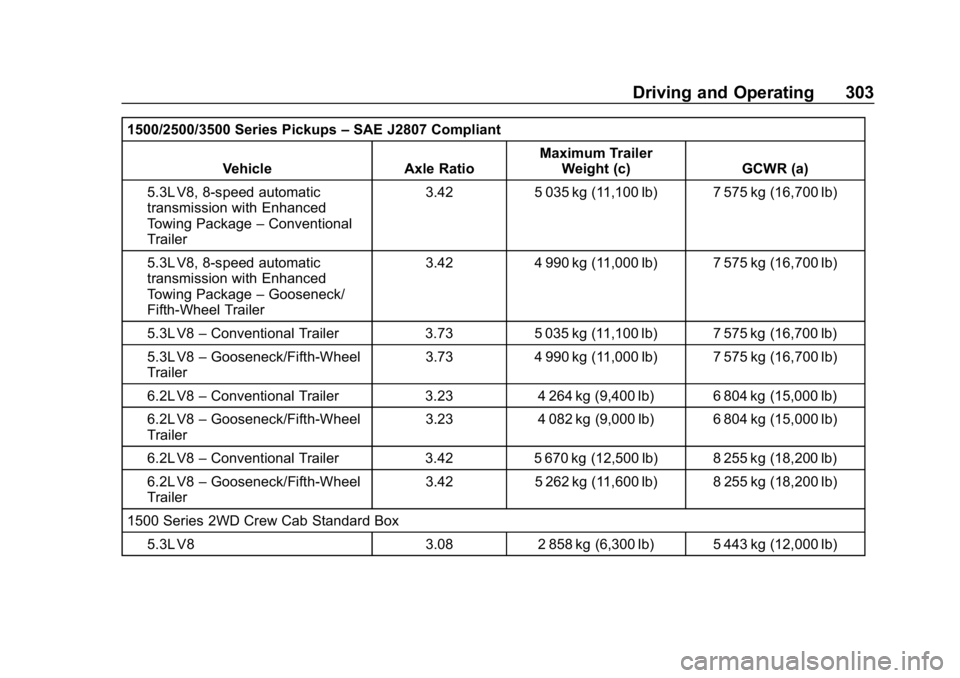
1500/2500/3500 Series Pickups–SAE J2807 Compliant
Vehicle Axle Ratio Maximum Trailer
Weight (c) GCWR (a)
5.3L V8, 8-speed automatic
transmission with Enhanced
Towing Package –Conventional
Trailer 3.42 5 035 kg (11,100 lb) 7 575 kg (16,700 lb)
5.3L V8, 8-speed automatic
transmission with Enhanced
Towing Package –Gooseneck/
Fifth-Wheel Trailer 3.42 4 990 kg (11,000 lb) 7 575 kg (16,700 lb)
5.3L V8 –Conventional Trailer 3.735 035 kg (11,100 lb) 7 575 kg (16,700 lb)
5.3L V8 –Gooseneck/Fifth-Wheel
Trailer 3.73
4 990 kg (11,000 lb) 7 575 kg (16,700 lb)
6.2L V8 –Conventional Trailer 3.234 264 kg (9,400 lb) 6 804 kg (15,000 lb)
6.2L V8 –Gooseneck/Fifth-Wheel
Trailer 3.23
4 082 kg (9,000 lb) 6 804 kg (15,000 lb)
6.2L V8 –Conventional Trailer 3.425 670 kg (12,500 lb) 8 255 kg (18,200 lb)
6.2L V8 –Gooseneck/Fifth-Wheel
Trailer 3.42
5 262 kg (11,600 lb) 8 255 kg (18,200 lb)
1500 Series 2WD Crew Cab Standard Box 5.3L V8 3.082 858 kg (6,300 lb) 5 443 kg (12,000 lb)
Page 305 of 501
Chevrolet Silverado Owner Manual (GMNA-Localizing-U.S./Canada/Mexico-
11349200) - 2018 - CRC - 2/27/18
304 Driving and Operating
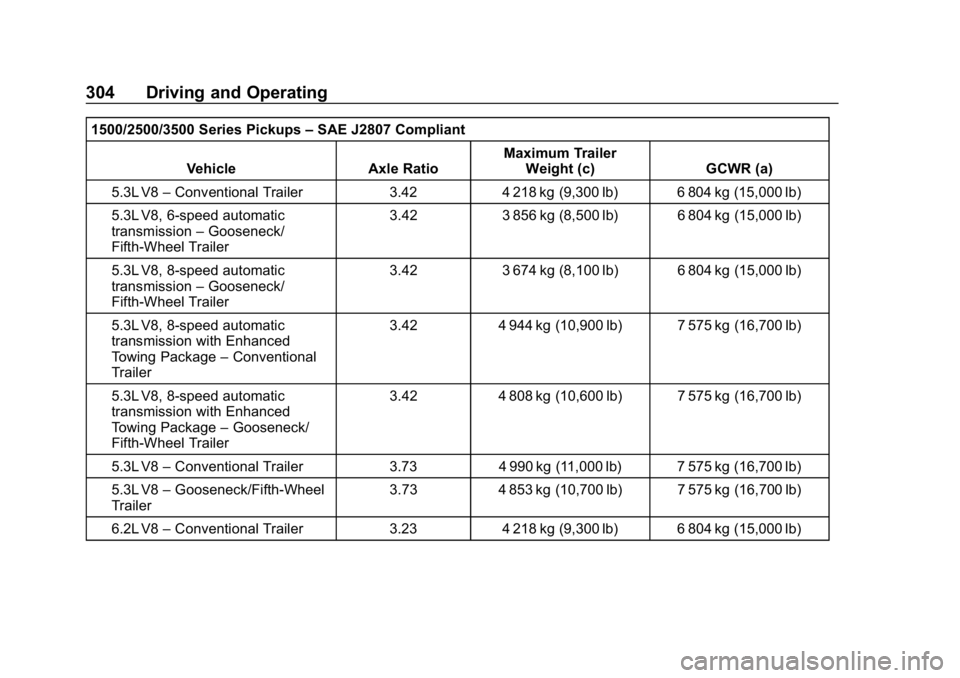
1500/2500/3500 Series Pickups–SAE J2807 Compliant
Vehicle Axle Ratio Maximum Trailer
Weight (c) GCWR (a)
5.3L V8 –Conventional Trailer 3.424 218 kg (9,300 lb) 6 804 kg (15,000 lb)
5.3L V8, 6-speed automatic
transmission –Gooseneck/
Fifth-Wheel Trailer 3.42
3 856 kg (8,500 lb) 6 804 kg (15,000 lb)
5.3L V8, 8-speed automatic
transmission –Gooseneck/
Fifth-Wheel Trailer 3.42
3 674 kg (8,100 lb) 6 804 kg (15,000 lb)
5.3L V8, 8-speed automatic
transmission with Enhanced
Towing Package –Conventional
Trailer 3.42
4 944 kg (10,900 lb) 7 575 kg (16,700 lb)
5.3L V8, 8-speed automatic
transmission with Enhanced
Towing Package –Gooseneck/
Fifth-Wheel Trailer 3.42
4 808 kg (10,600 lb) 7 575 kg (16,700 lb)
5.3L V8 –Conventional Trailer 3.734 990 kg (11,000 lb) 7 575 kg (16,700 lb)
5.3L V8 –Gooseneck/Fifth-Wheel
Trailer 3.73
4 853 kg (10,700 lb) 7 575 kg (16,700 lb)
6.2L V8 –Conventional Trailer 3.234 218 kg (9,300 lb) 6 804 kg (15,000 lb)
Page 306 of 501
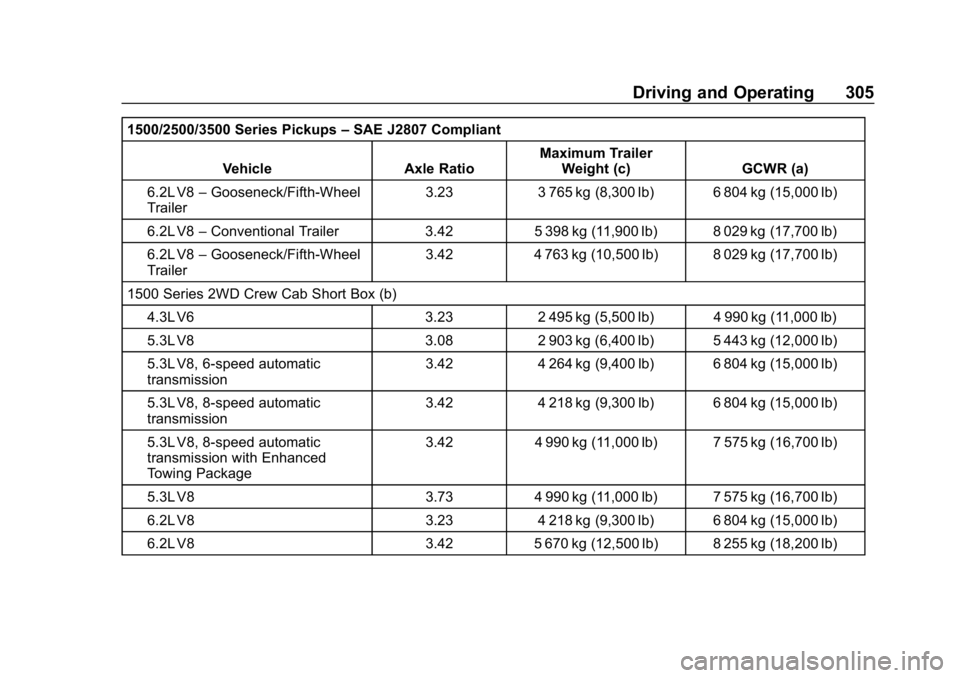
Chevrolet Silverado Owner Manual (GMNA-Localizing-U.S./Canada/Mexico-
11349200) - 2018 - CRC - 2/27/18
Driving and Operating 305
1500/2500/3500 Series Pickups–SAE J2807 Compliant
Vehicle Axle Ratio Maximum Trailer
Weight (c) GCWR (a)
6.2L V8 –Gooseneck/Fifth-Wheel
Trailer 3.23 3 765 kg (8,300 lb) 6 804 kg (15,000 lb)
6.2L V8 –Conventional Trailer 3.425 398 kg (11,900 lb) 8 029 kg (17,700 lb)
6.2L V8 –Gooseneck/Fifth-Wheel
Trailer 3.42
4 763 kg (10,500 lb) 8 029 kg (17,700 lb)
1500 Series 2WD Crew Cab Short Box (b) 4.3L V6 3.232 495 kg (5,500 lb) 4 990 kg (11,000 lb)
5.3L V8 3.082 903 kg (6,400 lb) 5 443 kg (12,000 lb)
5.3L V8, 6-speed automatic
transmission 3.42
4 264 kg (9,400 lb) 6 804 kg (15,000 lb)
5.3L V8, 8-speed automatic
transmission 3.42
4 218 kg (9,300 lb) 6 804 kg (15,000 lb)
5.3L V8, 8-speed automatic
transmission with Enhanced
Towing Package 3.42
4 990 kg (11,000 lb) 7 575 kg (16,700 lb)
5.3L V8 3.734 990 kg (11,000 lb) 7 575 kg (16,700 lb)
6.2L V8 3.234 218 kg (9,300 lb) 6 804 kg (15,000 lb)
6.2L V8 3.425 670 kg (12,500 lb) 8 255 kg (18,200 lb)
Page 308 of 501
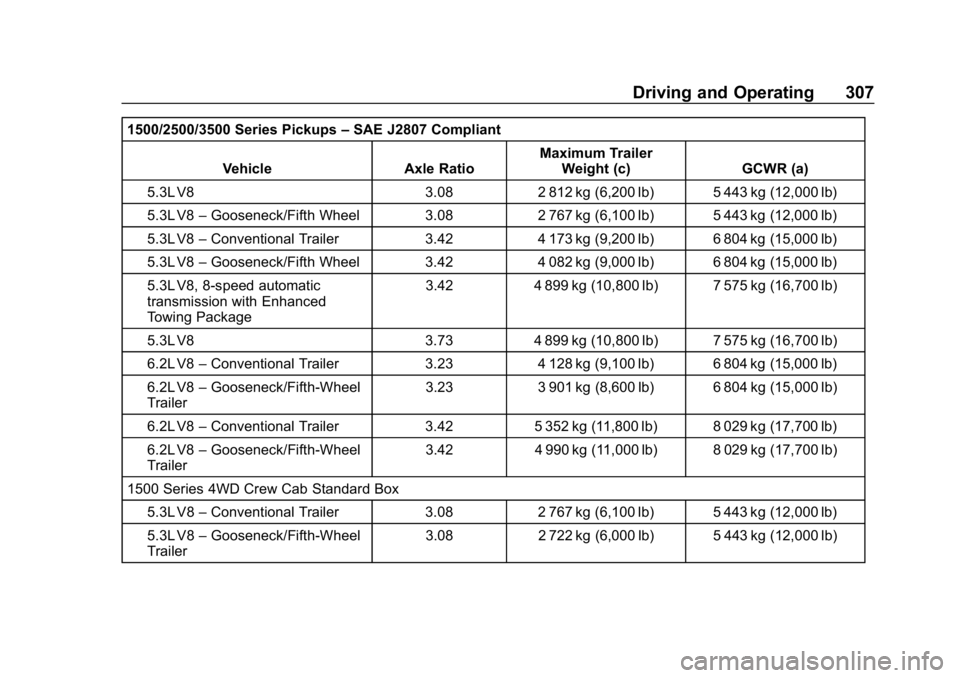
Chevrolet Silverado Owner Manual (GMNA-Localizing-U.S./Canada/Mexico-
11349200) - 2018 - CRC - 2/27/18
Driving and Operating 307
1500/2500/3500 Series Pickups–SAE J2807 Compliant
Vehicle Axle Ratio Maximum Trailer
Weight (c) GCWR (a)
5.3L V8 3.08 2 812 kg (6,200 lb) 5 443 kg (12,000 lb)
5.3L V8 –Gooseneck/Fifth Wheel 3.08 2 767 kg (6,100 lb) 5 443 kg (12,000 lb)
5.3L V8 –Conventional Trailer 3.424 173 kg (9,200 lb) 6 804 kg (15,000 lb)
5.3L V8 –Gooseneck/Fifth Wheel 3.42 4 082 kg (9,000 lb) 6 804 kg (15,000 lb)
5.3L V8, 8-speed automatic
transmission with Enhanced
Towing Package 3.42
4 899 kg (10,800 lb) 7 575 kg (16,700 lb)
5.3L V8 3.734 899 kg (10,800 lb) 7 575 kg (16,700 lb)
6.2L V8 –Conventional Trailer 3.234 128 kg (9,100 lb) 6 804 kg (15,000 lb)
6.2L V8 –Gooseneck/Fifth-Wheel
Trailer 3.23
3 901 kg (8,600 lb) 6 804 kg (15,000 lb)
6.2L V8 –Conventional Trailer 3.425 352 kg (11,800 lb) 8 029 kg (17,700 lb)
6.2L V8 –Gooseneck/Fifth-Wheel
Trailer 3.42
4 990 kg (11,000 lb) 8 029 kg (17,700 lb)
1500 Series 4WD Crew Cab Standard Box 5.3L V8 –Conventional Trailer 3.082 767 kg (6,100 lb) 5 443 kg (12,000 lb)
5.3L V8 –Gooseneck/Fifth-Wheel
Trailer 3.08
2 722 kg (6,000 lb) 5 443 kg (12,000 lb)
Page 309 of 501
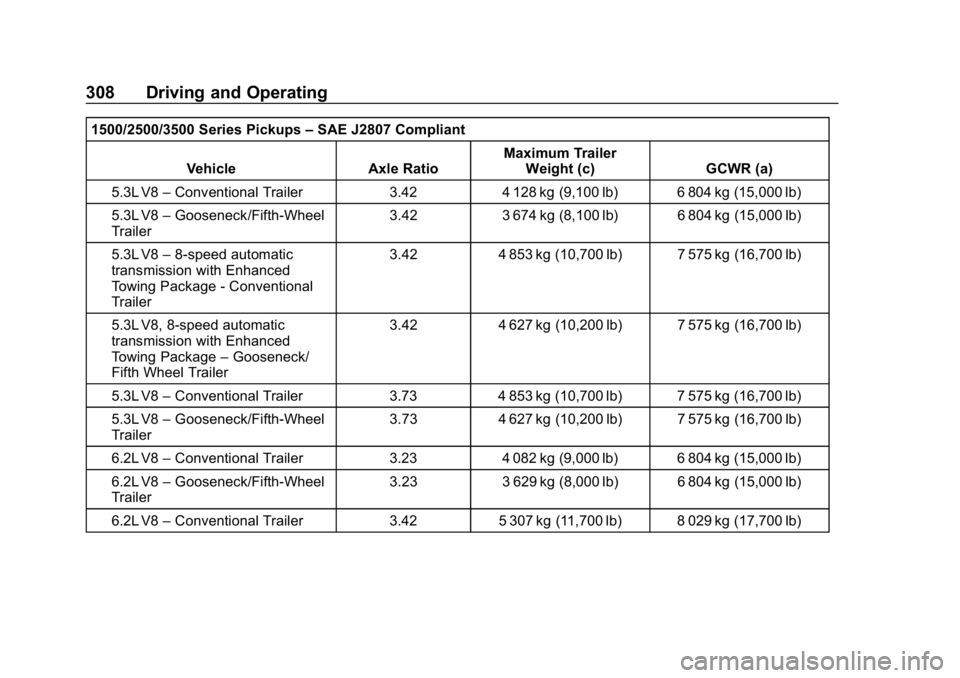
Chevrolet Silverado Owner Manual (GMNA-Localizing-U.S./Canada/Mexico-
11349200) - 2018 - CRC - 2/27/18
308 Driving and Operating
1500/2500/3500 Series Pickups–SAE J2807 Compliant
Vehicle Axle Ratio Maximum Trailer
Weight (c) GCWR (a)
5.3L V8 –Conventional Trailer 3.424 128 kg (9,100 lb) 6 804 kg (15,000 lb)
5.3L V8 –Gooseneck/Fifth-Wheel
Trailer 3.42
3 674 kg (8,100 lb) 6 804 kg (15,000 lb)
5.3L V8 –8-speed automatic
transmission with Enhanced
Towing Package - Conventional
Trailer 3.42
4 853 kg (10,700 lb) 7 575 kg (16,700 lb)
5.3L V8, 8-speed automatic
transmission with Enhanced
Towing Package –Gooseneck/
Fifth Wheel Trailer 3.42
4 627 kg (10,200 lb) 7 575 kg (16,700 lb)
5.3L V8 –Conventional Trailer 3.734 853 kg (10,700 lb) 7 575 kg (16,700 lb)
5.3L V8 –Gooseneck/Fifth-Wheel
Trailer 3.73
4 627 kg (10,200 lb) 7 575 kg (16,700 lb)
6.2L V8 –Conventional Trailer 3.234 082 kg (9,000 lb) 6 804 kg (15,000 lb)
6.2L V8 –Gooseneck/Fifth-Wheel
Trailer 3.23
3 629 kg (8,000 lb) 6 804 kg (15,000 lb)
6.2L V8 –Conventional Trailer 3.425 307 kg (11,700 lb) 8 029 kg (17,700 lb)
Page 310 of 501
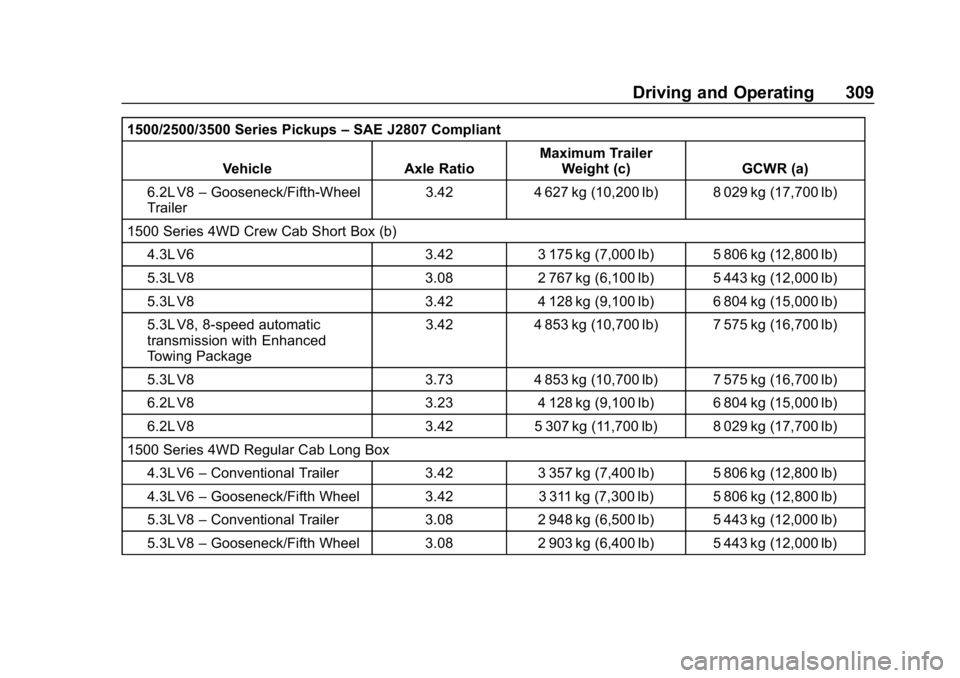
Chevrolet Silverado Owner Manual (GMNA-Localizing-U.S./Canada/Mexico-
11349200) - 2018 - CRC - 2/27/18
Driving and Operating 309
1500/2500/3500 Series Pickups–SAE J2807 Compliant
Vehicle Axle Ratio Maximum Trailer
Weight (c) GCWR (a)
6.2L V8 –Gooseneck/Fifth-Wheel
Trailer 3.42 4 627 kg (10,200 lb) 8 029 kg (17,700 lb)
1500 Series 4WD Crew Cab Short Box (b) 4.3L V6 3.42 3 175 kg (7,000 lb) 5 806 kg (12,800 lb)
5.3L V8 3.08 2 767 kg (6,100 lb) 5 443 kg (12,000 lb)
5.3L V8 3.42 4 128 kg (9,100 lb) 6 804 kg (15,000 lb)
5.3L V8, 8-speed automatic
transmission with Enhanced
Towing Package 3.42 4 853 kg (10,700 lb) 7 575 kg (16,700 lb)
5.3L V8 3.73 4 853 kg (10,700 lb) 7 575 kg (16,700 lb)
6.2L V8 3.23 4 128 kg (9,100 lb) 6 804 kg (15,000 lb)
6.2L V8 3.42 5 307 kg (11,700 lb) 8 029 kg (17,700 lb)
1500 Series 4WD Regular Cab Long Box 4.3L V6 –Conventional Trailer 3.423 357 kg (7,400 lb) 5 806 kg (12,800 lb)
4.3L V6 –Gooseneck/Fifth Wheel 3.42 3 311 kg (7,300 lb) 5 806 kg (12,800 lb)
5.3L V8 –Conventional Trailer 3.082 948 kg (6,500 lb) 5 443 kg (12,000 lb)
5.3L V8 –Gooseneck/Fifth Wheel 3.08 2 903 kg (6,400 lb) 5 443 kg (12,000 lb)
Page 319 of 501
Chevrolet Silverado Owner Manual (GMNA-Localizing-U.S./Canada/Mexico-
11349200) - 2018 - CRC - 2/27/18
318 Driving and Operating
Weight of the Trailering
Combination
It is important that the combination
of the tow vehicle and trailer
does not exceed any of its weight
ratings—GCWR, GVWR, RGAWR,
Trailer Weight Rating, or Tongue
Weight. The only way to be sure it is
not exceeding any of these ratings
is to weigh the tow vehicle and
trailer combination, fully loaded for
the trip, getting individual weights
for each of these items.
Towing Equipment
Hitches
The correct hitch equipment helps
maintain combination control. Many
trailers can be towed with a
weight-carrying hitch which simply
features a coupler latched to the
hitch ball, or a tow eye latched to a
pintle hook. Other trailers may
require a weight-distributing hitch
that uses spring bars to distribute
the trailer tongue weight among the
tow vehicle and trailer axles.
Fifth-wheel and gooseneck hitches
may also be used. See “Weight of
the Trailer Tongue” underTrailer
Towing 0300 for rating limits with
various hitch types. If a step-bumper hitch will be used,
the bumper could be damaged in
sharp turns. Make sure there
is ample room when turning to avoid
contact between the trailer and the
bumper.
Consider using sway controls with
any trailer. Ask a trailering
professional about sway controls or
refer to the trailer manufacturer's
recommendations and instructions.
Weight-Distributing Hitch and
Adjustment
A weight-distributing hitch may be
useful with some trailers. Use the
following guidelines to determine if a
weight-distributing hitch should
be used.
Page 320 of 501
Chevrolet Silverado Owner Manual (GMNA-Localizing-U.S./Canada/Mexico-
11349200) - 2018 - CRC - 2/27/18
Driving and Operating 319
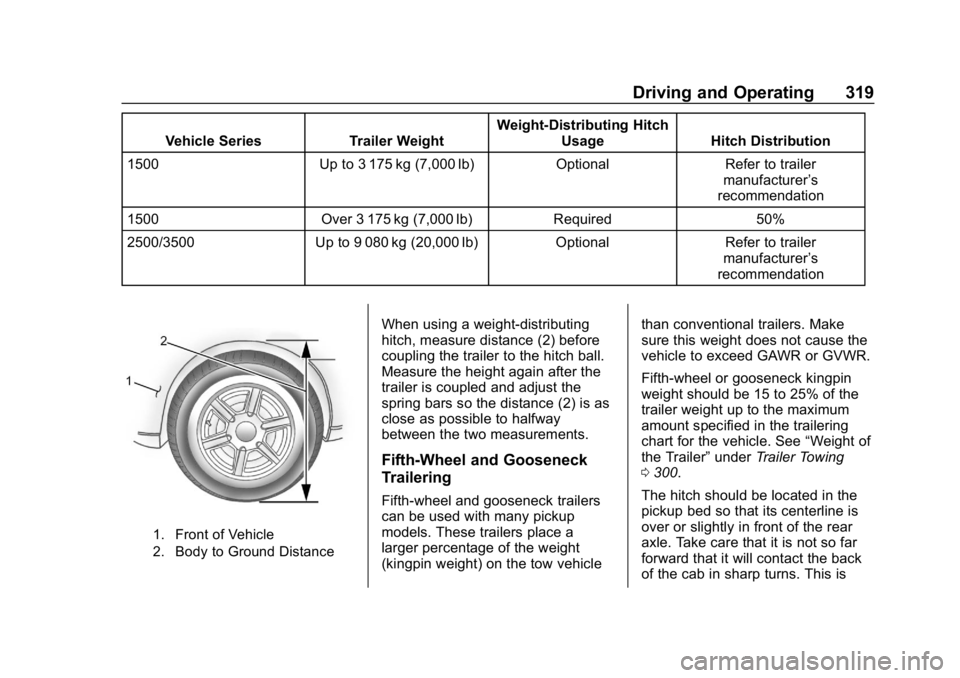
Vehicle SeriesTrailer WeightWeight-Distributing Hitch
Usage Hitch Distribution
1500 Up to 3 175 kg (7,000 lb) OptionalRefer to trailer
manufacturer ’s
recommendation
1500 Over 3 175 kg (7,000 lb) Required50%
2500/3500 Up to 9 080 kg (20,000 lb) OptionalRefer to trailer
manufacturer ’s
recommendation
1. Front of Vehicle
2. Body to Ground Distance
When using a weight-distributing
hitch, measure distance (2) before
coupling the trailer to the hitch ball.
Measure the height again after the
trailer is coupled and adjust the
spring bars so the distance (2) is as
close as possible to halfway
between the two measurements.
Fifth-Wheel and Gooseneck
Trailering
Fifth-wheel and gooseneck trailers
can be used with many pickup
models. These trailers place a
larger percentage of the weight
(kingpin weight) on the tow vehicle than conventional trailers. Make
sure this weight does not cause the
vehicle to exceed GAWR or GVWR.
Fifth-wheel or gooseneck kingpin
weight should be 15 to 25% of the
trailer weight up to the maximum
amount specified in the trailering
chart for the vehicle. See
“Weight of
the Trailer” underTrailer Towing
0 300.
The hitch should be located in the
pickup bed so that its centerline is
over or slightly in front of the rear
axle. Take care that it is not so far
forward that it will contact the back
of the cab in sharp turns. This is