ECU CHEVROLET SILVERADO 2002 1.G User Guide
[x] Cancel search | Manufacturer: CHEVROLET, Model Year: 2002, Model line: SILVERADO, Model: CHEVROLET SILVERADO 2002 1.GPages: 497, PDF Size: 3.09 MB
Page 57 of 497
1-50
CAUTION:
A child in a rear-facing child restraint can be
seriously injured or killed if the right front
passenger's air bag inflates. This is because the
back of the rear
-facing child restraint would be
very close to the inflating air bag. Be sure to turn
off the air bag before using a rear
-facing child
restraint in the right front seat position.
Wherever you install it, be sure to secure the child
restraint properly.
Keep in mind that an unsecured child restraint can move
around in a collision or sudden stop and injure people in
the vehicle. Be sure to properly secure any child
restraint in your vehicle
-- even when no child is in it.
Where to Put the Restraint
(Crew Cab Pickup)
Accident statistics show that children are safer if they
are restrained in the rear rather than the front seat.
General Motors, therefore, recommends that child
restraints be secured in the rear seat, including an infant
riding in a rear
-facing infant seat, a child riding in a
forward
-facing child seat and an older child riding in a
booster seat.
If a forward
-facing child seat must be secured in the
vehicle's right front seat, the seat should be moved as far
back as possible. However, it is better to secure the
restraint in a rear seat. Never put a rear
-facing child
restraint in the right front passenger seat. Here's why:
Page 58 of 497
1-51
CAUTION:
A child riding in a rear-facing child restraint can
be seriously injured or killed if the right front
passenger's air bag inflates. This is because the
back of the rear
-facing child restraint would be
very close to the inflating air bag. Always secure
a rear
-facing child restraint in the rear seat.
You may secure a forward-facing child restraint
in the right front seat, but before you do, always
move the front passenger seat as far back as it
will go. It's better to secure the child restraint in
a rear seat.
Wherever you install it, be sure to secure the child
restraint properly.
Keep in mind that an unsecured child restraint can move
around in a collision or sudden stop and injure people in
the vehicle. Be sure to properly secure any child
restraint in your vehicle
-- even when no child is in it.
Top Strap
Some child restraints have a top strap, or ªtop tether.º
It can help restrain the child restraint during a collision.
For it to work, a top strap must be properly anchored to
the vehicle. Some top strap
-equipped child restraints are
designed for use with or without the top strap being
anchored. Others require the top strap always to be
anchored. Be sure to read and follow the instructions
for your child restraint. If yours requires that the top
strap be anchored, don't use the restraint unless it is
anchored properly.
If the child restraint does not have a top strap, one can
be obtained, in kit form, for many child restraints.
Ask the child restraint manufacturer whether or not a
kit is available.
Page 59 of 497
1-52
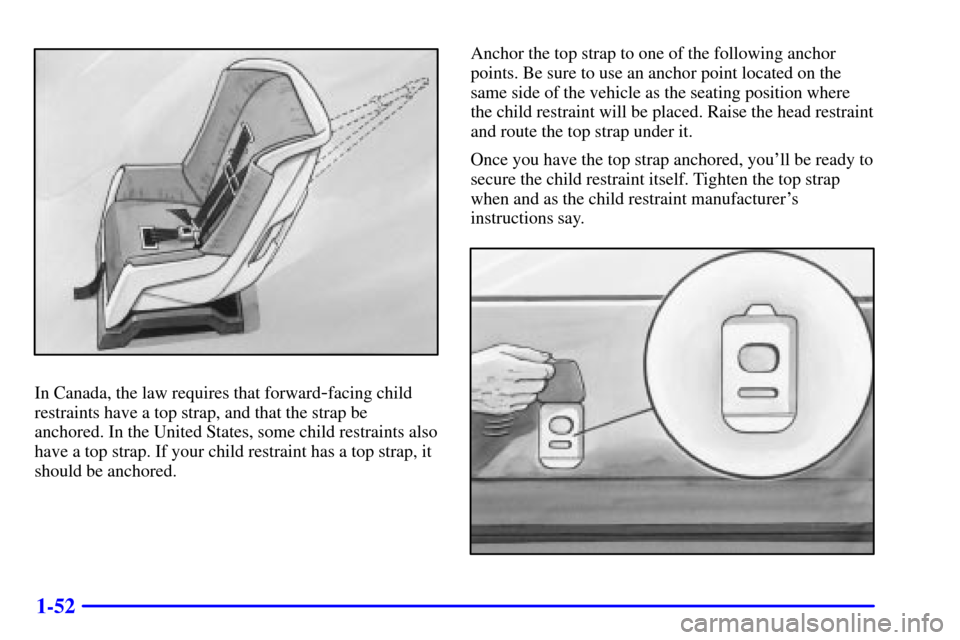
In Canada, the law requires that forward-facing child
restraints have a top strap, and that the strap be
anchored. In the United States, some child restraints also
have a top strap. If your child restraint has a top strap, it
should be anchored.Anchor the top strap to one of the following anchor
points. Be sure to use an anchor point located on the
same side of the vehicle as the seating position where
the child restraint will be placed. Raise the head restraint
and route the top strap under it.
Once you have the top strap anchored, you'll be ready to
secure the child restraint itself. Tighten the top strap
when and as the child restraint manufacturer's
instructions say.
Page 60 of 497
1-53
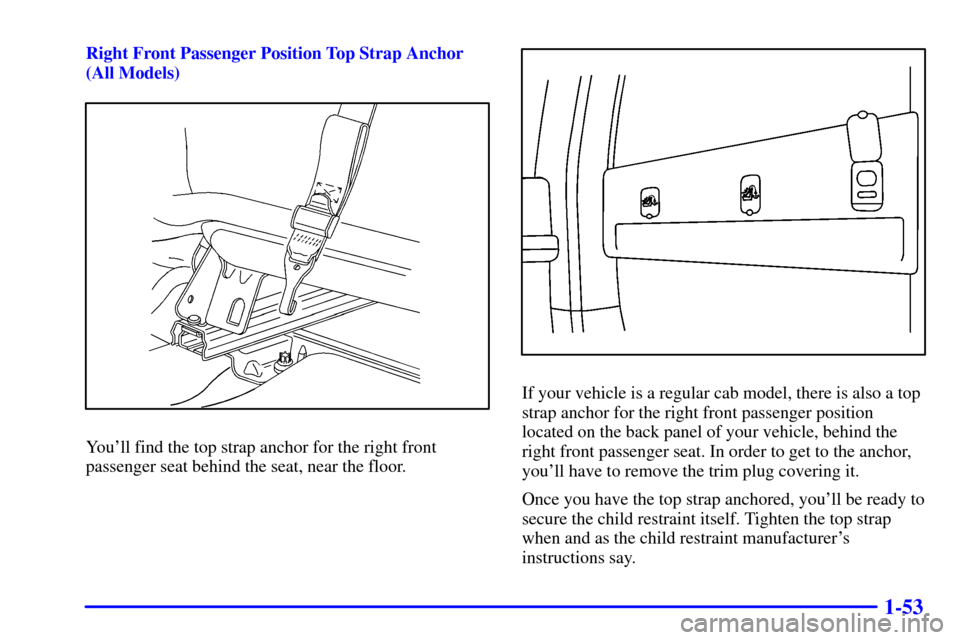
Right Front Passenger Position Top Strap Anchor
(All Models)
You'll find the top strap anchor for the right front
passenger seat behind the seat, near the floor.
If your vehicle is a regular cab model, there is also a top
strap anchor for the right front passenger position
located on the back panel of your vehicle, behind the
right front passenger seat. In order to get to the anchor,
you'll have to remove the trim plug covering it.
Once you have the top strap anchored, you'll be ready to
secure the child restraint itself. Tighten the top strap
when and as the child restraint manufacturer's
instructions say.
Page 62 of 497

1-55
When using a child restraint with a top strap in the
center rear position, route the top strap through the
fabric loop on the seatback. Then, raise the head
restraint and attach the top strap to the anchor point
located at the closest outboard position.
Once you have the top strap anchored, you'll be ready to
secure the child restrain itself. Tighten the top strap
when and as the child restraint manufacturer's
instructions say.Rear Seat Top Strap Anchors (Crew Cab Models)
If your vehicle is a Crew Cab model, you'll find top
strap anchors for the rear seating positions located on
the back panel of your vehicle, behind the rear seat.
In order to get to the brackets, you'll have to remove the
trim plugs covering them.
There are also anchorage points at the rear base of the
front passenger's seat.
Page 63 of 497
1-56 Lower Anchorages and Top Tethers for
Children (LATCH System) (If Equipped)
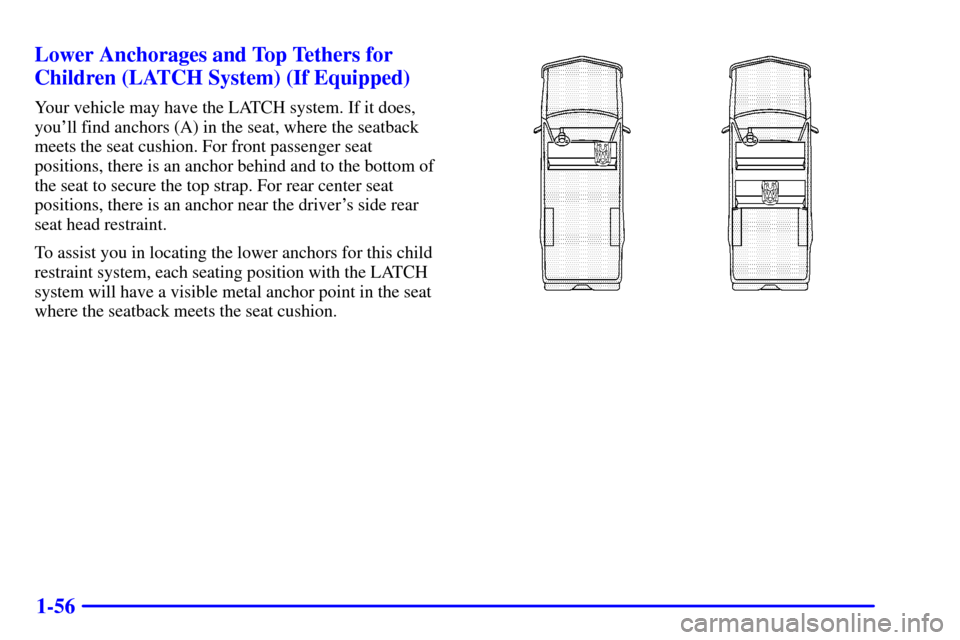
Your vehicle may have the LATCH system. If it does,
you'll find anchors (A) in the seat, where the seatback
meets the seat cushion. For front passenger seat
positions, there is an anchor behind and to the bottom of
the seat to secure the top strap. For rear center seat
positions, there is an anchor near the driver's side rear
seat head restraint.
To assist you in locating the lower anchors for this child
restraint system, each seating position with the LATCH
system will have a visible metal anchor point in the seat
where the seatback meets the seat cushion.
Page 64 of 497
1-57
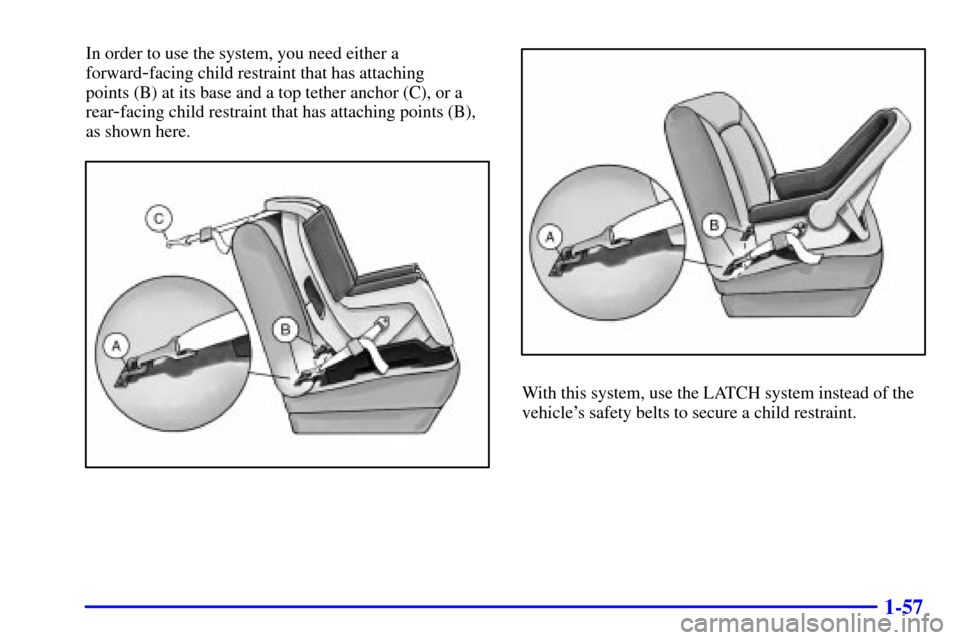
In order to use the system, you need either a
forward
-facing child restraint that has attaching
points (B) at its base and a top tether anchor (C), or a
rear
-facing child restraint that has attaching points (B),
as shown here.
With this system, use the LATCH system instead of the
vehicle's safety belts to secure a child restraint.
Page 65 of 497
1-58
CAUTION:
If a LATCH-type child restraint isn't attached to
its anchorage points, the restraint won't be able
to protect a child sitting there. In a crash, the
child could be seriously injured or killed. Make
sure that a LATCH
-type child restraint is
properly installed using the anchorage points, or
use the vehicle's safety belts to secure the
restraint. See ªSecuring a Child Restraint in the
Center Rear Seat Position (Extended Cab and
Crew Cab)º or ªSecuring a Child Restraint in the
Right Front Seat Positionº in the Index for
information on how to secure a child restraint in
your vehicle using the vehicle's safety belts.
Securing a Child Restraint Designed for the
LATCH System
1. Find the anchors for the seating position you want to
use, where the bottom of the seatback meets the back
of the seat cushion.
2. Put the child restraint on the seat.
3. Attach the anchor points on the child restraint to the
anchors in the vehicle. The child restraint
instructions will show you how.
4. If the child restraint is forward
-facing, attach the top
strap to the top strap anchor. See ªTop Strapº in the
Index. Tighten the top strap according to the child
restraint instructions.
5. Push and pull the child restraint in different
directions to be sure it is secure.
To remove the child restraint, simply unhook the top
strap from the top tether anchor and then disconnect the
anchor points.
Page 66 of 497
1-59 Securing a Child Restraint in a Rear
Outside Seat Position (Extended Cab
and Crew Cab)
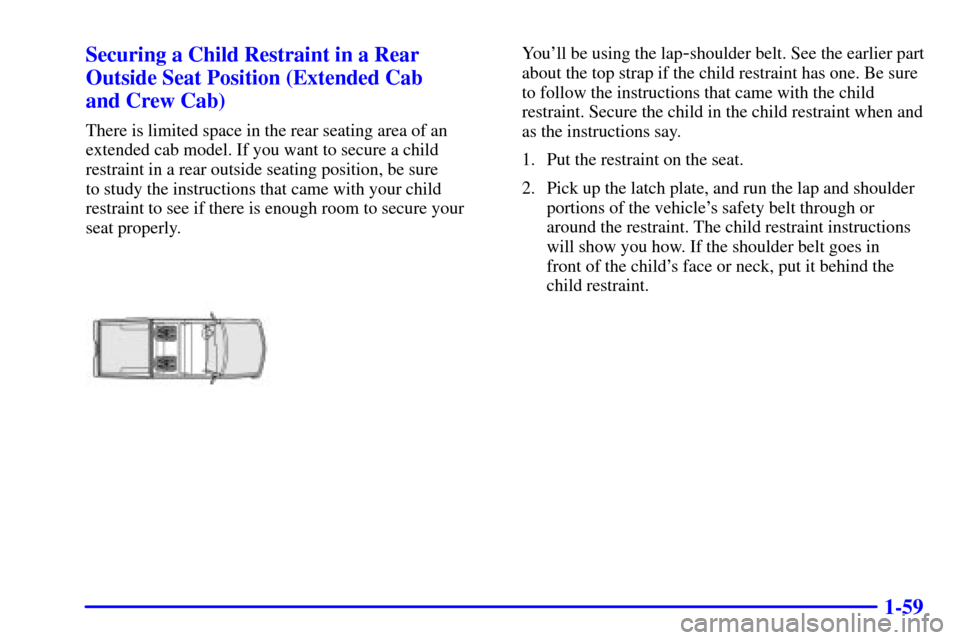
There is limited space in the rear seating area of an
extended cab model. If you want to secure a child
restraint in a rear outside seating position, be sure
to study the instructions that came with your child
restraint to see if there is enough room to secure your
seat properly.
You'll be using the lap-shoulder belt. See the earlier part
about the top strap if the child restraint has one. Be sure
to follow the instructions that came with the child
restraint. Secure the child in the child restraint when and
as the instructions say.
1. Put the restraint on the seat.
2. Pick up the latch plate, and run the lap and shoulder
portions of the vehicle's safety belt through or
around the restraint. The child restraint instructions
will show you how. If the shoulder belt goes in
front of the child's face or neck, put it behind the
child restraint.
Page 68 of 497
1-61
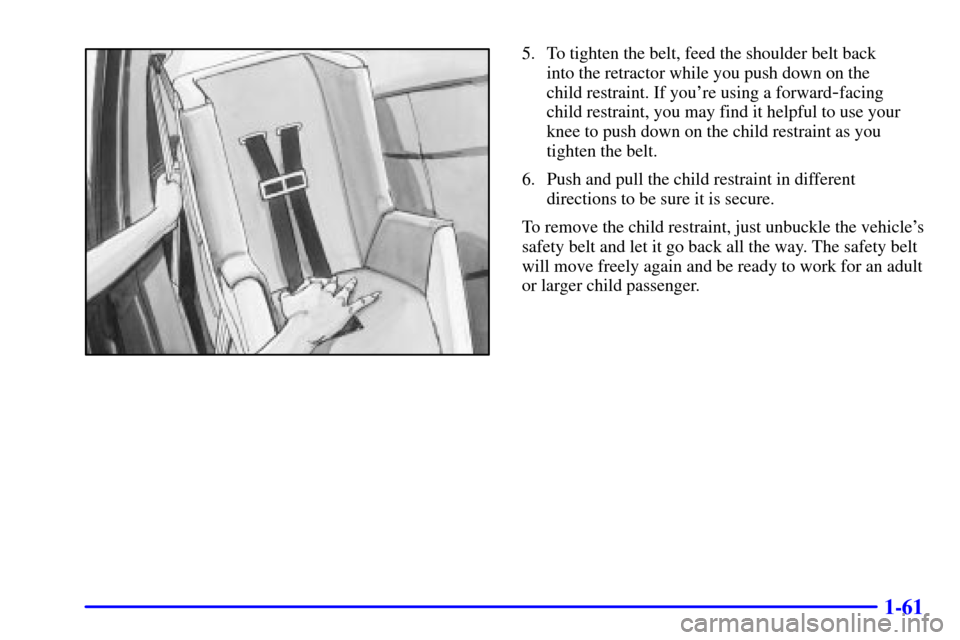
5. To tighten the belt, feed the shoulder belt back
into the retractor while you push down on the
child restraint. If you're using a forward
-facing
child restraint, you may find it helpful to use your
knee to push down on the child restraint as you
tighten the belt.
6. Push and pull the child restraint in different
directions to be sure it is secure.
To remove the child restraint, just unbuckle the vehicle's
safety belt and let it go back all the way. The safety belt
will move freely again and be ready to work for an adult
or larger child passenger.