wheel CHEVROLET SILVERADO 2002 1.G Repair Manual
[x] Cancel search | Manufacturer: CHEVROLET, Model Year: 2002, Model line: SILVERADO, Model: CHEVROLET SILVERADO 2002 1.GPages: 497, PDF Size: 3.09 MB
Page 277 of 497

4-49 Dinghy Towing
When towing your vehicle, turn the ignition off.
To prevent your battery from draining while towing,
remove the IGN 0 fuse from the instrument panel
fuse block. Be sure to reinstall the fuse when you reach
your destination. See ªFuses and Circuit Breakersº in
the Index.
Tw o
-Wheel-Drive Vehicles
Tw o
-wheel-drive vehicles, should not be towed with all
four wheels on the ground. Two
-wheel-drive
transmissions have no provisions for internal lubrication
while being towed. To properly tow these vehicles, they
should be placed on a platform trailer with all four
wheels off the ground.In rare cases when it's unavoidable that a
two
-wheel-drive vehicle is to be towed with all four
wheels on the ground, the propeller shaft to axle yoke
orientation should be marked and the propeller shaft
removed following the applicable service manual
removal/installation procedure.
Dust or dirt can enter the back of the transmission
through the opening created by removing the propeller
shaft if proper protection is not provided. Also, check
the transmission fluid level before driving the truck.
Page 278 of 497
4-50
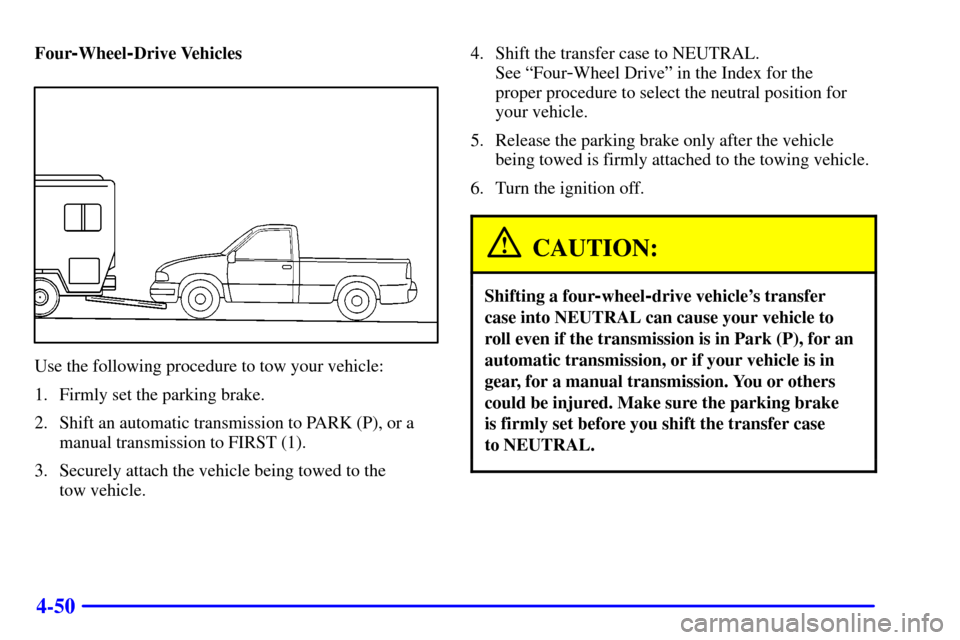
Four-Wheel-Drive Vehicles
Use the following procedure to tow your vehicle:
1. Firmly set the parking brake.
2. Shift an automatic transmission to PARK (P), or a
manual transmission to FIRST (1).
3. Securely attach the vehicle being towed to the
tow vehicle.4. Shift the transfer case to NEUTRAL.
See ªFour
-Wheel Driveº in the Index for the
proper procedure to select the neutral position for
your vehicle.
5. Release the parking brake only after the vehicle
being towed is firmly attached to the towing vehicle.
6. Turn the ignition off.
CAUTION:
Shifting a four-wheel-drive vehicle's transfer
case into NEUTRAL can cause your vehicle to
roll even if the transmission is in Park (P), for an
automatic transmission, or if your vehicle is in
gear, for a manual transmission. You or others
could be injured. Make sure the parking brake
is firmly set before you shift the transfer case
to NEUTRAL.
Page 279 of 497
4-51 Dolly Towing (Two-Wheel Drive Vehicles)
Tw o-Wheel-Drive Vehicles
Tw o
-wheel-drive vehicles, should not be towed
with the rear wheels on the ground. Two
-wheel-drive
transmissions have no provisions for internal lubrication
while being towed. To properly tow these vehicles, they
should be placed on a platform trailer with all four
wheels off the ground.
In rare cases when it's unavoidable that a
two
-wheel-drive vehicle is to be towed with the rear
wheels on the ground, the propeller shaft to axle yoke
orientation should be marked and the propeller shaft
removed following the applicable service manual
removal/installation procedure.
Dust or dirt can enter the back of the transmission
through the opening created by removing the propeller
shaft if proper protection is not provided. Also, check
the transmission fluid level before driving the truck.
When the vehicle is properly attached to the tow vehicle
and is ready to be towed, turn the ignition to LOCK.
Clamp the steering wheel in a straight
-ahead position
with a clamping device designed for towing.Four
-Wheel-Drive Vehicles
Four
-wheel-drive vehicles are not designed to be
dolly towed.
If you need to tow a four
-wheel-drive vehicle see
ªDinghy Towingº earlier in this section.
NOTICE:
Dolly towing a four-wheel-drive vehicle will
damage drivetrain components. Don't dolly tow
a four
-wheel-drive vehicle.
Page 282 of 497

4-54 Payload
The payload capacity is shown on the Certification/Tire
label. This is the maximum load capacity that your
vehicle can carry. Be sure to include the weight of the
occupants as part of your load. If you added any
accessories or equipment after your vehicle left the
factory, remember to subtract the weight of these things
from the payload. Your dealer can help you with this.
Remember not to exceed the Gross Axle Weight Rating
(GAWR) of the front or rear axle. See ªLoading Your
Vehicleº in the Index.
2-Tiered Loading
By positioning four 2, x 6, wooden planks across the
width of the pickup box, you can create an upper load
platform. The planks must be inserted in the pickup box
depressions. The length of the planks must allow for at
least a 3/4 inch (2 cm) bearing surface on each end of
the plank.
When using this upper load platform, be sure the load
is securely tied down to prevent it from shifting. The
load's center of gravity should be positioned in a zone
over the rear axle. The zone is located in the area
between the front of each wheel well and the rear of
each wheel well. The center of gravity height must not
extend above the top of the pickup box flareboard.
Any load that extends beyond the vehicle's taillamp
area must be properly marked according to local laws
and regulations.
Remember not to exceed the Gross Axle Weight Rating
(GAWR) of the front or rear axle. See ªLoading Your
Vehicleº in the Index.
Page 285 of 497

4-57
Q:What is front axle reserve capacity, and how do
I calculate it?
A:Front axle reserve capacity is the difference
between your front GAWR and the front axle
weight of your truck with full fuel and passengers.
Basically, it's the amount of weight you can add to
your front axle before reaching your front GAWR.
The front axle reserve capacity for your vehicle can
be found in the lower right corner of the
Certification/Tire label, as shown.
United States CanadaIn order to calculate the amount of weight any front
accessory, such as a snow plow, is adding to the
front axle, use the following formula:
(W x (A + W.B))/W.B.= Weight the accessory is
adding to the front axle.
Where:
W=Weight of added accessory
A=Distance that the accessory is in front of the
front axle
W.B.=Vehicle Wheelbase
Page 286 of 497

4-58
For example, adding a 700 lb. (318 kg) snow plow
actually adds more than 700 lb. (318 kg) to the
front axle. Using the formula, if the snow plow is
4 ft. (122 cm) in front of the front axle and the
wheel base is 10 ft. (305 cm), then:
W=700 lb. (318 kg)
A=4 ft. (122 cm)
W.B.=10 ft. (305 cm)
(W x (A + W.B.))/W.B.= (700 x (4 + 10))/10 =
980 lb. (445 kg)
So, if your truck's front axle reserve capacity is
more than 980 lb. (445 kg), you could add this
snow plow without exceeding the front GAWR.Q:What if I want to add heavier equipment to
my vehicle?
A:You can add heavier equipment on the front of the
vehicle if you compensate for it by carrying fewer
passengers, less cargo, or by positioning cargo more
towards the rear. This has the effect of reducing the
load on the front. However, the front GAWR, rear
GAWR and the GVWR must never be exceeded.
Page 289 of 497

4-61
Here is an example of proper truck and camper match:
A. Camper Center of Gravity
B. Recommended Center of Gravity Location Zone
The camper's center of gravity should fall within the
center of gravity zone for your vehicle's cargo load.
You must weigh any accessories or other equipment that
you add to your vehicle. Then, subtract this extra weight
from the CWR. This extra weight may shorten the
center of gravity zone of your vehicle. Your dealer can
help you with this.
If your slide
-in camper and its load weighs less than
the CWR, the center of gravity zone for your vehicle
may be larger.Your dealer can help you make a good vehicle
-camper
match. He'll also help you determine your CWR.
After you've loaded your vehicle and camper, drive to a
weigh station and weigh the front and rear wheels
separately. This will tell you the loads on your axles.
The loads on the front and rear axles shouldn't be more
than either of the GAWRs. The total of the axle loads
should not be more than the GVWR.
Open your driver's door and look at the
Certification/Tire label to find out your GAWR
and GVWR.
If you've gone over your weight ratings, move or take
out some things until all the weight falls below the
ratings. Of course, you should always tie down any
loose items when you load your vehicle or camper.
When you install and load your slide
-in camper, check
the manufacturer's instructions.
If you want more information on curb weights, cargo
weights, Cargo Weight Rating and the correct center of
gravity zone for your vehicle, your dealer can help you.
Just ask for a copy of ªConsumer Information,
Truck
-Camper Loading.º
Page 295 of 497

4-67
C-1500 Regular Cab Short Box (2WD)*
Engine (Trans.) Axle Ratio Max. Trailer Wt. GCWR
4300 V6 (Auto) 3.08 4,600 lbs. (2 088 kg) 9,000 lbs. (4 086 kg)
3.42 5,100 lbs. (2 315 kg) 9,500 lbs. (4 313 kg)
4300 V6 (Manual) 3.08 3,600 lbs. (1 634 kg) 8,000 lbs. (3 632 kg)
3.42 4,100 lbs. (1 861 kg) 8,500 lbs. (3 859 kg)
4800 V8 (Auto) 3.42 6,500 lbs. (2 951 kg) 11,000 lbs. (4 994 kg)
3.73 7,500 lbs. (3 405 kg) 12,000 lbs. (5 448 kg)
4800 V8 (Manual) 3.42 4,500 lbs. (2 043 kg) 9,000 lbs. (4 086 kg)
3.73 5,500 lbs. (2 497 kg) 10,000 lbs. (4 540 kg)
5300 V8 3.42 7,500 lbs. (3 405 kg) 12,000 lbs. (5 448 kg)
3.73 8,500 lbs. (3 859 kg) 13,000 lbs. (5 902 kg)
* Weight
-distributing hitch tongue weight 10 percent to 15 percent of hitch pulling weight 1,000 lb. (454 kg) maximum.
Fifth
-wheel hitch tongue weight 15 percent to 25 percent of hitch pulling weight 1,500 lb (680 kg) maximum.
Page 296 of 497

4-68
C-1500 Extended Cab Short Box (2WD)*
Engine (Trans.) Axle Ratio Max. Trailer Wt. GCWR
4300 V6 (Auto) 3.42 4,700 lbs. (2 133 kg) 9,500 lbs. (4 313 kg)
3.73 5,200 lbs. (2 360 kg) 10,000 lbs. (4 540 kg)
4300 V6 (Manual) 3.42 3,700 lbs. (1 679 kg) 8,500 lbs. (3 859 kg)
4800 V8 (Auto) 3.42 6,100 lbs. (2 858 kg) 11,000 lbs. (4 994 kg)
3.73 7,100 lbs. (3 223 kg) 12,000 lbs. (5 448 kg)
4800 V8 (Manual) 3.42 4,200 lbs. (1 906 kg) 9,000 lbs. (4 086 kg)
3.73 5,200 lbs. (2 360 kg) 10,000 lbs. (4 540 kg)
5300 V8 3.42 7,100 lbs. (3 223 kg) 12,000 lbs. (5 448 kg)
3.73 8,100 lbs. (3 677 kg) 13,000 lbs. (5 902 kg)
* Weight
-distributing hitch tongue weight 10 percent to 15 percent of hitch pulling weight 1,000 lb. (454 kg) maximum.
Fifth
-wheel hitch tongue weight 15 percent to 25 percent of hitch pulling weight 1,500 lb (680 kg) maximum.
Page 297 of 497

4-69
C-1500 Crew Cab Short Box (2WD)*
Engine (Trans.) Axle Ratio Max. Trailer Wt. GCWR
6000 V8 3.73 8,300 lbs. (3 765 kg) 14,000 lbs. (6 356 kg)
4.10 10,300 lbs. (4 672 kg) 16,000 lbs. (7 264 kg)
C
-1500 Regular Cab Long Box (2WD)*
Engine (Trans.) Axle Ratio Max. Trailer Wt. GCWR
4300 V6 (Auto) 3.08 4,500 lbs. (2 043 kg) 9,000 lbs. (4 086 kg)
3.42 5,000 lbs. (2 270 kg) 9,500 lbs. (4 313 kg)
4300 V6 (Manual) 3.08 3,500 lbs. (1 589 kg) 8,000 lbs. (3 632 kg)
3.42 4,000 lbs. (1 816 kg) 8,500 lbs. (3 859 kg)
4800 V8 (Auto) 3.42 6,400 lbs. (2 905 kg) 11,000 lbs. (4 994 kg)
3.73 7,400 lbs. (3 359 kg) 12,000 lbs. (5 448 kg)
4800 V8 (Manual) 3.42 4,400 lbs. (1 997 kg) 9,000 lbs. (4 086 kg)
3.73 5,400 lbs. (2 451 kg) 10,000 lbs. (4 540 kg)
5300 V8 3.42 7,400 lbs. (3 359 kg) 12,000 lbs. (5 448kg)
3.73 8,400 lbs. (3 813 kg) 13,000 lbs. (5 902 kg)
* Weight
-distributing hitch tongue weight 10 percent to 15 percent of hitch pulling weight 1,000 lb. (454 kg) maximum.
Fifth
-wheel hitch tongue weight 15 percent to 25 percent of hitch pulling weight 1,500 lb (680 kg) maximum.