key CHEVROLET SILVERADO 2003 1.G Owners Manual
[x] Cancel search | Manufacturer: CHEVROLET, Model Year: 2003, Model line: SILVERADO, Model: CHEVROLET SILVERADO 2003 1.GPages: 556, PDF Size: 3.56 MB
Page 1 of 556

Seats and Restraint Systems........................... 1-1
Front Seats
............................................... 1-3
Rear Seats
............................................... 1-8
Safety Belts
.............................................1-10
Child Restraints
.......................................1-31
Air Bag Systems
......................................1-64
Restraint System Check
............................1-81
Features and Controls..................................... 2-1
Keys
........................................................ 2-3
Doors and Locks
....................................... 2-7
Windows
.................................................2-15
Theft-Deterrent Systems
............................2-18
Starting and Operating Your Vehicle
...........2-20
Mirrors
....................................................2-53
OnStar
žSystem
......................................2-62
Storage Areas
.........................................2-64
Vehicle Personalization
.............................2-66
Instrument Panel............................................. 3-1
Instrument Panel Overview
.......................... 3-4
Climate Controls
......................................3-20
Warning Lights, Gages and Indicators
.........3-33
Driver Information Center (DIC)
..................3-54
Audio System(s)
.......................................3-71
Driving Your Vehicle....................................... 4-1
Your Driving, the Road, and Your Vehicle
..... 4-2
Towing
...................................................4-55Service and Appearance Care.......................... 5-1
Service
..................................................... 5-3
Fuel
......................................................... 5-4
Checking Things Under
the Hood
............................................... 5-8
All-Wheel Drive
........................................5-54
Rear Axle
...............................................5-55
Four-Wheel Drive
.....................................5-56
Noise Control System
...............................5-58
Bulb Replacement
....................................5-59
Windshield Wiper Blade Replacement
.........5-68
Tires
......................................................5-69
Appearance Care
...................................5-100
Vehicle Identi®cation
...............................5-108
Electrical System
....................................5-109
Capacities and Speci®cations
...................5-118
Normal Maintenance Replacement Parts
....5-121
Maintenance Schedule..................................... 6-1
Maintenance Schedule
................................ 6-2
Customer Assistance Information.................... 7-1
Customer Assistance Information
.................. 7-2
Reporting Safety Defects
............................ 7-8
Index................................................................ 1
2003 Chevrolet Silverado Owner ManualM
Page 30 of 556
The best way to protect the fetus is to protect the
mother. When a safety belt is worn properly, it's more
likely that the fetus won't be hurt in a crash. For
pregnant women, as for anyone, the key to making
safety belts effective is wearing them properly.
Right Front Passenger Position
To learn how to wear the right front passenger's safety
belt properly, seeDriver Position on page 1-16.
The right front passenger's safety belt works the same
way as the driver's safety beltÐexcept for one thing.
If you ever pull the shoulder portion of the belt out all the
way, you will engage the child restraint locking feature
which may turn off the passenger's frontal air bag. If this
happens unintentionally, just let the belt go back all
the way and start again.
Center Passenger Position
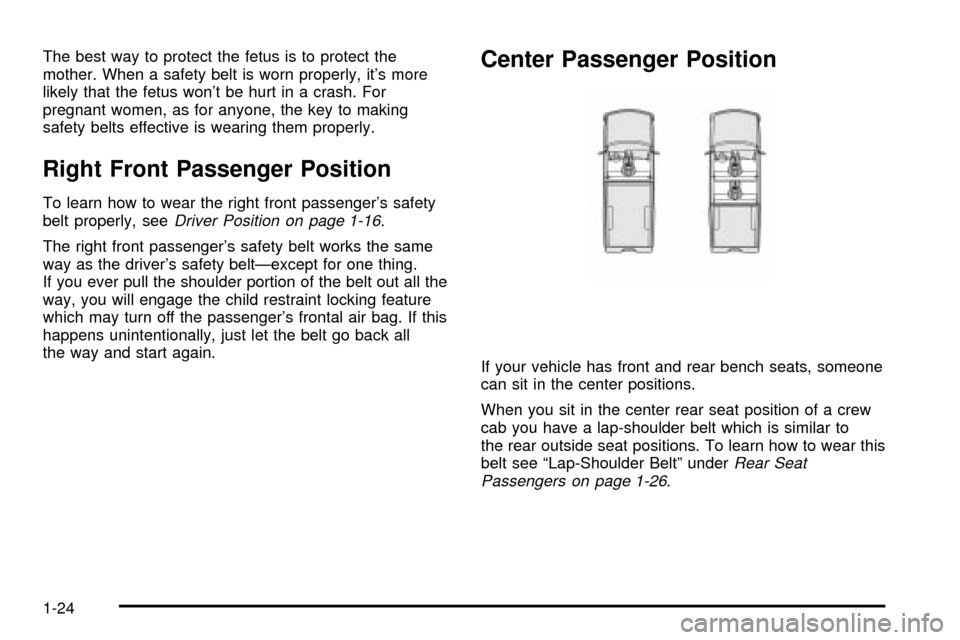
If your vehicle has front and rear bench seats, someone
can sit in the center positions.
When you sit in the center rear seat position of a crew
cab you have a lap-shoulder belt which is similar to
the rear outside seat positions. To learn how to wear this
belt see ªLap-Shoulder Beltº under
Rear Seat
Passengers on page 1-26.
1-24
Page 69 of 556

8. If your vehicle has the passenger sensing system
and you are using a rear-facing child restraint in
this seat, check to be sure the right front
passenger's frontal air bag is off before you begin
to drive. If the air bag is off, the off indicator
will be lit and stay lit in the inside rearview mirror
when the key is turned to RUN or START.
If the on indicator is lit, the passenger's frontal air bag
has not been turned off by the passenger sensing
system. If this ever happens, turn the vehicle off,
unbuckle the safety belt and perform the steps to install
the rear-facing restraint again. If the air bag still does
not turn off, check to make sure the AIR BAG OFF
switch has been turned to the off position or install the
infant restraint in a rear seat position if one is
available. See
Air Bag Off Switch on page 1-71for more
on this, including important safety information.
For heavy duty pickups without the passenger sensing
system, use the AIR BAG OFF switch to turn the air
bag off or install the infant restraint in a rear seat
position.
{CAUTION:
If the air bag ON indicator comes on when you
have a rear-facing child restraint installed in
the right front passenger's seat, it means that
the passenger sensing system has not turned
off the passenger's frontal air bag. A child in a
rear-facing child restraint can be seriously
injured or killed if the right front passenger's
air bag in¯ates. This is because the back of
the rear-facing child restraint would be very
close to the in¯ating air bag. Don't use a
rear-facing child restraint in the right front
passenger's seat unless the air bag is off.
1-63
Page 81 of 556
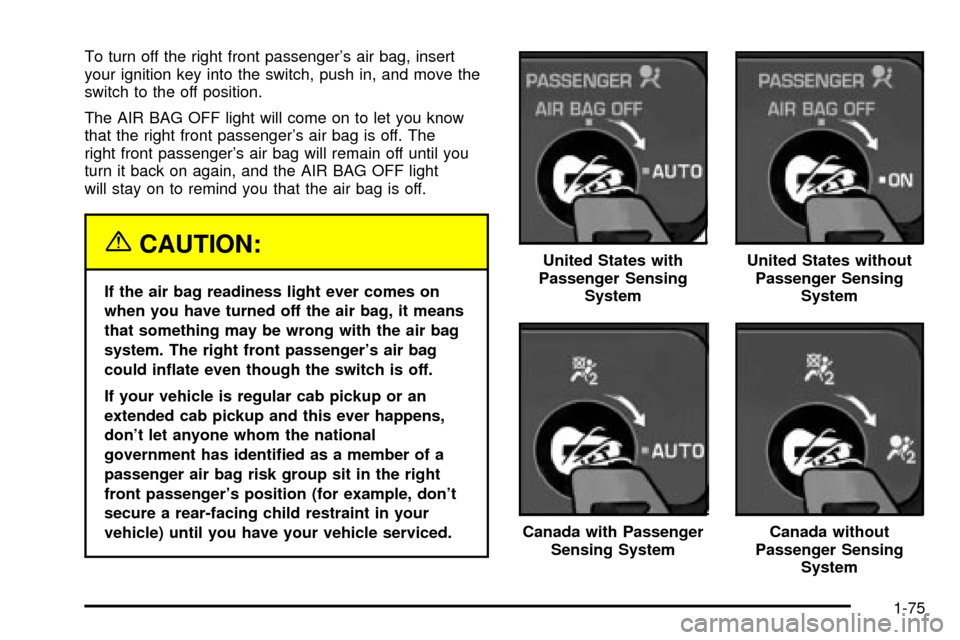
To turn off the right front passenger's air bag, insert
your ignition key into the switch, push in, and move the
switch to the off position.
The AIR BAG OFF light will come on to let you know
that the right front passenger's air bag is off. The
right front passenger's air bag will remain off until you
turn it back on again, and the AIR BAG OFF light
will stay on to remind you that the air bag is off.
{CAUTION:
If the air bag readiness light ever comes on
when you have turned off the air bag, it means
that something may be wrong with the air bag
system. The right front passenger's air bag
could in¯ate even though the switch is off.
If your vehicle is regular cab pickup or an
extended cab pickup and this ever happens,
don't let anyone whom the national
government has identi®ed as a member of a
passenger air bag risk group sit in the right
front passenger's position (for example, don't
secure a rear-facing child restraint in your
vehicle) until you have your vehicle serviced.United States with
Passenger Sensing
System
United States without
Passenger Sensing
System
Canada with Passenger
Sensing SystemCanada without
Passenger Sensing
System
1-75
Page 82 of 556

To turn the right front passenger's air bag on again,
insert your ignition key into the switch, push in,
and move the switch to the ON or AUTO position.
Passenger Sensing System
If your rearview mirror has one of the indicators pictured
in the following illustrations, your vehicle has a passenger
sensing system. The indicator will be visible when you
turn your ignition key to RUN or START. The words ON
and OFF or the symbol for on and off, will be visible on
the rearview mirror during the system check. When the
system check is complete, either the word ON or the word
OFF, or the symbol for on or the symbol for off will be
visible. See
Passenger Air Bag Status Indicator on
page 3-40. If your rearview mirror does not have either of
the indicators pictured below, then your vehicle does not
have the passenger sensing system.The passenger sensing system will turn off the right
front passenger's frontal air bag under certain
conditions. The driver's air bag and the side air bags
are not part of the passenger sensing system. In
addition to the passenger sensing system, your vehicle
also has an air bag off switch located on the instrument
panel as required by the government.
The passenger sensing system works with sensors that
are part of the right front passenger's seat and safety
belt. The sensors are designed to detect the presence of
a properly seated occupant and determine if the
passenger's frontal air bag should be enabled (may
in¯ate) or not.
Passenger Air Bag Status Indicator ± United States
Passenger
Air Bag Status
Indicator-Canada
1-76
Page 86 of 556

Servicing Your Air Bag-Equipped
Vehicle
Air bags affect how your vehicle should be serviced.
There are parts of the air bag system in several places
around your vehicle. You don't want the system to
in¯ate while someone is working on your vehicle. Your
dealer and the service manual have information
about servicing your vehicle and the air bag system. To
purchase a service manual, see
Service Publications
Ordering Information on page 7-9.
{CAUTION:
For up to 1 minute after the ignition key is
turned off and the battery is disconnected, an
air bag can still in¯ate during improper
service. You can be injured if you are close to
an air bag when it in¯ates. Avoid yellow
connectors. They are probably part of the air
bag system. Be sure to follow proper service
procedures, and make sure the person
performing work for you is quali®ed to do so.
The air bag system does not need regular maintenance.
Adding Equipment to Your Air
Bag-Equipped Vehicle
Q:Is there anything I might add to the front of the
vehicle that could keep the air bags from
working properly?
A:Yes. If you add things that change your vehicle's
frame, bumper system, front end sheet metal or
height, they may keep the air bag system
from working properly. Also, the air bag system
may not work properly if you relocate any of the air
bag sensors. If you have any questions about
this, you should contact Customer Assistance
before you modify your vehicle. The phone
numbers and addresses for Customer Assistance
are in Step Two of the Customer Satisfaction
Procedure in this manual. See²Customer
Satisfaction Procedure²in the Index.
1-80
Page 89 of 556

Keys...............................................................2-3
Remote Keyless Entry System.........................2-4
Remote Keyless Entry System Operation...........2-5
Doors and Locks.............................................2-7
Door Locks....................................................2-7
Power Door Locks..........................................2-8
Delayed Locking.............................................2-9
Programmable Automatic Door Locks..............2-10
Rear Door Security Locks
(Crew Cab)...............................................2-12
Lockout Protection........................................2-12
Rear Doors..................................................2-13
Tailgate.......................................................2-13
Windows........................................................2-15
Manual Windows..........................................2-15
Power Windows............................................2-16
Swing-Out Windows......................................2-17
Sun Visors...................................................2-17
Theft-Deterrent Systems..................................2-18
Content Theft-Deterrent.................................2-18
Passlock
ž....................................................2-19Starting and Operating Your Vehicle................2-20
New Vehicle Break-In....................................2-20
Ignition Positions..........................................2-20
Starting Your Engine.....................................2-22
Engine Coolant Heater..................................2-24
Automatic Transmission Operation...................2-25
Manual Transmission Operation......................2-29
Four-Wheel Drive..........................................2-33
All-Wheel Drive............................................2-44
Parking Brake..............................................2-44
Shifting Into Park (P).....................................2-46
Shifting Out of Park (P).................................2-49
Parking Your Vehicle.....................................2-49
Parking Over Things That Burn.......................2-50
Engine Exhaust............................................2-51
Running Your Engine While You Are Parked. . . .2-52
Mirrors...........................................................2-53
Manual Rearview Mirror.................................2-53
Automatic Dimming Rearview Mirror with
OnStar
ž, Compass and Temperature
Display....................................................2-53
Section 2 Features and Controls
2-1
Page 91 of 556
Keys
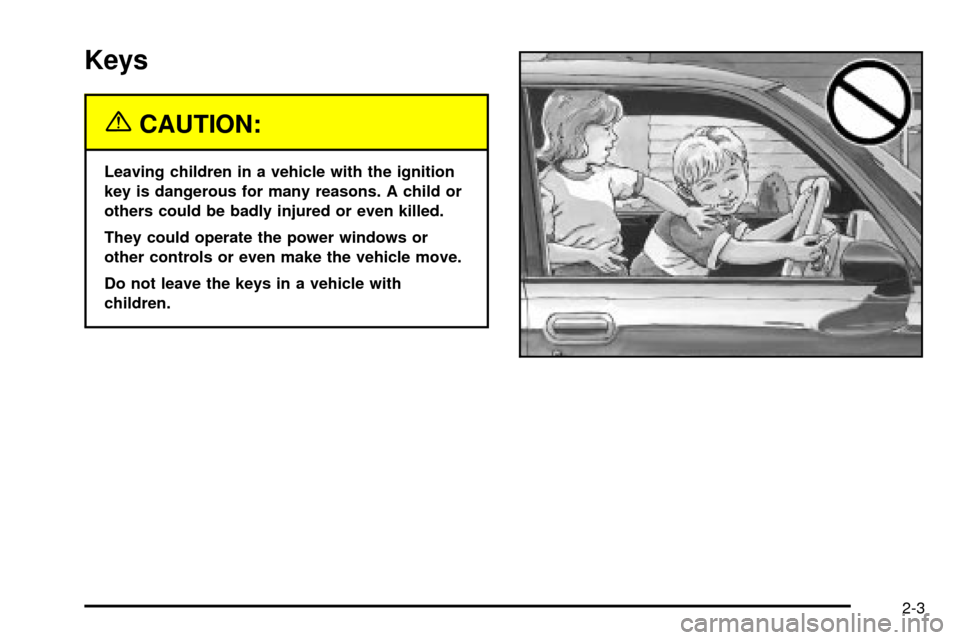
{CAUTION:
Leaving children in a vehicle with the ignition
key is dangerous for many reasons. A child or
others could be badly injured or even killed.
They could operate the power windows or
other controls or even make the vehicle move.
Do not leave the keys in a vehicle with
children.
2-3
Page 92 of 556

Your vehicle has one
double-sided key for the
ignition and all door locks
as well as the spare tire
hoist lock (if equipped).
If you ever lose your keys, your dealer will be able to
assist you with obtaining replacements.
Notice:Your vehicle has a number of features that
can help prevent theft. You can have a lot of trouble
getting into your vehicle if you ever lock your keys
inside. You may even have to damage your vehicle to
get in. So be sure you have spare keys.
If you ever do get locked out of your vehicle, call the
GM Roadside Assistance Center. See
Roadside
Assistance Program on page 7-5. If your vehicle is
equipped with the OnStaržsystem with an active
subscription and you lock your keys inside the vehicle,
OnStar
žmay be able to send a command to unlock
your vehicle. SeeOnStaržSystem on page 2-62for more information.
Remote Keyless Entry System
If equipped, the remote keyless entry system operates
on a radio frequency subject to Federal Communications
Commission (FCC) Rules and with Industry Canada.
This device complies with Part 15 of the FCC Rules.
Operation is subject to the following two conditions:
1. This device may not cause interference, and
2. This device must accept any interference received,
including interference that may cause undesired
operation of the device.
This device complies with RSS-210 of Industry Canada.
Operation is subject to the following two conditions:
1. This device may not cause interference, and
2. This device must accept any interference received,
including interference that may cause undesired
operation of the device.
Changes or modi®cations to this system by other than
an authorized service facility could void authorization to
use this equipment.
At times you may notice a decrease in range. This is
normal for any remote keyless entry system. If the
transmitter does not work or if you have to stand closer
to your vehicle for the transmitter to work, try this:
2-4
Page 93 of 556

·Check the distance. You may be too far from your
vehicle. You may need to stand closer during
rainy or snowy weather.
·Check the location. Other vehicles or objects may
be blocking the signal. Take a few steps to the
left or right, hold the transmitter higher, and
try again.
·Check to determine if battery replacement or
resynchronization is necessary. See ªBattery
Replacementº and ªResynchronizationº under
ªRemote Keyless Entry System Operationº following
this section.
·If you are still having trouble, see your dealer or a
quali®ed technician for service.
Remote Keyless Entry System
Operation
If your vehicle has this feature, you can lock and unlock
your doors from about 3 feet (1 m) up to 30 feet (9 m)
away using the remote keyless entry transmitter supplied
with your vehicle.
UNLOCK:Pressing this button once will unlock the
driver's door. The parking lamps will ¯ash and the interior
lights will come on. The ground illumination lamps will
come on. Pressing UNLOCK again within three seconds
will cause the remaining doors to unlock. The parkinglamps will ¯ash and the interior lights will come on.
LOCK:Pressing this button once will lock all of the
doors. Wait one second, then press LOCK again and the
horn will chirp.
Operating the keyless entry transmitter may interact with
the theft-deterrent system. See
Content Theft-Deterrent
on page 2-18.
Remote Alarm
When the panic button with the horn symbol on the
keyless entry transmitter is pressed, the horn will sound
and the headlamps and taillamps will ¯ash for up to
30 seconds. This can be turned off by pressing the panic
button again, waiting for 30 seconds, or starting the
vehicle.
Matching Transmitter(s) to Your
Vehicle
Each remote keyless entry transmitter is coded to prevent
another transmitter from unlocking your vehicle. If a
transmitter is lost or stolen, a replacement can be
purchased through your dealer. Remember to bring any
remaining transmitters with you when you go to your
dealer. When the dealer matches the replacement
transmitter to your vehicle, any remaining transmitters
must also be matched. Once your dealer has coded the
2-5