overheating CHEVROLET SILVERADO 2004 1.G User Guide
[x] Cancel search | Manufacturer: CHEVROLET, Model Year: 2004, Model line: SILVERADO, Model: CHEVROLET SILVERADO 2004 1.GPages: 584, PDF Size: 3.52 MB
Page 435 of 584
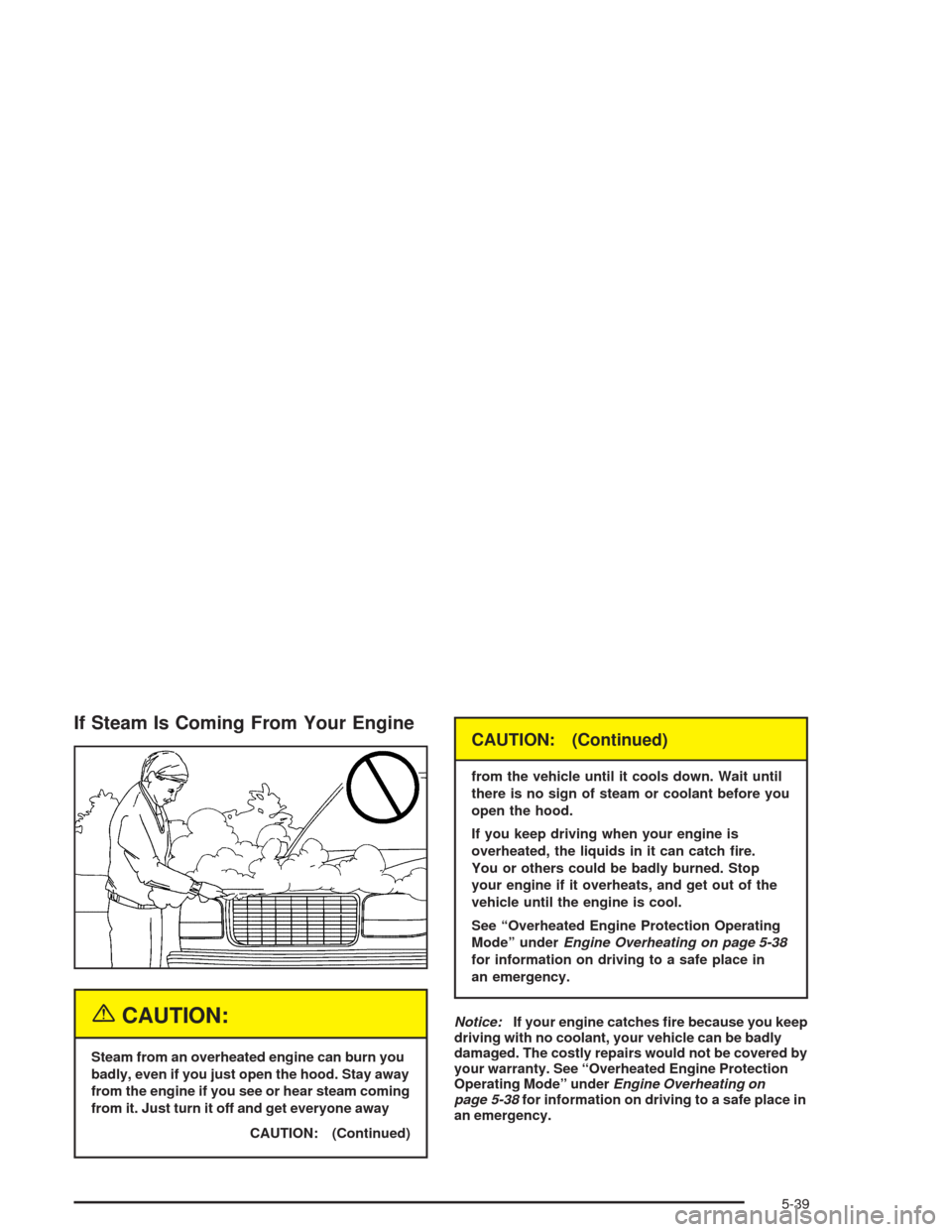
If Steam Is Coming From Your Engine
{CAUTION:
Steam from an overheated engine can burn you
badly, even if you just open the hood. Stay away
from the engine if you see or hear steam coming
from it. Just turn it off and get everyone away
CAUTION: (Continued)
CAUTION: (Continued)
from the vehicle until it cools down. Wait until
there is no sign of steam or coolant before you
open the hood.
If you keep driving when your engine is
overheated, the liquids in it can catch re.
You or others could be badly burned. Stop
your engine if it overheats, and get out of the
vehicle until the engine is cool.
See “Overheated Engine Protection Operating
Mode” underEngine Overheating on page 5-38
for information on driving to a safe place in
an emergency.
Notice:If your engine catches re because you keep
driving with no coolant, your vehicle can be badly
damaged. The costly repairs would not be covered by
your warranty. See “Overheated Engine Protection
Operating Mode” underEngine Overheating on
page 5-38for information on driving to a safe place in
an emergency.
5-39
Page 470 of 584
Tires
Your new vehicle comes with high-quality tires made by
a leading tire manufacturer. If you ever have questions
about your tire warranty and where to obtain service,
see your GM Warranty booklet for details. For additional
information refer to the tire manufacturer’s booklet
included with your vehicle’s Owner’s Manual.
{CAUTION:
Poorly maintained and improperly used tires
are dangerous.
Overloading your tires can cause
overheating as a result of too much
friction. You could have an air-out and a
serious accident. SeeLoading Your
Vehicle on page 4-56.
Underinated tires pose the same danger
as overloaded tires. The resulting accident
could cause serious injury. Check all tires
frequently to maintain the recommended
pressure. Tire pressure should be checked
when your tires are cold.
CAUTION: (Continued)
CAUTION: (Continued)
Overinated tires are more likely to be
cut, punctured or broken by a sudden
impact — such as when you hit a pothole.
Keep tires at the recommended pressure.
Worn, old tires can cause accidents. If
your tread is badly worn, or if your tires
have been damaged, replace them.
20-Inch Tires
If your vehicle has the optional 20-inch P275/55R20
size tires, they are classied as touring tires and
are designed for on road use. The low-prole, wide
tread design is not recommended for “off-road” driving
or commercial uses such as snow plowing. See
Off-Road Driving on page 4-21andAdding a Snow
Plow or Similar Equipment on page 4-63for
additional information.
Tire Sidewall Labeling
Useful information about a tire is molded into the
sidewall. The following illustrations are examples of a
typical P-Metric and a LT-Metric tire sidewall.
5-74
Page 572 of 584
E
Easy Exit Seat...............................................2-72
Electrical System
Add-On Equipment.....................................5-123
Fuses and Circuit Breakers.........................5-123
Power Windows and Other Power Options.......5-123
Windshield Wiper Fuses.............................5-123
Electronic Transfer Case..................................2-44
Emissions Inspection and Maintenance
Programs...................................................3-50
Engine
Air Cleaner/Filter.........................................5-25
Battery.......................................................5-52
Check and Service Engine Soon Light............3-48
Coolant......................................................5-35
Coolant Heater............................................2-26
Coolant Temperature Gage...........................3-46
Drive Belt Routing.......................................6-18
Engine Compartment Overview......................5-14
Exhaust.....................................................2-53
Fan Noise..................................................5-46
Oil .............................................................5-20
Overheating................................................5-38
Starting......................................................2-24
ENGINE COOLANT HOT.................................3-66
Engine Hour Meter Display...............................3-35
Engine Oil Additives........................................5-23
ENGINE OVERHEATED..................................3-66Entry Lighting.................................................3-18
Environmental Concerns..................................4-25
Event Data Recorders (EDR)............................. 7-9
Exit Lighting...................................................3-18
Express Down Windows..................................2-18
Extended Cab........................................1-56, 2-14
Extended Cab and Crew Cab...........................1-53
Extender, Safety Belt.......................................1-31
Exterior Lamps...............................................3-13
F
Fifth Wheel and Gooseneck Trailering................4-89
Filter
Engine Air Cleaner......................................5-25
Finding a Program Type (PTY) Station
(RDS and XM™).......................3-79, 3-90, 3-104
Finding a Station..................3-74, 3-77, 3-88, 3-102
Finish Care..................................................5-118
Finish Damage.............................................5-120
Five-Speed (VORTEC™ 4300 V6 and
4800 V8 Engines)........................................2-32
Five-Speed (VORTEC™ 6000 V8 Engine)...........2-31
Fixed Mast Antenna.......................................3-130
Flash-to-Pass................................................... 3-9
Flat Tire........................................................5-92
Flat Tire, Changing.........................................5-93
6