headlamp CHEVROLET SILVERADO 2005 1.G Owner's Manual
[x] Cancel search | Manufacturer: CHEVROLET, Model Year: 2005, Model line: SILVERADO, Model: CHEVROLET SILVERADO 2005 1.GPages: 580, PDF Size: 3.44 MB
Page 329 of 580
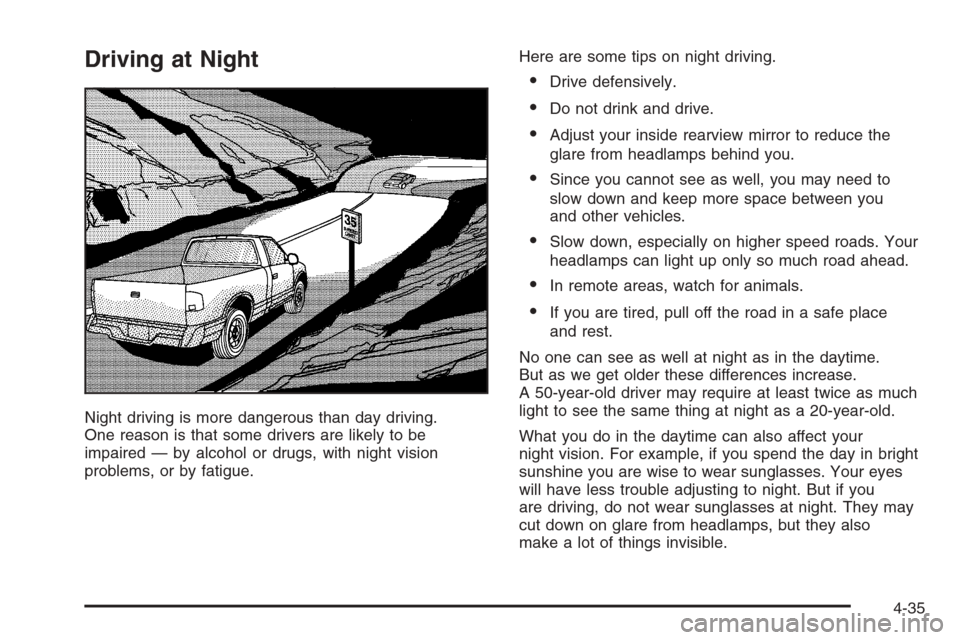
Driving at Night
Night driving is more dangerous than day driving.
One reason is that some drivers are likely to be
impaired — by alcohol or drugs, with night vision
problems, or by fatigue.Here are some tips on night driving.
Drive defensively.
Do not drink and drive.
Adjust your inside rearview mirror to reduce the
glare from headlamps behind you.
Since you cannot see as well, you may need to
slow down and keep more space between you
and other vehicles.
Slow down, especially on higher speed roads. Your
headlamps can light up only so much road ahead.
In remote areas, watch for animals.
If you are tired, pull off the road in a safe place
and rest.
No one can see as well at night as in the daytime.
But as we get older these differences increase.
A 50-year-old driver may require at least twice as much
light to see the same thing at night as a 20-year-old.
What you do in the daytime can also affect your
night vision. For example, if you spend the day in bright
sunshine you are wise to wear sunglasses. Your eyes
will have less trouble adjusting to night. But if you
are driving, do not wear sunglasses at night. They may
cut down on glare from headlamps, but they also
make a lot of things invisible.
4-35
Page 330 of 580
You can be temporarily blinded by approaching
headlamps. It can take a second or two, or even
several seconds, for your eyes to re-adjust to the dark.
When you are faced with severe glare, as from a
driver who does not lower the high beams, or a vehicle
with misaimed headlamps, slow down a little. Avoid
staring directly into the approaching headlamps.
Keep your windshield and all the glass on your vehicle
clean — inside and out. Glare at night is made much
worse by dirt on the glass. Even the inside of the glass
can build up a lm caused by dust. Dirty glass makes
lights dazzle and ash more than clean glass would,
making the pupils of your eyes contract repeatedly.
Remember that your headlamps light up far less of a
roadway when you are in a turn or curve. Keep your eyes
moving; that way, it is easier to pick out dimly lighted
objects. Just as your headlamps should be checked
regularly for proper aim, so should your eyes be
examined regularly. Some drivers suffer from night
blindness — the inability to see in dim light — and are
not even aware of it.Driving in Rain and on Wet Roads
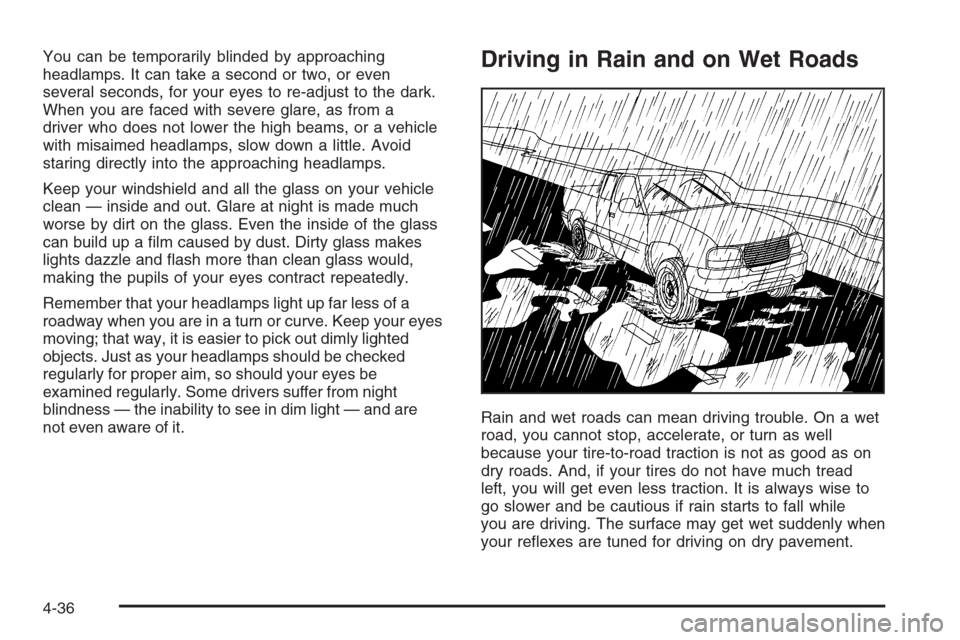
Rain and wet roads can mean driving trouble. On a wet
road, you cannot stop, accelerate, or turn as well
because your tire-to-road traction is not as good as on
dry roads. And, if your tires do not have much tread
left, you will get even less traction. It is always wise to
go slower and be cautious if rain starts to fall while
you are driving. The surface may get wet suddenly when
your reexes are tuned for driving on dry pavement.
4-36
Page 332 of 580
Driving Through Flowing Water
{CAUTION:
Flowing or rushing water creates strong forces.
If you try to drive through owing water, as you
might at a low water crossing, your vehicle can
be carried away. As little as six inches of
owing water can carry away a smaller vehicle.
If this happens, you and other vehicle
occupants could drown. Do not ignore police
warning signs, and otherwise be very cautious
about trying to drive through owing water.
Some Other Rainy Weather Tips
Turn on your low-beam headlamps — not just
your parking lamps — to help make you
more visible to others.
Besides slowing down, allow some extra following
distance. And be especially careful when you pass
another vehicle. Allow yourself more clear room
ahead, and be prepared to have your view restricted
by road spray.
Have good tires with proper tread depth. SeeTires
on page 5-73.
City Driving
One of the biggest problems with city streets is the
amount of traffic on them. You will want to watch out for
what the other drivers are doing and pay attention to
traffic signals.
4-38
Page 341 of 580
{CAUTION:
Snow can trap exhaust gases under your
vehicle. This can cause deadly CO (carbon
monoxide) gas to get inside. CO could
overcome you and kill you. You cannot see it
or smell it, so you might not know it is in your
vehicle. Clear away snow from around the
base of your vehicle, especially any that is
blocking your exhaust pipe. And check around
again from time to time to be sure snow does
not collect there.
Open a window just a little on the side of the
vehicle that is away from the wind. This will
help keep CO out.Run your engine only as long as you must. This saves
fuel. When you run the engine, make it go a little
faster than just idle. That is, push the accelerator
slightly. This uses less fuel for the heat that you get and
it keeps the battery charged. You will need a
well-charged battery to restart the vehicle, and possibly
for signaling later on with your headlamps. Let the
heater run for a while.
Then, shut the engine off and close the window almost
all the way to preserve the heat. Start the engine
again and repeat this only when you feel really
uncomfortable from the cold. But do it as little as
possible. Preserve the fuel as long as you can. To help
keep warm, you can get out of the vehicle and do
some fairly vigorous exercises every half hour or so until
help comes.
4-47
Page 390 of 580

Heavy-DutyTrailer Wiring Harness
PackageFor vehicles equipped with heavy duty trailering, the
harness is connected to the trailer mounted to the hitch
platform. The eight-wire harness contains the following
trailer circuits:
Yellow: Left Stop/Turn Signal
Dark Green: Right Stop/Turn Signal
Brown: Taillamps
White: Ground
Light Green: Back-up Lamps
Light Blue: CHMSL*
Red: Battery Feed**
Dark Blue: Trailer Brake
* The Center High-Mounted Stoplamp (CHMSL) wire is
tied next to the trailer wiring harness for use with a
trailer, slide-in camper or cap.
**If you are charging a remote (non-vehicle) battery,
turn on the headlamps to boost the vehicle system
voltage and properly charge the battery.
4-96
Page 400 of 580
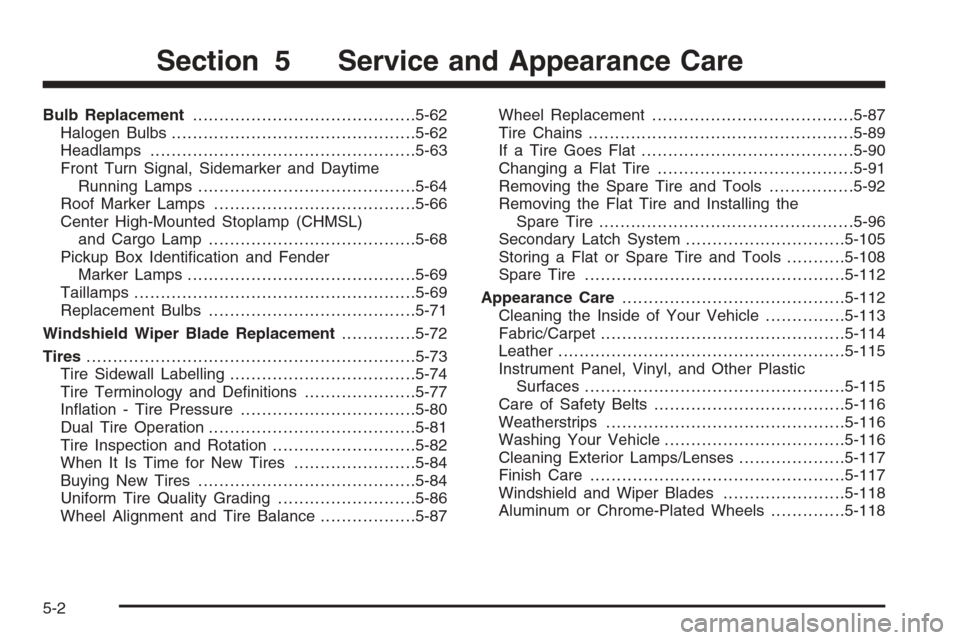
Bulb Replacement..........................................5-62
Halogen Bulbs..............................................5-62
Headlamps..................................................5-63
Front Turn Signal, Sidemarker and Daytime
Running Lamps.........................................5-64
Roof Marker Lamps......................................5-66
Center High-Mounted Stoplamp (CHMSL)
and Cargo Lamp.......................................5-68
Pickup Box Identication and Fender
Marker Lamps...........................................5-69
Taillamps.....................................................5-69
Replacement Bulbs.......................................5-71
Windshield Wiper Blade Replacement..............5-72
Tires..............................................................5-73
Tire Sidewall Labelling...................................5-74
Tire Terminology and Denitions.....................5-77
Ination - Tire Pressure.................................5-80
Dual Tire Operation.......................................5-81
Tire Inspection and Rotation...........................5-82
When It Is Time for New Tires.......................5-84
Buying New Tires.........................................5-84
Uniform Tire Quality Grading..........................5-86
Wheel Alignment and Tire Balance..................5-87Wheel Replacement......................................5-87
Tire Chains..................................................5-89
If a Tire Goes Flat........................................5-90
Changing a Flat Tire.....................................5-91
Removing the Spare Tire and Tools................5-92
Removing the Flat Tire and Installing the
Spare Tire................................................5-96
Secondary Latch System..............................5-105
Storing a Flat or Spare Tire and Tools...........5-108
Spare Tire.................................................5-112
Appearance Care..........................................5-112
Cleaning the Inside of Your Vehicle...............5-113
Fabric/Carpet..............................................5-114
Leather......................................................5-115
Instrument Panel, Vinyl, and Other Plastic
Surfaces.................................................5-115
Care of Safety Belts....................................5-116
Weatherstrips.............................................5-116
Washing Your Vehicle..................................5-116
Cleaning Exterior Lamps/Lenses....................5-117
Finish Care................................................5-117
Windshield and Wiper Blades.......................5-118
Aluminum or Chrome-Plated Wheels..............5-118
Section 5 Service and Appearance Care
5-2
Page 461 of 580

Headlamps
To replace a headlamp bulb, do the following:
1. Open the hood. SeeHood Release on page 5-13
for more information.
2. If your vehicle is equipped with two pins, remove
the two pins on the top of the headlamp assembly.
To remove the pins, turn the outer pin outward
and pull it straight up. To remove the inner pin,
turn it in and pull it straight up.If your vehicle has one pin on the headlamp
assembly, remove the pin. To remove the pin,
turn the pin up and pull it out straight out.
5-63
Page 462 of 580

A. Low-Beam Headlamp
B. High-Beam Headlamp
3. Pull the headlamp assembly out.
4. Unplug the electrical connector.
5. Turn the old bulb counterclockwise and remove it
from the headlamp assembly.
6. Install the new bulb into the assembly and turn it
clockwise until it is tight.
7. Plug in the electrical connector.
8. Reinstall the headlamp assembly.
9. Reinstall and tighten the two pins. If your vehicle
has one pin, reinstall it and turn it into the locking
feature.
Front Turn Signal, Sidemarker and
Daytime Running Lamps
A. Sidemarker Lamp
B. Retainer ClipC. Front Turn Signal Lamp
D. Daytime Running
Lamp (DRL)
5-64
Page 463 of 580

To replace a front turn signal, sidemarker or DRL bulb,
do the following:
1. Open the hood. SeeHood Release on page 5-13
for more information.
2. Remove the headlamp assembly as described
previously. SeeHeadlamps on page 5-63for
more information.
3. Press the retainer clip (B), located behind the turn
signal assembly, towards the outside of the vehicle.
4. Pull the turn signal assembly out of the vehicle.5. Press the locking release lever, turn the bulb socket
counterclockwise and remove it from the turn signal
assembly.
6. Remove the old bulb from the bulb socket.
7. Install a new bulb into the bulb socket.
8. Insert the bulb socket into the turn signal assembly
and turn it clockwise until it locks.
9. Reinstall the turn signal assembly back into the
vehicle placing the hook and posts on the inner
side into the alignment holes rst, then the
outer side into the retainer bracket until you hear
a click.
10. Reinstall the headlamp assembly.
5-65
Page 469 of 580

Taillamps (Chassis Cab Models)
A. Turn Signal Lamp
B. Taillamp/Stoplamp
C. Back-up Lamp
To replace one of these bulbs for chassis cab models,
do the following:
1. Peel the rubber seal away from the lens using
your hands.
2. Lift the lens off the lamp assembly.
3. Pull the old bulb straight out from the socket.
4. Install a new bulb into the socket and press it in
until it is tight.
5. Reinstall the lens and the lens seal.
Replacement Bulbs
Exterior Lamp Bulb Number
Back-up Lamp 3157
Back-up Lamp* 1156
Cargo Lamp 912
Center High-Mounted Stoplamp
(CHMSL)912
Daytime Running Lamps (DRL) 4114K
Fender Marker Lamps 194
Front Parking and Turn Lamp 3457A
Front Roof Marker Lamps 194
Headlamps
High-Beam 9005
Low-Beam 9006
Rear Marker Lamp, Taillamp and
Stoplamp*3157
Rear Turn Signal Lamp 3157
Rear Turn Signal Lamp* 1156
Sidemarker Lamp (If Equipped) 194
Stoplamp and Taillamp* 1157
* Chassis Cab Models
For replacement bulbs not listed here, contact your
dealer.
5-71