seats CHEVROLET SILVERADO 2007 1.G Owner's Guide
[x] Cancel search | Manufacturer: CHEVROLET, Model Year: 2007, Model line: SILVERADO, Model: CHEVROLET SILVERADO 2007 1.GPages: 684, PDF Size: 3.4 MB
Page 280 of 684
Relearn Remote Key
To access this display, the vehicle must be in
PARK (P). This display allows you to match
Remote Keyless Entry (RKE) transmitters to your
vehicle. To match an RKE transmitter to your
vehicle, do the following:
1. Press the trip odometer reset stem until
RELEARN REMOTE KEY displays.
2. Press and hold the trip odometer reset stem
for three seconds.
The message REMOTE KEY LEARNING
ACTIVE will display.
3. Press and hold the lock and unlock buttons
on the rst transmitter at the same time for
about 15 seconds.
On vehicles with memory recall seats, the rst
transmitter learned will match driver 1 and
the second will match driver 2.
A chime will sound indicating that the
transmitter is matched.
4. To match additional transmitters at this time,
repeat Step 3.
Each vehicle can have a maximum of eight
transmitters matched to it.
5. To exit the programming mode, you must
cycle the key to LOCK.
Language
This display allows you to select the language in
which the DIC messages will appear. To select
a language, do the following:
1. Press the trip odometer reset stem until
ODOMETER displays.
2. While in the ODOMETER display, press and
hold the trip odometer reset stem for three
seconds until the currently set language
displays.
3. Continue to press and hold the trip odometer
reset stem to scroll through all of the available
languages.
The available languages are ENGLISH
(default), FRANCAIS (French), ESPANOL
(Spanish), and NO CHANGE.
4. Once the desired language is displayed,
release the trip odometer reset stem to
set your choice.
280
Page 432 of 684
If you put things inside your vehicle — like
suitcases, tools, packages, or anything
else — they go as fast as the vehicle goes.
If you have to stop or turn quickly, or if there is
a crash, they will keep going.
{CAUTION:
Things you put inside your vehicle can
strike and injure people in a sudden stop
or turn, or in a crash.
Put things in the cargo area of your
vehicle. Try to spread the weight
evenly.
Never stack heavier things, like
suitcases, inside the vehicle so that
some of them are above the tops of
the seats.
CAUTION: (Continued)
CAUTION: (Continued)
Do not leave an unsecured child
restraint in your vehicle.
When you carry something inside the
vehicle, secure it whenever you can.
Do not leave a seat folded down
unless you need to.
There is also important loading information for
off-road driving in this manual. See “Loading Your
Vehicle for Off-Road Driving“ underOff-Road
Driving on page 392.
432
Page 558 of 684
(E) Rim Diameter:Diameter of the wheel in
inches.
(F) Service Description:The service description
indicates the load range and speed rating of a
tire. The load index can range from 1 to 279.
Speed ratings range from A to Z.
Tire Terminology and Denitions
Air Pressure:The amount of air inside the tire
pressing outward on each square inch of the
tire. Air pressure is expressed in pounds
per square inch (psi) or kilopascal (kPa).
Accessory Weight:This means the combined
weight of optional accessories. Some examples of
optional accessories are, automatic transmission,
power steering, power brakes, power windows,
power seats, and air conditioning.
Aspect Ratio:The relationship of a tire’s height
to its width.
Belt:A rubber coated layer of cords that is
located between the plies and the tread. Cords
may be made from steel or other reinforcing
materials.Bead:The tire bead contains steel wires wrapped
by steel cords that hold the tire onto the rim.
Bias Ply Tire:A pneumatic tire in which the plies
are laid at alternate angles less than 90 degrees
to the centerline of the tread.
Cold Tire Pressure:The amount of air pressure
in a tire, measured in pounds per square inch (psi)
or kilopascals (kPa) before a tire has built up heat
from driving. SeeInation - Tire Pressure on
page 561.
Curb Weight:This means the weight of a motor
vehicle with standard and optional equipment
including the maximum capacity of fuel, oil, and
coolant, but without passengers and cargo.
DOT Markings:A code molded into the sidewall
of a tire signifying that the tire is in compliance
with the U.S. Department of Transportation (DOT)
motor vehicle safety standards. The DOT code
includes the Tire Identication Number (TIN),
an alphanumeric designator which can also identify
the tire manufacturer, production plant, brand,
and date of production.
GVWR:Gross Vehicle Weight Rating. See
Loading Your Vehicle on page 427.
558
Page 583 of 684
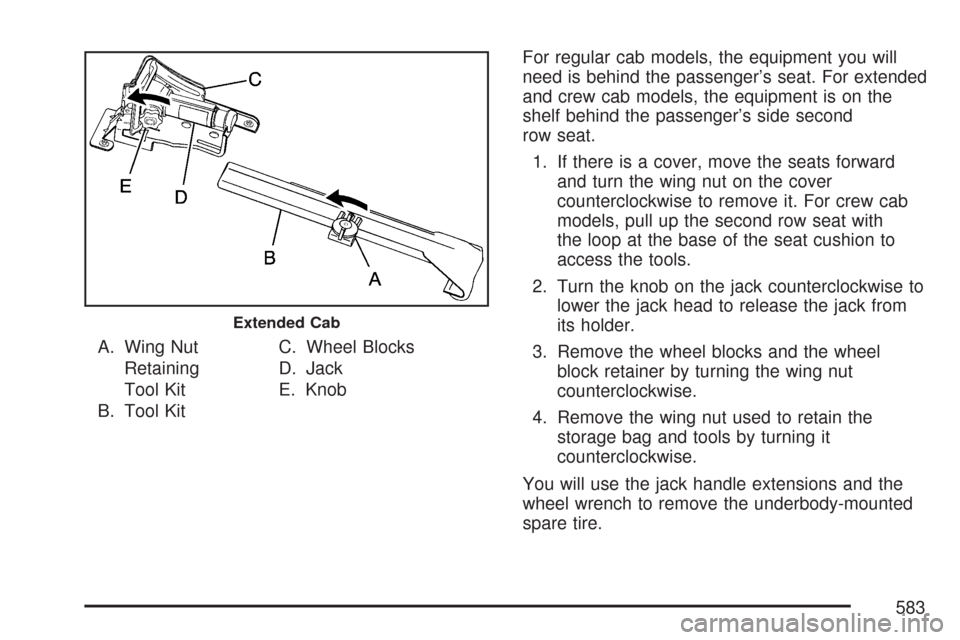
A. Wing Nut
Retaining
Tool Kit
B. Tool KitC. Wheel Blocks
D. Jack
E. KnobFor regular cab models, the equipment you will
need is behind the passenger’s seat. For extended
and crew cab models, the equipment is on the
shelf behind the passenger’s side second
row seat.
1. If there is a cover, move the seats forward
and turn the wing nut on the cover
counterclockwise to remove it. For crew cab
models, pull up the second row seat with
the loop at the base of the seat cushion to
access the tools.
2. Turn the knob on the jack counterclockwise to
lower the jack head to release the jack from
its holder.
3. Remove the wheel blocks and the wheel
block retainer by turning the wing nut
counterclockwise.
4. Remove the wing nut used to retain the
storage bag and tools by turning it
counterclockwise.
You will use the jack handle extensions and the
wheel wrench to remove the underbody-mounted
spare tire.
Extended Cab
583
Page 592 of 684
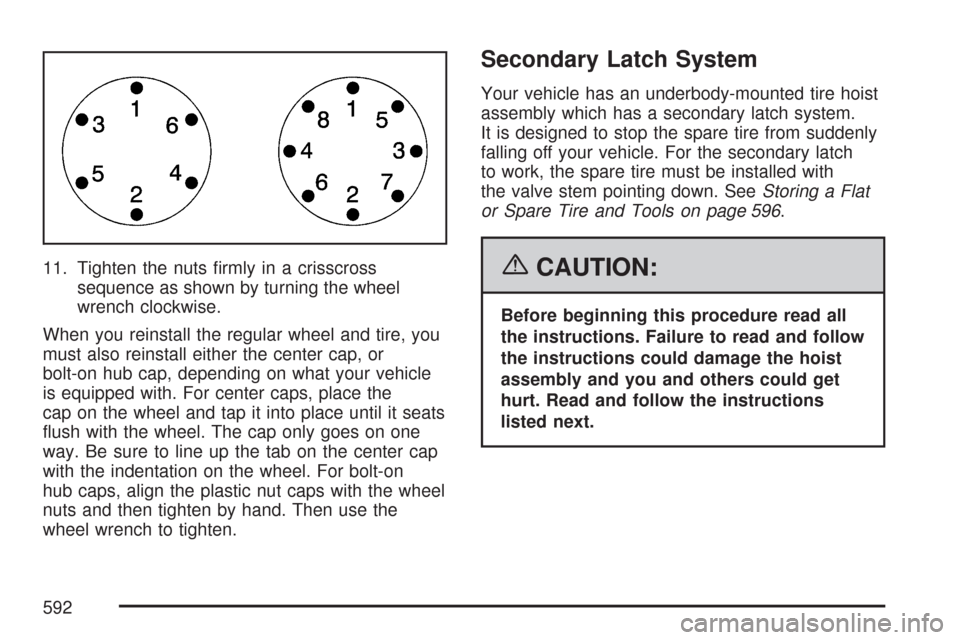
11. Tighten the nuts rmly in a crisscross
sequence as shown by turning the wheel
wrench clockwise.
When you reinstall the regular wheel and tire, you
must also reinstall either the center cap, or
bolt-on hub cap, depending on what your vehicle
is equipped with. For center caps, place the
cap on the wheel and tap it into place until it seats
ush with the wheel. The cap only goes on one
way. Be sure to line up the tab on the center cap
with the indentation on the wheel. For bolt-on
hub caps, align the plastic nut caps with the wheel
nuts and then tighten by hand. Then use the
wheel wrench to tighten.
Secondary Latch System
Your vehicle has an underbody-mounted tire hoist
assembly which has a secondary latch system.
It is designed to stop the spare tire from suddenly
falling off your vehicle. For the secondary latch
to work, the spare tire must be installed with
the valve stem pointing down. SeeStoring a Flat
or Spare Tire and Tools on page 596.
{CAUTION:
Before beginning this procedure read all
the instructions. Failure to read and follow
the instructions could damage the hoist
assembly and you and others could get
hurt. Read and follow the instructions
listed next.
592
Page 613 of 684
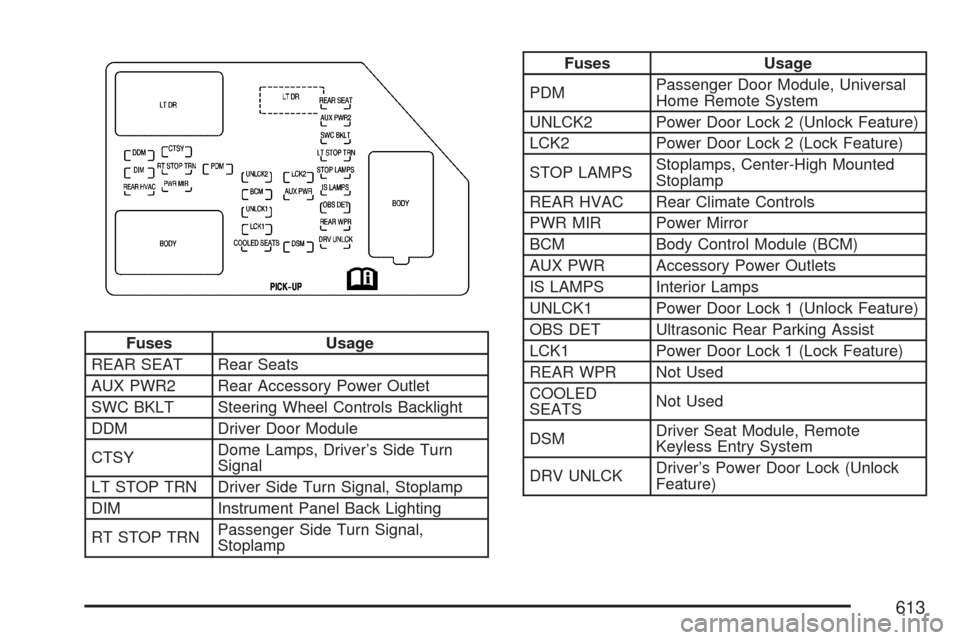
Fuses Usage
REAR SEAT Rear Seats
AUX PWR2 Rear Accessory Power Outlet
SWC BKLT Steering Wheel Controls Backlight
DDM Driver Door Module
CTSYDome Lamps, Driver’s Side Turn
Signal
LT STOP TRN Driver Side Turn Signal, Stoplamp
DIM Instrument Panel Back Lighting
RT STOP TRNPassenger Side Turn Signal,
Stoplamp
Fuses Usage
PDMPassenger Door Module, Universal
Home Remote System
UNLCK2 Power Door Lock 2 (Unlock Feature)
LCK2 Power Door Lock 2 (Lock Feature)
STOP LAMPSStoplamps, Center-High Mounted
Stoplamp
REAR HVAC Rear Climate Controls
PWR MIR Power Mirror
BCM Body Control Module (BCM)
AUX PWR Accessory Power Outlets
IS LAMPS Interior Lamps
UNLCK1 Power Door Lock 1 (Unlock Feature)
OBS DET Ultrasonic Rear Parking Assist
LCK1 Power Door Lock 1 (Lock Feature)
REAR WPR Not Used
COOLED
SEATSNot Used
DSMDriver Seat Module, Remote
Keyless Entry System
DRV UNLCKDriver’s Power Door Lock (Unlock
Feature)
613
Page 641 of 684
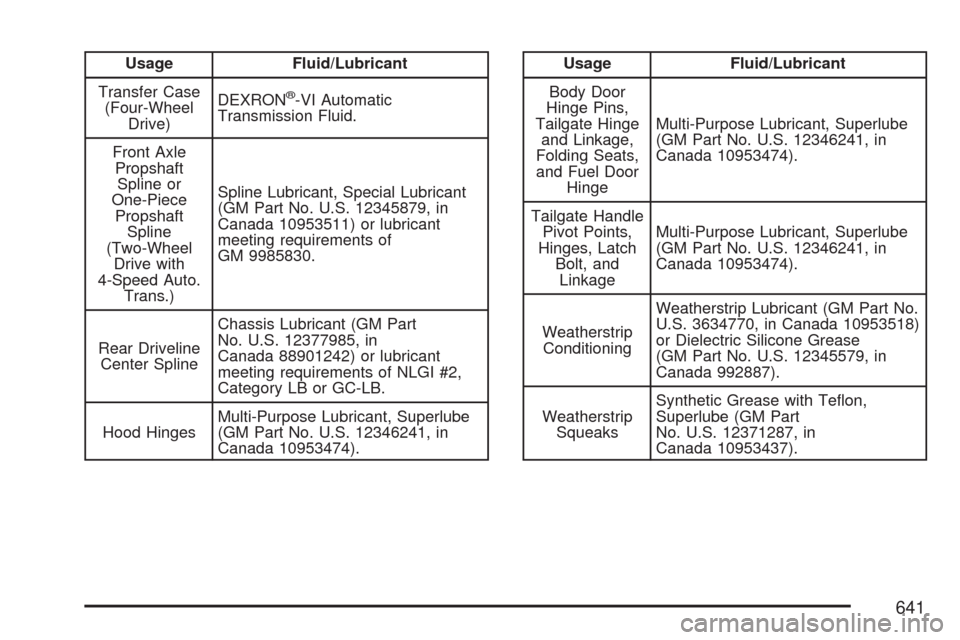
Usage Fluid/Lubricant
Transfer Case
(Four-Wheel
Drive)DEXRON
®-VI Automatic
Transmission Fluid.
Front Axle
Propshaft
Spline or
One-Piece
Propshaft
Spline
(Two-Wheel
Drive with
4-Speed Auto.
Trans.)Spline Lubricant, Special Lubricant
(GM Part No. U.S. 12345879, in
Canada 10953511) or lubricant
meeting requirements of
GM 9985830.
Rear Driveline
Center SplineChassis Lubricant (GM Part
No. U.S. 12377985, in
Canada 88901242) or lubricant
meeting requirements of NLGI #2,
Category LB or GC-LB.
Hood HingesMulti-Purpose Lubricant, Superlube
(GM Part No. U.S. 12346241, in
Canada 10953474).
Usage Fluid/Lubricant
Body Door
Hinge Pins,
Tailgate Hinge
and Linkage,
Folding Seats,
and Fuel Door
HingeMulti-Purpose Lubricant, Superlube
(GM Part No. U.S. 12346241, in
Canada 10953474).
Tailgate Handle
Pivot Points,
Hinges, Latch
Bolt, and
LinkageMulti-Purpose Lubricant, Superlube
(GM Part No. U.S. 12346241, in
Canada 10953474).
Weatherstrip
ConditioningWeatherstrip Lubricant (GM Part No.
U.S. 3634770, in Canada 10953518)
or Dielectric Silicone Grease
(GM Part No. U.S. 12345579, in
Canada 992887).
Weatherstrip
SqueaksSynthetic Grease with Teon,
Superlube (GM Part
No. U.S. 12371287, in
Canada 10953437).
641
Page 675 of 684
Gage (cont.)
Tachometer.............................................. 250
Voltmeter Gage........................................ 257
Garage Door Opener................................... 187
Gasoline
Octane..................................................... 491
Specications........................................... 491
Glove Box................................................... 198
GM Mobility Reimbursement Program.......... 653
H
Hazard Warning Flashers............................ 213
Head Restraints............................................ 18
Headlamps.................................................. 546
Bulb Replacement.................................... 545
Daytime Running Lamps.......................... 224
Flash-to-Pass........................................... 216
Halogen Bulbs......................................... 545
High/Low Beam Changer......................... 216
On Reminder........................................... 224
Pickup Box Identication and Fender
Marker Lamps...................................... 548
Heated Seats................................................ 12
Heater................................................236, 239
Heater......................................................... 240Highbeam On Light..................................... 267
Highway Hypnosis....................................... 417
Hill and Mountain Roads............................. 418
Hood
Checking Things Under............................ 498
Release................................................... 498
Horn............................................................ 213
How to Use This Manual................................ 4
How to Wear Safety Belts Properly............... 27
I
Ignition Positions......................................... 135
Infants and Young Children, Restraints.......... 49
Ination - Tire Pressure............................... 561
Instrument Panel
Overview.........................................208, 211
Storage Area............................................ 199
Instrument Panel (I/P)
Brightness................................................ 227
Cluster..................................................... 249
J
Jump Starting.............................................. 534
675
Page 677 of 684
Locks (cont.)
Lockout Protection................................... 122
Power Door............................................. 121
Programmable Automatic Door Locks....... 121
Rear Door Security Locks........................ 122
Loss of Control........................................... 391
Low Fuel Warning Light............................... 269
Luggage Carrier.......................................... 200
Lumbar
Manual Controls......................................... 11
Power Controls.......................................... 11
M
Maintenance Schedule
Additional Required Services.................... 631
At Each Fuel Fill...................................... 636
At Least Once a Month............................ 636
At Least Once a Year.............................. 637
At the First 100, 1,000 and 6,000 Miles
(160, 1 600 and 10 000km).................. 635
Introduction.............................................. 624
Maintenance Footnotes............................ 633
Maintenance Record................................ 644
Maintenance Requirements...................... 624
Normal Maintenance Replacement Parts.... 642Maintenance Schedule (cont.)
Owner Checks and Services.................... 635
Recommended Fluids and Lubricants....... 639
Scheduled Maintenance........................... 627
Using....................................................... 625
Your Vehicle and the Environment............ 625
Malfunction Indicator Light........................... 262
Manual Lumbar Controls............................... 11
Manual Seats.................................................. 9
Manual Windows......................................... 126
Memory Seat, Mirrors, and Pedals................ 13
Message
DIC Warnings and Messages................... 281
Mirrors
Automatic Dimming Rearview with
Compass and Temperature Display....... 175
Automatic Dimming Rearview with
OnStar
®, Compass and Temperature
Display................................................. 171
Manual Rearview Mirror........................... 171
Outside Manual Mirrors............................ 176
Outside Power Foldaway Mirrors.............. 179
Outside Power Mirrors............................. 178
Outside Trailer-Tow Mirrors....................... 177
MP3 ...................................................341, 347
MyGMLink.com............................................ 651
677
Page 681 of 684
Safety Warnings and Symbols......................... 4
Scheduled Maintenance............................... 627
Seatback Latches.......................................... 19
Seats
Center Seat............................................... 19
Head Restraints......................................... 18
Heated Seats............................................. 12
Manual........................................................ 9
Manual Lumbar.......................................... 11
Memory, Mirrors and Pedals...................... 13
Power Lumbar........................................... 11
Power Seats.............................................. 10
Rear Seat Operation........................... 20, 21
Reclining Seatbacks................................... 15
Seatback Latches...................................... 19
Secondary Latch System............................. 592
Securing a Child Restraint
Center Front Seat Position......................... 72
Rear Seat Position..................................... 69
Right Front Seat Position.................... 72, 78
Right Front Seat Position (Crew Cab)........ 83
Security Light.............................................. 266
Service........................................................ 488
Accessories and Modications.................. 488
Adding Equipment to the Outside of
Your Vehicle......................................... 490
California Proposition 65 Warning............. 489Service (cont.)
Doing Your Own Work............................. 489
Engine Soon Light................................... 262
Publications Ordering Information............. 666
Servicing Your Airbag-Equipped Vehicle....... 104
Sheet Metal Damage................................... 608
Shifting Into Park (P)................................... 165
Shifting Out of Park (P)............................... 167
Shoulder Belt Height Adjuster........................ 35
Signals, Turn and Lane-Change.................. 215
Sliding Rear Window, Power....................... 128
Snow Plow.................................................. 434
Spare Tire................................................... 600
Installing.................................................. 586
Removing................................................ 582
Storing..................................................... 596
Specications, Capacities............................ 620
Speedometer............................................... 250
StabiliTrak
®System..................................... 384
StabiliTrak®Indicator Light........................... 260
Starting Your Engine................................... 136
Steering...................................................... 387
Steering Wheel Controls, Audio................... 370
Steering Wheel, Tilt Wheel.......................... 214
Storage Areas............................................. 198
Cargo Management System..................... 201
Center Console Storage Area................... 199
681