radio CHEVROLET SILVERADO 2007 1.G Manual PDF
[x] Cancel search | Manufacturer: CHEVROLET, Model Year: 2007, Model line: SILVERADO, Model: CHEVROLET SILVERADO 2007 1.GPages: 684, PDF Size: 3.4 MB
Page 372 of 684
AM
The range for most AM stations is greater than for
FM, especially at night. The longer range can cause
station frequencies to interfere with each other. For
better radio reception, most AM radio stations
boosts the power levels during the day, and then
reduce these levels during the night. Static can also
occur when things like storms and power lines
interfere with radio reception. When this happens,
try reducing the treble on your radio.
FM Stereo
FM stereo gives the best sound, but FM signals
only reach about 10 to 40 miles (16 to 65 km). Tall
buildings or hills can interfere with FM signals,
causing the sound to fade in and out.
XM™ Satellite Radio Service
XM™ Satellite Radio Service gives digital radio
reception from coast-to-coast in the 48 contiguous
United States, and in Canada. Just as with FM,
tall buildings or hills can interfere with satellite
radio signals, causing the sound to fade in and out.In addition, traveling or standing under heavy
foliage, bridges, garages, or tunnels could cause
loss of the XM™ signal for a period of time.
The radio might display NO XM SIGNAL to
indicate interference.
Care of Your CDs and DVDs
Handle CDs carefully. Store them in their original
cases or other protective cases and away from
direct sunlight and dust. The CD player scans the
bottom surface of the disc. If the surface of a
CD is damaged, such as cracked, broken,
or scratched, the CD does not play properly or not
at all. If the surface of a CD is soiled, take a
soft, lint free cloth or dampen a clean, soft cloth in
a mild, neutral detergent solution mixed with
water, and clean it. Make sure the wiping process
starts from the center to the edge.
Do not touch the bottom side of a CD while
handling it; this could damage the surface. Pick up
CDs by grasping the outer edges or the edge of
the hole and the outer edge.
372
Page 373 of 684
Care of the CD and DVD Player
The use of CD lens cleaners for CDs is not
advised, due to the risk of contaminating the lens
of the CD optics with lubricants internal to the
CD mechanism.
Fixed Mast Antenna
The xed mast antenna can withstand most car
washes without being damaged. If the mast should
ever become slightly bent, straighten it out by
hand. If the mast is badly bent, replace it.
Check occasionally to make sure the mast is
still tightened to its base. If tightening is
required, tighten by hand, then with a wrench
one quarter turn.
XM™ Satellite Radio Antenna
System
The XM™ Satellite Radio antenna is located on
the roof of your vehicle. Keep this antenna clear of
snow and ice build up for clear radio reception.
A vehicle with a sunroof might not get the
best performance from the XM™ system if the
sunroof is open.
Loading items onto the roof of your vehicle can
interfere with the performance of the XM™ system.
Make sure the XM™ Satellite Radio antenna is
not obstructed.
373
Page 535 of 684
3. Get the vehicles close enough so the jumper
cables can reach, but be sure the vehicles are
not touching each other. If they are, it could
cause an unwanted ground connection.
You would not be able to start your vehicle,
and the bad grounding could damage the
electrical systems.
To avoid the possibility of the vehicles rolling,
set the parking brake rmly on both vehicles
involved in the jump start procedure. Put
the automatic transmission in PARK (P) or a
manual transmission in NEUTRAL before
setting the parking brake. If you have a
four-wheel-drive vehicle, be sure the transfer
case is in a drive gear, not in NEUTRAL.
Notice:If you leave your radio or other
accessories on during the jump starting
procedure, they could be damaged. The repairs
would not be covered by your warranty.
Always turn off your radio and other
accessories when jump starting your vehicle.4. Turn off the ignition on both vehicles. Unplug
unnecessary accessories plugged into the
cigarette lighter or the accessory power
outlets. Turn off the radio and all the lamps
that are not needed. This will avoid sparks and
help save both batteries. And it could save
the radio!
5. Open the hood on the other vehicle and
locate the positive (+) and negative (−)
terminal locations on that vehicle.
The positive (+) terminal, is located under a
red plastic cover at the positive battery
post. To uncover the positive (+) terminal,
open the red plastic cover.
535
Page 563 of 684
{CAUTION:
If you operate your vehicle with a tire that
is badly underinated, the tire can
overheat. An overheated tire can lose air
suddenly or catch re. You or others
could be injured. Be sure all tires
(including the spare) are properly inated.
SeeInation - Tire Pressure on page 561, for
information on proper tire ination.
Tire Pressure Monitor System
The Tire Pressure Monitor System (TPMS) uses
radio and sensor technology to check tire pressure
levels. If your vehicle has this feature, sensors
are mounted on each tire and wheel assembly,
except the spare tire. The TPMS sensors monitor
the air pressure in your vehicle’s tires and
transmit tire pressure readings to a receiver
located in the vehicle.The TPMS is designed to alert the driver, if a low
tire pressure condition exists. If your vehicle has the
Driver Information Center (DIC), the driver may also
check tire pressure levels using the DIC.
When a low tire pressure condition is detected,
the TPMS will illuminate the low tire pressure
warning symbol located on the instrument panel
cluster. If your vehicle has the DIC feature, a
message to check the pressure in a specic tire
will also appear on the DIC display. The low
tire pressure warning symbol on the instrument
panel cluster and the CHECK TIRE PRESSURE
warning message on the DIC display will appear at
each ignition cycle until the tires are inated to
the correct ination pressure. For additional
information and details about the DIC operation
and displays seeDIC Operation and Displays
(With DIC Buttons) on page 270orDIC Operation
and Displays (Without DIC Buttons) on page 277
andDIC Warnings and Messages on page 281.
563
Page 568 of 684
Federal Communications Commission
(FCC) and Industry and Science
Canada
The Tire Pressure Monitor System (TPMS)
operates on a radio frequency and complies with
Part 15 of the FCC Rules. Operation is subject
to the following two conditions:
1. This device may not cause harmful
interference.
2. This device must accept any interference
received, including interference that may
cause undesired operation.
The Tire Pressure Monitor System (TPMS)
operates on a radio frequency and complies with
RSS-210 of Industry and Science Canada.
Operation is subject to the following two
conditions:
1. This device may not cause interference.
2. This device must accept any interference
received, including interference that may
cause undesired operation of the device.
Changes or modications to this system by other
than an authorized service facility could void
authorization to use this equipment.
Tire Inspection and Rotation
Tires should be rotated every 5,000 to 8,000 miles
(8 000 to 13 000 km).
Any time you notice unusual wear, rotate your
tires as soon as possible and check wheel
alignment. Also check for damaged tires or wheels.
SeeWhen It Is Time for New Tires on page 571
andWheel Replacement on page 576for
more information.
Make sure the spare tire is stored securely. Push,
pull, and then try to rotate or turn the tire. If it
moves, use the wheel wrench/hoist shaft to tighten
the cable. SeeChanging a Flat Tire on page 580.
If your vehicle has dual rear wheels, also see
Dual Tire Operation on page 562.
The purpose of regular rotation is to achieve more
uniform wear for all tires on the vehicle. The
rst rotation is the most important. SeeScheduled
Maintenance (Gasoline Engine) on page 627.
568
Page 612 of 684
Fuses and Circuit Breakers
The wiring circuits in your vehicle are protected
from short circuits by a combination of fuses,
circuit breakers and fusible thermal links.
This greatly reduces the chance of res caused by
electrical problems.
Look at the silver-colored band inside the fuse. If
the band is broken or melted, replace the fuse.
Be sure you replace a bad fuse with a new one of
the identical size and rating.
If you ever have a problem on the road and do not
have a spare fuse, you can borrow one that has
the same amperage. Just pick some feature
of your vehicle that you can get along without, like
the radio or cigarette lighter, and use its fuse if
it is the correct amperage. Replace it as soon as
you can.
Instrument Panel Fuse Block
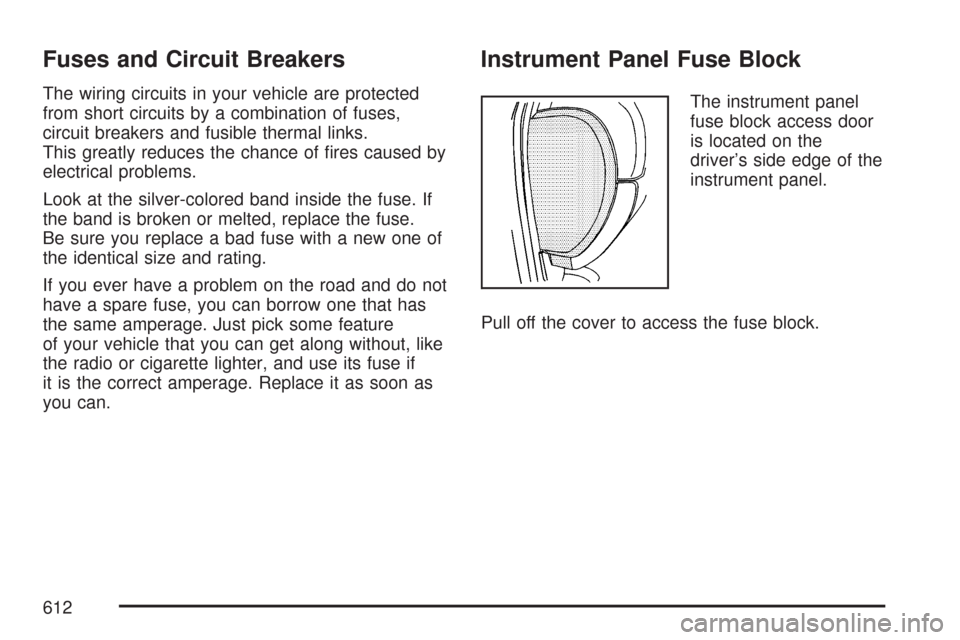
The instrument panel
fuse block access door
is located on the
driver’s side edge of the
instrument panel.
Pull off the cover to access the fuse block.
612
Page 669 of 684
A
Accessories and Modications..................... 488
Adding a Snow Plow or Similar Equipment..... 434
Adding Equipment to Your Airbag-Equipped
Vehicle..................................................... 105
Additives, Fuel............................................ 492
Add-On Electrical Equipment....................... 611
Adjustable Throttle and Brake Pedal............ 138
Air Cleaner/Filter, Engine............................. 507
Air Conditioning.........................236, 239, 240
Airbag
Off Light.................................................. 252
Passenger Status Indicator....................... 254
Readiness Light....................................... 252
Airbag Sensing and Diagnostic
Module (SDM).......................................... 659
Airbag System............................................... 85
What Will You See After an Airbag
Inates?................................................. 94
When Should an Airbag Inate?................. 91
Where Are the Airbags?............................. 88
Airbag Systems
Adding Equipment to Your
Airbag-Equipped Vehicle....................... 105
Airbag Off Switch....................................... 95
How Does an Airbag Restrain?.................. 93Airbag Systems (cont.)
Passenger Sensing System....................... 99
Servicing Your Airbag-Equipped Vehicle.... 104
What Makes an Airbag Inate?.................. 93
AM-FM Radio.............................................. 306
Antenna, Fixed Mast................................... 373
Antenna, XM™ Satellite Radio Antenna
System.................................................... 373
Anti-Lock Brake System.............................. 381
Anti-Lock Brake, System Warning Light....... 259
Appearance Care
Aluminum or Chrome-Plated Wheels........ 607
Care of Safety Belts................................ 604
Chemical Paint Spotting........................... 609
Cleaning Exterior Lamps/Lenses.............. 605
Cleaning the Inside of Your Vehicle.......... 601
Fabric/Carpet........................................... 602
Finish Care.............................................. 605
Finish Damage......................................... 608
Instrument Panel, Vinyl, and Other
Plastic Surfaces.................................... 604
Leather.................................................... 603
Sheet Metal Damage............................... 608
Tires........................................................ 608
Underbody Maintenance........................... 608
Vehicle Care/Appearance Materials.......... 609
Washing Your Vehicle.............................. 605
669
Page 670 of 684
Appearance Care (cont.)
Weatherstrips........................................... 604
Windshield and Wiper Blades................... 606
Ashtray....................................................... 235
Audio System.............................................. 302
AM-FM Radio.......................................... 306
Audio Steering Wheel Controls................. 370
Care of Your CD and DVD Player............ 373
Care of Your CDs and DVDs................... 372
Fixed Mast Antenna................................. 373
Navigation/Radio System, see
Navigation Manual................................ 357
Radio with CD................................308, 314
Rear Seat Audio (RSA)............................ 368
Setting the Time...................................... 303
Theft-Deterrent Feature............................ 370
Understanding Radio Reception............... 371
XM™ Satellite Radio Antenna System...... 373
Audio System(s)
Radio with CD and DVD.......................... 324
Automatic Headlamp System....................... 225
Automatic Transmission
Fluid........................................................ 510
Operation................................................. 140
Auxiliary Roof Mounted Lamp Switch.......... 227B
Battery........................................................ 533
Electric Power Management..................... 229
Run-Down Protection............................... 230
Before Leaving on a Long Trip.................... 416
Brake
Emergencies............................................ 383
Parking.................................................... 164
Brakes........................................................ 529
System Warning Light.............................. 258
Braking....................................................... 380
Braking in Emergencies............................... 383
Break-In, New Vehicle................................. 134
Bulb Replacement....................................... 545
Center High-Mounted Stoplamp
(CHMSL) and Cargo Lamp................... 547
Halogen Bulbs......................................... 545
Headlamps............................................... 546
License Plate Lamps................................ 550
Pickup Box Identication and Fender
Marker Lamps...................................... 548
Replacement Bulbs.................................. 551
Taillamps, Turn Signal, Stoplamps and
Back-up Lamps..................................... 548
Buying New Tires........................................ 572
670
Page 678 of 684
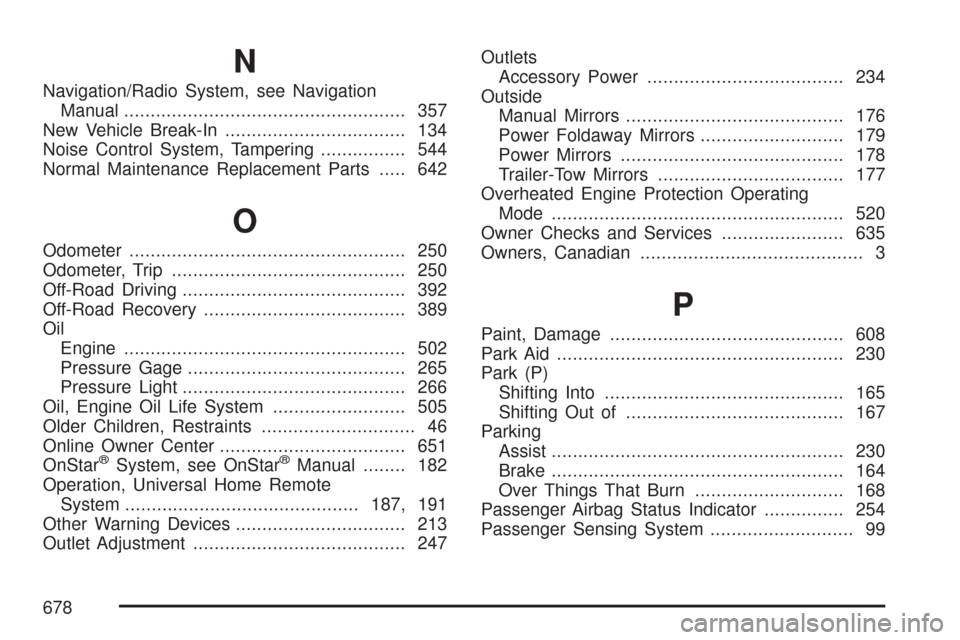
N
Navigation/Radio System, see Navigation
Manual..................................................... 357
New Vehicle Break-In.................................. 134
Noise Control System, Tampering................ 544
Normal Maintenance Replacement Parts..... 642
O
Odometer.................................................... 250
Odometer, Trip............................................ 250
Off-Road Driving.......................................... 392
Off-Road Recovery...................................... 389
Oil
Engine..................................................... 502
Pressure Gage......................................... 265
Pressure Light.......................................... 266
Oil, Engine Oil Life System......................... 505
Older Children, Restraints............................. 46
Online Owner Center................................... 651
OnStar
®System, see OnStar®Manual........ 182
Operation, Universal Home Remote
System............................................187, 191
Other Warning Devices................................ 213
Outlet Adjustment........................................ 247Outlets
Accessory Power..................................... 234
Outside
Manual Mirrors......................................... 176
Power Foldaway Mirrors........................... 179
Power Mirrors.......................................... 178
Trailer-Tow Mirrors................................... 177
Overheated Engine Protection Operating
Mode....................................................... 520
Owner Checks and Services....................... 635
Owners, Canadian.......................................... 3
P
Paint, Damage............................................ 608
Park Aid...................................................... 230
Park (P)
Shifting Into............................................. 165
Shifting Out of......................................... 167
Parking
Assist....................................................... 230
Brake....................................................... 164
Over Things That Burn............................ 168
Passenger Airbag Status Indicator............... 254
Passenger Sensing System........................... 99
678
Page 679 of 684
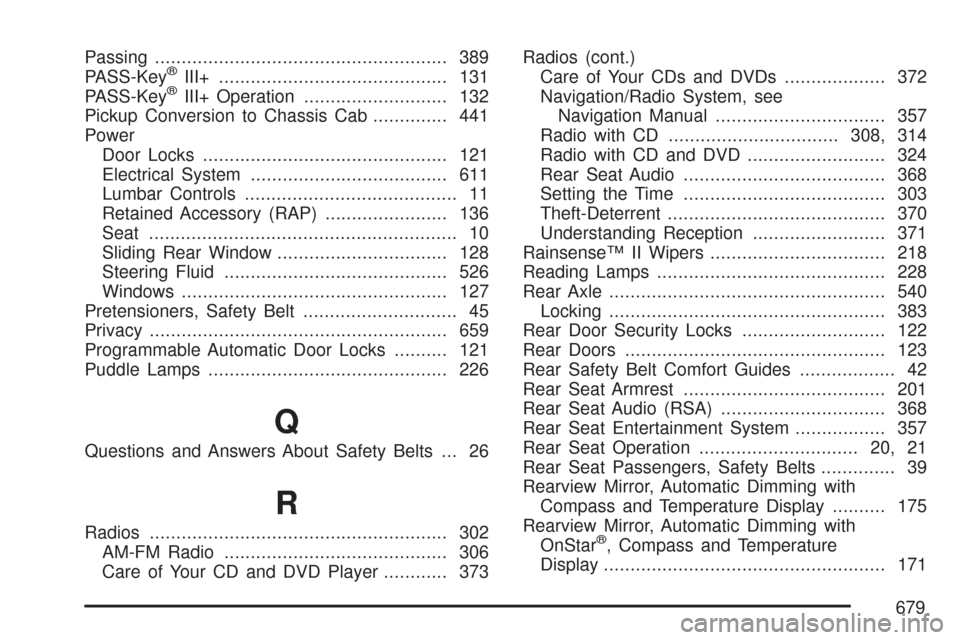
Passing....................................................... 389
PASS-Key®III+........................................... 131
PASS-Key®III+ Operation........................... 132
Pickup Conversion to Chassis Cab.............. 441
Power
Door Locks.............................................. 121
Electrical System..................................... 611
Lumbar Controls........................................ 11
Retained Accessory (RAP)....................... 136
Seat.......................................................... 10
Sliding Rear Window................................ 128
Steering Fluid.......................................... 526
Windows.................................................. 127
Pretensioners, Safety Belt............................. 45
Privacy........................................................ 659
Programmable Automatic Door Locks.......... 121
Puddle Lamps............................................. 226
Q
Questions and Answers About Safety Belts ... 26
R
Radios........................................................ 302
AM-FM Radio.......................................... 306
Care of Your CD and DVD Player............ 373Radios (cont.)
Care of Your CDs and DVDs................... 372
Navigation/Radio System, see
Navigation Manual................................ 357
Radio with CD................................308, 314
Radio with CD and DVD.......................... 324
Rear Seat Audio...................................... 368
Setting the Time...................................... 303
Theft-Deterrent......................................... 370
Understanding Reception......................... 371
Rainsense™ II Wipers................................. 218
Reading Lamps........................................... 228
Rear Axle.................................................... 540
Locking.................................................... 383
Rear Door Security Locks........................... 122
Rear Doors................................................. 123
Rear Safety Belt Comfort Guides.................. 42
Rear Seat Armrest...................................... 201
Rear Seat Audio (RSA)............................... 368
Rear Seat Entertainment System................. 357
Rear Seat Operation.............................. 20, 21
Rear Seat Passengers, Safety Belts.............. 39
Rearview Mirror, Automatic Dimming with
Compass and Temperature Display.......... 175
Rearview Mirror, Automatic Dimming with
OnStar®, Compass and Temperature
Display..................................................... 171
679