cooling CHEVROLET SILVERADO 2010 2.G User Guide
[x] Cancel search | Manufacturer: CHEVROLET, Model Year: 2010, Model line: SILVERADO, Model: CHEVROLET SILVERADO 2010 2.GPages: 626, PDF Size: 4.8 MB
Page 390 of 626
Hill and Mountain Roads
Driving on steep hills or through mountains is different
than driving on flat or rolling terrain. Tips for driving in
these conditions include:
.Keep the vehicle serviced and in good shape.
.Check all fluid levels and brakes, tires, cooling
system, and transmission.
.Going down steep or long hills, shift to a
lower gear.
{WARNING:
If you do not shift down, the brakes could get so
hot that they would not work well. You would then
have poor braking or even none going down a hill.
You could crash. Shift down to let the engine
assist the brakes on a steep downhill slope.
{WARNING:
Coasting downhill in N (Neutral) or with the
ignition off is dangerous. The brakes will have to
do all the work of slowing down and they could
get so hot that they would not work well. You
would then have poor braking or even none going
down a hill. You could crash. Always have the
engine running and the vehicle in gear when
going downhill.
.Stay in your own lane. Do not swing wide or cut
across the center of the road. Drive at speeds that
let you stay in your own lane.
.Top of hills: Be alert—something could be in your
lane (stalled car, accident).
.Pay attention to special road signs (falling rocks
area, winding roads, long grades, passing or
no-passing zones) and take appropriate action.
See Off-Road Driving
on page 5‑11for information
about driving off-road.
5-24
Page 419 of 626
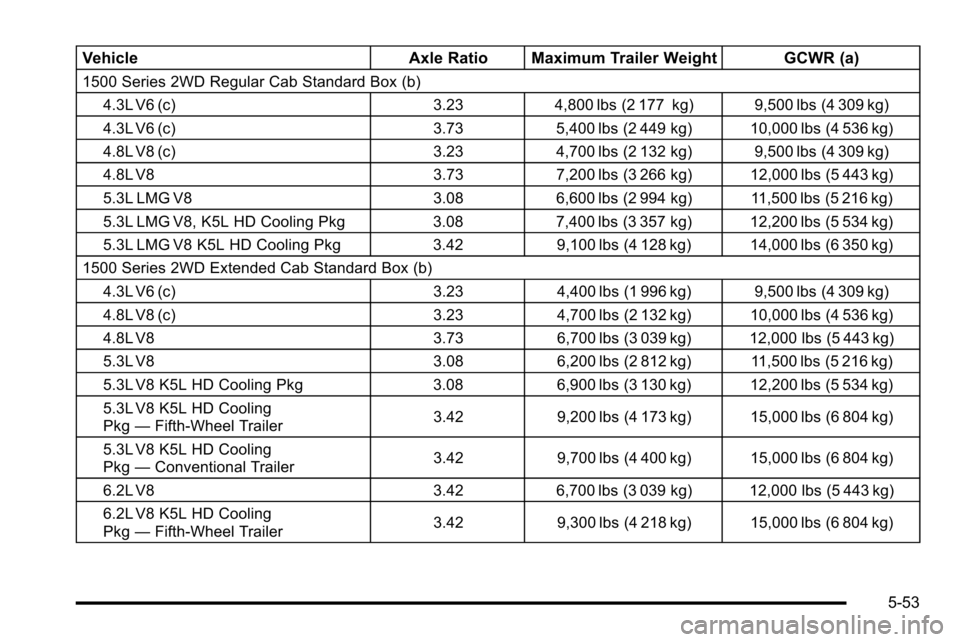
VehicleAxle Ratio Maximum Trailer Weight GCWR (a)
1500 Series 2WD Regular Cab Standard Box (b)
4.3L V6 (c) 3.23 4,800 lbs (2 177 kg) 9,500 lbs (4 309 kg)
4.3L V6 (c) 3.73 5,400 lbs (2 449 kg) 10,000 lbs (4 536 kg)
4.8L V8 (c) 3.23 4,700 lbs (2 132 kg) 9,500 lbs (4 309 kg)
4.8L V8 3.73 7,200 lbs (3 266 kg) 12,000 lbs (5 443 kg)
5.3L LMG V8 3.08 6,600 lbs (2 994 kg) 11,500 lbs (5 216 kg)
5.3L LMG V8, K5L HD Cooling Pkg 3.08 7,400 lbs (3 357 kg) 12,200 lbs (5 534 kg)
5.3L LMG V8 K5L HD Cooling Pkg 3.42 9,100 lbs (4 128 kg) 14,000 lbs (6 350 kg)
1500 Series 2WD Extended Cab Standard Box (b)
4.3L V6 (c) 3.23 4,400 lbs (1 996 kg) 9,500 lbs (4 309 kg)
4.8L V8 (c) 3.23 4,700 lbs (2 132 kg) 10,000 lbs (4 536 kg)
4.8L V8 3.73 6,700 lbs (3 039 kg) 12,000 lbs (5 443 kg)
5.3L V8 3.08 6,200 lbs (2 812 kg) 11,500 lbs (5 216 kg)
5.3L V8 K5L HD Cooling Pkg 3.08 6,900 lbs (3 130 kg) 12,200 lbs (5 534 kg)
5.3L V8 K5L HD Cooling
Pkg —Fifth-Wheel Trailer 3.42 9,200 lbs (4 173 kg) 15,000 lbs (6 804 kg)
5.3L V8 K5L HD Cooling
Pkg —Conventional Trailer 3.42 9,700 lbs (4 400 kg) 15,000 lbs (6 804 kg)
6.2L V8 3.42 6,700 lbs (3 039 kg) 12,000 lbs (5 443 kg)
6.2L V8 K5L HD Cooling
Pkg —Fifth-Wheel Trailer 3.42 9,300 lbs (4 218 kg) 15,000 lbs (6 804 kg)
5-53
Page 420 of 626
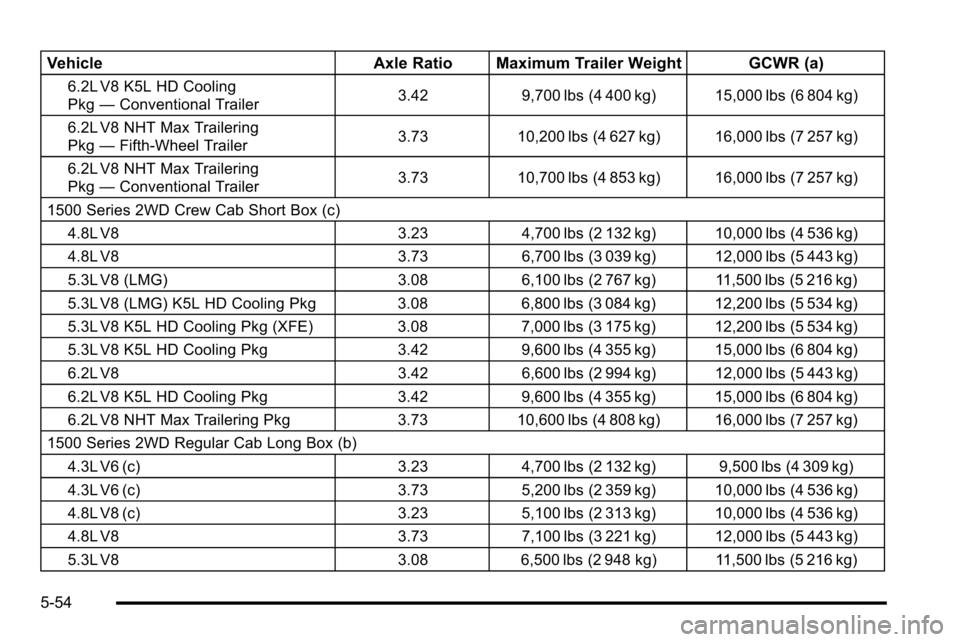
VehicleAxle Ratio Maximum Trailer Weight GCWR (a)
6.2L V8 K5L HD Cooling
Pkg—Conventional Trailer 3.42 9,700 lbs (4 400 kg) 15,000 lbs (6 804 kg)
6.2L V8 NHT Max Trailering
Pkg —Fifth-Wheel Trailer 3.73 10,200 lbs (4 627 kg) 16,000 lbs (7 257 kg)
6.2L V8 NHT Max Trailering
Pkg —Conventional Trailer 3.73 10,700 lbs (4 853 kg) 16,000 lbs (7 257 kg)
1500 Series 2WD Crew Cab Short Box (c) 4.8L V8 3.23 4,700 lbs (2 132 kg) 10,000 lbs (4 536 kg)
4.8L V8 3.73 6,700 lbs (3 039 kg) 12,000 lbs (5 443 kg)
5.3L V8 (LMG) 3.08 6,100 lbs (2 767 kg) 11,500 lbs (5 216 kg)
5.3L V8 (LMG) K5L HD Cooling Pkg 3.08 6,800 lbs (3 084 kg) 12,200 lbs (5 534 kg)
5.3L V8 K5L HD Cooling Pkg (XFE) 3.08 7,000 lbs (3 175 kg) 12,200 lbs (5 534 kg)
5.3L V8 K5L HD Cooling Pkg 3.42 9,600 lbs (4 355 kg) 15,000 lbs (6 804 kg)
6.2L V8 3.42 6,600 lbs (2 994 kg) 12,000 lbs (5 443 kg)
6.2L V8 K5L HD Cooling Pkg 3.42 9,600 lbs (4 355 kg) 15,000 lbs (6 804 kg)
6.2L V8 NHT Max Trailering Pkg 3.73 10,600 lbs (4 808 kg) 16,000 lbs (7 257 kg)
1500 Series 2WD Regular Cab Long Box (b) 4.3L V6 (c) 3.23 4,700 lbs (2 132 kg) 9,500 lbs (4 309 kg)
4.3L V6 (c) 3.73 5,200 lbs (2 359 kg) 10,000 lbs (4 536 kg)
4.8L V8 (c) 3.23 5,100 lbs (2 313 kg) 10,000 lbs (4 536 kg)
4.8L V8 3.73 7,100 lbs (3 221 kg) 12,000 lbs (5 443 kg)
5.3L V8 3.08 6,500 lbs (2 948 kg) 11,500 lbs (5 216 kg)
5-54
Page 421 of 626
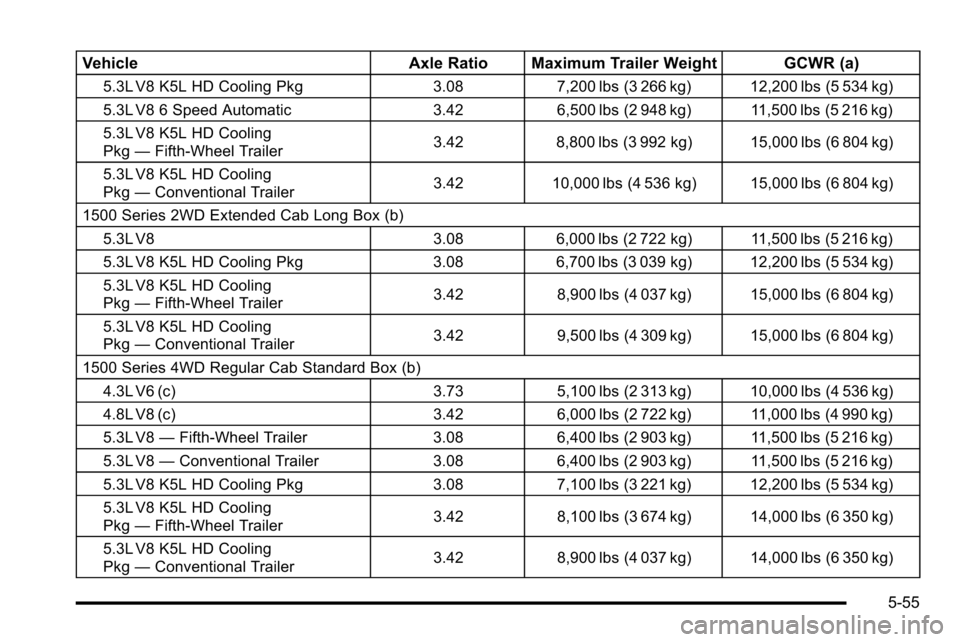
VehicleAxle Ratio Maximum Trailer Weight GCWR (a)
5.3L V8 K5L HD Cooling Pkg 3.087,200 lbs (3 266 kg) 12,200 lbs (5 534 kg)
5.3L V8 6 Speed Automatic 3.426,500 lbs (2 948 kg) 11,500 lbs (5 216 kg)
5.3L V8 K5L HD Cooling
Pkg —Fifth-Wheel Trailer 3.42
8,800 lbs (3 992 kg) 15,000 lbs (6 804 kg)
5.3L V8 K5L HD Cooling
Pkg —Conventional Trailer 3.42
10,000 lbs (4 536 kg) 15,000 lbs (6 804 kg)
1500 Series 2WD Extended Cab Long Box (b) 5.3L V8 3.086,000 lbs (2 722 kg) 11,500 lbs (5 216 kg)
5.3L V8 K5L HD Cooling Pkg 3.086,700 lbs (3 039 kg) 12,200 lbs (5 534 kg)
5.3L V8 K5L HD Cooling
Pkg —Fifth-Wheel Trailer 3.42
8,900 lbs (4 037 kg) 15,000 lbs (6 804 kg)
5.3L V8 K5L HD Cooling
Pkg —Conventional Trailer 3.42
9,500 lbs (4 309 kg) 15,000 lbs (6 804 kg)
1500 Series 4WD Regular Cab Standard Box (b) 4.3L V6 (c) 3.735,100 lbs (2 313 kg) 10,000 lbs (4 536 kg)
4.8L V8 (c) 3.426,000 lbs (2 722 kg) 11,000 lbs (4 990 kg)
5.3L V8 —Fifth-Wheel Trailer 3.086,400 lbs (2 903 kg) 11,500 lbs (5 216 kg)
5.3L V8 —Conventional Trailer 3.086,400 lbs (2 903 kg) 11,500 lbs (5 216 kg)
5.3L V8 K5L HD Cooling Pkg 3.087,100 lbs (3 221 kg) 12,200 lbs (5 534 kg)
5.3L V8 K5L HD Cooling
Pkg —Fifth-Wheel Trailer 3.42
8,100 lbs (3 674 kg) 14,000 lbs (6 350 kg)
5.3L V8 K5L HD Cooling
Pkg —Conventional Trailer 3.42
8,900 lbs (4 037 kg) 14,000 lbs (6 350 kg)
5-55
Page 422 of 626
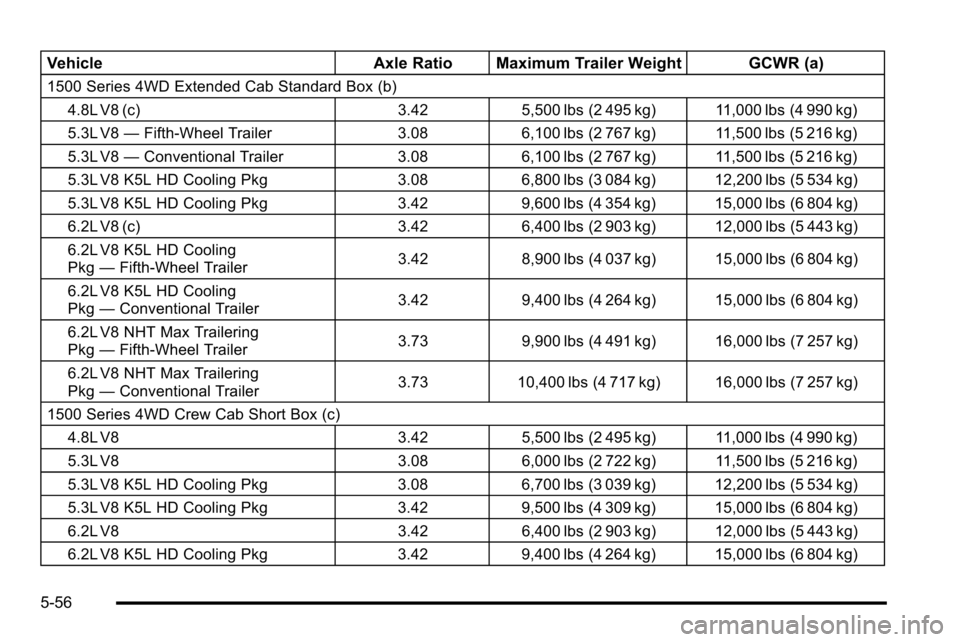
VehicleAxle Ratio Maximum Trailer Weight GCWR (a)
1500 Series 4WD Extended Cab Standard Box (b)
4.8L V8 (c) 3.42 5,500 lbs (2 495 kg) 11,000 lbs (4 990 kg)
5.3L V8 —Fifth-Wheel Trailer 3.08 6,100 lbs (2 767 kg) 11,500 lbs (5 216 kg)
5.3L V8 —Conventional Trailer 3.08 6,100 lbs (2 767 kg) 11,500 lbs (5 216 kg)
5.3L V8 K5L HD Cooling Pkg 3.08 6,800 lbs (3 084 kg) 12,200 lbs (5 534 kg)
5.3L V8 K5L HD Cooling Pkg 3.42 9,600 lbs (4 354 kg) 15,000 lbs (6 804 kg)
6.2L V8 (c) 3.42 6,400 lbs (2 903 kg) 12,000 lbs (5 443 kg)
6.2L V8 K5L HD Cooling
Pkg —Fifth-Wheel Trailer 3.42 8,900 lbs (4 037 kg) 15,000 lbs (6 804 kg)
6.2L V8 K5L HD Cooling
Pkg —Conventional Trailer 3.42 9,400 lbs (4 264 kg) 15,000 lbs (6 804 kg)
6.2L V8 NHT Max Trailering
Pkg —Fifth-Wheel Trailer 3.73 9,900 lbs (4 491 kg) 16,000 lbs (7 257 kg)
6.2L V8 NHT Max Trailering
Pkg —Conventional Trailer 3.73 10,400 lbs (4 717 kg) 16,000 lbs (7 257 kg)
1500 Series 4WD Crew Cab Short Box (c) 4.8L V8 3.42 5,500 lbs (2 495 kg) 11,000 lbs (4 990 kg)
5.3L V8 3.08 6,000 lbs (2 722 kg) 11,500 lbs (5 216 kg)
5.3L V8 K5L HD Cooling Pkg 3.08 6,700 lbs (3 039 kg) 12,200 lbs (5 534 kg)
5.3L V8 K5L HD Cooling Pkg 3.42 9,500 lbs (4 309 kg) 15,000 lbs (6 804 kg)
6.2L V8 3.42 6,400 lbs (2 903 kg) 12,000 lbs (5 443 kg)
6.2L V8 K5L HD Cooling Pkg 3.42 9,400 lbs (4 264 kg) 15,000 lbs (6 804 kg)
5-56
Page 423 of 626
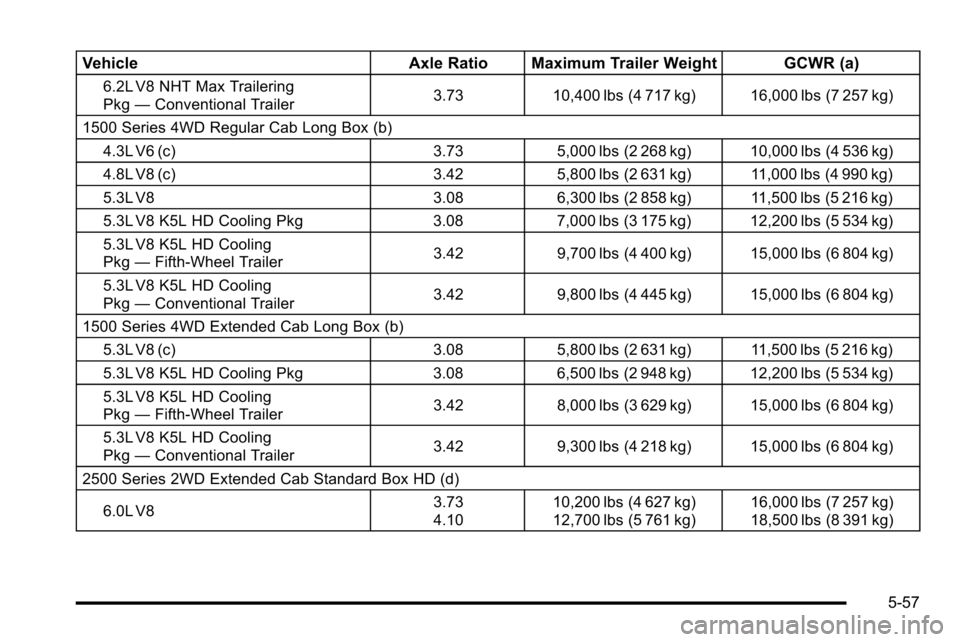
VehicleAxle Ratio Maximum Trailer Weight GCWR (a)
6.2L V8 NHT Max Trailering
Pkg—Conventional Trailer 3.73 10,400 lbs (4 717 kg) 16,000 lbs (7 257 kg)
1500 Series 4WD Regular Cab Long Box (b) 4.3L V6 (c) 3.73 5,000 lbs (2 268 kg) 10,000 lbs (4 536 kg)
4.8L V8 (c) 3.42 5,800 lbs (2 631 kg) 11,000 lbs (4 990 kg)
5.3L V8 3.08 6,300 lbs (2 858 kg) 11,500 lbs (5 216 kg)
5.3L V8 K5L HD Cooling Pkg 3.08 7,000 lbs (3 175 kg) 12,200 lbs (5 534 kg)
5.3L V8 K5L HD Cooling
Pkg —Fifth-Wheel Trailer 3.42 9,700 lbs (4 400 kg) 15,000 lbs (6 804 kg)
5.3L V8 K5L HD Cooling
Pkg —Conventional Trailer 3.42 9,800 lbs (4 445 kg) 15,000 lbs (6 804 kg)
1500 Series 4WD Extended Cab Long Box (b) 5.3L V8 (c) 3.08 5,800 lbs (2 631 kg) 11,500 lbs (5 216 kg)
5.3L V8 K5L HD Cooling Pkg 3.08 6,500 lbs (2 948 kg) 12,200 lbs (5 534 kg)
5.3L V8 K5L HD Cooling
Pkg —Fifth-Wheel Trailer 3.42 8,000 lbs (3 629 kg) 15,000 lbs (6 804 kg)
5.3L V8 K5L HD Cooling
Pkg —Conventional Trailer 3.42 9,300 lbs (4 218 kg) 15,000 lbs (6 804 kg)
2500 Series 2WD Extended Cab Standard Box HD (d) 6.0L V8 3.73
4.1010,200 lbs (4 627 kg)
12,700 lbs (5 761 kg) 16,000 lbs (7 257 kg)
18,500 lbs (8 391 kg)
5-57
Page 441 of 626
Leaving After Parking on a Hill
1. Apply and hold the brake pedal.
2. Start the engine
3. Shift into a gear
4. Release the parking brake
5. Let up on the brake pedal.
6. Drive slowly until the trailer is clear of the chocks.
7. Stop and have someone pick up and store thechocks.
Maintenance When Trailer Towing
The vehicle needs service more often when pulling a
trailer. See this manual's Maintenance Schedule or
Index for more information. Things that are especially
important in trailer operation are automatic transmission
fluid, engine oil, axle lubricant, belts, cooling system
and brake system. It is a good idea to inspect these
before and during the trip.
Check periodically to see that all hitch nuts and bolts
are tight.
Trailer Wiring Harness
The vehicle is equipped with one of the following wiring
harnesses for towing a trailer or hauling a slide-in
camper.
Basic Trailer Wiring
All regular, extended cab and crew cab pickups have a
seven‐wire trailer towing harness.
For vehicles not equipped with heavy duty trailering, the
harness is secured to the vehicle's frame behind the
spare tire mount. The harness requires the installation
of a trailer connector, which is available through your
dealer.
If towing a light‐duty trailer with a standard four‐way
round pin connector, an adapter is available from your
dealer.
5-75
Page 445 of 626
Section 6 Service and Appearance Care
Service. . . . . . . . . . . . . . . . . . . . . . . . . . . . . . . . . . . . . . . . . . . . . 6-4
Accessories and Modifications . . . . . . . . . . . . . . . . . . 6-4
California Proposition 65 Warning . . . . . . . . . . . . . . . 6-5
California Perchlorate Materials Requirements . . . . . . . . . . . . . . . . . . . . . . . . . . . . . . . . . 6-5
Doing Your Own Service Work . . . . . . . . . . . . . . . . . . 6-5
Adding Equipment to the Outside of the Vehicle . . . . . . . . . . . . . . . . . . . . . . . . . . . . . . . . . . . . . . . . 6-6
Fuel . . . . . . . . . . . . . . . . . . . . . . . . . . . . . . . . . . . . . . . . . . . . . . . . . 6-6
Gasoline Octane . . . . . . . . . . . . . . . . . . . . . . . . . . . . . . . . 6-7
Gasoline Specifications . . . . . . . . . . . . . . . . . . . . . . . . . 6-7
California Fuel . . . . . . . . . . . . . . . . . . . . . . . . . . . . . . . . . . 6-8
Additives . . . . . . . . . . . . . . . . . . . . . . . . . . . . . . . . . . . . . . . . 6-8
Fuel E85 (85% Ethanol) . . . . . . . . . . . . . . . . . . . . . . . . . 6-9
Fuels in Foreign Countries . . . . . . . . . . . . . . . . . . . . . 6-11
Filling the Tank . . . . . . . . . . . . . . . . . . . . . . . . . . . . . . . . . 6-11
Filling a Portable Fuel Container . . . . . . . . . . . . . . . 6-13
Checking Things Under the Hood . . . . . . . . . . . . . . .6-14
Hood Release . . . . . . . . . . . . . . . . . . . . . . . . . . . . . . . . . 6-15
Engine Compartment Overview . . . . . . . . . . . . . . . . 6-16
Engine Oil . . . . . . . . . . . . . . . . . . . . . . . . . . . . . . . . . . . . . 6-18
Engine Oil Life System . . . . . . . . . . . . . . . . . . . . . . . . 6-20
Engine Air Cleaner/Filter . . . . . . . . . . . . . . . . . . . . . . . 6-21 Automatic Transmission Fluid (4-Speed
Transmission) . . . . . . . . . . . . . . . . . . . . . . . . . . . . . . . 6-23
Automatic Transmission Fluid (6-Speed Transmission) . . . . . . . . . . . . . . . . . . . . . . . . . . . . . . . 6-26
Cooling System . . . . . . . . . . . . . . . . . . . . . . . . . . . . . . . . 6-29
Engine Coolant . . . . . . . . . . . . . . . . . . . . . . . . . . . . . . . . 6-31
Engine Overheating . . . . . . . . . . . . . . . . . . . . . . . . . . . 6-34
Overheated Engine Protection
Operating Mode . . . . . . . . . . . . . . . . . . . . . . . . . . . . . 6-36
Engine Fan Noise . . . . . . . . . . . . . . . . . . . . . . . . . . . . . 6-37
Power Steering Fluid . . . . . . . . . . . . . . . . . . . . . . . . . . 6-37
Windshield Washer Fluid . . . . . . . . . . . . . . . . . . . . . . 6-38
Brakes . . . . . . . . . . . . . . . . . . . . . . . . . . . . . . . . . . . . . . . . . 6-39
Battery . . . . . . . . . . . . . . . . . . . . . . . . . . . . . . . . . . . . . . . . . 6-43
Jump Starting . . . . . . . . . . . . . . . . . . . . . . . . . . . . . . . . . . 6-44
Rear Axle . . . . . . . . . . . . . . . . . . . . . . . . . . . . . . . . . . . . . . . . . 6-48
Four-Wheel Drive . . . . . . . . . . . . . . . . . . . . . . . . . . . . . . . . . 6-50
Front Axle . . . . . . . . . . . . . . . . . . . . . . . . . . . . . . . . . . . . . . . . . 6-52
Noise Control System . . . . . . . . . . . . . . . . . . . . . . . . . . . . 6-53
Tampering with Noise Control System Prohibited . . . . . . . . . . . . . . . . . . . . . . . . . . . . . . . . . . . 6-53
Headlamp Aiming . . . . . . . . . . . . . . . . . . . . . . . . . . . . . . . . 6-54
6-1
Page 461 of 626

A.Engine Air Cleaner/Filter on page 6‑21.
B. Coolant Surge Tank and Pressure Cap. See Cooling System on page 6‑29.
C. Positive (+) Terminal. See Jump Starting
on
page 6‑44.
D. Battery on page 6‑43.
E. Engine Oil Fill Cap. See “When to Add Engine Oil”
under Engine Oil on page 6‑18.
F. Automatic Transmission Dipstick. See “Checking
the Fluid Level” underAutomatic Transmission
Fluid (4-Speed Transmission)
on page 6‑23or
Automatic Transmission Fluid (6-Speed
Transmission) on page 6‑26.
G. Remote Negative (−) Terminal (Out of View). See Jump Starting on page 6‑44. H. Engine Oil Dipstick (Out of View). See
“Checking
Engine Oil” underEngine Oil on page 6‑18.
I. Engine Cooling Fan. See Cooling System
on
page 6‑29.
J. Power Steering Fluid Reservoir. See Power
Steering Fluid on page 6‑37.
K. Brake Master Cylinder Reservoir. See “Brake
Fluid” under Brakes on page 6‑39.
L. Underhood Fuse Block on page 6‑122.
M. Windshield Washer Fluid Reservoir. See “Adding
Washer Fluid” underWindshield Washer Fluid
on
page 6‑38.
6-17
Page 473 of 626
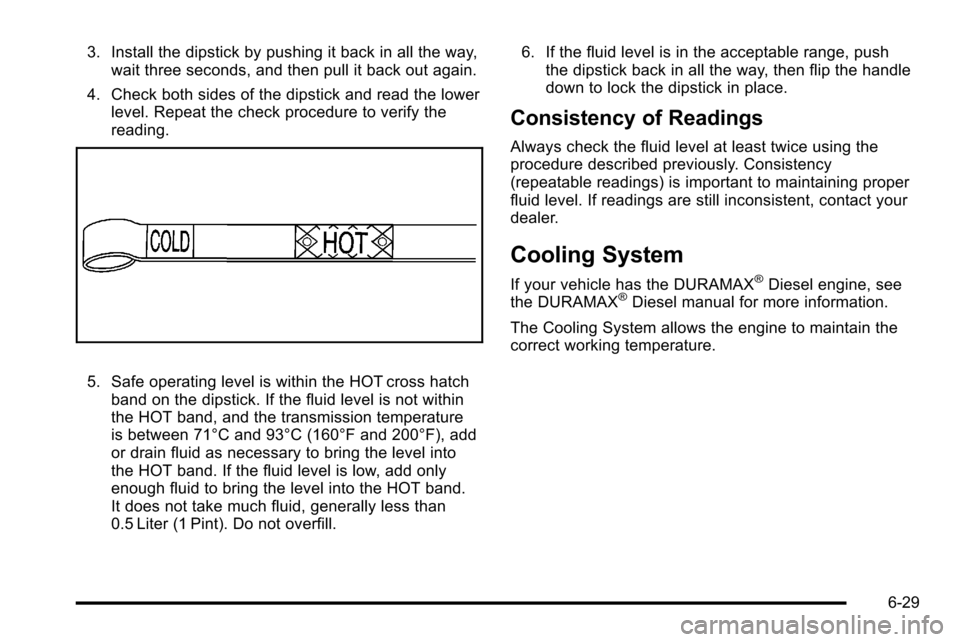
3. Install the dipstick by pushing it back in all the way,wait three seconds, and then pull it back out again.
4. Check both sides of the dipstick and read the lower level. Repeat the check procedure to verify the
reading.
5. Safe operating level is within the HOT cross hatchband on the dipstick. If the fluid level is not within
the HOT band, and the transmission temperature
is between 71°C and 93°C (160°F and 200°F), add
or drain fluid as necessary to bring the level into
the HOT band. If the fluid level is low, add only
enough fluid to bring the level into the HOT band.
It does not take much fluid, generally less than
0.5 Liter (1 Pint). Do not overfill. 6. If the fluid level is in the acceptable range, push
the dipstick back in all the way, then flip the handle
down to lock the dipstick in place.
Consistency of Readings
Always check the fluid level at least twice using the
procedure described previously. Consistency
(repeatable readings) is important to maintaining proper
fluid level. If readings are still inconsistent, contact your
dealer.
Cooling System
If your vehicle has the DURAMAX®Diesel engine, see
the DURAMAX®Diesel manual for more information.
The Cooling System allows the engine to maintain the
correct working temperature.
6-29