lock CHEVROLET SILVERADO 2010 2.G Owner's Manual
[x] Cancel search | Manufacturer: CHEVROLET, Model Year: 2010, Model line: SILVERADO, Model: CHEVROLET SILVERADO 2010 2.GPages: 626, PDF Size: 4.8 MB
Page 55 of 626
Power Reclining Seatbacks
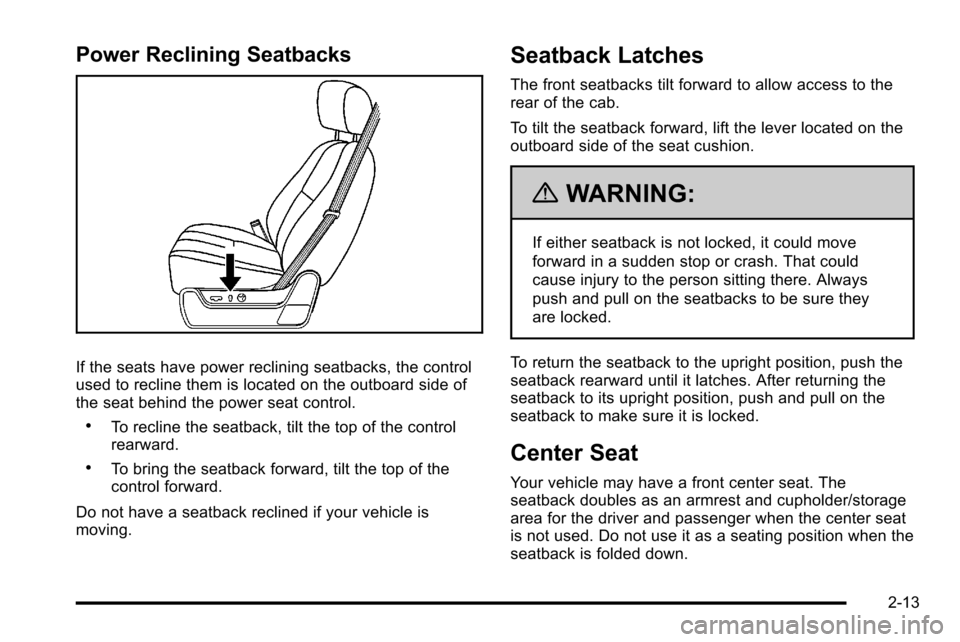
If the seats have power reclining seatbacks, the control
used to recline them is located on the outboard side of
the seat behind the power seat control.
.To recline the seatback, tilt the top of the control
rearward.
.To bring the seatback forward, tilt the top of the
control forward.
Do not have a seatback reclined if your vehicle is
moving.
Seatback Latches
The front seatbacks tilt forward to allow access to the
rear of the cab.
To tilt the seatback forward, lift the lever located on the
outboard side of the seat cushion.
{WARNING:
If either seatback is not locked, it could move
forward in a sudden stop or crash. That could
cause injury to the person sitting there. Always
push and pull on the seatbacks to be sure they
are locked.
To return the seatback to the upright position, push the
seatback rearward until it latches. After returning the
seatback to its upright position, push and pull on the
seatback to make sure it is locked.
Center Seat
Your vehicle may have a front center seat. The
seatback doubles as an armrest and cupholder/storage
area for the driver and passenger when the center seat
is not used. Do not use it as a seating position when the
seatback is folded down.
2-13
Page 56 of 626
Rear Seats
Rear Seat Operation (Extended Cab
Full Bench)
Folding the Rear Seat
To fold the seat up, do the following:
Notice:Folding a rear seat with the safety belts still
fastened may cause damage to the seat or the
safety belts. Always unbuckle the safety belts and
return them to their normal stowed position before
folding a rear seat.
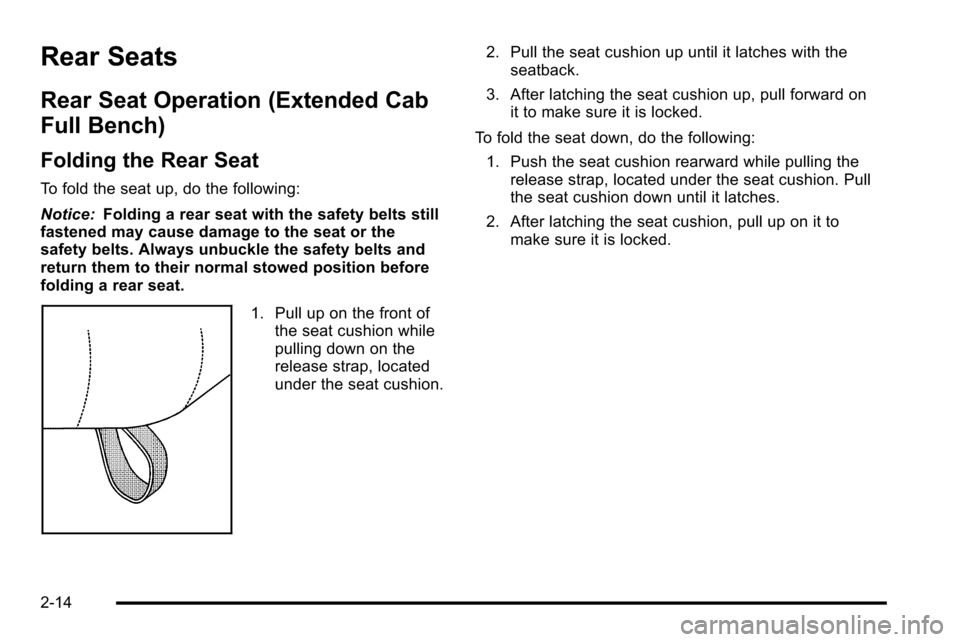
1. Pull up on the front of
the seat cushion while
pulling down on the
release strap, located
under the seat cushion. 2. Pull the seat cushion up until it latches with the
seatback.
3. After latching the seat cushion up, pull forward on it to make sure it is locked.
To fold the seat down, do the following: 1. Push the seat cushion rearward while pulling the release strap, located under the seat cushion. Pull
the seat cushion down until it latches.
2. After latching the seat cushion, pull up on it to make sure it is locked.
2-14
Page 64 of 626
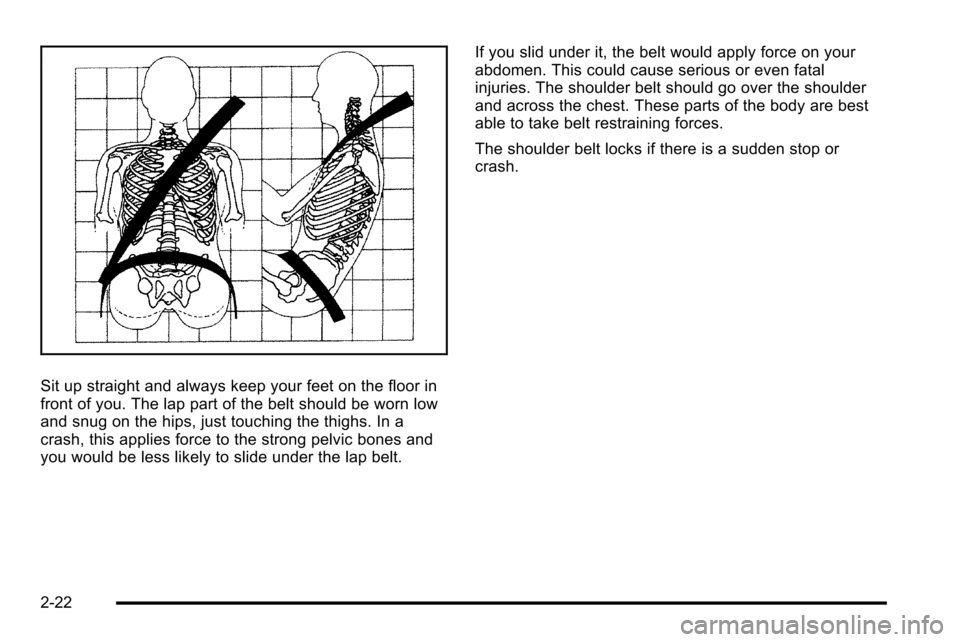
Sit up straight and always keep your feet on the floor in
front of you. The lap part of the belt should be worn low
and snug on the hips, just touching the thighs. In a
crash, this applies force to the strong pelvic bones and
you would be less likely to slide under the lap belt.If you slid under it, the belt would apply force on your
abdomen. This could cause serious or even fatal
injuries. The shoulder belt should go over the shoulder
and across the chest. These parts of the body are best
able to take belt restraining forces.
The shoulder belt locks if there is a sudden stop or
crash.
2-22
Page 72 of 626
Lap-Shoulder Belt
If the vehicle is a regular cab, then all seating positions
in the vehicle have a lap-shoulder belt. If the vehicle is
a crew or extended cab, then all seating positions in the
vehicle have a lap-shoulder belt except for the center
front passenger position (if equipped), which has a lap
belt. SeeLap Belt (Crew and Extended Cab)
on
page 2‑37for more information.
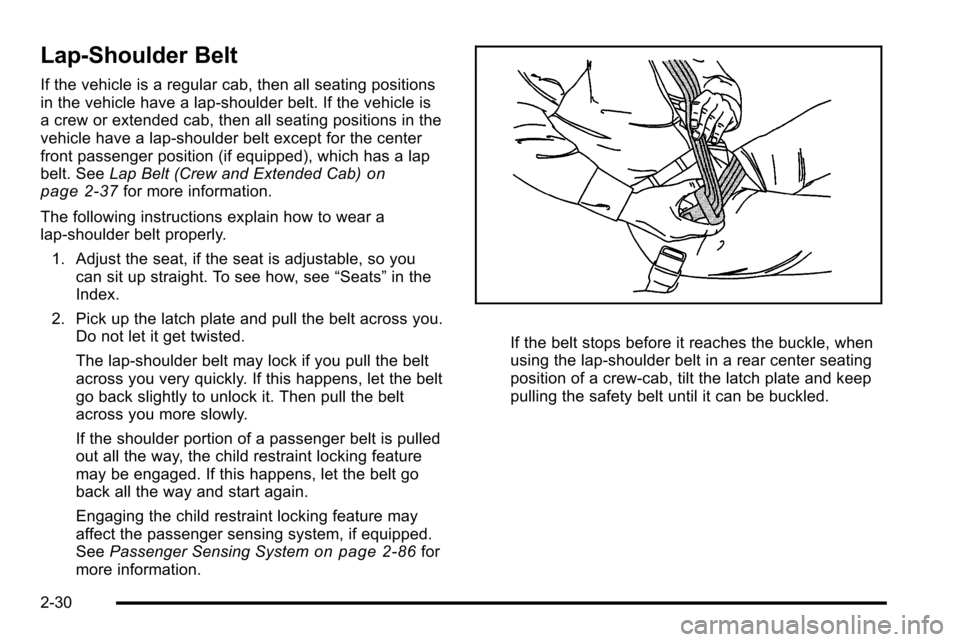
The following instructions explain how to wear a
lap-shoulder belt properly. 1. Adjust the seat, if the seat is adjustable, so you can sit up straight. To see how, see “Seats”in the
Index.
2. Pick up the latch plate and pull the belt across you. Do not let it get twisted.
The lap-shoulder belt may lock if you pull the belt
across you very quickly. If this happens, let the belt
go back slightly to unlock it. Then pull the belt
across you more slowly.
If the shoulder portion of a passenger belt is pulled
out all the way, the child restraint locking feature
may be engaged. If this happens, let the belt go
back all the way and start again.
Engaging the child restraint locking feature may
affect the passenger sensing system, if equipped.
See Passenger Sensing System
on page 2‑86for
more information.
If the belt stops before it reaches the buckle, when
using the lap-shoulder belt in a rear center seating
position of a crew-cab, tilt the latch plate and keep
pulling the safety belt until it can be buckled.
2-30
Page 75 of 626
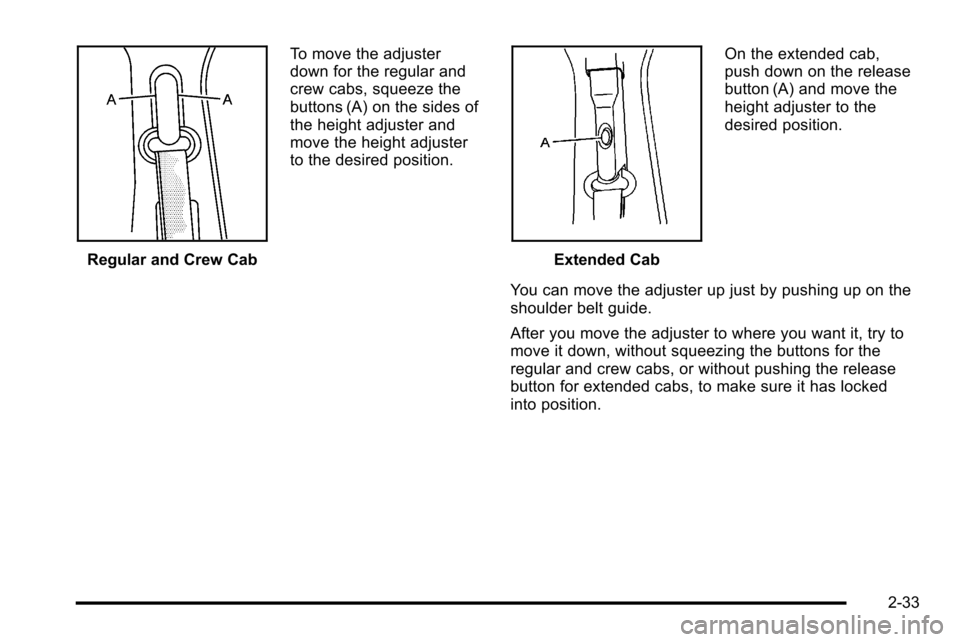
Regular and Crew CabTo move the adjuster
down for the regular and
crew cabs, squeeze the
buttons (A) on the sides of
the height adjuster and
move the height adjuster
to the desired position.Extended CabOn the extended cab,
push down on the release
button (A) and move the
height adjuster to the
desired position.
You can move the adjuster up just by pushing up on the
shoulder belt guide.
After you move the adjuster to where you want it, try to
move it down, without squeezing the buttons for the
regular and crew cabs, or without pushing the release
button for extended cabs, to make sure it has locked
into position.
2-33
Page 96 of 626
Do not secure a child restraint in a position without a
top tether anchor if a national or local law requires that
the top tether be attached, or if the instructions that
come with the child restraint say that the top tether must
be attached.
According to accident statistics, children and infants are
safer when properly restrained in a child restraint
system or infant restraint system secured in a rear
seating position. SeeWhere to Put the Restraint
on
page 2‑48for additional information.
Securing a Child Restraint Designed for the
LATCH System
{WARNING:
If a LATCH-type child restraint is not attached to
anchors, the child restraint will not be able to
protect the child correctly. In a crash, the child
could be seriously injured or killed. Install a
LATCH-type child restraint properly using the
anchors, or use the vehicle's safety belts to
secure the restraint, following the instructions that
came with the child restraint and the instructions
in this manual.
{WARNING:
Do not attach more than one child restraint to a
single anchor, except for the center top tether
anchors in the crew and extended cabs. Attaching
more than one child restraint to a single anchor
could cause the anchor or attachment to come
loose or even break during a crash. A child or
others could be injured. To reduce the risk of
serious or fatal injuries during a crash, attach only
one child restraint per anchor.
{WARNING:
Children can be seriously injured or strangled if a
shoulder belt is wrapped around their neck and
the safety belt continues to tighten. Buckle any
unused safety belts behind the child restraint so
children cannot reach them. Pull the shoulder belt
all the way out of the retractor to set the lock,
if your vehicle has one, after the child restraint
has been installed.
2-54
Page 101 of 626
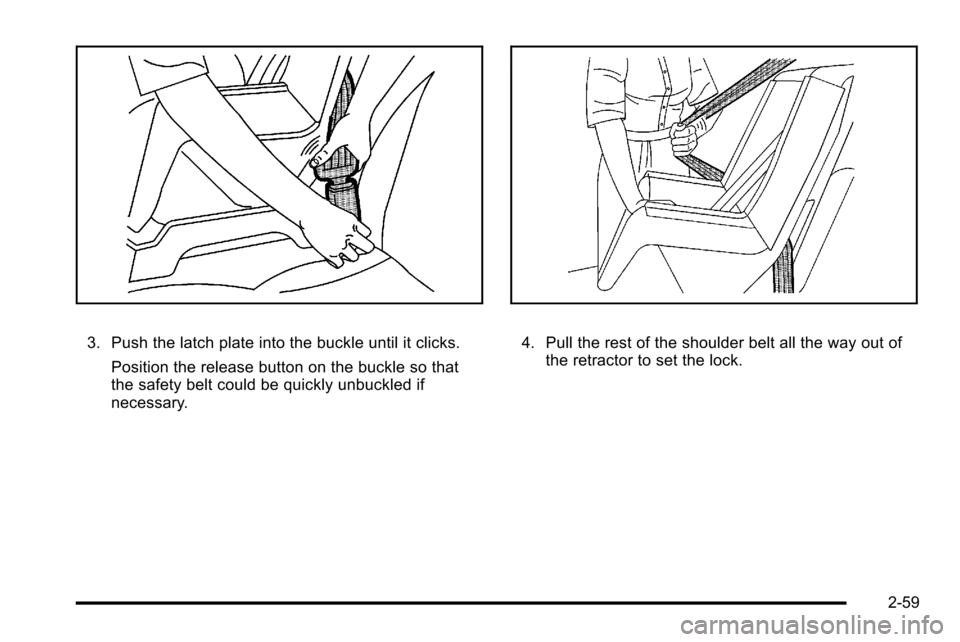
3. Push the latch plate into the buckle until it clicks.Position the release button on the buckle so that
the safety belt could be quickly unbuckled if
necessary.4. Pull the rest of the shoulder belt all the way out ofthe retractor to set the lock.
2-59
Page 106 of 626
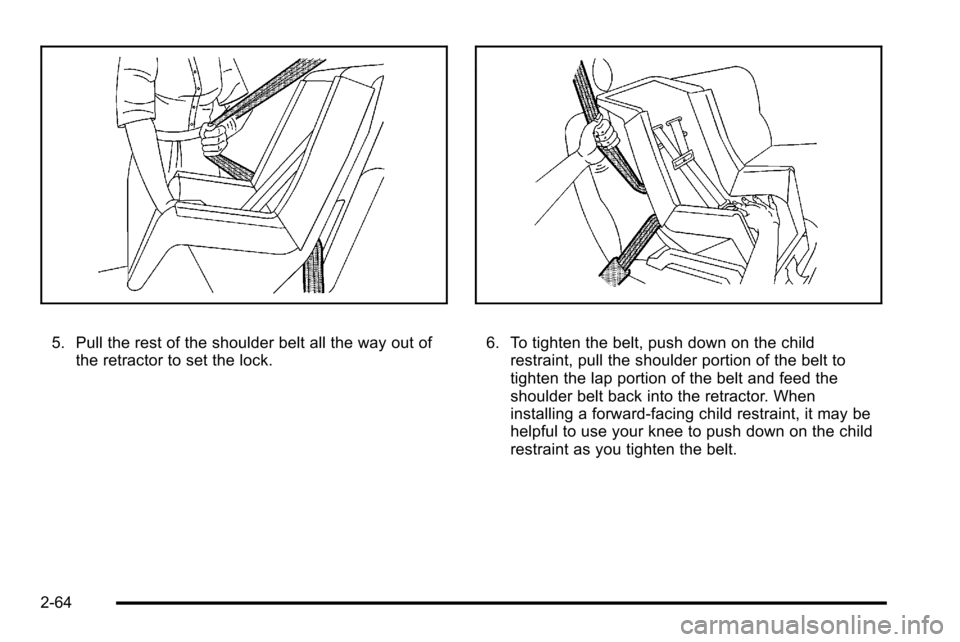
5. Pull the rest of the shoulder belt all the way out ofthe retractor to set the lock.6. To tighten the belt, push down on the childrestraint, pull the shoulder portion of the belt to
tighten the lap portion of the belt and feed the
shoulder belt back into the retractor. When
installing a forward-facing child restraint, it may be
helpful to use your knee to push down on the child
restraint as you tighten the belt.
2-64
Page 110 of 626
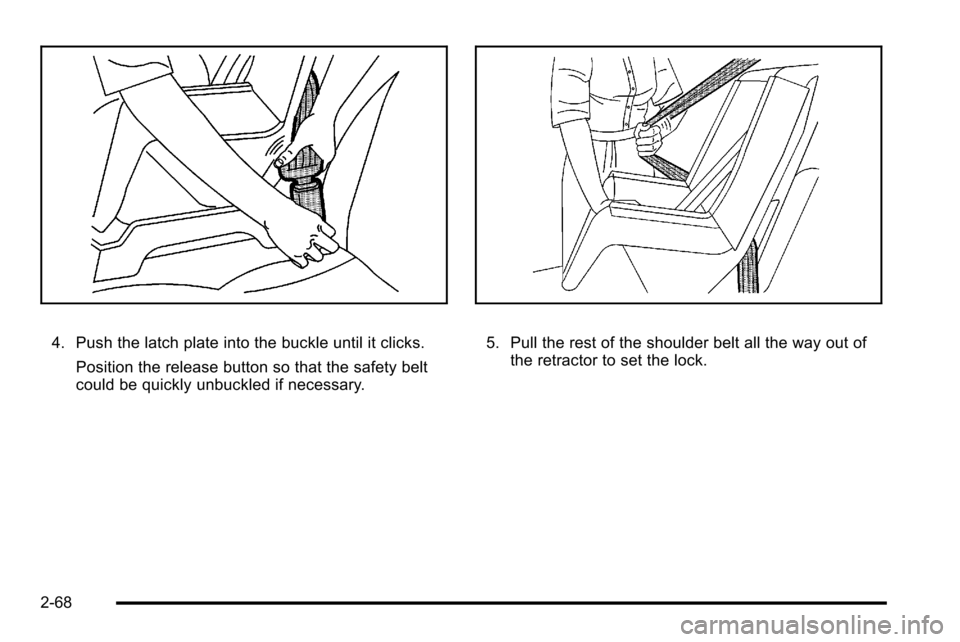
4. Push the latch plate into the buckle until it clicks.Position the release button so that the safety belt
could be quickly unbuckled if necessary.5. Pull the rest of the shoulder belt all the way out ofthe retractor to set the lock.
2-68
Page 113 of 626
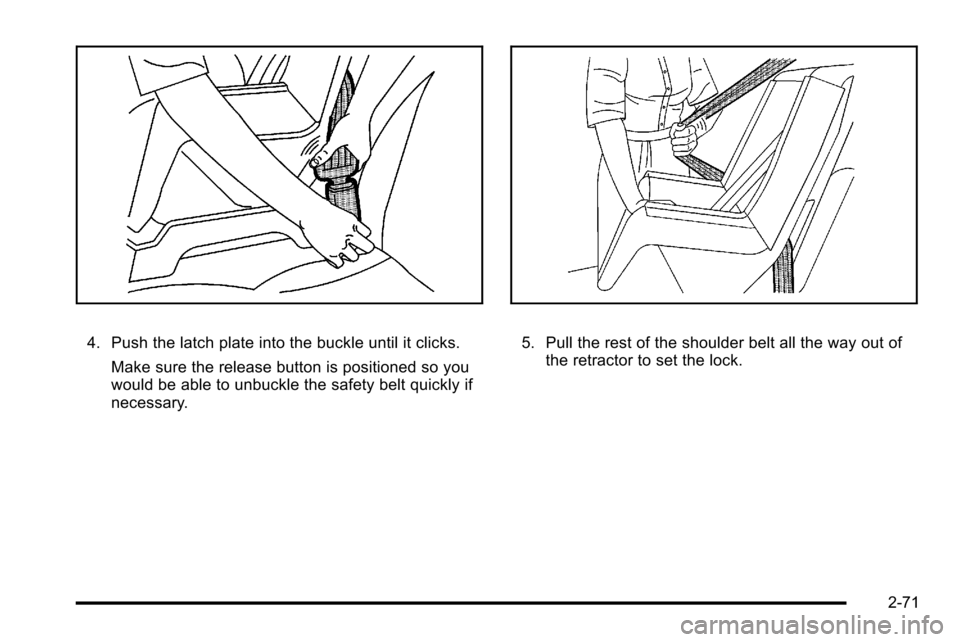
4. Push the latch plate into the buckle until it clicks.Make sure the release button is positioned so you
would be able to unbuckle the safety belt quickly if
necessary.5. Pull the rest of the shoulder belt all the way out ofthe retractor to set the lock.
2-71