heater CHEVROLET SILVERADO 2011 2.G User Guide
[x] Cancel search | Manufacturer: CHEVROLET, Model Year: 2011, Model line: SILVERADO, Model: CHEVROLET SILVERADO 2011 2.GPages: 588, PDF Size: 7.99 MB
Page 283 of 588
Black plate (1,1)Chevrolet Silverado Owner Manual - 2011
Climate Controls 8-1
Climate Controls
Climate Control Systems
Climate Control Systems (withAir Conditioning) . . . . . . . . . . . . . 8-1
Climate Control Systems (with Heater Only) . . . . . . . . . . . . . . . . . 8-4
Dual Automatic Climate Control System . . . . . . . . . . . . . . . . . . . . . . 8-5
Air Vents
Air Vents . . . . . . . . . . . . . . . . . . . . . 8-11
Climate Control Systems
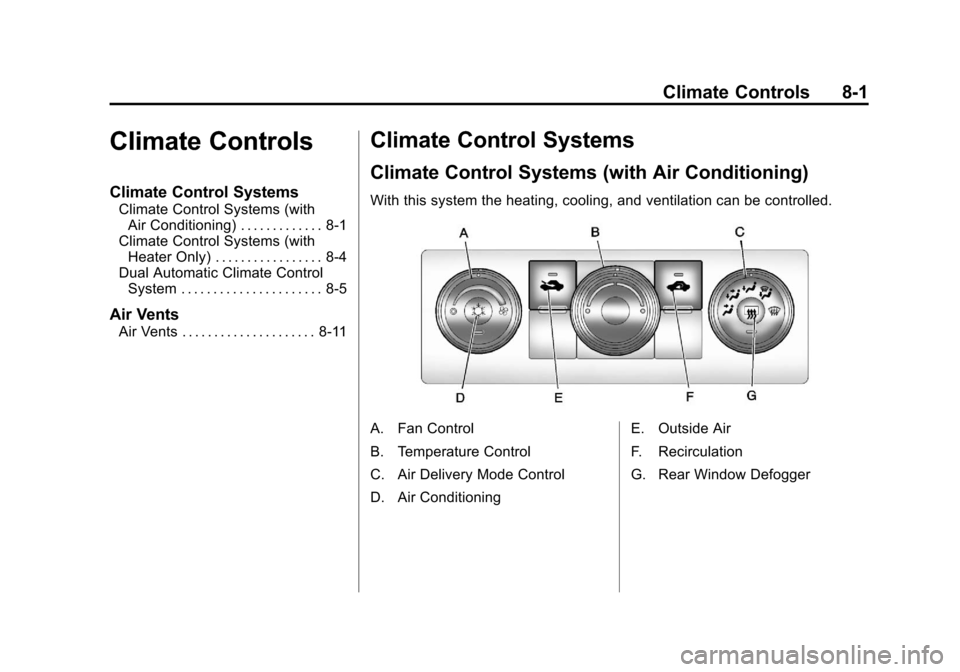
Climate Control Systems (with Air Conditioning)
With this system the heating, cooling, and ventilation can be controlled.
A. Fan Control
B. Temperature Control
C. Air Delivery Mode Control
D. Air Conditioning E. Outside Air
F. Recirculation
G. Rear Window Defogger
Page 286 of 588
Black plate (4,1)Chevrolet Silverado Owner Manual - 2011
8-4 Climate Controls
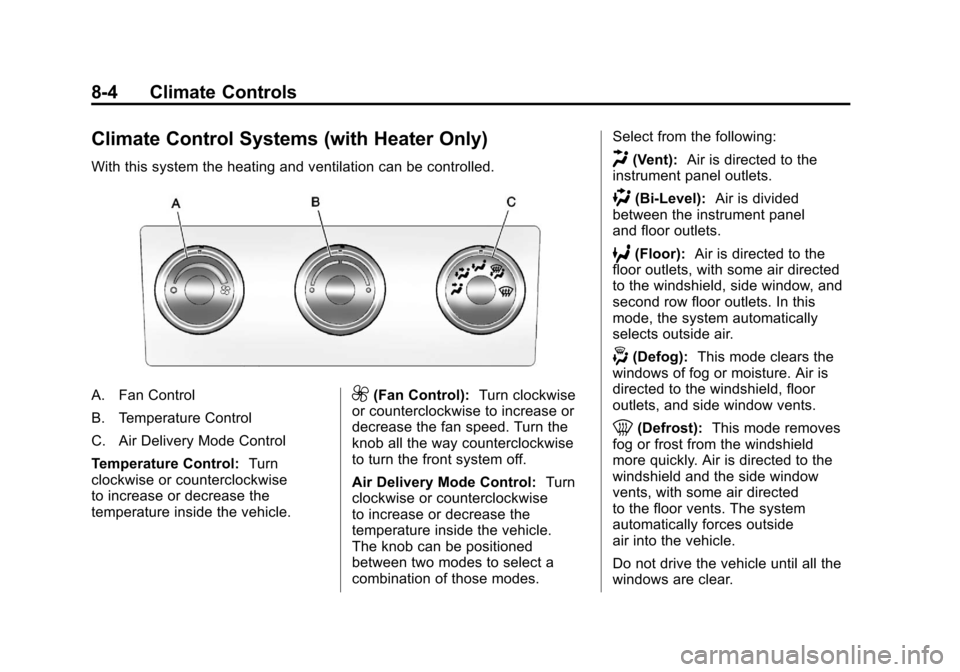
Climate Control Systems (with Heater Only)
With this system the heating and ventilation can be controlled.
A. Fan Control
B. Temperature Control
C. Air Delivery Mode Control
Temperature Control:Turn
clockwise or counterclockwise
to increase or decrease the
temperature inside the vehicle.9(Fan Control): Turn clockwise
or counterclockwise to increase or
decrease the fan speed. Turn the
knob all the way counterclockwise
to turn the front system off.
Air Delivery Mode Control: Turn
clockwise or counterclockwise
to increase or decrease the
temperature inside the vehicle.
The knob can be positioned
between two modes to select a
combination of those modes. Select from the following:
H(Vent):
Air is directed to the
instrument panel outlets.
)(Bi-Level): Air is divided
between the instrument panel
and floor outlets.
6(Floor): Air is directed to the
floor outlets, with some air directed
to the windshield, side window, and
second row floor outlets. In this
mode, the system automatically
selects outside air.
-(Defog): This mode clears the
windows of fog or moisture. Air is
directed to the windshield, floor
outlets, and side window vents.
0(Defrost): This mode removes
fog or frost from the windshield
more quickly. Air is directed to the
windshield and the side window
vents, with some air directed
to the floor vents. The system
automatically forces outside
air into the vehicle.
Do not drive the vehicle until all the
windows are clear.
Page 295 of 588
Black plate (1,1)Chevrolet Silverado Owner Manual - 2011
Driving and Operating 9-1
Driving and
Operating
Driving Information
Defensive Driving . . . . . . . . . . . . . 9-2
Drunk Driving . . . . . . . . . . . . . . . . . 9-2
Control of a Vehicle . . . . . . . . . . . 9-3
Braking . . . . . . . . . . . . . . . . . . . . . . . 9-3
Steering . . . . . . . . . . . . . . . . . . . . . . . 9-4
Off-Road Recovery . . . . . . . . . . . . 9-5
Loss of Control . . . . . . . . . . . . . . . . 9-6
Off-Road Driving . . . . . . . . . . . . . . 9-7
Driving on Wet Roads . . . . . . . 9-18
Highway Hypnosis . . . . . . . . . . . 9-19
Hill and Mountain Roads . . . . . 9-19
Winter Driving . . . . . . . . . . . . . . . 9-20
If the Vehicle is Stuck . . . . . . . . 9-22
Vehicle Load Limits . . . . . . . . . . 9-23
Truck-Camper LoadingInformation . . . . . . . . . . . . . . . . . 9-30
Starting and Operating
New Vehicle Break-In . . . . . . . . 9-32
Adjustable Throttle and BrakePedal . . . . . . . . . . . . . . . . . . . . . . . 9-32
Ignition Positions . . . . . . . . . . . . 9-33 Retained Accessory
Power (RAP) . . . . . . . . . . . . . . . 9-35
Starting the Engine . . . . . . . . . . 9-35
Fast Idle System . . . . . . . . . . . . . 9-37
Engine Coolant Heater . . . . . . . 9-37
Shifting Into Park . . . . . . . . . . . . 9-38
Shifting Out of Park . . . . . . . . . . 9-40
Parking (Manual Transmission) . . . . . . . . . . . . . . 9-41
Parking Over Things That Burn . . . . . . . . . . . . . . . . . . 9-41
Active Fuel Management™ . . . . . . . . . . . . . 9-41
Engine Exhaust
Engine Exhaust . . . . . . . . . . . . . . 9-42
Running the Vehicle While
Parked . . . . . . . . . . . . . . . . . . . . . 9-42
Automatic Transmission
Automatic Transmission . . . . . 9-43
Manual Mode . . . . . . . . . . . . . . . . 9-47
Tow/Haul Mode . . . . . . . . . . . . . . 9-49
Manual Transmission
Manual Transmission . . . . . . . . 9-51
Drive Systems
Four-Wheel Drive . . . . . . . . . . . . 9-53
Brakes
Antilock BrakeSystem (ABS) . . . . . . . . . . . . . . 9-67
Parking Brake . . . . . . . . . . . . . . . 9-68
Brake Assist (Except With 4.3L V6 Engine) . . . . . . . . . . . . 9-69
Hill Start Assist (HSA) . . . . . . . 9-70
Ride Control Systems
StabiliTrak®System . . . . . . . . . 9-70
Locking Rear Axle . . . . . . . . . . . 9-73
Cruise Control
Cruise Control . . . . . . . . . . . . . . . 9-73
Object Detection Systems
Ultrasonic Parking Assist . . . . 9-76
Rear Vision Camera (RVC) . . . . . . . . . . . . . 9-78
Fuel
Fuel . . . . . . . . . . . . . . . . . . . . . . . . . 9-83
Recommended Fuel . . . . . . . . . 9-84
Gasoline Specifications . . . . . . 9-84
California FuelRequirements . . . . . . . . . . . . . . 9-84
Fuels in Foreign Countries . . . 9-85
Fuel Additives . . . . . . . . . . . . . . . 9-85
Page 331 of 588
Black plate (37,1)Chevrolet Silverado Owner Manual - 2011
Driving and Operating 9-37
Fast Idle System
If the vehicle has this feature it is
available only with cruise control.
The manual fast idle switch is
operated using the cruise control
buttons located on the left hand
side of the steering wheel.
This system can be used to
increase engine idle speed
whenever the following conditions
are met:
.The park brake is set.
.The brake pedal is not pressed.
.The vehicle must not be moving
and the accelerator must not be
pressed.
To control the fast idle:
.To enable the Fast Idle System,
press and release the Cruise
Control On/Off button and
ensure that the switch LED is lit.
.Press and release the Cruise
Control Set switch. Engine
speed will be held at
approximately 1200 RPM. When the fast idle is active the
Driver Information Center (DIC) will
display
“FAST IDLE ON.”
One of the following actions will turn
off the fast idle:
.Pressing the brake.
.Selecting the Cruise Control
Cancel button.
.Releasing the Parking Brake.
.The transmission shifter is
moved out of P (Park) or
N (Neutral).
.Selecting the Cruise Control
On/Off button when it was
previously on.
.Pressing the Cruise Control Set
switch a second time.
.Pressing the accelerator greater
than a quarter of the down.
.Turning the ignition switch to the
LOCK/OFF position.
Engine Coolant Heater
The engine heater can provide
easier starting and better fuel
economy during engine warm-up
in cold weather conditions at or
below −18°C (0°F). Vehicles with an
engine heater should be plugged in
at least four hours before starting.
An internal thermostat in the
plug-end of the cord may exist
which will prevent engine coolant
heater operation at temperatures
above −18°C (0°F).
If the vehicle has a diesel engine,
see the Duramax Diesel supplement
for more information.
Page 332 of 588
Black plate (38,1)Chevrolet Silverado Owner Manual - 2011
9-38 Driving and Operating
To Use the Engine Coolant
Heater
1. Turn off the engine.
2. Open the hood and unwrapthe electrical cord. The cord
is secured to the Engine
Compartment Fuse Block
with a clip. Carefully remove
the wire tie which bundles the
electrical plug. Do not cut the
electrical cord.
3. Plug the cord into a normal, grounded 110-volt AC outlet.
{WARNING
Plugging the cord into an
ungrounded outlet could cause
an electrical shock. Also, the
wrong kind of extension cord
could overheat and cause a fire.
(Continued)
WARNING (Continued)
You could be seriously injured.
Plug the cord into a properly
grounded three-prong 110-volt AC
outlet. If the cord will not reach,
use a heavy-duty three-prong
extension cord rated for at least
15 amps.
4. Before starting the engine, be sure to unplug and store the
cord as it was before to keep it
away from moving engine parts.
If you do not, it could be
damaged.
The length of time the heater should
remain plugged in depends on
several factors. Ask a dealer in the
area where you will be parking the
vehicle for the best advice on this.
Shifting Into Park
{WARNING
It can be dangerous to get out of
the vehicle if the shift lever is not
fully in P (Park) with the parking
brake firmly set. The vehicle can
roll. If you have left the engine
running, the vehicle can move
suddenly. You or others could be
injured. To be sure the vehicle will
not move, even when you are on
fairly level ground, use the steps
that follow. With four-wheel
drive, if the transfer case is in
N (Neutral), the vehicle will be
free to roll, even if the shift lever
is in P (Park). So, be sure the
transfer case is in a drive
gear —not in N (Neutral). If you
are pulling a trailer, see Driving
Characteristics and Towing Tips
on page 9‑90.
Page 381 of 588
Black plate (87,1)Chevrolet Silverado Owner Manual - 2011
Driving and Operating 9-87
Those stations that do have E85
should have a label indicating
ethanol content. Do not use the fuel
if the ethanol content is greater
than 85%.
At a minimum, E85 should meet
ASTM Specification D 5798.
By definition, this means that fuel
labeled E85 will have an ethanol
content between 70% and 85%.
Filling the fuel tank with fuel
mixtures that do not meet ASTM
specifications can affect driveability
and could cause the malfunction
indicator lamp to come on.
To ensure quick starts in the
wintertime, the E85 fuel must be
formulated properly for your climate
according to ASTM specification
D 5798. If you have trouble starting
on E85, it could be because theE85 fuel is not properly formulated
for your climate. If this happens,
switching to gasoline or adding
gasoline to the fuel tank can
improve starting. For good starting
and heater efficiency below 0°C
(32°F), the fuel mix in the fuel tank
should contain no more than
70% ethanol. It is best not to
alternate repeatedly between
gasoline and E85. If you do
switch fuels, it is recommended
that you add as much fuel as
possible
—do not add less than
11 L (three gallons) when refueling.
You should drive the vehicle
immediately after refueling for at
least 11 km (seven miles) to allow
the vehicle to adapt to the change
in ethanol concentration. E85 has less energy per gallon
than gasoline, so you will need to
refill the fuel tank more often when
using E85 than when you are using
gasoline. See
Filling the Tank
on
page 9‑88.
Notice: Some additives are not
compatible with E85 fuel and can
harm the vehicle's fuel system.
Do not add anything to E85.
Damage caused by additives
would not be covered by the
vehicle warranty.
Notice: This vehicle was not
designed for fuel that contains
methanol. Do not use fuel
containing methanol. It can
corrode metal parts in the fuel
system and also damage plastic
and rubber parts. That damage
would not be covered under the
vehicle warranty.
Page 442 of 588
Black plate (20,1)Chevrolet Silverado Owner Manual - 2011
10-20 Vehicle Care
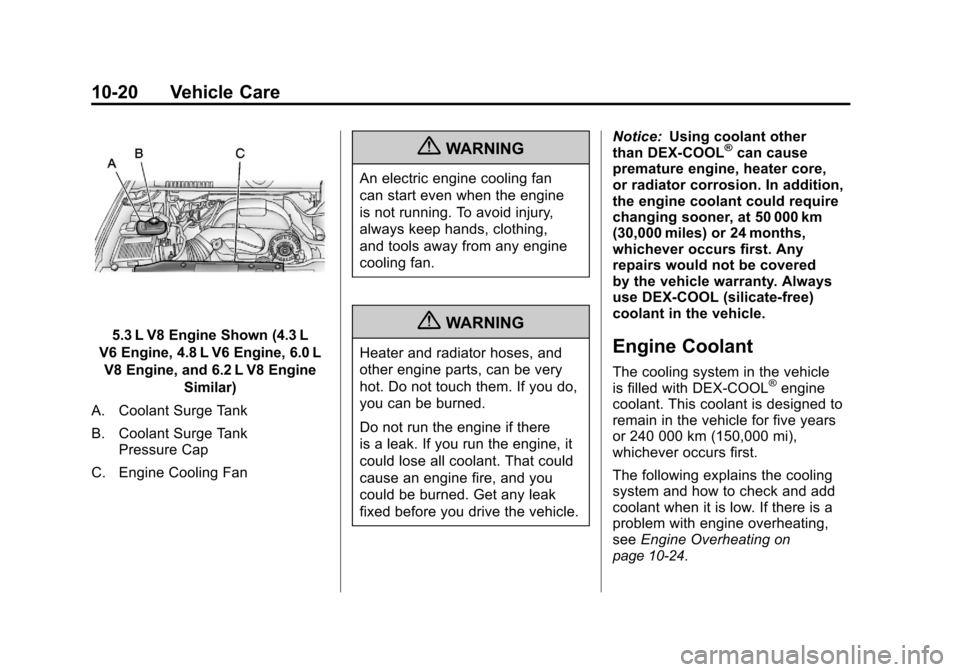
5.3 L V8 Engine Shown (4.3 L
V6 Engine, 4.8 L V6 Engine, 6.0 L V8 Engine, and 6.2 L V8 Engine
Similar)
A. Coolant Surge Tank
B. Coolant Surge Tank Pressure Cap
C. Engine Cooling Fan
{WARNING
An electric engine cooling fan
can start even when the engine
is not running. To avoid injury,
always keep hands, clothing,
and tools away from any engine
cooling fan.
{WARNING
Heater and radiator hoses, and
other engine parts, can be very
hot. Do not touch them. If you do,
you can be burned.
Do not run the engine if there
is a leak. If you run the engine, it
could lose all coolant. That could
cause an engine fire, and you
could be burned. Get any leak
fixed before you drive the vehicle. Notice:
Using coolant other
than DEX-COOL
®can cause
premature engine, heater core,
or radiator corrosion. In addition,
the engine coolant could require
changing sooner, at 50 000 km
(30,000 miles) or 24 months,
whichever occurs first. Any
repairs would not be covered
by the vehicle warranty. Always
use DEX-COOL (silicate-free)
coolant in the vehicle.
Engine Coolant
The cooling system in the vehicle
is filled with DEX-COOL®engine
coolant. This coolant is designed to
remain in the vehicle for five years
or 240 000 km (150,000 mi),
whichever occurs first.
The following explains the cooling
system and how to check and add
coolant when it is low. If there is a
problem with engine overheating,
see Engine Overheating
on
page 10‑24.
Page 443 of 588
Black plate (21,1)Chevrolet Silverado Owner Manual - 2011
Vehicle Care 10-21
What to Use
{WARNING
Adding only plain water or some
other liquid to the cooling system
can be dangerous. Plain water
and other liquids, can boil before
the proper coolant mixture will.
The vehicle's coolant warning
system is set for the proper
coolant mixture. With plain water
or the wrong mixture, the engine
could get too hot but you would
not get the overheat warning.
The engine could catch fire and
you or others could be burned.
Use a 50/50 mixture of clean,
drinkable water and DEX-COOL
coolant.Use a 50/50 mixture of clean,
drinkable water and DEX-COOL
coolant. If using this mixture,
nothing else needs to be added.
This mixture:.Gives freezing protection down
to
−37°C (−34°F), outside
temperature
.Gives boiling protection up
to 129°C (265°F), engine
temperature
.Protects against rust and
corrosion
.Will not damage aluminum parts
.Helps keep the proper engine
temperature Notice:
If an improper coolant
mixture is used, the engine could
overheat and be badly damaged.
The repair cost would not be
covered by the vehicle warranty.
Too much water in the mixture
can freeze and crack the engine,
radiator, heater core, and other
parts.
Notice: If extra inhibitors
and/or additives are used in
the vehicle's cooling system,
the vehicle could be damaged.
Use only the proper mixture of
the engine coolant listed in this
manual for the cooling system.
See Recommended Fluids and
Lubricants
on page 11‑8for more
information.
Page 447 of 588
Black plate (25,1)Chevrolet Silverado Owner Manual - 2011
Vehicle Care 10-25
If Steam is Coming from the
Engine Compartment
{WARNING
Steam from an overheated engine
can burn you badly, even if you
just open the hood. Stay away
from the engine if you see or
hear steam coming from it. Turn it
off and get everyone away from
the vehicle until it cools down.
Wait until there is no sign of
steam or coolant before you
open the hood.
If you keep driving when the
vehicles engine is overheated,
the liquids in it can catch fire.
You or others could be badly
burned. Stop the engine if it
overheats, and get out of the
vehicle until the engine is cool.(Continued)
WARNING (Continued)
SeeOverheated Engine
Protection Operating Mode
on
page 10‑26
for information on
driving to a safe place in an
emergency.
If No Steam is Coming from
the Engine Compartment
The ENGINE OVERHEATED
STOP ENGINE or the ENGINE
OVERHEATED IDLE ENGINE
message, along with a low coolant
condition, can indicate a serious
problem.
If there is an engine overheat
warning, but no steam is seen or
heard, the problem may not be too
serious. Sometimes the engine can
get a little too hot when the vehicle:
.Climbs a long hill on a hot day
.Stops after high-speed driving
.Idles for long periods in traffic
.Tows a trailer; see Trailer Towingon page 9‑94.
If the ENGINE OVERHEATED
STOP ENGINE or the ENGINE
OVERHEATED IDLE ENGINE
message appears with no sign of
steam, try this for a minute or so:
1. Turn the air conditioning off.
2. Turn the heater on to the highest temperature and to the highest
fan speed. Open the windows as
necessary.
3. If stopped in a traffic jam, apply the brake, shift to N (Neutral);
otherwise, shift to the highest
gear while driving —D (Drive) or
3 (Third).
Page 579 of 588

Black plate (5,1)Chevrolet Silverado Owner Manual - 2011
INDEX i-5
EngineAir Cleaner/Filter . . . . . . . . . . . 10-18
Check and Service Engine
Soon Light . . . . . . . . . . . . . . . . . . 5-27
Compartment Overview . . . . . . . 10-6
Coolant . . . . . . . . . . . . . . . . . . . . . 10-20
Coolant Heater . . . . . . . . . . . . . . . 9-37
Coolant Temperature Gauge . . . . . . . . . . . . . . . . . . . . . . 5-19
Cooling System . . . . . . . . . . . . . 10-19
Cooling System Messages . . . . . . . . . . . . . . . . . . . 5-46
Drive Belt Routing . . . . . . . . . . . . 12-6
Exhaust . . . . . . . . . . . . . . . . . . . . . . 9-42
Fan . . . . . . . . . . . . . . . . . . . . . . . . . 10-26
Oil Pressure Gauge . . . . . . . . . . 5-18
Overheated Protection Operating Mode . . . . . . . . . . . 10-26
Overheating . . . . . . . . . . . . . . . . 10-24
Power Messages . . . . . . . . . . . . . 5-47
Pressure Light . . . . . . . . . . . . . . . . 5-32
Running While Parked . . . . . . . . 9-42
Starting . . . . . . . . . . . . . . . . . . . . . . . 9-35 Engine Oil
Life System . . . . . . . . . . . . . . . . . . . 10-9
Messages . . . . . . . . . . . . . . . . . . . . 5-47
Entry Lighting . . . . . . . . . . . . . . . . . . . 6-9
Equipment, Towing . . . . . . . . . . . 9-111
Event Data Recorders . . . . . . . . 13-17
Exit Lighting . . . . . . . . . . . . . . . . . . . . 6-9
Extender, Safety Belt . . . . . . . . . . 3-29
Exterior Lamp Controls . . . . . . . . . 6-1
Exterior Lamps Off Reminder . . . . . . . . . . . . . . . . . . . . . 6-3
F
Fan
Engine . . . . . . . . . . . . . . . . . . . . . . 10-26
Fast Idle System . . . . . . . . . . . . . . . 9-37
Features Memory . . . . . . . . . . . . . . . . . . . . . . . 1-13
Filter Engine Air Cleaner . . . . . . . . . 10-18
Flash-to-Pass . . . . . . . . . . . . . . . . . . . 6-3
Flashers, Hazard Warning . . . . . . 6-5 Flat Tire . . . . . . . . . . . . . . . . . . . . . . 10-81
Flat Tire, Changing . . . . . . . . . . . 10-83
Floor Mats . . . . . . . . . . . . . . . . . . . 10-114
Fluid
AutomaticTransmission . . . . . . . 10-11, 10-14
Brakes . . . . . . . . . . . . . . . . . . . . . . 10-30
Four-Wheel Drive
Transfer Case . . . . . . . . . . . . . . . 9-53
Power Steering . . . . . . . . . . . . . 10-27
Washer . . . . . . . . . . . . . . . . . . . . . 10-28
Fog Lamps Bulb Replacement . . . . . . . . . . . . . 6-6
Folding Mirrors . . . . . . . . . . . . . . . . 2-17
Four-Wheel Drive . . . . . . . 10-32, 9-53
Four-Wheel-Drive Light . . . . . . . . 5-31
Front Axle . . . . . . . . . . . . . . . . . . . . 10-34
Front Fog Lamps Light . . . . . . . . . . . . . . . . . . . . . . . . . . 5-33
Front Seats Adjustment . . . . . . . . . . . . . . . . . . . . 3-3
Heated . . . . . . . . . . . . . . . . . . . . . . . 3-11