ABS CHEVROLET SILVERADO 2011 2.G Owner's Manual
[x] Cancel search | Manufacturer: CHEVROLET, Model Year: 2011, Model line: SILVERADO, Model: CHEVROLET SILVERADO 2011 2.GPages: 588, PDF Size: 7.99 MB
Page 362 of 588
Black plate (68,1)Chevrolet Silverado Owner Manual - 2011
9-68 Driving and Operating
Braking in Emergencies
If the vehicle has ABS, it allows
the driver to steer and brake at
the same time. However, if the
vehicle does not have ABS, the
first reaction, to hit the brake pedal
hard and hold it down, might be
the wrong thing to do. The wheels
can stop rolling. Once they do,
the vehicle cannot respond to the
driver's steering. Momentum will
carry it in whatever direction it was
headed when the wheels stopped
rolling. That could be off the road,
into the very thing the driver was
trying to avoid, or into traffic.
If the vehicle does not have ABS,
use a squeeze braking technique.
This gives maximum braking while
maintaining steering control. Do this
by pushing on the brake pedal with
steadily increasing pressure.
In an emergency, you will probably
want to squeeze the brakes hard
without locking the wheels. If you
hear or feel the wheels sliding, easeoff the brake pedal. This helps
retain steering control. With ABS,
it is different.
In many emergencies, steering can
help more than even the very best
braking.
Parking Brake
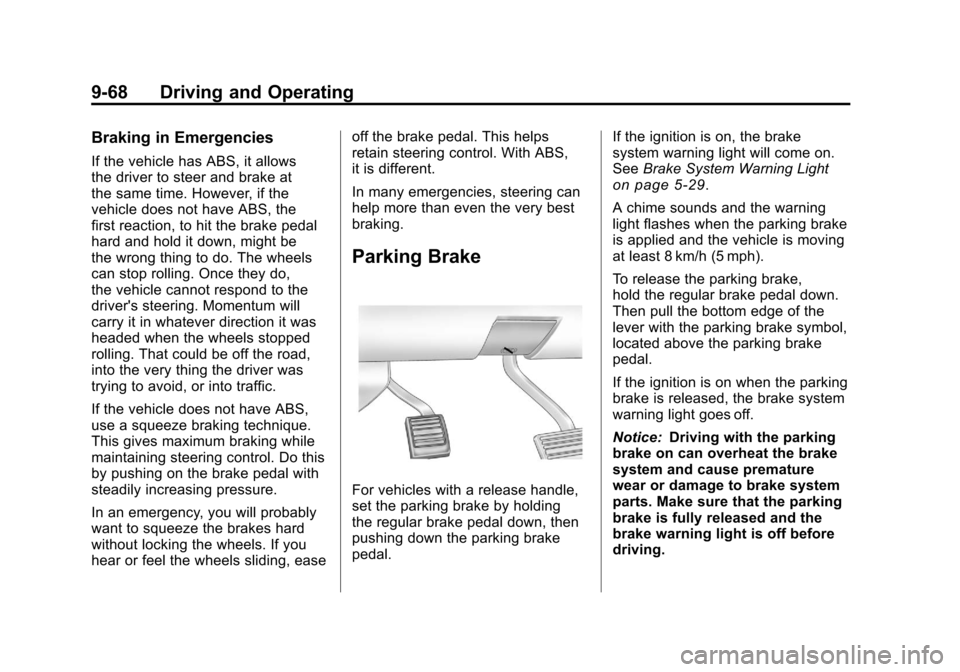
For vehicles with a release handle,
set the parking brake by holding
the regular brake pedal down, then
pushing down the parking brake
pedal.
If the ignition is on, the brake
system warning light will come on.
See
Brake System Warning Light
on page 5‑29.
A chime sounds and the warning
light flashes when the parking brake
is applied and the vehicle is moving
at least 8 km/h (5 mph).
To release the parking brake,
hold the regular brake pedal down.
Then pull the bottom edge of the
lever with the parking brake symbol,
located above the parking brake
pedal.
If the ignition is on when the parking
brake is released, the brake system
warning light goes off.
Notice: Driving with the parking
brake on can overheat the brake
system and cause premature
wear or damage to brake system
parts. Make sure that the parking
brake is fully released and the
brake warning light is off before
driving.
Page 363 of 588
Black plate (69,1)Chevrolet Silverado Owner Manual - 2011
Driving and Operating 9-69
If you are towing a trailer and are
parking on any hill, seeDriving
Characteristics and Towing Tips
on
page 9‑90.
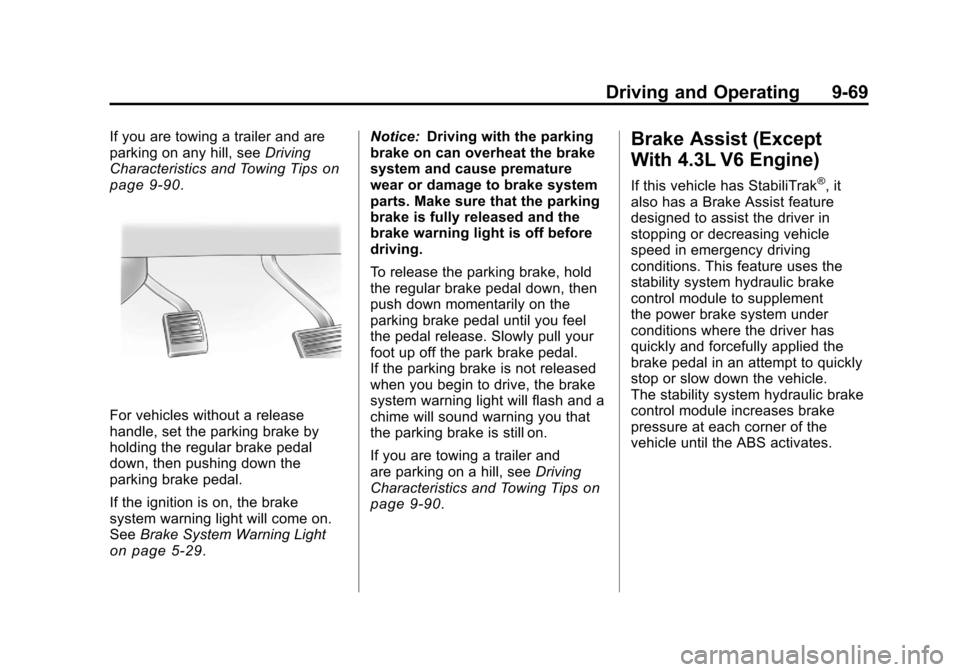
For vehicles without a release
handle, set the parking brake by
holding the regular brake pedal
down, then pushing down the
parking brake pedal.
If the ignition is on, the brake
system warning light will come on.
See Brake System Warning Light
on page 5‑29. Notice:
Driving with the parking
brake on can overheat the brake
system and cause premature
wear or damage to brake system
parts. Make sure that the parking
brake is fully released and the
brake warning light is off before
driving.
To release the parking brake, hold
the regular brake pedal down, then
push down momentarily on the
parking brake pedal until you feel
the pedal release. Slowly pull your
foot up off the park brake pedal.
If the parking brake is not released
when you begin to drive, the brake
system warning light will flash and a
chime will sound warning you that
the parking brake is still on.
If you are towing a trailer and
are parking on a hill, see Driving
Characteristics and Towing Tips
on
page 9‑90.
Brake Assist (Except
With 4.3L V6 Engine)
If this vehicle has StabiliTrak®, it
also has a Brake Assist feature
designed to assist the driver in
stopping or decreasing vehicle
speed in emergency driving
conditions. This feature uses the
stability system hydraulic brake
control module to supplement
the power brake system under
conditions where the driver has
quickly and forcefully applied the
brake pedal in an attempt to quickly
stop or slow down the vehicle.
The stability system hydraulic brake
control module increases brake
pressure at each corner of the
vehicle until the ABS activates.
Page 366 of 588
Black plate (72,1)Chevrolet Silverado Owner Manual - 2011
9-72 Driving and Operating
It is recommended to leave the
system on for normal driving
conditions, but it may be necessary
to turn the system off if the vehicle
is stuck in sand, mud, ice or snow,
and you want to“rock”the vehicle
to attempt to free it. It may also be
necessary to turn off the system
when driving in extreme off-road
conditions where high wheel spin is
required. See If the Vehicle is Stuck
on page 9‑22.
When the transfer case is in 4LO,
the stability system is automatically
disabled, the StabiliTrak light comes
on, and the STABILITRAK OFF
message will appear on the DIC.
Both traction control and StabiliTrak
are automatically disabled in this
condition.
Traction Control Operation
The traction control system is part
of the StabiliTrak system. Traction
control limits wheel spin by reducing
engine power to the wheels (engine
speed management) and by
applying brakes to each individual
wheel (brake-traction control) as
necessary.
The traction control system is
enabled automatically when the
vehicle is started. It will activate
and the StabiliTrak light will flash
if it senses that any of the wheels
are spinning or beginning to lose
traction while driving. If traction
control is turned off, only the
brake-traction control portion
of traction control will work.
The engine speed management will
be disabled. In this mode, engine
power is not reduced automatically
and the driven wheels can spin
more freely. This can cause the
brake-traction control to activate
constantly. Notice:
If the wheel(s) of one axle
is allowed to spin excessively
while the StabiliTrak®, ABS, brake
warning lights, and any relevant
DIC messages are displayed, the
transfer case could be damaged.
The repairs would not be covered
by the vehicle warranty. Reduce
engine power and do not spin the
wheel(s) excessively while these
lights and messages are
displayed.
The traction control system may
activate on dry or rough roads or
under conditions such as heavy
acceleration while turning or
abrupt upshifts/downshifts of the
transmission. When this happens,
a reduction in acceleration may be
noticed, or a noise or vibration may
be heard. This is normal.
If cruise control is being used when
the system activates, the StabiliTrak
light will flash and cruise control will
automatically disengage. Cruise
control may be reengaged when
road conditions allow. See Cruise
Control on page 9‑73.
Page 387 of 588
Black plate (93,1)Chevrolet Silverado Owner Manual - 2011
Driving and Operating 9-93
To avoid this, let the engine
run while parked, preferably on
level ground, with the automatic
transmission in P (Park) for a few
minutes before turning the engine
off. If the overheat warning comes
on, seeEngine Overheating
on
page 10‑24.
Parking on Hills
{WARNING
Parking the vehicle on a hill
with the trailer attached can be
dangerous. If something goes
wrong, the rig could start to move.
People can be injured, and both
the vehicle and the trailer can be
damaged. When possible, always
park the rig on a flat surface. If parking the rig on a hill:
1. Press the brake pedal, but do
not shift into P (Park) yet. Turn
the wheels into the curb if facing
downhill or into traffic if facing
uphill.
2. Have someone place chocks under the trailer wheels.
3. When the wheel chocks are in place, release the regular brakes
until the chocks absorb the load.
4. Reapply the brake pedal. Then apply the parking brake and shift
into P (Park).
5. If the vehicle is four-wheel-drive, be sure the transfer case is in a
drive gear and not in N (Neutral).
6. Release the brake pedal.
{WARNING
It can be dangerous to get out of
the vehicle if the shift lever is not
fully in P (Park) with the parking
brake firmly set. The vehicle
can roll.
If the engine has been left
running, the vehicle can move
suddenly. You or others could be
injured. To be sure the vehicle will
not move, even when on fairly
level ground, use the steps that
follow.
Always put the shift lever fully in
P (Park) with the parking brake
firmly set.
If the transfer case on a
four-wheel-drive vehicle is in
N (Neutral), the vehicle will be
free to roll, even if the shift lever
is in P (Park). Be sure the transfer
case is in a drive gear —not in
N (Neutral).
Page 510 of 588
Black plate (88,1)Chevrolet Silverado Owner Manual - 2011
10-88 Vehicle Care
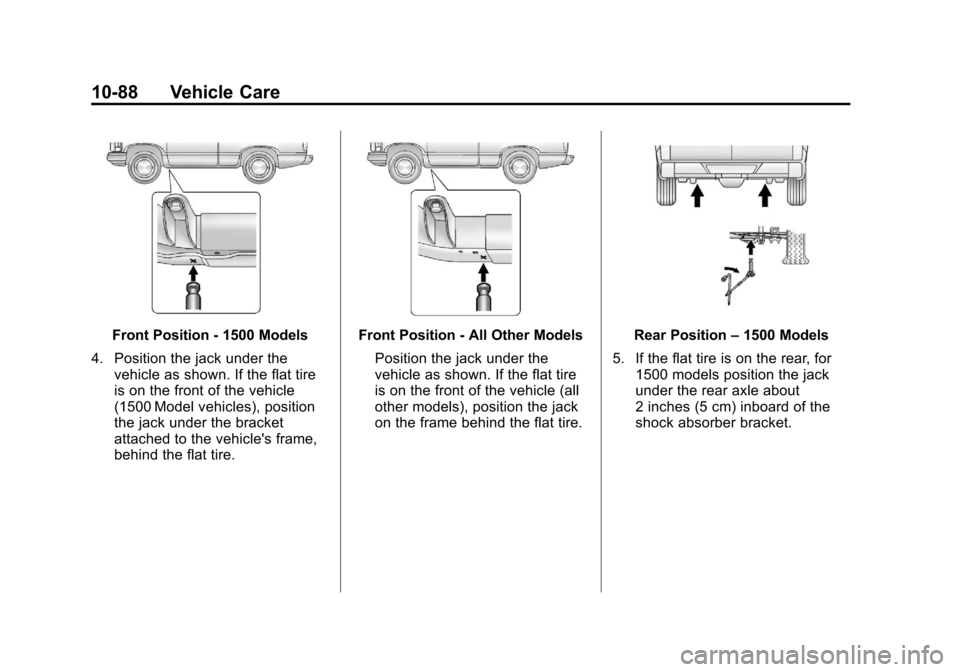
Front Position - 1500 Models
4. Position the jack under the vehicle as shown. If the flat tire
is on the front of the vehicle
(1500 Model vehicles), position
the jack under the bracket
attached to the vehicle's frame,
behind the flat tire.Front Position - All Other Models
Position the jack under the
vehicle as shown. If the flat tire
is on the front of the vehicle (all
other models), position the jack
on the frame behind the flat tire.Rear Position –1500 Models
5. If the flat tire is on the rear, for 1500 models position the jack
under the rear axle about
2 inches (5 cm) inboard of the
shock absorber bracket.
Page 511 of 588
Black plate (89,1)Chevrolet Silverado Owner Manual - 2011
Vehicle Care 10-89
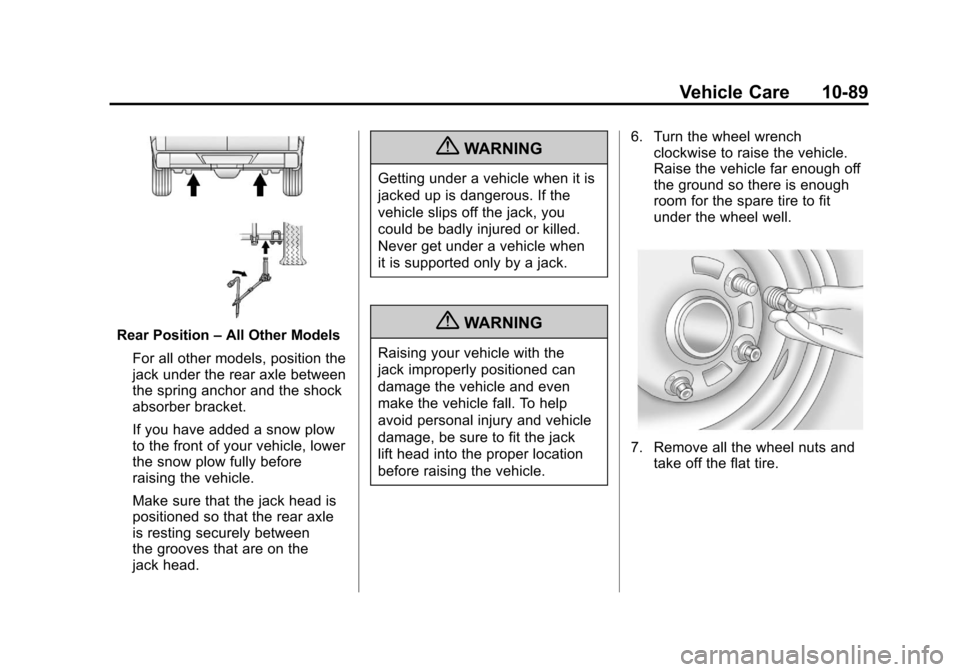
Rear Position–All Other Models
For all other models, position the
jack under the rear axle between
the spring anchor and the shock
absorber bracket.
If you have added a snow plow
to the front of your vehicle, lower
the snow plow fully before
raising the vehicle.
Make sure that the jack head is
positioned so that the rear axle
is resting securely between
the grooves that are on the
jack head.
{WARNING
Getting under a vehicle when it is
jacked up is dangerous. If the
vehicle slips off the jack, you
could be badly injured or killed.
Never get under a vehicle when
it is supported only by a jack.
{WARNING
Raising your vehicle with the
jack improperly positioned can
damage the vehicle and even
make the vehicle fall. To help
avoid personal injury and vehicle
damage, be sure to fit the jack
lift head into the proper location
before raising the vehicle. 6. Turn the wheel wrench
clockwise to raise the vehicle.
Raise the vehicle far enough off
the ground so there is enough
room for the spare tire to fit
under the wheel well.
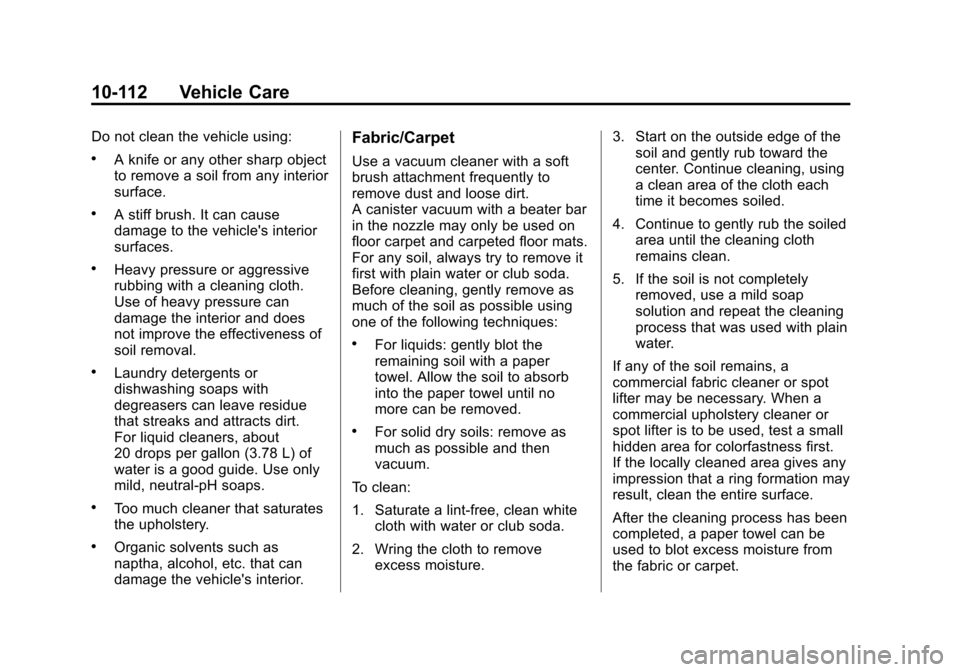
7. Remove all the wheel nuts andtake off the flat tire.
Page 534 of 588
Black plate (112,1)Chevrolet Silverado Owner Manual - 2011
10-112 Vehicle Care
Do not clean the vehicle using:
.A knife or any other sharp object
to remove a soil from any interior
surface.
.A stiff brush. It can cause
damage to the vehicle's interior
surfaces.
.Heavy pressure or aggressive
rubbing with a cleaning cloth.
Use of heavy pressure can
damage the interior and does
not improve the effectiveness of
soil removal.
.Laundry detergents or
dishwashing soaps with
degreasers can leave residue
that streaks and attracts dirt.
For liquid cleaners, about
20 drops per gallon (3.78 L) of
water is a good guide. Use only
mild, neutral-pH soaps.
.Too much cleaner that saturates
the upholstery.
.Organic solvents such as
naptha, alcohol, etc. that can
damage the vehicle's interior.
Fabric/Carpet
Use a vacuum cleaner with a soft
brush attachment frequently to
remove dust and loose dirt.
A canister vacuum with a beater bar
in the nozzle may only be used on
floor carpet and carpeted floor mats.
For any soil, always try to remove it
first with plain water or club soda.
Before cleaning, gently remove as
much of the soil as possible using
one of the following techniques:
.For liquids: gently blot the
remaining soil with a paper
towel. Allow the soil to absorb
into the paper towel until no
more can be removed.
.For solid dry soils: remove as
much as possible and then
vacuum.
To clean:
1. Saturate a lint-free, clean white cloth with water or club soda.
2. Wring the cloth to remove excess moisture. 3. Start on the outside edge of the
soil and gently rub toward the
center. Continue cleaning, using
a clean area of the cloth each
time it becomes soiled.
4. Continue to gently rub the soiled area until the cleaning cloth
remains clean.
5. If the soil is not completely removed, use a mild soap
solution and repeat the cleaning
process that was used with plain
water.
If any of the soil remains, a
commercial fabric cleaner or spot
lifter may be necessary. When a
commercial upholstery cleaner or
spot lifter is to be used, test a small
hidden area for colorfastness first.
If the locally cleaned area gives any
impression that a ring formation may
result, clean the entire surface.
After the cleaning process has been
completed, a paper towel can be
used to blot excess moisture from
the fabric or carpet.
Page 575 of 588

Black plate (1,1)Chevrolet Silverado Owner Manual - 2011
INDEX i-1
A
Accessories andModifications . . . . . . . . . . . . . . . . . 10-3
Accessory Power . . . . . . . . . . . . . . 9-35
Active Fuel Management™ . . . . 9-41
Add-On Electrical Equipment . . . . . . . . . . . . . . . . . . 9-123
Adding a Snow Plow or Similar Equipment . . . . . . . . . . . 9-123
Adding Equipment to the Airbag-Equipped Vehicle . . . . . 3-48
Adjustable Throttle and Brake Pedal . . . . . . . . . . . . . . . . . . 9-32
Adjustments Lumbar, Front Seats . . . . . . . . . . . 3-7
Air Cleaner/Filter, Engine . . . . . 10-18
Air Vents . . . . . . . . . . . . . . . . . . . . . . 8-11
Airbag
Light On-Off . . . . . . . . . . . . . . . . . . 5-23 Airbag System
Check . . . . . . . . . . . . . . . . . . . . . . . . 3-50
How Does an Airbag
Restrain? . . . . . . . . . . . . . . . . . . . 3-37
Passenger Sensing System . . . . . . . . . . . . . . . . . . . . . . 3-42
What Makes an Airbag
Inflate? . . . . . . . . . . . . . . . . . . . . . . 3-36
What Will You See After an Airbag Inflates? . . . . . . . . . . 3-37
When Should an Airbag
Inflate? . . . . . . . . . . . . . . . . . . . . . . 3-34
Where Are the Airbags? . . . . . . 3-33
Airbags Adding Equipment to theVehicle . . . . . . . . . . . . . . . . . . . . . . 3-48
On-Off Light . . . . . . . . . . . . . . . . . . 5-23
On-Off Switch . . . . . . . . . . . . . . . . 3-39
Passenger Status Indicator . . . . . . . . . . . . . . . . . . . . 5-25
Readiness Light . . . . . . . . . . . . . . 5-22
Servicing Airbag-Equipped
Vehicles . . . . . . . . . . . . . . . . . . . . . 3-48
System Check . . . . . . . . . . . . . . . . 3-31 Alarm System
Anti-Theft . . . . . . . . . . . . . . . . . . . . . 2-12
AM-FM Radio . . . . . . . . . . . . . . . . . . . 7-8
Antenna Satellite Radio . . . . . . . . . . . . . . . . 7-14
Anti-Theft Alarm System . . . . . . . . . . . . . . . . 2-12
Alarm System Messages . . . . . 5-50
Antilock Brake System (ABS) . . . . . . . . . . . . . . . . 9-67
Warning Light . . . . . . . . . . . . . . . . . 5-30
Appearance Care Exterior . . . . . . . . . . . . . . . . . . . . 10-106
Interior . . . . . . . . . . . . . . . . . . . . . 10-111
Armrest Storage . . . . . . . . . . . . . . . . 4-1
Ashtrays . . . . . . . . . . . . . . . . . . . . . . . 5-12
Assistance Program, Roadside . . . . . . . . . . . . . . . 13-7, 13-9
Audio Players . . . . . . . . . . . . . . . . . 7-14 CD . . . . . . . . . . . . . . . . . . . . . . . . . . . 7-14
CD/DVD . . . . . . . . . . . . . . . . . . . . . . 7-21
Page 581 of 588

Black plate (7,1)Chevrolet Silverado Owner Manual - 2011
INDEX i-7
Horn . . . . . . . . . . . . . . . . . . . . . . . . . . . . 5-5
How to Wear Safety BeltsProperly . . . . . . . . . . . . . . . . . . . . . . 3-17
Hydraulic Clutch . . . . . . . . . . . . . . 10-17
I
Idle System Fast . . . . . . . . . . . . . . . . . . . . . . . . . . 9-37
Ignition Positions . . . . . . . . . . . . . . 9-33
Ignition Transmission Lock
Check . . . . . . . . . . . . . . . . . . . . . . . 10-38
Immobilizer . . . . . . . . . . . . . . . . . . . . 2-14
Infants and Young Children, Restraints . . . . . . . . . . . . . . . . . . . . 3-53
Instrument Cluster . . . . . . . . . . . . . 5-13
Instrument Panel Storage Area . . . . . . . . . . . . . . . . . . 4-1
Introduction . . . . . . . . . . . . . . . . . . .iii, 7-1
J
Jump Starting . . . . . . . . . . . . . . . . . 10-96
K
Key and Lock Messages . . . . . . . 5-48
Keyless Entry
Remote (RKE) System . . . . . . . . 2-3
Keyless Entry System . . . . . . . . . . 2-3
Keys . . . . . . . . . . . . . . . . . . . . . . . . . . . . 2-2
L
Labeling, Tire Sidewall . . . . . . . . 10-56
Lamp Messages . . . . . . . . . . . . . . . 5-48
Lamps Auxiliary RoofMounted Lamp . . . . . . . . . . . . . . . 6-7
Cargo . . . . . . . . . . . . . . . . . . . . . . . . . . 6-8
Daytime Running (DRL) . . . . . . . 6-4
Dome . . . . . . . . . . . . . . . . . . . . . . . . . . 6-8
Exterior Controls . . . . . . . . . . . . . . . 6-1
Exterior Lamps Off Reminder . . . . . . . . . . . . . . . . . . . . 6-3
License Plate . . . . . . . . . . . . . . . 10-46
Malfunction Indicator . . . . . . . . . 5-27 Lamps (cont.)
Pick-Up Box Identification
and Fender Marker . . . . . . . . 10-44
Reading . . . . . . . . . . . . . . . . . . . . . . . 6-8
Taillamps . . . . . . . . . . . . . . . . . . . 10-44
Lap Belt . . . . . . . . . . . . . . . . . . . . . . . 3-28
Lap-Shoulder Belt . . . . . . . . . . . . . 3-23
LATCH System Replacing Parts After a
Crash . . . . . . . . . . . . . . . . . . . . . . . 3-68
Latch, Lower Anchors and Tethers for Children . . . . . . . . . . 3-59
Latches, Seatback . . . . . . . . . . . . . 3-11
Lighter, Cigarette . . . . . . . . . . . . . . 5-11
Lighting Entry . . . . . . . . . . . . . . . . . . . . . . . . . . 6-9
Exit . . . . . . . . . . . . . . . . . . . . . . . . . . . . 6-9
Illumination Control . . . . . . . . . . . . 6-7
Lights Airbag On-Off . . . . . . . . . . . . . . . . . 5-23
Airbag Readiness . . . . . . . . . . . . . 5-22
Antilock Brake System(ABS) Warning . . . . . . . . . . . . . . 5-30