light CHEVROLET SILVERADO 2012 2.G Owner's Manual
[x] Cancel search | Manufacturer: CHEVROLET, Model Year: 2012, Model line: SILVERADO, Model: CHEVROLET SILVERADO 2012 2.GPages: 584, PDF Size: 8.03 MB
Page 56 of 584
Black plate (14,1)Chevrolet Silverado Owner Manual - 2012
2-14 Keys, Doors, and Windows
4. Insert the new key to beprogrammed and turn it to
the ON/RUN position within
five seconds of turning the
ignition to the LOCK/OFF
position in Step 3.
The security light will turn off
once the key has been
programmed.
5. Repeat Steps 1 through 4 if additional keys are to be
programmed.
If you lose or damage your
PASS-Key III+ key, see your dealer
or a locksmith who can service
PASS-Key III+ to have a new
key made.
Do not leave the key or device
that disarms or deactivates the
theft-deterrent system in the vehicle.Exterior Mirrors
Convex Mirrors
{WARNING
A convex mirror can make things,
like other vehicles, look farther
away than they really are. If you
cut too sharply into the right lane,
you could hit a vehicle on the
right. Check the inside mirror or
glance over your shoulder before
changing lanes.
The passenger side mirror is convex
shaped. A convex mirror's surface is
curved so more can be seen from
the driver seat.
Manual Mirrors
Vehicles with outside manual
mirrors can be adjusted by moving
the mirror up and down or left to
right to see a little of the side of the
vehicle, and have a clear view
behind the vehicle.
Using hood-mounted air deflectors
and add-on convex mirror
attachments could decrease mirror
performance.
Page 59 of 584
Black plate (17,1)Chevrolet Silverado Owner Manual - 2012
Keys, Doors, and Windows 2-17
Park Tilt Mirrors
If the vehicle has the memory
package, the passenger and/or
driver mirror tilts to a preselected
position when the vehicle is in
R (Reverse). This feature lets the
driver view the curb when parallel
parking. The mirror(s) return to the
original position when the vehicle is
shifted out of R (Reverse), or the
ignition is turned off or to
OFF/LOCK.
Turn this feature on or off through
the Driver Information Center (DIC).
SeeVehicle Personalization
(With DIC Buttons) on page 5‑52
for more information.
Interior Mirrors
Manual Rearview Mirror
Hold the mirror in the center to
move it for a clearer view of behind
your vehicle. Adjust the mirror to
avoid glare from the headlamps
behind you. Push the tab at the
bottom of the mirror forward for
daytime use and pull it for
nighttime use.
Automatic Dimming
Rearview Mirror
The vehicle may have an automatic
dimming inside rearview mirror.
Automatic dimming reduces the
glare from the headlamps of the
vehicle behind you. The dimming
feature comes on and the indicator
light illuminates each time the
ignition is turned to start.
O(On/Off): Press to turn the
dimming feature on or off.
The vehicle may also have a Rear
Vision Camera (RVC). See Rear
Vision Camera (RVC) on page 9‑70
for more information.
If the vehicle has a RVC, the
O
button for turning the dimming
feature on or off will not be
available.
Vehicles with OnStar have three
additional control buttons for the
OnStar system. See your dealer for
more information about OnStar and
how to subscribe to it. See OnStar
Overview on page 14‑1.
Cleaning the Mirror
Do not spray glass cleaner directly
on the mirror. Use a soft towel
dampened with water.
Page 61 of 584
Black plate (19,1)Chevrolet Silverado Owner Manual - 2012
Keys, Doors, and Windows 2-19
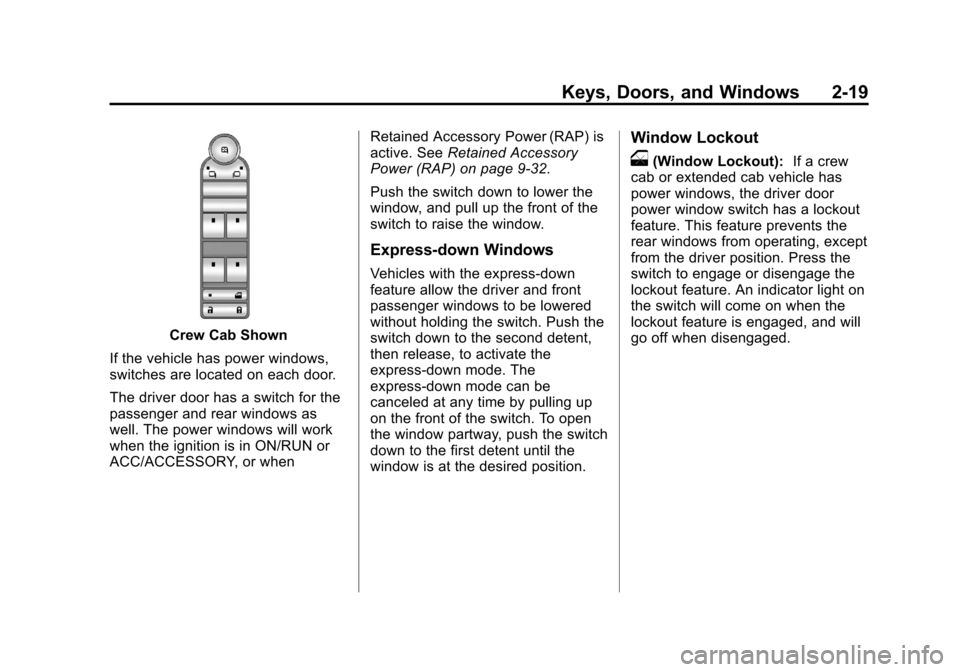
Crew Cab Shown
If the vehicle has power windows,
switches are located on each door.
The driver door has a switch for the
passenger and rear windows as
well. The power windows will work
when the ignition is in ON/RUN or
ACC/ACCESSORY, or when Retained Accessory Power (RAP) is
active. See
Retained Accessory
Power (RAP) on page 9‑32.
Push the switch down to lower the
window, and pull up the front of the
switch to raise the window.
Express-down Windows
Vehicles with the express-down
feature allow the driver and front
passenger windows to be lowered
without holding the switch. Push the
switch down to the second detent,
then release, to activate the
express-down mode. The
express-down mode can be
canceled at any time by pulling up
on the front of the switch. To open
the window partway, push the switch
down to the first detent until the
window is at the desired position.
Window Lockout
o(Window Lockout): If a crew
cab or extended cab vehicle has
power windows, the driver door
power window switch has a lockout
feature. This feature prevents the
rear windows from operating, except
from the driver position. Press the
switch to engage or disengage the
lockout feature. An indicator light on
the switch will come on when the
lockout feature is engaged, and will
go off when disengaged.
Page 74 of 584
Black plate (10,1)Chevrolet Silverado Owner Manual - 2012
3-10 Seats and Restraints
Heated and Ventilated
Front Seats
{WARNING
If you cannot feel temperature
change or pain to the skin, the
seat heater may cause burns
even at low temperatures.
To reduce the risk of burns,
people with such a condition
should use care when using the
seat heater, especially for long
periods of time. Do not place
anything on the seat that
insulates against heat, such as
a blanket, cushion, cover,
or similar item. This may cause
the seat heater to overheat.
An overheated seat heater may
cause a burn or may damage
the seat.
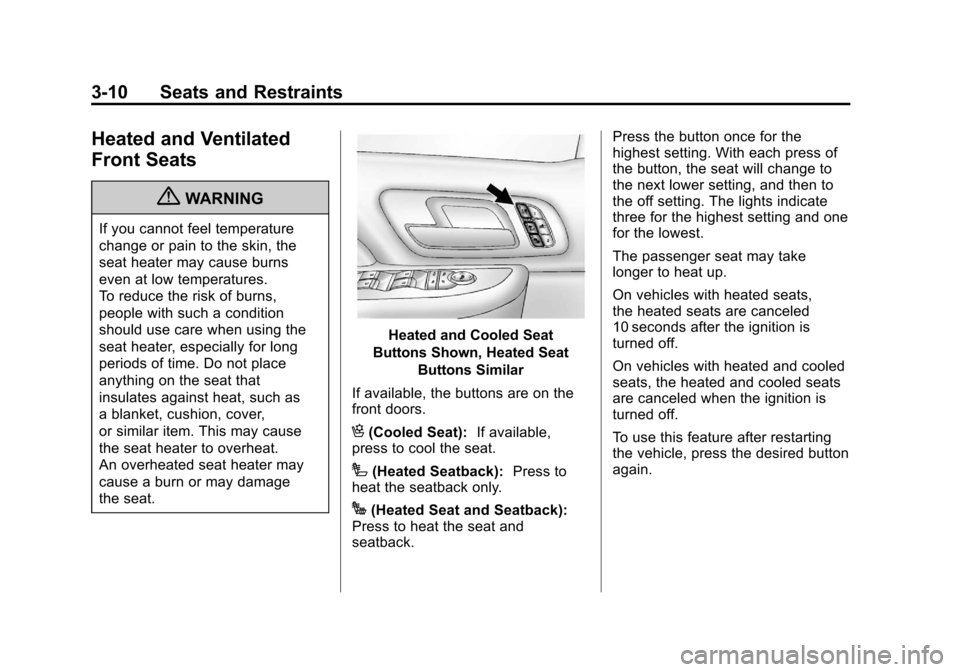
Heated and Cooled Seat
Buttons Shown, Heated Seat Buttons Similar
If available, the buttons are on the
front doors.
H(Cooled Seat): If available,
press to cool the seat.
I(Heated Seatback): Press to
heat the seatback only.
J(Heated Seat and Seatback):
Press to heat the seat and
seatback. Press the button once for the
highest setting. With each press of
the button, the seat will change to
the next lower setting, and then to
the off setting. The lights indicate
three for the highest setting and one
for the lowest.
The passenger seat may take
longer to heat up.
On vehicles with heated seats,
the heated seats are canceled
10 seconds after the ignition is
turned off.
On vehicles with heated and cooled
seats, the heated and cooled seats
are canceled when the ignition is
turned off.
To use this feature after restarting
the vehicle, press the desired button
again.
Page 75 of 584
Black plate (11,1)Chevrolet Silverado Owner Manual - 2012
Seats and Restraints 3-11
Remote Start Heated Seats
When it is cold outside, the heated
seats may turn on automatically
during a remote vehicle start. The
heated seats will be canceled when
the ignition is turned on. Press the
desired button to use the heated
seats after the vehicle is started.
The lights on the heated seat
buttons do not turn on during a
remote start.
The temperature performance of an
unoccupied seat may be reduced.
This is normal.
SeeRemote Vehicle Start on
page 2‑5 for more information.Rear Seats
Rear Seats (Extended
Cab Full Bench)
Folding the Rear Seat
Notice:Folding a rear seat with
the safety belts still fastened may
cause damage to the seat or the
safety belts. Always unbuckle the
safety belts and return them to
their normal stowed position
before folding a rear seat.
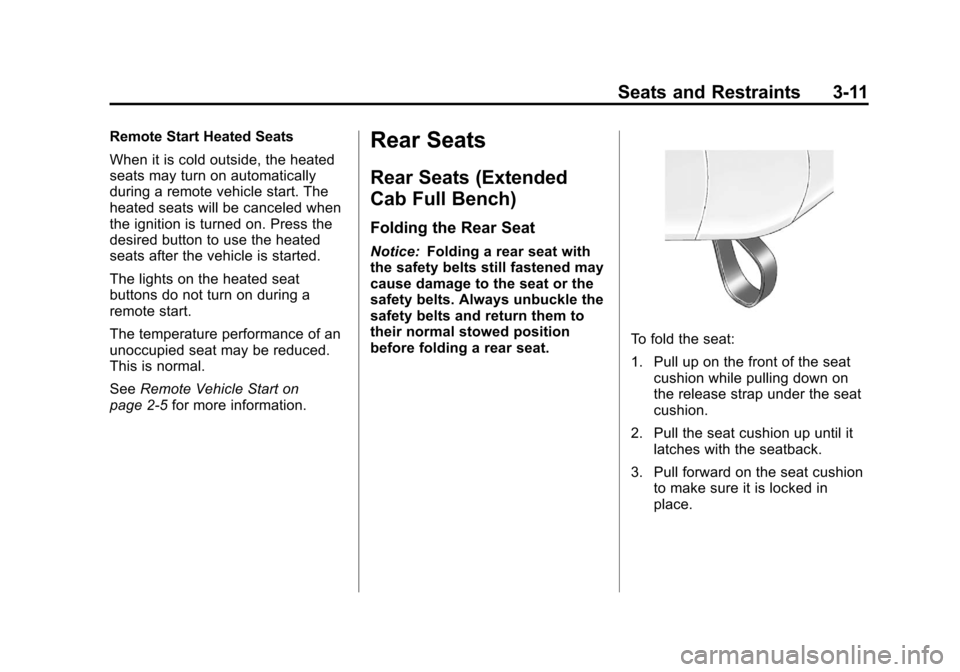
To fold the seat:
1. Pull up on the front of the seat cushion while pulling down on
the release strap under the seat
cushion.
2. Pull the seat cushion up until it latches with the seatback.
3. Pull forward on the seat cushion to make sure it is locked in
place.
Page 79 of 584
Black plate (15,1)Chevrolet Silverado Owner Manual - 2012
Seats and Restraints 3-15
.Wear the shoulder belt over the
shoulder and across the chest.
These parts of the body are best
able to take belt restraining
forces. The shoulder belt locks if
there is a sudden stop or crash.
{WARNING
You can be seriously injured,
or even killed, by not wearing
your safety belt properly.
.Never allow the lap or
shoulder belt to become
loose or twisted.
.Never wear the shoulder belt
under both arms or behind
your back.
.Never route the lap or
shoulder belt over an
armrest.
Lap-Shoulder Belt
All seating positions in the vehicle
have a lap-shoulder belt.
The following instructions explain
how to wear a lap-shoulder belt
properly.
1. Adjust the seat, if the seat isadjustable, so you can sit up
straight. To see how, see “Seats”
in the Index.
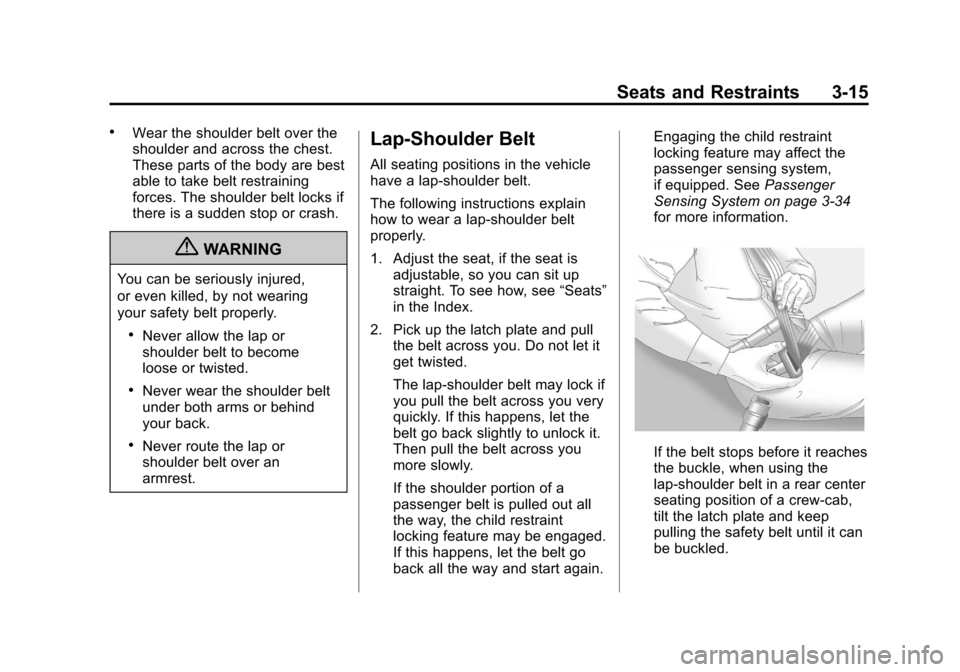
2. Pick up the latch plate and pull the belt across you. Do not let it
get twisted.
The lap-shoulder belt may lock if
you pull the belt across you very
quickly. If this happens, let the
belt go back slightly to unlock it.
Then pull the belt across you
more slowly.
If the shoulder portion of a
passenger belt is pulled out all
the way, the child restraint
locking feature may be engaged.
If this happens, let the belt go
back all the way and start again. Engaging the child restraint
locking feature may affect the
passenger sensing system,
if equipped. See
Passenger
Sensing System on page 3‑34
for more information.
If the belt stops before it reaches
the buckle, when using the
lap-shoulder belt in a rear center
seating position of a crew-cab,
tilt the latch plate and keep
pulling the safety belt until it can
be buckled.
Page 85 of 584
Black plate (21,1)Chevrolet Silverado Owner Manual - 2012
Seats and Restraints 3-21
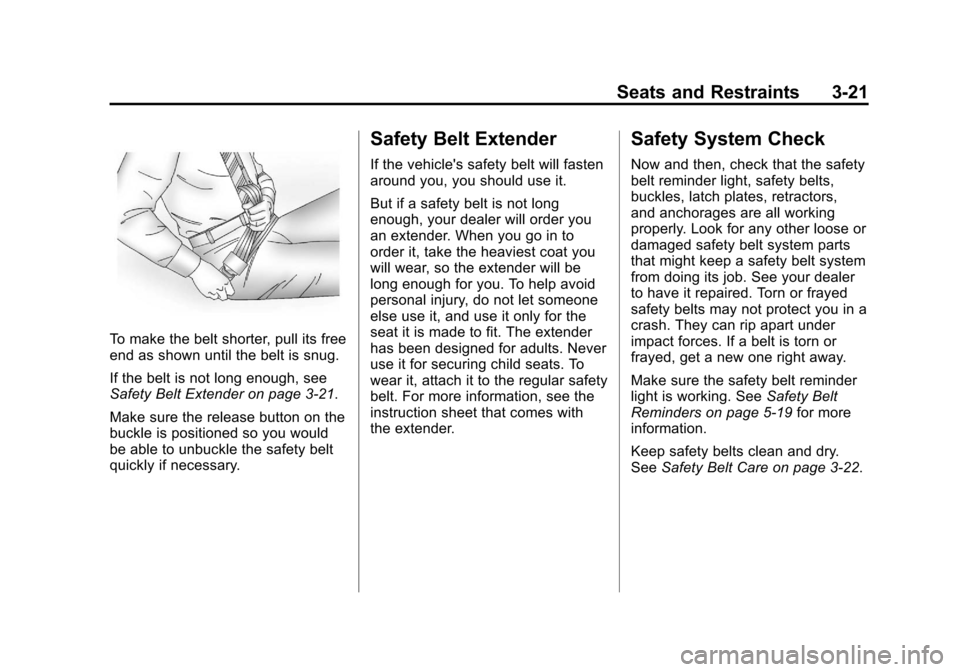
To make the belt shorter, pull its free
end as shown until the belt is snug.
If the belt is not long enough, see
Safety Belt Extender on page 3‑21.
Make sure the release button on the
buckle is positioned so you would
be able to unbuckle the safety belt
quickly if necessary.
Safety Belt Extender
If the vehicle's safety belt will fasten
around you, you should use it.
But if a safety belt is not long
enough, your dealer will order you
an extender. When you go in to
order it, take the heaviest coat you
will wear, so the extender will be
long enough for you. To help avoid
personal injury, do not let someone
else use it, and use it only for the
seat it is made to fit. The extender
has been designed for adults. Never
use it for securing child seats. To
wear it, attach it to the regular safety
belt. For more information, see the
instruction sheet that comes with
the extender.
Safety System Check
Now and then, check that the safety
belt reminder light, safety belts,
buckles, latch plates, retractors,
and anchorages are all working
properly. Look for any other loose or
damaged safety belt system parts
that might keep a safety belt system
from doing its job. See your dealer
to have it repaired. Torn or frayed
safety belts may not protect you in a
crash. They can rip apart under
impact forces. If a belt is torn or
frayed, get a new one right away.
Make sure the safety belt reminder
light is working. SeeSafety Belt
Reminders on page 5‑19 for more
information.
Keep safety belts clean and dry.
See Safety Belt Care on page 3‑22.
Page 86 of 584
Black plate (22,1)Chevrolet Silverado Owner Manual - 2012
3-22 Seats and Restraints
Safety Belt Care
Keep belts clean and dry.
{WARNING
Do not bleach or dye safety belts.
It may severely weaken them.
In a crash, they might not be able
to provide adequate protection.
Clean safety belts only with mild
soap and lukewarm water.
Replacing Safety Belt
System Parts after a
Crash
{WARNING
A crash can damage the safety
belt system in the vehicle.
A damaged safety belt system
may not properly protect the
person using it, resulting in
serious injury or even death in a
crash. To help make sure the
safety belt systems are working
properly after a crash, have them
inspected and any necessary
replacements made as soon as
possible.After a minor crash, replacement of
safety belts may not be necessary.
But the safety belt assemblies that
were used during any crash may
have been stressed or damaged.
See your dealer to have the safety
belt assemblies inspected or
replaced.
New parts and repairs may be
necessary even if the safety belt
system was not being used at the
time of the crash.
Have the safety belt pretensioners
checked if the vehicle has been in a
crash, or if the airbag readiness light
stays on after you start the vehicle
or while you are driving. See
Airbag
Readiness Light on page 5‑20.
Page 88 of 584
Black plate (24,1)Chevrolet Silverado Owner Manual - 2012
3-24 Seats and Restraints
{WARNING
Because airbags inflate with great
force and faster than the blink of
an eye, anyone who is up
against, or very close to any
airbag when it inflates can be
seriously injured or killed. Do not
sit unnecessarily close to any
airbag, as you would be if sitting
on the edge of the seat or leaning
forward. Safety belts help keep
you in position before and during
a crash. Always wear a safety
belt, even with airbags. The driver
should sit as far back as possible
while still maintaining control of
the vehicle.
Occupants should not lean on or
sleep against the door or side
windows in seating positions with
seat-mounted side impact airbags
and/or roof-rail airbags.
{WARNING
Children who are up against,
or very close to, any airbag
when it inflates can be seriously
injured or killed. Airbags plus
lap-shoulder belts offer protection
for adults and older children,
but not for young children and
infants. Neither the vehicle
safety belt system nor its airbag
system is designed for them.
Young children and infants
need the protection that a child
restraint system can provide.
Always secure children properly
in the vehicle. To read how, see
Older Children on page 3‑42or
Infants and Young Children on
page 3‑44.
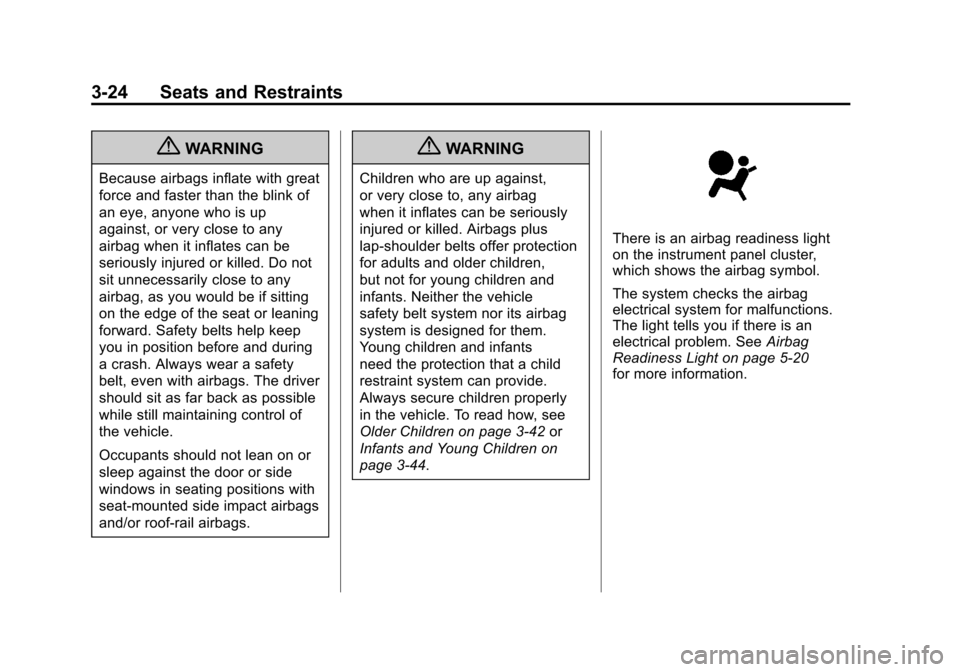
There is an airbag readiness light
on the instrument panel cluster,
which shows the airbag symbol.
The system checks the airbag
electrical system for malfunctions.
The light tells you if there is an
electrical problem. See Airbag
Readiness Light on page 5‑20
for more information.
Page 91 of 584
Black plate (27,1)Chevrolet Silverado Owner Manual - 2012
Seats and Restraints 3-27
Frontal airbags may inflate at
different crash speeds.
For example:
.If the vehicle hits a stationary
object, the airbags could inflate
at a different crash speed than if
the vehicle hits a moving object.
.If the vehicle hits an object that
deforms, the airbags could
inflate at a different crash speed
than if the vehicle hits an object
that does not deform.
.If the vehicle hits a narrow object
(like a pole), the airbags could
inflate at a different crash speed
than if the vehicle hits a wide
object (like a wall).
.If the vehicle goes into an object
at an angle, the airbags could
inflate at a different crash speed
than if the vehicle goes straight
into the object.
Thresholds can also vary with
specific vehicle design.
Frontal airbags are not intended to
inflate during vehicle rollovers, rear
impacts, or in many side impacts. If the GVWR (Gross Vehicle Weight
Rating) of your vehicle is 3 855 kg
(8,500 lb) or above, the vehicle has
single stage airbags. If the GVWR is
below 3 855 kg (8,500 lb) then the
vehicle has dual stage airbags.
Vehicles with a full bench seat are
equipped with single state airbags.
You can find the GVWR on the
certification label on the rear edge
of the driver door. See
Vehicle Load
Limits on page 9‑17 for more
information.
The vehicle may have dual‐stage
frontal airbags. Dual-stage airbags
adjust the restraint according to
crash severity. The vehicle has
electronic frontal sensors, which
help the sensing system distinguish
between a moderate frontal impact
and a more severe frontal impact.
For moderate frontal impacts,
dual-stage airbags inflate at a
level less than full deployment.
For more severe frontal impacts,
full deployment occurs. Vehicles with dual stage airbags
also have seat position sensors
which enable the sensing system to
monitor the position of the driver
seat (all models), and on crew cab
and extended cab models the right
front passenger seat on light duty
models only. The seat position
sensor provides information that is
used to determine if the airbags
should deploy at a reduced level or
at full deployment.
The vehicle may or may not have
seat‐mounted side impact and
roof-rail airbags. See
Airbag System
on page 3‑23. Seat‐mounted side
impact and roof-rail airbags are
intended to inflate in moderate to
severe side crashes. In addition,
these roof-rail airbags are intended
to inflate during a rollover or in a
severe frontal impact. Seat‐mounted
side impact and roof-rail airbags will
inflate if the crash severity is above
the system's designed threshold
level. The threshold level can vary
with specific vehicle design.