weight CHEVROLET SILVERADO 2500 2018 Owner's Manual
[x] Cancel search | Manufacturer: CHEVROLET, Model Year: 2018, Model line: SILVERADO 2500, Model: CHEVROLET SILVERADO 2500 2018Pages: 489, PDF Size: 6.81 MB
Page 299 of 489
Chevrolet Silverado LD 1500 and Silverado 2500/3500 Owner Manual (GMNA-
Localizing-U.S./Canada-12162993) - 2019 - crc - 4/4/18
298 Driving and Operating
Trailer Towing
If equipped with a diesel engine,
see the Duramax diesel
supplement.
Caution
Towing a trailer improperly can
damage the vehicle and result in
costly repairs not covered by the
vehicle warranty. To tow a trailer
correctly, follow the directions in
this section and see your dealer
for important information about
towing a trailer with the vehicle.
Trailering is different than just
driving the vehicle by itself.
Trailering means changes in
handling, acceleration, braking,
durability, and fuel economy.
Successful, safe trailering takes
correct equipment, and it has to be
used properly.
The following information has many
time-tested, important trailering tips
and safety rules. Many of these are important for your safety and that of
your passengers. Read this section
carefully before pulling a trailer.
Trailer Weight
{Warning
Never exceed the towing capacity
for your vehicle.
Safe trailering requires monitoring
the weight, speed, altitude, road
grades, outside temperature,
dimensions of the front of the trailer,
and how frequently the vehicle is
used to tow a trailer.
Trailering Weight Ratings
When towing a trailer, the weight of
the loaded vehicle and trailer must
be within the weight ratings for the
vehicle.
. GCWR: Gross Combined Weight
Rating
. GVWR: Gross Vehicle Weight
Rating
. Maximum Trailer Weight Rating .
GAWR-RR: Gross Axle Weight
Rating-Rear
. Maximum Trailer Tongue Weight
Rating
The only way to be sure the weight
is not exceeding any of these
ratings is to weigh the tow vehicle
and trailer combination, fully loaded
for the trip, getting individual
weights for each of these items.
{Warning
You and others could be seriously
injured or killed if the trailer is too
heavy or the trailer brakes are
inadequate for the load. The
vehicle may be damaged, and the
repairs would not be covered by
the vehicle warranty.
Only tow a trailer if all the steps in
this section have been followed.
Ask your dealer for advice and
information about towing a trailer.
Page 300 of 489
Chevrolet Silverado LD 1500 and Silverado 2500/3500 Owner Manual (GMNA-
Localizing-U.S./Canada-12162993) - 2019 - crc - 4/4/18
Driving and Operating 299
Gross Combined Weight
Rating (GCWR)
GCWR is the total allowable weight
of the completely loaded vehicle
and trailer including any fuel,
passengers, cargo, equipment, and
accessories. Do not exceed the
GCWR for your vehicle. The GCWR
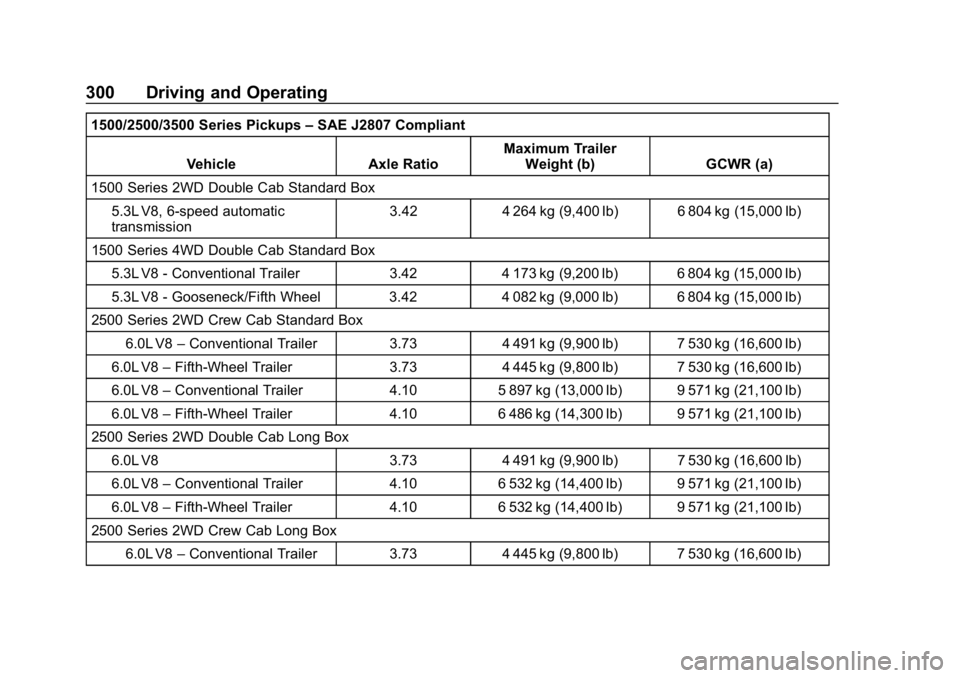
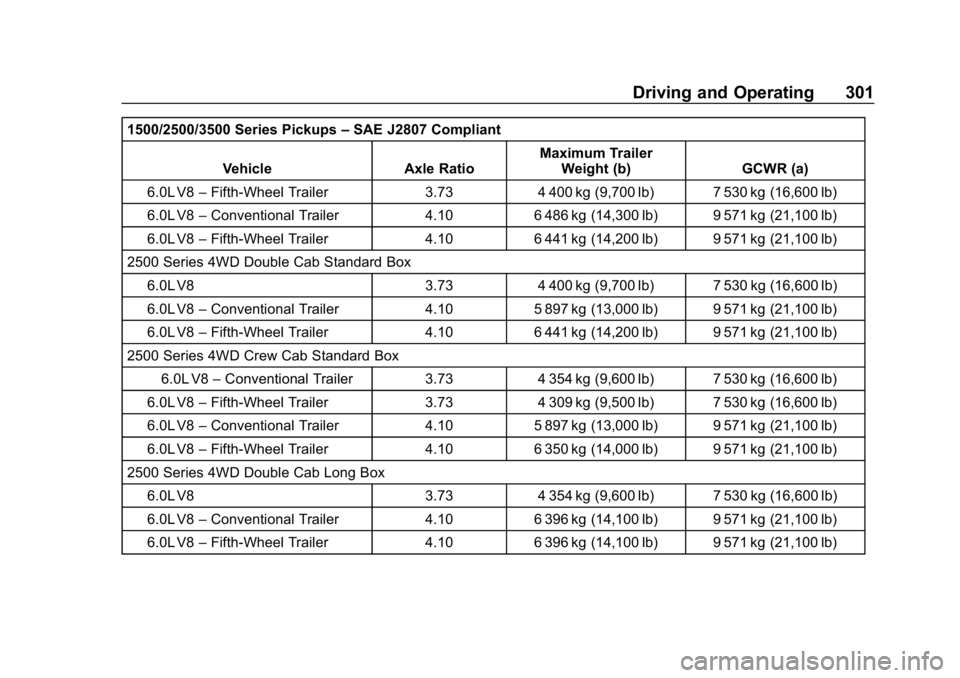
for the vehicle is on the Tow Rating
Chart following.
Gross Vehicle Weight
Rating (GVWR)
For information about the vehicle's
maximum load capacity, seeVehicle
Load Limits 0238. When calculating
the GVWR with a trailer attached,
the trailer tongue weight must be
included as part of the weight the
vehicle is carrying.
Maximum Trailer Weight
The maximum trailer weight rating is
calculated assuming the tow vehicle
has a driver, a front seat passenger,
and all required trailering
equipment. Weight of additional
optional equipment, passengers, and cargo in the tow vehicle must
be subtracted from the trailer weight
rating.
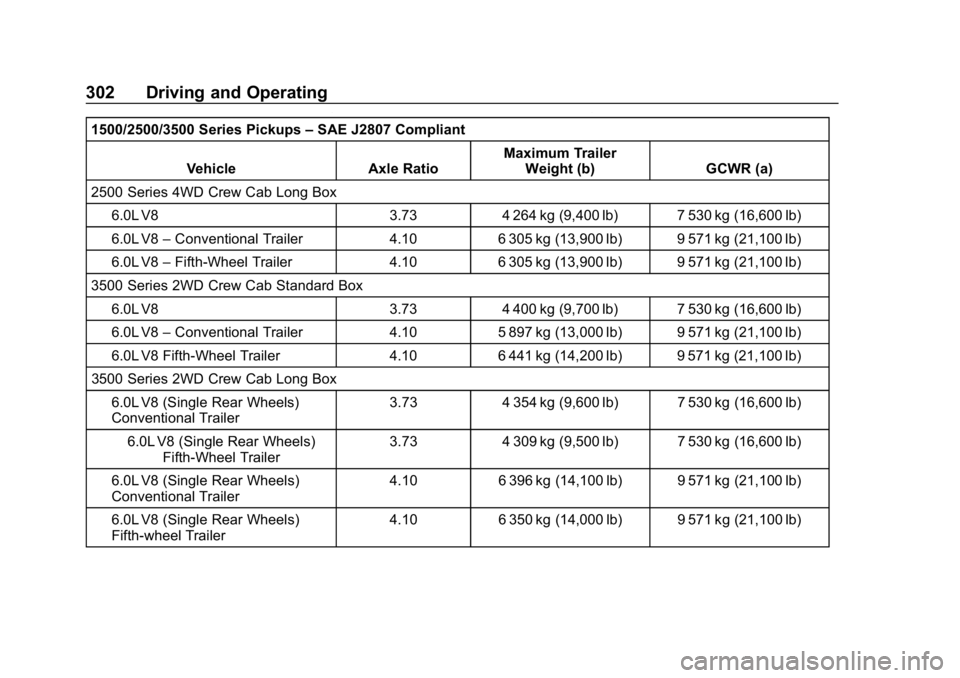
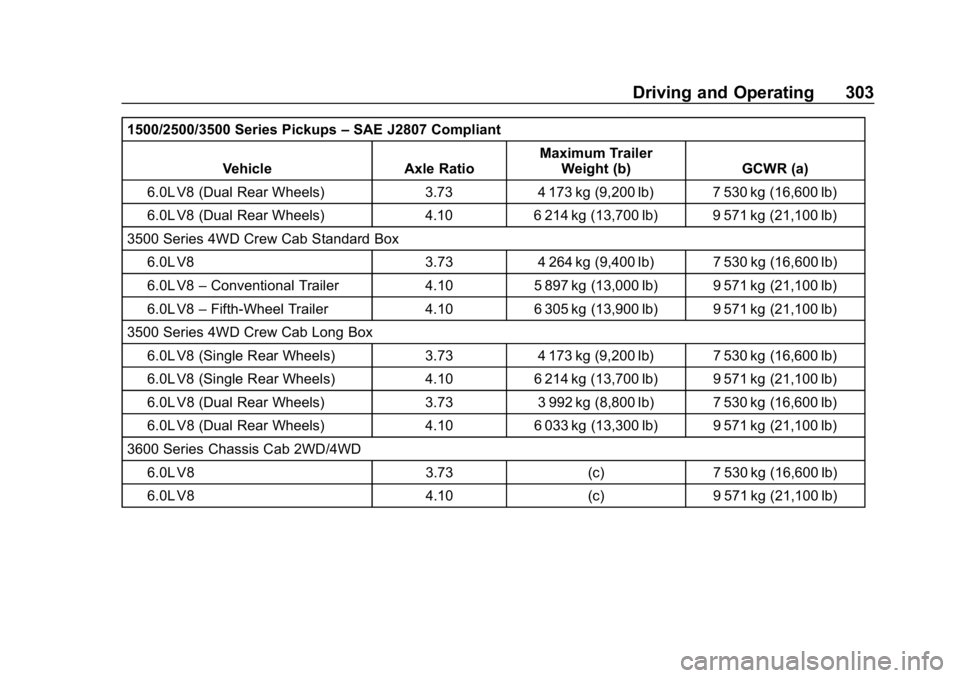
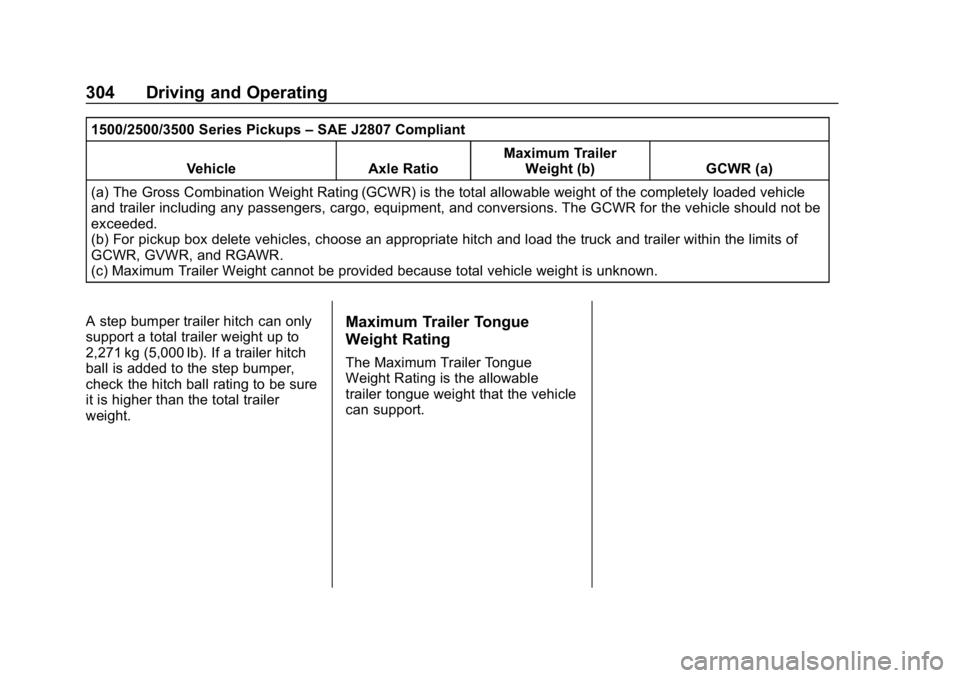
Use the tow rating chart to
determine how much the trailer can
weigh, based on the vehicle model
and options.
Weights listed apply for
conventional trailers and
gooseneck/fifth-wheel trailers unless
otherwise noted.
Page 301 of 489
Chevrolet Silverado LD 1500 and Silverado 2500/3500 Owner Manual (GMNA-
Localizing-U.S./Canada-12162993) - 2019 - crc - 4/4/18
300 Driving and Operating
1500/2500/3500 Series Pickups–SAE J2807 Compliant
Vehicle Axle Ratio Maximum Trailer
Weight (b) GCWR (a)
1500 Series 2WD Double Cab Standard Box 5.3L V8, 6-speed automatic
transmission 3.42
4 264 kg (9,400 lb) 6 804 kg (15,000 lb)
1500 Series 4WD Double Cab Standard Box 5.3L V8 - Conventional Trailer 3.424 173 kg (9,200 lb) 6 804 kg (15,000 lb)
5.3L V8 - Gooseneck/Fifth Wheel 3.42 4 082 kg (9,000 lb) 6 804 kg (15,000 lb)
2500 Series 2WD Crew Cab Standard Box
6.0L V8 –Conventional Trailer 3.734 491 kg (9,900 lb) 7 530 kg (16,600 lb)
6.0L V8 –Fifth-Wheel Trailer 3.734 445 kg (9,800 lb) 7 530 kg (16,600 lb)
6.0L V8 –Conventional Trailer 4.105 897 kg (13,000 lb) 9 571 kg (21,100 lb)
6.0L V8 –Fifth-Wheel Trailer 4.106 486 kg (14,300 lb) 9 571 kg (21,100 lb)
2500 Series 2WD Double Cab Long Box 6.0L V8 3.734 491 kg (9,900 lb) 7 530 kg (16,600 lb)
6.0L V8 –Conventional Trailer 4.106 532 kg (14,400 lb) 9 571 kg (21,100 lb)
6.0L V8 –Fifth-Wheel Trailer 4.106 532 kg (14,400 lb) 9 571 kg (21,100 lb)
2500 Series 2WD Crew Cab Long Box 6.0L V8 –Conventional Trailer 3.734 445 kg (9,800 lb) 7 530 kg (16,600 lb)
Page 302 of 489
Chevrolet Silverado LD 1500 and Silverado 2500/3500 Owner Manual (GMNA-
Localizing-U.S./Canada-12162993) - 2019 - crc - 4/4/18
Driving and Operating 301
1500/2500/3500 Series Pickups–SAE J2807 Compliant
Vehicle Axle Ratio Maximum Trailer
Weight (b) GCWR (a)
6.0L V8 –Fifth-Wheel Trailer 3.734 400 kg (9,700 lb) 7 530 kg (16,600 lb)
6.0L V8 –Conventional Trailer 4.106 486 kg (14,300 lb) 9 571 kg (21,100 lb)
6.0L V8 –Fifth-Wheel Trailer 4.106 441 kg (14,200 lb) 9 571 kg (21,100 lb)
2500 Series 4WD Double Cab Standard Box 6.0L V8 3.734 400 kg (9,700 lb) 7 530 kg (16,600 lb)
6.0L V8 –Conventional Trailer 4.105 897 kg (13,000 lb) 9 571 kg (21,100 lb)
6.0L V8 –Fifth-Wheel Trailer 4.106 441 kg (14,200 lb) 9 571 kg (21,100 lb)
2500 Series 4WD Crew Cab Standard Box 6.0L V8 –Conventional Trailer 3.734 354 kg (9,600 lb) 7 530 kg (16,600 lb)
6.0L V8 –Fifth-Wheel Trailer 3.734 309 kg (9,500 lb) 7 530 kg (16,600 lb)
6.0L V8 –Conventional Trailer 4.105 897 kg (13,000 lb) 9 571 kg (21,100 lb)
6.0L V8 –Fifth-Wheel Trailer 4.106 350 kg (14,000 lb) 9 571 kg (21,100 lb)
2500 Series 4WD Double Cab Long Box 6.0L V8 3.734 354 kg (9,600 lb) 7 530 kg (16,600 lb)
6.0L V8 –Conventional Trailer 4.106 396 kg (14,100 lb) 9 571 kg (21,100 lb)
6.0L V8 –Fifth-Wheel Trailer 4.106 396 kg (14,100 lb) 9 571 kg (21,100 lb)
Page 303 of 489
Chevrolet Silverado LD 1500 and Silverado 2500/3500 Owner Manual (GMNA-
Localizing-U.S./Canada-12162993) - 2019 - crc - 4/4/18
302 Driving and Operating
1500/2500/3500 Series Pickups–SAE J2807 Compliant
Vehicle Axle Ratio Maximum Trailer
Weight (b) GCWR (a)
2500 Series 4WD Crew Cab Long Box 6.0L V8 3.734 264 kg (9,400 lb) 7 530 kg (16,600 lb)
6.0L V8 –Conventional Trailer 4.106 305 kg (13,900 lb) 9 571 kg (21,100 lb)
6.0L V8 –Fifth-Wheel Trailer 4.106 305 kg (13,900 lb) 9 571 kg (21,100 lb)
3500 Series 2WD Crew Cab Standard Box 6.0L V8 3.734 400 kg (9,700 lb) 7 530 kg (16,600 lb)
6.0L V8 –Conventional Trailer 4.105 897 kg (13,000 lb) 9 571 kg (21,100 lb)
6.0L V8 Fifth-Wheel Trailer 4.106 441 kg (14,200 lb) 9 571 kg (21,100 lb)
3500 Series 2WD Crew Cab Long Box 6.0L V8 (Single Rear Wheels)
Conventional Trailer 3.73
4 354 kg (9,600 lb) 7 530 kg (16,600 lb)
6.0L V8 (Single Rear Wheels) Fifth-Wheel Trailer 3.73
4 309 kg (9,500 lb) 7 530 kg (16,600 lb)
6.0L V8 (Single Rear Wheels)
Conventional Trailer 4.10
6 396 kg (14,100 lb) 9 571 kg (21,100 lb)
6.0L V8 (Single Rear Wheels)
Fifth-wheel Trailer 4.10
6 350 kg (14,000 lb) 9 571 kg (21,100 lb)
Page 304 of 489
Chevrolet Silverado LD 1500 and Silverado 2500/3500 Owner Manual (GMNA-
Localizing-U.S./Canada-12162993) - 2019 - crc - 4/4/18
Driving and Operating 303
1500/2500/3500 Series Pickups–SAE J2807 Compliant
Vehicle Axle Ratio Maximum Trailer
Weight (b) GCWR (a)
6.0L V8 (Dual Rear Wheels) 3.73 4 173 kg (9,200 lb) 7 530 kg (16,600 lb)
6.0L V8 (Dual Rear Wheels) 4.10 6 214 kg (13,700 lb) 9 571 kg (21,100 lb)
3500 Series 4WD Crew Cab Standard Box
6.0L V8 3.73 4 264 kg (9,400 lb) 7 530 kg (16,600 lb)
6.0L V8 –Conventional Trailer 4.105 897 kg (13,000 lb) 9 571 kg (21,100 lb)
6.0L V8 –Fifth-Wheel Trailer 4.106 305 kg (13,900 lb) 9 571 kg (21,100 lb)
3500 Series 4WD Crew Cab Long Box
6.0L V8 (Single Rear Wheels) 3.734 173 kg (9,200 lb) 7 530 kg (16,600 lb)
6.0L V8 (Single Rear Wheels) 4.106 214 kg (13,700 lb) 9 571 kg (21,100 lb)
6.0L V8 (Dual Rear Wheels) 3.733 992 kg (8,800 lb) 7 530 kg (16,600 lb)
6.0L V8 (Dual Rear Wheels) 4.106 033 kg (13,300 lb) 9 571 kg (21,100 lb)
3600 Series Chassis Cab 2WD/4WD 6.0L V8 3.73(c)7 530 kg (16,600 lb)
6.0L V8 4.10(c)9 571 kg (21,100 lb)
Page 305 of 489
Chevrolet Silverado LD 1500 and Silverado 2500/3500 Owner Manual (GMNA-
Localizing-U.S./Canada-12162993) - 2019 - crc - 4/4/18
304 Driving and Operating
1500/2500/3500 Series Pickups–SAE J2807 Compliant
Vehicle Axle Ratio Maximum Trailer
Weight (b) GCWR (a)
(a) The Gross Combination Weight Rating (GCWR) is the total allowable weight of the completely loaded vehicle
and trailer including any passengers, cargo, equipment, and conversions. The GCWR for the vehicle should not be
exceeded.
(b) For pickup box delete vehicles, choose an appropriate hitch and load the truck and trailer within the limits of
GCWR, GVWR, and RGAWR.
(c) Maximum Trailer Weight cannot be provided because total vehicle weight is unknown.
A step bumper trailer hitch can only
support a total trailer weight up to
2,271 kg (5,000 lb). If a trailer hitch
ball is added to the step bumper,
check the hitch ball rating to be sure
it is higher than the total trailer
weight.
Maximum Trailer Tongue
Weight Rating
The Maximum Trailer Tongue
Weight Rating is the allowable
trailer tongue weight that the vehicle
can support.
Page 306 of 489
Chevrolet Silverado LD 1500 and Silverado 2500/3500 Owner Manual (GMNA-
Localizing-U.S./Canada-12162993) - 2019 - crc - 4/4/18
Driving and Operating 305
Vehicle Series Hitch TypeMaximum Tongue
Weight
1500 Weight-Carrying or Weight-Distributing 567 kg (1,250 lb)
2500/3500
Standard Box Weight-Carrying or
Weight-Distributing 680 kg (1,500 lb)
2500/
3500 Long Box Weight-Carrying or
Weight-Distributing 907 kg (2,000 lb)
2500 Fifth-Wheel Gooseneck 1 361 kg (3,000 lb)
3500 Single Rear
Wheels Fifth-Wheel Gooseneck 1 814 kg (4,000 lb)
3500 Dual Rear
Wheels Fifth-Wheel Gooseneck 2 495 kg (5,500 lb)
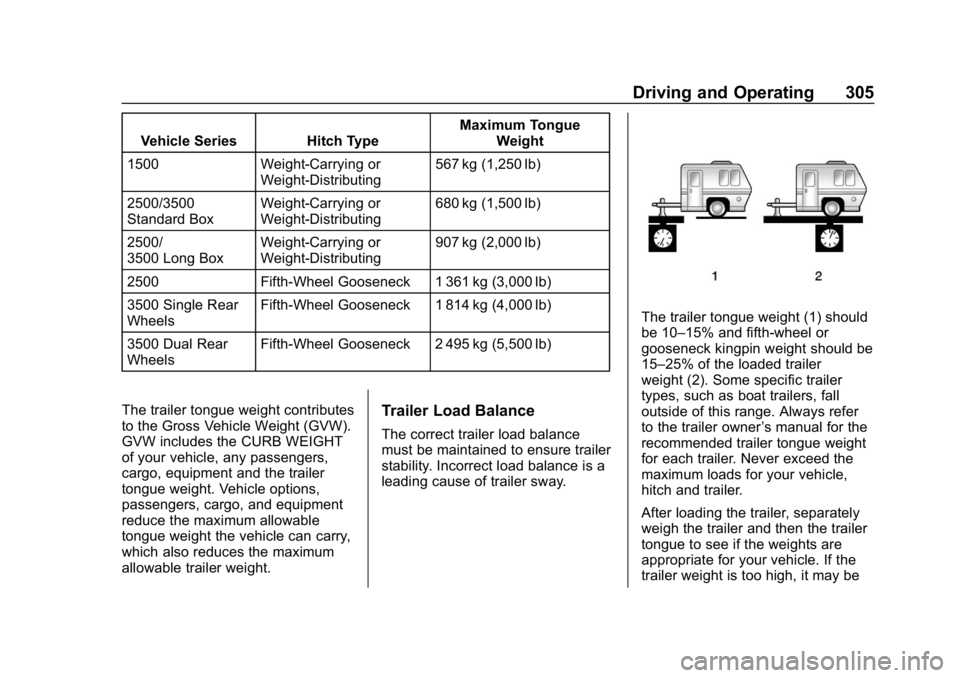
The trailer tongue weight contributes
to the Gross Vehicle Weight (GVW).
GVW includes the CURB WEIGHT
of your vehicle, any passengers,
cargo, equipment and the trailer
tongue weight. Vehicle options,
passengers, cargo, and equipment
reduce the maximum allowable
tongue weight the vehicle can carry,
which also reduces the maximum
allowable trailer weight.
Trailer Load Balance
The correct trailer load balance
must be maintained to ensure trailer
stability. Incorrect load balance is a
leading cause of trailer sway.
The trailer tongue weight (1) should
be 10–15% and fifth-wheel or
gooseneck kingpin weight should be
15–25% of the loaded trailer
weight (2). Some specific trailer
types, such as boat trailers, fall
outside of this range. Always refer
to the trailer owner ’s manual for the
recommended trailer tongue weight
for each trailer. Never exceed the
maximum loads for your vehicle,
hitch and trailer.
After loading the trailer, separately
weigh the trailer and then the trailer
tongue to see if the weights are
appropriate for your vehicle. If the
trailer weight is too high, it may be
Page 307 of 489
Chevrolet Silverado LD 1500 and Silverado 2500/3500 Owner Manual (GMNA-
Localizing-U.S./Canada-12162993) - 2019 - crc - 4/4/18
306 Driving and Operating
possible to trasfer some of the
cargo into your vehicle. If the trailer
tongue weight is too high or too low,
it may be possible to rearrange
some of the cargo inside of the
trailer.
Do not exceed the maximum
allowable tongue weight for your
vehicle. Use the shortest hitch
extension available to position the
hitch ball closer to your vehicle. This
will help reduce the effect of the
trailer tongue weight on the trailer
hitch and the rear axle.
If a cargo carrier is used in the
trailer hitch receiver, choose a
carrier that positions the load as
close to the vehicle as possible.
Make sure the total weight,
including the carrier, is no more than
half of the maximum allowable
tongue weight for the vehicle or
227 kg (500 lb), whichever is less.
Rear Gross Axle Weight Rating
(GAWR-RR)
The GAWR-RR is the total weight
that can be supported by the rear
axle of the vehicle. Do not exceedthe GAWR-RR for the vehicle, with
the tow vehicle and trailer fully
loaded for the trip including the
weight of the trailer tongue. If using
a weight-distributing hitch, do not
exceed the GAWR-RR before
applying the weight distribution
spring bars.
Ask your dealer for trailering
information or assistance.
Towing Equipment
Hitches
Always use the correct hitch
equipment for your vehicle.
Crosswinds, large trucks going by,
and rough roads can affect the
trailer and the hitch.
Proper hitch equipment for your
vehicle helps maintain control of the
vehicle-trailer combination. Many
trailers can be towed using a
weight-carrying hitch which has a
coupler latched to the hitch ball, or a
tow eye latched to a pintle hook.
Other trailers may require a
weight-distributing hitch that uses
spring bars to distribute the trailertongue weight between your vehicle
and trailer axles. Fifth-wheel and
gooseneck hitches may also be
used. See
“Trailer Tongue Weight”
under Trailer Towing 0298 for
weight limits with various hitch
types.
Avoid sharp turns when using a
step-bumper hitch to prevent
damage. Make wider turns to
prevent contact between your trailer
and your bumper.
Consider using mechanical sway
controls with any trailer. Ask a
trailering professional about sway
controls or refer to the trailer
manufacturer's recommendations
and instructions.
Weight-Distributing Hitch
Adjustment
A weight-distributing hitch may be
useful with some trailers. Use the
following guidelines to determine if a
weight-distributing hitch should
be used.
Page 308 of 489
Chevrolet Silverado LD 1500 and Silverado 2500/3500 Owner Manual (GMNA-
Localizing-U.S./Canada-12162993) - 2019 - crc - 4/4/18
Driving and Operating 307
Vehicle SeriesTrailer WeightWeight-Distributing Hitch
Usage Hitch Distribution
1500 Up to 3 175 kg (7,000 lb) OptionalRefer to trailer
manufacturer ’s
recommendation
1500 Over 3 175 kg (7,000 lb) Required50%
2500/3500 Up to 9 080 kg (20,000 lb) Optional50%
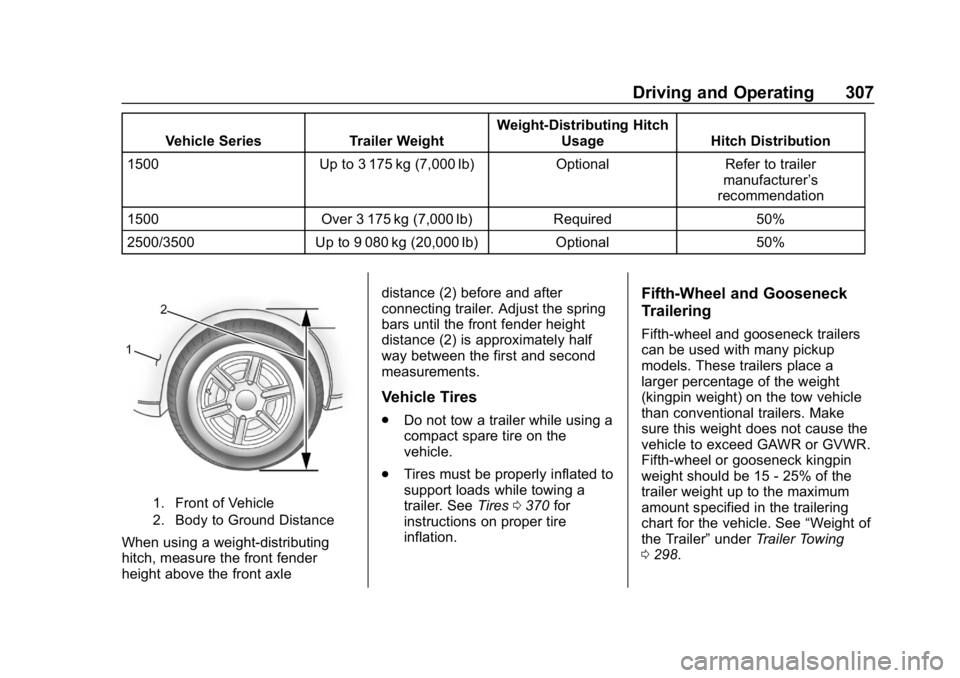
1. Front of Vehicle
2. Body to Ground Distance
When using a weight-distributing
hitch, measure the front fender
height above the front axle distance (2) before and after
connecting trailer. Adjust the spring
bars until the front fender height
distance (2) is approximately half
way between the first and second
measurements.
Vehicle Tires
.
Do not tow a trailer while using a
compact spare tire on the
vehicle.
. Tires must be properly inflated to
support loads while towing a
trailer. See Tires0370 for
instructions on proper tire
inflation.
Fifth-Wheel and Gooseneck
Trailering
Fifth-wheel and gooseneck trailers
can be used with many pickup
models. These trailers place a
larger percentage of the weight
(kingpin weight) on the tow vehicle
than conventional trailers. Make
sure this weight does not cause the
vehicle to exceed GAWR or GVWR.
Fifth-wheel or gooseneck kingpin
weight should be 15 - 25% of the
trailer weight up to the maximum
amount specified in the trailering
chart for the vehicle. See “Weight of
the Trailer” underTrailer Towing
0 298.