warning light CHEVROLET SILVERADO 2500 2018 Workshop Manual
[x] Cancel search | Manufacturer: CHEVROLET, Model Year: 2018, Model line: SILVERADO 2500, Model: CHEVROLET SILVERADO 2500 2018Pages: 489, PDF Size: 6.81 MB
Page 383 of 489
Chevrolet Silverado LD 1500 and Silverado 2500/3500 Owner Manual (GMNA-
Localizing-U.S./Canada-12162993) - 2019 - crc - 4/4/18
382 Vehicle Care
and displays, seeDriver Information
Center (DIC) (Base Level) 0154 or
Driver Information Center (DIC)
(Uplevel) 0156.
The low tire pressure warning light
may come on in cool weather when
the vehicle is first started, and then
turn off as the vehicle is driven. This
could be an early indicator that the
air pressure is getting low and
needs to be inflated to the proper
pressure.
A Tire and Loading Information label
shows the size of the original
equipment tires and the correct
inflation pressure for the tires when
they are cold. See Vehicle Load
Limits 0238, for an example of the
Tire and Loading Information label
and its location. Also see Tire
Pressure 0378.
The TPMS can warn about a low
tire pressure condition but it does
not replace normal tire
maintenance. See Tire Inspection
0 385, Tire Rotation 0386 andTires
0 370.Caution
Tire sealant materials are not all
the same. A non-approved tire
sealant could damage the TPMS
sensors. TPMS sensor damage
caused by using an incorrect tire
sealant is not covered by the
vehicle warranty. Always use only
the GM approved tire sealant
available through your dealer or
included in the vehicle.
TPMS Malfunction Light and
Message
The TPMS will not function properly
if one or more of the TPMS sensors
are missing or inoperable. When the
system detects a malfunction, the
low tire pressure warning light
flashes for about one minute and
then stays on for the remainder of
the ignition cycle. A DIC warning
message also displays. The
malfunction light and DIC warning
message come on at each ignition cycle until the problem is corrected.
Some of the conditions that can
cause these to come on are:
.
One of the road tires has been
replaced with the spare tire. The
spare tire does not have a
TPMS sensor. The malfunction
light and the DIC message
should go off after the road tire
is replaced and the sensor
matching process is performed
successfully. See "TPMS Sensor
Matching Process" later in this
section.
. The TPMS sensor matching
process was not done or not
completed successfully after
rotating the tires. The
malfunction light and the DIC
message should go off after
successfully completing the
sensor matching process. See
"TPMS Sensor Matching
Process" later in this section.
. One or more TPMS sensors are
missing or damaged. The
malfunction light and the DIC
message should go off when the
TPMS sensors are installed and
Page 384 of 489
Chevrolet Silverado LD 1500 and Silverado 2500/3500 Owner Manual (GMNA-
Localizing-U.S./Canada-12162993) - 2019 - crc - 4/4/18
Vehicle Care 383
the sensor matching process is
performed successfully. See
your dealer for service.
. Replacement tires or wheels do
not match the original equipment
tires or wheels. Tires and wheels
other than those recommended
could prevent the TPMS from
functioning properly. See Buying
New Tires 0389.
. Operating electronic devices or
being near facilities using radio
wave frequencies similar to the
TPMS could cause the TPMS
sensors to malfunction.
If the TPMS is not functioning
properly, it cannot detect or signal a
low tire pressure condition. See
your dealer for service if the TPMS
malfunction light and DIC message
come on and stay on.
Tire Fill Alert (If Equipped)
This feature provides visual and
audible alerts outside the vehicle to
help when inflating an underinflated
tire to the recommended cold tire
pressure. When the low tire pressure warning
light comes on:
1. Park the vehicle in a safe, level place.
2. Set the parking brake firmly.
3. Place the vehicle in P (Park).
4. Add air to the tire that is underinflated. The turn signal
lamp will flash.
When the recommended
pressure is reached, the horn
sounds once and the turn
signal lamp will stop flashing
and briefly turn solid.
Repeat these steps for all
underinflated tires that have
illuminated the low tire pressure
warning light.
{Warning
Overinflating a tire could cause
the tire to rupture and you or
others could be injured. Do not
exceed the maximum pressure (Continued)
Warning (Continued)
listed on the tire sidewall.
SeeTire Sidewall Labeling 0372
and Vehicle Load Limits 0238.
If the tire is overinflated by more
than 35 kPa (5 psi), the horn will
sound multiple times and the turn
signal lamp will continue to flash for
several seconds after filling stops.
To release and correct the pressure,
while the turn signal lamp is still
flashing, briefly press the center of
the valve stem. When the
recommended pressure is reached,
the horn sounds once.
If the turn signal lamp does not flash
within 15 seconds after starting to
inflate the tire, the tire fill alert has
not been activated or is not working.
If the hazard warning flashers are
on, the tire fill alert visual feedback
will not work properly.
The TPMS will not activate the tire
fill alert properly under the following
conditions:
Page 389 of 489
Chevrolet Silverado LD 1500 and Silverado 2500/3500 Owner Manual (GMNA-
Localizing-U.S./Canada-12162993) - 2019 - crc - 4/4/18
388 Vehicle Care
Warning (Continued)
wheel attaches to the vehicle. In
an emergency, a cloth or a paper
towel can be used; however, use
a scraper or wire brush later to
remove all rust or dirt.
Lightly coat the inner diameter of
the wheel hub opening with
wheel bearing grease after a
wheel change or tire rotation to
prevent corrosion or rust
build-up. Do not get grease on
the flat wheel mounting surface
or on the wheel nuts or bolts.
Reset the Tire Pressure Monitor
System (TPMS), if the vehicle
has one. SeeTire Pressure
Monitor Operation 0381.
Check that the spare tire, if the
vehicle has one, is stored
properly. Push, pull, and then try
to rotate or turn the tire. If it
moves, tighten the cable. See “Storing a Flat or Spare Tire and
Tools”
underTire Changing
0 396.
When It Is Time for New
Tires
Factors, such as maintenance,
temperatures, driving speeds,
vehicle loading, and road conditions
affect the wear rate of the tires.
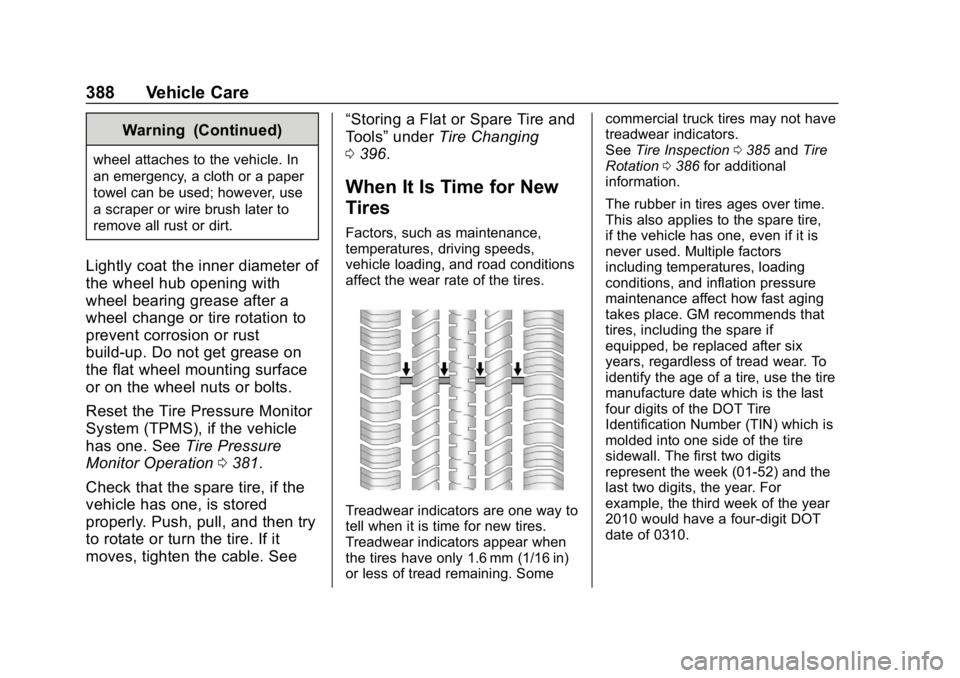
Treadwear indicators are one way to
tell when it is time for new tires.
Treadwear indicators appear when
the tires have only 1.6 mm (1/16 in)
or less of tread remaining. Some commercial truck tires may not have
treadwear indicators.
See
Tire Inspection 0385 andTire
Rotation 0386 for additional
information.
The rubber in tires ages over time.
This also applies to the spare tire,
if the vehicle has one, even if it is
never used. Multiple factors
including temperatures, loading
conditions, and inflation pressure
maintenance affect how fast aging
takes place. GM recommends that
tires, including the spare if
equipped, be replaced after six
years, regardless of tread wear. To
identify the age of a tire, use the tire
manufacture date which is the last
four digits of the DOT Tire
Identification Number (TIN) which is
molded into one side of the tire
sidewall. The first two digits
represent the week (01-52) and the
last two digits, the year. For
example, the third week of the year
2010 would have a four-digit DOT
date of 0310.
Page 390 of 489
Chevrolet Silverado LD 1500 and Silverado 2500/3500 Owner Manual (GMNA-
Localizing-U.S./Canada-12162993) - 2019 - crc - 4/4/18
Vehicle Care 389
Vehicle Storage
Tires age when stored normally
mounted on a parked vehicle. Park
a vehicle that will be stored for at
least a month in a cool, dry, clean
area away from direct sunlight to
slow aging. This area should be free
of grease, gasoline, or other
substances that can deteriorate
rubber.
Parking for an extended period can
cause flat spots on the tires that
may result in vibrations while
driving. When storing a vehicle for
at least a month, remove the tires or
raise the vehicle to reduce the
weight from the tires.
Buying New Tires
GM has developed and matched
specific tires for the vehicle. The
original equipment tires installed
were designed to meet General
Motors Tire Performance Criteria
Specification (TPC Spec)
system rating. When
replacement tires are needed,GM strongly recommends
buying tires with the same TPC
Spec rating.
GM's exclusive TPC Spec
system considers over a dozen
critical specifications that impact
the overall performance of the
vehicle, including brake system
performance, ride and handling,
traction control, and tire
pressure monitoring
performance. GM's TPC Spec
number is molded onto the tire's
sidewall near the tire size. If the
tires have an all-season tread
design, the TPC Spec number
will be followed by MS for mud
and snow. See
Tire Sidewall
Labeling 0372 for additional
information.
GM recommends replacing worn
tires in complete sets of four (six
for dual rear wheels). Uniform
tread depth on all tires will help
to maintain the performance of
the vehicle. Braking and handling performance may be
adversely affected if all the tires
are not replaced at the same
time. If proper rotation and
maintenance have been done,
all four tires (six for dual rear
wheels) should wear out at
about the same time. See
Tire
Rotation 0386 for information
on proper tire rotation. However,
if it is necessary to replace only
one axle set of worn tires, place
the new tires on the rear axle
(two for single rear wheels, four
for dual rear wheels).
{Warning
Tires could explode during
improper service. Attempting
to mount or dismount a tire
could cause injury or death.
Only your dealer or authorized
tire service center should
mount or dismount the tires.
Page 392 of 489
Chevrolet Silverado LD 1500 and Silverado 2500/3500 Owner Manual (GMNA-
Localizing-U.S./Canada-12162993) - 2019 - crc - 4/4/18
Vehicle Care 391
or All-Wheel Drive, the performance
of these systems can also be
affected.
{Warning
If different sized wheels are used,
there may not be an acceptable
level of performance and safety if
tires not recommended for those
wheels are selected. This
increases the chance of a crash
and serious injury. Only use GM
specific wheel and tire systems
developed for the vehicle, and
have them properly installed by a
GM certified technician.
See Buying New Tires 0389 and
Accessories and Modifications
0 325.
Uniform Tire Quality
Grading
The following information relates
to the system developed by the
United States National Highway
Traffic Safety Administration (NHTSA), which grades tires by
treadwear, traction, and
temperature performance. This
applies only to vehicles sold in
the United States. The grades
are molded on the sidewalls of
most passenger car tires. The
Uniform Tire Quality Grading
(UTQG) system does not apply
to deep tread, winter tires,
compact spare tires, tires with
nominal rim diameters of
10 to 12 inches (25 to 30 cm),
or to some limited-production
tires.
While the tires available on
General Motors passenger cars
and light trucks may vary with
respect to these grades, they
must also conform to federal
safety requirements and
additional General Motors Tire
Performance Criteria (TPC)
standards.
Quality grades can be found
where applicable on the tire
sidewall between tread shoulder
and maximum section width. For
example:
Treadwear 200 Traction AA
Temperature A
All Passenger Car Tires Must
Conform to Federal Safety
Requirements In Addition To
These Grades.
Treadwear
The treadwear grade is a
comparative rating based on the
wear rate of the tire when tested
under controlled conditions on a
specified government test
course. For example, a tire
graded 150 would wear one and
one-half (1½) times as well on
the government course as a tire
graded 100. The relative
performance of tires depends
upon the actual conditions of
their use, however, and may
depart significantly from the
Page 393 of 489
Chevrolet Silverado LD 1500 and Silverado 2500/3500 Owner Manual (GMNA-
Localizing-U.S./Canada-12162993) - 2019 - crc - 4/4/18
392 Vehicle Care
norm due to variations in driving
habits, service practices and
differences in road
characteristics and climate.
Traction
The traction grades, from
highest to lowest, are AA, A, B,
and C. Those grades represent
the tire's ability to stop on wet
pavement as measured under
controlled conditions on
specified government test
surfaces of asphalt and
concrete. A tire marked C may
have poor traction performance.
Warning: The traction grade
assigned to this tire is based on
straight-ahead braking traction
tests, and does not include
acceleration, cornering,
hydroplaning, or peak traction
characteristics.Temperature
The temperature grades are A
(the highest), B, and C,
representing the tire's resistance
to the generation of heat and its
ability to dissipate heat when
tested under controlled
conditions on a specified indoor
laboratory test wheel. Sustained
high temperature can cause the
material of the tire to degenerate
and reduce tire life, and
excessive temperature can lead
to sudden tire failure. The grade
C corresponds to a level of
performance which all
passenger car tires must meet
under the Federal Motor Safety
Standard No. 109. Grades B and
A represent higher levels of
performance on the laboratory
test wheel than the minimum
required by law. Warning: The
temperature grade for this tire is
established for a tire that is
properly inflated and not
overloaded. Excessive speed,underinflation, or excessive
loading, either separately or in
combination, can cause heat
buildup and possible tire failure.
Wheel Alignment and Tire
Balance
The tires and wheels were aligned
and balanced at the factory to
provide the longest tire life and best
overall performance. Adjustments to
wheel alignment and tire balancing
are not necessary on a regular
basis. Consider an alignment check
if there is unusual tire wear or the
vehicle is significantly pulling to one
side or the other. Some slight pull to
the left or right, depending on the
crown of the road and/or other road
surface variations such as troughs
or ruts, is normal. If the vehicle is
vibrating when driving on a smooth
road, the tires and wheels may need
to be rebalanced. See your dealer
for proper diagnosis.
Page 411 of 489
Chevrolet Silverado LD 1500 and Silverado 2500/3500 Owner Manual (GMNA-
Localizing-U.S./Canada-12162993) - 2019 - crc - 4/4/18
410 Vehicle Care
{Warning
Using a match near a battery can
cause battery gas to explode.
People have been hurt doing this,
and some have been blinded.
Use a flashlight if you need more
light.
Battery fluid contains acid that
can burn you. Do not get it on
you. If you accidentally get it in
your eyes or on your skin, flush
the place with water and get
medical help immediately.
{Warning
Fans or other moving engine
parts can injure you badly. Keep
your hands away from moving
parts once the engine is running.6. Check that the jumper cables
do not have loose or missing
insulation. If they do, you could
get a shock. The vehicles
could be damaged too.
Before you connect the cables,
here are some basic things you
should know. Positive (+) will
go to positive (+) or to a remote
positive (+) terminal if the
vehicle has one. Negative (−)
will go to a heavy, unpainted
metal engine part or to a
remote negative (−) terminal if
the vehicle has one.
Do not connect positive (+) to
negative (−) or you will get a
short that would damage the
battery and maybe other parts
too. And do not connect the
negative (−) cable to the
negative (−) terminal on the
dead battery because this can
cause sparks.
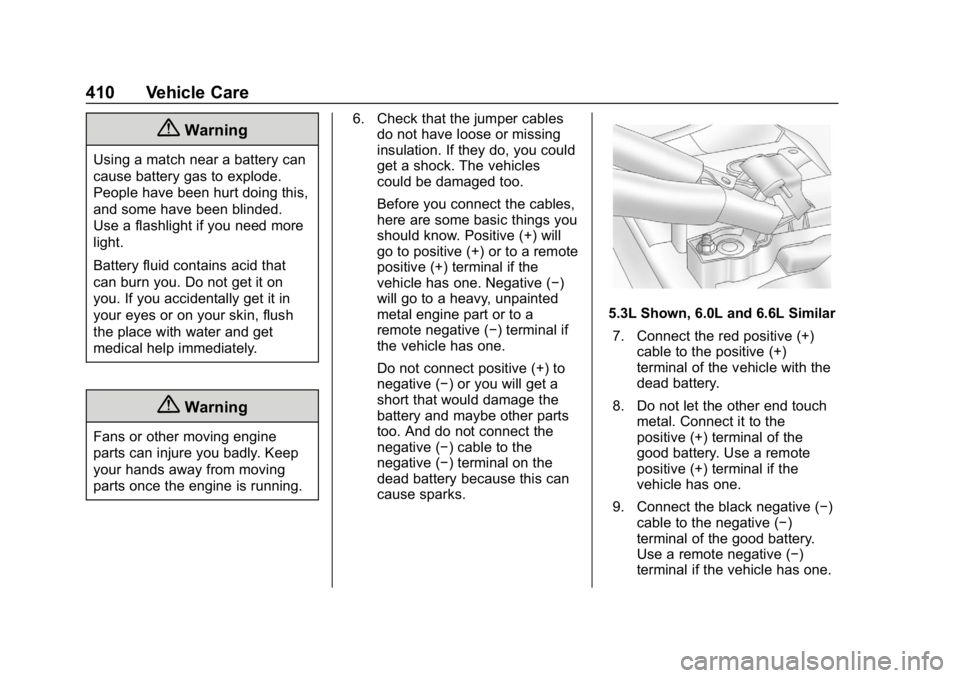
5.3L Shown, 6.0L and 6.6L Similar
7. Connect the red positive (+) cable to the positive (+)
terminal of the vehicle with the
dead battery.
8. Do not let the other end touch metal. Connect it to the
positive (+) terminal of the
good battery. Use a remote
positive (+) terminal if the
vehicle has one.
9. Connect the black negative (−) cable to the negative (−)
terminal of the good battery.
Use a remote negative (−)
terminal if the vehicle has one.
Page 419 of 489
Chevrolet Silverado LD 1500 and Silverado 2500/3500 Owner Manual (GMNA-
Localizing-U.S./Canada-12162993) - 2019 - crc - 4/4/18
418 Vehicle Care
Appearance Care
Exterior Care
Locks
Locks are lubricated at the factory.
Use a de-icing agent only when
absolutely necessary, and have the
locks greased after using. See
Recommended Fluids and
Lubricants0440.
Washing the Vehicle
To preserve the vehicle's finish,
wash it often and out of direct
sunlight.
{Warning
Do not power wash any part of
the vehicle’s interior, including the
vinyl floor covering. This could
damage safety and other systems
in the vehicle, which would not be
covered by the vehicle warranty.
Caution
Do not use petroleum-based,
acidic, or abrasive cleaning
agents as they can damage the
vehicle's paint, metal, or plastic
parts. If damage occurs, it would
not be covered by the vehicle
warranty. Approved cleaning
products can be obtained from
your dealer. Follow all
manufacturer directions regarding
correct product usage, necessary
safety precautions, and
appropriate disposal of any
vehicle care product.
Caution
Avoid using high-pressure
washes closer than 30 cm (12 in)
to the surface of the vehicle. Use
of power washers exceeding
8,274 kPa (1,200 psi) can result
in damage or removal of paint
and decals.
Caution
Do not power wash any
component under the hood that
has this
esymbol.
This could cause damage that
would not be covered by the
vehicle warranty.
If using an automatic car wash,
follow with the car wash
instructions. The windshield wiper
and rear window wiper, if equipped,
must be turned off. Remove any
accessories that may be damaged
or interfere with the car wash
equipment.
See Power Assist Steps 042 for
cleaning information.
Rinse the vehicle well, before
washing and after, to remove all
cleaning agents completely. If they
are allowed to dry on the surface,
they could stain.
Page 477 of 489

Chevrolet Silverado LD 1500 and Silverado 2500/3500 Owner Manual (GMNA-
Localizing-U.S./Canada-12162993) - 2019 - crc - 4/4/18
476 Index
Antilock Brake System (ABS) . . . 270Warning Light . . . . . . . . . . . . . . . . . 149
Appearance Care Exterior . . . . . . . . . . . . . . . . . . . . . . . 418
Interior . . . . . . . . . . . . . . . . . . . . . . . . 423
Apple CarPlay and Android Auto . . . . . . . . . . . . . . . . . . 209
Assistance Program, Roadside . . . . . . . . . . . . . . . . . . . . . . 453
Assistance Systems for Driving . . . . . . . . . . . . . . . . . . . . . . . . 282
Assistance Systems for Parking and Backing . . . . . . . . . . 280
Audio Bluetooth . . . . . . . . . . . . . . . . . . . . . 196
Theft-Deterrent Feature . . . . . . . 182
Automatic Dimming Mirrors . . . . . . . . . . . . . . . . 48
Door Locks . . . . . . . . . . . . . . . . . . . . . 40
Forward Braking . . . . . . . . . . . . . . 285
Headlamp System . . . . . . . . . . . . 174
Transmission . . . . . . . . . . . . . . . . . 256
Transmission Fluid . . . . . . 335, 337
Automatic Transmission Manual Mode . . . . . . . . . . . . . . . . . 259
Shift Lock Control Function
Check . . . . . . . . . . . . . . . . . . . . . . . 354 Auxiliary
Roof Mounted Lamp . . . . . . . . . . 176
Auxiliary Jack . . . . . . . . . . . . . . . . . . . 195
Avoiding Untrusted Media Devices . . . . . . . . . . . . . . . . . . . . . . . 190
Axle, Front . . . . . . . . . . . . . . . . . . . . . . 350
Axle, Rear . . . . . . . . . . . . . . . . . . . . . . 351
B
Battery Exterior Lighting BatterySaver . . . . . . . . . . . . . . . . . . . . . . . 180
Load Management . . . . . . . . . . . . 179
Power Protection . . . . . . . . . . . . . 180
Battery - North America . . . . 349, 408
Blade Replacement, Wiper . . . . . 355
Blind Spot Mirrors . . . . . . . . . . . . . . . 48
Bluetooth Overview . . . . . . . . . . . . . . . . 203, 205
Bluetooth Audio . . . . . . . . . . . . . . . . 196
Brake Pedal and AdjustableThrottle . . . . . . . . . . . . . . . . . . . . . . 246
System Warning Light . . . . . . . . 148
Brakes . . . . . . . . . . . . . . . . . . . . . . . . . . 347 Antilock . . . . . . . . . . . . . . . . . . . . . . . 270
Assist . . . . . . . . . . . . . . . . . . . . . . . . . 272
Fluid . . . . . . . . . . . . . . . . . . . . . . . . . . 348 Brakes (cont'd)
Parking . . . . . . . . . . . . . . . . . . . . . . . 271
Braking . . . . . . . . . . . . . . . . . . . . . . . . . 227 Automatic Forward . . . . . . . . . . . 285
Break-In, New Vehicle . . . . . . . . . . 246
Bulb Replacement Center High-MountedStoplamp (CHMSL) and
Cargo Lamp . . . . . . . . . . . . . . . . . 361
Fog Lamps . . . . . . . . . . . . . . . . . . . 359
Halogen Bulbs . . . . . . . . . . . . . . . . 357
Headlamp Aiming . . . . . . . . . . . . . 357
Headlamps . . . . . . . . . . . . . . . . . . . 357
Headlamps, Front Turn Signal, Sidemarker, and
Parking Lamps . . . . . . . . . . . . . . 358
High Intensity Discharge (HID) Lighting . . . . . . . . . . . . . . . 358
Taillamps . . . . . . . . . . . . . . . . . . . . . 359
Taillamps, Turn Signal, Stoplamps, and Back-up
Lamps . . . . . . . . . . . . . . . . . . . . . . 359
Buying New Tires . . . . . . . . . . . . . . . 389
C
Calibration . . . . . . . . . . . . . . . . . . . . . . 129
Page 478 of 489

Chevrolet Silverado LD 1500 and Silverado 2500/3500 Owner Manual (GMNA-
Localizing-U.S./Canada-12162993) - 2019 - crc - 4/4/18
Index 477
CaliforniaPerchlorate Materials
Requirements . . . . . . . . . . . . . . . 325
California Proposition
65 Warning . . . . . . . . . .325, 349, 408, Back Cover
Canadian Vehicle Owners . . . . . . . . 2
Capacities and Specifications . . . . . . . . . . . . . . . . . 446
Carbon Monoxide
Engine Exhaust . . . . . . . . . . . . . . . 255
Tailgate . . . . . . . . . . . . . . . . . . . . . . . . . 42
Winter Driving . . . . . . . . . . . . . . . . 236
Cargo Tie-Downs . . . . . . . . . . . . . . . . . . . . 124
Caution, Danger, and Warning . . . . 3
Center Console Storage . . . . . . . . 123
Center High-Mounted Stoplamp (CHMSL) and
Cargo Lamp . . . . . . . . . . . . . . . . . . . 361
Center Seat . . . . . . . . . . . . . . . . . . . . . 57
Chains, Tire . . . . . . . . . . . . . . . . . . . . 394
Charging Wireless . . . . . . . . . . . . . . . . . . . . . . 132
Charging System Light . . . . . . . . . 146 Check
Engine Light (Malfunction
Indicator) . . . . . . . . . . . . . . . . . . . . 146
Ignition Transmission Lock . . . 354
Child Restraints Infants and Young Children . . . . . 92
Lower Anchors and Tethersfor Children . . . . . . . . . . . . . . . . . . . 98
Older Children . . . . . . . . . . . . . . . . . . 91
Securing . . . . . . . . . . . . . . . . . .110, 113
Systems . . . . . . . . . . . . . . . . . . . . . . . . 95
Circuit Breakers . . . . . . . . . . . . . . . . 362
Cleaning Exterior Care . . . . . . . . . . . . . . . . . 418
Interior Care . . . . . . . . . . . . . . . . . . 423
Climate Control
Systems . . . . . . . . . . . . . . . . . 216, 218
Air Conditioning . . . . . . . . . 216, 218
Dual Automatic . . . . . . . . . . . . . . . 220
Heating . . . . . . . . . . . . . . . . . . 216, 218
Clock . . . . . . . . . . . . . . . . . . . . . . . . . . . 130
Cluster, Instrument . . . . . . . . . . . . . 136
Collision Damage Repair . . . . . . . 456
Compartments Storage . . . . . . . . . . . . . . . . . . . . . . . 122
Compass . . . . . . . . . . . . . . . . . . . . . . . 129
Connected Services Connections . . . . . . . . . . . . . . . . . . 472 Connected Services (cont'd)
Diagnostics . . . . . . . . . . . . . . . . . . . 474
Navigation . . . . . . . . . . . . . . . . . . . . 471
Connections
Connected Services . . . . . . . . . . 472
Control Hill Descent . . . . . . . . . . . . . . . . . . 275
Traction and ElectronicStability . . . . . . . . . . . . . . . . . . . . . 273
Control Light Hill Descent . . . . . . . . . . . . . . . . . . 150
Control of a Vehicle . . . . . . . . . . . . . 227
Convex Mirrors . . . . . . . . . . . . . . . . . . 45
Coolant Engine Temperature Gauge . . 141
Cooling . . . . . . . . . . . . . . .216, 218, 220
Cooling System . . . . . . . . . . . . . . . . . 339
Courtesy Transportation Program . . . . . . . . . . . . . . . . . . . . . . . 455
Cruise Control . . . . . . . . . . . . . . . . . . 276 Light . . . . . . . . . . . . . . . . . . . . . . . . . . 154
Cupholders . . . . . . . . . . . . . . . . . . . . . 123
Customer Assistance . . . . . . . . . . . 452 Offices . . . . . . . . . . . . . . . . . . . . . . . . 451
Text Telephone (TTY)Users . . . . . . . . . . . . . . . . . . . . . . . 452