belt CHEVROLET SILVERADO 2500 2019 Service Manual
[x] Cancel search | Manufacturer: CHEVROLET, Model Year: 2019, Model line: SILVERADO 2500, Model: CHEVROLET SILVERADO 2500 2019Pages: 489, PDF Size: 6.81 MB
Page 104 of 489
Chevrolet Silverado LD 1500 and Silverado 2500/3500 Owner Manual (GMNA-
Localizing-U.S./Canada-12162993) - 2019 - crc - 4/4/18
Seats and Restraints 103
Warning (Continued)
tightened around a child’s neck,
the only way to loosen the belt is
to cut it.
Buckle any unused seat belts
behind the child restraint so
children cannot reach them. Pull
the shoulder belt all the way out
of the retractor to set the lock,
and tighten the belt behind the
child restraint after the child
restraint has been installed.
Caution
Do not let the LATCH
attachments rub against the
vehicle’s seat belts. This may
damage these parts. If necessary,
move buckled seat belts to avoid
rubbing the LATCH attachments.(Continued)
Caution (Continued)
Do not fold the rear seatback
when the seat is occupied. Do not
fold the empty rear seat with a
seat belt buckled. This could
damage the seat belt or the seat.
Unbuckle and return the seat belt
to its stowed position, before
folding the seat.
If you need to secure more than one
child restraint in the rear seat, see
Where to Put the Restraint 096.
Regular Cab Models 1. For models without a rear seat, forward-facing child restraints
should only be installed in the
right front seating position with
belts and a top tether.
See Securing Child Restraints
(With the Seat Belt in the
Center Front Seat) 0113 or
Securing Child Restraints (With
the Seat Belt in the Rear Seat)
0 110 orSecuring Child
Restraints (With the Seat Belt
in the Front Seat) 0113. If the child restraint
manufacturer recommends that
the top tether be attached,
attach and tighten the top
tether to the top tether anchor,
if your vehicle has one. Refer
to the child restraint
instructions and the following
steps:
1.1. Fold the passenger
seatback forward to
access the top tether
anchor. See Reclining
Seatbacks 059.
1.2. Find the top tether anchor.
1.3. Remove the cover to expose the anchor.
1.4. Route, attach, and tighten the top tether according
to your child restraint
instructions and the
following instructions:
Page 105 of 489
Chevrolet Silverado LD 1500 and Silverado 2500/3500 Owner Manual (GMNA-
Localizing-U.S./Canada-12162993) - 2019 - crc - 4/4/18
104 Seats and Restraints
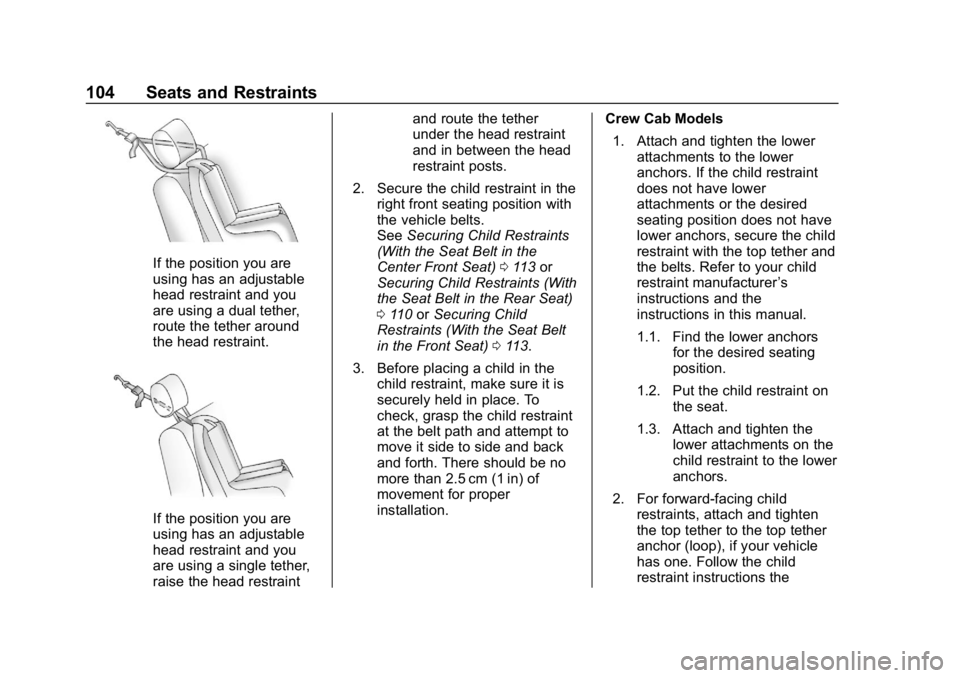
If the position you are
using has an adjustable
head restraint and you
are using a dual tether,
route the tether around
the head restraint.
If the position you are
using has an adjustable
head restraint and you
are using a single tether,
raise the head restraintand route the tether
under the head restraint
and in between the head
restraint posts.
2. Secure the child restraint in the right front seating position with
the vehicle belts.
See Securing Child Restraints
(With the Seat Belt in the
Center Front Seat) 0113 or
Securing Child Restraints (With
the Seat Belt in the Rear Seat)
0 110 orSecuring Child
Restraints (With the Seat Belt
in the Front Seat) 0113.
3. Before placing a child in the child restraint, make sure it is
securely held in place. To
check, grasp the child restraint
at the belt path and attempt to
move it side to side and back
and forth. There should be no
more than 2.5 cm (1 in) of
movement for proper
installation. Crew Cab Models
1. Attach and tighten the lower attachments to the lower
anchors. If the child restraint
does not have lower
attachments or the desired
seating position does not have
lower anchors, secure the child
restraint with the top tether and
the belts. Refer to your child
restraint manufacturer ’s
instructions and the
instructions in this manual.
1.1. Find the lower anchors for the desired seating
position.
1.2. Put the child restraint on the seat.
1.3. Attach and tighten the lower attachments on the
child restraint to the lower
anchors.
2. For forward-facing child restraints, attach and tighten
the top tether to the top tether
anchor (loop), if your vehicle
has one. Follow the child
restraint instructions the
Page 106 of 489
Chevrolet Silverado LD 1500 and Silverado 2500/3500 Owner Manual (GMNA-
Localizing-U.S./Canada-12162993) - 2019 - crc - 4/4/18
Seats and Restraints 105
vehicle LATCH anchor weight
limits described at the
beginning of this section, and
the following steps:
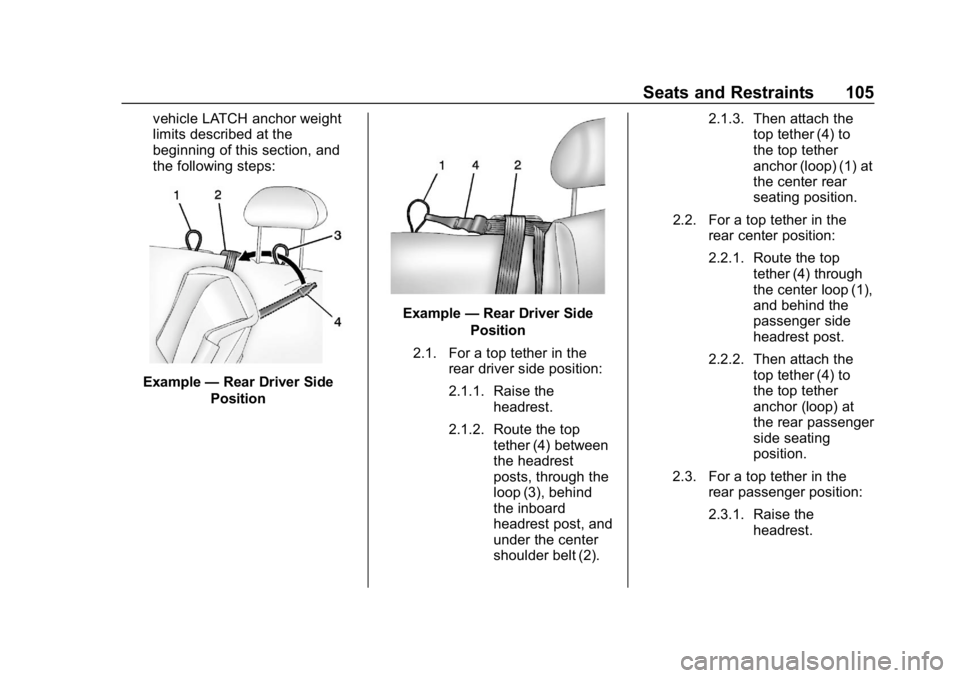
Example—Rear Driver Side
Position
Example —Rear Driver Side
Position
2.1. For a top tether in the rear driver side position:
2.1.1. Raise the headrest.
2.1.2. Route the top tether (4) between
the headrest
posts, through the
loop (3), behind
the inboard
headrest post, and
under the center
shoulder belt (2). 2.1.3. Then attach the
top tether (4) to
the top tether
anchor (loop) (1) at
the center rear
seating position.
2.2. For a top tether in the rear center position:
2.2.1. Route the top tether (4) through
the center loop (1),
and behind the
passenger side
headrest post.
2.2.2. Then attach the top tether (4) to
the top tether
anchor (loop) at
the rear passenger
side seating
position.
2.3. For a top tether in the rear passenger position:
2.3.1. Raise the headrest.
Page 107 of 489
Chevrolet Silverado LD 1500 and Silverado 2500/3500 Owner Manual (GMNA-
Localizing-U.S./Canada-12162993) - 2019 - crc - 4/4/18
106 Seats and Restraints
2.3.2. Route the toptether (4) between
the headrest
posts, through the
loop on the
passenger side
and behind the
inboard
headrest post.
2.3.3. Then attach the top tether (4) to
the top tether
anchor (loop) (1) at
the center rear
seating position.
3. Tighten the top tether per the child restraint manufacturer's
instructions.
When the top tether is properly
tightened, the anchor (loop)
may bend. This is normal and
will not damage the vehicle.
If child restraints are installed
in both outboard positions, both
top tethers can be attached to
the center loop. Top tethers
can be attached for child
restraints in all three rear seating positions at the same
time, following the routing
instructions above.
4. Before placing a child in the child restraint, make sure it is
securely held in place. To
check, grasp the child restraint
at the LATCH path and attempt
to move it side to side and
back and forth. There should
be no more than 2.5 cm (1 in)
of movement for proper
installation.
Double Cab Models 1. Remove the headrest prior to installing a forward-facing child
restraint in an outboard rear
seating position. See “Headrest
Removal and Reinstallation” at
the end of this section.
2. Attach and tighten the lower attachments to the lower
anchors. If the child restraint
does not have lower
attachments or the desired
seating position does not have
lower anchors, secure the child
restraint with the top tether and the belts. Refer to your child
restraint manufacturer
’s
instructions and the
instructions in this manual.
2.1. Find the lower anchors for the desired seating
position.
2.2. Put the child restraint on the seat.
2.3. Attach and tighten the lower attachments on the
child restraint to the lower
anchors.
3. For forward-facing child restraints, attach and tighten
the top tether to the top tether
anchor (loop). Follow the child
restraint instructions, the
vehicle LATCH anchor weight
limits described at the
beginning of this section, and
the following steps:
Page 108 of 489
Chevrolet Silverado LD 1500 and Silverado 2500/3500 Owner Manual (GMNA-
Localizing-U.S./Canada-12162993) - 2019 - crc - 4/4/18
Seats and Restraints 107
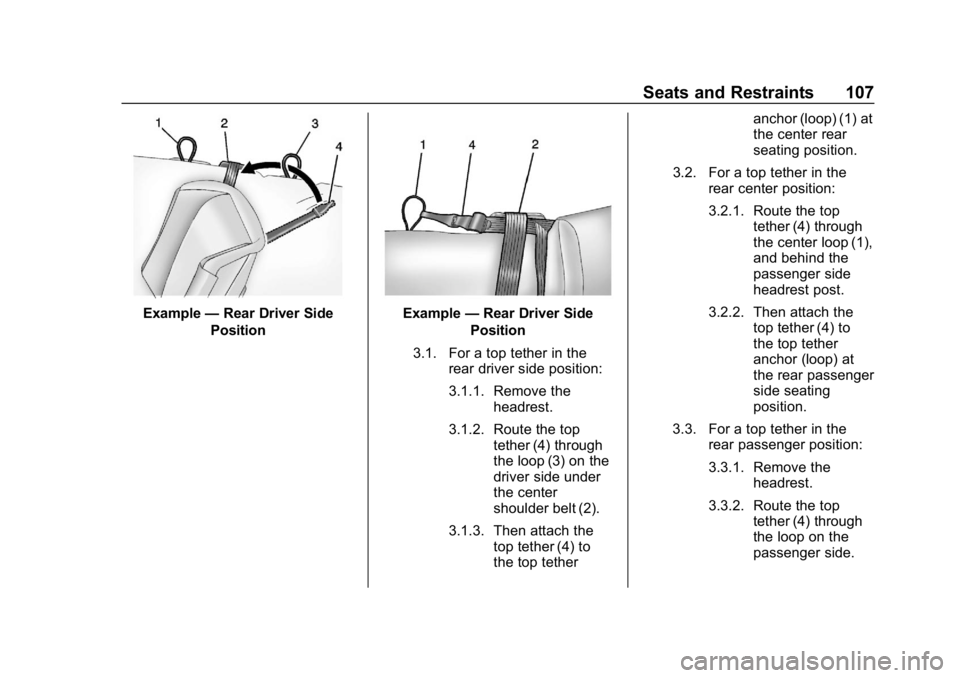
Example—Rear Driver Side
PositionExample —Rear Driver Side
Position
3.1. For a top tether in the rear driver side position:
3.1.1. Remove the headrest.
3.1.2. Route the top tether (4) through
the loop (3) on the
driver side under
the center
shoulder belt (2).
3.1.3. Then attach the top tether (4) to
the top tether anchor (loop) (1) at
the center rear
seating position.
3.2. For a top tether in the rear center position:
3.2.1. Route the top tether (4) through
the center loop (1),
and behind the
passenger side
headrest post.
3.2.2. Then attach the top tether (4) to
the top tether
anchor (loop) at
the rear passenger
side seating
position.
3.3. For a top tether in the rear passenger position:
3.3.1. Remove the
headrest.
3.3.2. Route the top tether (4) through
the loop on the
passenger side.
Page 111 of 489
Chevrolet Silverado LD 1500 and Silverado 2500/3500 Owner Manual (GMNA-
Localizing-U.S./Canada-12162993) - 2019 - crc - 4/4/18
110 Seats and Restraints
Securing Child Restraints
(With the Seat Belt in the
Rear Seat)
When securing a child restraint with
the seat belts in a rear seat position,
study the instructions that came with
the child restraint to make sure it is
compatible with this vehicle.
If the child restraint has the LATCH
system, seeLower Anchors and
Tethers for Children (LATCH
System) 098 for how and where to
install the child restraint using
LATCH. If a child restraint is secured
in the vehicle using a seat belt and
it uses a top tether, see Lower
Anchors and Tethers for Children
(LATCH System) 098 for top tether
anchor locations.
Do not secure a child seat in a
position without a top tether anchor
if a national or local law requires
that the top tether be anchored, or if
the instructions that come with the
child restraint say that the top tether
must be anchored. In Canada, the law requires that
forward-facing child restraints have
a top tether, and that the tether be
attached.
If the child restraint or vehicle seat
position does not have the LATCH
system, you will be using the seat
belt to secure the child restraint. Be
sure to follow the instructions that
came with the child restraint.
If more than one child restraint
needs to be installed in the rear
seat, be sure to read
Where to Put
the Restraint 096.
Double Cab
1. Remove the head restraint or
headrest prior to installing a
forward-facing child restraint in
an outboard rear seating
position. See “Head Restraint
or Headrest Removal and
Reinstallation” underLower
Anchors and Tethers for
Children (LATCH System) 098.
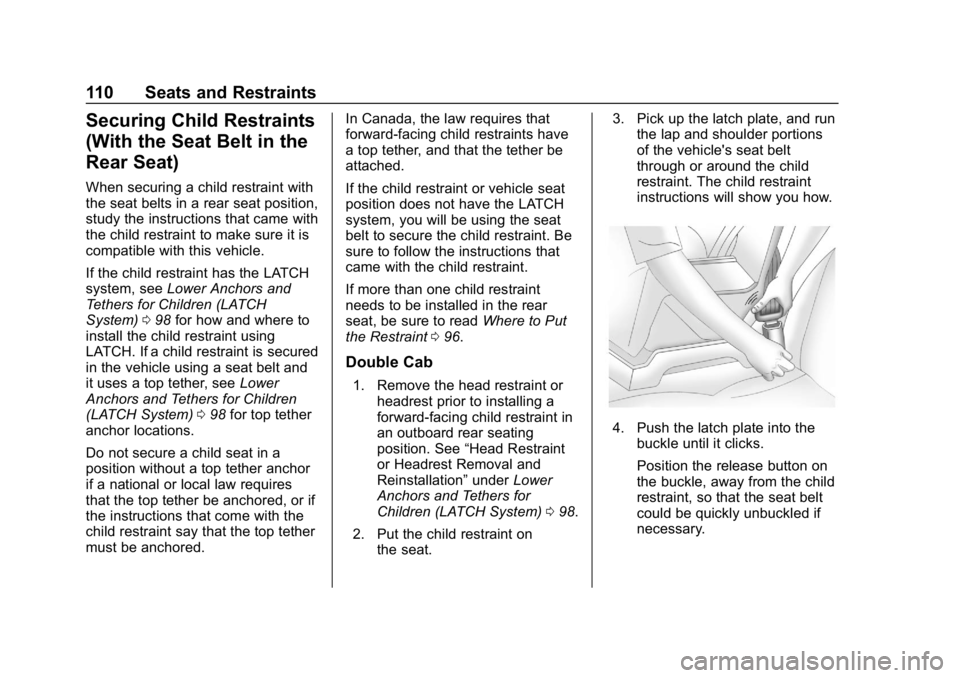
2. Put the child restraint on the seat. 3. Pick up the latch plate, and run
the lap and shoulder portions
of the vehicle's seat belt
through or around the child
restraint. The child restraint
instructions will show you how.
4. Push the latch plate into thebuckle until it clicks.
Position the release button on
the buckle, away from the child
restraint, so that the seat belt
could be quickly unbuckled if
necessary.
Page 112 of 489
Chevrolet Silverado LD 1500 and Silverado 2500/3500 Owner Manual (GMNA-
Localizing-U.S./Canada-12162993) - 2019 - crc - 4/4/18
Seats and Restraints 111
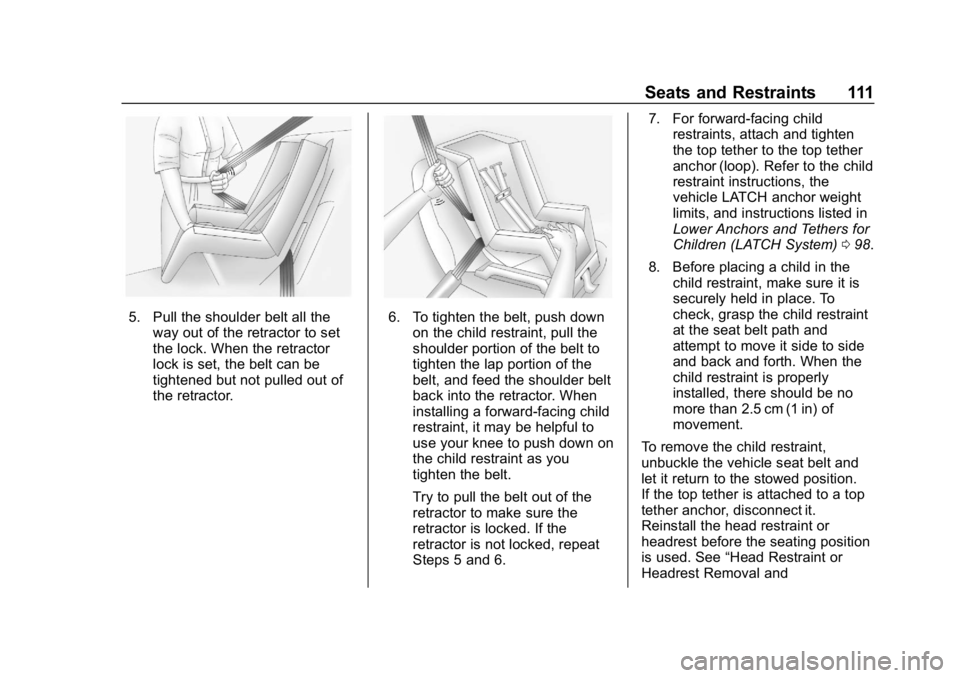
5. Pull the shoulder belt all theway out of the retractor to set
the lock. When the retractor
lock is set, the belt can be
tightened but not pulled out of
the retractor.6. To tighten the belt, push downon the child restraint, pull the
shoulder portion of the belt to
tighten the lap portion of the
belt, and feed the shoulder belt
back into the retractor. When
installing a forward-facing child
restraint, it may be helpful to
use your knee to push down on
the child restraint as you
tighten the belt.
Try to pull the belt out of the
retractor to make sure the
retractor is locked. If the
retractor is not locked, repeat
Steps 5 and 6. 7. For forward-facing child
restraints, attach and tighten
the top tether to the top tether
anchor (loop). Refer to the child
restraint instructions, the
vehicle LATCH anchor weight
limits, and instructions listed in
Lower Anchors and Tethers for
Children (LATCH System) 098.
8. Before placing a child in the child restraint, make sure it is
securely held in place. To
check, grasp the child restraint
at the seat belt path and
attempt to move it side to side
and back and forth. When the
child restraint is properly
installed, there should be no
more than 2.5 cm (1 in) of
movement.
To remove the child restraint,
unbuckle the vehicle seat belt and
let it return to the stowed position.
If the top tether is attached to a top
tether anchor, disconnect it.
Reinstall the head restraint or
headrest before the seating position
is used. See “Head Restraint or
Headrest Removal and
Page 113 of 489
Chevrolet Silverado LD 1500 and Silverado 2500/3500 Owner Manual (GMNA-
Localizing-U.S./Canada-12162993) - 2019 - crc - 4/4/18
112 Seats and Restraints
Reinstallation”underLower Anchors
and Tethers for Children (LATCH
System) 098 for additional
information on installing the
headrest properly.
Crew Cab
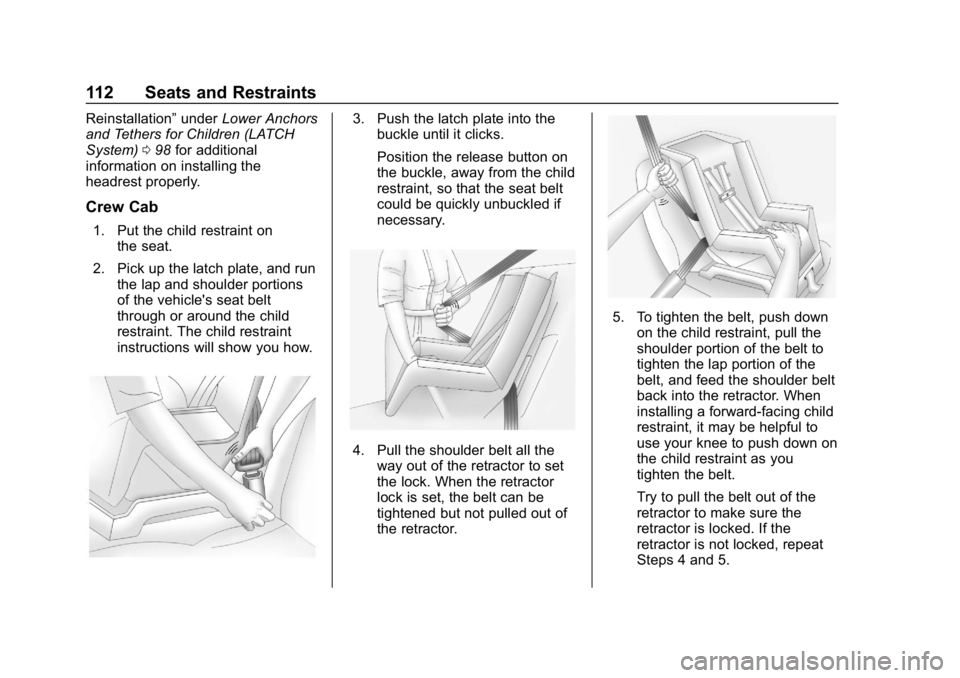
1. Put the child restraint on the seat.
2. Pick up the latch plate, and run the lap and shoulder portions
of the vehicle's seat belt
through or around the child
restraint. The child restraint
instructions will show you how.
3. Push the latch plate into thebuckle until it clicks.
Position the release button on
the buckle, away from the child
restraint, so that the seat belt
could be quickly unbuckled if
necessary.
4. Pull the shoulder belt all the
way out of the retractor to set
the lock. When the retractor
lock is set, the belt can be
tightened but not pulled out of
the retractor.
5. To tighten the belt, push downon the child restraint, pull the
shoulder portion of the belt to
tighten the lap portion of the
belt, and feed the shoulder belt
back into the retractor. When
installing a forward-facing child
restraint, it may be helpful to
use your knee to push down on
the child restraint as you
tighten the belt.
Try to pull the belt out of the
retractor to make sure the
retractor is locked. If the
retractor is not locked, repeat
Steps 4 and 5.
Page 114 of 489
Chevrolet Silverado LD 1500 and Silverado 2500/3500 Owner Manual (GMNA-
Localizing-U.S./Canada-12162993) - 2019 - crc - 4/4/18
Seats and Restraints 113
6. If the child restraint has a toptether, follow the child restraint
manufacturer's instructions
regarding the use of the top
tether. See Lower Anchors and
Tethers for Children (LATCH
System) 098 for more
information on using the top
tether anchors.
7. Before placing a child in the child restraint, make sure it is
securely held in place. To
check, grasp the child restraint
at the seat belt path and
attempt to move it side to side
and back and forth. When the
child restraint is properly
installed, there should be no
more than 2.5 cm (1 in) of
movement.
To remove the child restraint,
unbuckle the vehicle seat belt and
let it return to the stowed position.
If the top tether is attached to a top
tether anchor, disconnect it.
For outboard rear seating positions,
if the child restraint cannot be
installed properly with the head
restraint in place, the head restraint may be removed. See your dealer
for assistance with removal, and
store the removed head restraint in
a secure place. When the child
restraint is removed, reinstall the
head restraint before the seating
position is used. For reinstallation
instructions, see
“Head Restraint or
Headrest Removal and
Reinstallation” underLower Anchors
and Tethers for Children (LATCH
System) 098.
Securing Child Restraints
(With the Seat Belt in the
Center Front Seat)
{Warning
A child in a child restraint in the
center front seat can be badly
injured or killed by the frontal
airbags if they inflate. Never
secure a child restraint in the
center front seat. It is always
better to secure a child restraint in
a rear seat. Do not use child restraints in the
center front seat position.
Securing Child Restraints
(With the Seat Belt in the
Front Seat)
With Passenger Sensing
System
This vehicle has airbags. A rear
seat is a safer place to secure a
forward-facing child restraint. See
Where to Put the Restraint
096.
In addition, the vehicle may have a
passenger sensing system which is
designed to turn off the front
outboard passenger frontal airbag
under certain conditions.
See Passenger Sensing System
0 84 and Passenger Airbag Status
Indicator 0145 for more information,
including important safety
information.
Never put a rear-facing child
restraint in the front. This is because
the risk to the rear-facing child is so
great, if the airbag deploys.
Page 115 of 489
Chevrolet Silverado LD 1500 and Silverado 2500/3500 Owner Manual (GMNA-
Localizing-U.S./Canada-12162993) - 2019 - crc - 4/4/18
114 Seats and Restraints
{Warning
A child in a rear-facing child
restraint can be seriously injured
or killed if the front outboard
passenger airbag inflates. This is
because the back of the
rear-facing child restraint would
be very close to the inflating
airbag. A child in a forward-facing
child restraint can be seriously
injured or killed if the front
outboard passenger airbag
inflates and the passenger seat is
in a forward position.
The vehicle may have a
passenger sensing system which
is designed to turn off the front
outboard passenger frontal airbag
under certain conditions.
Even if the passenger sensing
system, if equipped, has turned
off the front outboard passenger
frontal airbag, no system is
fail-safe. No one can guarantee
that an airbag will not deploy(Continued)
Warning (Continued)
under some unusual
circumstance, even though it is
turned off.
Secure rear-facing child restraints
in a rear seat, even if the airbag
is off. If you secure a
forward-facing child restraint in
the front outboard passenger
seat, always move the seat as far
back as it will go. It is better to
secure the child restraint in a
rear seat.
SeePassenger Sensing System
0 84 for additional information.
If the vehicle does not have a rear
seat that will accommodate a
rear-facing child restraint, a
rear-facing child restraint should not
be installed in the vehicle, even if
the airbag is off.
If a child restraint uses a top tether,
see Lower Anchors and Tethers for
Children (LATCH System) 098 for
top tether anchor locations. Do not secure a child restraint in a
position without a top tether anchor
if a national or local law requires
that the top tether be anchored, or if
the instructions that come with the
child restraint say that the top tether
must be anchored.
In Canada, the law requires that
forward-facing child restraints have
a top tether, and that the tether be
attached.
When using the lap-shoulder belt to
secure the child restraint in this
position, follow the instructions that
came with the child restraint and the
following instructions:
1. Move the seat as far back as it will go before securing the
forward-facing child restraint.
Move the seat upward or the
seatback to an upright position,
if needed, to get a tight
installation of the child
restraint.
When the passenger sensing
system, if equipped, has turned
off the front outboard
passenger frontal airbag, the