park assist CHEVROLET SS 2016 User Guide
[x] Cancel search | Manufacturer: CHEVROLET, Model Year: 2016, Model line: SS, Model: CHEVROLET SS 2016Pages: 397, PDF Size: 7.17 MB
Page 251 of 397
Chevrolet SS Sedan Owner Manual (GMNA-Localizing-U.S.-9234782) - 2016 -
CRC - 8/24/15
250 Driving and Operating
The speedometer reading can be
displayed in either English or metric
units. SeeDriver Information Center
(DIC) 0105
ii. The increment value
used depends on the units
displayed.
Passing Another Vehicle While
Using Cruise Control
Use the accelerator pedal to
increase the vehicle speed. When
you take your foot off the pedal, the
vehicle slows down to the previously
set cruise control speed. While
pressing the accelerator pedal or
shortly following the release to
override cruise control, briefly
moving the thumbwheel toward
SET/– will result in cruise control set
to the current vehicle speed.
Using Cruise Control on Hills
How well the cruise control works
on hills depends upon the vehicle
speed, load, and the steepness of
the hills. When going up steep hills,
you might have to step on the
accelerator pedal to maintain the
vehicle speed. When going
downhill, you might have to brake or
shift to a lower gear to keep your speed down. If the brake pedal is
applied, cruise control will
disengage.
Ending Cruise Control
There are four ways to disengage
cruise control:
.
Step lightly on the brake pedal
or clutch for a manual
transmission.
. Press
*.
. Shift the transmission to
N (Neutral).
. To turn off the cruise control,
press
1.
Erasing Speed Memory
The cruise control set speed is
erased from memory if
1is pressed
or if the vehicle is turned off.
Driver Assistance
Systems
This vehicle may have features that
work together to help avoid crashes
or reduce crash damage while
driving, backing, and parking. Read
this entire section before using
these systems.
{Warning
Do not rely on the Driver
Assistance Systems. These
systems do not replace the need
for paying attention and driving
safely. You may not hear or see
alerts or warnings provided by
these systems. Failure to use
proper care when driving may
result in injury, death, or vehicle
damage. See Defensive Driving
0 215
ii.
(Continued)
ProCarManuals.com
Page 252 of 397
Chevrolet SS Sedan Owner Manual (GMNA-Localizing-U.S.-9234782) - 2016 -
CRC - 8/24/15
Driving and Operating 251
Warning (Continued)
Under many conditions, these
systems will not:. Detect children,
pedestrians, bicyclists,
or animals.
. Detect vehicles or objects
outside the area monitored
by the system.
. Work at all driving speeds.
. Warn you or provide you
with enough time to avoid a
crash.
. Work under poor visibility or
bad weather conditions.
. Work if the detection sensor
is not cleaned or is covered
by ice, snow, mud, or dirt.
Complete attention is always
required while driving, and you
should be ready to take action
and apply the brakes and/or steer
the vehicle to avoid crashes. Audible Alert
Some driver assistance features
alert the driver of obstacles by
beeping. To change the volume of
the warning chime, see
“Comfort
and Convenience” underVehicle
Personalization 0117
ii.
Assistance Systems for
Parking or Backing
If equipped, the Rear Vision Camera
(RVC), Rear Parking Assist (RPA),
Front Parking Assist (FPA), Rear
Cross Traffic Alert (RCTA), and
Automatic Parking Assist (APA) may
help the driver park or avoid objects.
Always check around the vehicle
when parking or backing.
Rear Vision Camera (RVC)
When the vehicle is shifted into
R (Reverse), the RVC displays an
image of the area behind the vehicle
in the center stack display. When
the vehicle is shifted out of
R (Reverse), the screen returns to
the previous content, after a short
delay. To see the previous content
sooner, press one of the radio buttons. If the message Service
Rear Camera System is displayed,
the vehicle may need service.
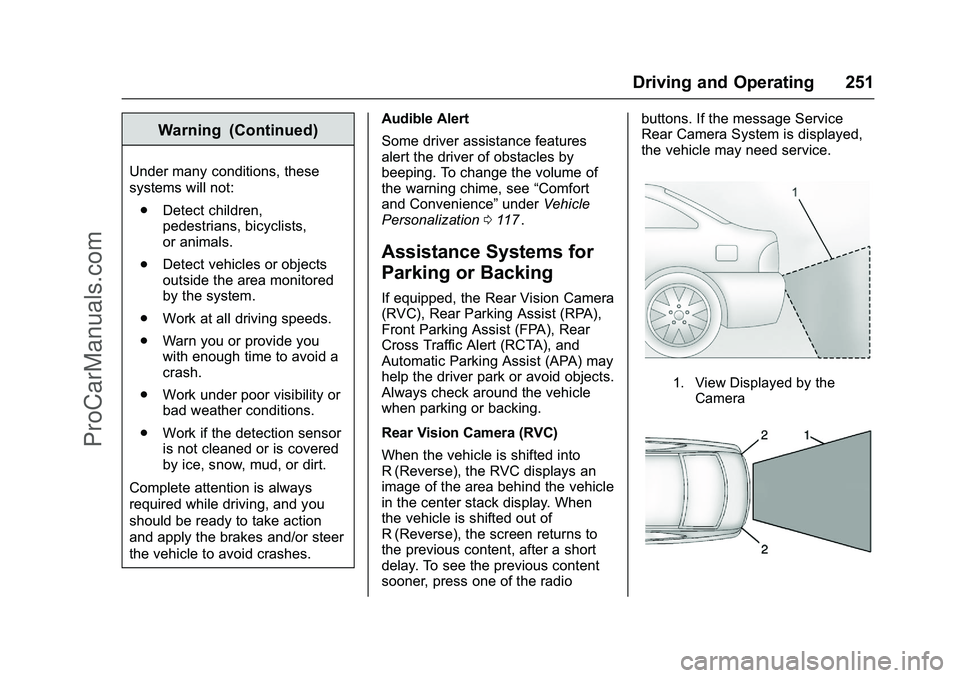
1. View Displayed by the
Camera
ProCarManuals.com
Page 253 of 397
Chevrolet SS Sedan Owner Manual (GMNA-Localizing-U.S.-9234782) - 2016 -
CRC - 8/24/15
252 Driving and Operating
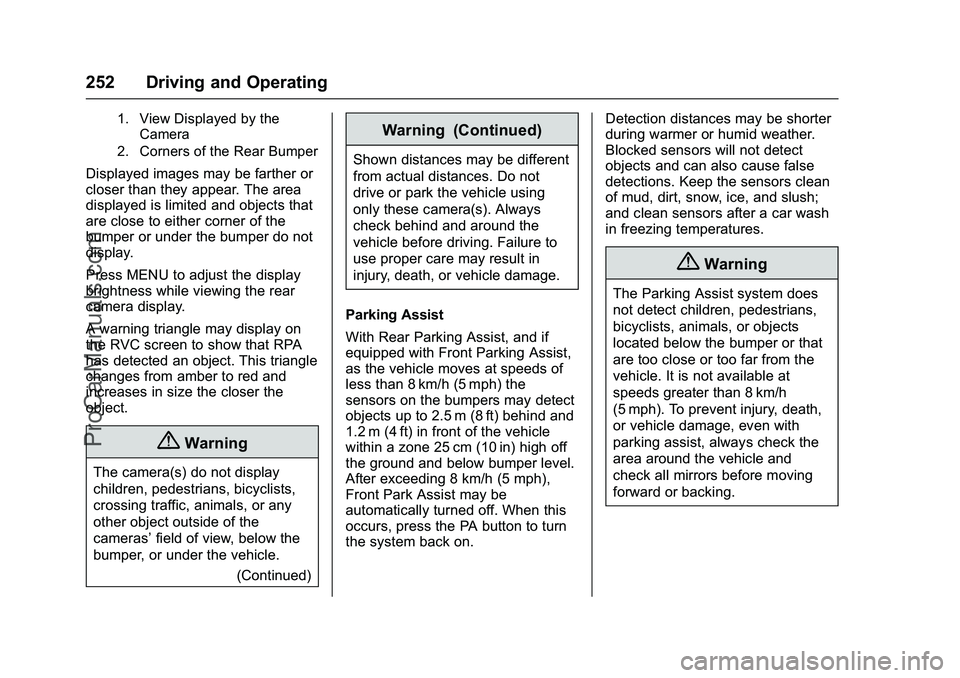
1. View Displayed by theCamera
2. Corners of the Rear Bumper
Displayed images may be farther or
closer than they appear. The area
displayed is limited and objects that
are close to either corner of the
bumper or under the bumper do not
display.
Press MENU to adjust the display
brightness while viewing the rear
camera display.
A warning triangle may display on
the RVC screen to show that RPA
has detected an object. This triangle
changes from amber to red and
increases in size the closer the
object.
{Warning
The camera(s) do not display
children, pedestrians, bicyclists,
crossing traffic, animals, or any
other object outside of the
cameras’ field of view, below the
bumper, or under the vehicle.
(Continued)
Warning (Continued)
Shown distances may be different
from actual distances. Do not
drive or park the vehicle using
only these camera(s). Always
check behind and around the
vehicle before driving. Failure to
use proper care may result in
injury, death, or vehicle damage.
Parking Assist
With Rear Parking Assist, and if
equipped with Front Parking Assist,
as the vehicle moves at speeds of
less than 8 km/h (5 mph) the
sensors on the bumpers may detect
objects up to 2.5 m (8 ft) behind and
1.2 m (4 ft) in front of the vehicle
within a zone 25 cm (10 in) high off
the ground and below bumper level.
After exceeding 8 km/h (5 mph),
Front Park Assist may be
automatically turned off. When this
occurs, press the PA button to turn
the system back on. Detection distances may be shorter
during warmer or humid weather.
Blocked sensors will not detect
objects and can also cause false
detections. Keep the sensors clean
of mud, dirt, snow, ice, and slush;
and clean sensors after a car wash
in freezing temperatures.
{Warning
The Parking Assist system does
not detect children, pedestrians,
bicyclists, animals, or objects
located below the bumper or that
are too close or too far from the
vehicle. It is not available at
speeds greater than 8 km/h
(5 mph). To prevent injury, death,
or vehicle damage, even with
parking assist, always check the
area around the vehicle and
check all mirrors before moving
forward or backing.
ProCarManuals.com
Page 254 of 397
Chevrolet SS Sedan Owner Manual (GMNA-Localizing-U.S.-9234782) - 2016 -
CRC - 8/24/15
Driving and Operating 253
An obstacle is indicated by audible
beeps. The interval between the
beeps becomes shorter as the
vehicle gets closer to the obstacle.
When the distance is less than
30 cm (12 in) the beeping is a
continuous tone for three seconds.
Beeps for Front Parking Assist are
higher pitched than for Rear Parking
Assist.
Rear Cross Traffic Alert (RCTA)
If equipped, RCTA displays a red
warning triangle with a left or right
pointing arrow on the RVC screen to
warn of traffic coming from the left
or right. This system detects objects
coming from up to 20 m (65 ft) from
the left or right side behind the
vehicle. When an object is detected
beeps sound from the left or right
side, depending on the direction of
the detected vehicle.Turning the Features On or Off
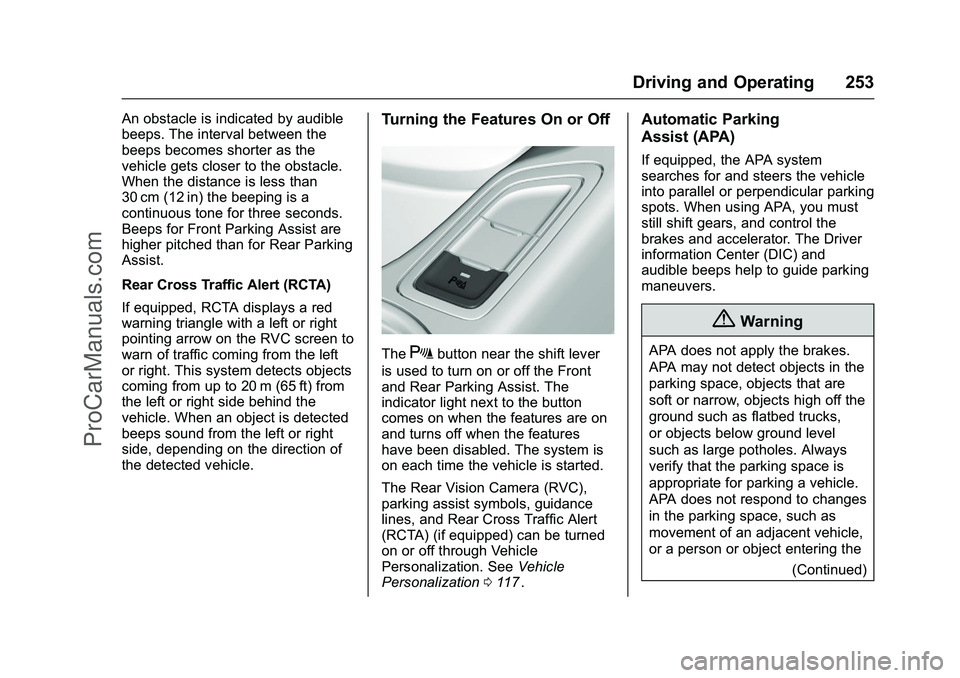
TheXbutton near the shift lever
is used to turn on or off the Front
and Rear Parking Assist. The
indicator light next to the button
comes on when the features are on
and turns off when the features
have been disabled. The system is
on each time the vehicle is started.
The Rear Vision Camera (RVC),
parking assist symbols, guidance
lines, and Rear Cross Traffic Alert
(RCTA) (if equipped) can be turned
on or off through Vehicle
Personalization. See Vehicle
Personalization 0117
ii.
Automatic Parking
Assist (APA)
If equipped, the APA system
searches for and steers the vehicle
into parallel or perpendicular parking
spots. When using APA, you must
still shift gears, and control the
brakes and accelerator. The Driver
information Center (DIC) and
audible beeps help to guide parking
maneuvers.
{Warning
APA does not apply the brakes.
APA may not detect objects in the
parking space, objects that are
soft or narrow, objects high off the
ground such as flatbed trucks,
or objects below ground level
such as large potholes. Always
verify that the parking space is
appropriate for parking a vehicle.
APA does not respond to changes
in the parking space, such as
movement of an adjacent vehicle,
or a person or object entering the
(Continued)
ProCarManuals.com
Page 256 of 397
Chevrolet SS Sedan Owner Manual (GMNA-Localizing-U.S.-9234782) - 2016 -
CRC - 8/28/15
Driving and Operating 255
wheel will vibrate briefly as a
reminder to remove hands from the
steering wheel. Check surroundings
and continue braking or accelerating
as needed, and be prepared to stop
to avoid vehicles, pedestrians,
or objects. If the vehicle is in
R (Reverse), but does not steer into
the expected space, this may be
because the system is maneuvering
the vehicle into a previously
detected space. The APA system
does not need service.
A DIC progress arrow displays the
status of the parking maneuver.
Depending on the space size,
additional maneuvers may be
required, and there will be additional
instructions. When changing gears,
allow the automatic steering to
complete before continuing the
parking maneuver. Upon completion
of a successful maneuver, APA will
beep and display a PARKING
COMPLETE message. Place the
vehicle in P (Park) for an automatic
transmission or in N (Neutral) with
the parking brake set for a manual
transmission.APA may automatically disengage if:
.
The steering wheel is used by
the driver.
. If the vehicle exceeds
10 km/h (6 mph).
. There is a failure with the APA
system.
. Electronic stability control or
antilock brakes are activated.
. An important vehicle message is
displayed in the DIC.
APA search is only available when
the vehicle speed is below 30 km/h
(18 mph).
The APA system is constantly
scanning for parking spaces when
the vehicle is moving forward.
A suitable space will be offered
even when the APA button is
pressed after the initial drive-by. The APA system is capable of
parking in subsequent spots after
the first parking space is found.
To cancel APA, press the APA
button again.
When the System Does Not Seem
to Work Properly
The APA system may require a
short period of driving along curves
to calibrate.
Assistance Systems for
Driving
If equipped, when driving the
vehicle in a forward gear, Forward
Collision Alert (FCA), Lane
Departure Warning (LDW), and Side
Blind Zone Alert (SBZA) can help to
avoid a crash or reduce crash
damage.
Forward Collision Alert
(FCA) System
If equipped, the FCA system may
help to avoid or reduce the harm
caused by front-end crashes. When
approaching a vehicle ahead too
ProCarManuals.com
Page 282 of 397
Chevrolet SS Sedan Owner Manual (GMNA-Localizing-U.S.-9234782) - 2016 -
CRC - 8/24/15
Vehicle Care 281
You may decide not to lift the hood
when this warning appears, but
instead get service help right away.
SeeRoadside Assistance Program
0 365
ii.
If you do decide to lift the hood,
make sure the vehicle is parked on
a level surface.
Then check to see if the engine
cooling fans are running. If the
engine is overheating, both fans
should be running. If they are not,
do not continue to run the engine
and have the vehicle serviced.
Caution
Running the engine without
coolant may cause damage or a
fire. Vehicle damage would not be
covered by the vehicle warranty.
If Steam is Coming from the
Engine Compartment
{Warning
Steam from an overheated engine
can burn you badly, even if you
just open the hood. Stay away
from the engine if you see or hear
steam coming from it. Just turn it
off and get everyone away from
the vehicle until it cools down.
Wait until there is no sign of
steam or coolant before you open
the hood.
If you keep driving when the
engine is overheated, the liquids
in it can catch fire. You or others
could be badly burned. Stop the
engine if it overheats, and get out
of the vehicle until the engine
is cool.
If No Steam is Coming from
the Engine Compartment
If an engine overheat warning is
displayed but no steam can be seen
or heard, the problem may not be too serious. Sometimes the engine
can get a little too hot when the
vehicle:
.
Climbs a long hill on a hot day.
. Stops after high-speed driving.
. Idles for long periods in traffic.
If the overheat warning is displayed
with no sign of steam: 1. Turn the air conditioning off.
2. Turn the heater on to the highest temperature and to the
highest fan speed. Open the
windows as necessary.
3. When it is safe to do so, pull off the road, shift to P (Park) or
N (Neutral), and let the
engine idle.
If the temperature overheat gauge is
no longer in the overheat zone or an
overheat warning no longer
displays, the vehicle can be driven.
Continue to drive the vehicle slowly
for about 10 minutes. Keep a safe
vehicle distance from the vehicle in
front. If the warning does not come
ProCarManuals.com
Page 299 of 397
Chevrolet SS Sedan Owner Manual (GMNA-Localizing-U.S.-9234782) - 2016 -
CRC - 8/24/15
298 Vehicle Care
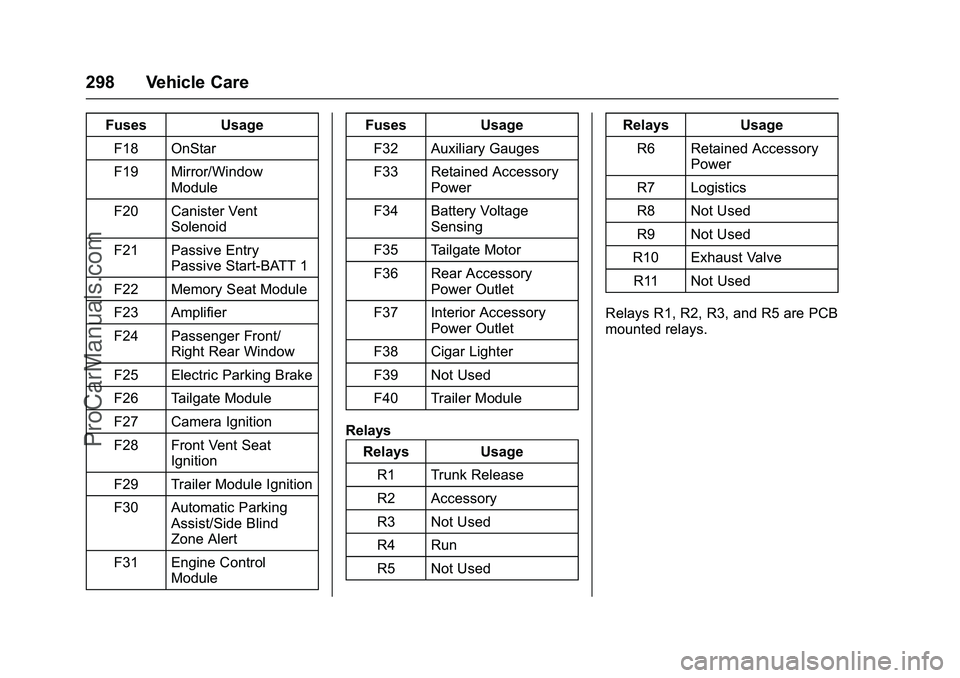
FusesUsage
F18 OnStar
F19 Mirror/Window Module
F20 Canister Vent Solenoid
F21 Passive Entry Passive Start-BATT 1
F22 Memory Seat Module
F23 Amplifier
F24 Passenger Front/ Right Rear Window
F25 Electric Parking Brake
F26 Tailgate Module
F27 Camera Ignition
F28 Front Vent Seat Ignition
F29 Trailer Module Ignition
F30 Automatic Parking Assist/Side Blind
Zone Alert
F31 Engine Control Module Fuses
Usage
F32 Auxiliary Gauges
F33 Retained Accessory Power
F34 Battery Voltage Sensing
F35 Tailgate Motor
F36 Rear Accessory Power Outlet
F37 Interior Accessory Power Outlet
F38 Cigar Lighter
F39 Not Used
F40 Trailer Module
Relays Relays Usage
R1 Trunk Release
R2 Accessory
R3 Not Used
R4 Run
R5 Not Used Relays
Usage
R6 Retained Accessory Power
R7 Logistics
R8 Not Used
R9 Not Used
R10 Exhaust Valve R11 Not Used
Relays R1, R2, R3, and R5 are PCB
mounted relays.
ProCarManuals.com
Page 320 of 397
Chevrolet SS Sedan Owner Manual (GMNA-Localizing-U.S.-9234782) - 2016 -
CRC - 8/24/15
Vehicle Care 319
Warning (Continued)
2. Put an automatictransmission in P (Park) or a
manual transmission in
1 (First) or R (Reverse).
3. Turn off the engine and do not restart while the vehicle
is raised.
4. Do not allow passengers to remain in the vehicle.
5. Place wheel blocks, if equipped, on both sides of
the tire at the opposite
corner of the tire being
changed.
This vehicle may come with a jack
and spare tire or a tire sealant and
compressor kit. To use the jacking
equipment to change a spare tire
safely, follow the instructions below.
Then see Tire Changing 0326
ii. To
use the tire sealant and compressor
kit, see Tire Sealant and
Compressor Kit 0319
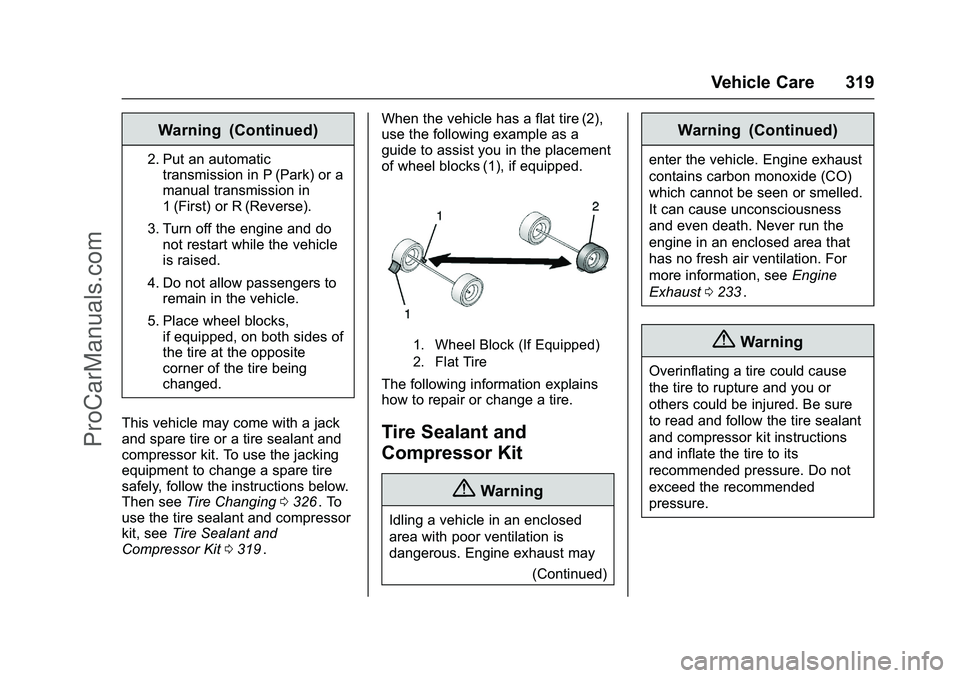
ii. When the vehicle has a flat tire (2),
use the following example as a
guide to assist you in the placement
of wheel blocks (1), if equipped.
1. Wheel Block (If Equipped)
2. Flat Tire
The following information explains
how to repair or change a tire.
Tire Sealant and
Compressor Kit
{Warning
Idling a vehicle in an enclosed
area with poor ventilation is
dangerous. Engine exhaust may
(Continued)
Warning (Continued)
enter the vehicle. Engine exhaust
contains carbon monoxide (CO)
which cannot be seen or smelled.
It can cause unconsciousness
and even death. Never run the
engine in an enclosed area that
has no fresh air ventilation. For
more information, seeEngine
Exhaust 0233
ii.
{Warning
Overinflating a tire could cause
the tire to rupture and you or
others could be injured. Be sure
to read and follow the tire sealant
and compressor kit instructions
and inflate the tire to its
recommended pressure. Do not
exceed the recommended
pressure.
ProCarManuals.com
Page 382 of 397
Chevrolet SS Sedan Owner Manual (GMNA-Localizing-U.S.-9234782) - 2016 -
CRC - 8/24/15
OnStar 381
OnStar Personal Identification
Number (PIN)
A PIN is needed to access some
OnStar services. The PIN will need
to be changed the first time when
speaking with an Advisor. To
change the OnStar PIN, contact an
OnStar Advisor by pressing
Qor
calling 1-888-4ONSTAR.
Warranty
OnStar equipment may be
warranted as part of the vehicle
warranty.
Languages
The vehicle can be programmed to
respond in multiple languages.
Press
Qand ask for an Advisor.
Advisors are available in English,
Spanish, and French. Available
languages may vary by country.
Potential Issues
OnStar cannot perform Remote
Door Unlock or Stolen Vehicle
Assistance after the vehicle has
been off continuously for five days
without an ignition cycle. If the vehicle has not been started for
five days, OnStar can contact
Roadside Assistance or a locksmith
to help gain access to the vehicle.
Global Positioning
System (GPS)
.
Obstruction of the GPS can
occur in a large city with tall
buildings; in parking garages;
around airports; in tunnels and
underpasses; or in an area with
very dense trees. If GPS signals
are not available, the OnStar
system should still operate to
call OnStar. However, OnStar
could have difficulty identifying
the exact location.
. In emergency situations, OnStar
can use the last stored GPS
location to send to emergency
responders.
A temporary loss of GPS can cause
loss of the ability to send a
Turn-by-Turn Navigation route. The
Advisor may give a verbal route or
may ask for a call back after the
vehicle is driven into an open area.
Cellular and GPS Antennas
Cellular reception is required for
OnStar to send remote signals to
the vehicle. Do not place items over
or near the antenna to prevent
blocking cellular and GPS signal
reception.
Unable to Connect to OnStar
Message
If there is limited cellular coverage
or the cellular network has reached
maximum capacity, this message
may come on. Press
Qto try the
call again or try again after driving a
few miles into another cellular area.
Vehicle and Power Issues
OnStar services require a vehicle
electrical system, wireless service,
and GPS satellite technologies to be
available and operating for features
to function properly. These systems
may not operate if the battery is
discharged or disconnected.
ProCarManuals.com
Page 387 of 397
Chevrolet SS Sedan Owner Manual (GMNA-Localizing-U.S.-9234782) - 2016 -
CRC - 8/24/15
386 Index
Assistance Systems forParking and Backing . . . . . . . . . . 251
Audio Bluetooth . . . . . . . . . . . . . . . . . . . . . 161
Automatic Dimming Mirrors . . . . . . . . . . . . . . . . 38
Door Locks . . . . . . . . . . . . . . . . . . . . . 32
Headlamp System . . . . . . . . . . . . 124
Transmission . . . . . . . . . . . . . . . . . 234
Transmission Fluid . . . . . . . . . . . 274
Automatic Transmission
Manual Mode . . . . . . . . . . . . . . . . . 236
Shift Lock Control FunctionCheck . . . . . . . . . . . . . . . . . . . . . . . 286
Axle, Rear . . . . . . . . . . . . . . . . . . . . . . 285
B
Backglass Antenna . . . . . . . . . . . . . 145
Battery Power Protection . . . . . . . . . . . . . 127
Voltage and ChargingMessages . . . . . . . . . . . . . . . . . . . .110
Battery - North America . . . . 284, 331
Blade Replacement, Wiper . . . . . 287
Bluetooth . . . . . . . . . . . . . . . . . . . . . . . 193
Bluetooth Audio . . . . . . . . . . . . . . . . 161
Brake Parking, Electric . . . . . . . . . . . . . . 240
System Warning Light . . . . . . . . . . 99 Brakes . . . . . . . . . . . . . . . . . . . . . . . . . . 282
Antilock . . . . . . . . . . . . . . . . . . . . . . . 239
Assist . . . . . . . . . . . . . . . . . . . . . . . . . 242
Fluid . . . . . . . . . . . . . . . . . . . . . . . . . . 283
System Messages . . . . . . . . . . . . .110
Braking . . . . . . . . . . . . . . . . . . . . . . . . . 216
Break-In, New Vehicle . . . . . . . . . . 227
Bulb Replacement . . . . . . . . . . . . . . 290 Headlamp Aiming . . . . . . . . . . . . . 288
Headlamps . . . . . . . . . . . . . . . . . . . 289
High Intensity Discharge(HID) Lighting . . . . . . . . . . . . . . . 289
License Plate Lamps . . . . . . . . . 289
Buying New Tires . . . . . . . . . . . . . . . 313
C
California Fuel Requirements . . . . . . . . . . . 262
Perchlorate MaterialsRequirements . . . . . . . . . . . . . . . 267
California
Proposition
65 Warning . . . . . . . . . .267, 284, 331
Capacities and Specifications . . . . . . . . . . . . . . . . . 358
Carbon Monoxide
Engine Exhaust . . . . . . . . . . . . . . . 233
Trunk . . . . . . . . . . . . . . . . . . . . . . . . . . . 34
Winter Driving . . . . . . . . . . . . . . . . 222 Caution, Danger, and Warning . . . . 2
Center Console Storage . . . . . . . . . 86
Chains, Tire . . . . . . . . . . . . . . . . . . . . 317
Charging System Light . . . . . . . . . . 97
Check
Malfunction Indicator EngineLight . . . . . . . . . . . . . . . . . . . . . . . . . . 97
Child Restraints Infants and Young Children . . . . . 69
Lower Anchors and Tethersfor Children . . . . . . . . . . . . . . . . . . . 74
Older Children . . . . . . . . . . . . . . . . . . 68
Securing . . . . . . . . . . . . . . . . . . . . 80, 82
Systems . . . . . . . . . . . . . . . . . . . . . . . . 72
Cleaning Exterior Care . . . . . . . . . . . . . . . . . 335
Interior Care . . . . . . . . . . . . . . . . . . 339
Climate Control Systems Dual Automatic . . . . . . . . . . . . . . . 208
Clock . . . . . . . . . . . . . . . . . . . . . . . . . . . . 91
Cluster, Instrument . . . . . . . . . . . . . . 93
Clutch, Hydraulic . . . . . . . . . . . . . . . 274
Collision Damage Repair . . . . . . . 368
Compartments Storage . . . . . . . . . . . . . . . . . . . . . . . . . 85
Compressor Kit, Tire Sealant . . . 319
Configure Menu . . . . . . . . . . . . . . . . 180
ProCarManuals.com