run flat CHEVROLET SS 2016 Owners Manual
[x] Cancel search | Manufacturer: CHEVROLET, Model Year: 2016, Model line: SS, Model: CHEVROLET SS 2016Pages: 397, PDF Size: 7.17 MB
Page 23 of 397
Chevrolet SS Sedan Owner Manual (GMNA-Localizing-U.S.-9234782) - 2016 -
CRC - 8/24/15
22 In Brief
Resetting the Oil Life System1. Display the REMAINING OIL LIFE on the DIC. See Driver
Information Center (DIC)
0 105
ii.
2. Press and hold the SET/CLR button on the DIC while the Oil
Life display is active. The oil
life will change to 100%.
The oil life system can also be reset
as follows: 1. Turn the ignition to ON/RUN with the engine off.
2. Fully press and release the accelerator pedal three times
within five seconds.
See Engine Oil Life System 0273
ii.
Driving for Better Fuel
Economy
Driving habits can affect fuel
mileage. Here are some driving tips
to get the best fuel economy
possible.
.
Avoid fast starts and accelerate
smoothly. .
Brake gradually and avoid
abrupt stops.
. Avoid idling the engine for long
periods of time.
. When road and weather
conditions are appropriate, use
cruise control.
. Always follow posted speed
limits or drive more slowly when
conditions require.
. Keep vehicle tires properly
inflated.
. Combine several trips into a
single trip.
. Replace the vehicle's tires with
the same TPC Spec number
molded into the tire's sidewall
near the size.
. Follow recommended scheduled
maintenance.
Battery
The battery is located in the trunk,
behind a trim panel, on the driver
side. When it is time for a new
battery, see your dealer for one that
has the replacement number shown
on the original battery's label.
See Battery - North America 0284
ii.
Roadside Assistance
Program
U.S.: 1-800-243-8872
TTY Users (U.S. Only):
1-888-889-2438
Canada: 1-800-268-6800
As the owner of a new Chevrolet,
you are automatically enrolled in the
Roadside Assistance program.
See Roadside Assistance Program
0 365
ii.
ProCarManuals.com
Page 98 of 397
Chevrolet SS Sedan Owner Manual (GMNA-Localizing-U.S.-9234782) - 2016 -
CRC - 8/24/15
Instruments and Controls 97
When the vehicle is started, the
passenger airbag status indicator
will light ON and OFF for several
seconds as a system check. Then,
after several more seconds, the
status indicator will light either ON
or OFF to let you know the status of
the front outboard passenger frontal
airbag and knee airbag.
If the word ON is lit on the
passenger airbag status indicator, it
means that the front outboard
passenger frontal airbag and knee
airbag are allowed to inflate.
If the word OFF is lit on the
passenger airbag status indicator, it
means that the passenger sensing
system has turned off the front
outboard passenger frontal airbag
and knee airbag.
If, after several seconds, both status
indicator lights remain on, or if there
are no lights at all, there may be aproblem with the lights or the
passenger sensing system. See
your dealer for service.
{Warning
If the airbag readiness light ever
comes on and stays on, it means
that something may be wrong
with the airbag system. To help
avoid injury to yourself or others,
have the vehicle serviced right
away. See
Airbag Readiness
Light 096
iifor more information,
including important safety
information.
Charging System Light
The charging system light comes on
briefly when the ignition is turned
on, but the engine is not running, as
a check to show the light is working. The light turns off when the engine
is started. If it does not, have the
vehicle serviced by your dealer.
If the light stays on, or comes on
while driving, there could be a
problem with the electrical charging
system. Have it checked by your
dealer. Driving while this light is on
could drain the battery.
If a short distance must be driven
with the light on, be sure to turn off
all accessories, such as the radio
and air conditioner.
Malfunction Indicator
Lamp (Check Engine
Light)
This light is part of the vehicle’s
emission control on-board
diagnostic system. If this light is on
while the engine is running, a
malfunction has been detected and
the vehicle may require service. The
light should come on to show that it
is working when the ignition is in
Service Only Mode. See
Ignition
Positions 0227
ii.
ProCarManuals.com
Page 222 of 397
Chevrolet SS Sedan Owner Manual (GMNA-Localizing-U.S.-9234782) - 2016 -
CRC - 8/24/15
Driving and Operating 221
Hydroplaning
Hydroplaning is dangerous. Water
can build up under the vehicle's
tires so they actually ride on the
water. This can happen if the road is
wet enough and you are going fast
enough. When the vehicle is
hydroplaning, it has little or no
contact with the road.
There is no hard and fast rule about
hydroplaning. The best advice is to
slow down when the road is wet.
Other Rainy Weather Tips
Besides slowing down, other wet
weather driving tips include:
.Allow extra following distance.
. Pass with caution.
. Keep windshield wiping
equipment in good shape.
. Keep the windshield washer fluid
reservoir filled.
. Have good tires with proper
tread depth. See Tires0299
ii.
. Turn off cruise control.
Hill and Mountain Roads
Driving on steep hills or through
mountains is different than driving
on flat or rolling terrain. Tips include:
.Keep the vehicle serviced and in
good shape.
. Check all fluid levels and brakes,
tires, cooling system, and
transmission.
. Shift to a lower gear when going
down steep or long hills.
{Warning
Using the brakes to slow the
vehicle on a long downhill slope
can cause brake overheating, can
reduce brake performance, and
could result in a loss of braking.
Shift the transmission to a lower
gear to let the engine assist the
brakes on a steep downhill slope.
{Warning
Coasting downhill in N (Neutral)
or with the ignition off is
dangerous. This can cause
overheating of the brakes and
loss of steering. Always have the
engine running and the vehicle
in gear.
. Drive at speeds that keep the
vehicle in its own lane. Do not
swing wide or cross the
center line.
. Be alert on top of hills;
something could be in your lane
(e.g., stalled car, accident).
. Pay attention to special road
signs (e.g., falling rocks area,
winding roads, long grades,
passing or no-passing zones)
and take appropriate action.
ProCarManuals.com
Page 320 of 397
Chevrolet SS Sedan Owner Manual (GMNA-Localizing-U.S.-9234782) - 2016 -
CRC - 8/24/15
Vehicle Care 319
Warning (Continued)
2. Put an automatictransmission in P (Park) or a
manual transmission in
1 (First) or R (Reverse).
3. Turn off the engine and do not restart while the vehicle
is raised.
4. Do not allow passengers to remain in the vehicle.
5. Place wheel blocks, if equipped, on both sides of
the tire at the opposite
corner of the tire being
changed.
This vehicle may come with a jack
and spare tire or a tire sealant and
compressor kit. To use the jacking
equipment to change a spare tire
safely, follow the instructions below.
Then see Tire Changing 0326
ii. To
use the tire sealant and compressor
kit, see Tire Sealant and
Compressor Kit 0319
ii. When the vehicle has a flat tire (2),
use the following example as a
guide to assist you in the placement
of wheel blocks (1), if equipped.
1. Wheel Block (If Equipped)
2. Flat Tire
The following information explains
how to repair or change a tire.
Tire Sealant and
Compressor Kit
{Warning
Idling a vehicle in an enclosed
area with poor ventilation is
dangerous. Engine exhaust may
(Continued)
Warning (Continued)
enter the vehicle. Engine exhaust
contains carbon monoxide (CO)
which cannot be seen or smelled.
It can cause unconsciousness
and even death. Never run the
engine in an enclosed area that
has no fresh air ventilation. For
more information, seeEngine
Exhaust 0233
ii.
{Warning
Overinflating a tire could cause
the tire to rupture and you or
others could be injured. Be sure
to read and follow the tire sealant
and compressor kit instructions
and inflate the tire to its
recommended pressure. Do not
exceed the recommended
pressure.
ProCarManuals.com
Page 322 of 397
Chevrolet SS Sedan Owner Manual (GMNA-Localizing-U.S.-9234782) - 2016 -
CRC - 8/24/15
Vehicle Care 321
If a tire goes flat, avoid further tire
and wheel damage by driving slowly
to a level place. Turn on the hazard
warning flashers. SeeHazard
Warning Flashers 0124
ii.
See If a Tire Goes Flat 0318
iifor
other important safety warnings.
Do not remove any objects that
have penetrated the tire.
1. Remove the tire sealant and compressor kit from its storage
location. See Storing the Tire
Sealant and Compressor Kit
0 325
ii.
2. Remove the sealant/air hose (5) from the side of the
compressor.
3. Remove the power plug (6).
4. Place the kit on the ground. Make sure the tire valve stem
is positioned close to the
ground so the hose will
reach it.
5. Remove the valve stem cap from the flat tire by turning it
counterclockwise. 6. Attach the sealant/air hose (5)
onto the tire valve. Turn it
clockwise until it is tight.
7. Switch the on/off switch (1) to the O position.
8. Plug the power plug (6) into the power outlet in the vehicle.
Unplug all items from other
accessory power outlets. See
Power Outlets 091
ii.
If the vehicle has an accessory
power outlet, do not use the
cigarette lighter.
If the vehicle only has a
cigarette lighter, use the
cigarette lighter.
Do not pinch the power plug
cord in the door or window.
9. Start the vehicle. The vehicle must be running while using
the air compressor.
10. Switch the on/off switch (1) to the I position.
The compressor will inject
sealant and air into the tire. Sealant may leak from the
puncture hole until the vehicle
is driven and the hole has
sealed.
The pressure gauge (2) will
initially show a high pressure
while the compressor pushes
the sealant into the tire. Once
the sealant is completely
dispersed into the tire, the
pressure will quickly drop and
start to rise again as the tire
inflates with air only.
11. Inflate the tire to the recommended inflation
pressure using the pressure
gauge (2). The recommended
inflation pressure can be found
on the Tire and Loading
Information label. See Tire
Pressure 0305
ii.
The pressure gauge (2) may
read higher than the actual tire
pressure while the compressor
is on. Turn the compressor off
to get an accurate pressure
reading. The compressor may
be turned on/off until the
correct pressure is reached.
ProCarManuals.com
Page 325 of 397
Chevrolet SS Sedan Owner Manual (GMNA-Localizing-U.S.-9234782) - 2016 -
CRC - 8/24/15
324 Vehicle Care
7. Plug the power plug (6) into theaccessory power outlet in the
vehicle. Unplug all items from
other accessory power outlets.
See Power Outlets 091
ii.
If the vehicle has an accessory
power outlet, do not use the
cigarette lighter.
If the vehicle only has a
cigarette lighter, use the
cigarette lighter.
Do not pinch the power plug
cord in the door or window.
8. Start the vehicle. The vehicle must be running while using
the air compressor.
9. Switch the on/off switch (1) to the I position.
The compressor will inflate the
tire with air only.
10. Inflate the tire to the recommended inflation
pressure using the pressure
gauge (2). The recommended
inflation pressure can be found
on the Tire and Loading
Information label. See Tire
Pressure 0305
ii. The pressure gauge (2) may
read higher than the actual tire
pressure while the compressor
is on. Turn the compressor off
to get an accurate reading. The
compressor may be turned on/
off until the correct pressure is
reached.
11. Switch the on/off switch (1) to the O position.
Be careful while handling the
tire sealant and compressor kit
as it could be warm after
usage.
12. Unplug the power plug (6) and the air only hose (4).
13. Replace the tire valve stem cap.
14. Place the equipment in the original storage location in the
vehicle.
Removal and Installation of the
Sealant Canister
After repairing a tire, replace the tire
sealant canister. To remove the sealant canister:
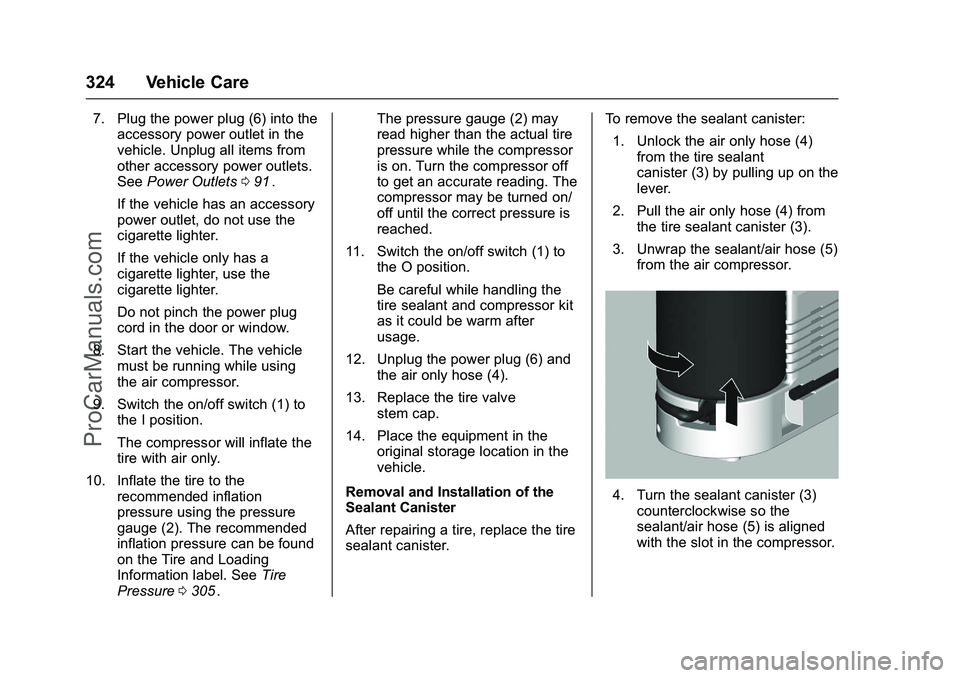
1. Unlock the air only hose (4) from the tire sealant
canister (3) by pulling up on the
lever.
2. Pull the air only hose (4) from the tire sealant canister (3).
3. Unwrap the sealant/air hose (5) from the air compressor.
4. Turn the sealant canister (3)
counterclockwise so the
sealant/air hose (5) is aligned
with the slot in the compressor.
ProCarManuals.com
Page 331 of 397
Chevrolet SS Sedan Owner Manual (GMNA-Localizing-U.S.-9234782) - 2016 -
CRC - 8/24/15
330 Vehicle Care
Warning (Continued)
nuts. SeeCapacities and
Specifications 0358
iifor original
equipment wheel nut torque
specifications.
Caution
Improperly tightened wheel nuts
can lead to brake pulsation and
rotor damage. To avoid expensive
brake repairs, evenly tighten the
wheel nuts in the proper
sequence and to the proper
torque specification. See
Capacities and Specifications
0 358
iifor the wheel nut torque
specification.
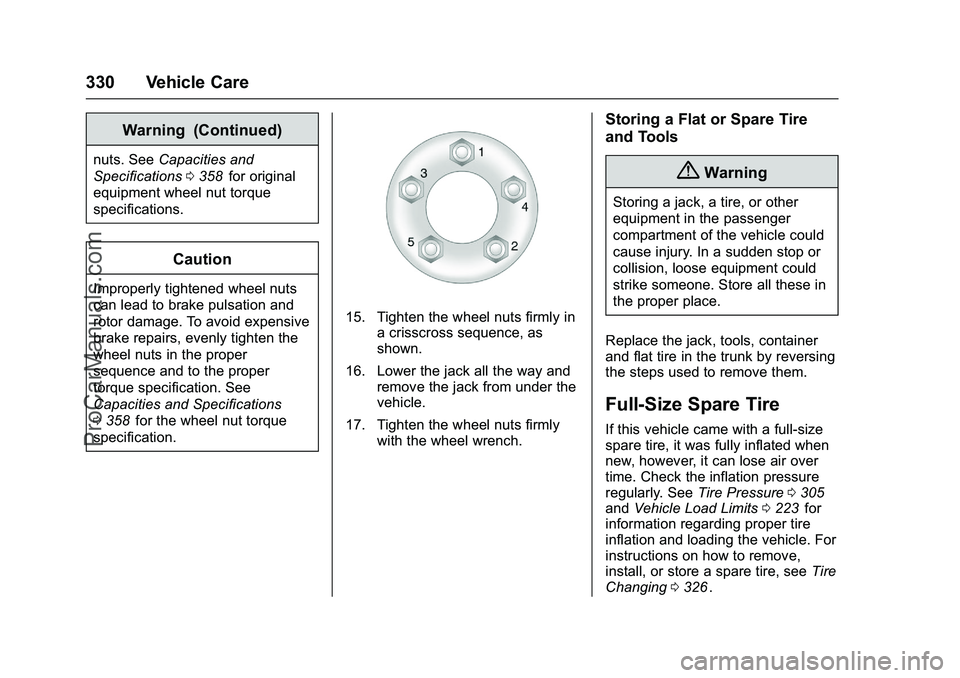
15. Tighten the wheel nuts firmly in a crisscross sequence, as
shown.
16. Lower the jack all the way and remove the jack from under the
vehicle.
17. Tighten the wheel nuts firmly with the wheel wrench.
Storing a Flat or Spare Tire
and Tools
{Warning
Storing a jack, a tire, or other
equipment in the passenger
compartment of the vehicle could
cause injury. In a sudden stop or
collision, loose equipment could
strike someone. Store all these in
the proper place.
Replace the jack, tools, container
and flat tire in the trunk by reversing
the steps used to remove them.
Full-Size Spare Tire
If this vehicle came with a full-size
spare tire, it was fully inflated when
new, however, it can lose air over
time. Check the inflation pressure
regularly. See Tire Pressure0305
iiand Vehicle Load Limits 0223iifor
information regarding proper tire
inflation and loading the vehicle. For
instructions on how to remove,
install, or store a spare tire, see Tire
Changing 0326
ii.
ProCarManuals.com
Page 332 of 397
Chevrolet SS Sedan Owner Manual (GMNA-Localizing-U.S.-9234782) - 2016 -
CRC - 8/24/15
Vehicle Care 331
After installing the spare tire on the
vehicle, stop as soon as possible
and check that the spare is correctly
inflated. The spare tire is made to
perform well at speeds up to
112 km/h (70 mph) at the
recommended inflation pressure, so
you can finish your trip.
The full-size spare includes a TPMS
sensor. The TPMS will not monitor
or display the spare tire air pressure
until the tire/wheel is installed at one
of the four tire/wheel positions on
the vehicle and matched to the new
position. SeeTire Pressure Monitor
Operation 0308
iifor information
about matching the spare tire to
the TPMS.
Have the damaged or flat road tire
repaired or replaced and installed
back onto the vehicle as soon as
possible so the spare tire will be
available in case it is needed again.
Do not mix tires and wheels of
different sizes, because they will not
fit. Keep the spare tire and its wheel
together.
Jump Starting
Jump Starting - North
America
For more information about the
vehicle battery, see Battery - North
America 0284
ii.
If the battery has run down, try to
use another vehicle and some
jumper cables to start your vehicle.
Be sure to use the following steps to
do it safely.
{Warning
WARNING: Battery posts,
terminals, and related
accessories contain lead and lead
compounds, chemicals known to
the State of California to cause
cancer and birth defects or other
reproductive harm. Batteries also
contain other chemicals known to
the State of California to cause
cancer. WASH HANDS AFTER
HANDLING. SeeCalifornia
Proposition 65 Warning 0267
ii.
{Warning
Batteries can hurt you. They can
be dangerous because:
. They contain acid that can
burn you.
. They contain gas that can
explode or ignite.
. They contain enough
electricity to burn you.
If you do not follow these steps
exactly, some or all of these
things can hurt you.
Caution
Ignoring these steps could result
in costly damage to the vehicle
that would not be covered by the
vehicle warranty. Trying to start
the vehicle by pushing or pulling it
will not work, and it could damage
the vehicle.
ProCarManuals.com
Page 389 of 397
Chevrolet SS Sedan Owner Manual (GMNA-Localizing-U.S.-9234782) - 2016 -
CRC - 8/24/15
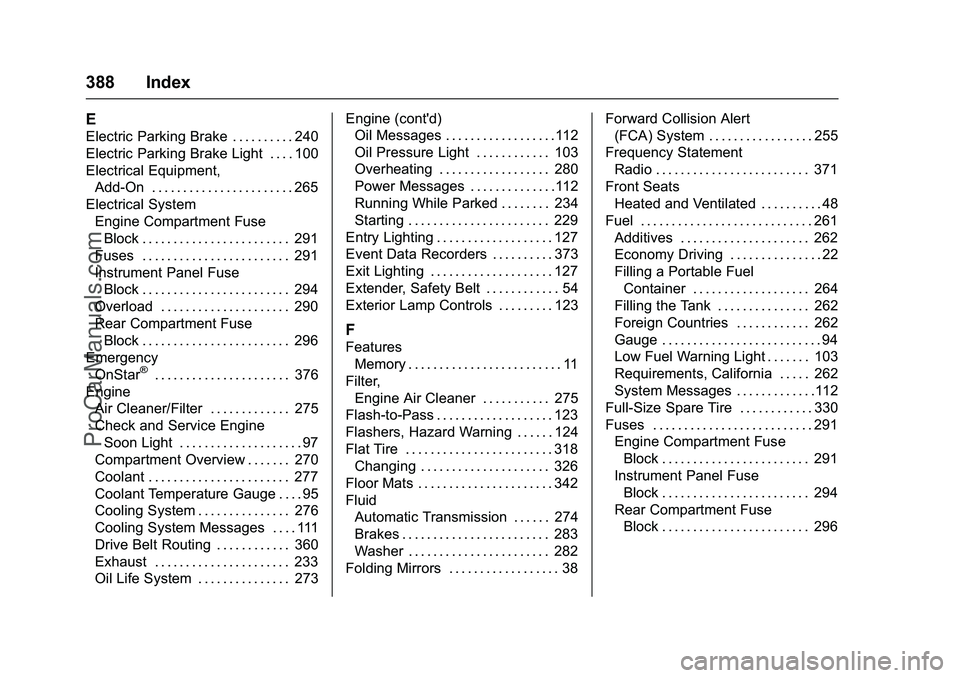
388 Index
E
Electric Parking Brake . . . . . . . . . . 240
Electric Parking Brake Light . . . . 100
Electrical Equipment,Add-On . . . . . . . . . . . . . . . . . . . . . . . 265
Electrical System Engine Compartment FuseBlock . . . . . . . . . . . . . . . . . . . . . . . . 291
Fuses . . . . . . . . . . . . . . . . . . . . . . . . 291
Instrument Panel Fuse Block . . . . . . . . . . . . . . . . . . . . . . . . 294
Overload . . . . . . . . . . . . . . . . . . . . . 290
Rear Compartment Fuse Block . . . . . . . . . . . . . . . . . . . . . . . . 296
Emergency OnStar
®. . . . . . . . . . . . . . . . . . . . . . 376
Engine Air Cleaner/Filter . . . . . . . . . . . . . 275
Check and Service EngineSoon Light . . . . . . . . . . . . . . . . . . . . 97
Compartment Overview . . . . . . . 270
Coolant . . . . . . . . . . . . . . . . . . . . . . . 277
Coolant Temperature Gauge . . . . 95
Cooling System . . . . . . . . . . . . . . . 276
Cooling System Messages . . . . 111
Drive Belt Routing . . . . . . . . . . . . 360
Exhaust . . . . . . . . . . . . . . . . . . . . . . 233
Oil Life System . . . . . . . . . . . . . . . 273 Engine (cont'd)
Oil Messages . . . . . . . . . . . . . . . . . .112
Oil Pressure Light . . . . . . . . . . . . 103
Overheating . . . . . . . . . . . . . . . . . . 280
Power Messages . . . . . . . . . . . . . .112
Running While Parked . . . . . . . . 234
Starting . . . . . . . . . . . . . . . . . . . . . . . 229
Entry Lighting . . . . . . . . . . . . . . . . . . . 127
Event Data Recorders . . . . . . . . . . 373
Exit Lighting . . . . . . . . . . . . . . . . . . . . 127
Extender, Safety Belt . . . . . . . . . . . . 54
Exterior Lamp Controls . . . . . . . . . 123
F
Features Memory . . . . . . . . . . . . . . . . . . . . . . . . . 11
Filter, Engine Air Cleaner . . . . . . . . . . . 275
Flash-to-Pass . . . . . . . . . . . . . . . . . . . 123
Flashers, Hazard Warning . . . . . . 124
Flat Tire . . . . . . . . . . . . . . . . . . . . . . . . 318
Changing . . . . . . . . . . . . . . . . . . . . . 326
Floor Mats . . . . . . . . . . . . . . . . . . . . . . 342
Fluid Automatic Transmission . . . . . . 274
Brakes . . . . . . . . . . . . . . . . . . . . . . . . 283
Washer . . . . . . . . . . . . . . . . . . . . . . . 282
Folding Mirrors . . . . . . . . . . . . . . . . . . 38 Forward Collision Alert
(FCA) System . . . . . . . . . . . . . . . . . 255
Frequency Statement Radio . . . . . . . . . . . . . . . . . . . . . . . . . 371
Front Seats Heated and Ventilated . . . . . . . . . . 48
Fuel . . . . . . . . . . . . . . . . . . . . . . . . . . . . 261
Additives . . . . . . . . . . . . . . . . . . . . . 262
Economy Driving . . . . . . . . . . . . . . . 22
Filling a Portable FuelContainer . . . . . . . . . . . . . . . . . . . 264
Filling the Tank . . . . . . . . . . . . . . . 262
Foreign Countries . . . . . . . . . . . . 262
Gauge . . . . . . . . . . . . . . . . . . . . . . . . . . 94
Low Fuel Warning Light . . . . . . . 103
Requirements, California . . . . . 262
System Messages . . . . . . . . . . . . .112
Full-Size Spare Tire . . . . . . . . . . . . 330
Fuses . . . . . . . . . . . . . . . . . . . . . . . . . . 291 Engine Compartment FuseBlock . . . . . . . . . . . . . . . . . . . . . . . . 291
Instrument Panel Fuse Block . . . . . . . . . . . . . . . . . . . . . . . . 294
Rear Compartment Fuse Block . . . . . . . . . . . . . . . . . . . . . . . . 296
ProCarManuals.com