weight CHEVROLET SSR 2003 1.G Owner's Manual
[x] Cancel search | Manufacturer: CHEVROLET, Model Year: 2003, Model line: SSR, Model: CHEVROLET SSR 2003 1.GPages: 374, PDF Size: 2.55 MB
Page 292 of 374
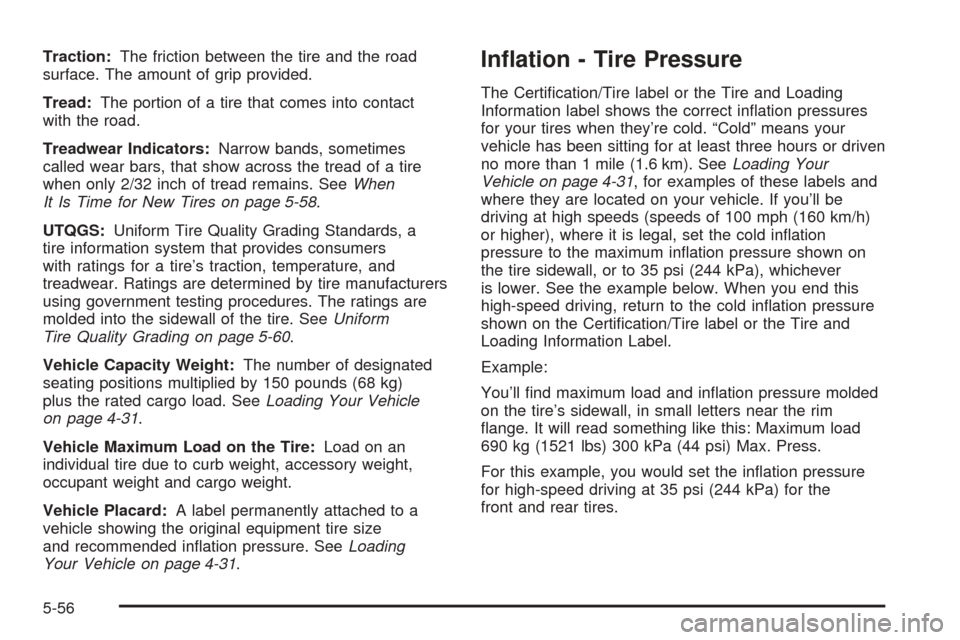
Traction:The friction between the tire and the road
surface. The amount of grip provided.
Tread:The portion of a tire that comes into contact
with the road.
Treadwear Indicators:Narrow bands, sometimes
called wear bars, that show across the tread of a tire
when only 2/32 inch of tread remains. SeeWhen
It Is Time for New Tires on page 5-58.
UTQGS:Uniform Tire Quality Grading Standards, a
tire information system that provides consumers
with ratings for a tire’s traction, temperature, and
treadwear. Ratings are determined by tire manufacturers
using government testing procedures. The ratings are
molded into the sidewall of the tire. SeeUniform
Tire Quality Grading on page 5-60.
Vehicle Capacity Weight:The number of designated
seating positions multiplied by 150 pounds (68 kg)
plus the rated cargo load. SeeLoading Your Vehicle
on page 4-31.
Vehicle Maximum Load on the Tire:Load on an
individual tire due to curb weight, accessory weight,
occupant weight and cargo weight.
Vehicle Placard:A label permanently attached to a
vehicle showing the original equipment tire size
and recommended ination pressure. SeeLoading
Your Vehicle on page 4-31.Ination - Tire Pressure
The Certication/Tire label or the Tire and Loading
Information label shows the correct ination pressures
for your tires when they’re cold. “Cold” means your
vehicle has been sitting for at least three hours or driven
no more than 1 mile (1.6 km). SeeLoading Your
Vehicle on page 4-31, for examples of these labels and
where they are located on your vehicle. If you’ll be
driving at high speeds (speeds of 100 mph (160 km/h)
or higher), where it is legal, set the cold ination
pressure to the maximum ination pressure shown on
the tire sidewall, or to 35 psi (244 kPa), whichever
is lower. See the example below. When you end this
high-speed driving, return to the cold ination pressure
shown on the Certication/Tire label or the Tire and
Loading Information Label.
Example:
You’ll nd maximum load and ination pressure molded
on the tire’s sidewall, in small letters near the rim
ange. It will read something like this: Maximum load
690 kg (1521 lbs) 300 kPa (44 psi) Max. Press.
For this example, you would set the ination pressure
for high-speed driving at 35 psi (244 kPa) for the
front and rear tires.
5-56
Page 372 of 374
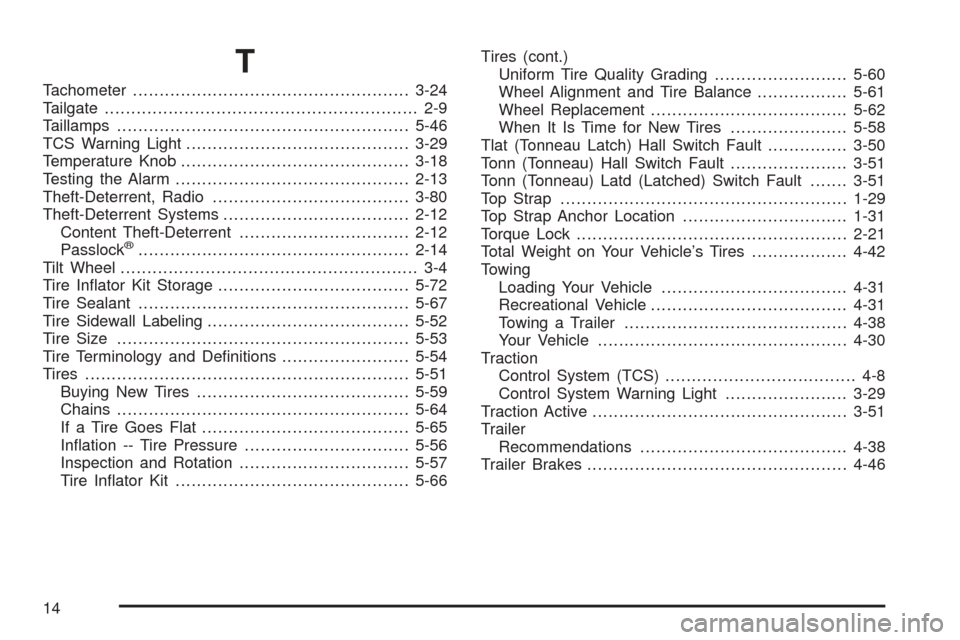
T
Tachometer....................................................3-24
Tailgate........................................................... 2-9
Taillamps.......................................................5-46
TCS Warning Light..........................................3-29
Temperature Knob...........................................3-18
Testing the Alarm............................................2-13
Theft-Deterrent, Radio.....................................3-80
Theft-Deterrent Systems...................................2-12
Content Theft-Deterrent................................2-12
Passlock
®...................................................2-14
Tilt Wheel........................................................ 3-4
Tire Inator Kit Storage....................................5-72
Tire Sealant...................................................5-67
Tire Sidewall Labeling......................................5-52
Tire Size.......................................................5-53
Tire Terminology and Denitions........................5-54
Tires.............................................................5-51
Buying New Tires........................................5-59
Chains.......................................................5-64
If a Tire Goes Flat.......................................5-65
Ination -- Tire Pressure...............................5-56
Inspection and Rotation................................5-57
Tire Inator Kit............................................5-66Tires (cont.)
Uniform Tire Quality Grading.........................5-60
Wheel Alignment and Tire Balance.................5-61
Wheel Replacement.....................................5-62
When It Is Time for New Tires......................5-58
Tlat (Tonneau Latch) Hall Switch Fault...............3-50
Tonn (Tonneau) Hall Switch Fault......................3-51
Tonn (Tonneau) Latd (Latched) Switch Fault.......3-51
Top Strap......................................................1-29
Top Strap Anchor Location...............................1-31
Torque Lock...................................................2-21
Total Weight on Your Vehicle’s Tires..................4-42
Towing
Loading Your Vehicle...................................4-31
Recreational Vehicle.....................................4-31
Towing a Trailer..........................................4-38
Your Vehicle...............................................4-30
Traction
Control System (TCS).................................... 4-8
Control System Warning Light.......................3-29
Traction Active................................................3-51
Trailer
Recommendations.......................................4-38
Trailer Brakes.................................................4-46
14
Page 374 of 374
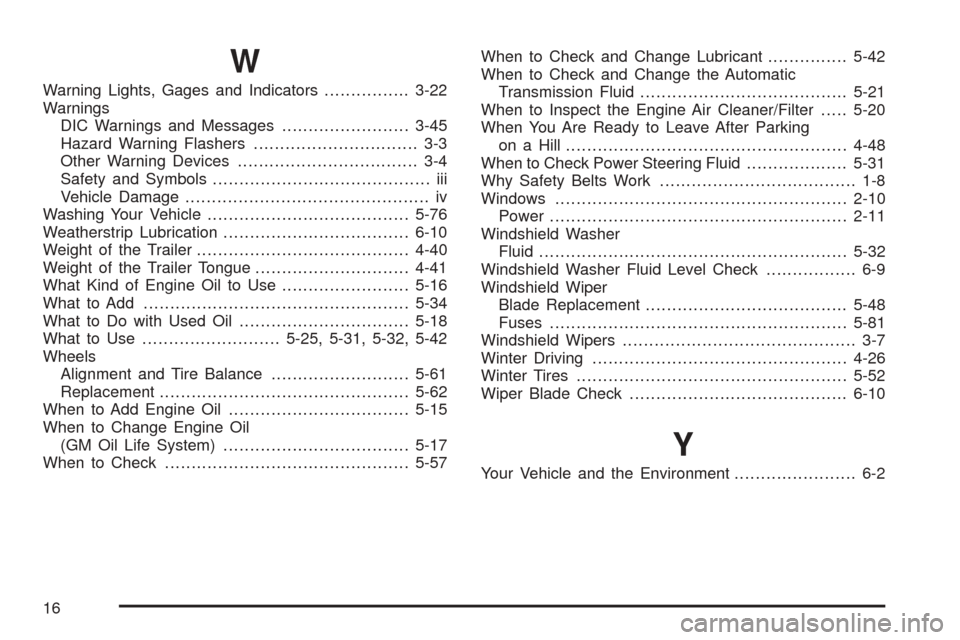
W
Warning Lights, Gages and Indicators................3-22
Warnings
DIC Warnings and Messages........................3-45
Hazard Warning Flashers............................... 3-3
Other Warning Devices.................................. 3-4
Safety and Symbols......................................... iii
Vehicle Damage.............................................. iv
Washing Your Vehicle......................................5-76
Weatherstrip Lubrication...................................6-10
Weight of the Trailer........................................4-40
Weight of the Trailer Tongue.............................4-41
What Kind of Engine Oil to Use........................5-16
What to Add..................................................5-34
What to Do with Used Oil................................5-18
What to Use..........................5-25, 5-31, 5-32, 5-42
Wheels
Alignment and Tire Balance..........................5-61
Replacement...............................................5-62
When to Add Engine Oil..................................5-15
When to Change Engine Oil
(GM Oil Life System)...................................5-17
When to Check..............................................5-57When to Check and Change Lubricant...............5-42
When to Check and Change the Automatic
Transmission Fluid.......................................5-21
When to Inspect the Engine Air Cleaner/Filter.....5-20
When You Are Ready to Leave After Parking
on a Hill.....................................................4-48
When to Check Power Steering Fluid...................5-31
Why Safety Belts Work..................................... 1-8
Windows.......................................................2-10
Power........................................................2-11
Windshield Washer
Fluid..........................................................5-32
Windshield Washer Fluid Level Check................. 6-9
Windshield Wiper
Blade Replacement......................................5-48
Fuses........................................................5-81
Windshield Wipers............................................ 3-7
Winter Driving................................................4-26
Winter Tires...................................................5-52
Wiper Blade Check.........................................6-10
Y
Your Vehicle and the Environment....................... 6-2
16