seats CHEVROLET SSR 2004 1.G User Guide
[x] Cancel search | Manufacturer: CHEVROLET, Model Year: 2004, Model line: SSR, Model: CHEVROLET SSR 2004 1.GPages: 398, PDF Size: 2.49 MB
Page 42 of 398
{CAUTION:
If the air bag readiness light ever comes on
when you have turned off the passenger’s
frontal air bag, it means that something may
be wrong with the air bag system. The
passenger’s frontal air bag could inate even
though the switch is off. If this ever happens,
do not let anyone whom the national
government has identied as a member of a
passenger air bag risk group sit in the
passenger’s position (for example, do not
secure a rear-facing child restraint in your
vehicle) until you have your vehicle serviced.
SeeAir Bag Off Switch on page 1-51.
1. Your vehicle has a passenger’s air bag. SeeAir
Bag Off Switch on page 1-51. If your child restraint
is forward-facing, always move the seat as far
back as it will go before securing it in this seat. See
Power Seats on page 1-2. Never use a rear-facing
child restraint in this seat unless the air bag
is off.2. Find the LATCH anchorages in the passenger seat.
SeeLower Anchorages and Top Tethers for
Children (LATCH System) on page 1-32.
3. Put the child restraint on the seat.
4. Attach and tighten the LATCH attachments on the
child restraint to the LATCH anchorages in the
vehicle. The child restraint instructions will show
you how.
5. If the child restraint is forward-facing, attach and
tighten the top tether to the top tether anchorage.
The child restraint instructions will show you
how. Also seeTop Strap on page 1-30.
6. Push and pull the child restraint in different
directions to be sure it is secure.
To remove the child restraint, simply unhook the top
strap from the top tether anchor and then disconnect the
anchor points.
1-36
Page 45 of 398
{CAUTION:
If the air bag readiness light ever comes on
when you have turned off the passenger’s
frontal air bag, it means that something may
be wrong with the air bag system. The
passenger’s frontal air bag could inate even
though the switch is off. If this ever happens,
do not let anyone whom the national
government has identied as a member of a
passenger air bag risk group sit in the
passenger’s position (for example, do not
secure a rear-facing child restraint in your
vehicle) until you have your vehicle serviced.
SeeAir Bag Off Switch on page 1-51.
If your child restraint is equipped with the LATCH
system, seeLower Anchorages and Top Tethers for
Children (LATCH System) on page 1-32. SeeTop Strap
on page 1-30if the child restraint has one.If your child restraint does not have the LATCH system,
you will be using the lap-shoulder belt. Be sure to
follow the instructions that came with the child restraint.
Secure the child in the child restraint when and as
the instructions say.
1. Your vehicle has a passenger’s air bag. If you are
using a rear-facing child restraint in this seat, make
sure the air bag is turned off. SeeAir Bag Off
Switch on page 1-51. If your child restraint is
forward-facing, always move the seat as far back
as it will go before securing it in this seat. See
Power Seats on page 1-2.
2. Put the child restraint on the seat.
3. Pick up the latch plate, and run the lap and shoulder
portions of the vehicle’s safety belt through or
around the restraint. The child restraint instructions
will show you how.
1-39
Page 109 of 398

If you cannot raise or lower the convertible top by using
your convertible top switch, you may need to replace
the fuse. SeeFuses and Circuit Breakers on page 5-84
for more information.
If you still cannot operate your convertible top, contact
your dealer.
You may need to raise the roof tonneau and convertible
top manually in the event of a power loss. You will
need two people to lift the roof tonneau and convertible
top when using the following procedure. To manually
raise the roof tonneau and convertible top, do the
following:
1. Turn the ignition to OFF.
2. Be sure the cargo cover is closed. SeeCargo
Cover on page 2-31andRemote Keyless Entry
System Operation on page 2-4for more information.
3. Open both doors.
4. In the area behind the seats, locate the two sets of
cables behind the carpet aps. The cables on the
driver’s side of the vehicle are located behind
the tire inator kit. The tire inator kit must be
removed to access the cables. SeeTire Inator Kit
on page 5-67for instructions on how to remove
the tire inator kit.5. Locate the loops at the ends of the cables.
One has a red band on it, and the other has
a green band.
The cable with the green band opens the tonneau
latch, and the cable with the red band closes it.
6. Using the release tool from the convertible top,
hook the tool into the green loop.
The convertible top release tool is provided when
you purchase your new SSR from the dealer.
It is stored in the glovebox.
2-47
Page 114 of 398
19. Repeat Step 18 on the other side of the vehicle.
20. You will know the latches are engaged if the
roof tonneau cannot be raised. If the roof tonneau
can be raised, repeat Step 18 on both sides of
the vehicle until the roof tonneau cannot be raised.
21. Once the roof tonneau is closed, adjust the cables
located behind the seats. Pull the cable with the red
band until both cables are the same length.
Repeat this step on the other side of the vehicle.
22. Check the roof tonneau to make sure it is secure
before driving.Vehicle Personalization
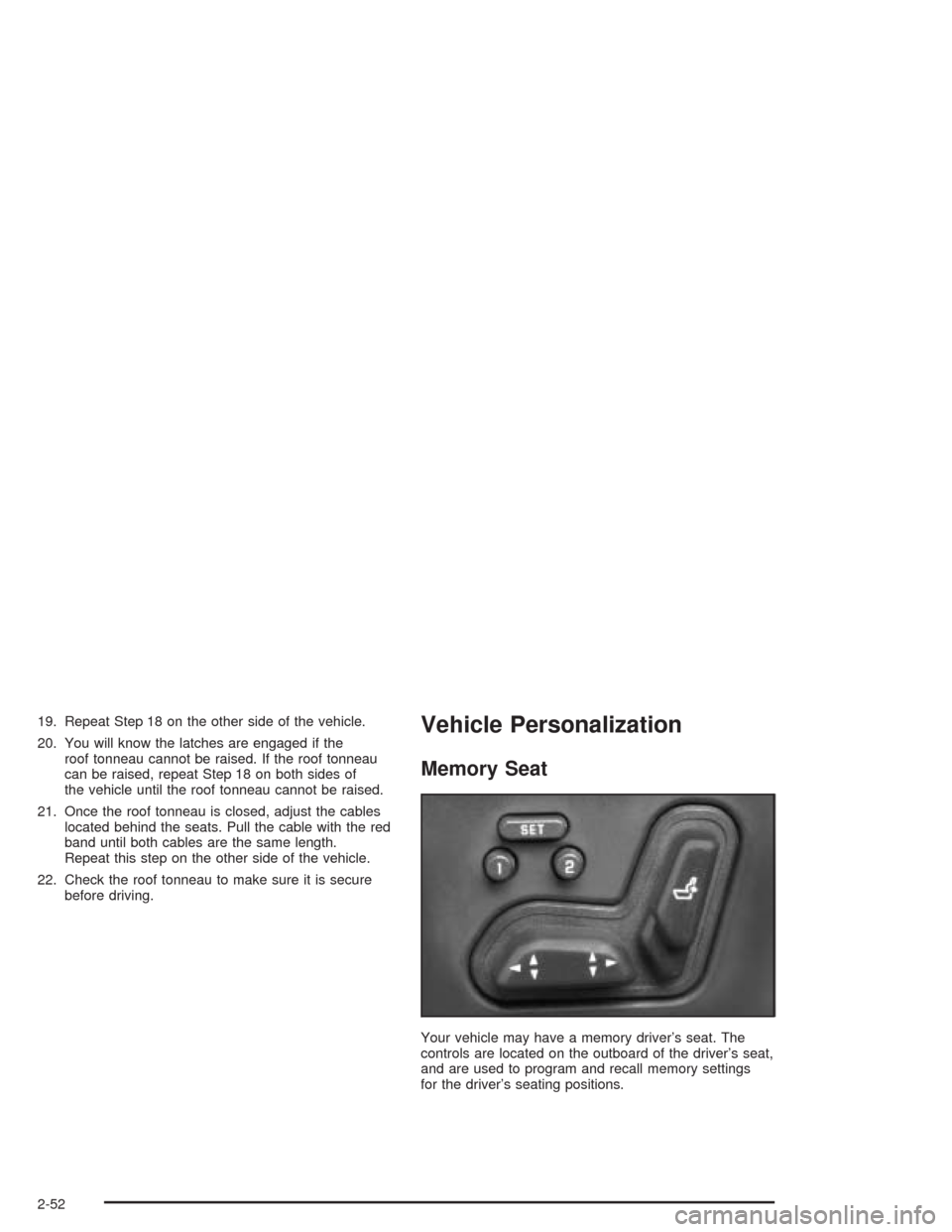
Memory Seat
Your vehicle may have a memory driver’s seat. The
controls are located on the outboard of the driver’s seat,
and are used to program and recall memory settings
for the driver’s seating positions.
2-52
Page 138 of 398

Rear Window Defogger
The rear window defogger uses a warming grid to
remove fog from the rear window.
The rear window defogger will only work when the
ignition is on.
=(Rear):Press this button on the right knob to turn
the rear window defogger on or off. An indicator light
on the button will come on to let you know that the rear
window defogger is activated.
When the rear defogger button is pressed, the outside
heated mirrors will warm to help clear any fog or
frost from the surface of the mirrors.
Notice:Using a razor blade or sharp object to clear
the inside rear window may damage the rear
window defogger. Repairs would not be covered by
your warranty. Do not clear the inside of the rear
window with sharp objects.
Outlet Adjustment
Use the levers located in
the center of each outlet to
change the direction of
the airow.
Operation Tips
Clear away any ice, snow or leaves from the air
inlets at the base of the windshield that may
block the ow of air into your vehicle.
Use of non-GM approved hood deectors may
adversely affect the performance of the system.
Keep the path under the front seats clear of objects
to help circulate the air inside of your vehicle more
effectively.
3-22
Page 241 of 398
{CAUTION:
Do not load your vehicle any heavier than the
GVWR, or either the maximum front or rear
GAWR. If you do, parts on your vehicle can
break, and it can change the way your vehicle
handles. These could cause you to lose
control and crash. Also, overloading can
shorten the life of your vehicle.
Using heavier suspension components to get added
durability might not change your weight ratings. Ask your
dealer to help you load your vehicle the right way.
Notice:Overloading your vehicle may cause
damage. Repairs would not be covered by your
warranty. Do not overload your vehicle.
If you put things inside your vehicle — like suitcases,
tools, packages, or anything else — they will go as fast
as the vehicle goes. If you have to stop or turn
quickly, or if there is a crash, they’ll keep going.
{CAUTION:
Things you put inside your vehicle can strike
and injure people in a sudden stop or turn, or
in a crash.
Put things in the rear area of your vehicle.
Try to spread the weight evenly.
Never stack heavier things, like suitcases,
above the tops of the seats inside the
vehicle or in the cargo area when the
convertible top is lowered.
If you carry tall objects in the cargo area,
secure them properly and have the
convertible top fastened in the raised
position.
Do not leave an unsecured child restraint
in your vehicle.
When you carry something inside the
vehicle, secure it whenever you can.
4-37
Page 311 of 398
(C) Aspect Ratio:A two-digit number that indicates the
tire height-to-width measurements. For example, if
the tire size aspect ratio is 75, as shown in item C, of
the illustration, it would mean that the tire’s sidewall is
75 percent as high as it is wide.
(D) Construction Code:A letter code is used to
indicate the type of ply construction in the tire. The letter
“R” means radial ply construction; the letter “D” means
diagonal or bias ply construction; and the letter “B”
means belted-bias ply construction.
(E) Rim Diameter:Diameter of the wheel in inches.
(F) Service Description:The service description
indicates the load range and speed rating of a tire.
The load index can range from 1 to 279. Speed ratings
range from A to Z.
Tire Terminology and Denitions
Air Pressure:The amount of air inside the tire pressing
outward on each square inch of the tire. Air pressure
is expressed in pounds per square inch (psi) or
kilopascal (kPa).
Accessory Weight:This means the combined weight
of optional accessories. Some examples of optional
accessories are, automatic transmission, power steering,
power brakes, power windows, power seats, and air
conditioning.Aspect Ratio:The relationship of a tire’s height to
its width.
Belt:A rubber coated layer of cords that is located
between the plies and the tread. Cords may be made
from steel or other reinforcing materials.
Bead:The tire bead contains steel wires wrapped by
steel cords that hold the tire onto the rim.
Bias Ply Tire:A pneumatic tire in which the plies are
laid at alternate angles less than 90 degrees to the
centerline of the tread.
Cold Ination Pressure:The amount of air pressure
in a tire, measured in pounds per square inch (psi)
or kilopascals (kPa) before a tire has built up heat from
driving. SeeInation - Tire Pressure on page 5-58.
Curb Weight:This means the weight of a motor vehicle
with standard and optional equipment including the
maximum capacity of fuel, oil and coolant, but without
passengers and cargo.
DOT Markings:A code molded into the sidewall of a
tire signifying that the tire is in compliance with the U.S.
Department of Transportation motor vehicle safety
standards. The DOT code includes the Tire Identication
Number (TIN), an alphanumeric designator which can
also identify the tire manufacturer, production plant,
brand and date of production.
5-55
Page 340 of 398
Fuses and Circuit Breakers
The wiring circuits in your vehicle are protected from
short circuits by a combination of fuses and circuit
breakers. This greatly reduces the chance of res
caused by electrical problems.
Look at the silver-colored band inside the fuse. If the
band is broken or melted, replace the fuse. Be sure you
replace a bad fuse with a new one of the identical
size and rating.
If you ever have a problem on the road and don’t have
a spare fuse, you can borrow one that has the same
amperage. Just pick some feature of your vehicle
that you can get along without — like the radio or
cigarette lighter — and use its fuse, if it is the correct
amperage. Replace it as soon as you can.
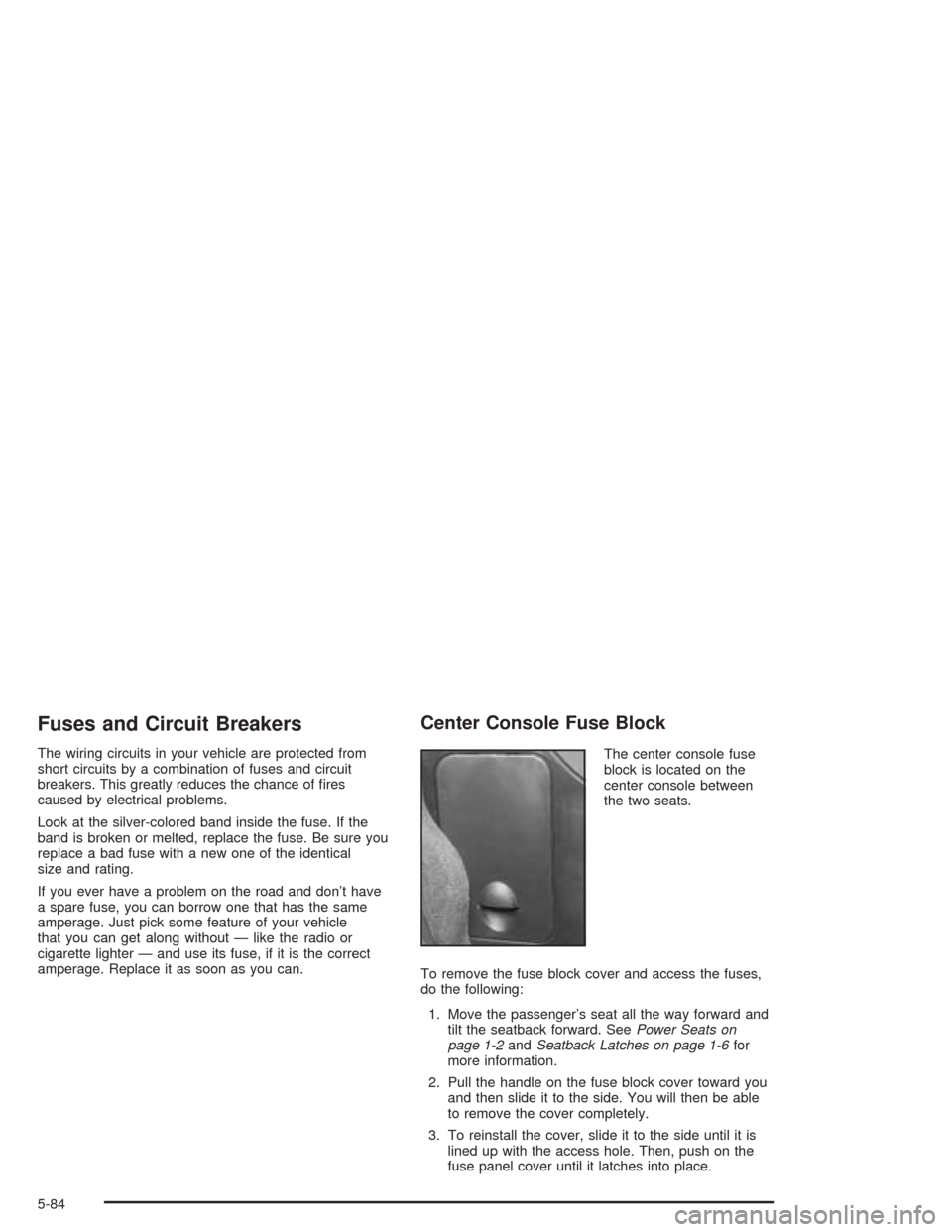
Center Console Fuse Block
The center console fuse
block is located on the
center console between
the two seats.
To remove the fuse block cover and access the fuses,
do the following:
1. Move the passenger’s seat all the way forward and
tilt the seatback forward. SeePower Seats on
page 1-2andSeatback Latches on page 1-6for
more information.
2. Pull the handle on the fuse block cover toward you
and then slide it to the side. You will then be able
to remove the cover completely.
3. To reinstall the cover, slide it to the side until it is
lined up with the access hole. Then, push on the
fuse panel cover until it latches into place.
5-84
Page 342 of 398

Fuses Usage
28 Roof Door Module
29 Blank
31 Truck Body Controller
32 Remote Keyless Entry (RKE)
33 Windshield Wipers
34 Stoplamps
35 Blank
36Climate Control System, Driver’s
Door Unlock
37 Front Parking Lamps
38 Driver’s Side Turn Signal
39 Climate Control System
40 Truck Body Controller
41 Radio
42 Trailer Parking Lamps
43 Passenger’s Side Turn Signal
44 Blank
46 Accessory Power Outlets
47 Ignition
48 BlankFuses Usage
49 Blank
50 Truck Body Controller, Ignition
51 Brakes
52 Blank
Relays Usage
18 Locks
24 Unlock
30 Parking Lamps
45Rear Window Defogger, Outside
Power Heated Mirrors
Circuit
BreakersUsage
01 Roof & Door Module
02 Roof Pump
08 Power Seats
5-86
Page 362 of 398
Usage Fluid/Lubricant
Chassis
LubricationChassis Lubricant
(GM Part No. U.S. 12377985, in
Canada 88901242) or lubricant
meeting requirements of NLGI #2,
Category LB or GC-LB.
Rear AxleSAE 75W-90 Synthetic Axle
Lubricant
(GM Part No. U.S. 12378261, in
Canada 10953455) meeting GM
Specication 9986115.
Hood Latch
Assembly,
Secondary
Latch, Pivots,
Spring
Anchor and
Release PawlLubriplate Lubricant Aerosol
(GM Part No. U.S. 12346293, in
Canada 992723) or lubricant
meeting requirements of NLGI #2,
Category LB or GC-LB.Usage Fluid/Lubricant
Hood and Door
Hinges, Fuel
Filler Door and
Folding SeatsMulti-Purpose Lubricant, Superlube
(GM Part No. U.S. 12346241, in
Canada 10953474).
Tailgate Handle
Pivot Points,
Hinges, Latch
Bolt and
LinkageMulti-Purpose Lubricant, Superlube
(GM Part No. U.S. 12346241, in
Canada 10953474).
Weatherstrip
ConditioningDielectric Silicone Grease
(GM Part No. U.S. 12345579, in
Canada 992887).
Weatherstrip
SqueaksSynthetic Grease with Teon,
Superlube (GM Part No. U.S.
12371287, in Canada 10953437).
6-14