ignition CHEVROLET SSR 2005 1.G Owner's Manual
[x] Cancel search | Manufacturer: CHEVROLET, Model Year: 2005, Model line: SSR, Model: CHEVROLET SSR 2005 1.GPages: 388, PDF Size: 2.5 MB
Page 112 of 388

If the cargo area is closed and the roof tonneau does
not raise or lower, check to see if a fuse is blown.
SeeFuses and Circuit Breakers on page 5-84for more
information.
Contact your GM dealer if the roof tonneau still does not
raise or lower after replacing the fuse.
The roof tonneau can manually be raised or lowered in
the event of a power loss. SeeRaising the Convertible
Top on page 2-54for instructions.
Raising the Convertible Top
Notice:If you operate the convertible top switch
continuously while the ignition is in ACCESSORY,
the battery will drain and you might not be able
to start your vehicle. Do not use the convertible
top switch for extended periods of time when
the ignition is in ACCESSORY.
The ignition must be in RUN or ACCESSORY, your
foot must be on the brake, and the vehicle must
be stopped in order to raise the convertible top.
b(Top Closed):Press and hold this symbol on
the convertible top switch located on the center console
switchbank to close the convertible top. Two chimes
will sound when the top is fully closed.A “Roof Cycle Timeout” message will display on the
Driver Information Center (DIC) and the convertible top
will stop moving when the programmed time limit is
exceeded for the raised position. See “Roof Cycle
Timeout” underDIC Warnings and Messages on
page 3-45.
If the convertible top cannot be raised by using the
convertible top switch, the fuse may need to be
replaced. SeeFuses and Circuit Breakers on page 5-84
for more information.
If the convertible top still cannot be lowered or raised,
contact your GM dealer.
The roof tonneau and convertible top can be raised in
the event of a power loss. Two people are needed to lift
the roof tonneau and convertible top when using the
following procedure.
1. Turn the ignition to OFF.
2. Open both doors.
3. In the area behind the seats, locate the two sets of
cables behind the carpet aps. The cables on the
driver’s side are located behind the tire inator
kit. The tire inator kit must be removed to access
the cables. SeeTire Inator Kit on page 5-68
for instructions on how to remove the tire inator kit.
2-54
Page 118 of 388

To program memory settings to each button, use the
following steps:
1. Adjust the driver’s seat to the desired position.
2. Press the SET button.
3. Press and hold button 1 (for Driver 1) for three
seconds. A double chime will sound to let you
know that the position has been stored.
A second seating position can be programmed by
repeating the procedure with a second driver and
pressing button 2 for three seconds.
To recall a memory position, do one of the following:
If you have an automatic transmission vehicle,
press and release the desired button 1 or 2
while the vehicle is in PARK (P). A single chime
will sound and the memory position will be recalled.
If the vehicle is not in PARK (P), the memory
position will not be recalled.
If you have a manual transmission vehicle, press
and release the desired button 1 or 2 while the
vehicle is off. A single chime will sound and
the memory position will be recalled. If the vehicle
is not off, the memory position will not be
recalled.If you use the unlock button on the remote keyless entry
transmitter to enter your vehicle, the preset driver’s
seat positions will be recalled if programmed to do so
through the Driver Information Center (DIC). The
numbers on the back of the transmitters, 1 or 2,
correspond to the numbers on the memory controls.
The seat positions can also be recalled by placing the
key in the ignition if programmed to do so through
the Driver Information Center (DIC).
To stop recall movement of the memory feature at any
time, press one of the power seat controls or memory
buttons.
Further programming for automatic seat can be
done through the Driver Information Center (DIC).
SeeDIC Vehicle Personalization on page 3-52for
more information.
2-60
Page 123 of 388

A. Climate Control Vents. SeeClimate Control System
on page 3-20.
B. Instrument Panel Cluster. See
Instrument Panel
Cluster on page 3-24.
C. Turn Signal/Multifunction Lever. See
Turn
Signal/Multifunction Lever on page 3-6.
D. Exterior and Interior Lamps Control. See
Exterior
Lamps on page 3-12andInterior Lamps on
page 3-16.
E. Driver Information Center (DIC) buttons. See
Driver
Information Center (DIC) on page 3-42.
F. Audio Steering Wheel Controls. See
Audio Steering
Wheel Controls on page 3-82.
G. Storage Tray. See
Instrument Panel Storage Area
on page 2-35.
H. Audio System. See
Audio System(s) on page 3-58.
I. Climate Control System. See
Climate Control
System on page 3-20.
J. Transmission Shift Lever. See
Automatic
Transmission Operation on page 2-19orManual
Transmission Operation on page 2-21.
K. Cupholder. See
Cupholder(s) on page 2-35.
L. Glovebox. See
Glove Box on page 2-35.
Hazard Warning Flashers
Your hazard warning ¯ashers let you warn others. They
also let police know you have a problem. Your front
and rear turn signal lamps will ¯ash on and off.
The hazard warning
¯asher button is located
on top of the steering
column.
Your hazard warning ¯ashers work no matter what
position your key is in, and even if the key is not in the
ignition.
Press the button to make the front and rear turn signal
lamps ¯ash on and off. Press the button again to
turn the ¯ashers off.
When the hazard warning ¯ashers are on, your turn
signals will not work.
Other Warning Devices
If you carry re¯ective triangles, you can set them up at
the side of the road about 300 feet (100 m) behind
your vehicle.
3-5
Page 130 of 388
Using Cruise Control on Hills
How well your cruise control will work on hills depends
upon your speed, load and the steepness of the hills.
When going up steep hills, you may want to step on the
accelerator pedal to maintain your speed. When going
downhill, you may have to brake or shift to a lower gear to
keep your speed down. Of course, applying your brakes
or the clutch, if equipped, takes you out of cruise control.
Many drivers ®nd this to be too much trouble and do not
use cruise control on steep hills.
Ending Cruise Control
There are three ways to turn off the cruise control:
·Step lightly on the brake pedal or clutch,
if equipped.
·Move the cruise switch to off, or
·Shift the transmission to NEUTRAL (N).
Erasing Speed Memory
When you turn off the cruise control or the ignition,
your cruise control set speed memory is erased.
Exterior Lamps
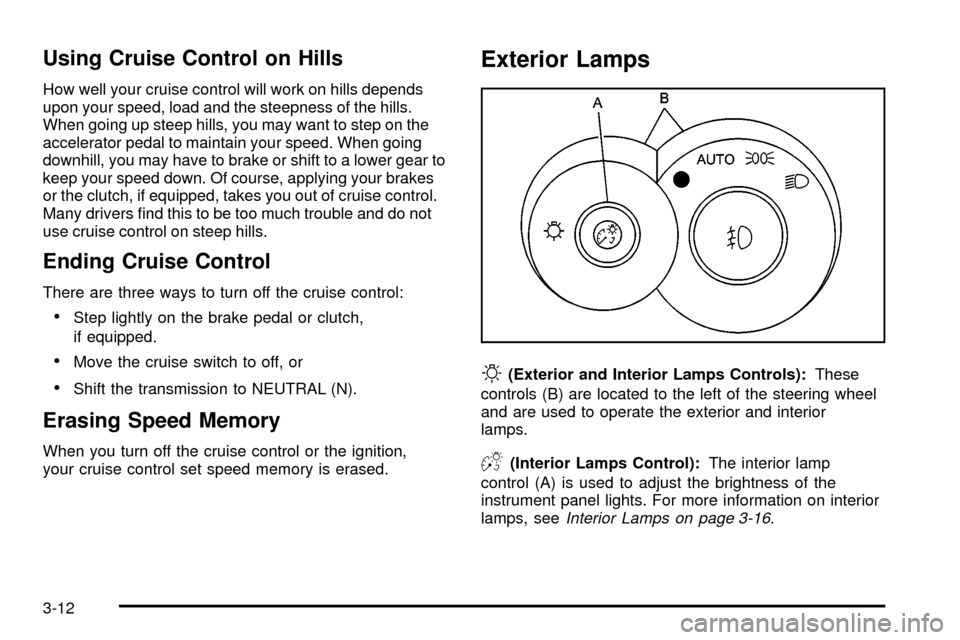
O(Exterior and Interior Lamps Controls):These
controls (B) are located to the left of the steering wheel
and are used to operate the exterior and interior
lamps.
D(Interior Lamps Control): The interior lamp
control (A) is used to adjust the brightness of the
instrument panel lights. For more information on interior
lamps, see
Interior Lamps on page 3-16.
3-12
Page 131 of 388

The exterior lamps control operates the following
systems:
·Headlamps
·Taillamps
·Parking Lamps
·License Lamps
·Sidemarker Lamps
·Instrument Panel Lights
·Interior Courtesy Lamps
O(Fog Lamp Indicator Light):This light illuminates
when the fog lamps are turned on. See
Fog Lamps
on page 3-15for more information.
AUTO (Automatic Headlamp System): Turning the
exterior lamps control to this position activates the
automatic headlamp system. See
Automatic Headlamp
System on page 3-14for more information.
;(Parking Lamps): Turning the exterior lamps
control to this position turns on the parking lamps,
license plate lamps, the sidemarker lamps and the
instrument panel lights.
2(Headlamps): Turning the exterior lamps control
to this position turns on the headlamps, together with the
previously listed lamps and lights.
Headlamps on Reminder
A reminder tone will sound when your headlamps or
parking lamps are manually turned on, the driver's door
is open and your ignition is in OFF or ACCESSORY.
To turn the tone off, turn the knob all the way
counterclockwise. In the automatic mode, the headlamps
turn off once the ignition key is in OFF.
3-13
Page 132 of 388

Daytime Running Lamps (DRL)
Daytime Running Lamps (DRL) can make it easier for
others to see the front of your vehicle during the
day. DRL can be helpful in many different driving
conditions, but they can be especially helpful in the short
periods after dawn and before sunset. Fully functional
daytime running lamps are required on all vehicles
®rst sold in Canada.
The DRL system will make your headlamps come
on at reduced brightness when the following conditions
are met:
·The ignition is on,
·the exterior lamps knob is in AUTO,
·the light sensor detects daytime light, and
·the automatic transmission is not in PARK (P)
or the parking brake is not set on a manual
transmission.
When the DRL are on, only your headlamps will be on.
The taillamps, sidemarker and other lamps won't be
on. The instrument panel won't be lit up either. When it begins to get dark, the headlamps will
automatically switch from DRL to the regular headlamps.
To idle your vehicle with the DRL off, put your
automatic transmission in PARK (P). The DRL will
stay off until you shift out of PARK (P). If you have a
manual transmission, set the parking brake when
the ignition is off and then start your vehicle. The DRL
will stay off until you release the parking brake.
Automatic Headlamp System
When it is dark enough outside, your automatic
headlamp system will turn on your headlamps at the
normal brightness along with other lamps such as
the taillamps, sidemarker, parking lamps and the
instrument panel lights when the exterior lamps knob is
turned to AUTO. See
Exterior Lamps on page 3-12for more information. The radio lights will also be on.
Your vehicle is equipped with a light sensor on the top
of the instrument panel. Be sure it is not covered or
the system will be on whenever the ignition is on.
The system may also turn on your lights when driving
through a parking garage, heavy overcast weather
or a tunnel. This is normal.
3-14
Page 133 of 388

There is a delay in the transition between the daytime
and nighttime operation of the Daytime Running
Lamps (DRL) and the automatic headlamp systems so
that driving under bridges or bright overhead street
lights does not affect the system. The DRL and
automatic headlamp system will only be affected when
the light sensor sees a change in lighting lasting
longer than the delay. See
Daytime Running Lamps
(DRL) on page 3-14for more information.
To idle your vehicle with the automatic headlamp
system off, set the parking brake while the ignition is
off. Then start your vehicle. The automatic headlamp
system will stay off until you release the parking brake,
or until you shift out of PARK (P).
You may be able to turn off your automatic headlamp
system. See
Daytime Running Lamps (DRL) on
page 3-14for more information.
If you start your vehicle in a dark garage, the automatic
headlamp system will come on immediately. Once you
leave the garage, it will take approximately one minute
for the automatic headlamp system to change to
DRL if it is light outside. During that delay, your
instrument panel cluster may not be as bright as usual. Make sure your instrument panel brightness control is in
the full bright position. See
Instrument Panel Brightness
on page 3-16for more information.
As with any vehicle, you should turn on the regular
headlamp system when you need it.
Fog Lamps
Use your fog lamps for better vision in foggy or misty
conditions. Your ignition must be in RUN for your
fog lamps to work.
-(Fog Lamps): Press this button located on the
exterior lamps control to turn the fog lamps on or off.
The fog lamps will go off whenever you turn on the
high-beam headlamps. When the high beams are turned
off, the fog lamps will come on again.
O(Fog Lamp Indicator Light): This light located on
the exterior lamps control illuminates when the fog
lamps are turned on.
3-15
Page 135 of 388

Theater Dimming
This feature allows for a three to ®ve-second fade out
of the courtesy lamps instead of immediate turn off.
Exit Lighting
With the exit lighting, the interior lamps will come on
when you remove the key from the ignition to help you
see while exiting the vehicle.
Perimeter Lighting
When the button with the unlock symbol on the remote
keyless entry transmitter is pressed, the DRL, parking
lamps and back-up lamps will come on if it is dark
enough outside.
This feature can be personalized for up to two drivers.
See
DIC Vehicle Personalization on page 3-52for
more information.
Map Lamps
If your vehicle has front map lamps, they are located on
the inside rearview mirror. They will automatically come
on for approximately 40 seconds when the doors are
unlocked with the remote keyless entry transmitter or
until the ignition key is turned to RUN or ACCESSORY.
The lamps will also stay on for approximately 40 seconds
after you exit the vehicle unless you lock the doors with
the remote keyless entry transmitter.
You can also turn the lamps on and off by pressing the
button near each lamp.
Battery Run-Down Protection
This feature shuts off all lamps that are left on for
more than 10 minutes when the ignition is off. This
will keep your battery from running down.
3-17
Page 140 of 388
1(Maximum Defrost):This mode directs most of
the air to the windshield, with some air directed to
the side window outlets and the ¯oor outlets. The rear
window defogger and heated outside mirrors will turn on,
and the fan speed will be at the highest setting (5).
The temperature will be at the hottest setting also.
Recirculation is not available in this mode.
If this mode was selected when you turn your vehicle
off, the warmest temperature and highest fan speed will
be restored when the vehicle is started, regardless of
the temperature and fan setting.
Do not drive the vehicle until all the windows are clear.
Rear Window Defogger
The rear window defogger uses a warming grid to
remove fog from the rear window.
The rear window defogger will only work when the
ignition is on.
=(Rear): Press this button on the right knob to turn
the rear window defogger on or off. An indicator light
on the button will come on to let you know that the rear
window defogger is activated. When the rear defogger button is pressed, the outside
heated mirrors will warm to help clear any fog or
frost from the surface of the mirrors.
Notice:Using a razor blade or sharp object to
clear the inside rear window may damage the rear
window defogger. Repairs would not be covered
by your warranty. Do not clear the inside of the rear
window with sharp objects.
Outlet Adjustment
Use the levers located in the center of each outlet to
change the direction of the air¯ow.
Operation Tips
·
Clear away any ice, snow or leaves from the air
inlets at the base of the windshield that may
block the ¯ow of air into your vehicle.
·Use of non-GM approved hood de¯ectors may
adversely affect the performance of the system.
·Keep the path under the front seats clear of objects
to help circulate the air inside of your vehicle more
effectively.
3-22
Page 143 of 388

Speedometer and Odometer
The speedometer lets you see your speed in both
miles per hour (mph) and kilometers per hour (km/h).
The odometer shows how far your vehicle has been
driven, in either miles (used in the United States)
or kilometers (used in Canada).
The odometer mileage can be checked without the
vehicle running. Turn the ignition to RUN and press the
trip information button located on the steering wheel.
See
DIC Controls and Displays on page 3-42for more
information.
You may wonder what happens if your vehicle needs a
new odometer installed. If the new one can be set to
the mileage total of the old odometer, then it must
be. But if it can't, then it's set at zero, and a label must
be put on the driver's door to show the old mileage
reading when the new odometer was installed.
Trip Odometer
The trip odometer can tell you how far your vehicle has
been driven since you last set the trip odometer to zero.
Your trip odometer is part of your Driver Information
Center (DIC). The trip information button toggles
to display your trip odometer, Trip A, and Trip B
functions. See ªTrip Odometerº under
DIC Controls
and Displays on page 3-42for more information.
3-25