maintenance CHEVROLET SSR 2006 1.G User Guide
[x] Cancel search | Manufacturer: CHEVROLET, Model Year: 2006, Model line: SSR, Model: CHEVROLET SSR 2006 1.GPages: 390, PDF Size: 2.44 MB
Page 246 of 390

When You Are Ready to Leave After
Parking on a Hill
1. Apply your regular brakes and hold the pedal down
while you:
•Start your engine.
•Shift into a gear.
•Release the parking brake.
2. Let up on the brake pedal.
3. Drive slowly until the trailer is clear of the chocks.
4. Stop and have someone pick up and store
the chocks.
Maintenance When Trailer Towing
Your vehicle will need service more often when you’re
pulling a trailer. SeeScheduled Maintenance on
page 6-4for more information. Things that are especially
important in trailer operation are automatic transmission
fluid (don’t overfill), engine oil, axle lubricant, belt,
cooling system and brake system. Each of these is
covered in this manual. If you’re trailering, it’s a
good idea to review these sections before you start
your trip.
Check periodically to see that all hitch nuts and bolts
are tight.
4-46
Page 250 of 390

Different Size Tires and Wheels......................5-62
Uniform Tire Quality Grading..........................5-62
Wheel Alignment and Tire Balance..................5-63
Wheel Replacement......................................5-64
Tire Chains..................................................5-66
If a Tire Goes Flat........................................5-67
Tire Inflator Kit.............................................5-68
Appearance Care............................................5-76
Cleaning the Inside of Your Vehicle.................5-76
Fabric/Carpet...............................................5-78
Leather.......................................................5-78
Instrument Panel, Vinyl, and Other
Plastic Surfaces........................................5-79
Care of Safety Belts......................................5-79
Weatherstrips...............................................5-79
Washing Your Vehicle...................................5-80
Cleaning Exterior Lamps/Lenses.....................5-80
Finish Care..................................................5-80
Windshield and Wiper Blades.........................5-81
Aluminum or Chrome-Plated Wheels................5-82Tires...........................................................5-82
Sheet Metal Damage.....................................5-83
Finish Damage.............................................5-83
Underbody Maintenance................................5-83
Chemical Paint Spotting.................................5-83
Vehicle Care/Appearance Materials..................5-84
Vehicle Identication......................................5-85
Vehicle Identification Number (VIN).................5-85
Service Parts Identification Label.....................5-85
Electrical System............................................5-86
Add-On Electrical Equipment..........................5-86
Headlamps..................................................5-86
Windshield Wiper Fuses................................5-86
Power Windows and Other Power Options.......5-86
Fuses and Circuit Breakers............................5-86
Floor Console Fuse Block..............................5-87
Engine Compartment Fuse Block....................5-90
Relay Center................................................5-92
Capacities and Specications..........................5-95
Section 5 Service and Appearance Care
5-2
Page 252 of 390

Doing Your Own Service Work
{CAUTION:
You can be injured and your vehicle could be
damaged if you try to do service work on a
vehicle without knowing enough about it.
Be sure you have sufficient knowledge,
experience, the proper replacement parts,
and tools before you attempt any vehicle
maintenance task.
Be sure to use the proper nuts, bolts, and
other fasteners. English and metric
fasteners can be easily confused. If you
use the wrong fasteners, parts can later
break or fall off. You could be hurt.If you want to do some of your own service work, you
will want to use the proper service manual. It tells
you much more about how to service your vehicle than
this manual can. To order the proper service manual,
seeService Publications Ordering Information on
page 7-14.
Your vehicle has an airbag system. Before attempting to
do your own service work, seeServicing Your
Airbag-Equipped Vehicle on page 1-51.
You should keep a record with all parts receipts and list
the mileage and the date of any service work you
perform. SeeMaintenance Record on page 6-15.
5-4
Page 253 of 390

Adding Equipment to the Outside of
Your Vehicle
Things you might add to the outside of your vehicle
can affect the airflow around it. This may cause
wind noise and affect windshield washer performance.
Check with your dealer before adding equipment to
the outside of your vehicle.
Fuel
Use of the recommended fuel is an important part of the
proper maintenance of your vehicle.
Gasoline Octane
Use premium unleaded gasoline with a posted octane
rating of 91 or higher. You may also use regular
unleaded gasoline rated at 87 octane or higher, but
your vehicle’s acceleration may be slightly reduced, and
you may notice a slight audible knocking noise,
commonly referred to as spark knock. If the octane is
less than 87, you may notice a heavy knocking
noise when you drive. If this occurs, use a gasoline
rated at 87 octane or higher as soon as possible.
Otherwise, you might damage your engine. If you are
using gasoline rated at 87 octane or higher and you hear
heavy knocking, your engine needs service.
5-5
Page 266 of 390

Engine Cover
Your vehicle has a removable engine cover.
To remove the engine cover do the following:
1. Unscrew the four bolts from the engine.
2. Lift off the cover.
3. To reinstall the engine cover, reverse the steps.
Engine Air Cleaner/Filter
SeeEngine Compartment Overview on page 5-12for
the location of the engine air cleaner/filter.
When to Inspect the Engine Air
Cleaner/Filter
Inspect the air cleaner/filter at the MaintenanceII
intervals and replace it at the first oil change after each
50,000 mile (83 000 km) interval. SeeScheduled
Maintenance on page 6-4for more information. If you
are driving in dusty/dirty conditions, inspect the filter
at each engine oil change.
5-18
Page 270 of 390

Consistency of Readings
Always check the fluid level at least twice using the
procedure described previously. Consistency (repeatable
readings) is important to maintaining proper fluid level. If
inconsistent readings continue, contact your dealer.
How to Add Automatic
Transmission Fluid
Refer to the Maintenance Schedule to determine what
kind of transmission fluid to use. SeeRecommended
Fluids and Lubricants on page 6-12.
Add fluid only after checking the transmission fluid while
it is hot. A cold check is used only as a reference. If
the fluid level is low, add only enough of the proper fluid
to bring the level up to the HOT area for a hot check.
It does not take much fluid, generally less than one pint
(0.5 L). Do not overfill.
Notice:Use of the incorrect automatic transmission
uid may damage your vehicle, and the damages
may not be covered by your warranty. Always
use the automatic transmission uid listed in
Recommended Fluids and Lubricants on page 6-12.
•After adding fluid, recheck the fluid level as
described under “How to Check Automatic
Transmission Fluid,” earlier in this section.
•When the correct fluid level is obtained, push the
dipstick back in all the way; then flip the handle
down to lock the dipstick in place.
Manual Transmission Fluid
When to Check Manual
Transmission Fluid
A good time to have the manual transmission fluid
checked is when the engine oil is changed. However,
the fluid in your manual transmission does not
require changing.
How to Check Manual
Transmission Fluid
Because this operation can be a little difficult, you
may choose to have this done at the dealership
service department.
If you do it yourself, be sure to follow all the instructions
here, or you could get a false reading.
Notice:Too much or too little uid can damage your
transmission. Too little uid could cause the
transmission to overheat. Be sure to get an accurate
reading if you check your transmission uid.
Check the fluid level only when your engine is off, the
vehicle is parked on a level place, and the transmission
is cool enough for you to rest your fingers on the
transmission case.
5-22
Page 271 of 390
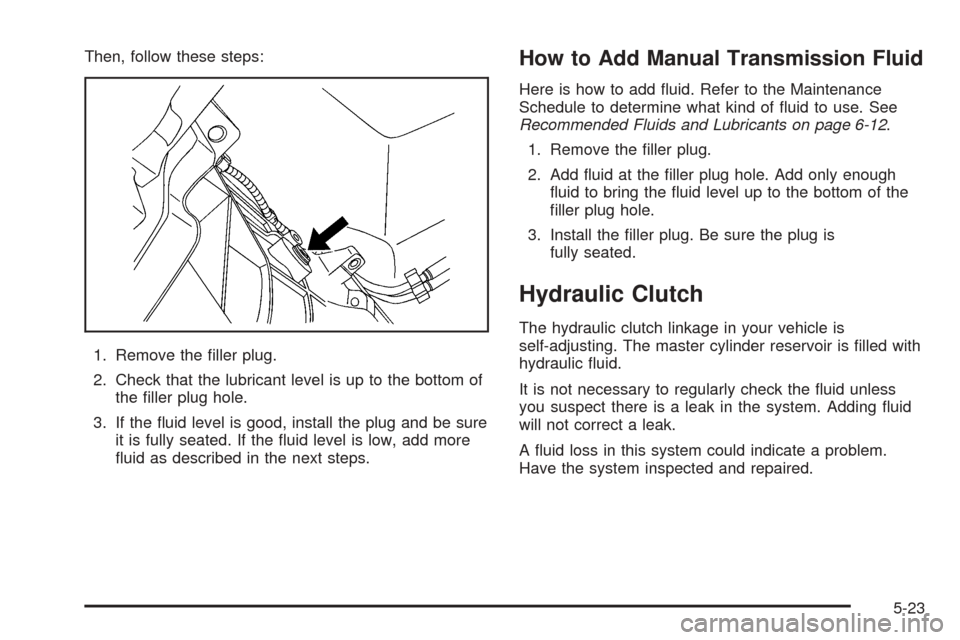
Then, follow these steps:
1. Remove the filler plug.
2. Check that the lubricant level is up to the bottom of
the filler plug hole.
3. If the fluid level is good, install the plug and be sure
it is fully seated. If the fluid level is low, add more
fluid as described in the next steps.How to Add Manual Transmission Fluid
Here is how to add fluid. Refer to the Maintenance
Schedule to determine what kind of fluid to use. See
Recommended Fluids and Lubricants on page 6-12.
1. Remove the filler plug.
2. Add fluid at the filler plug hole. Add only enough
fluid to bring the fluid level up to the bottom of the
filler plug hole.
3. Install the filler plug. Be sure the plug is
fully seated.
Hydraulic Clutch
The hydraulic clutch linkage in your vehicle is
self-adjusting. The master cylinder reservoir is filled with
hydraulic fluid.
It is not necessary to regularly check the fluid unless
you suspect there is a leak in the system. Adding fluid
will not correct a leak.
A fluid loss in this system could indicate a problem.
Have the system inspected and repaired.
5-23
Page 272 of 390

When to Check and What to Use
Refer to the Maintenance
Schedule to determine
how often you should
check the fluid level in your
master cylinder reservoir
and for the proper
fluid. SeeOwner Checks
and Services on page 6-8
andRecommended
Fluids and Lubricants on
page 6-12.
How to Check and Add Fluid
You do not need to check the fluid level unless you
suspect a clutch problem. To check the fluid level, take
the cap off. If the fluid reaches the step inside the
reservoir, the fluid level is correct. SeeEngine
Compartment Overview on page 5-12for more
information on location.
Engine Coolant
The cooling system in your vehicle is filled with
DEX-COOL®engine coolant. This coolant is designed
to remain in your vehicle for five years or 150,000 miles
(240 000 km), whichever occurs first, if you add only
DEX-COOL
®extended life coolant.
The following explains your cooling system and how to
add coolant when it is low. If you have a problem
with engine overheating or if you need to add coolant to
your radiator, seeEngine Overheating on page 5-27.
A 50/50 mixture of clean, drinkable water and
DEX-COOL
®coolant will:
•Give freezing protection down to−34°F (−37°C).
•Give boiling protection up to 265°F (129°C).
•Protect against rust and corrosion.
•Help keep the proper engine temperature.
•Let the warning lights and gages work as
they should.
Notice:Using coolant other than DEX-COOL
®may
cause premature engine, heater core, or radiator
corrosion. In addition, the engine coolant may
require changing sooner, at the rst maintenance
service after each 30,000 miles (50 000 km) or
24 months, whichever occurs rst. Any repairs
would not be covered by your warranty. Always use
DEX-COOL
®(silicate-free) coolant in your vehicle.
5-24
Page 281 of 390

So, it is not a good idea to top off your brake fluid.
Adding brake fluid will not correct a leak. If you add fluid
when your linings are worn, then you will have too
much fluid when you get new brake linings. You should
add or remove brake fluid, as necessary, only when
work is done on the brake hydraulic system.
{CAUTION:
If you have too much brake uid, it can spill on
the engine. The uid will burn if the engine is
hot enough. You or others could be burned,
and your vehicle could be damaged. Add brake
uid only when work is done on the brake
hydraulic system. See “Checking Brake Fluid”
in this section.
Refer to the Maintenance Schedule to determine when
to check your brake fluid. SeeScheduled Maintenance
on page 6-4.
Checking Brake Fluid
You can check the brake fluid without taking off the cap.
Look at the brake fluid
reservoir. The fluid level
should be above MIN. If it
is not, have your brake
system checked to
see if there is a leak.
After work is done on the brake hydraulic system, make
sure the level is above the MIN, but not over the
MAX mark.
5-33
Page 284 of 390

Brake Adjustment
Every time you make a brake stop, your disc brakes
adjust for wear.
Replacing Brake System Parts
The braking system on a vehicle is complex. Its many
parts have to be of top quality and work well together if
the vehicle is to have really good braking. Your
vehicle was designed and tested with top-quality
GM brake parts. When you replace parts of your braking
system — for example, when your brake linings wear
down and you need new ones put in — be sure you get
new approved GM replacement parts. If you do not,
your brakes may no longer work properly. For example,
if someone puts in brake linings that are wrong for
your vehicle, the balance between your front and rear
brakes can change — for the worse. The braking
performance you have come to expect can change in
many other ways if someone puts in the wrong
replacement brake parts.
Battery
Your vehicle has a maintenance free battery. When it is
time for a new battery, get one that has the replacement
number shown on the original battery’s label. We
recommend an ACDelco
®replacement battery. The
battery is located under the rear of the vehicle.Warning:Battery posts, terminals, and related
accessories contain lead and lead compounds,
chemicals known to the State of California to
cause cancer and reproductive harm. Wash hands
after handling.
Vehicle Storage
If you are not going to drive your vehicle for 25 days
or more, remove the black, negative (−) cable from
the battery. This will help keep your battery from
running down.
{CAUTION:
Batteries have acid that can burn you and gas
that can explode. You can be badly hurt if you
are not careful. SeeJump Starting on
page 5-37for tips on working around a battery
without getting hurt.
5-36