tire pressure CHEVROLET SSR 2006 1.G Owner's Manual
[x] Cancel search | Manufacturer: CHEVROLET, Model Year: 2006, Model line: SSR, Model: CHEVROLET SSR 2006 1.GPages: 390, PDF Size: 2.44 MB
Page 321 of 390
18. Immediately drive the vehicle 5 miles (8 km) to
distribute the sealant evenly in the tire. Stop at a
safe location and check the tire pressure. Refer to
Steps 1 through 8 under “Using the Air Compressor
without Sealant” next in this section. If the tire
pressure has fallen more than 10 psi (68 kPa) below
the recommended inflation pressure, stop driving
the vehicle. The tire is too damaged for the sealant
to work. SeeRoadside Assistance Program on
page 7-6.
If the tire pressure has not dropped more than
10 psi (68 kPa) from the recommended inflation
pressure, you can inflate the tire back up to
the recommended inflation pressure.
19. Dispose of the sealant canister at a local
GM dealer or in accordance with your local state
codes and practices.
After using the sealant canister, replace it with a
new canister from a GM dealer.
20. After temporarily repairing a tire with the emergency
flat tire repair kit, take your vehicle to an authorized
GM dealer to have the tire inspected and repaired.Using the Air Compressor
without Sealant
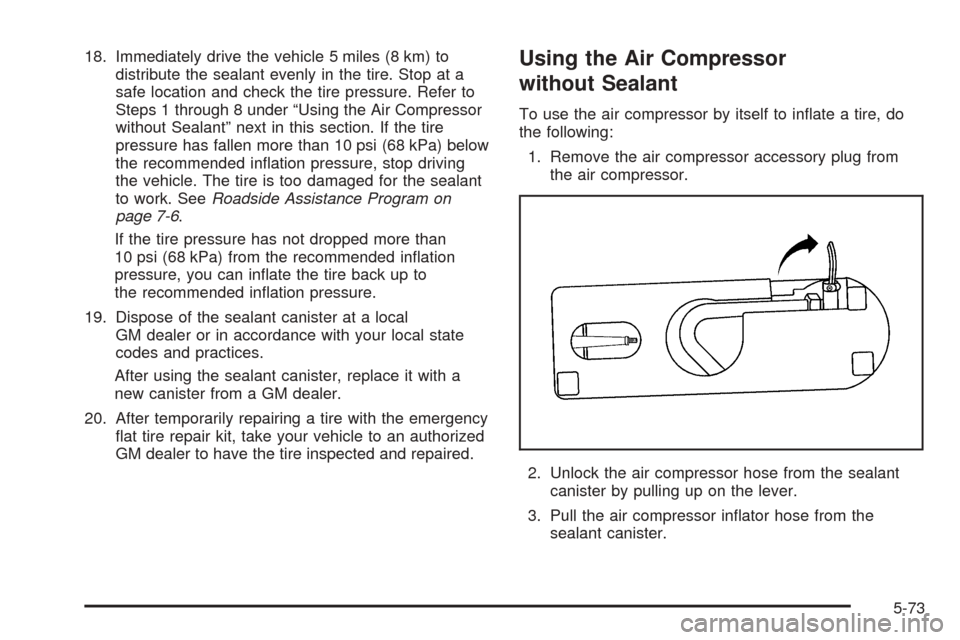
To use the air compressor by itself to inflate a tire, do
the following:
1. Remove the air compressor accessory plug from
the air compressor.
2. Unlock the air compressor hose from the sealant
canister by pulling up on the lever.
3. Pull the air compressor inflator hose from the
sealant canister.
5-73
Page 322 of 390

4. Push the air compressor inflator hose onto the
tire valve stem and push the lever down to
secure in place.
5. Plug the air compressor accessory plug into an
accessory power outlet in the vehicle. See
Accessory Power Outlet(s) on page 3-19for
more information.
{CAUTION:
Idling the engine in a closed-in place or with
the climate control system off can cause
deadly carbon monoxide (CO). SeeEngine
Exhaust on page 2-26.
6. Start the vehicle. SeeStarting the Engine on
page 2-17for more information. The vehicle must be
running while using the air compressor.
{CAUTION:
Inating something too much can make it
explode, and you or others could be injured.
Be sure to read the inator instructions, and
inate the tire to its recommended pressure.
Do not exceed 36 psi (248 kPa).
7. Move the inflator kit switch to the I (on) position.
8. Make sure there is a proper connection between the
tire valve stem and the air compressor hose by
looking at the air pressure gage. If there is not a
pressure reading while the compressor is running,
the connection between the inflator kit and the
tire is bad.
Check the attachment between the air compressor
hose and the tire valve stem.
5-74
Page 323 of 390
9. Inflate the tire up to the recommended inflation
pressure using the air pressure gage on the top
of the unit as a guide.
10. Turn off the air compressor by moving the switch to
the O (off) position.
{CAUTION:
Storing the tire inator kit or other equipment
in the passenger compartment of the vehicle
could cause injury. In a sudden stop or
collision, loose equipment could strike
someone. Store the tire inator kit in the
proper place.
11. Disconnect the compressor inflator hose and wrap
the hose in the bottom of the inflator kit.
12. Place the equipment in the original location behind
the driver’s seatback.
Removal and Installation of the
Sealant Canister
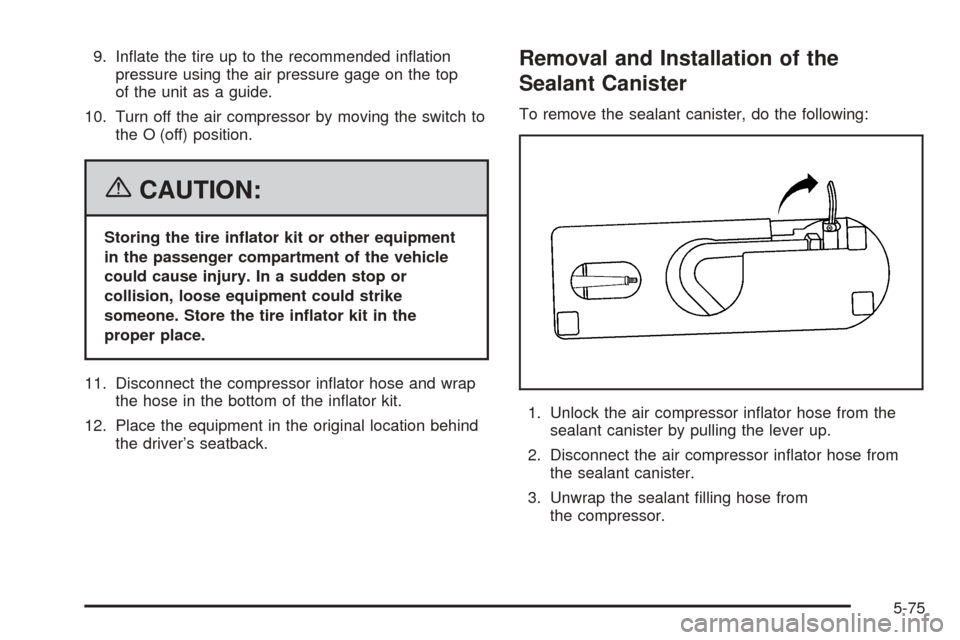
To remove the sealant canister, do the following:
1. Unlock the air compressor inflator hose from the
sealant canister by pulling the lever up.
2. Disconnect the air compressor inflator hose from
the sealant canister.
3. Unwrap the sealant filling hose from
the compressor.
5-75
Page 328 of 390
Washing Your Vehicle
The paint finish on the vehicle provides beauty, depth of
color, gloss retention, and durability.
The best way to preserve the vehicle’s finish is to keep it
clean by washing it often with lukewarm or cold water.
Do not wash the vehicle in the direct rays of the sun.
Use a car washing soap. Do not use strong soaps
or chemical detergents. Be sure to rinse the vehicle well,
removing all soap residue completely. GM-approved
cleaning products can be obtained from your dealer. See
Vehicle Care/Appearance Materials on page 5-84.Do
not use cleaning agents that are petroleum based,
or that contain acid or abrasives. All cleaning agents
should be flushed promptly and not allowed to dry on the
surface, or they could stain. Dry the finish with a soft,
clean chamois or an all-cotton towel to avoid surface
scratches and water spotting.
Notice:If you drive your vehicle through an
automatic car wash that does not have enough
clearance for the wide rear tires and wheels, you
could damage your vehicle. Verify with the manager
of the car wash that your vehicle will t before
entering the car wash or use a touchless car wash.
High pressure car washes may cause water to enter
the vehicle.
Cleaning Exterior Lamps/Lenses
Use only lukewarm or cold water, a soft cloth and a car
washing soap to clean exterior lamps and lenses.
Follow instructions underWashing Your Vehicle on
page 5-80.
Finish Care
Occasional waxing or mild polishing of your vehicle by
hand may be necessary to remove residue from the
paint finish. You can get GM-approved cleaning products
from your dealer. SeeVehicle Care/Appearance
Materials on page 5-84.
If your vehicle has a “basecoat/clearcoat” paint finish,
the clearcoat gives more depth and gloss to the colored
basecoat. Always use waxes and polishes that are
non-abrasive and made for a basecoat/clearcoat
paint finish.
Notice:Machine compounding or aggressive
polishing on a basecoat/clearcoat paint nish may
damage it. Use only non-abrasive waxes and
polishes that are made for a basecoat/clearcoat
paint nish on your vehicle.
5-80
Page 349 of 390

Scheduled Maintenance
Service MaintenanceIMaintenanceII
Change engine oil and filter. SeeEngine Oil on page 5-13. Reset oil
life system. SeeEngine Oil Life System on page 5-16.An Emission
Control Service.••
Visually check for any leaks or damage.See footnote (g).••
Inspect engine air cleaner filter. If necessary, replace filter. SeeEngine Air
Cleaner/Filter on page 5-18.See footnote (j).•
Check tire inflation pressures and tire wear. SeeTires on page 5-51.••
Inspect brake system.See footnote (a).••
Check engine coolant and windshield washer fluid levels and add fluid
as needed.••
Perform any needed additional services. See “Additional Required Services”
in this section.••
Inspect suspension and steering components.See footnote (b).•
Inspect engine cooling system.See footnote (c).•
Inspect wiper blades.See footnote (d).•
Inspect restraint system components.See footnote (e).•
Lubricate body components.See footnote (f).•
Check transmission fluid level and add fluid as needed.•
6-5
Page 353 of 390

At Least Once a Month
Tire Inspection and Ination Check
Visually inspect your tires for wear and make sure tires
are inflated to the correct pressures. SeeTires on
page 5-51for further details.
At Least Once a Year
Starter Switch Check
{CAUTION:
When you are doing this inspection, the
vehicle could move suddenly. If the vehicle
moves, you or others could be injured.
1. Before you start, be sure you have enough room
around the vehicle.2. Firmly apply both the parking brake and the regular
brake. SeeParking Brake on page 2-23if
necessary.
Do not use the accelerator pedal, and be ready to
turn off the engine immediately if it starts.
3. On automatic transmission vehicles, try to
start the engine in each gear. The starter should
work only in PARK (P) or NEUTRAL (N). If the
starter works in any other position, contact your
GM Goodwrench
®dealer for service.
On manual transmission vehicles, put the shift lever
in NEUTRAL, push the clutch down halfway and
try to start the engine. The starter should work only
when the clutch is pushed down all the way to
the floor. If the starter works when the clutch is
not pushed all the way down, contact your
GM Goodwrench
®dealer for service.
6-9
Page 381 of 390

Child Restraints
Child Restraint Systems...............................1-26
Infants and Young Children...........................1-23
Lower Anchors and Tethers for Children..........1-30
Older Children.............................................1-20
Securing a Child Restraint in the Passenger
Seat Position...........................................1-36
Cigarette Lighter.............................................3-20
Cleaning
Aluminum or Chrome-Plated Wheels..............5-82
Exterior Lamps/Lenses.................................5-80
Fabric/Carpet..............................................5-78
Finish Care.................................................5-80
Inside of Your Vehicle..................................5-76
Instrument Panel, Vinyl, and Other
Plastic Surfaces.......................................5-79
Leather......................................................5-78
Tires..........................................................5-82
Underbody Maintenance...............................5-83
Washing Your Vehicle...................................5-80
Weatherstrips..............................................5-79
Windshield and Wiper Blades........................5-81
Climate Control System...................................3-21
Outlet Adjustment........................................3-23
Clutch, Hydraulic.............................................5-23
Collision Damage Repair..................................7-10
Content Theft-Deterrent....................................2-13
Control of a Vehicle.......................................... 4-6
Convertible Top..............................................2-45
Lowering the Convertible Top........................2-47Convertible Top (cont.)
Raising the Convertible Top..........................2-48
Coolant
Engine Temperature Gage............................3-32
Surge Tank Pressure Cap.............................5-27
Cooling System..............................................5-29
Cruise Control................................................3-10
Cruise Control Light........................................3-37
Cupholder(s)..................................................2-34
Customer Assistance Information
Courtesy Transportation.................................. 7-7
Customer Assistance for Text
Telephone (TTY) Users............................... 7-4
Customer Assistance Offices........................... 7-4
Customer Satisfaction Procedure..................... 7-2
GM Mobility Reimbursement Program............... 7-5
Reporting Safety Defects to General Motors.......7-14
Reporting Safety Defects to the Canadian
Government............................................7-14
Reporting Safety Defects to the United
States Government...................................7-13
Roadside Assistance Program......................... 7-6
Service Publications Ordering Information........7-14
D
Daytime Running Lamps..................................3-14
Defensive Driving............................................. 4-2
Doing Your Own Service Work........................... 5-4
3
Page 383 of 390
F
Filter
Engine Air Cleaner......................................5-18
Finish Damage...............................................5-83
Flash-to-Pass................................................... 3-8
Flat Tire........................................................5-67
Floor Tracks...................................................2-38
Fluid
Automatic Transmission................................5-20
Manual Transmission....................................5-22
Power Steering...........................................5-31
Windshield Washer......................................5-31
Fog Lamps....................................................3-16
Fuel............................................................... 5-5
Additives...................................................... 5-6
California Fuel.............................................. 5-6
Filling a Portable Fuel Container....................5-10
Filling Your Tank........................................... 5-8
Fuels in Foreign Countries.............................. 5-7
Gage.........................................................3-39
Gasoline Octane........................................... 5-5
Gasoline Specifications.................................. 5-6
Fuses
Engine Compartment Fuse Block...................5-90
Floor Console Fuse Block.............................5-87
Fuses and Circuit Breakers...........................5-86
Relay Center..............................................5-92
Windshield Wiper.........................................5-86
G
Gage
Auxiliary Package........................................3-40
Check Gages Warning Light..........................3-38
Engine Coolant Temperature.........................3-32
Fuel..........................................................3-39
Oil Pressure...............................................3-36
Speedometer..............................................3-26
Tachometer.................................................3-26
Garage Door Opener.......................................2-30
Gasoline
Octane........................................................ 5-5
Specifications............................................... 5-6
Glove Box.....................................................2-34
GM Mobility Reimbursement Program.................. 7-5
H
Hazard Warning Flashers................................... 3-6
Headlamp
Aiming.......................................................5-43
Headlamps....................................................5-44
Automatic Headlamp System.........................3-15
Bulb Replacement.......................................5-43
Daytime Running Lamps...............................3-14
Electrical System.........................................5-86
Flash-to-Pass............................................... 3-8
5
Page 384 of 390

Headlamps (cont.)
Front Turn Signal, Sidemarker and
Parking Lamps.........................................5-45
Halogen Bulbs............................................5-44
High/Low Beam Changer................................ 3-8
On Reminder..............................................3-14
Heated Seats................................................... 1-4
Heater...........................................................3-21
Highbeam On Light.........................................3-38
Highway Hypnosis...........................................4-21
Hill and Mountain Roads..................................4-22
Hood
Checking Things Under................................5-10
Release.....................................................5-11
Horn............................................................... 3-6
How to Use This Manual...................................... ii
How to Wear Safety Belts Properly...................1-12
Hydraulic Clutch.............................................5-23
I
Ignition Positions.............................................2-16
Infants and Young Children, Restraints...............1-23
Inflation - Tire Pressure...................................5-57
Inflator Kit, Tire...............................................5-68
Instrument Panel
Overview..................................................... 3-4
Storage Area..............................................2-34Instrument Panel (I/P)
Brightness..................................................3-17
Cluster.......................................................3-25
Integrated Windshield Antenna..........................3-86
Interior Lamps................................................3-17
J
Jump Starting.................................................5-37
K
Keyless Entry System....................................... 2-5
Keys............................................................... 2-3
L
Labeling, Tire Sidewall.....................................5-52
Lamps
Battery Run-Down Protection.........................3-18
Exterior......................................................3-13
Fog ...........................................................3-16
Interior.......................................................3-17
Map ..........................................................3-18
LATCH System
Child Restraints...........................................1-30
Latches, Seatback............................................ 1-6
6
Page 389 of 390

Tires.............................................................5-51
Aluminum or Chrome-Plated Wheels,
Cleaning.................................................5-82
Buying New Tires........................................5-60
Chains.......................................................5-66
Cleaning....................................................5-82
Different Size..............................................5-62
If a Tire Goes Flat.......................................5-67
Inflation - Tire Pressure................................5-57
Inspection and Rotation................................5-59
Tire Inflator Kit............................................5-68
Tire Sidewall Labeling..................................5-52
Tire Terminology and Definitions....................5-54
Uniform Tire Quality Grading.........................5-62
Wheel Alignment and Tire Balance.................5-63
Wheel Replacement.....................................5-64
When It Is Time for New Tires......................5-59
Towing
Recreational Vehicle.....................................4-35
Towing a Trailer..........................................4-35
Your Vehicle...............................................4-35
Traction
Control System (TCS).................................... 4-9
Control System Warning Light.......................3-32
Trailer
Recommendations.......................................4-47
Transmission
Fluid, Automatic...........................................5-20
Fluid, Manual..............................................5-22Transmission Operation, Automatic....................2-19
Transmission Operation, Manual........................2-21
Trip Odometer................................................3-26
Truck-Camper Loading Information....................4-34
Turn and Lane-Change Signals.......................... 3-7
Turn Signal/Multifunction Lever........................... 3-7
U
Understanding Radio Reception........................3-85
Uniform Tire Quality Grading............................5-62
Universal Home Remote System.......................2-30
Operation...................................................2-30
V
Vehicle
Control........................................................ 4-6
Damage Warnings........................................... iv
Loading......................................................4-29
Parking Your...............................................2-25
Symbols......................................................... iv
Vehicle Data Collection and Event
Data Recorders............................................. 7-9
Vehicle Identification
Number (VIN).............................................5-85
Service Parts Identification Label...................5-85
11