wheel CHEVROLET SSR 2006 1.G Owner's Guide
[x] Cancel search | Manufacturer: CHEVROLET, Model Year: 2006, Model line: SSR, Model: CHEVROLET SSR 2006 1.GPages: 390, PDF Size: 2.44 MB
Page 225 of 390
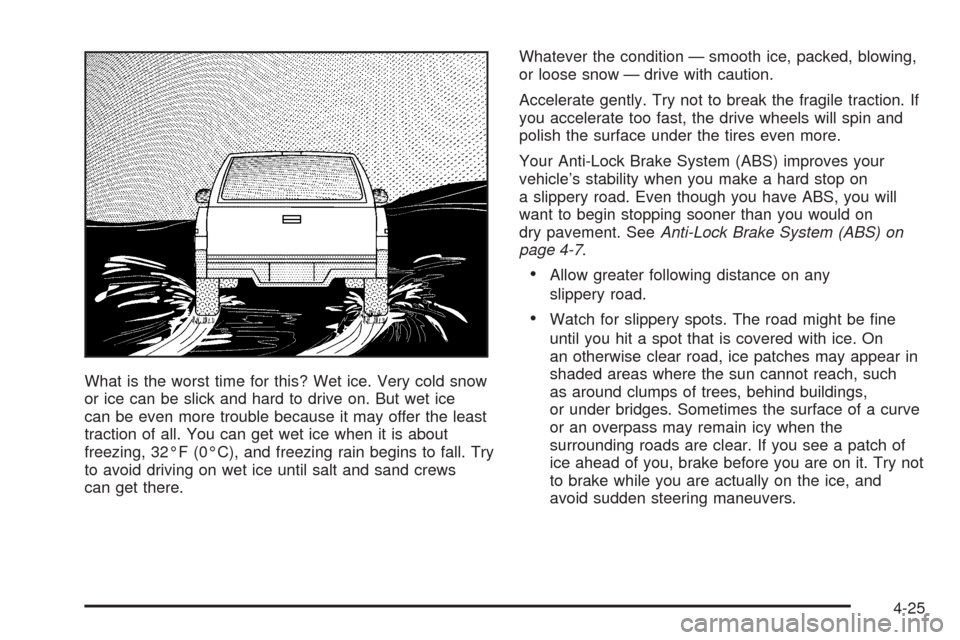
What is the worst time for this? Wet ice. Very cold snow
or ice can be slick and hard to drive on. But wet ice
can be even more trouble because it may offer the least
traction of all. You can get wet ice when it is about
freezing, 32°F (0°C), and freezing rain begins to fall. Try
to avoid driving on wet ice until salt and sand crews
can get there.Whatever the condition — smooth ice, packed, blowing,
or loose snow — drive with caution.
Accelerate gently. Try not to break the fragile traction. If
you accelerate too fast, the drive wheels will spin and
polish the surface under the tires even more.
Your Anti-Lock Brake System (ABS) improves your
vehicle’s stability when you make a hard stop on
a slippery road. Even though you have ABS, you will
want to begin stopping sooner than you would on
dry pavement. SeeAnti-Lock Brake System (ABS) on
page 4-7.
•Allow greater following distance on any
slippery road.
•Watch for slippery spots. The road might be fine
until you hit a spot that is covered with ice. On
an otherwise clear road, ice patches may appear in
shaded areas where the sun cannot reach, such
as around clumps of trees, behind buildings,
or under bridges. Sometimes the surface of a curve
or an overpass may remain icy when the
surrounding roads are clear. If you see a patch of
ice ahead of you, brake before you are on it. Try not
to brake while you are actually on the ice, and
avoid sudden steering maneuvers.
4-25
Page 228 of 390

If Your Vehicle is Stuck in Sand,
Mud, Ice or Snow
In order to free your vehicle when it is stuck, you will
need to spin the wheels, but you do not want to
spin your wheels too fast. The method known as rocking
can help you get out when you are stuck, but you
must use caution.
{CAUTION:
If you let your tires spin at high speed, they
can explode, and you or others could be
injured. And, the transmission or other parts of
the vehicle can overheat. That could cause an
engine compartment re or other damage.
When you are stuck, spin the wheels as little
as possible. Do not spin the wheels above
35 mph (55 km/h) as shown on the
speedometer.Notice:Spinning your wheels can destroy parts of
your vehicle as well as the tires. If you spin the
wheels too fast while shifting your transmission
back and forth, you can destroy your transmission.
For more information about using tire chains on your
vehicle, seeTire Chains on page 5-66.
Rocking Your Vehicle to Get It Out
First, turn your steering wheel left and right. That will clear
the area around your front wheels. If you have traction
control, you should turn the system off. SeeTraction
Control System (TCS) (Automatic Transmission) on
page 4-9. Then shift back and forth between
REVERSE (R) and a forward gear, or with a manual
transmission, between FIRST (1) or SECOND (2) and
REVERSE (R), spinning the wheels as little as possible.
Release the accelerator pedal while you shift, and press
lightly on the accelerator pedal when the transmission is
in gear. By slowly spinning your wheels in the forward
and reverse directions, you will cause a rocking motion
that may free your vehicle. If that does not get you out
after a few tries, you may need to be towed out. If you do
need to be towed out, seeTowing Your Vehicle on
page 4-35.
4-28
Page 235 of 390
Towing
Towing Your Vehicle
Consult your dealer or a professional towing service if
you need to have your disabled vehicle towed. See
Roadside Assistance Program on page 7-6.
For information about recreational vehicle towing, see
the following entry.
Recreational Vehicle Towing
Recreational vehicle towing means towing your vehicle
behind another vehicle — such as behind a motorhome.
The two most common types of recreational vehicle
towing are known as “dinghy towing” (towing your vehicle
with all four wheels on the ground) and “dolly towing”
(towing your vehicle with two wheels on the ground and
two wheels up on a device known as a “dolly”).
Notice:If you tow your vehicle with two or all
four wheels on the ground, the transmission could
be damaged. The repairs would not be covered
by your warranty. Do not tow your vehicle with
two or all four wheels on the ground.
Your vehicle was not designed to be towed with any of
its wheels on the ground. If your vehicle must be
towed, it should be placed on a platform trailer.
Towing a Trailer
{CAUTION:
If you do not use the correct equipment and
drive properly, you can lose control when you
pull a trailer. For example, if the trailer is too
heavy, the brakes may not work well — or even
at all. You and your passengers could be
seriously injured. Pull a trailer only if you have
followed all the steps in this section. Ask your
dealer for advice and information about towing
a trailer with your vehicle.
Notice:Pulling a trailer improperly can damage
your vehicle and result in costly repairs that would
not be covered by your warranty. Always follow
the instructions in this section and check with your
dealer for more information about towing a trailer
with your vehicle.
To identify the trailering capacity of your vehicle, you
should read the information in “Weight of the Trailer” that
appears later in this section.
4-35
Page 237 of 390
Weight of the Trailer
How heavy can a trailer safely be?
It depends on how you plan to use your rig. For
example, speed, altitude, road grades, outside
temperature and how much your vehicle is used to pull
a trailer are all important. It can also depend on any
special equipment that you have on your vehicle,
and the amount of tongue weight the vehicle can carry.
See “Weight of the Trailer Tongue” later in this
section for more information.
Maximum trailer weight is calculated assuming only the
driver is in the tow vehicle and it has all the required
trailering equipment. The weight of additional optional
equipment, passengers and cargo in the tow vehicle
must be subtracted from the maximum trailer weight.Your vehicle is a two-wheel drive vehicle. The axle ratio
is 3.73, the maximum trailer weight is 2,500 lbs
(1 134 kg) and the Gross Combination Weight Rating
(GCWR) is 8,000 lbs (3 629 kg).
The Gross Combination Weight Rating (GCWR) is the
total allowable weight of the completely loaded
vehicle and trailer including any passengers, cargo,
equipment and conversions. The GCWR for your vehicle
should not be exceeded.
You can ask your dealer for trailering information or
advice, or you can write us at the address listed in your
Warranty and Owner Assistance Information Booklet.
In Canada, write to:
General Motors of Canada Limited
Customer Communication Centre, 163-005
1908 Colonel Sam Drive
Oshawa, Ontario L1H 8P7
4-37
Page 239 of 390
Total Weight on Your Vehicle’s Tires
Be sure your vehicle’s tires are inflated to the upper limit
for cold tires. You’ll find these numbers on the
Certification label at the rear edge of the driver’s door.
SeeLoading Your Vehicle on page 4-29. Then be
sure you don’t go over the GVW limit for your vehicle,
including the weight of the trailer tongue.
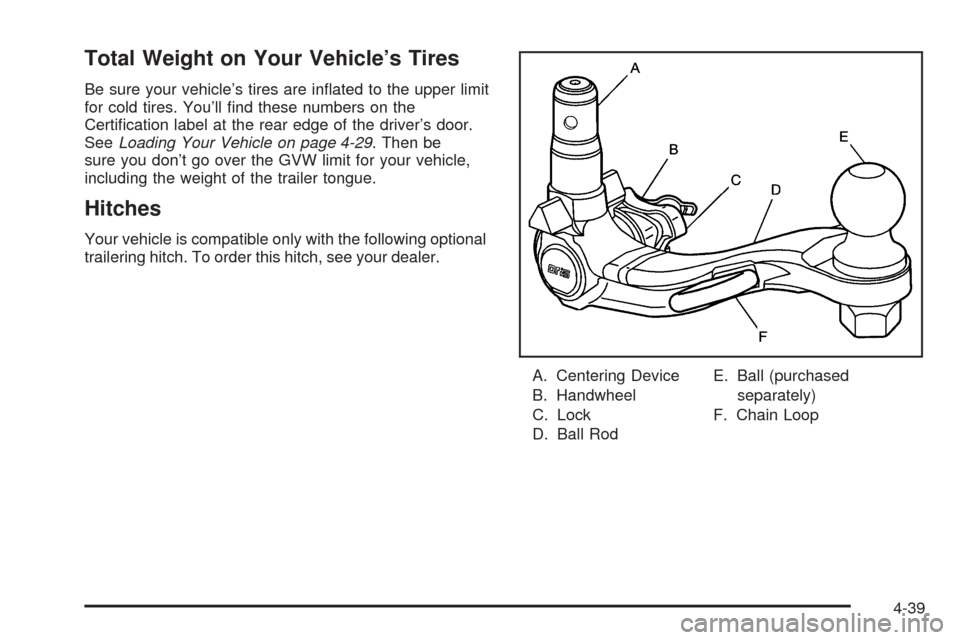
Hitches
Your vehicle is compatible only with the following optional
trailering hitch. To order this hitch, see your dealer.
A. Centering Device
B. Handwheel
C. Lock
D. Ball RodE. Ball (purchased
separately)
F. Chain Loop
4-39
Page 240 of 390

Installing the Ball Rod
To install the ball rod do the following:
1. Remove the cover of the housing located behind
the license plate area by pushing in the tabs and
pulling downward.2. Be sure the unit is unlocked before pretensioning.
Unlock using the key.
Then pretension the ball rod by pulling out the
handwheel and turning it counterclockwise. When
the ball is pretensioned, it means:
•The red area of the handwheel should be
opposite the white marking on the ball rod.
•The key cannot be withdrawn.
•The ball rod can only be installed in this position.
If the key is inserted and the lock is open,
tighten the handwheel slightly and turn clockwise
as far as the stop. Insert the ball rod as far
into the housing as it will go. When this happens,
you will hear the lock engage.
4-40
Page 241 of 390

3. Check that the ball rod is tight by doing the
following:
•Close the lock, withdraw the key, and install the
lock cover securely.
•The green area on the handwheel should be
opposite the white dot on the ball rod.
•Move the hitch back and forth to ensure it is
properly secured.
If you cannot complete all of the above checks, repeat
the assembly procedure.
Removing the Ball Rod
To remove the ball rod do the following:
1. Open the lock cover on the handwheel and unlock
with the key.
4-41
Page 242 of 390
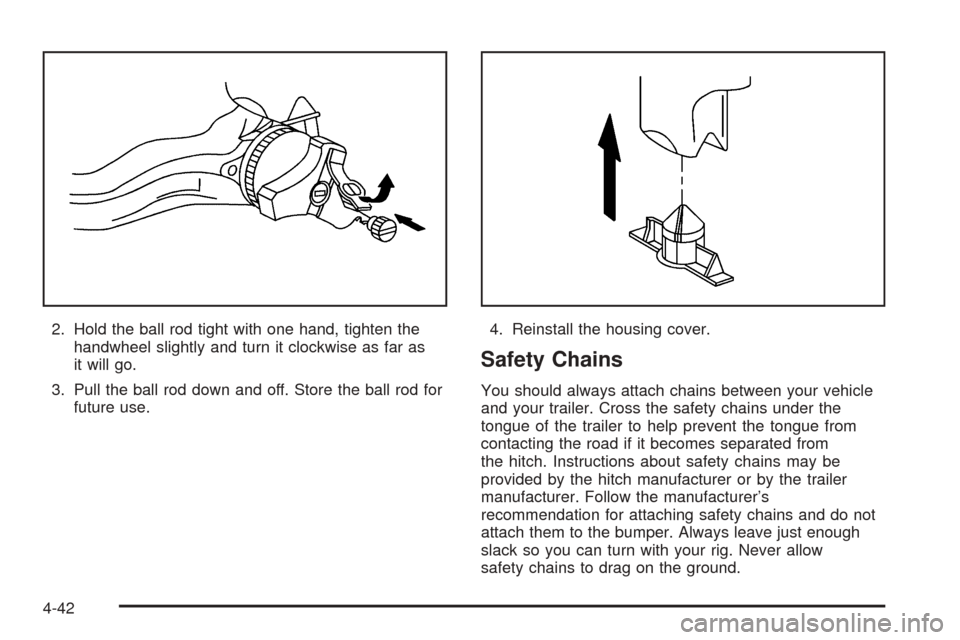
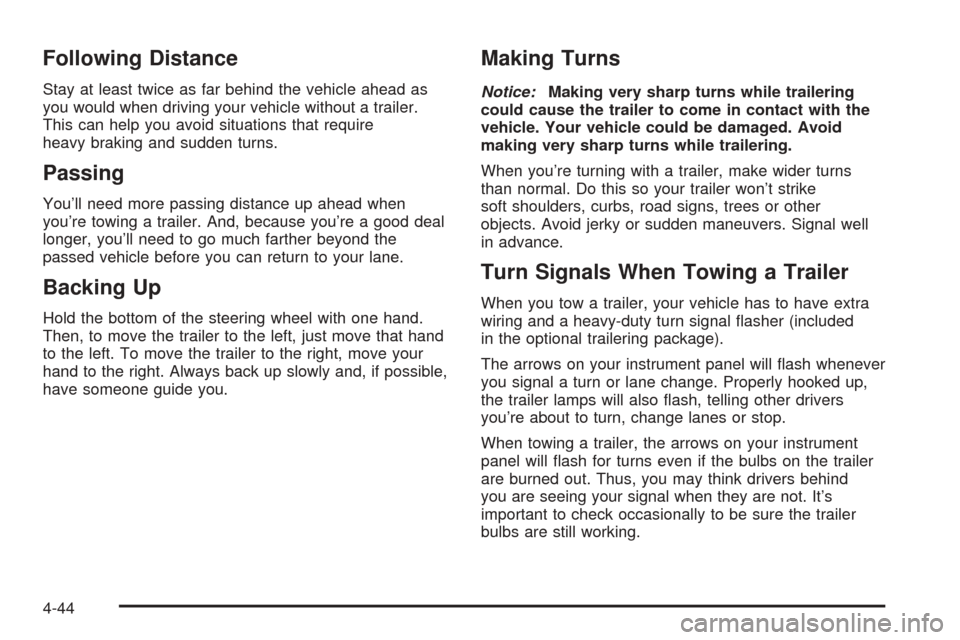
2. Hold the ball rod tight with one hand, tighten the
handwheel slightly and turn it clockwise as far as
it will go.
3. Pull the ball rod down and off. Store the ball rod for
future use.4. Reinstall the housing cover.
Safety Chains
You should always attach chains between your vehicle
and your trailer. Cross the safety chains under the
tongue of the trailer to help prevent the tongue from
contacting the road if it becomes separated from
the hitch. Instructions about safety chains may be
provided by the hitch manufacturer or by the trailer
manufacturer. Follow the manufacturer’s
recommendation for attaching safety chains and do not
attach them to the bumper. Always leave just enough
slack so you can turn with your rig. Never allow
safety chains to drag on the ground.
4-42
Page 244 of 390
Following Distance
Stay at least twice as far behind the vehicle ahead as
you would when driving your vehicle without a trailer.
This can help you avoid situations that require
heavy braking and sudden turns.
Passing
You’ll need more passing distance up ahead when
you’re towing a trailer. And, because you’re a good deal
longer, you’ll need to go much farther beyond the
passed vehicle before you can return to your lane.
Backing Up
Hold the bottom of the steering wheel with one hand.
Then, to move the trailer to the left, just move that hand
to the left. To move the trailer to the right, move your
hand to the right. Always back up slowly and, if possible,
have someone guide you.
Making Turns
Notice:Making very sharp turns while trailering
could cause the trailer to come in contact with the
vehicle. Your vehicle could be damaged. Avoid
making very sharp turns while trailering.
When you’re turning with a trailer, make wider turns
than normal. Do this so your trailer won’t strike
soft shoulders, curbs, road signs, trees or other
objects. Avoid jerky or sudden maneuvers. Signal well
in advance.
Turn Signals When Towing a Trailer
When you tow a trailer, your vehicle has to have extra
wiring and a heavy-duty turn signal flasher (included
in the optional trailering package).
The arrows on your instrument panel will flash whenever
you signal a turn or lane change. Properly hooked up,
the trailer lamps will also flash, telling other drivers
you’re about to turn, change lanes or stop.
When towing a trailer, the arrows on your instrument
panel will flash for turns even if the bulbs on the trailer
are burned out. Thus, you may think drivers behind
you are seeing your signal when they are not. It’s
important to check occasionally to be sure the trailer
bulbs are still working.
4-44
Page 245 of 390

Driving On Grades
Reduce speed and shift to a lower gear before you start
down a long or steep downgrade. If you don’t shift
down, you might have to use your brakes so much that
they would get hot and no longer work well.
If you have an automatic transmission, you can tow in
DRIVE (D). You may want to shift the transmission
to THIRD (3) or, if necessary, a lower gear if the
transmission shifts too often under heavy loads or hilly
conditions. If you have a manual transmission and
you are towing a trailer, it is better not to use SIXTH (6)
gear. Just drive in FIFTH (5) gear (or, as you need
to, a lower gear).
When towing at high altitude on steep uphill grades,
consider the following: Engine coolant will boil at a lower
temperature than at normal altitudes. If you turn your
engine off immediately after towing at high altitude
on steep uphill grades, your vehicle may show signs
similar to engine overheating. To avoid this, let the
engine run while parked, preferably on level ground, with
the automatic transmission in PARK (P) for a few
minutes before turning the engine off. For manual
transmissions, let the engine run while parked,
preferably on level ground, with the transmission out of
gear and the parking brake applied, for a few minutes
before turning the engine off. If you do get the overheat
warning, seeEngine Overheating on page 5-27.
Parking on Hills
{CAUTION:
You really should not park your vehicle, with a
trailer attached, on a hill. If something goes
wrong, your rig could start to move. People
can be injured, and both your vehicle and the
trailer can be damaged.
But if you ever have to park your rig on a hill, here’s
how to do it:
1. Apply your regular brakes, but don’t shift into
PARK (P) yet for an automatic transmission, or
into gear for a manual transmission. Turn your
wheels into the curb if facing downhill or into traffic
if facing uphill.
2. Have someone place chocks under the
trailer wheels.
3. When the wheel chocks are in place, release the
regular brakes until the chocks absorb the load.
4. Release the regular brakes.
4-45