lock CHEVROLET SSR 2006 1.G Manual PDF
[x] Cancel search | Manufacturer: CHEVROLET, Model Year: 2006, Model line: SSR, Model: CHEVROLET SSR 2006 1.GPages: 390, PDF Size: 2.44 MB
Page 269 of 390

Checking the Automatic Transmission
Fluid Level
Prepare your vehicle as follows:
1. Park your vehicle on a level place. Keep the
engine running.
2. With the parking brake applied, place the shift lever
in PARK (P).
3. With your foot on the brake pedal, move the shift
lever through each gear range, pausing for about
three seconds in each range. Then, position
the shift lever in PARK (P).
4. Let the engine run at idle for three minutes or more.
Then, without shutting off the engine, follow
these steps:
The automatic
transmission dipstick
handle will have this
symbol on it.The automatic transmission dipstick is located in the
rear of the engine compartment on the passenger’s side
of the vehicle. SeeEngine Compartment Overview on
page 5-12for more information on location.
1. Flip the handle up and then pull out the dipstick
and wipe it with a clean rag or paper towel.
2. Push it back in all the way, wait three seconds and
then pull it back out again.
3. Check both sides of the dipstick, and read the lower
level. The fluid level must be in the COLD area,
below the cross-hatched area, for a cold check or in
the HOT or cross-hatched area for a hot check.
Be sure to keep the dipstick pointed down to get an
accurate reading.
4. If the fluid level is in the acceptable range, push the
dipstick back in all the way; then flip the handle
down to lock the dipstick in place.
5-21
Page 270 of 390

Consistency of Readings
Always check the fluid level at least twice using the
procedure described previously. Consistency (repeatable
readings) is important to maintaining proper fluid level. If
inconsistent readings continue, contact your dealer.
How to Add Automatic
Transmission Fluid
Refer to the Maintenance Schedule to determine what
kind of transmission fluid to use. SeeRecommended
Fluids and Lubricants on page 6-12.
Add fluid only after checking the transmission fluid while
it is hot. A cold check is used only as a reference. If
the fluid level is low, add only enough of the proper fluid
to bring the level up to the HOT area for a hot check.
It does not take much fluid, generally less than one pint
(0.5 L). Do not overfill.
Notice:Use of the incorrect automatic transmission
uid may damage your vehicle, and the damages
may not be covered by your warranty. Always
use the automatic transmission uid listed in
Recommended Fluids and Lubricants on page 6-12.
•After adding fluid, recheck the fluid level as
described under “How to Check Automatic
Transmission Fluid,” earlier in this section.
•When the correct fluid level is obtained, push the
dipstick back in all the way; then flip the handle
down to lock the dipstick in place.
Manual Transmission Fluid
When to Check Manual
Transmission Fluid
A good time to have the manual transmission fluid
checked is when the engine oil is changed. However,
the fluid in your manual transmission does not
require changing.
How to Check Manual
Transmission Fluid
Because this operation can be a little difficult, you
may choose to have this done at the dealership
service department.
If you do it yourself, be sure to follow all the instructions
here, or you could get a false reading.
Notice:Too much or too little uid can damage your
transmission. Too little uid could cause the
transmission to overheat. Be sure to get an accurate
reading if you check your transmission uid.
Check the fluid level only when your engine is off, the
vehicle is parked on a level place, and the transmission
is cool enough for you to rest your fingers on the
transmission case.
5-22
Page 286 of 390

Notice:Jump starting your vehicle’s battery using
the engine compartment fuse block battery posts
can damage your vehicle. See item K in theEngine
Compartment Overview on page 5-12.Always
use the remote positive terminal and remote
negative terminal to jump start your vehicle’s
battery. See items A and H in theEngine
Compartment Overview on page 5-12
for location.4. Open the hoods and locate the positive (+) and
negative (−) terminal locations on the other
vehicle. Your vehicle has a remote positive (+) jump
starting terminal and a remote negative (−) jump
starting terminal. You should always use these
remote terminals instead of the terminals on
the battery.
The remote positive (+)
terminal is located inside
a red cover in the
engine compartment on
the passenger’s side of
the vehicle. See item A in
theEngine Compartment
Overview on page 5-12.
Press inward on the tabs located on the outboard
sides of the remote positive (+) terminal cover
and pull outward to access the terminal.
5-38
Page 292 of 390

Halogen Bulbs
{CAUTION:
Halogen bulbs have pressurized gas inside
and can burst if you drop or scratch the
bulb. You or others could be injured. Be
sure to read and follow the instructions on
the bulb package.
Headlamps
To replace the headlamp bulbs, do the following:
1. Turn the front wheels as far as they will go in the
opposite direction of the bulb that is being changed.
2. Reach underneath the vehicle and locate the
headlamp door. Remove the fastener retaining
the door.3. Turn the bulb socket counterclockwise to remove it
from the headlamp assembly.
There are separate sockets for the high and
low-beam headlamps.
4. Pull the bulb socket out of the headlamp assembly.
5-44
Page 293 of 390

5. Disconnect the bulb socket from the wiring harness
and replace the unit.
6. Reinstall the bulb socket back into the headlamp
assembly by turning it clockwise.
7. Reinstall the headlamp cover and tighten
the fastener.
Front Turn Signal, Sidemarker and
Parking Lamps
Front Turn and Parking Lamps
To replace the front turn or parking lamp bulbs, do
the following:
1. Open the hood. SeeHood Release on page 5-11
for more information.
2. Locate the bar that runs across the front of the
vehicle and remove the two screws located near
the front of the hood that hold the bar in place.
3. Release the tabs that attach the bar to
the headlamps.
5-45
Page 294 of 390
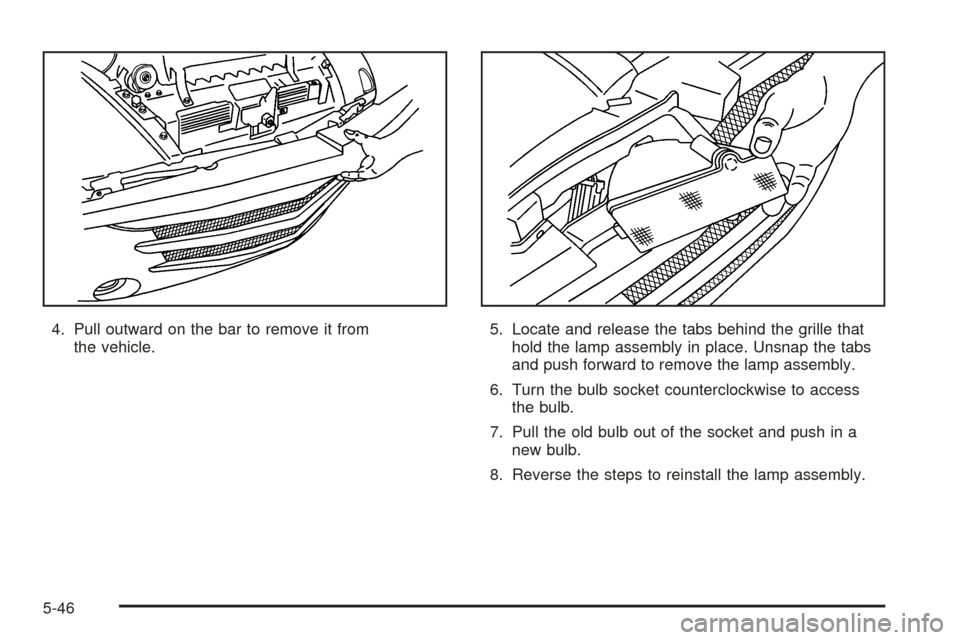
4. Pull outward on the bar to remove it from
the vehicle.5. Locate and release the tabs behind the grille that
hold the lamp assembly in place. Unsnap the tabs
and push forward to remove the lamp assembly.
6. Turn the bulb socket counterclockwise to access
the bulb.
7. Pull the old bulb out of the socket and push in a
new bulb.
8. Reverse the steps to reinstall the lamp assembly.
5-46
Page 295 of 390
Sidemarker Lamps
To replace a sidemarker bulb, do the following:
1. Reach underneath the vehicle to locate the
sidemarker bulb.
2. Turn the bulb socket counterclockwise to remove it.
3. Pull the old bulb out of the socket and push in a
new bulb.
4. Reverse steps to reinstall the bulb socket.
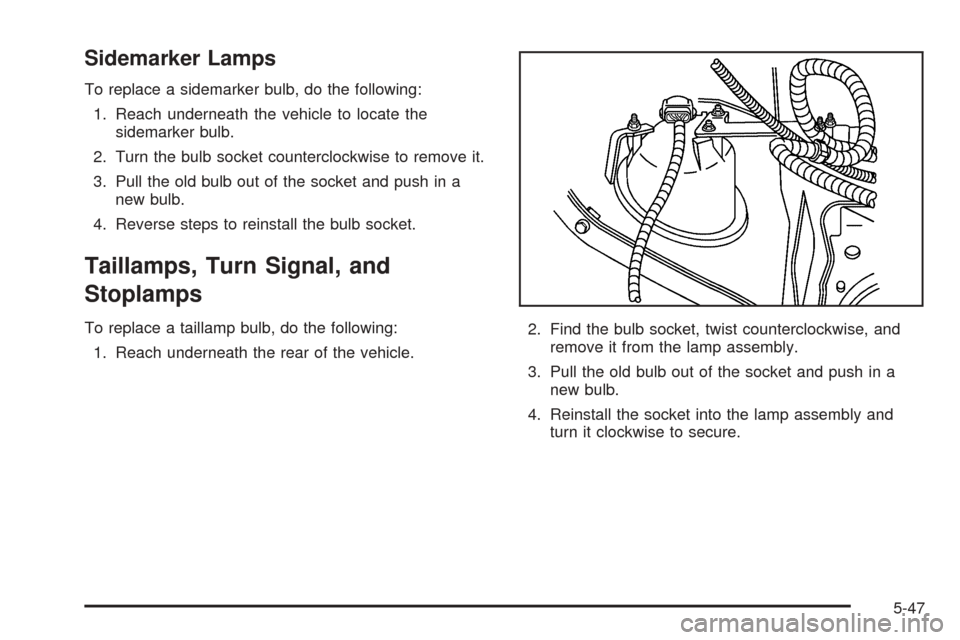
Taillamps, Turn Signal, and
Stoplamps
To replace a taillamp bulb, do the following:
1. Reach underneath the rear of the vehicle.2. Find the bulb socket, twist counterclockwise, and
remove it from the lamp assembly.
3. Pull the old bulb out of the socket and push in a
new bulb.
4. Reinstall the socket into the lamp assembly and
turn it clockwise to secure.
5-47
Page 296 of 390

Back-Up Lamps
To replace a back-up lamp bulb, do the following:
1. Reach underneath the vehicle near the license plate
and find the bulb socket.
2. Remove the socket from the lamp assembly by
locating and then squeezing the release tab
while turning the socket counterclockwise.3. Turn the bulb counterclockwise and then pull
outward to remove it from the socket.
4. Insert a new bulb into the socket by lining up the
notches on the bulb and turn it clockwise to
secure it.
5. Reverse the steps to reinstall the lamp assembly on
the vehicle.
Replacement Bulbs
Exterior Lamp Bulb Number
Back-Up Lamp 2057
Front Turn Signal/Parking Lamp T20
Headlamps
High-Beam 9005HB3
Low-Beam H11
Sidemarker Lamp 194
Stoplamp, Taillamp and Turn
Signal Lamp3157
For replacement bulbs not listed here, contact
your dealer.
5-48
Page 297 of 390
Windshield Wiper Blade
Replacement
Windshield wiper blades should be inspected
periodically for wear and cracking. SeeScheduled
Maintenance on page 6-4.
Replacement blades come in different types and are
removed in different ways. For proper type and length,
seeNormal Maintenance Replacement Parts on
page 6-14.
Allowing the wiper blade arm to touch the windshield
when no wiper blade is installed could damage the
windshield. Any damage that occurs would not
be covered by your warranty. Do not allow the wiper
blade arm to touch the windshield.
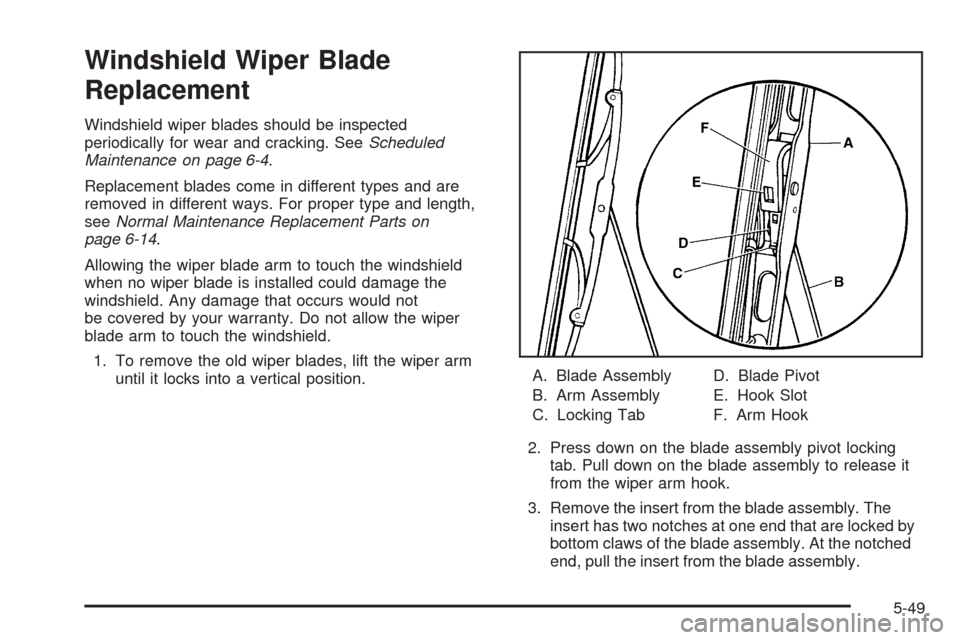
1. To remove the old wiper blades, lift the wiper arm
until it locks into a vertical position.A. Blade Assembly
B. Arm Assembly
C. Locking TabD. Blade Pivot
E. Hook Slot
F. Arm Hook
2. Press down on the blade assembly pivot locking
tab. Pull down on the blade assembly to release it
from the wiper arm hook.
3. Remove the insert from the blade assembly. The
insert has two notches at one end that are locked by
bottom claws of the blade assembly. At the notched
end, pull the insert from the blade assembly.
5-49
Page 298 of 390
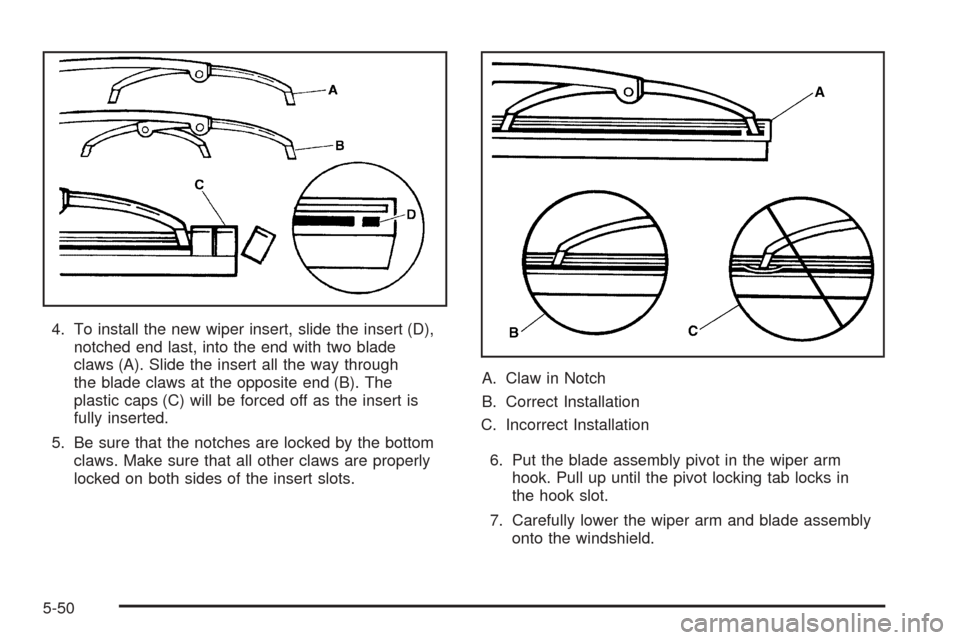
4. To install the new wiper insert, slide the insert (D),
notched end last, into the end with two blade
claws (A). Slide the insert all the way through
the blade claws at the opposite end (B). The
plastic caps (C) will be forced off as the insert is
fully inserted.
5. Be sure that the notches are locked by the bottom
claws. Make sure that all other claws are properly
locked on both sides of the insert slots.A. Claw in Notch
B. Correct Installation
C. Incorrect Installation
6. Put the blade assembly pivot in the wiper arm
hook. Pull up until the pivot locking tab locks in
the hook slot.
7. Carefully lower the wiper arm and blade assembly
onto the windshield.
5-50