wheel size CHEVROLET SSR 2006 1.G Owners Manual
[x] Cancel search | Manufacturer: CHEVROLET, Model Year: 2006, Model line: SSR, Model: CHEVROLET SSR 2006 1.GPages: 390, PDF Size: 2.44 MB
Page 250 of 390

Different Size Tires and Wheels......................5-62
Uniform Tire Quality Grading..........................5-62
Wheel Alignment and Tire Balance..................5-63
Wheel Replacement......................................5-64
Tire Chains..................................................5-66
If a Tire Goes Flat........................................5-67
Tire Inflator Kit.............................................5-68
Appearance Care............................................5-76
Cleaning the Inside of Your Vehicle.................5-76
Fabric/Carpet...............................................5-78
Leather.......................................................5-78
Instrument Panel, Vinyl, and Other
Plastic Surfaces........................................5-79
Care of Safety Belts......................................5-79
Weatherstrips...............................................5-79
Washing Your Vehicle...................................5-80
Cleaning Exterior Lamps/Lenses.....................5-80
Finish Care..................................................5-80
Windshield and Wiper Blades.........................5-81
Aluminum or Chrome-Plated Wheels................5-82Tires...........................................................5-82
Sheet Metal Damage.....................................5-83
Finish Damage.............................................5-83
Underbody Maintenance................................5-83
Chemical Paint Spotting.................................5-83
Vehicle Care/Appearance Materials..................5-84
Vehicle Identication......................................5-85
Vehicle Identification Number (VIN).................5-85
Service Parts Identification Label.....................5-85
Electrical System............................................5-86
Add-On Electrical Equipment..........................5-86
Headlamps..................................................5-86
Windshield Wiper Fuses................................5-86
Power Windows and Other Power Options.......5-86
Fuses and Circuit Breakers............................5-86
Floor Console Fuse Block..............................5-87
Engine Compartment Fuse Block....................5-90
Relay Center................................................5-92
Capacities and Specications..........................5-95
Section 5 Service and Appearance Care
5-2
Page 300 of 390

Winter Tires
If you expect to drive on snow or ice covered roads
often, you may want to get winter tires for your vehicle.
All season tires provide good overall performance on
most surfaces but they may not offer the traction
you would like or the same level of performance as
winter tires on snow or ice covered roads.
See your dealer for details regarding winter tire
availability and proper tire selection. Also, seeBuying
New Tires on page 5-60
If you choose to use winter tires:
•Use tires of the same brand and tread type on all
four wheel positions.
•Use only radial ply tires of the same size, load
range, and speed rating as the original
equipment tires.
Winter tires with the same speed rating as your original
equipment tires may not be available for H, V, W
and ZR speed rated tires. If you choose winter tires with
a lower speed rating, never exceed the tire’s maximum
speed capability.
Tire Sidewall Labeling
Useful information about a tire is molded into the
sidewall. The following illustration is an example of a
typical P-Metric tire sidewall.
(A) Tire Size:The tire size code is a combination of
letters and numbers used to define a particular
tire’s width, height, aspect ratio, construction type, and
service description. See the Tire Size illustration
later in this section for more detail.
5-52
Page 302 of 390
Tire Size
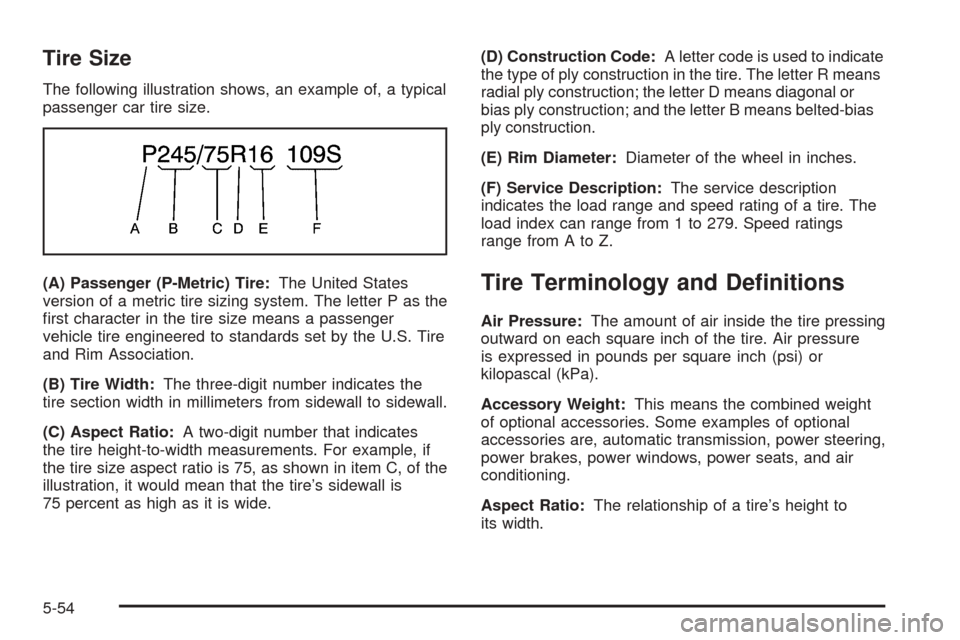
The following illustration shows, an example of, a typical
passenger car tire size.
(A) Passenger (P-Metric) Tire:The United States
version of a metric tire sizing system. The letter P as the
first character in the tire size means a passenger
vehicle tire engineered to standards set by the U.S. Tire
and Rim Association.
(B) Tire Width:The three-digit number indicates the
tire section width in millimeters from sidewall to sidewall.
(C) Aspect Ratio:A two-digit number that indicates
the tire height-to-width measurements. For example, if
the tire size aspect ratio is 75, as shown in item C, of the
illustration, it would mean that the tire’s sidewall is
75 percent as high as it is wide.(D) Construction Code:A letter code is used to indicate
the type of ply construction in the tire. The letter R means
radial ply construction; the letter D means diagonal or
bias ply construction; and the letter B means belted-bias
ply construction.
(E) Rim Diameter:Diameter of the wheel in inches.
(F) Service Description:The service description
indicates the load range and speed rating of a tire. The
load index can range from 1 to 279. Speed ratings
range from A to Z.
Tire Terminology and Denitions
Air Pressure:The amount of air inside the tire pressing
outward on each square inch of the tire. Air pressure
is expressed in pounds per square inch (psi) or
kilopascal (kPa).
Accessory Weight:This means the combined weight
of optional accessories. Some examples of optional
accessories are, automatic transmission, power steering,
power brakes, power windows, power seats, and air
conditioning.
Aspect Ratio:The relationship of a tire’s height to
its width.
5-54
Page 307 of 390
If you will be driving your vehicle at speeds of 100 mph
(160 km/h) or higher, where it is legal, set the cold
inflation pressure to the maximum inflation pressure
shown on the tire sidewall, or 35 psi (244 kPa),
whichever is lower. See the example following. When
you end this high-speed driving, return the tires to
the cold inflation pressure shown on the Tire and
Loading Information label. SeeLoading Your Vehicle on
page 4-29.
Example:
You will find the maximum load and inflation pressure
molded on the tire’s sidewall, in small letters, near
the rim flange. It will read something like this: Maximum
load 690 kg (1521 lbs) 300 kPa (44 psi) Max. Press.
For this example, you would set the inflation pressure for
high-speed driving at 35 psi (244 kPa) for the front
and rear tires.
Racing or other competitive driving may affect the
warranty coverage of your vehicle. See your warranty
booklet for more information.Tire Inspection and Rotation
The tires on your vehicle are different sizes front to rear.
Due to this, your tires should not be rotated. Each tire
and wheel should be used only in the position it is in.
Check your tires and wheels regularly for unusual wear
and damage. Also see,Scheduled Maintenance on
page 6-4,When It Is Time for New Tires on page 5-59
andWheel Replacement on page 5-64.
When It Is Time for New Tires
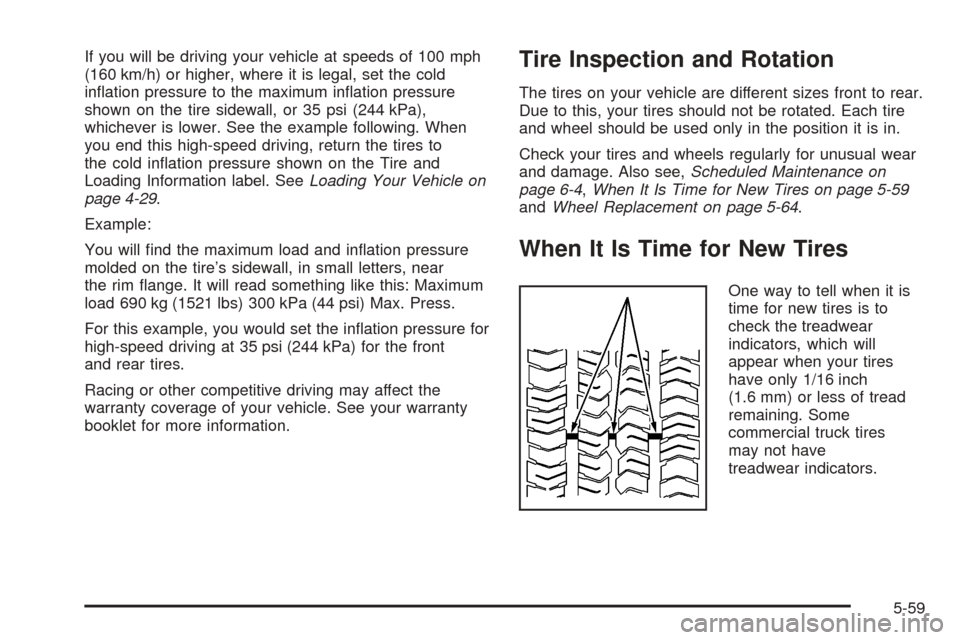
One way to tell when it is
time for new tires is to
check the treadwear
indicators, which will
appear when your tires
have only 1/16 inch
(1.6 mm) or less of tread
remaining. Some
commercial truck tires
may not have
treadwear indicators.
5-59
Page 309 of 390
Winter tires with the same speed rating as your original
equipment tires may not be available for H, V, W, Y,
and ZR speed rated tires. If you choose snow tires with
a lower speed rating, never exceed the tire’s maximum
speed capability.
{CAUTION:
Mixing tires could cause you to lose control
while driving. If you mix tires of different sizes
(other than those originally installed on your
vehicle), brands, or types (radial and
bias-belted tires), the vehicle may not handle
properly, and you could have a crash. Using
tires of different sizes (other than those
originally installed on your vehicle), brands or
types, may also cause damage to your vehicle.
Be sure to use the correct size, brand, and
type tires on all four wheels.
{CAUTION:
If you use bias-ply tires on your vehicle, the
wheel rim anges could develop cracks after
many miles of driving. A tire and/or wheel
could fail suddenly, causing a crash. Use only
radial-ply tires with the wheels on your vehicle.
If you must replace your vehicle’s tires with those that
do not have a TPC Spec number, make sure they
are the same size, load range, speed rating, and
construction type (radial and bias-belted tires) as your
vehicle’s original tires.
Your vehicle’s original equipment tires are listed on the
Tire and Loading Information Label. This label is
attached to the vehicle’s B-pillar. SeeLoading Your
Vehicle on page 4-29for more information about the Tire
and Loading Information Label and its location on
your vehicle.
5-61
Page 310 of 390

Different Size Tires and Wheels
If you add wheels or tires that are a different size than
your original equipment wheels and tires, this may
affect the way your vehicle performs, including its
braking, ride and handling characteristics, stability and
resistance to rollover. Additionally, if your vehicle
has electronic systems such as, anti-lock brakes,
traction control, and electronic stability control, the
performance of these systems can be affected.
{CAUTION:
If you add different sized wheels, your vehicle
may not provide an acceptable level of
performance and safety if tires not
recommended for those wheels are selected.
You may increase the chance that you will
crash and suffer serious injury. Only use GM
specic wheel and tire systems developed for
your vehicle, and have them properly installed
by a GM certied technician.
SeeBuying New Tires on page 5-60andAccessories
and Modications on page 5-3for additional information.
Uniform Tire Quality Grading
Quality grades can be found where applicable on the
tire sidewall between tread shoulder and maximum
section width. For example:
Treadwear 200 Traction AA Temperature A
The following information relates to the system
developed by the United States National Highway
Traffic Safety Administration, which grades tires by
treadwear, traction and temperature performance. (This
applies only to vehicles sold in the United States.)
The grades are molded on the sidewalls of most
passenger car tires. The Uniform Tire Quality Grading
system does not apply to deep tread, winter-type
snow tires, space-saver or temporary use spare tires,
tires with nominal rim diameters of 10 to 12 inches
(25 to 30 cm), or to some limited-production tires.
While the tires available on General Motors passenger
cars and light trucks may vary with respect to these
grades, they must also conform to federal safety
requirements and additional General Motors Tire
Performance Criteria (TPC) standards.
5-62
Page 314 of 390
Used Replacement Wheels
{CAUTION:
Putting a used wheel on your vehicle is
dangerous. You cannot know how it has been
used or how far it has been driven. It could fail
suddenly and cause a crash. If you have to
replace a wheel, use a new GM original
equipment wheel.
Tire Chains
{CAUTION:
Do not use tire chains. There is not enough
clearance. Tire chains used on a vehicle without
the proper amount of clearance can cause
damage to the brakes, suspension or other
vehicle parts. The area damaged by the tire
chains could cause you to lose control of your
vehicle and you or others may be injured in a
crash. Use another type of traction device only
if its manufacturer recommends it for use on
your vehicle and tire size combination and road
conditions. Follow that manufacturer’s
instructions. To help avoid damage to your
vehicle, drive slowly, re-adjust or remove the
device if it is contacting your vehicle, and do
not spin your wheels. If you do nd traction
devices that will t, install them on the
rear tires.
5-66
Page 389 of 390

Tires.............................................................5-51
Aluminum or Chrome-Plated Wheels,
Cleaning.................................................5-82
Buying New Tires........................................5-60
Chains.......................................................5-66
Cleaning....................................................5-82
Different Size..............................................5-62
If a Tire Goes Flat.......................................5-67
Inflation - Tire Pressure................................5-57
Inspection and Rotation................................5-59
Tire Inflator Kit............................................5-68
Tire Sidewall Labeling..................................5-52
Tire Terminology and Definitions....................5-54
Uniform Tire Quality Grading.........................5-62
Wheel Alignment and Tire Balance.................5-63
Wheel Replacement.....................................5-64
When It Is Time for New Tires......................5-59
Towing
Recreational Vehicle.....................................4-35
Towing a Trailer..........................................4-35
Your Vehicle...............................................4-35
Traction
Control System (TCS).................................... 4-9
Control System Warning Light.......................3-32
Trailer
Recommendations.......................................4-47
Transmission
Fluid, Automatic...........................................5-20
Fluid, Manual..............................................5-22Transmission Operation, Automatic....................2-19
Transmission Operation, Manual........................2-21
Trip Odometer................................................3-26
Truck-Camper Loading Information....................4-34
Turn and Lane-Change Signals.......................... 3-7
Turn Signal/Multifunction Lever........................... 3-7
U
Understanding Radio Reception........................3-85
Uniform Tire Quality Grading............................5-62
Universal Home Remote System.......................2-30
Operation...................................................2-30
V
Vehicle
Control........................................................ 4-6
Damage Warnings........................................... iv
Loading......................................................4-29
Parking Your...............................................2-25
Symbols......................................................... iv
Vehicle Data Collection and Event
Data Recorders............................................. 7-9
Vehicle Identification
Number (VIN).............................................5-85
Service Parts Identification Label...................5-85
11
Page 390 of 390
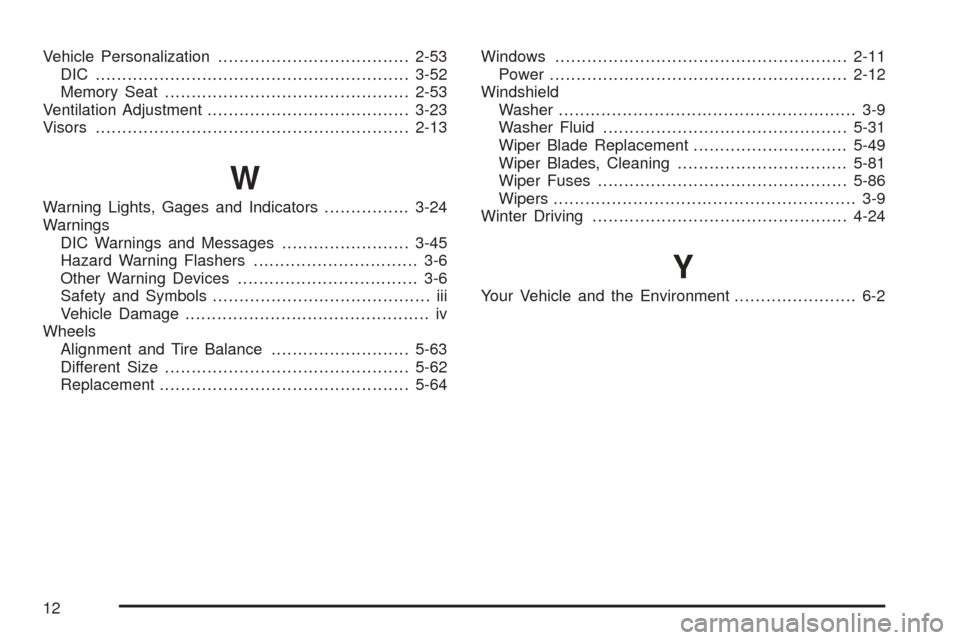
Vehicle Personalization....................................2-53
DIC ...........................................................3-52
Memory Seat..............................................2-53
Ventilation Adjustment......................................3-23
Visors...........................................................2-13
W
Warning Lights, Gages and Indicators................3-24
Warnings
DIC Warnings and Messages........................3-45
Hazard Warning Flashers............................... 3-6
Other Warning Devices.................................. 3-6
Safety and Symbols......................................... iii
Vehicle Damage.............................................. iv
Wheels
Alignment and Tire Balance..........................5-63
Different Size..............................................5-62
Replacement...............................................5-64Windows.......................................................2-11
Power........................................................2-12
Windshield
Washer........................................................ 3-9
Washer Fluid..............................................5-31
Wiper Blade Replacement.............................5-49
Wiper Blades, Cleaning................................5-81
Wiper Fuses...............................................5-86
Wipers......................................................... 3-9
Winter Driving................................................4-24
Y
Your Vehicle and the Environment....................... 6-2
12