cooling CHEVROLET SUBURBAN 1993 User Guide
[x] Cancel search | Manufacturer: CHEVROLET, Model Year: 1993, Model line: SUBURBAN, Model: CHEVROLET SUBURBAN 1993Pages: 386, PDF Size: 21.06 MB
Page 247 of 386

Engine Fan Noise
This vehicle has a clutched engine cooling fan. When the clutc\
h is engaged,
the fan spins faster
to provide more air to cool the engine. In most every day
driving conditions the clutch is not engaged. This improves fuel economy and
reduces fan noise. Under heavy vehicle loading, trailer towing \
and/or high
outside temperatures, the fan speed increases when the clutch e\
ngages.
So
you may hear an increase in fan noise. This is normal and sh\
ould not be
mistaken
as the transmission slipping or making extra shifts. It is merely the
cooling system functioning properly. The fan
will slow down when additional
cooling is not required and the clutch disengages.
You may also hear this fan noise when you start the engine. \
It will go away
as the fan clutch disengages.
If a Tire Goes Fiat
It’s unusual for a tire to “blow out” while you’re driving,\
especially if you
maintain your tires properly.
If air goes out of a tire, it’s much more likely to
leak out slowly. But if you should ever have a “blowout,” here are a few tips
about what
to expect and what to do:
If a front tire fails, the flat tire will create a drag that pulls the vehicle toward
that side. Take your foot
off the accelerator pedal and grip the steering wheel
firmly. Steer to maintain lane position, then gently brake
to a stop well out of
the traffic lane.
A rear blowout, particularly on a curve, acts much like a skid and may
require the same correction you’d use in a skid. In any rear blowout, remove
your foot from the accelerator pedal. Get the vehicle under co\
ntrol by steering
the way you want the vehicle
to go. It may be very bumpy and noisy, but
you can still steer. Gently brake to a stop, well off the road if possible.
If your tire goes flat, the next part shows how to use your jacking equipment
to change a flat tire safely.
Changing a Flat Tire
If a tire goes flat, avoid further tire and wheel damage by driving slowly to a
level place. Turn
on your hazard warning flashers.
5-1 6
ProCarManuals.com
Page 291 of 386

Service & Appearance Care
The following explains your cooling system and how to add cool\
ant when it is
low.
If you have a problem with engine overheating, see “Engine
Overheating” in the Index.
The proper coolant for your vehicle
will:
Give freezing protection down to -34°F (-37°C).
Give boiling protection up to 258°F (125°C).
Protect against rust and corrosion.
Help keep the proper engine temperature.
Let the warning lights and gages work as they should.
What to Use:
Use a mixture of clean water (preferably distilled), and antifreeze that meets
“GM Specification
6038-M,” which won’t damage aluminum parts. Also use
GM Engine Coolant Supplement (sealer) with a complete coolant change.
If
you use these, you don’t need to add anything else.
Adding only plain water to your cooling system can be dangerous.
I
Plain water, or some other liquid like alcohol, can boil before the \
proper coolant mix will. Your vehicle’s coolant warning system is set
for the proper coolant mix. With plain water or the wrong mix, your
engine could get too hot but you wouldn’t get the overheat \
warning. Your engine could catch fire and you or others could be burned. Us\
e
a 50/50 mix of clean water and a proper antifreeze.
jIi ,yo.w use an improper coolant mix, your engine .coutd overheat andi
badly damaged. The repair cost wouldn’t be covered by your warranty.’ TP~
much water in ;the mix can freeze and crack the engine, radiator, .heater
wre-ad -.other parts.
Some conditions, such as air trapped in the cooling system, can affect the
coolant level in the radiator. Check the coolant level when th\
e engine is cold
and follow the steps under “Adding Coolant” for the prope\
r way to
add
coolant.
.. .. ..
If you have to add coolant mdre than four times a year, have your dealer
check
your cooling system.
6-26
ProCarManuals.com
Page 300 of 386
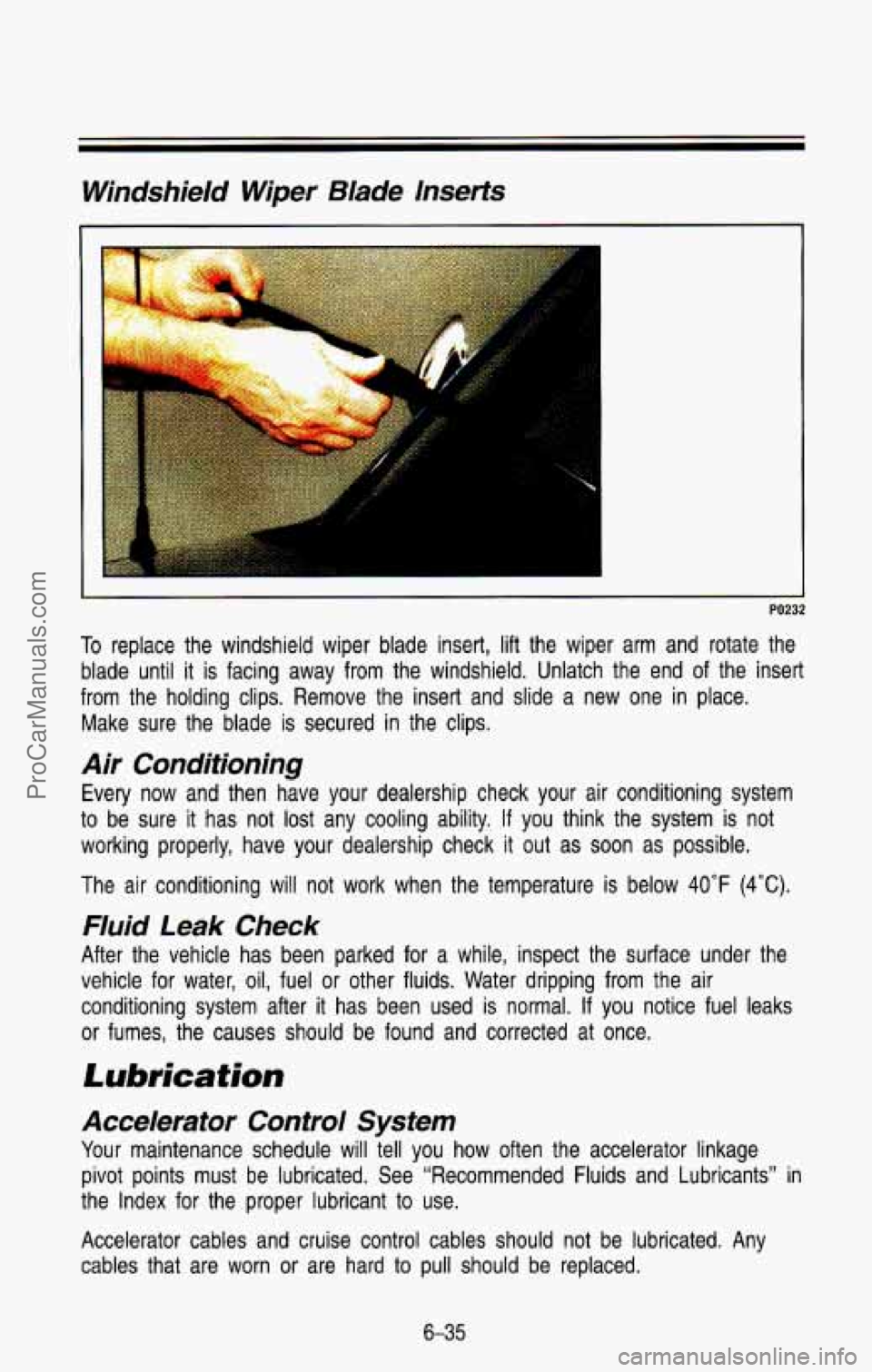
Windshield Wiper Blade lnserfs
J
PO232
To replace the windshield wiper blade insert, lift the wiper arm and rotate the
blade until
it is facing away from the windshield. Unlatch the end of the insert
from the holding clips. Remove the insert and slide a new one in place,
Make sure the blade
is secured in the clips.
Air Conditioning
Every now and then have your dealership check your air conditioning system
to be sure it has not lost any cooling ability,
If you think the system is not
working properly, have your dealership check
it out as soon as possible.
The air conditioning will not work when the temperature is below
40°F (4°C).
Fluid Leak Check
After the vehicle has been parked for a while, inspect the su\
rface under the
vehicle for water, oil, fuel or other fluids. Water dripping from the air
conditioning system after
it has been used is normal. If you notice fuel leaks
or fumes, the causes should be found and corrected at once.
Lubrication
Accelerator Control System
Your maintenance schedule will tell you how often the accelerator linkage
pivot points must be lubricated. See “Recommended Fluids and Lubric\
ants”
in
the Index for the proper lubricant to use.
Accelerator cables and cruise control cables should not be lubr\
icated. Any
cables that are worn or are hard to pull
should be replaced.
6-35
ProCarManuals.com
Page 321 of 386
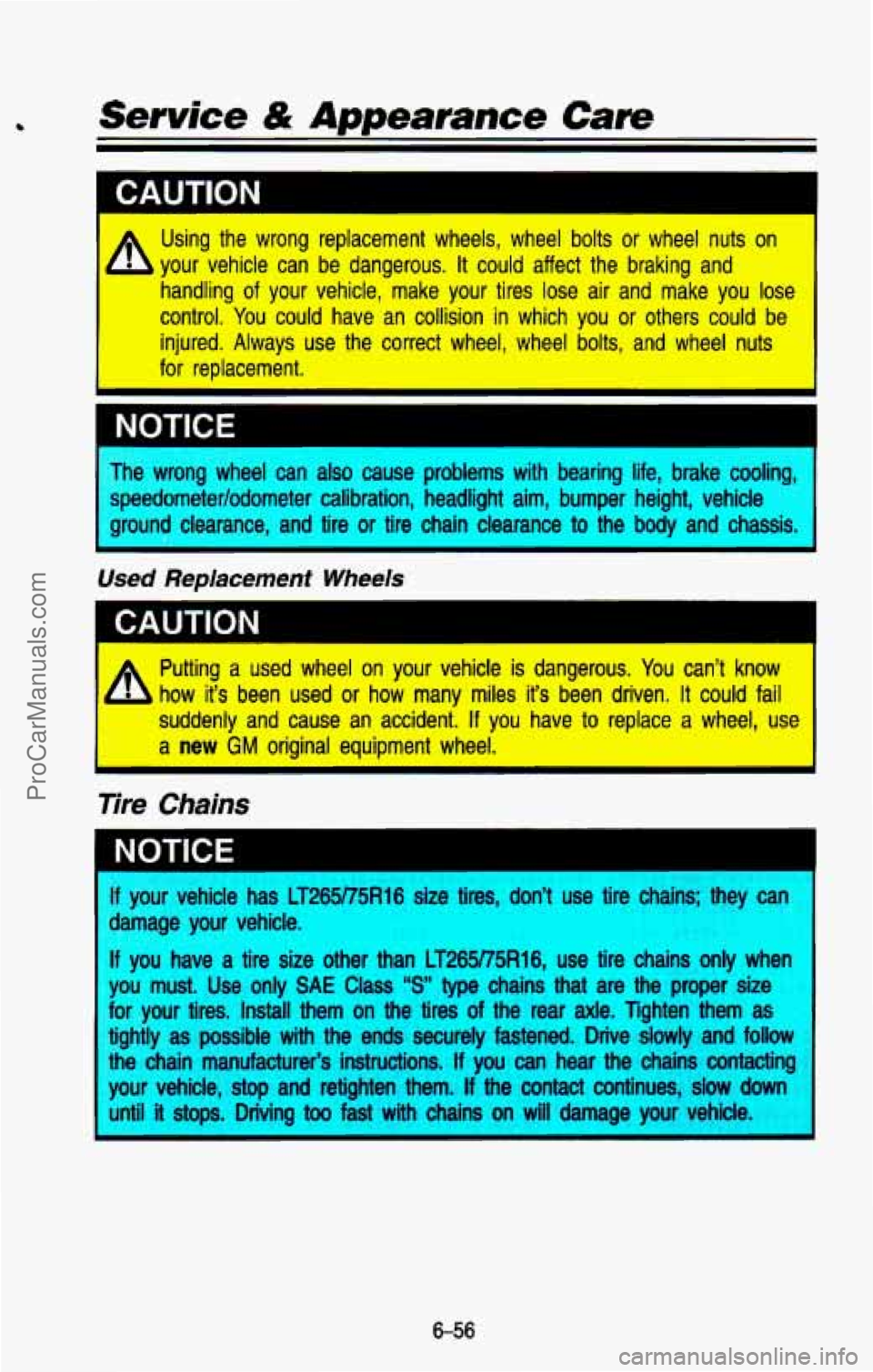
I CAUTION I
A Using the wrong replacement wheels, wheel bolts or wheel nuts on
your vehicle can be dangerous.
It could affect the braking and
handling
of your vehicle, make your tires lose air and make you lose
control. You could have an collision in which you or others could be
injured. Always use the correct wheel, wheel
bolts, and wheel nuts
for replacement.
I
I
I The wrong wheel can also cause problems with bearing life, brake cooling,
speedometerlodometer calibration, headlight aim, bumper height, vehicle
ground clearance, and tire
or tire chain clearance to the body and chassis.
A Putting a used wheel on your vehicle is dangerous. You can't know
how it's been used or how many miles it's been driven. It could fail
suddenly and cause an accident. If you have to replace a wheel, use
a new GM original equipment wheel,
I
Tire Chains
rNOTICE 'If put vehicle has LT265/75R16 size tires, don't use tire chams; they i can!
damage your vehicle.
6-56
ProCarManuals.com
Page 333 of 386
Service & Appearance Care
Specification Charts
Replacement Parts
Replacement part numbers listed in this section are based on the latest
information available at the time
of printing, and are subject to change. If a
part listed in this manual is not the same as the part used in your vehicle
when
it was built, or if you have any questions, please contact your GM truck
dealer.
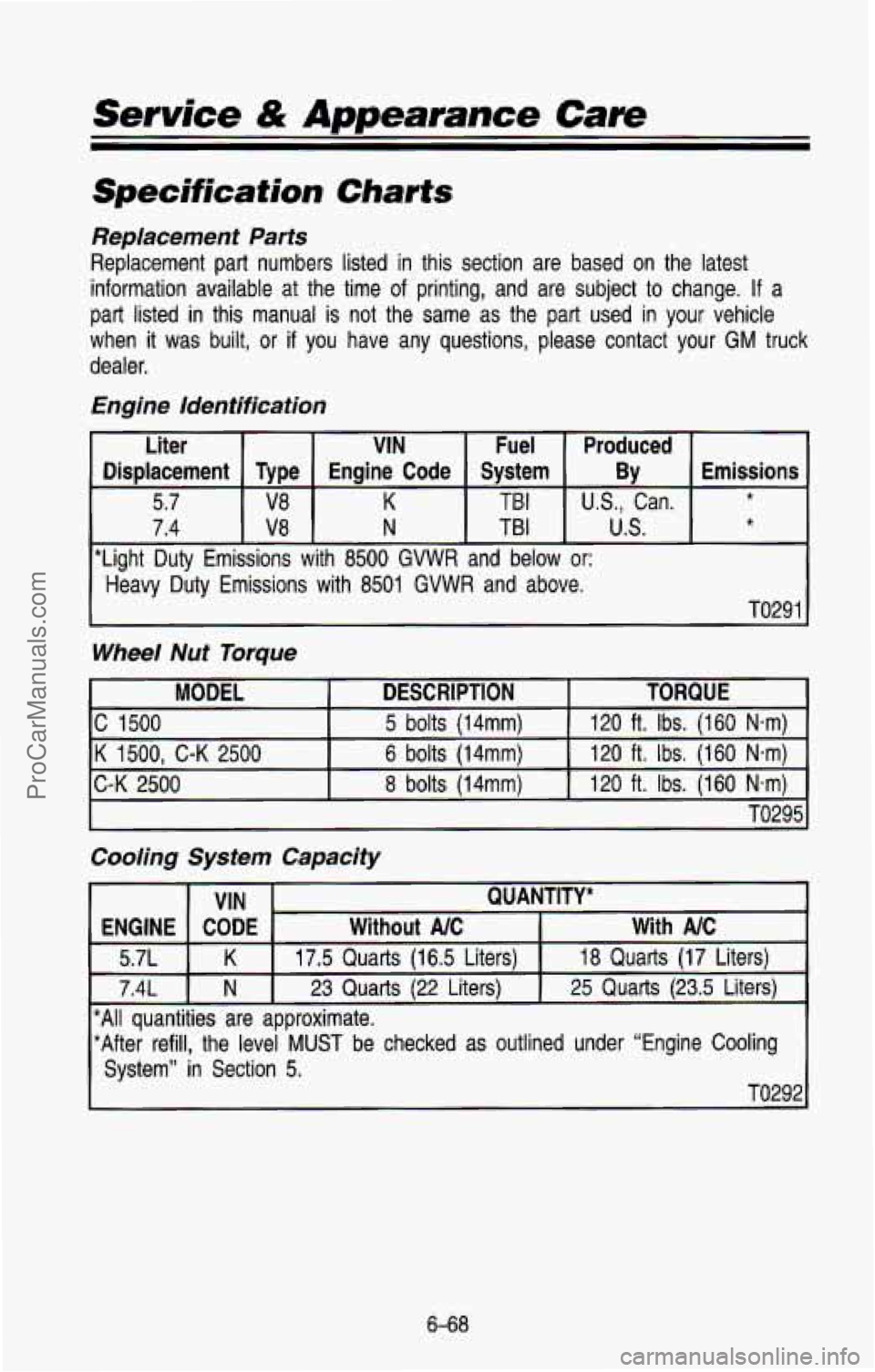
Engine identification
Liter VIN Fuel Produced
Displacement Type Engine Code System BY Emissions
5.7 V8 K TB I U.S., Can.
7.4 V8 N TB I us.
*
*
*Light Duty Emissions with 8500 GVWR and below or:
Heavy Duty Emissions with 8501 GVWR and
above.
TO291
Wheel Nut Torque
MODEL DESCRIPTION TORQUE
C 1500 5 bolts (14mm) 120 ft. Ibs. (1 60 Nmm)
K 1500, C-K 2500 6 bolts (1 4mm) 120 ft. Ibs. (160
N-m)
C-K 2500 8 bolts (14mm) 120 ft. Ibs. (160 Nem)
I TO2951
Cooling System Capacity
VIN QUANTITY*
ENGINE CODE Without NC With AIC
5.7L K 17.5 Quarts (16.5 Liters)
18 Quarts (1 7 Liters)
7.4- N 23 Quarts
(22 Liters) 25 Quarts (23.5 Liters)
*All quantities are approximate.
*After refill, the level
MUST be checked as outlined under “Engine Cooling
System” in Section
5.
TO292
6-68
ProCarManuals.com
Page 345 of 386

Scheduled Maintenance Services
GASOLINE ENGINES WITH LIGHT DUTY EMISSIONS-
If your driving conditions meet those specified in “Scheduled Ma\
intenancc
Services” in this section, use Maintenance Schedule
I (t).
Item Miles (000) 3 6 7.5 9 12 15 18
No. Service Kilometers (000) 5 10 12.5 15 20 25 30
1 Engine Oil Change*-Every 12 Months, or e
Oil Filter Change*-Every 12 Months, or e
2 Chassis Lubrication-Every 12 Months, or e
3 Clutch Fork Ball Stud Lubrication
5 Cooling System Service*-Every 24
6 Air Cleaner Filter Replacement* Months
or
7 Front Wheel Bearing Repack
8 Transmission Service**
25 Drive Axle Service**
26 Brake Systems Inspection**
FOOTNOTES:
**See “Explanation
of Scheduled Maintenance Services” in this section.
*An Emission Control Service
tTo determine the emissions classification of your engine refer to “Selecting
the
Proper Maintenance Chart”
in this section.
TO332
ProCarManuals.com
Page 355 of 386
Scheduled Maintenance Services
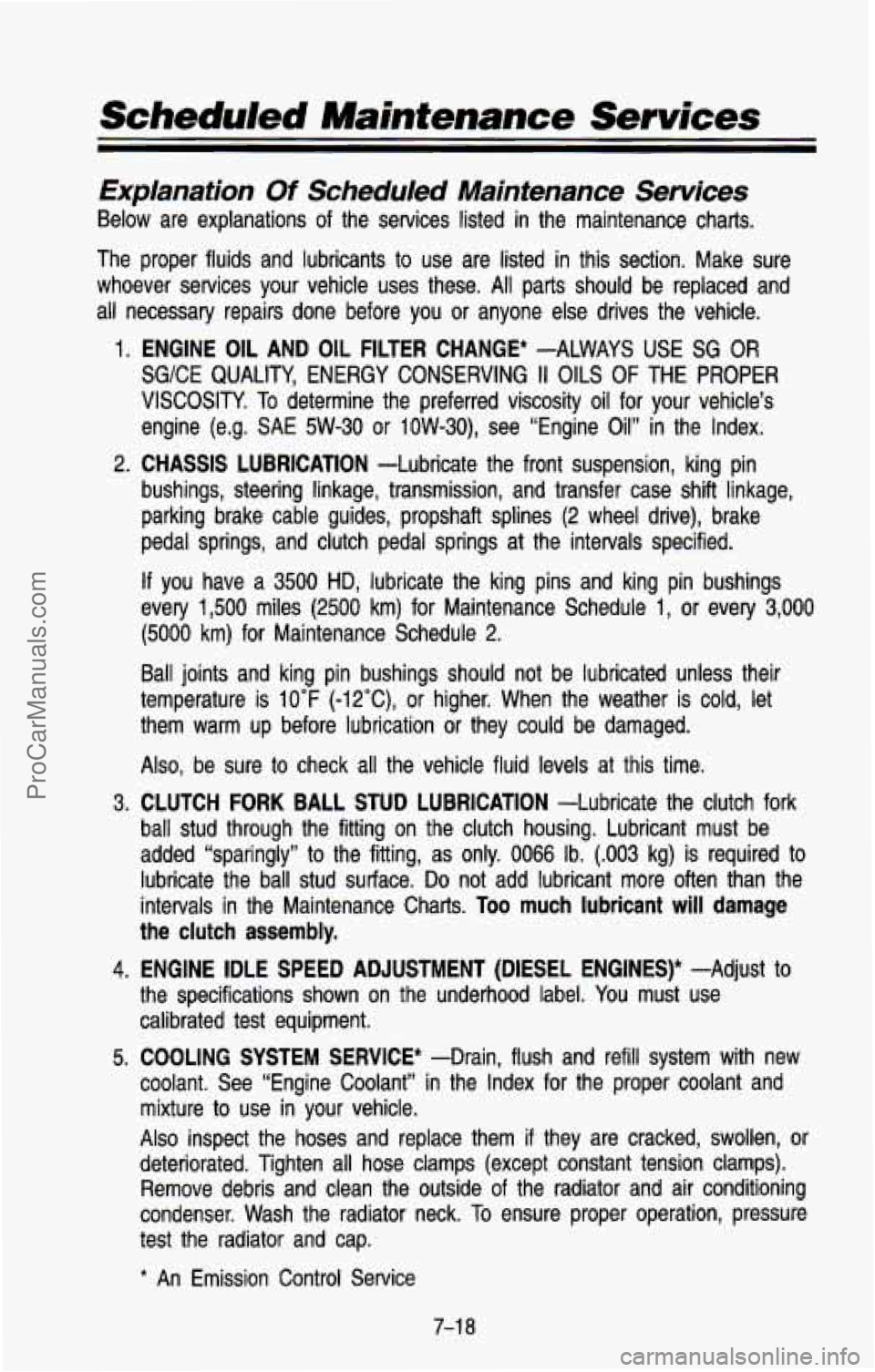
Explanation Of Scheduled Maintenance Services
Below are explanations of the services listed in the maintenance charts.
The proper fluids and lubricants to use are listed in this section. Make sure
whoever services your vehicle uses these.
All parts should be replaced and
all necessary repairs done before you or anyone else drives the ve\
hicle.
1. ENGINE OIL AND OIL FILTER CHANGE* -ALWAYS USE SG OR
SG/CE QUALITY, ENERGY CONSERVING II OILS OF THE PROPER
VISCOSITY. To determine the preferred viscosity oil for your vehicle’s
engine (e.g. SAE 5W-30 or
10W-30), see “Engine Oil” in the Index.
2. CHASSIS LUBRICATION -Lubricate the front suspension, king pin
bushings, steering linkage, transmission, and transfer case shift\
linkage,
parking brake cable guides, propshaft splines
(2 wheel drive), brake
pedal springs, and clutch pedal springs at the intervals specif\
ied.
If you have a 3500 HD, lubricate the king pins and king pin bushings
every
1,500 miles (2500 km) for Maintenance Schedule 1, or every 3,000
(5000 km) for Maintenance Schedule 2.
Ball joints and king pin bushings should not be lubricated unl\
ess their
temperature is
10°F (-12”C), or higher. When the weather is cold, let
them warm up before lubrication
or they could be damaged.
Also, be sure to check all the vehicle fluid levels at this time.
3.
CLUTCH FORK BALL STUD LUBRICATION -Lubricate the clutch fork
ball stud through the fitting on the clutch housing. Lubricant \
must be
added “sparingly” to the fitting, as only.
0066 Ib. (.003 kg) is required to
lubricate the ball stud surface. Do not add lubricant more often than the
intervals in the Maintenance Charts.
Too much lubricant will damage
the clutch
assembly.
4. ENGINE IDLE SPEED ADJUSTMENT (DIESEL ENGINES)* -Adjust to
the specifications shown on the underhood label. You must use
calibrated test equipment.
5. COOLING SYSTEM SERVICE* -Drain, flush and refill system with new
coolant. See “Engine Coolant” in the Index for the proper\
coolant and
mixture
to use in your vehicle.
Also inspect the hoses and replace them if they i cracked, swollen, or
deteriorated. Tighten all hose clamps (except consrant tension clamps).
Remove debris and clean the outside of the radiator and air c\
onditioning
condenser. Wash the radiator neck.
To ensure proper operation, pressure
test the radiator and cap.
* An Emission Control Service
7-1 8
ProCarManuals.com
Page 357 of 386
Scheduled Maintenance Services
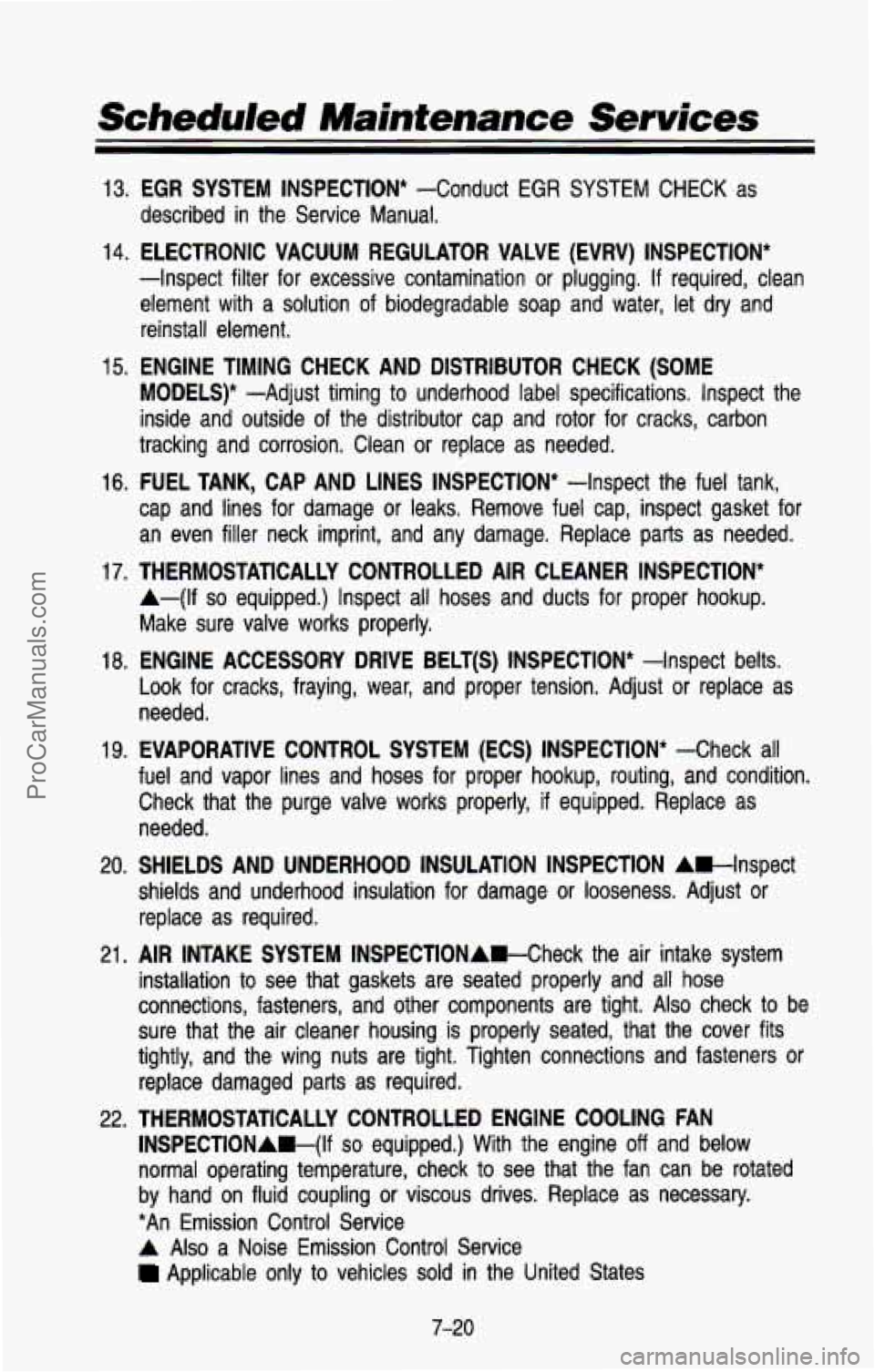
13. EGR SYSTEM INSPECTION* -Conduct EGR SYSl /l CHECK as
described in the Service Manual.
14. ELECTRONIC VACUUM REGULATOR VALVE (EVRV) INSPECTION*
-Inspect filter for excessive contamination or plugging. If required, clean
element with a solution of biodegradable soap and water, let
dry and
reinstall element.
MODELS)* -Adjust timing to underhood label specifications. Inspect the
inside and outside of the distributor cap and rotor for cracks, carbon
tracking and corrosion. Clean or replace as needed.
15. ENGINE TIMING CHECK AND DISTRIBUTOR CHECK (SOME
16. FUEL TANK, CAP AND LINES INSPECTION* -Inspect the fuel tank,
cap and lines
for damage or leaks. Remove fuel cap, inspect gasket for
an even filler neck imprint, and any damage, Replace parts as needed.
17.
THERMOSTATICALLY CONTROLLED AIR CLEANER INSPECTION*
A-(If so equipped.) Inspect all hoses and ducts for proper hookup.
Make sure valve works properly.
Look for cracks, fraying, wear, and proper tension. Adjust or replace as
needed.
19. EVAPORATIVE CONTROL SYSTEM (ECS) INSPECTION* -Check all
fuel and vapor lines and hoses for proper hookup, routing, and\
condition.
Check that the purge valve works properly, if equipped. Replace\
as needed.
20.
SHIELDS AND UNDERHOOD INSULATION INSPECTION Awlnspect
shields and underhood insulation for damage or looseness. Adjust
or
replace as required.
installation to see that gaskets are seated properly and all hose
connections, fasteners, and other components are tight.
Also check to be
sure that the air cleaner housing is properly seated, that the\
cover
fits
tightly, and the wing nuts are tight. Tighten connections and \
fasteners or
replace damaged parts as required.
18. ENGINE ACCESSORY DRIVE BELT(S) INSPECTION* --Inspect belts.
21.
AIR INTAKE SYSTEM INSPECTlONAWCheck the air intake system
22. THERMOSTATICALLY CONTROLLED ENGINE COOLING FAN INSPECTIONAB-(If
so equipped.) With the engine off and below
normal operating temperature, check
to see that the fan can be rotated
by hand on fluid coupling or viscous drives. Replace as necessary.
*An Emission Control Service
A Also a Noise Emission Control Service
Applicable only to vehicles sold in the United States
7-20
ProCarManuals.com
Page 377 of 386
INDEX
C
Capacities and Specification Charts
......................................... 6-68
Carbon Monoxide
................. 2.7. 2.28.
Cassette Tape Player
Catalytic Converter
...................... 6-45
Certificationnire Label
................. 6-46
Changing a Flat Tire
......... 5.16. 5-20
Chemical Paint Spotting
.............. 6-63
Child Restraints 2.29. 4.55.
4-61
(See “Audio Systems”)
(See “Safety Belts”)
Cigarette LightedAshtrays
........... 2-55
Circuit Breakers (See “Fuses”)
Cleaning Finish Care
................................ 6-61
Glass
.......................................... 6.60
Inside of Vehicle
....................... 6-58
Instrument Panel. Top
............. 6-60
Outside of Vehicle
.................... 6-61
Special Problems
...................... 6-59
Vinyl
or Leather ........................ 6-60
Wheels and Tires
..................... 6-62
Windshield
................................ 6-60
Comfort Controls
............................ 3-2
Console
Floor
.......................................... 2-56
Overhead
.................................... 2.58
Convenience Net
.......................... 2-80
Coolant (See “Engine”)
Cooling System Capacity
............ 6-68
Crankcase Capacity
...................... 6-69
Cruise Control
............................... 2-41
Increase Speed
......................... 2-43
OnHills
........................................ 2-45
Clock
.................................... 3-15
3-18
Passing
...................................... 2-45
Reduce Speed
.......................... 2-44
Resume
..................................... 2-43
Set
.............................................. 2-42
ToGet Out Of
............................. 2-45 Cup Holder
................................... 2-57
Customer Assistance for the
Hearing
or Speech Impaired .... 8-3
Customer Satisfaction Procedure 8-2
D
(Canada Only) ............................... 2-47
Daytime Running Lights
Indicator Light
............... 2.47. 2-73
Dome Lights
................................. 2-48
Doors
............................................... 2-5
Panel
............................................ 2-9
Across an Incline
........... 4-31 . 4-32
After Off-Road Driving
............ 4-34
At Night ..................................... 4-35
Braking
...................................... 4-13
Control
of A Vehicle ................. 4-13
Defensive
..................................... 4-9
Downhill
..................................... 4-30
Freeway
..................................... 4-43
Guidelines
.................................. 4-24
High Beams
.............................. 4-36
Highway Hypnosis
................... 4-46
Hydroplaning
............................. 4-38
In Blizzard
................................. 4-55
In City
....................................... 4-42
In Fog. Mist and Haze .4.40. 4-41
In Rain
............................ 4.37. 4-39
In Sand. Mud. Ice.
Or Snow ..................... 4.33. 5-31
In Water
.................................... 4-34
Long Distance
.......................... 4-44
Loss of Control
........................ 4-23
Night Vision
.............................. 4-35
Off -Roading ............................... 4-24
On Curves
................................. 4-18
On Grades
................................. 4.62
On Hill and Mountain Roads
. 4-47
On Off-Road Hills
.................... 4-27
On Snow
or Ice ....................... 4-53
Passing
............................ 4-21 . 4-61
Locks
............................................ 2-6
Driving
9-2
ProCarManuals.com
Page 378 of 386
Skidding ..................................... 4-23
Stuck
in Deep Snow .... 4-56, 5-31
Through Water
............... 2-1 5, 4-34
Uphill
.......................................... 4-28
Winter
........................................ 4-53
With a Trailer
............................ 4-60
Drunken Driving
........................... 4-1 0
E
Electrical System ......................... 6-37
Add-on Equipment
................... 6-67
Engine
Adding Coolant
... 5-1 1, 5-13, 6-27
Air Cleaner
................................ 6-1 6
Block Heater
.......... 2-16, 3-5, 6-16
Computer Command Control
System
..................................... 6-45
Coolant
............................ 6-25, 6-68
Coolant Temperature Gage
...... 2-77
Cooling System
......................... 5-10
Crankcase .................................. 6-69
Exhaust
..................................... 2-28
Fan Noise
.................................. 5-1 6
Identification
................... 6-65, 6-68
Leaving Vehicle While Running
....................... 2-26
Oil (See
“Oil”)
Overheating ................................. 5-8
Running While Parked
............. 2-29
Starting
...................................... 2-1 4
Equipment, Add-on
...................... 6-48
Exhaust System
........................... 6-45
F
Fan Noise ...................................... 5-1 6
Filter Replacement Chart
............ 6-69
Finish
Care
............................................ 6-61
Damage
..................................... 6-62
Automatic Transmission
........... 6-17
Brake
.......................................... 6-32
Fluid Capacities
.................................. 6-68
Coolant
....................................... 5-11
Front Axle ................................. 6-24
Hydraulic
Clutch ....................... 6-21
Leak Check
............................... 6-35
Manual Transmission
............... 6-20
Power Steering
......................... 6-29
Radiator
..................................... 5-13
Rear Axle
.................................. 6-24
Recommended Fluids
.............. 7-25
Transfer Case
............................ 6-23
Windshield Washer
........ 2-40, 6-31
Four-wheel Drive
............... 2-30, 6-23
Transfer Case
................. 2-30, 6-23
Front Axle
..................................... 6-24
Fuel
.................................................. 6-4
Filling Your Tank
......................... 6-6
Foreign Countries
....................... 6-6
Gage
.......................................... 2-76
Gasolines
for Cleaner Air ......... 6-5
Tank Capacity
........................... 6-69
Fuses and Circuit Breakers
.......... 6-43
Fuse Block
................................ 6-44
Headlights
................................. 6-43
Power Windows and
Other Power Options
........... 6-44
Trailer Wiring Harness
............. 6-44
Windshield Wipers
................... 6-44
G
Gages .................................. 2-66, 2-76
Coolant Temperature Gage
..... 2-77
Fuel Gage
.................................. 2-76
Odometer
................................... 2-66
Oil Pressure Gage
.................... 2-78
Speedometer
............................. 2-66
Tachometer
................................ 2-67
Trip Odometer
........................... 2-67
Voltmeter
................. ................. 2-79
Glove Box
..................................... 2-56
9-3
ProCarManuals.com