maintenance CHEVROLET SUBURBAN 1993 User Guide
[x] Cancel search | Manufacturer: CHEVROLET, Model Year: 1993, Model line: SUBURBAN, Model: CHEVROLET SUBURBAN 1993Pages: 386, PDF Size: 21.06 MB
Page 282 of 386
I CAUTION
I 10 Operating the engine with the air cleaner off can cause you or others
to be burned. The air cleaner not only cleans the air, it
stops flame
if the engine backfires.
If it isn’t there, and the engine backfires, y(--
could be burned. Don’t drive with it
off, and be cr-ful working on
the engine with the air cleaner
off.
~
NOTICE I
If the air cleaner is off, a backfire can cause a damaging engine fire. And,
dirt
can easily get into your engine, which will damage it. Always have the
air cleaner
in place when you’re driving.
Ib remove the air cleaner filter on a gas engine, turn the wing nuts
counterclockwise. Remove the cover and change the filter.
-
Automatic Transmission Fluid
When to Check and Change:
A good time to check your automatic transmission fluid level is when the
engine
oil is changed. Refer to the Maintenance Schedule to determine when
to change your fluid. See “Scheduled Maintenance Services” in \
the Index.
How to Check:
Because this operation can be a little difficult, you may choose to have this
done at a General Motors dealership Sewice Department.
If you do it yourself, be sure to follow all the instructions here, or you could
get
a false reading on the dipstick.
NOTICE I
I
Too much or too little fluid can damage your transmission. Too much can
mean that some of the fluid could come out and fail
on hot engine parts,
I
starting a fire. Be sure to get an accurate reading if you check-your
transmission fluid.
Wait at least
30 minutes before checking the transmission fluid level if you
have been driving:
When outside temperatures are above 90°F (32°C).
At high speed for quite a while.
In heavy traffic-especially in hot weather.
While pulling a trailer.
6-1 7
ProCarManuals.com
Page 284 of 386
PO053
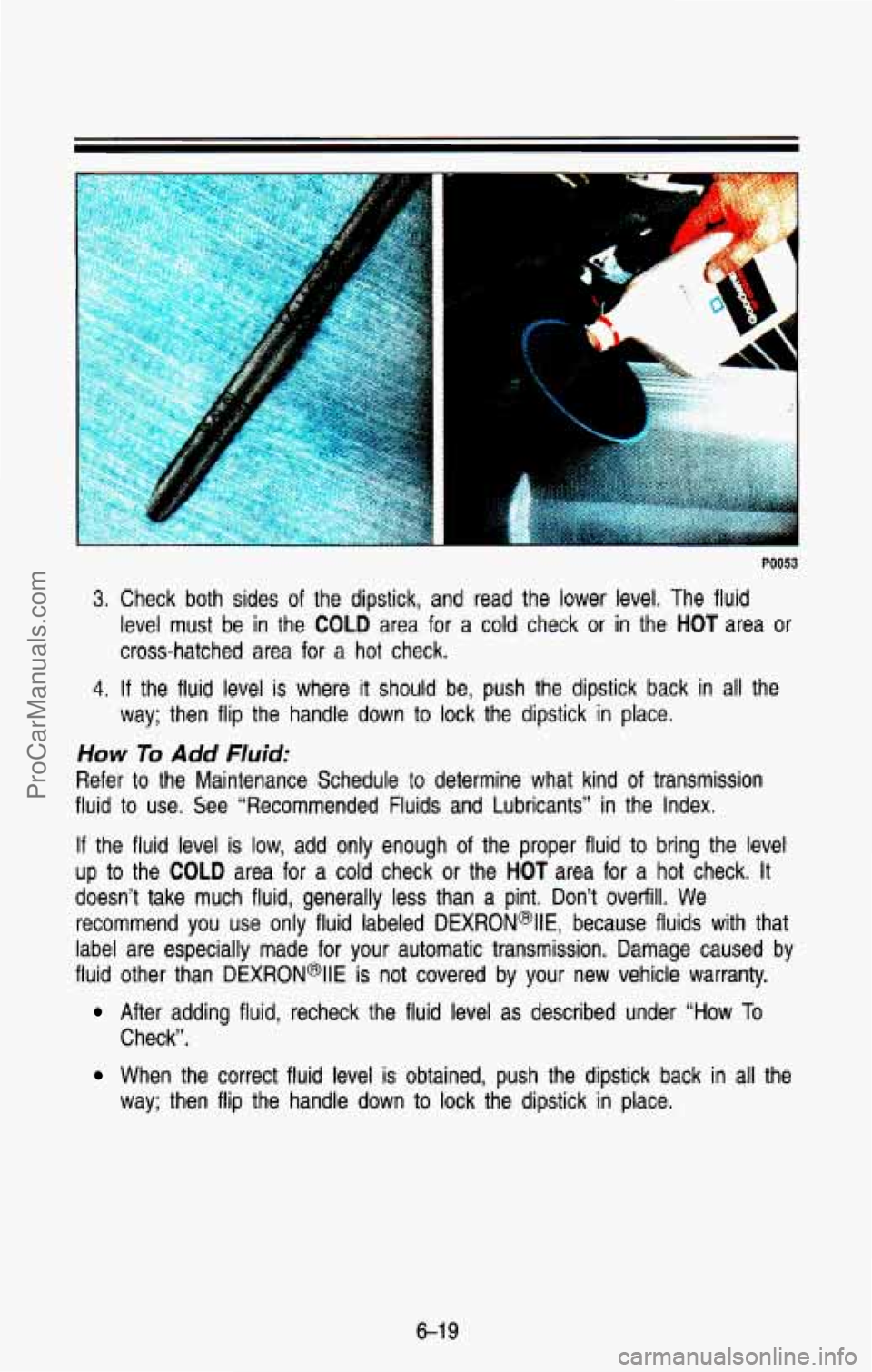
3. Check both sides of the dipstick, and read the lower level, The fluid
level must be in the
COLD area for a cold check or in the HOT area or
cross-hatched area for a hot check.
4. If the fluid level is where it should be, push the dipstick back in all the
way; then flip the handle down to lock the dipstick in place.
HOW To Add Fluid:
Refer to the Maintenance Schedule to determine what kind of transmission
fluid
to use. See “Recommended Fluids and Lubricants” in the Index.
If the fluid level is low, add only enough of the proper fluid to bring the level
up to the COLD area for a cold check or the HOT area for a hot check. It
doesn’t take much fluid, generally less than a pint. Don’t overfill. We
recommend you use only fluid labeled
DEXRON@IIE, because fluids with that
label are especially made for your automatic transmission. Damag\
e caused by
fluid other than
DEXRON@llE is not covered by your new vehicle warranty.
After adding fluid, recheck the fluid level as described under “How To
Check”.
When the correct fluid level is obtained, push the dipstick back in all the
way; then flip the handle down
to lock the dipstick in place.
6-1 9
ProCarManuals.com
Page 286 of 386
How to Add Fluid:
Here’s how to add fluid. Refer to the Maintenance Schedule to determine
what kind
of fluid to use. See “Recommended Fluids and Lubricants” in the
Index.
1. Remove the filler plug.
2. Add fluid at the filler plug hole. Add only enough fluid to \
bring the fluid
3. Install the filler plug. Be sure that the filler plug is full\
y seated.
level up
to the bottom of the filler plug hole.
Hydraulic Clutch
I
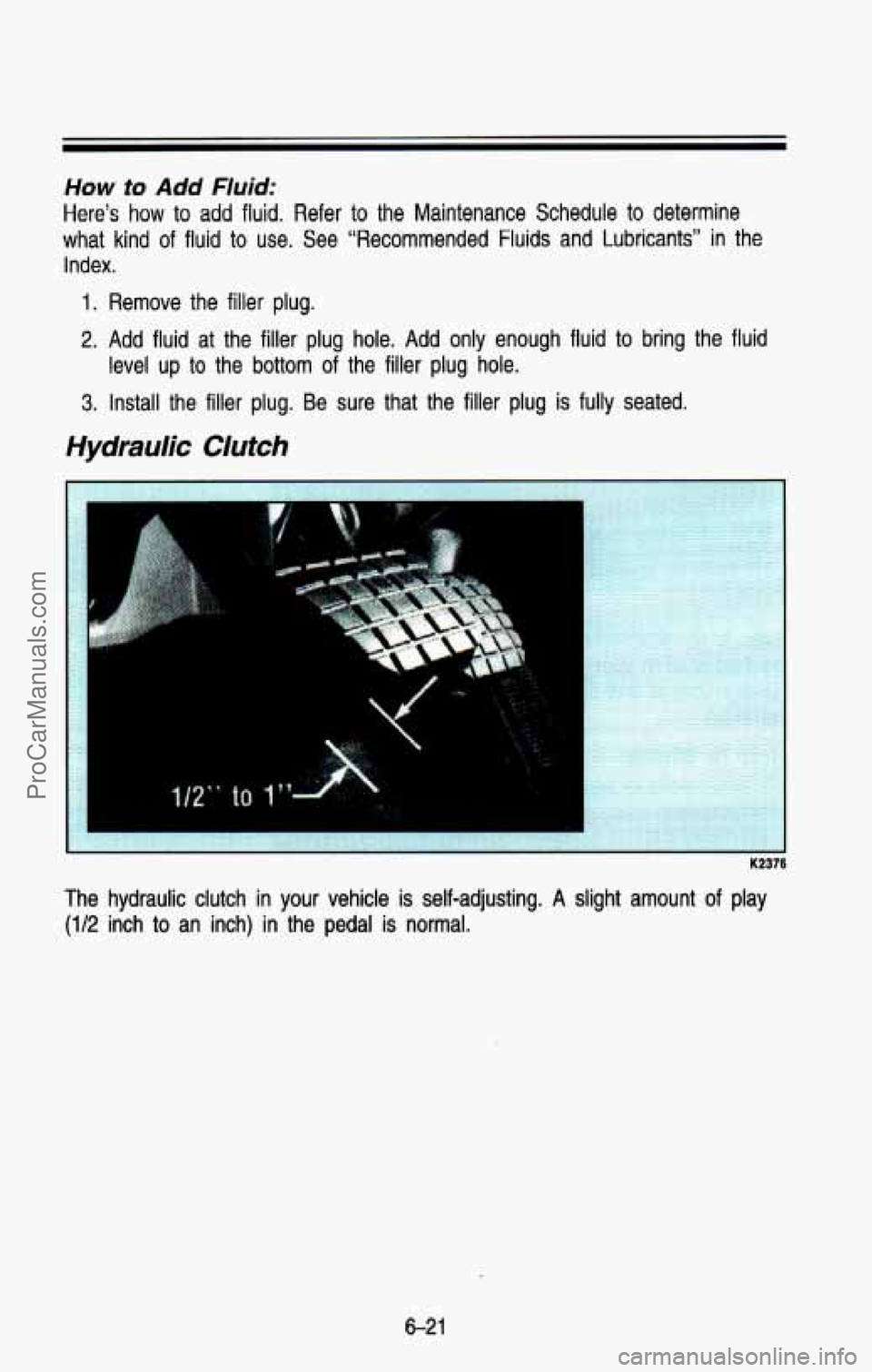
The hydraulic clutch in your vehicle is self-adjusting. A slight amount of play
(1/2 inch to an inch) in the pedal is normal.
6-21
ProCarManuals.com
Page 287 of 386
Service & Appearance Cave
When to Check and What to Use:
K2343
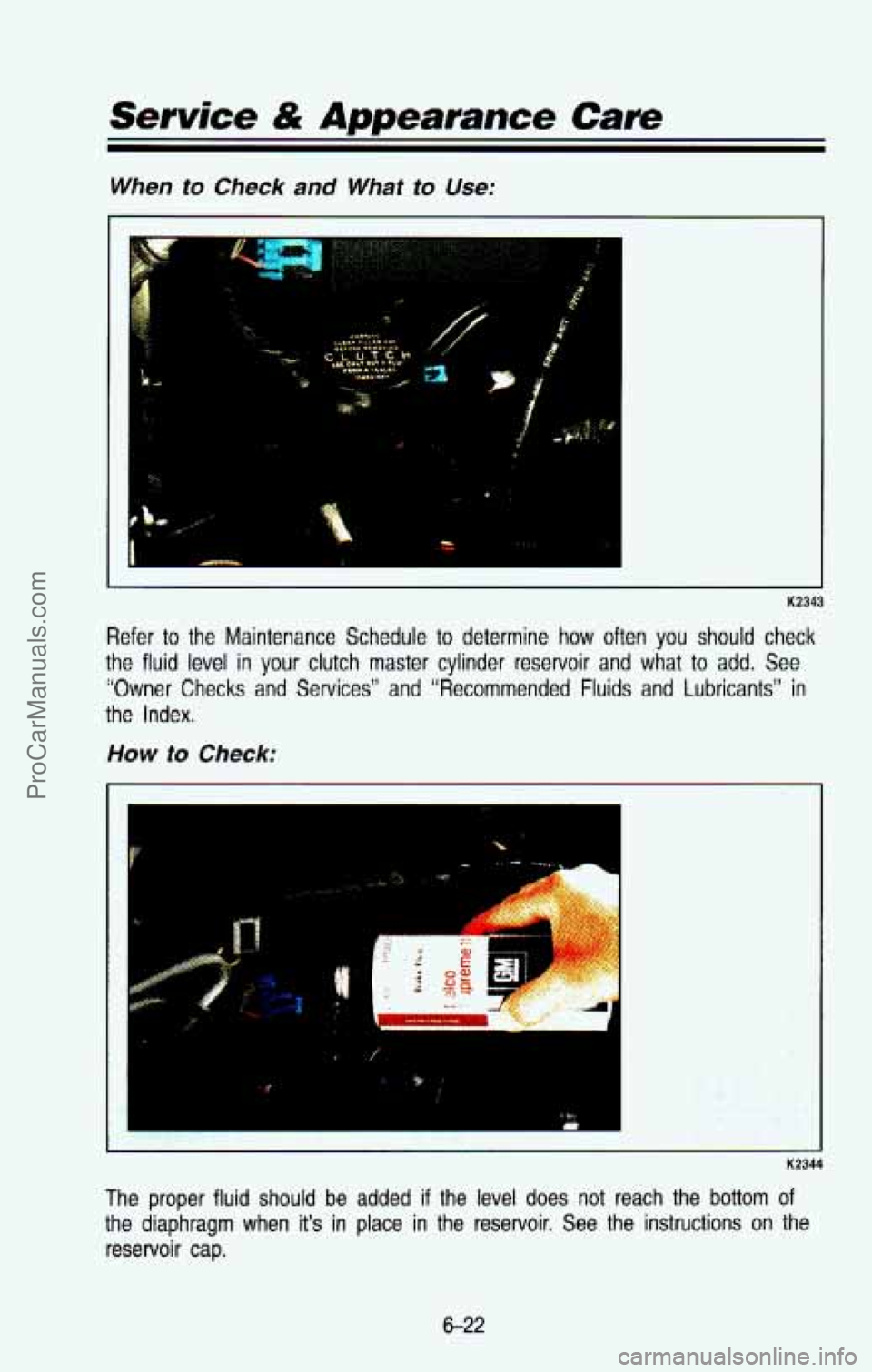
Refer to the Maintenance Schedule to determine how often you should check
the fluid level in
your clutch master cylinder reservoir and what to add. See
"Owner Checks and Services" and "Recommended Fluids and Lubrican\
ts" in
the Index.
Now to Check:
I
K2344
The proper fluid should be added if the level does not reach the bottom of
the diaphragm when it's in place in the reservoir. See the instructions on the
reservoir cap.
6-22
ProCarManuals.com
Page 288 of 386
Hydraulic Clufch Grease Fittrhg
A grease fitting is on the clutch housing for lubricating the clutch fork ball
stud. See your Maintenance Schedule for when to lubricate the clutch
housing. See “Recommended Fluids and Lubricants” in the In\
dex for the
proper lubricant to use.
Be sure not to over-fill because you could damage your clutch.
Four- Wheel Drive
Most lubricant checks in this section also apply to four-wheel-drive vehicles.
However, they have
two additional systems that need lubrication.
Transfer Case
When to Check Lubricant:
Refer to the Maintenance Schedule to determine how often to check the
lubricant. See “Periodic Maintenance Inspections” in the In\
dex.
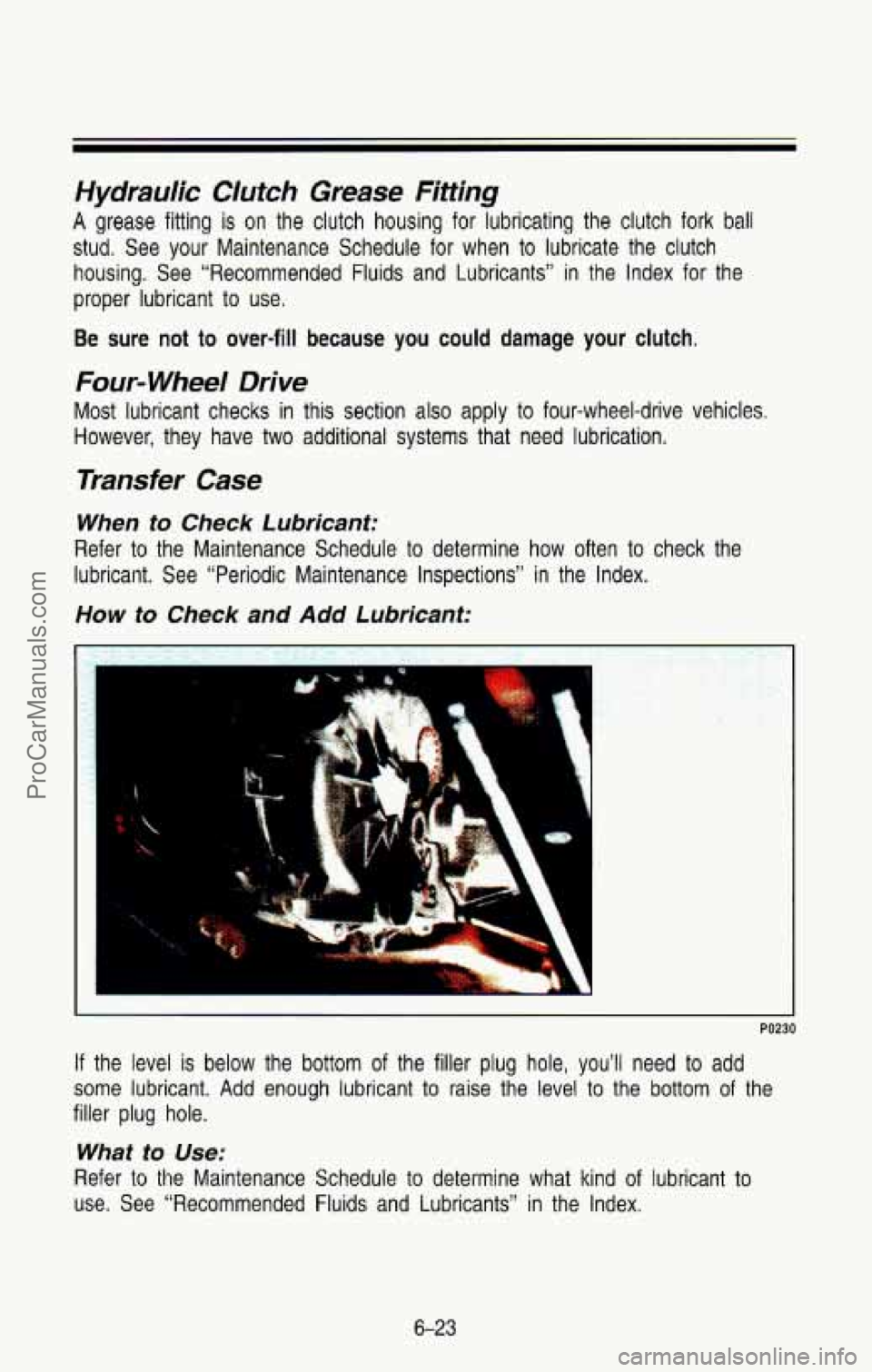
How to Check and Add Lubricant:
d Ti
I
PO230
If the level is below the bottom of the filler plug hole, you’ll need to add
some lubricant. Add enough lubricant to raise the level
to the bottom of the
filler plug hole.
What to Use:
Refer to the Maintenance Schedule to determine what kind of lubricant to
use. See “Recommended Fluids and Lubricants” in the Index.\
6-23
ProCarManuals.com
Page 289 of 386
Service & Appearance Care
Front Axle
When to Check and Change Lubricant:
Refer to the Maintenance Schedule to determine how often to check the
lubricant and when to change it. See “Scheduled Maintenance Services” in
the Index.
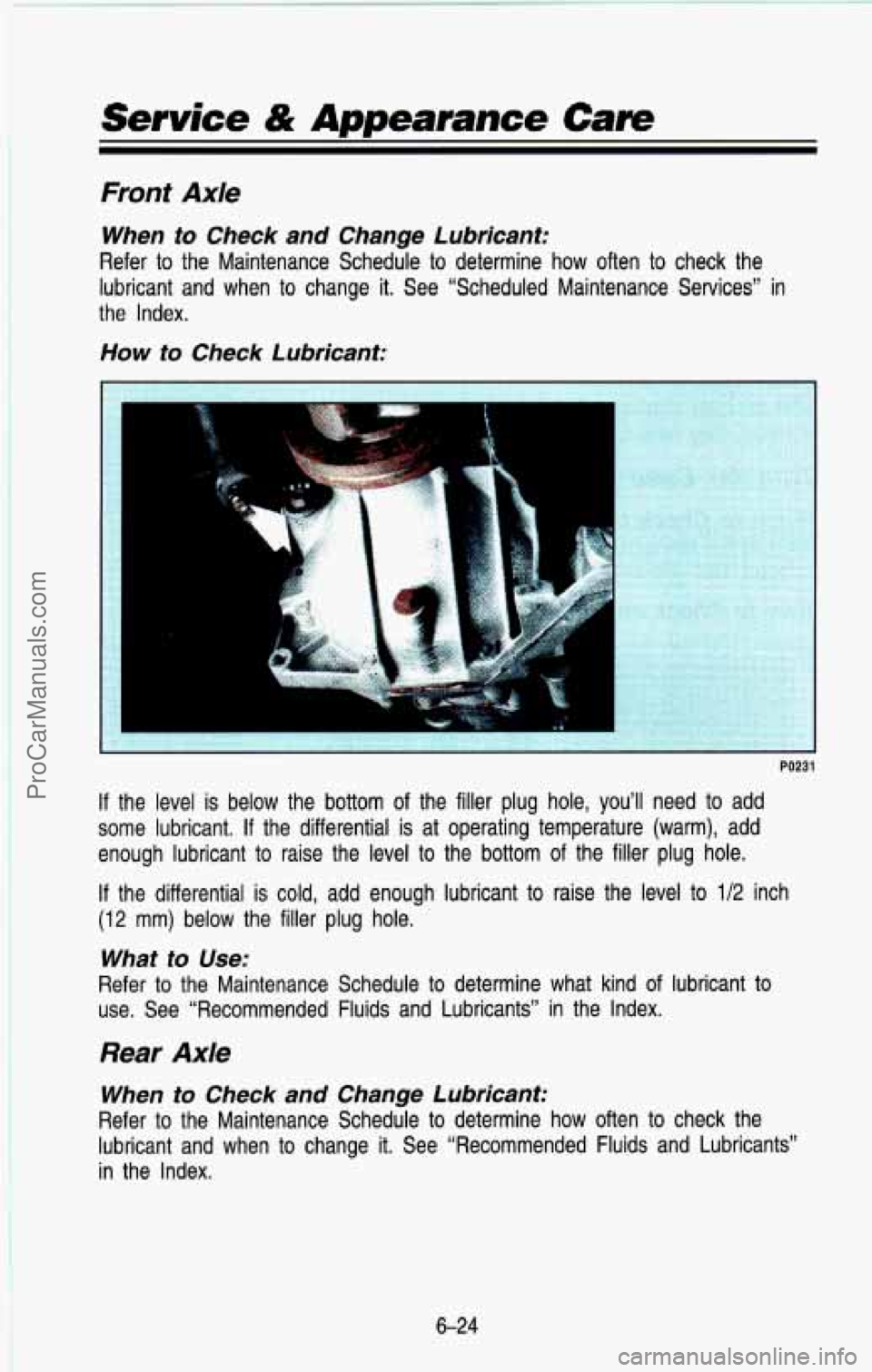
How to Check Lubricant:
PO231
If the level is below the bottom of the filler plug hole, you’ll need to add
some lubricant.
If the differential is at operating temperature (warm), add
enough lubricant to raise the level
to the bottom of the filler plug hole.
If the differential is cold, add enough lubricant to raise the level to 1/2 inch
(12 mm) below the filler plug hole.
What to Use:
Refer to the Maintenance Schedule to determine what kind of lubricant to
use. See “Recommended Fluids and Lubricants” in the Index.\
Rear Axle
When to Check and Change Lubricant:
Refer to the Maintenance Schedule to determine how often to check the
lubricant and when to change it. See “Recommended Fluids and Lubricants”
in the Index.
6-24
ProCarManuals.com
Page 290 of 386
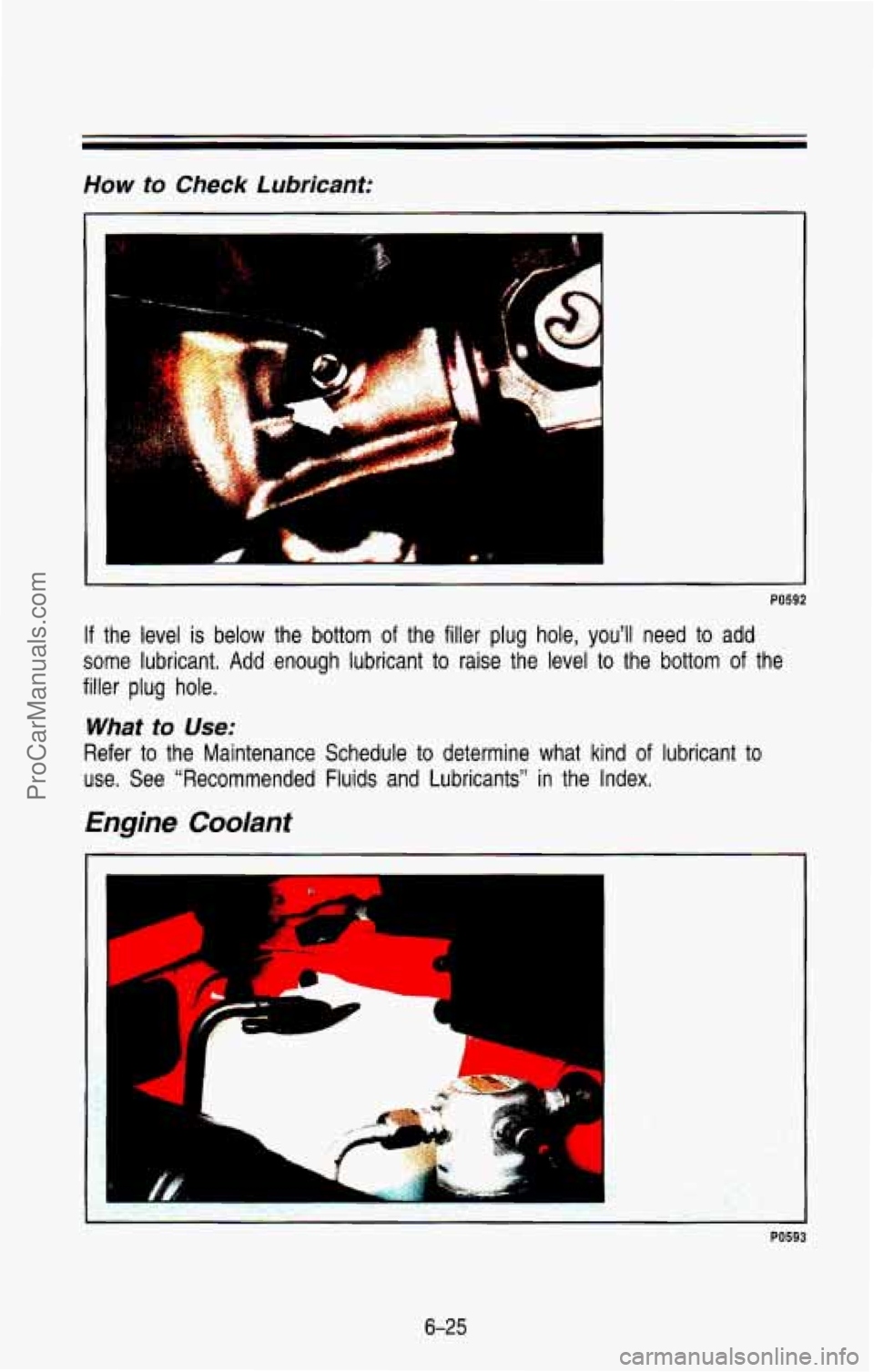
How to Check Lubricant:
PO592
If the level is below the bottom of the filler plug hole, you’ll need to add
some lubricant.
Add enough lubricant to raise the level to the bottom of the
filler
plug hole.
What to Use:
Refer to the Maintenance Schedule to determine what kind of lubricant to
use. See “Recommended Fluids and Lubricants” in the Index.
Engine Coolant
I
PO593
6-25
ProCarManuals.com
Page 295 of 386
Service & Appearance Care
i .. c
K2694
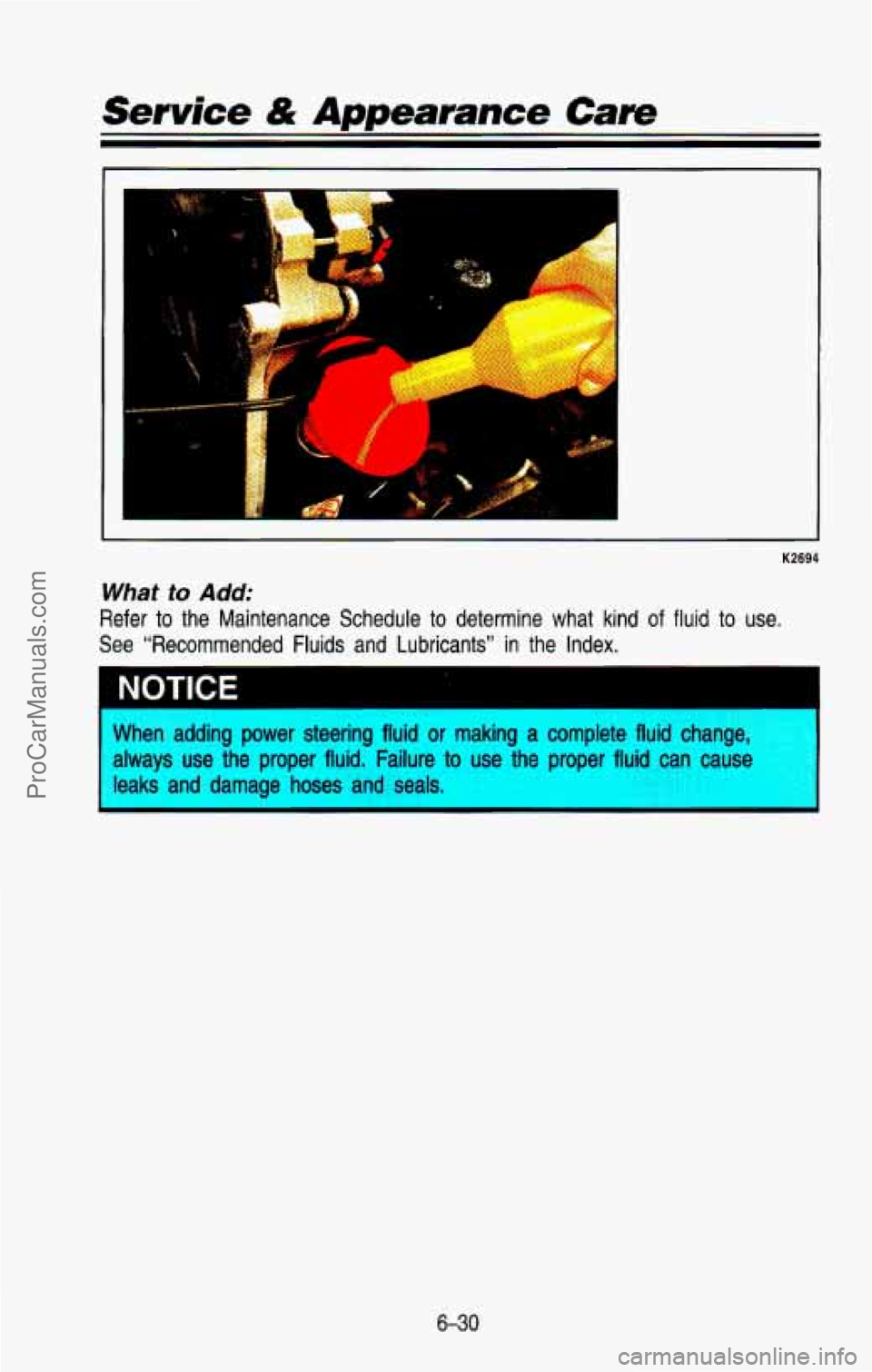
What to Add:
Refer to the Maintenance Schedule to determine what kind of fluid to use.
See “Recommended Fluids and Lubricants” in the Index.
NOTICE I
When adding power steering fluid or making a complete fluid change,
always use the proper fluid. Failure
to use the proper fluid can cause
leaks and damage hoses
and seals.
6-30
ProCarManuals.com
Page 297 of 386
Service & Appearance Care
Brake Master Cylinder
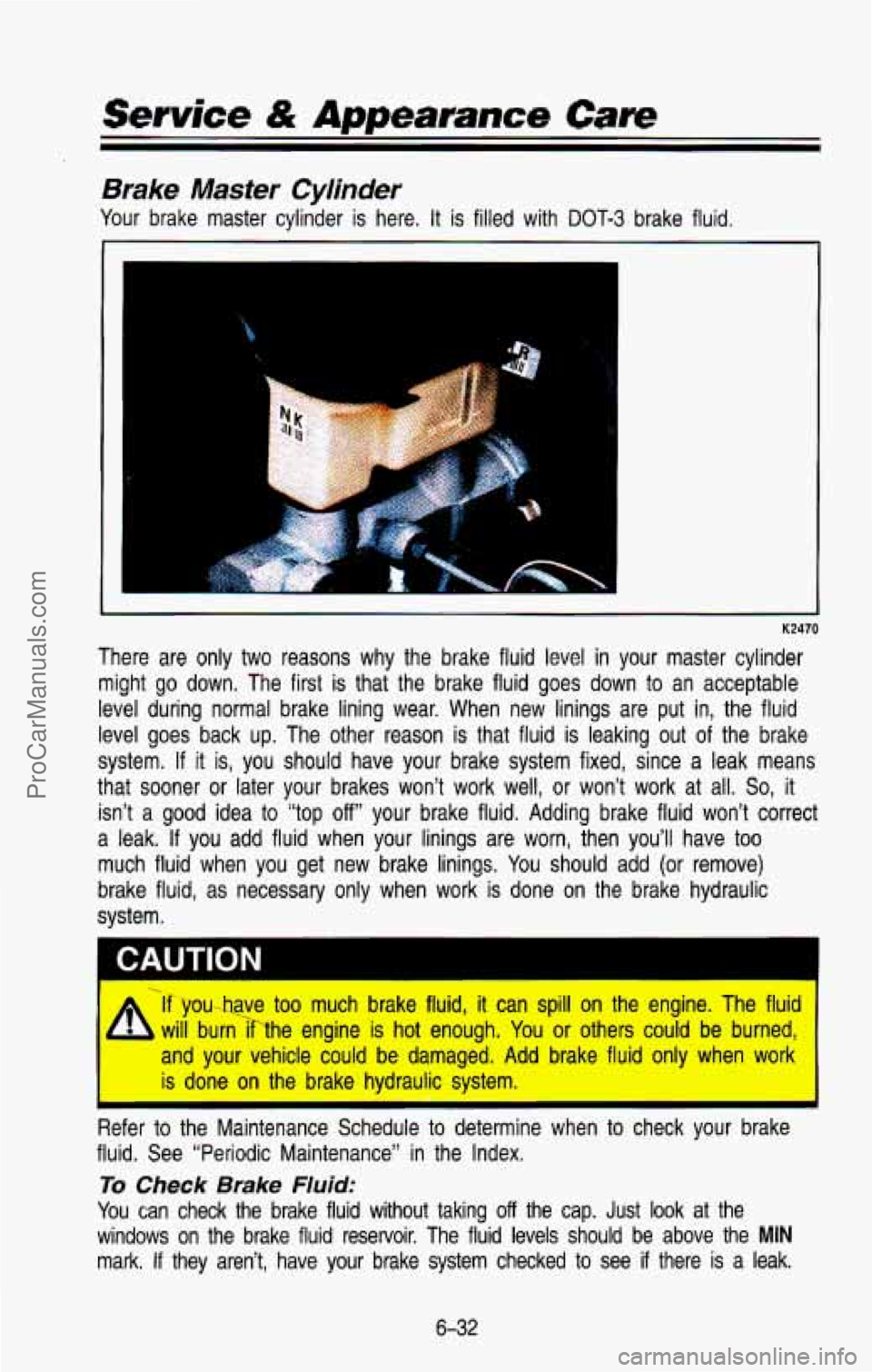
Your brake master cylinder is here. It is filled with DOT-3 brake fluid.
P
K2470
There are only two reasons why the brake fluid level in your master cylinder
might go down. The first is that the brake fluid goes down to an acceptable
level during normal brake lining wear. When new linings are put in, the fluid
level goes back up. The other reason is that fluid is leaking out of the brake
system.
If it is, you should have your brake system fixed, since a leak means
that sooner or later your brakes won’t work well, or won’\
t work at all.
So, it
isn’t a good idea to “top
off your brake fluid. Adding brake fluid won’t correct
a leak.
If you add fluid when your linings are worn, then you’ll have \
too
much fluid when you get new brake linings. You should add (or remove)
brake fluid, as necessary only when work is done on the brake hydraulic
system.
.
4 If you---have too much brake fluid, it can spill on the engine. The fluid
will burnhhe engine is hot enough. You or others could be burned,
and your vehicle could be damaged. Add brake fluid only when \
work
is done on the brake hydraulic system.
Refer to the Maintenance Schedule to determine when to check your brake
fluid. See “Periodic Maintenance” in the Index,
To Check Brake Fluid:
You can check the brake fluid without taking off the cap. Just look at the
windows on the brake fluid reservoir. The fluid levels should \
be above the
MIN
mark. If they aren’t, have your brake system checked to see if there is a leak.
6-32
ProCarManuals.com
Page 299 of 386
Service & Appearance Care
Front Suspension and Steering Linkage
Your maintenance schedule will tell you how often to lubricate the fittings. See
“Recommended Fluids and Lubricants” in the Index for the \
proper lubricant to
use.
Front Wheel Bearings
Your vehicle has front wheel bearings that must be cleaned and repa\
cked.
Your maintenance schedule will
tell you how often this must be done.
Front Shock Absorbers
The front shock absorbers of your vehicle do many things. They help the
vehicle ride smoothly and also control the travel of the suspension system.
When the shock absorbers are serviced, any replacement shock ab\
sorbers must be the same as the original equipment shock absorbers in \
both
extended length and strength.
Wheel Nut Torque
For vehicles with dual wheels, when the vehicle, wheel or fast\
eners are new,
have the torque set at the first
100, 1,000 and 6,000 miles (160, 1600 and
9600 km). Use the torque specified in the appropriate Specification \
Chart later
in this section.
Single Belt Accessory Drive
If your new vehicle uses a serpentine belt, it is lighter, and more durable
than systems with several belts.
The belt runs over or around the pulleys on the engine.
A tensioner is used
to keep the belt tight at all times. The tensioner also makes replacing the
belt easier. If you need
to replace the belt, be sure to get the correct
replacement belt. Your dealership or parts supplier can help you with this.
The Accessory Drive Belt Routing label on your vehicle will sh\
ow you how to route the belt your vehicle uses.
6-34
ProCarManuals.com