pressure CHEVROLET SUBURBAN 1993 User Guide
[x] Cancel search | Manufacturer: CHEVROLET, Model Year: 1993, Model line: SUBURBAN, Model: CHEVROLET SUBURBAN 1993Pages: 386, PDF Size: 21.06 MB
Page 227 of 386

Your Driving and 0% Road
Will you have to make any holes in the body of your vehicle when you
install a trailer hitch?
If you do, then be sure to seal the holes later
when you remove the hitch.
If you don’t seal them, deadly carbon
monoxide
(CO) from your exhaust can get into your vehicle (see “Carbon
Monoxide” in the Index). Dirt and water can, too.
Safety Chains
You should always attach chains between your vehicle and your trail\
er. Cross
the safety chains under the tongue of the trailer
so that the tongue will not
drop to the road
if it becomes separated from the hitch. Instructions about
safety chains may be provided by the trailer manufacturer. Follow the
manufacturer’s recommendation
for attaching safety chains. Always leave just
enough slack
so you can turn with your rig. And, never allow safety chains to
drag on the ground.
Trailer Brakes
If your trailer weighs more than 1,000 pounds (450 kg) loaded, then it needs
its own brakes-and they must be adequate. Be sure
to read and follow the
instructions for the trailer brakes
so you’ll be able to install, adjust and
maintain them properly.
Don’t tap into your vehicle’s brake system if the trailer’s brake system will use
more than
0.02 cubic inch (0.3 cc) of fluid from your vehicles master cylinder.
If it does, both braking systems won’t work well. You could even lose your
brakes.
Will the trailer brake parts take 3,000 psi (20 650 kPa) of pressure? If
not, the trailer brake system must not be used with your vehi\
cle.
If everything checks out this far, then make the brake fluid tap at the
port on the master cylinder that sends fluid
to the rear brakes. But don’t
use copper tubing for this.
If you do, it will bend and finally break off.
Use steel brake tubing.
Driving with a Trailer
Towing a trailer requires a certain amount of experience. Before setting out
for the open road, you’ll want
to get to know your rig. Acquaint yourself with
the feel of handling and braking with the added weight of the trailer. And
always keep in mind that the vehicle you are driving is now a good deal
longer and not nearly
so responsive as your vehicle is by itself.
Before you start, check the trailer hitch and platform, safety \
chains, electrical
connector, lights, tires and mirror adjustment.
If the trailer has electric brakes,
start your vehicle and trailer moving and then apply the trail\
er brake controller
by hand to be sure the brakes are working. This lets vou check your
electrical connection at the same time.
4-60
ProCarManuals.com
Page 241 of 386

Cooling System
.i
I
PO21 0
When you decide it's safe to lift the hood, here's what you'l\
l see:
A. Coolant recovery tank
B. Radiator pressure cap
C. Engine fan
A
An electric fan under the hood can start up even when the engine is
not running and can injure you. Keep hands, clothing, and tools
away from any underhood
electric fan.
CAUTION
If the coolant inside the coolant recovery tank or surge tank is \
boiling, don't
do anything else until it cools down.
5-1 0
ProCarManuals.com
Page 244 of 386
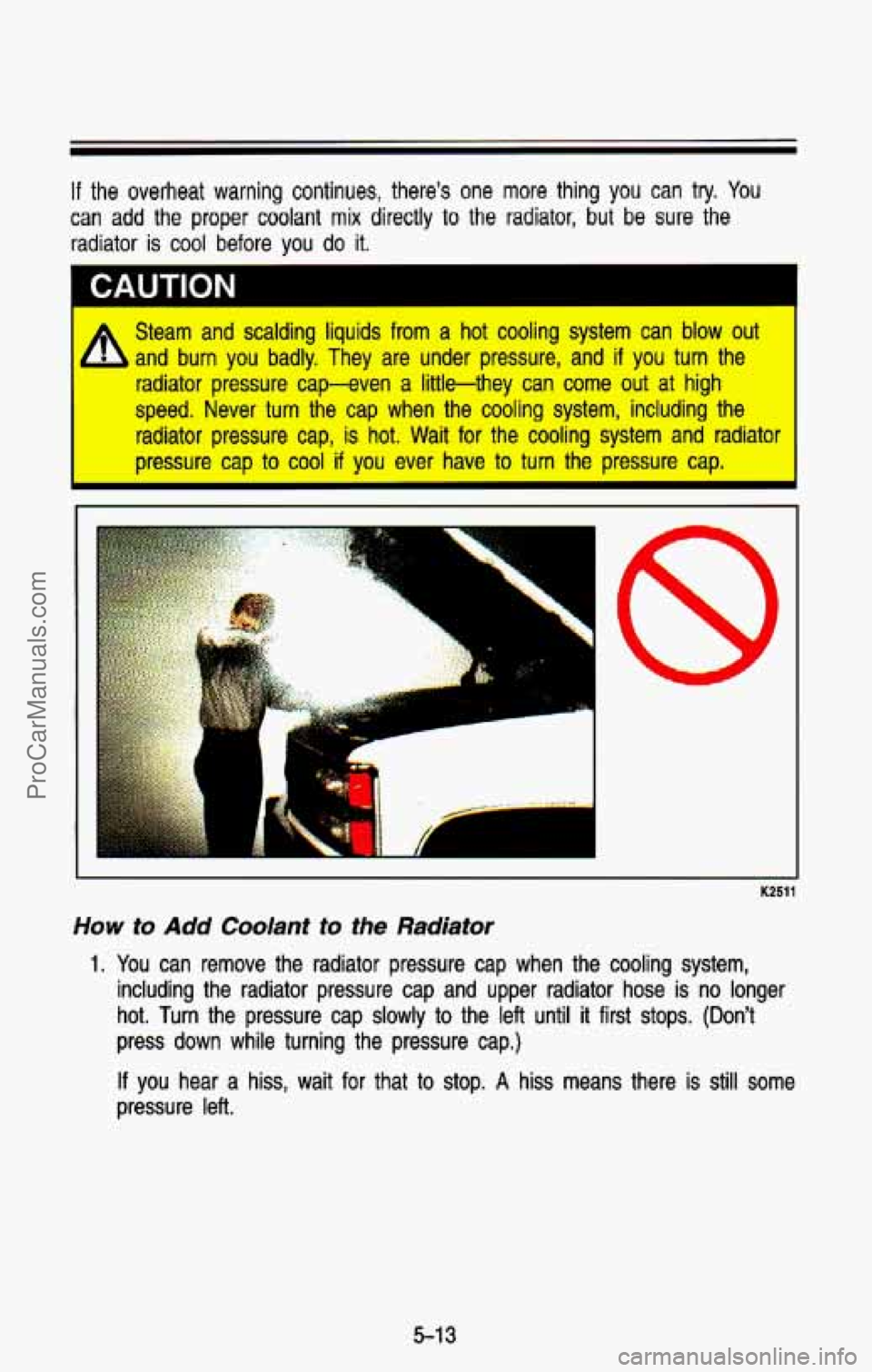
If the overheat warning continues, there's one more thing you can try. You
can add the proper coolant mix directly to the radiator, but be sure the
radiator is cool before you
do it.
I CAUTION
4 Steam and scalding liquids from a hot cooling system can blow out
- and burn you badly. They are under pressure, and if you turn the
radiator
pressure capeven a little-they can come out at high
speed. Never turn the cap when the cooling system, Including the
radiator pressure cap, is hat. Wait for the cooling system and radiato
pressure cap to cool if you ever have to turn the pressure cap.
I
8
K2511
How to Add Coolant to the Radiator
1. You can remove the radiator pressure cap when the cooling system,
including the radiator pressure cap and upper radiator hose is no longer
hot. Turn the pressure cap
slowly to the left until it first stops. (Don't
press down while turning the pressure cap.)
If you hear a hiss, wait for that to stop. A hiss means there is still some
pressure left.
5-1 3
ProCarManuals.com
Page 245 of 386
PO244
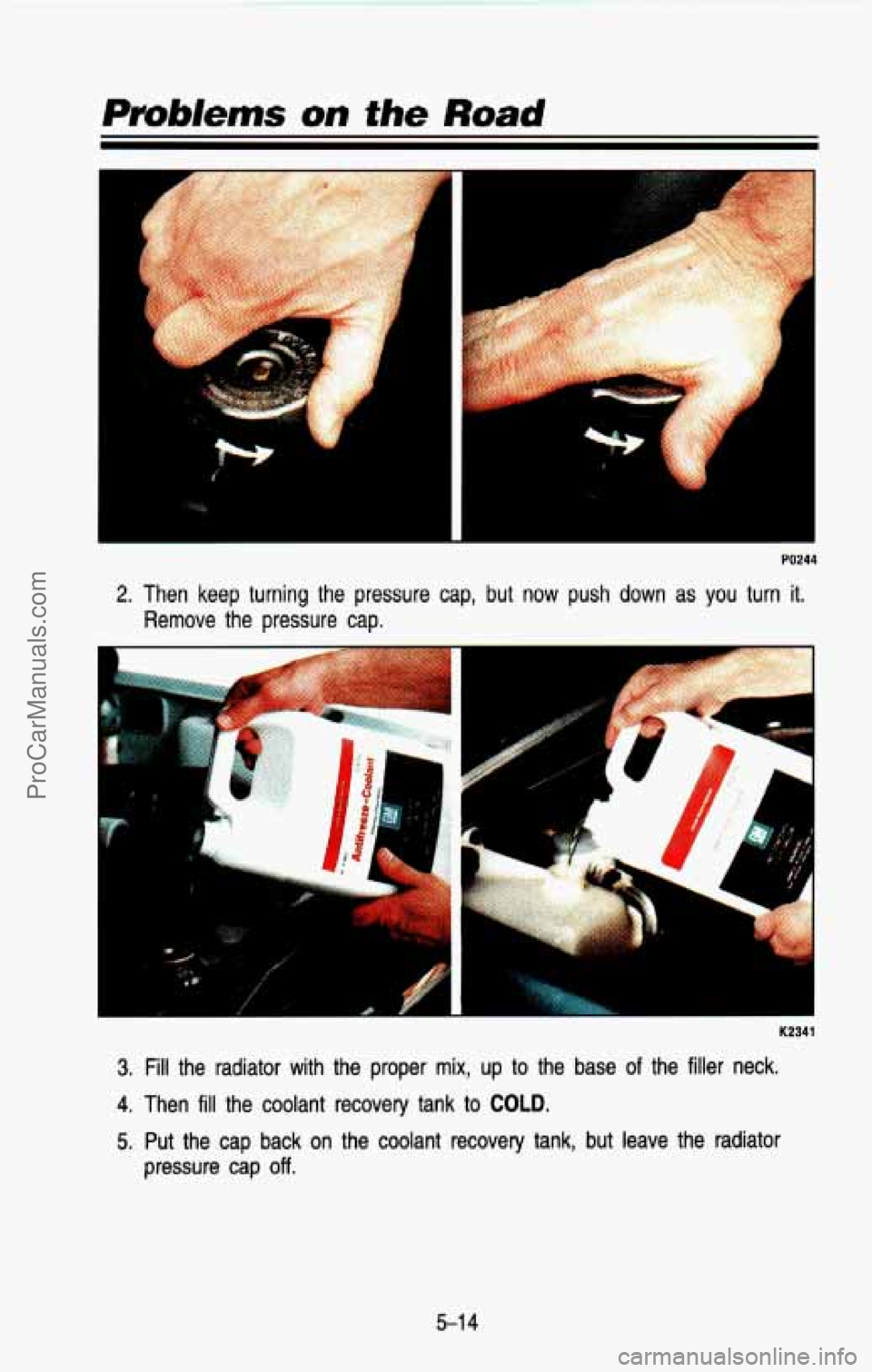
2. Then keep turning the pressure cap, but now push down as you turn it.
Remove the pressure cap.
L
K2341
3. Fill the radiator with the proper mix, up to the base of the filler neck.
4. Then fill the coolant recovery tank to COLD.
5. Put the cap back on the coolant recovery tank, but leave the radi\
ator
pressure
cap off.
5-1 4
ProCarManuals.com
Page 246 of 386
K2550
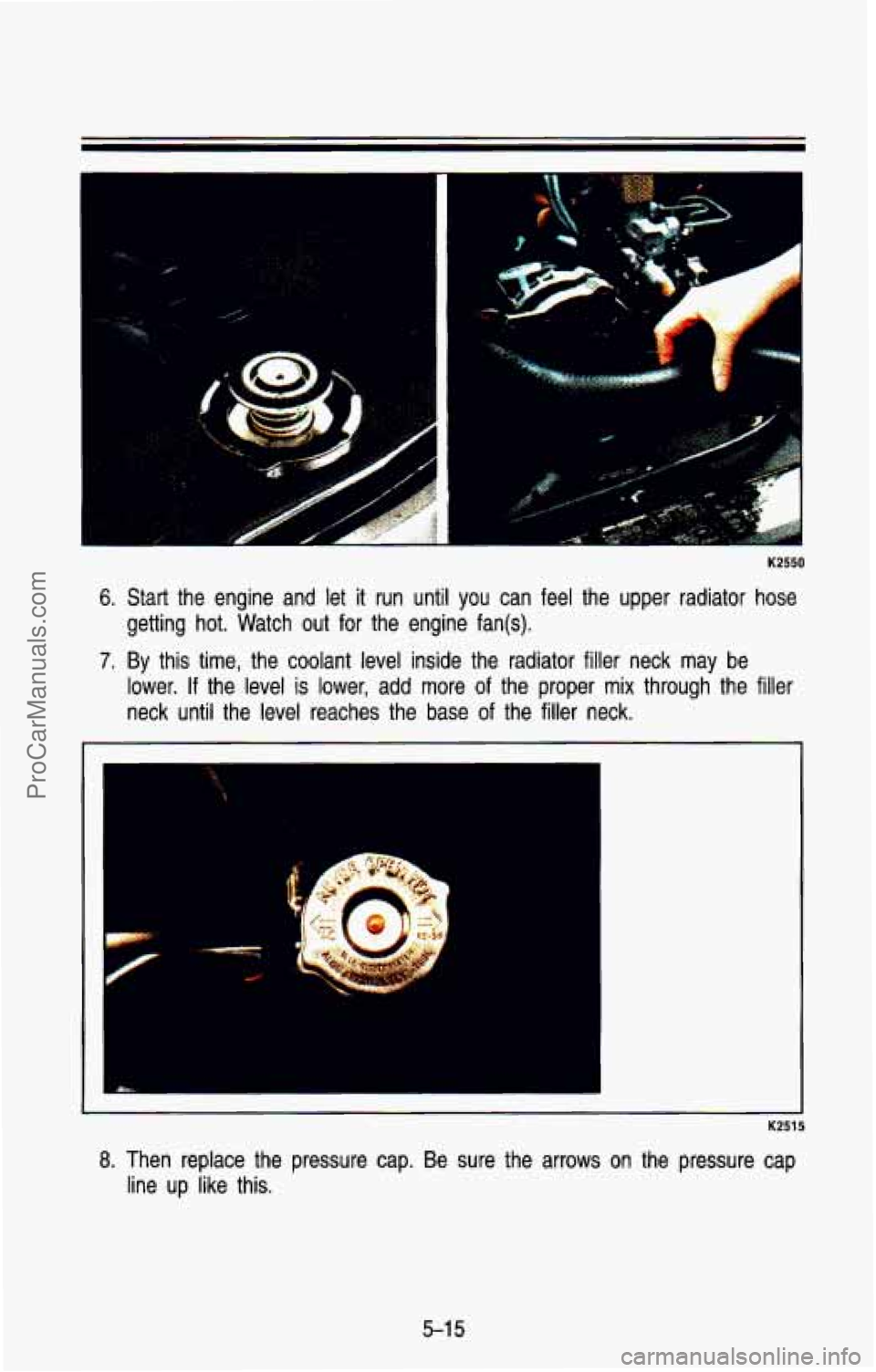
6. Start the engine and let it run until you can feel the upper radiator hose
getting hot. Watch out for the engine fan@).
7. By this time, the coolant level inside the radiator filler neck m\
ay be
lower.
If the level is lower, add more of the proper mix through the filler
neck until the level reaches the base
of the filler neck.
1
K2515
8. Then replace the pressure cap. Be sure the arrows on the pressure cap
line up like this.
5-1 5
ProCarManuals.com
Page 267 of 386

Service & Appearance Care
Replacing Brake System Parts ........................................................................\
.. 6-33
Other Maintenance Items
........................................................................\
........... 6-34
Lubrication
........................................................................\
.................................... 6-35
Electrical System
........................................................................\
......................... 6-37
Battery
........................................................................\
...................................... 6-37
Bulb Replacement
........................................................................\
.................... 6-37
Fuses and Circuit Breakers
........................................................................\
.... 6-43
Exhaust System
........................................................................\
........................... 6-45
Loading Your Vehicle
........................................................................\
.................. 6-46
Tires
........................................................................\
.............................................. 6-48
Inflation-Tire Pressure
........................................................................\
........... 6-49
Tire Inspection and Rotation
........................................................................\
.. 6-52
When It’s Time for New Tires ........................................................................\
6-53
Buying New Tires
........................................................................\
.................... 6-53
Uniform Tire Quality Grading
........................................................................\
.. 6-54
Wheel Alignment and Tire Balance
............................................................... 6-55
Wheel Replacement
........................................................................\
................. 6-55
Tire Chains
........................................................................\
............................... 6-56
Appearance Care
........................................................................\
........................ 6-57
Cleaning the Inside Of Your Vehicle
............................................................. 6-58
Cleaning the Outside
Of Your Vehicle .......................................................... 6-61
Appearance Care Materials
........................................................................\
........ 6-64
Vehicle Identification Number
........................................................................\
..... 6-65
Service Parts Identification Label
...................................................................... 6-67
Specification Charts ........................................................................\
..................... 6-68
6-2
ProCarManuals.com
Page 292 of 386
k
NOTICE
f YOU use the proper coolant, you don’t have to add extra inhibitors or
idditives which claim to improve the system. These can be harmful
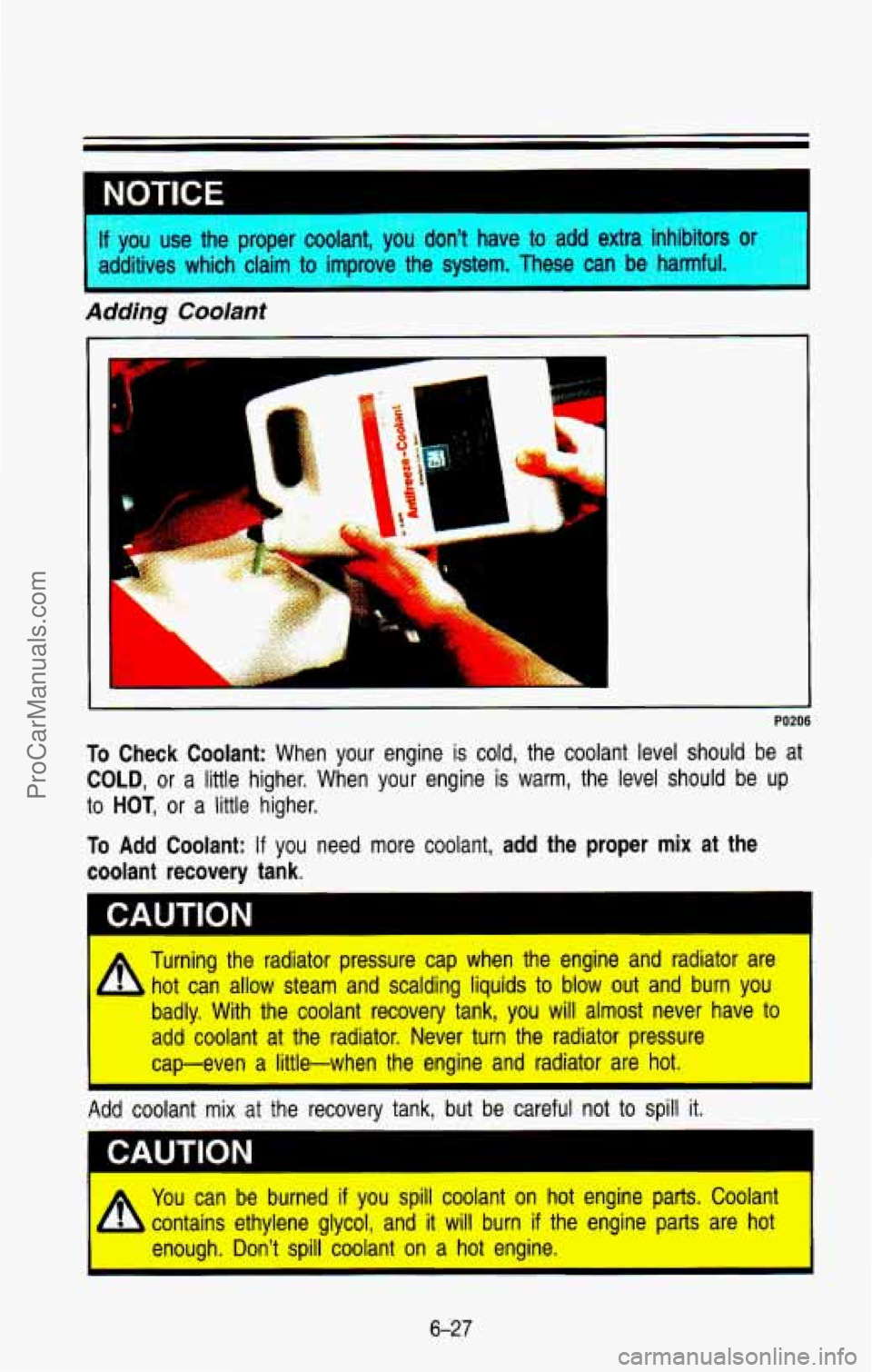
Adding Coolant
‘1 L
L
L
PO206
To Check Coolant: When your engine is cold, the coolant level should be at
COLD, or a little higher. When your engine is warm, the level shoul\
d be up
to HOT, or a little higher.
To Add Coolant: If you need more coolant, add the proper mix at the
coolant recovery tank.
I CAUTION
4
Turning the radiator pressure cap when the engine and radiator are
hot can allow steam and scalding liquids to blow out and burn you
badly. With the coolant recovery tank, you will almost never have to
add coolant at the radiator. Never turn the radiator pressure
I cap-even a little-when the engine and radiator are hot. I
Add coolant mix at the recovery tank, but be careful not to spill it.
~ ~~
1 CAUTION I
You can be burned if you spill coolant on hot engine parts. Coolant
- b contains ethylene glycol, and it will burn if the engine parts are hot
I enough. Don’t spill coolant on a hot engine. I
6-27
ProCarManuals.com
Page 293 of 386
Service & Appearance Care
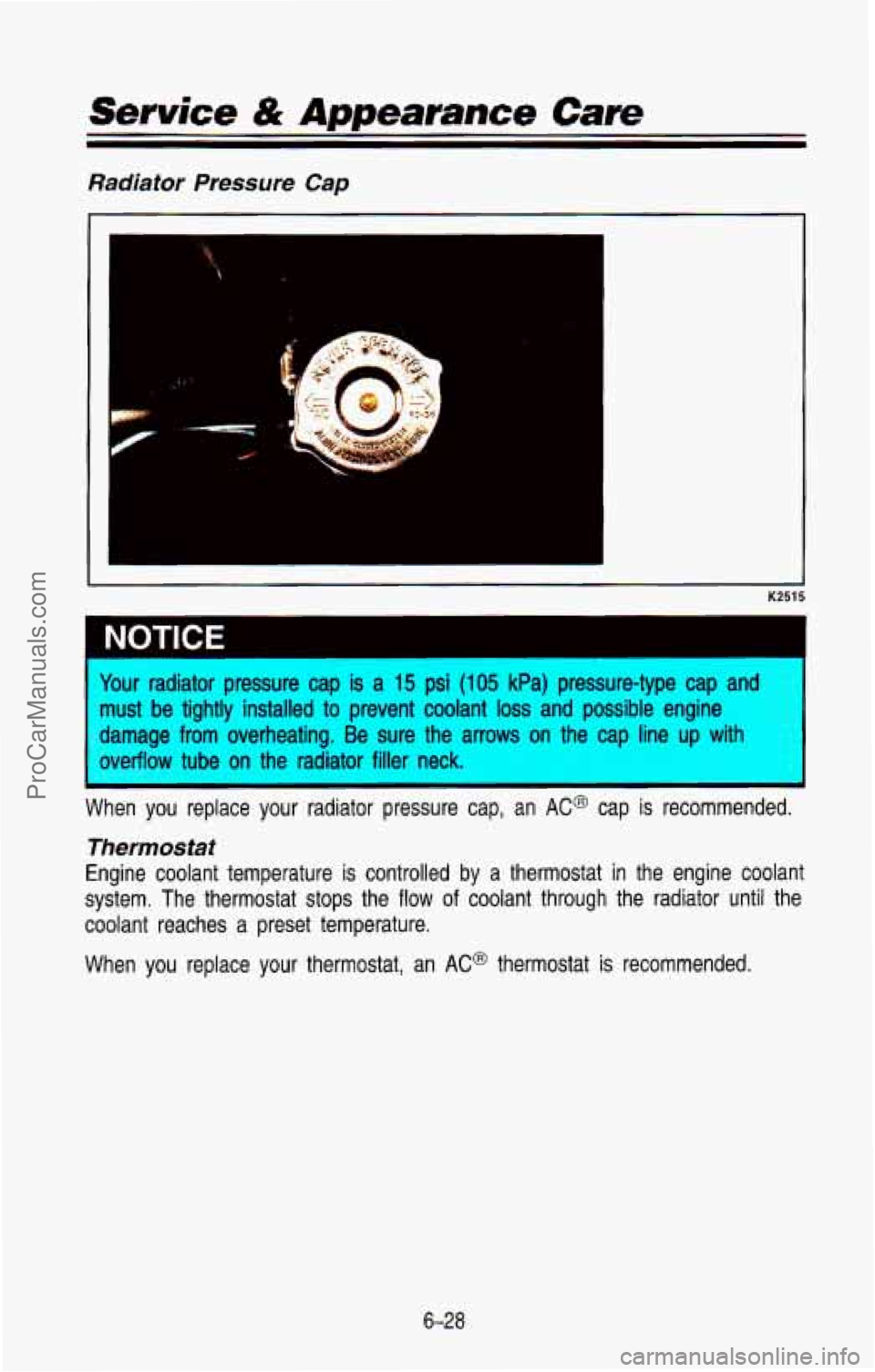
Radiator Pressure Cap
I
I
-
- K2515
1 NOTICE
four radiator pressure cap is a 15 psi (105 kPa) pressure-type cap and
nust be tightly installed to prevent coolant loss and possible engine
mage from overheating. Be sure the arrows on the cap line up \
with
werffow tube
on the radiator filler neck.
-m recommended.
I
Thermostat
Engine coolant temperature is controlled by a thermostat in the engine coolant
system. The thermostat stops the
flow of coolant through the radiator until the
coolant reaches a preset temperature.
When you replace
your thermostat, an AC@ thermostat is recommended.
6-28
ProCarManuals.com
Page 311 of 386
Loading Your Vehicle
MFD BY GENERAL MOTORS CORP L-4
I
. , .. .-. .. ,. . ,FFECT
CROWN ABOVE.
1
TIRE SIZE
-EL XISPEED RIM PSVKPA (COLD)
SPA
SEE OWNERS MANUAL FOR ADDITIONAL INFORMATION
K2134
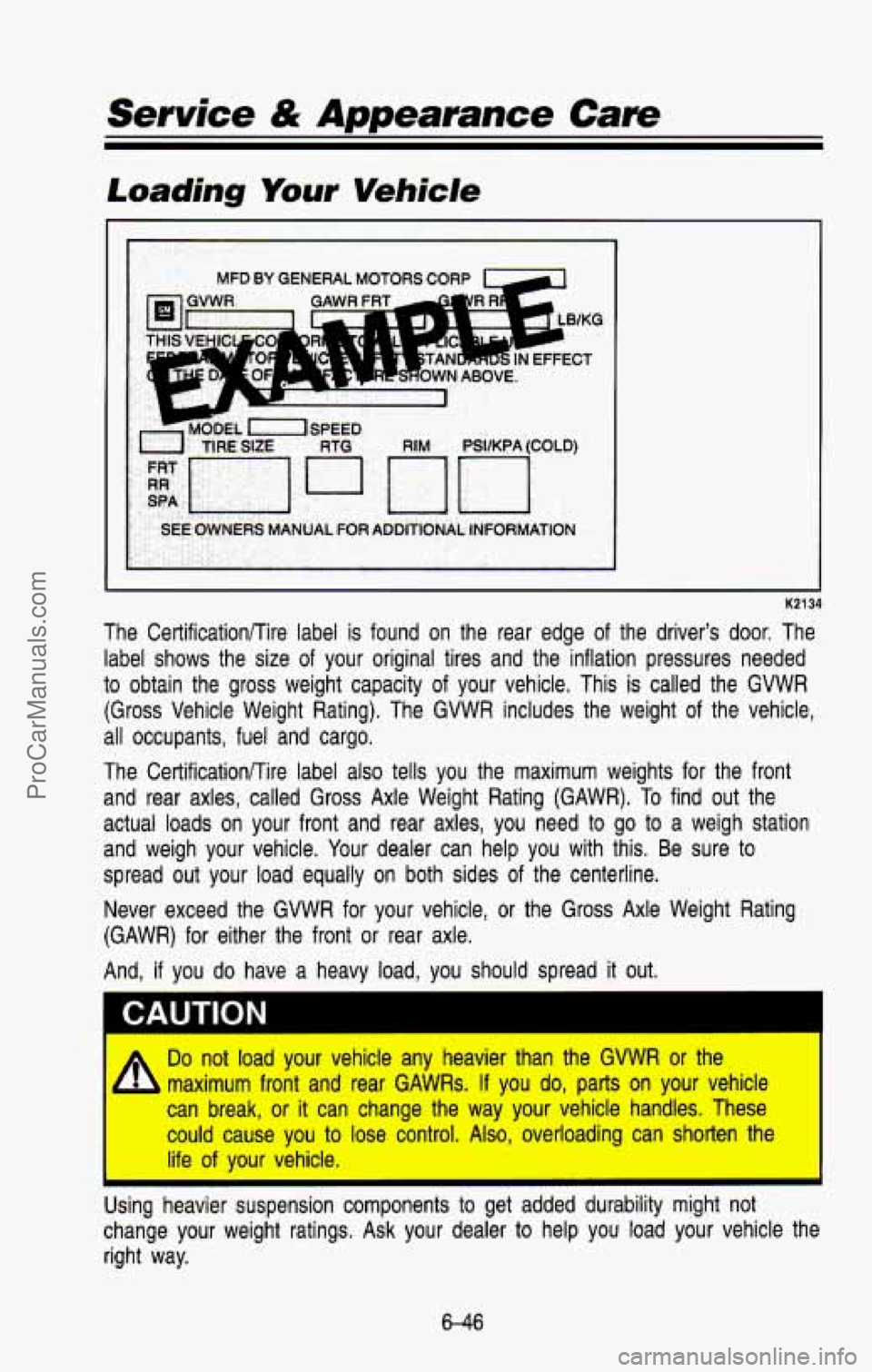
The Certificationflire label is found on the rear edge of the driver's door. The
label shows the size of your original tires and the inflation \
pressures needed
to obtain the gross weight capacity of your vehicle. This is called the GVWR
(Gross Vehicle Weight Rating). The GVWR includes the weight o\
f the vehicle,
all occupants, fuel and cargo.
The Certificationnire label also tells you the maximum weights for the front
and rear axles, called Gross Axle Weight Rating (GAWR). To find out the
actual loads on your front and rear axles, you need to go to\
a weigh station
and weigh your vehicle. Your dealer can help you with this. Be sure to
spread out your load equally on both sides of the centerline. \
Never exceed the GVWR
for your vehicle, or the Gross Axle Weight Rating
(GAWR) for either the front or rear axle.
And,
if you do have a heavy load, you should spread it out.
A
Do not load your vehicle any heavier than the GVWR or the I
maximum front and rear GAWRs. If you do, parts on your vehicl\
e
can break, or
it can change the way your vehicle handles. These
could cause you
to lose control. Also, overloading can shorten the
life of your vehicle.
Using heavier suspension components
to get added durability might not
change your weight ratings. Ask your dealer to help you load your vehicle the
right way.
6-46
ProCarManuals.com
Page 314 of 386
Poorly maintained and improperly used tires are dangerous. Overloading your tires can cause overheating as
a result of too
much friction. You could have an air-out and a serious accident.
See “Loading Your Vehicle”
in the Index.
The resulting accident could cause serious injury. Check all tires
frequently to maintain the recommended pressure. Tire pressure
should
be checked when your tires are cold,
0 Overinflated tires are more likely to be cut, punctured, or broken
by sudden impact, such as when you hit a pothole. Keep tires
at the recommended pressure.
0 Worn, old tires can cause accidents, If your tread is badly worn,
or if your tires have been damaged, replace them.
Even if it’s legal, don’t drive over 85 mph (135 kmh) if you
have
16 inch tires.
See “Special Tire Inflation”
in this section for more information on
loading
and inflation pressures at speeds above 65 mph (105 kmh).
Underinflated tires pose the same danger as overloaded tires.
Inflation-Tire Pressure
The Certification/Tire label which is on the rear edge of the driver’s door, or
on the incomplete vehicle document in the cab, shows the correct inflation
pressures for your tires, when they’re cold. “Cold” mea\
ns your vehicle has
been sitting for at least three hours or driven no more than a mile.
You can operate some vehicles at reduced inflation pressures only when you’ll
be carrying reduced loads. On those vehicles, the minimum cold \
inflation
pressures for a typical reduced load are printed
on the “Improved Ride Tire
Pressure” label located on the driver’s door. Weigh the v\
ehicle to find the
load on each tire and see the label for the minimum cold inflation pressures
for that load.
6-49
ProCarManuals.com