stop start CHEVROLET SUBURBAN 1993 Owner's Manual
[x] Cancel search | Manufacturer: CHEVROLET, Model Year: 1993, Model line: SUBURBAN, Model: CHEVROLET SUBURBAN 1993Pages: 386, PDF Size: 21.06 MB
Page 229 of 386

Your Driving and the Road
Turn Signals When Towing a Trailer
When you tow a trailer, your vehicle has to have a different turn signal
flasher and extra wiring. The green arrows on your instrument \
panel will flash
whenever you signal a turn
or lane change. Properly hooked up, the trailer
lights will also flash, telling other drivers you’re about
to turn, change lanes,
or stop.
When towing a trailer, the green arrows on your instrument pan\
el will flash for
turns even
if the bulbs on the trailer are burned out. Thus, you may think \
drivers behind you are seeing your signal when they are not.
It’s important to
check occasionally to be sure the trailer bulbs are still working.
Driving on Grades
Reduce speed and shift to a lower gear before you start down a long or
steep downgrade. If you don’t shift down, you might have to use your brakes
so much that they would get hot and no longer work well.
On
a long uphill grade, shift down and reduce your speed to 45 mph (70
kmlh) or less to reduce the possibility of engine and transmission overheating.
If you have an automatic transmission, you should use D (or, as you need to,
a lower gear) when towing a trailer. Operating your vehicle in D when towing
a trailer will minimize heat buildup and extend the
life of your transmission.
Or,
if you have a manual transmission with fifth gear and you are to\
wing a
trailer, it’s better not
to use fifth gear, just drive in fourth gear (or, as you
need to, a lower gear).
Parking on Hilk
You really should not park your rig on a hill. If something goes wrong, your
rig could start
to move. People can be injured and both your vehicle and the
trailer can be damaged.
But
if you ever have to park your rig on a hill, here’s how to do it:
1. Apply your regular brakes, but don’t shift into P (Park) yet, or into gear
for a manual transmission.
2. Have someone place chocks under the trailer wheels.
3, When the wheel chocks are in place, release the regular brakes\
until the
4. Reapply the regular brakes. Then apply your parking brake, and \
then
chocks absorb the load.
shift
to P (Park), or R (Reverse) for a manual transmission.
5. If you have a four-wheel-drive vehicle, be sure the transfer case \
is in
a
drive gear-not in
N (Neutral).
4-62
ProCarManuals.com
Page 230 of 386

. .
6. Release the regular brakes.
CAUTION
It can be dangerous to get out of your vehicle if the shift lever is no
fully in
P (Park) wi-. the parking brake firmly set. Your vehicle can
roll.
If you have left the engine running, the vehicle can move suddenl\
y.
You or others could be injured.
To be sure your vehicle won’t move,
when you’re on fairly level ground, use the steps that foll\
ow.
If you have four-wheel drive and your transfer case is in N (Neutral),
your vehicle will be free to
roll, even if your shift lever is in P (Park)
So, be sure the transfer case is in a drive gear-not in N (Neutral).
If you are parking on a hill, or if you’re pulling a trailer, also see
I “Parking On Hills” in the Index. I
When You Are Ready to Leave After Parking on a Hill
1. Apply your regular brakes and hold the pedal down while you:
Start your engine.
Shift into a gear; and
Release the parking brake.
2. Let up on the brake pedal.
3. Drive slowly until the trailer is clear of the chocks.
4. Stop and have someone pick up and stow the chocks.
Maintenance When Trailer Towing
Your vehicle will need service more often when you’re pulling a \
trailer. .See
the Maintenance Schedule for more on this. Things that are especially
important in trailer operation are automatic transmission fluid (don’t overfill),
engine oil, axle lubricant, belts, cooling system, and brake ad\
justment. Each
of these is covered in this manual, and the Index will help you find them
quickly.
If you’re trailering, it’s a good idea to review these sections before
you start your trip.
Check periodically to see that all hitch nuts and bolts are tight.
4-63
ProCarManuals.com
Page 247 of 386

Engine Fan Noise
This vehicle has a clutched engine cooling fan. When the clutc\
h is engaged,
the fan spins faster
to provide more air to cool the engine. In most every day
driving conditions the clutch is not engaged. This improves fuel economy and
reduces fan noise. Under heavy vehicle loading, trailer towing \
and/or high
outside temperatures, the fan speed increases when the clutch e\
ngages.
So
you may hear an increase in fan noise. This is normal and sh\
ould not be
mistaken
as the transmission slipping or making extra shifts. It is merely the
cooling system functioning properly. The fan
will slow down when additional
cooling is not required and the clutch disengages.
You may also hear this fan noise when you start the engine. \
It will go away
as the fan clutch disengages.
If a Tire Goes Fiat
It’s unusual for a tire to “blow out” while you’re driving,\
especially if you
maintain your tires properly.
If air goes out of a tire, it’s much more likely to
leak out slowly. But if you should ever have a “blowout,” here are a few tips
about what
to expect and what to do:
If a front tire fails, the flat tire will create a drag that pulls the vehicle toward
that side. Take your foot
off the accelerator pedal and grip the steering wheel
firmly. Steer to maintain lane position, then gently brake
to a stop well out of
the traffic lane.
A rear blowout, particularly on a curve, acts much like a skid and may
require the same correction you’d use in a skid. In any rear blowout, remove
your foot from the accelerator pedal. Get the vehicle under co\
ntrol by steering
the way you want the vehicle
to go. It may be very bumpy and noisy, but
you can still steer. Gently brake to a stop, well off the road if possible.
If your tire goes flat, the next part shows how to use your jacking equipment
to change a flat tire safely.
Changing a Flat Tire
If a tire goes flat, avoid further tire and wheel damage by driving slowly to a
level place. Turn
on your hazard warning flashers.
5-1 6
ProCarManuals.com
Page 282 of 386
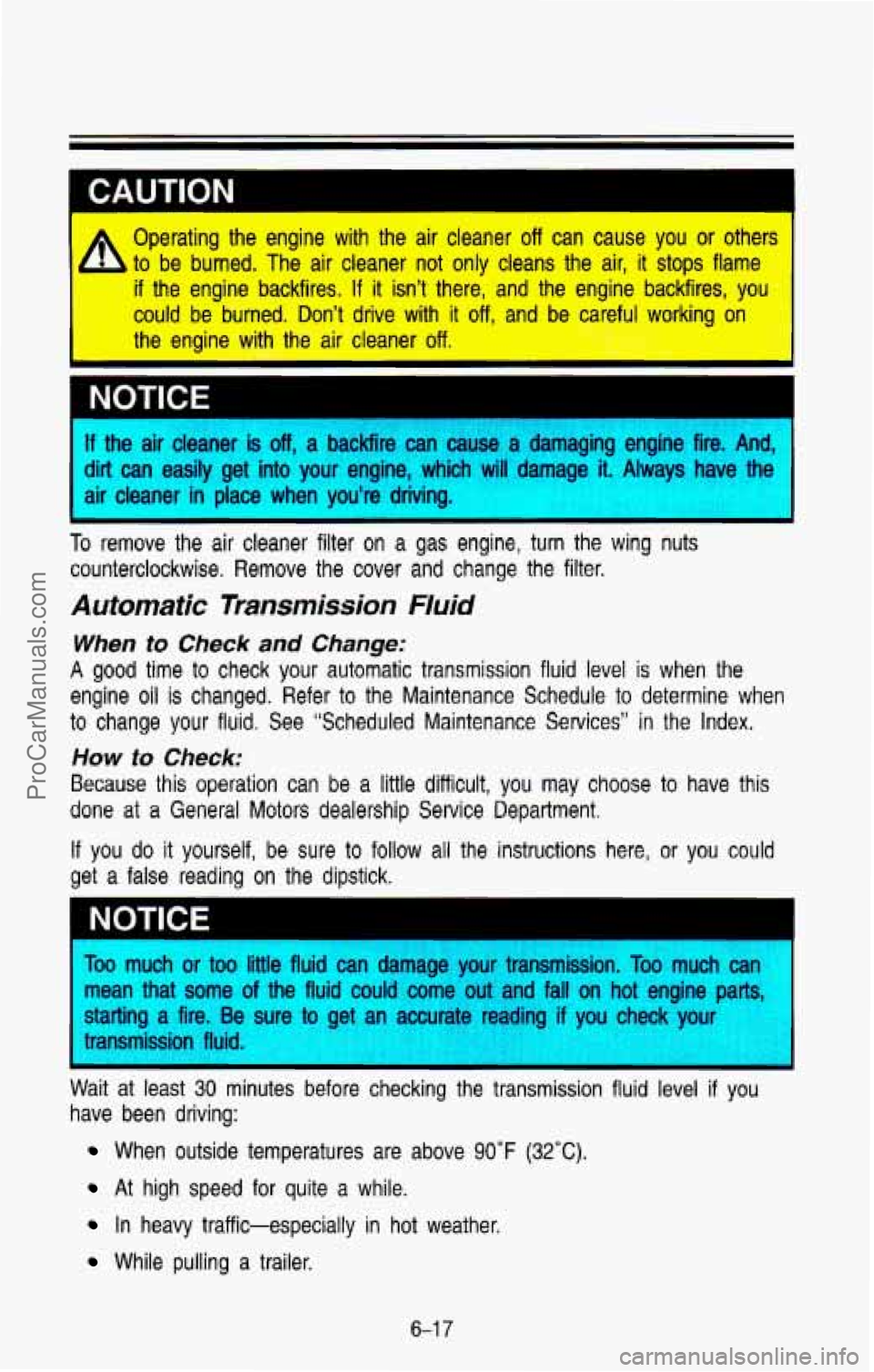
I CAUTION
I 10 Operating the engine with the air cleaner off can cause you or others
to be burned. The air cleaner not only cleans the air, it
stops flame
if the engine backfires.
If it isn’t there, and the engine backfires, y(--
could be burned. Don’t drive with it
off, and be cr-ful working on
the engine with the air cleaner
off.
~
NOTICE I
If the air cleaner is off, a backfire can cause a damaging engine fire. And,
dirt
can easily get into your engine, which will damage it. Always have the
air cleaner
in place when you’re driving.
Ib remove the air cleaner filter on a gas engine, turn the wing nuts
counterclockwise. Remove the cover and change the filter.
-
Automatic Transmission Fluid
When to Check and Change:
A good time to check your automatic transmission fluid level is when the
engine
oil is changed. Refer to the Maintenance Schedule to determine when
to change your fluid. See “Scheduled Maintenance Services” in \
the Index.
How to Check:
Because this operation can be a little difficult, you may choose to have this
done at a General Motors dealership Sewice Department.
If you do it yourself, be sure to follow all the instructions here, or you could
get
a false reading on the dipstick.
NOTICE I
I
Too much or too little fluid can damage your transmission. Too much can
mean that some of the fluid could come out and fail
on hot engine parts,
I
starting a fire. Be sure to get an accurate reading if you check-your
transmission fluid.
Wait at least
30 minutes before checking the transmission fluid level if you
have been driving:
When outside temperatures are above 90°F (32°C).
At high speed for quite a while.
In heavy traffic-especially in hot weather.
While pulling a trailer.
6-1 7
ProCarManuals.com