ECU CHEVROLET SUBURBAN 1994 User Guide
[x] Cancel search | Manufacturer: CHEVROLET, Model Year: 1994, Model line: SUBURBAN, Model: CHEVROLET SUBURBAN 1994Pages: 385, PDF Size: 19.88 MB
Page 134 of 385
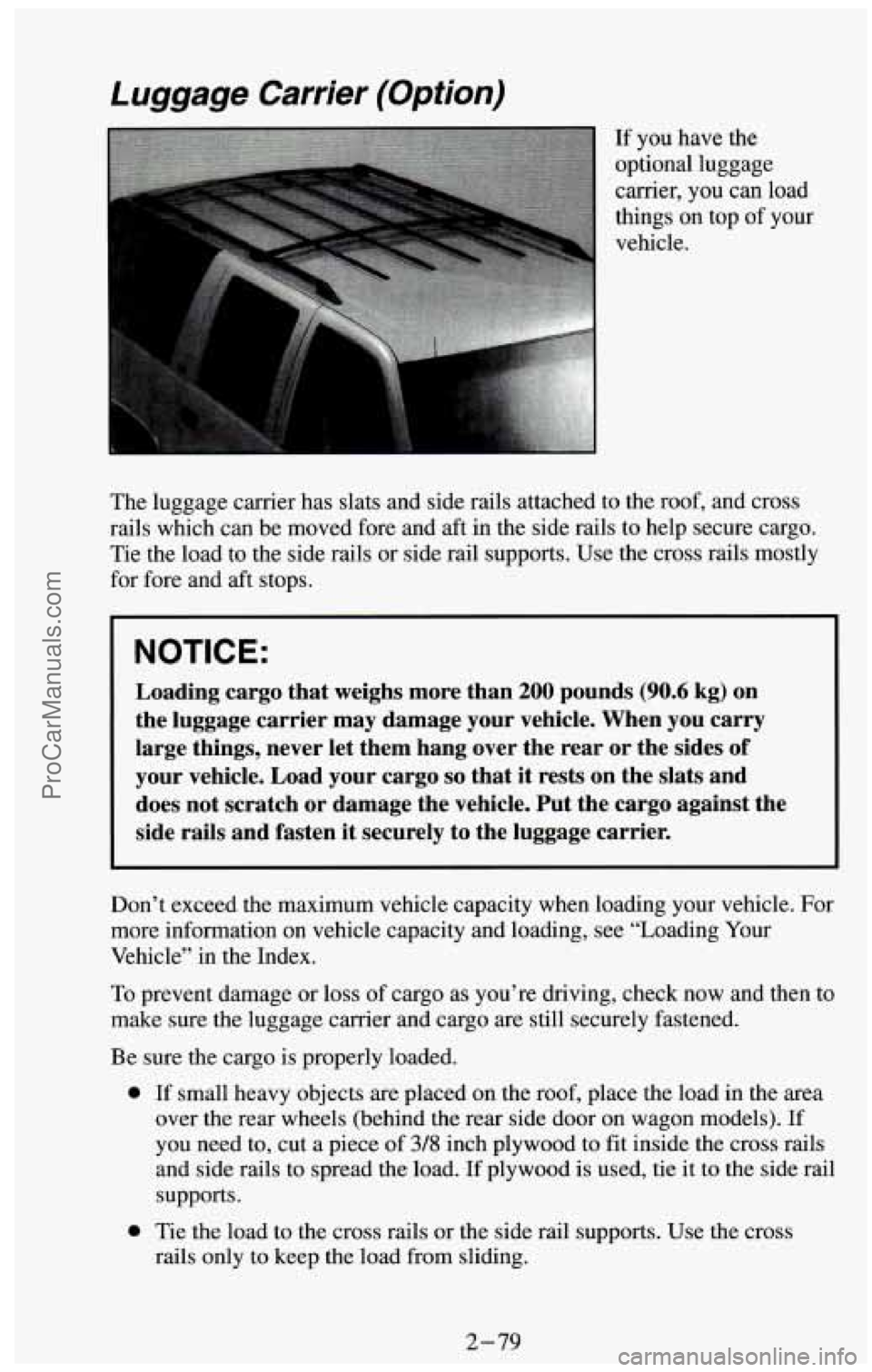
Luggage Carrier (Option)
The luggage carrier has slats and side rails attached to the roof, and cross
rails which can be moved fore and aft in the side rails to help secure cargo.
Tie the load
to the side rails or side rail supports. Use the cross rails mostly
for fore and aft stops.
NOTICE:
Loading cargo that weighs more than 200 pounds (90.6 kg) on
the luggage carrier may damage your vehicle. When you carry
large things, never let them hang over the rear or the sides of
your vehicle. Load your cargo
so that it rests on the slats and
does not scratch or damage the vehicle. Put the cargo against the
side rails and fasten
it securely to the luggage carrier.
Don’t exceed the maximum vehicle capacity when loading your vehicle. For
more information on vehicle capacity and loading, see “Loading Your
Vehicle” in the Index.
To prevent damage or loss of cargo as you’re driving, check now and then to
make sure the luggage carrier and cargo are still securely fastened.
Be sure the cargo is properly loaded.
0 If small heavy objects are placed on the roof, place the load in the area
over the rear wheels (behind the rear side door
on wagon models). If
you need to, cut a piece of 3/8 inch plywood to fit inside the cross rails
and side rails to spread the load.
If plywood is used, tie it to the side rail
supports.
0 Tie the load to the cross rails or the side rail supports. Use the cross
rails only
to keep the load from sliding.
2-79
ProCarManuals.com
Page 135 of 385
If you need to carry long items, move the cross rails as far apart as they
will go. Tie the load to the cross rails and the side rails or side rail
supports. Also tie
the load to the bumpers. Do not tie the load so tightly
that the cross rails or side rails are damaged.
After moving the cross rails, be sure to tighten all the slider screws.
Trailer Wiring Harness (Option)
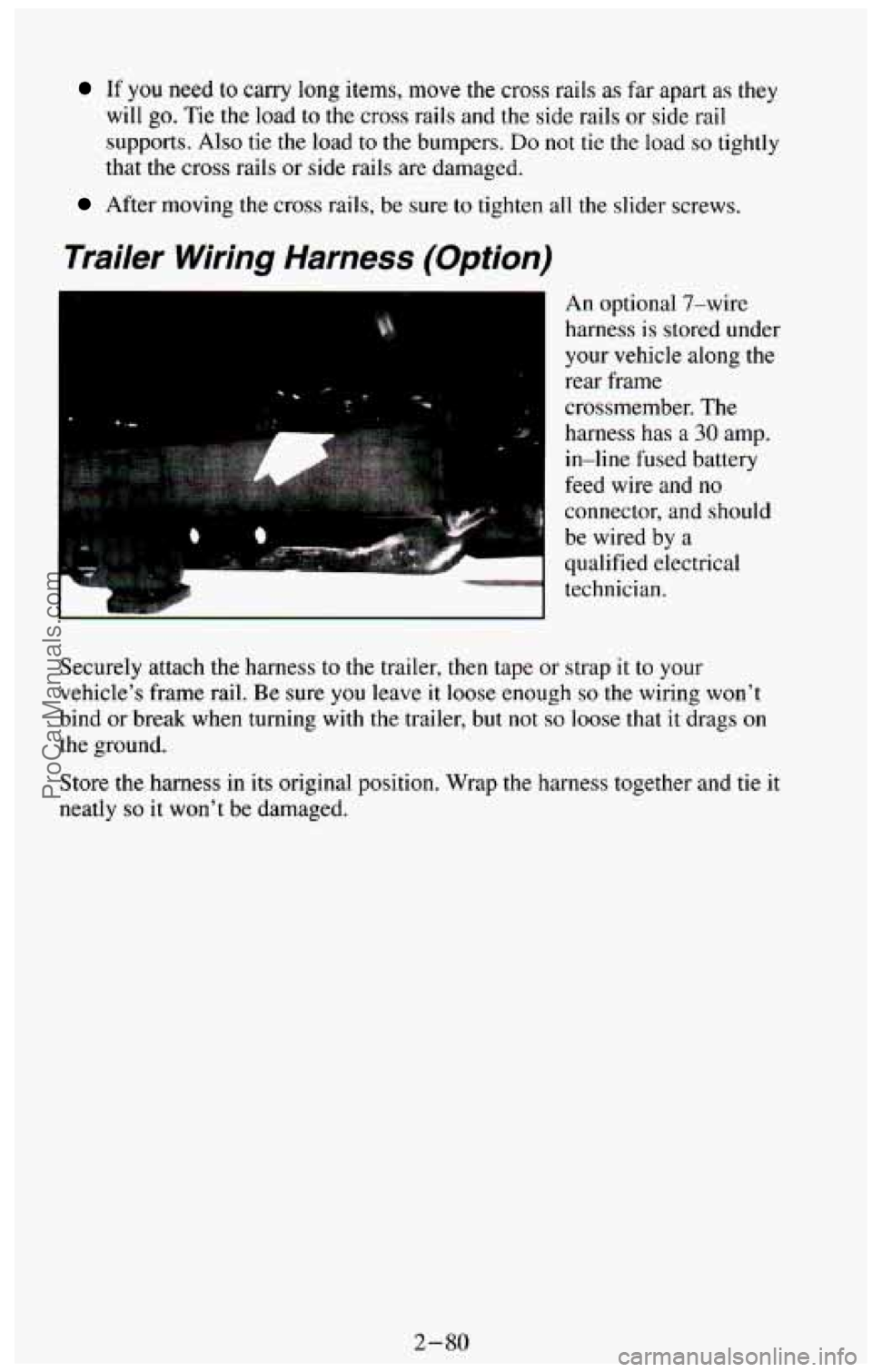
An optional 7-wire
harness
is stored under
your vehicle along the
rear frame
crossmember. The
harness has a
30 amp.
in-line fused battery
feed wire and no
connector, and should
be wired by a
qualified electrical
technician.
Securely attach the harness
to the trailer, then tape or strap it to your
vehicle’s frame rail. Be sure
you leave it loose enough so the wiring won‘t
bind or break when turning with the trailer, but
not so loose that it drags on
the ground.
Store the harness in its original position. Wrap the harness together and tie it
neatly so it won’t be damaged.
2-80
ProCarManuals.com
Page 171 of 385
Off-Road Driving with Your
Four- Wheel Drive Vehicle
This off-road guide is for vehicles that have four-wheel drive.
Also, see “Anti-lock Brakes”
in the Index.
If your vehicle doesn’t have four-wheel drive, you shouldn’t drive off-road
unless you’re
on a level, solid surface.
Off-road driving
can be great fun. But it does have some definite hazards.
The greatest of these is the terrain itself.
“Off-roading” means you’ve left the great North American road system
behind. Traffic lanes aren’t marked. Curves aren’t banked. There are no
road signs. Surfaces can be slippery, rough, uphill or downhill. In short,
you’ve gone right back
to nature.
Off-road driving involves some new skills. And that’s
why it’s very
important that you read this guide. You’ll find many driving tips and
suggestions. These will help make your off-road driving safer and more
enjoyable.
Before You Go Off-Roading
There are some things to do before you go out. For example, be sure to have
all necessary maintenance and service work done. Be sure you read
all the
information about your four-wheel drive vehicle
in this manual. Is there
enough fuel?
Is the spare tire fully inflated? Are the fluid levels up where
they should be? What are the local laws that apply to off-roading where
you’ll be driving? If you don’t know, you should check
with law
enforcement people in the area. Will you be on someone’s private land? If
so, be sure to get the necessary permission.
Loading Your Vehicle for Off-Road Driving
There are some important things to remember about how to load your
vehicle.
The heaviest things should be on the load floor and forward of your
Be sure the load is secured properly, so driving on the off-road terrain
rear axle.
Put heavier items as far forward as you can.
doesn’t toss things around.
4-12
ProCarManuals.com
Page 190 of 385
Winter Driving
Here are some tips for winter driving:
0 Have your vehicle in good shape for winter. Be sure your engine
coolant
mix is correct.
0 You may want to put winter emergency supplies in your vehicle.
Include an ice scraper, a small brush or broom, a supply
of windshield
washer fluid, a rag, some winter outer clothing, a small shovel, a flashlight,
a red cloth, and a couple
of reflective warning triangles. And, if you will be
driving under severe conditions, include a small bag of sand, a piece
of old
carpet or a couple of burlap bags to help provide traction. Be sure you
properly secure these items in your vehicle.
Driving on Snow or Ice
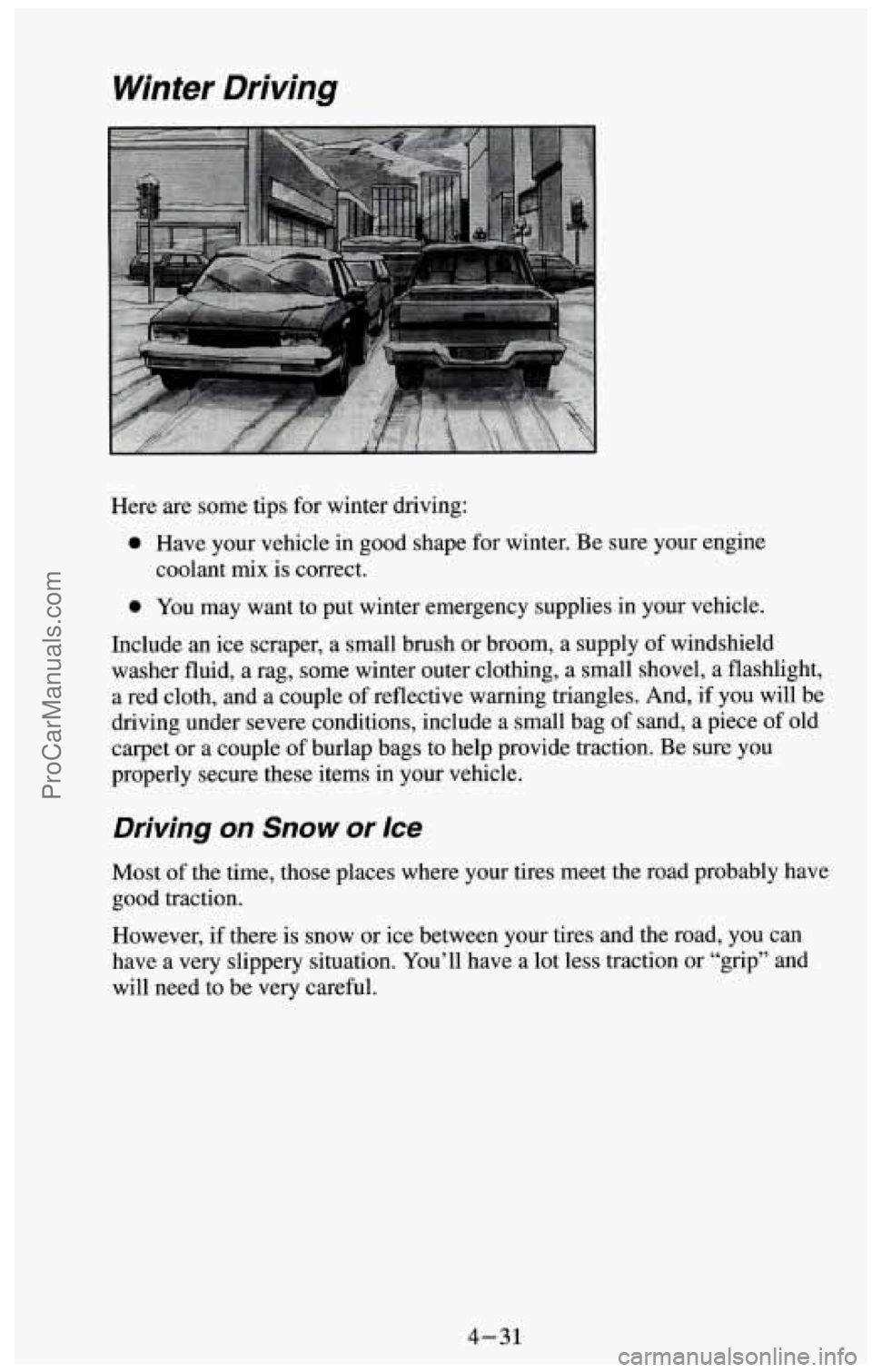
Most of the time, those places where your tires meet the road probably have
good traction.
However, if there is snow or ice between your tires and the road, you can
have a very slippery situation. You’ll have a lot less traction or “grip” and
will need
to be very careful.
4-31
ProCarManuals.com
Page 200 of 385
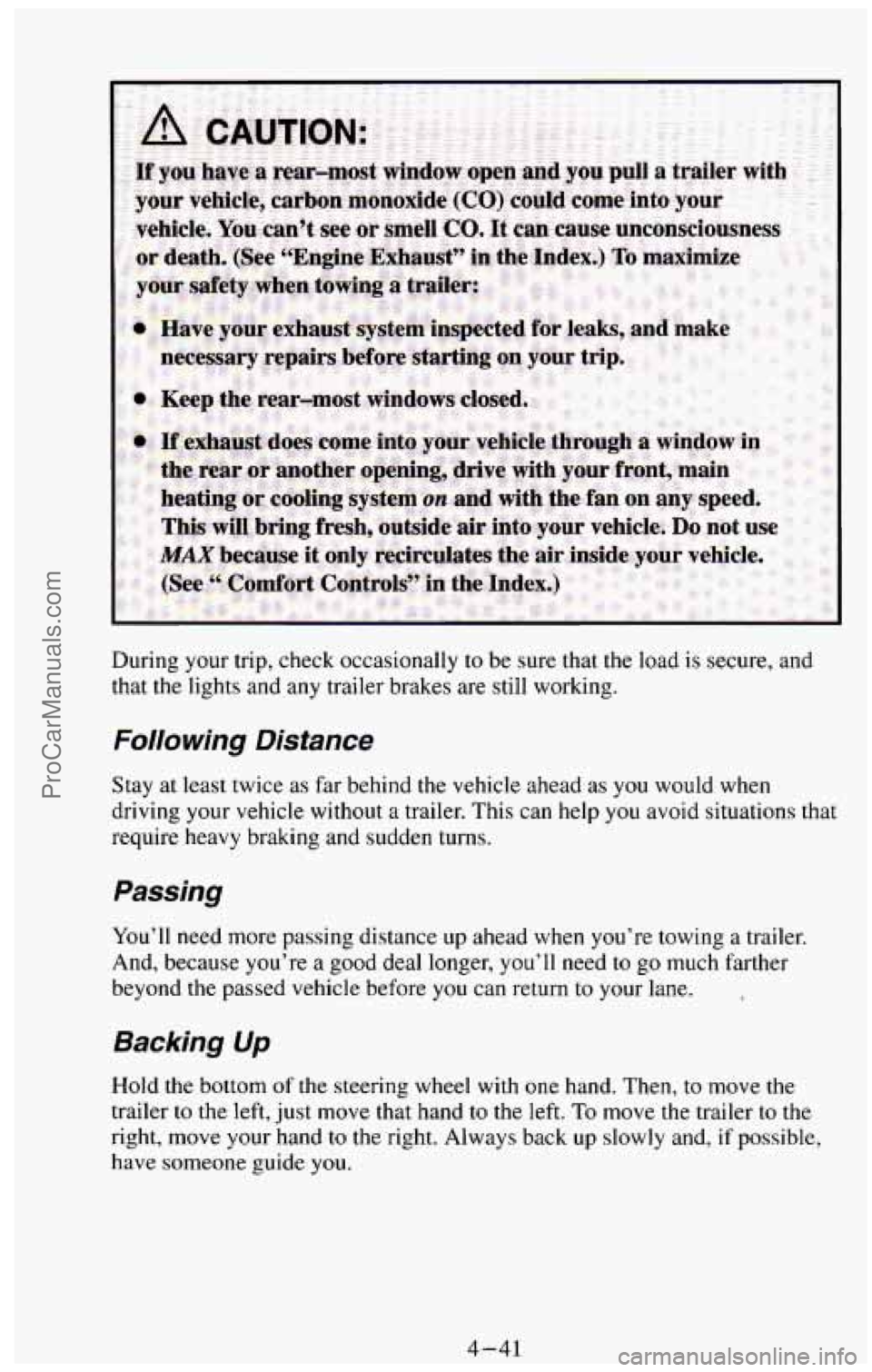
During your trip, check occasionally to be sure that the load is secure, and
that the lights and any trailer brakes are still working.
Following Distance
Stay at least twice as far behind the vehicle ahead as you would when
driving your
vehicle without a trailer. This can help you avoid situations that
require heavy braking and sudden turns.
Passing
You’ll need more passing distance up ahead when you’re towing a trailer.
And, because you’re a good deal longer, you’ll need
to go much farther
beyond the passed vehicle
before you can return to your lane.
Backing Up
Hold the bottom of the steering wheel with one hand. Then, to move the
trailer to
the left, just move that hand to the left. To move the trailer to the
right, move your hand to the right. Always back up slowly and,
if possible,
have someone guide you.
4-41 ProCarManuals.com
Page 230 of 385
e
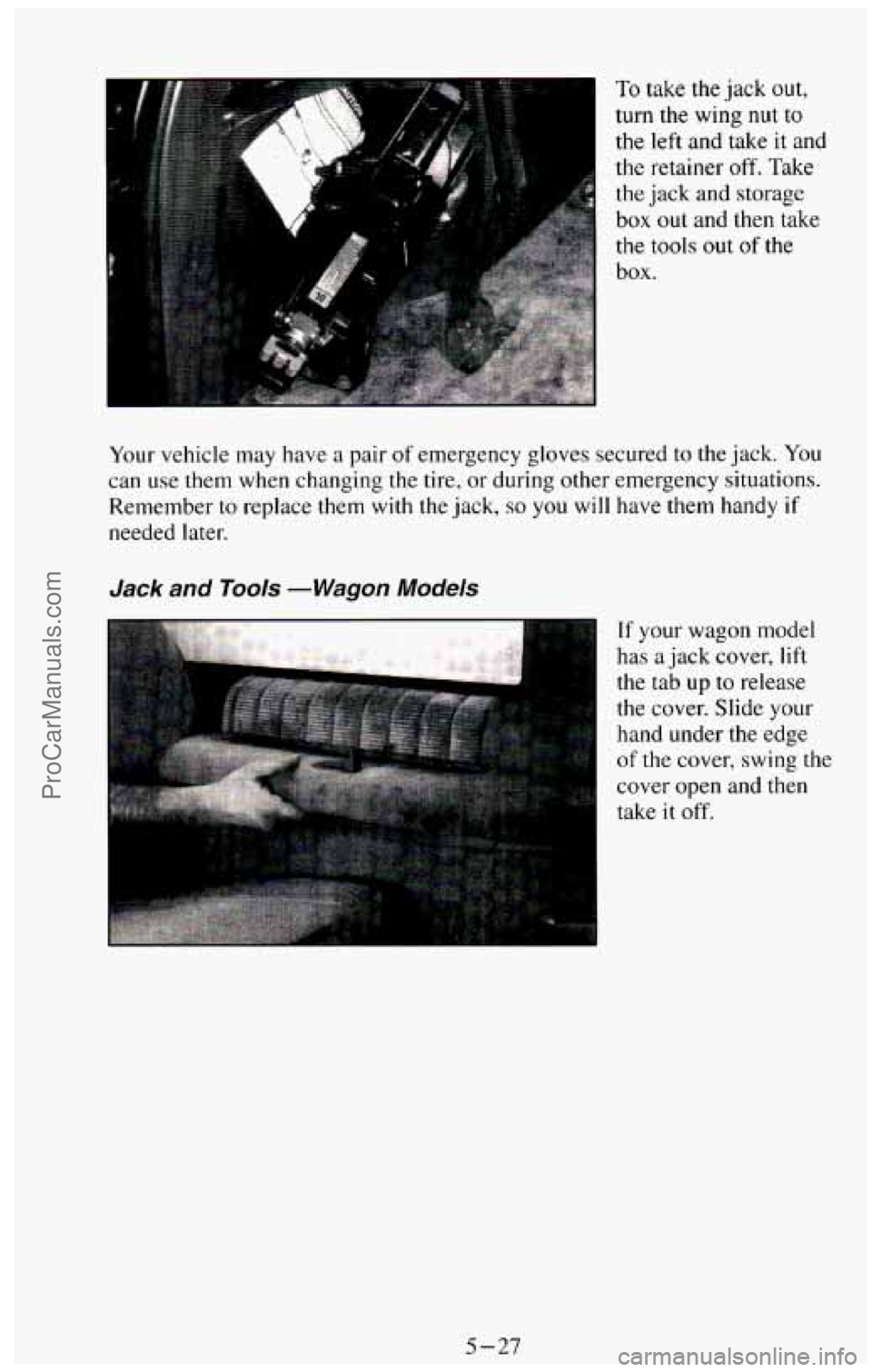
To take the jack out,
turn the wing
nut to
the left and take it and
the retainer
off. Take
the jack and storage
box
out and then take
the
tools out of the
box.
Your vehicle may have
a pair of emergency gloves secured to the jack. You
can use them when changing the tire, or during other emergency situations.
Remember to replace them
with the jack, so you will have them handy if
needed later.
Jack and Tools -Wagon Models
If your wagon model
has a jack cover,
lift
the tab up to release
the cover. Slide your
hand under the edge
of the cover, swing the
cover open
and then
take
it off.
5-27
ProCarManuals.com
Page 231 of 385
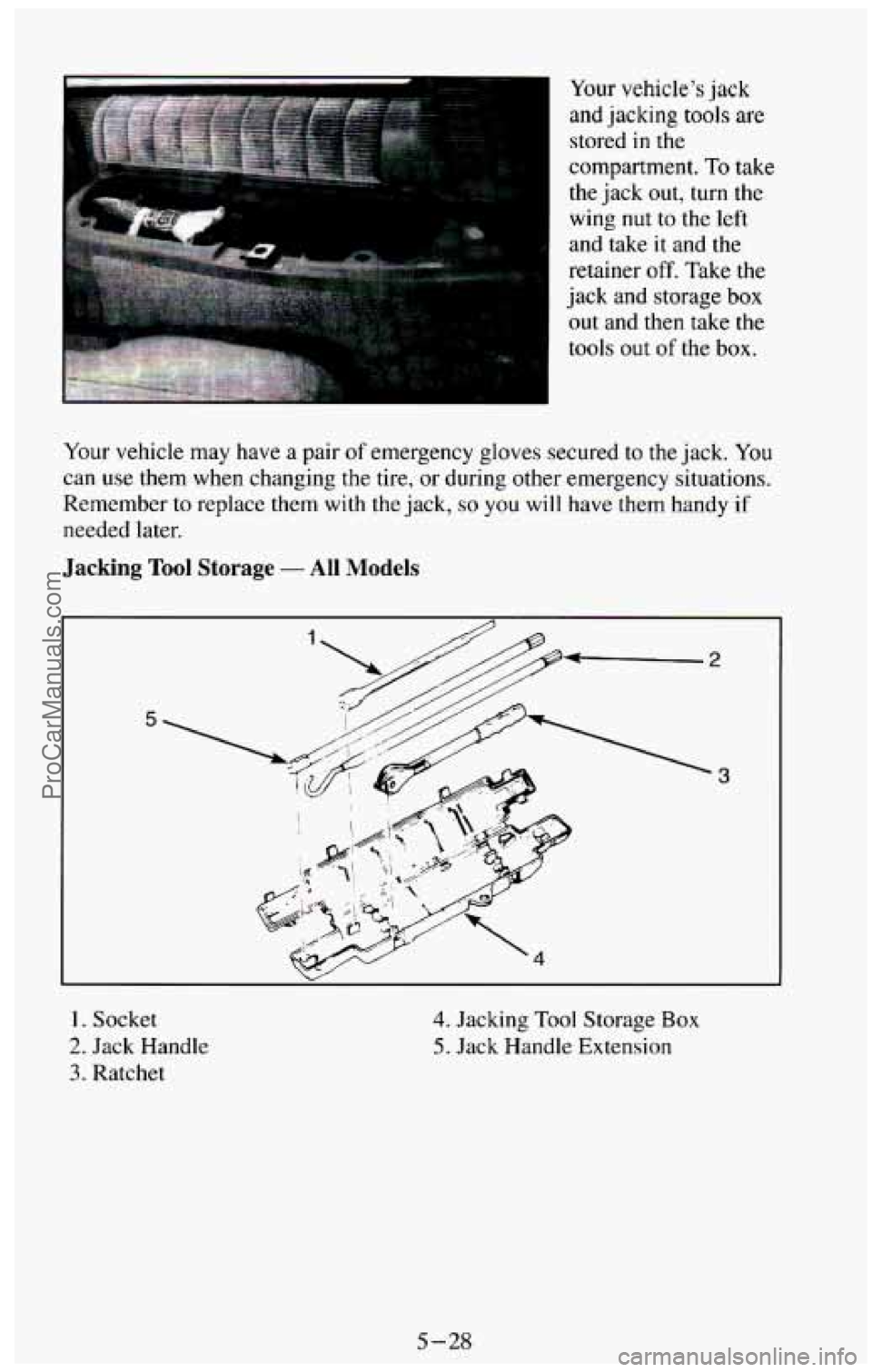
.... .. . . .. ...... . ... .. Your vehicle’s jack
and
jacking tools are
stored in the
compartment.
To take
the jack out,
turn the
wing nut to the left
and take it and the
retainer
off. Take the
jack and storage
box
out and then take the
tools out
of the box.
Your vehicle may have a pair
of emergency gloves secured to the jack. You
can
use them when changing the tire, or during other emergency situations.
Remember to replace them with the jack,
so you will have them handy if
needed later.
Jacking Tool Storage - All Models
1. Socket
2. Jack Handle
3. Ratchet
4. Jacking Tool Storage Box
5. Jack Handle Extension
5-28
ProCarManuals.com
Page 232 of 385
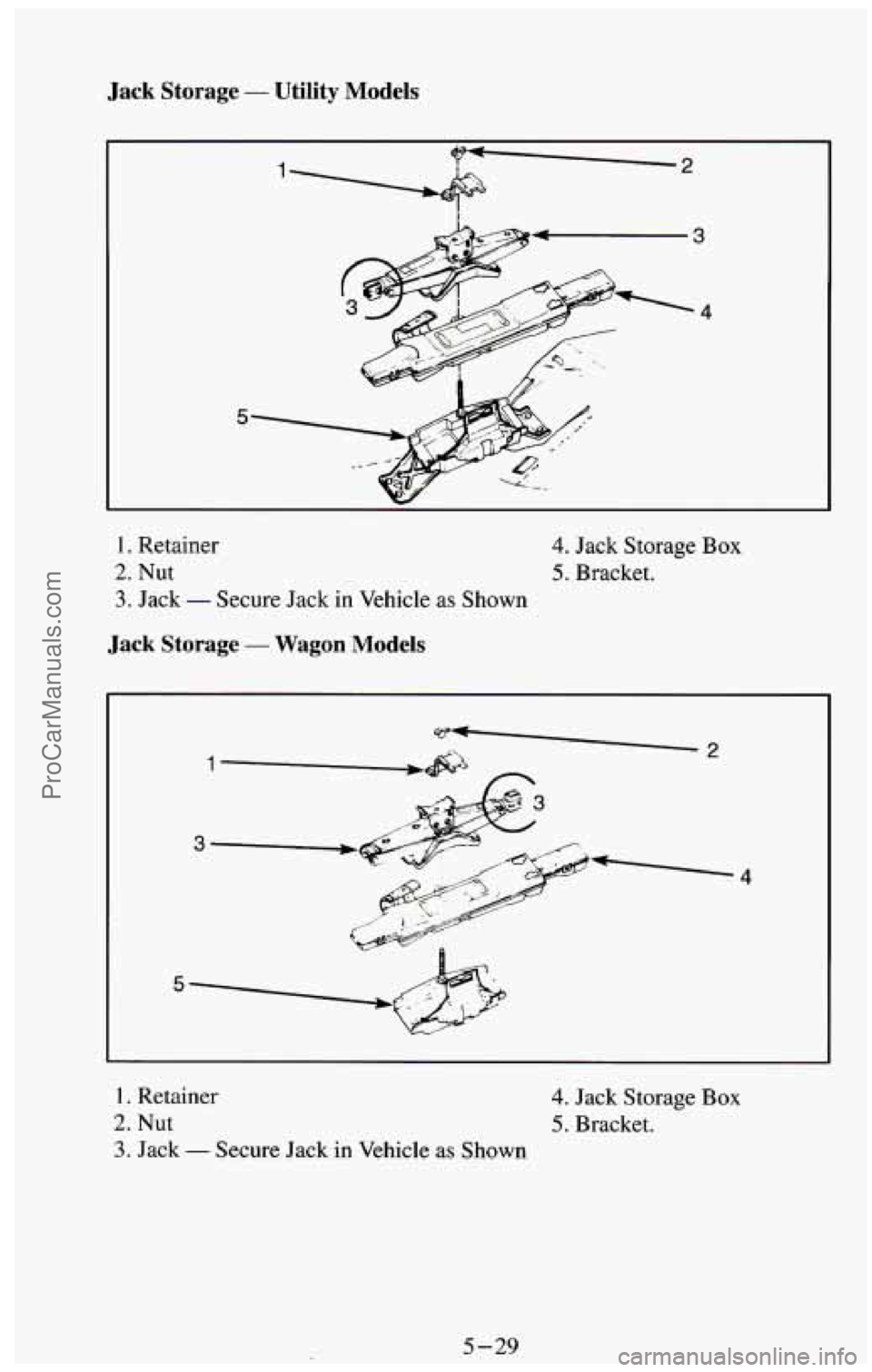
Jack Storage - Utility Models
-3
4
5
1. Retainer
2. Nut
3. Jack - Secure Jack in Vehicle as Shown
Jack Storage - Wagon Models
4. Jack Stbrage Box
5. Bracket.
1. Retainer
2. Nut
3. Jack - Secure Jack in Vehicle as Shown
4. Jack Storage Box
5. Bracket.
5-29
ProCarManuals.com
Page 240 of 385
Storing the Jack and Tire
Storing the Jack
Put the tools into the storage box and close it tightly. Fit the storage box into
the bracket with the bolt through the box. Put the jack onto the box. Be sure
the jack points in the right direction as shown for your model. See the jack
and jack tools storage diagrams earlier in this section. Secure the emergency
gloves,
if your vehicle has them, to the jack using the provided strap.
Slide the retainer over the bolt onto the jack and put the wing nut on. Turn
the nut to the right until it is tight against the retainer.
Replace the jack storage cover, if your vehicle has one, by simply reversing
the removal procedure described earlier.
5-37
ProCarManuals.com
Page 292 of 385
Wheel Nut Torque
For vehicles with dual wheels, when the vehicle, wheel or fasteners are new,
have the torque set at
the first 100, 1,000 and 6,000 miles (160, 1600 and
9600 km). Use the torque specified in the appropriate Specification Chart
later
in this section.
Single Belt Accessory Drive
If your new vehicle uses a serpentine belt, it is lighter, and more durable
than systems with several belts.
The belt
ruIl 'li'vkf br iir6und the pulleys or^ the engine. A tensione'r'n'iay be
used to keep the belt tight at all times. The tensioner also makes replacing
the belt easier
if you need to replace the belt, be sure to get the correct
replacement belt. Your dealership
or parts supplier can help you with this.
The Accessory Drive Belt Routing label on your vehicle will show you how
to route the belt your vehicle uses.
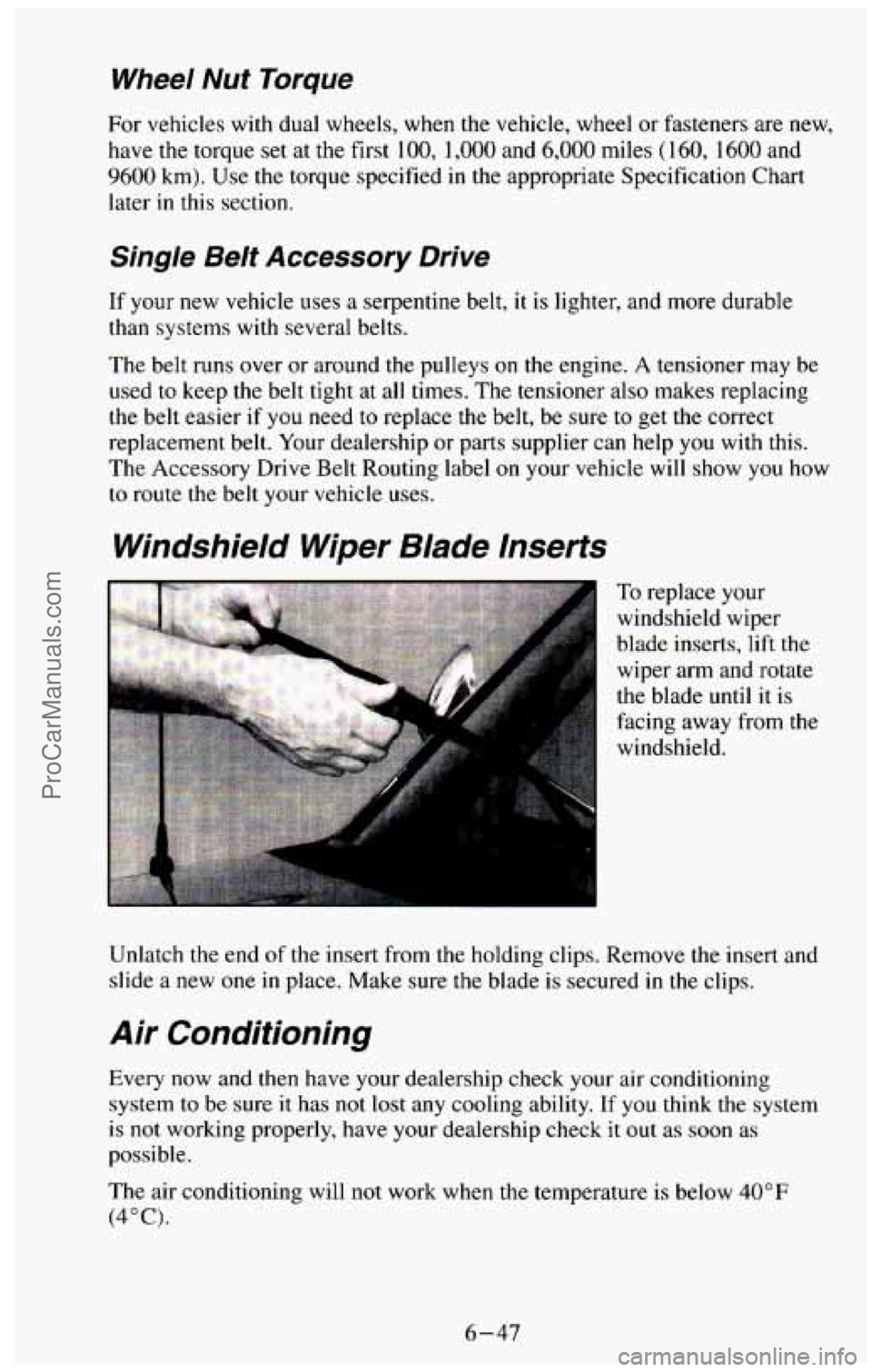
Windshield Wiper Blade lnserts
To replace your
windshield wiper
blade inserts, lift the
wiper arm and rotate
the blade until
it is
facing
away from the
windshield.
Unlatch the end
of the insert from the holding clips. Remove the insert and
slide
a new one in place. Make sure the blade is secured in the clips.
Air Conditioning
Every now and then have your dealership check your air conditioning
system to be sure
it has not lost any cooling ability. If you think the system
is not working properly, have your dealership check it out as soon as
possible.
The air conditioning will not work when the temperature
is below 40°F
(4°C).
6-47
ProCarManuals.com