Oil CHEVROLET SUBURBAN 1994 User Guide
[x] Cancel search | Manufacturer: CHEVROLET, Model Year: 1994, Model line: SUBURBAN, Model: CHEVROLET SUBURBAN 1994Pages: 385, PDF Size: 19.88 MB
Page 222 of 385
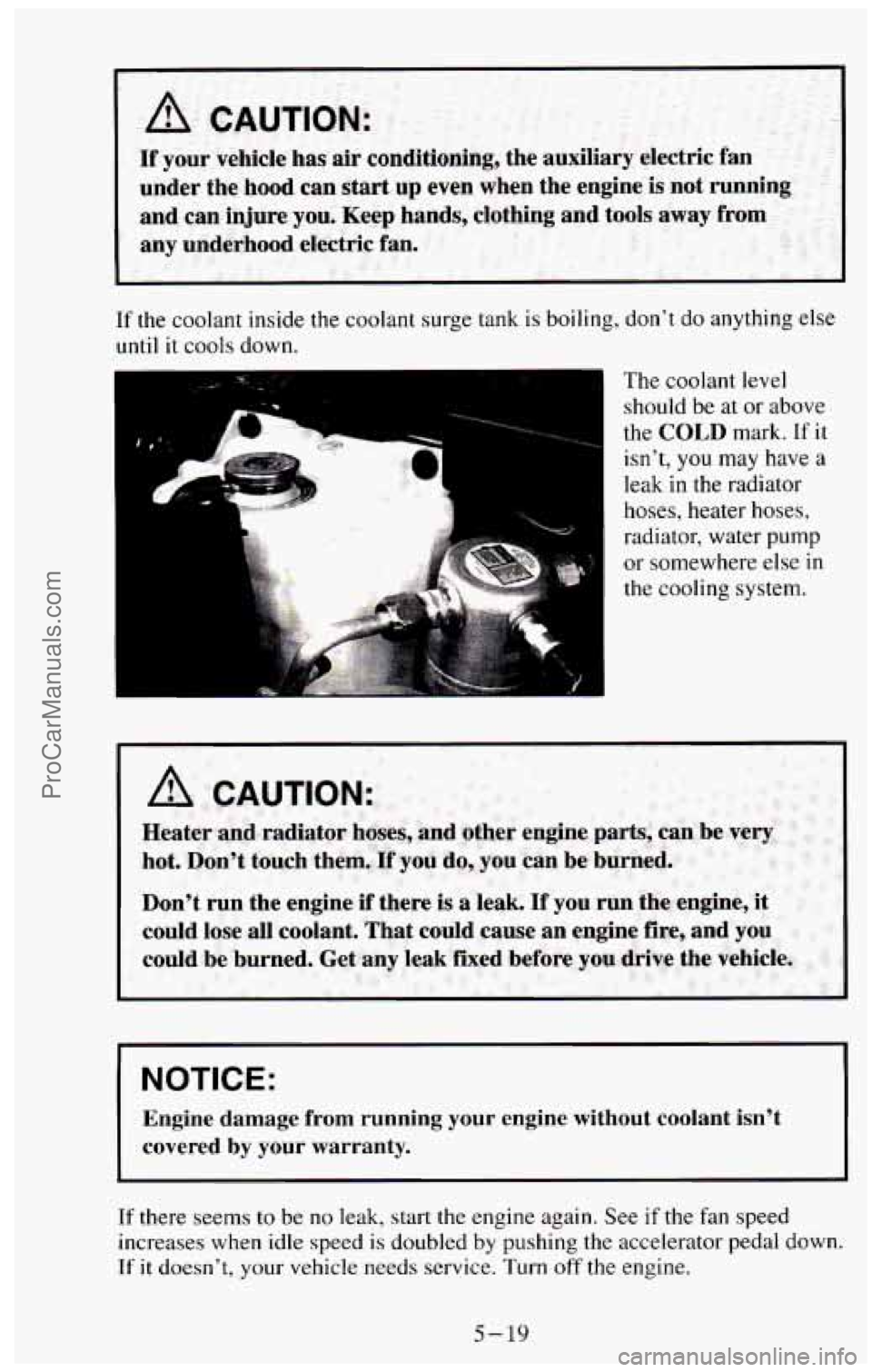
If the coolant inside the coolant surge tank is boiling, don't do anything else
until it cools down.
The coolant level
should be at
or above
the
COLD mark. If it
isn't, you may have
a
leak in the radiator
hoses, heater hoses,
radiator, water
pump
or somewhere else in
the cooling system.
NOTICE:
Engine damage from running your engine without coolant isn't
covered by your warranty.
If there seems to be no leak, start the engifie again. See if the fan speed
increases when idle speed
is doubled by pushing the accelerator pedal down
If
it doesn't, your vehicle needs service. Turn off the engine.
5-19
ProCarManuals.com
Page 246 of 385
Service & Appearance
I Section
Here you will find information about the care of your vehicle . This section
begins with service and fuel information. and then it shows how to check
important fluid and lubricant levels
. There is also technical information
about your vehicle. and a section devoted to its appearance care
.
Service ................................................... 6-3
Fuel (Gasoline Engines)
............................
Diesel Fuel Requirements and Fuel System ..........
Checking Things Under the Hood ........... .....
........ 6-4
.......... 6-5
......... 6-14
HoodRelease
.......................................... 6-14
Cleaning Your Diesel Engine
............................ 6-15
Engine Oil (Except Diesel)
................................ 6-16
Engine Oil (Diesel Engines)
............................... 6-22
Aircleaner
.................... .................. 6-27 ..
Automatic Transmission Fluid ............................. 6-28
Manual Transmission Fluid
............................... 6-31
Hydraulic Clutch
........................................ 6-32
RearAxle
............................................. 6-33
Transfer Case
.......................................... 6-34
FrontAxle
........................................... 6-35
Engine Coolant
......................................... 6-35
Power Steering Fluid
.............. .................. 640
Windshield Washer Fluid
............................... 6-42
6-1
ProCarManuals.com
Page 250 of 385
Gasolines for Cleaner Air
Your use of gasoline with deposit control additives will help prevent
deposits from forming
in your engine and fuel system. That helps keep your
engine in tune and your emission control system working properly. It’s good
for your vehicle, and you’ll be doing your part for cleaner air.
Many gasolines are now blended with oxygenates. General Motors
recommends that you use gasolines with these blending materials, such as
MTBE and ethanol. By doing
so, you can help clean the air, especially in
those parts of the country that have high carbon monoxide levels.
In addition, some gasoline suppliers are now producing reformulated
gasolines. These gasolines are specially designed to reduce vehicle
emissions. General Motors recommends that you use reformulated gasoline.
By doing
so, you can help clean the air, especially in those parts of the
country that have high ozone levels.
You should ask your service station operators if their gasolines contain
deposit control additives and oxygenates, and
if they have been
reformulated to reduce vehicle emissions.
Diesel Fuel Requirements and Fuel System
Some states and provinces have restrictions on the purchase of diesel fuel
for light-duty vehicles and require you to
buy permits or pay special taxes.
Some of these restrictions apply only to residents, and others apply to both
residents and visitors. These restrictions can change.
To learn the current
restrictions
in any state or province, contact your auto club, the police or
other officials.
Fuel Requirements
NOTICE:
Diesel fuel or fuel additives not recommended in this manual
could damage your fuel system and engine, Your warranty
wouldn’t cover this damage, And:
0 Diesel fuel that has been mixed with engine oil could damage
your engine and emission controls. Always check with your
service station operator to make sure his diesel fuel has not
been mixed with engine oil.
If you ever run out of diesel fuel, it can be difficult to restart
your engine. “Running Out of Fuel,” later in this section,
tells
you how to get it started again. To avoid all this, try never to
let your tank get empty.
6-5
ProCarManuals.com
Page 251 of 385
What Fuel to Use
You can use either Number 1-D or Number 2-D diesel fuel, but you’ll get
better fuel economy using
2-D.
Diesel fuel may foam when you fill your tank. This can cause the automatic
pump nozzle to shut
off, even though your tank isn’t full. If this happens,
just wait
for the foaming to stop and then continue to fill your tank.
Cold Weather Operation
In cold weather (below 20”F, or -7”C), use 1-D or “Winterized” Number
2-D fuel (a blend of 1-D and 2-D). Be sure you get the right fuel. In very
cold temperatures (when it stays below
0°F or -18”C), use Number 1-D.
If you’re driving in very cold temperatures and can’t get Number 1-D or a
“winterized” Number
2-D, you can use one gallon of kerosene for every
two gallons of diesel fuel. Once you add the kerosene, run your engine for
several minutes
so the fuels will mix. Add kerosene only when the
temperature falls below
0°F (-1 8 “C), because the fuel economy of kerosene
isn’t as good
as that of diesel fuel.
NOTICE:
Never use home heating oil or gasoline in your diesel engine.
They can cause engine damage.
In cold weather, your fuel filter may become clogged, especially if you use
Number 2-D diesel fuel that hasn’t been “winterized.” To unclog it, warm
the filter to between
32°F and 50°F (0°C to 10°C). You won’t need to
replace it.
6-6
ProCarManuals.com
Page 253 of 385
To drain water:
1. Stop and park the vehicle in a safe place. Turn off the engine and apply
2. Remove the fuel tank cap.
the parking brake.
3. Place a
fuel-resistant container under the filter
drain hose.
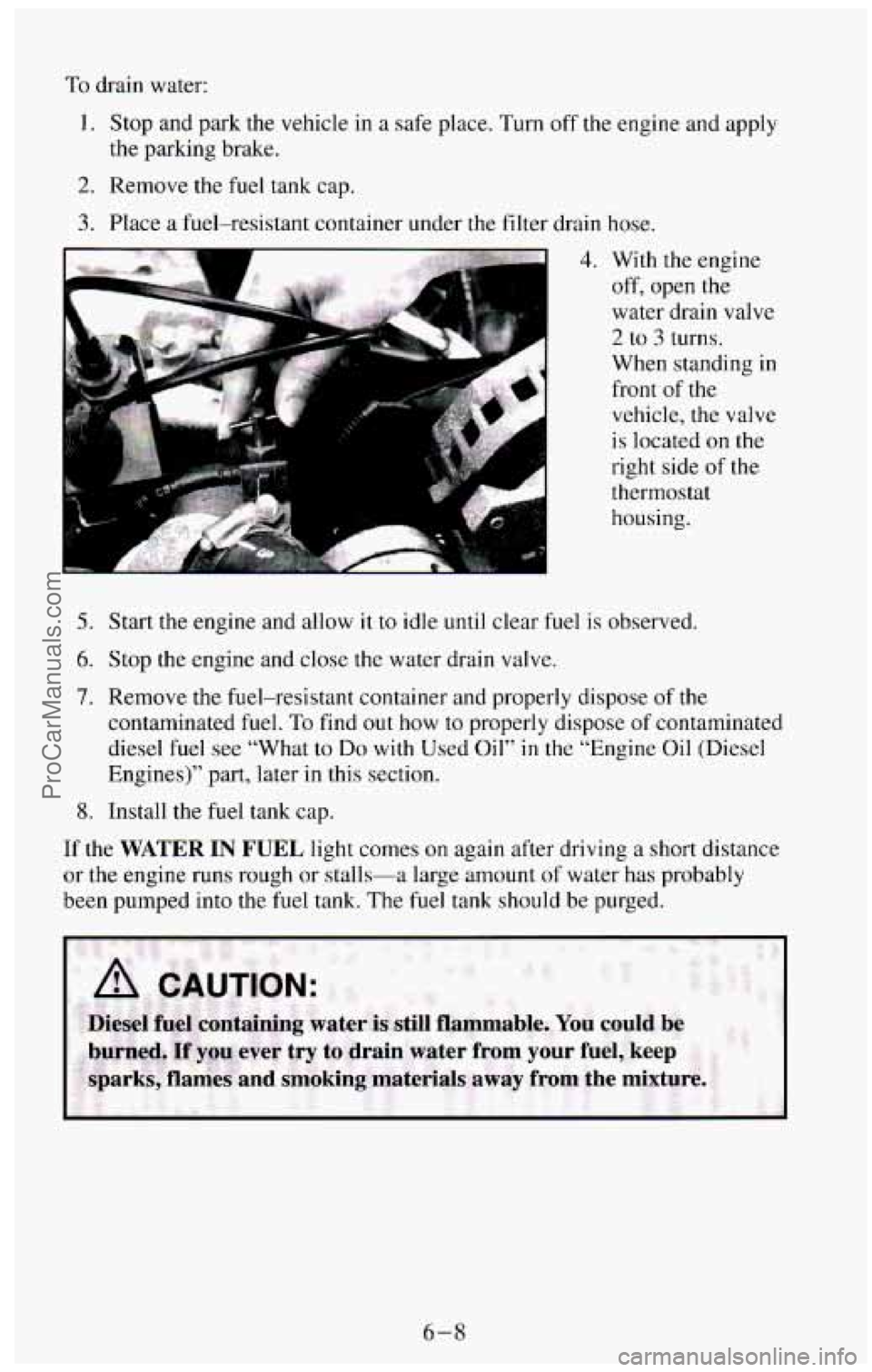
4. With the engine
off, open the
water drain valve
2 to 3 turns.
When standing in
front of the
vehicle,
the valve
is located
on the
right side
of the
thermostat housing.
5. Start the engine and allow it to idle until clear fuel is observed.
6. Stop the engine and close the water drain valve.
7. Remove the fuel-resistant container and properly dispose of the
contaminated fuel. To find out how
to properly dispose of contaminated
diesel
fuel see “What to Do with Used Oil” in the “Engine Oil (Diesel
Engines)” part, later in
this section.
8. Install the fuel tank cap.
If the
WATER IN FUEL light comes on again after driving a short distance
or the engine
runs rough or stalls-a large amount of water has probably
been pumped into the fuel tank. The fuel tank should be purged.
6-8
ProCarManuals.com
Page 257 of 385
Fuels in Foreign Countries
If you plan on driving in another country outside the U.S. or Canada,
unleaded fuel may be hard to find.
Do not use leaded gasoline. If you use
even one tankful, your emission controls won’t work well or at all. With
continuous use, spark plugs can get fouled, the exhaust system can corrode,
and your engine oil can deteriorate
quickly. Your vehicle’s oxygen sensor
will be damaged. All of that means costly repairs that wouldn’t be covered
by your warranty.
To check on fuel availability, ask an auto club, or contact a major oil
company that does business
in the country where you’ll be driving.
You
can also write us at the following address for advice. Just tell us where
you’re going and give
your Vehicle Identification Number (VIN).
General Motors Overseas Distribution Corporation,
North American Export Sales
(NAES)
1908 Colonel Sam Drive
Oshawa, Ontario
LlH 8P7
Filling Your Tank
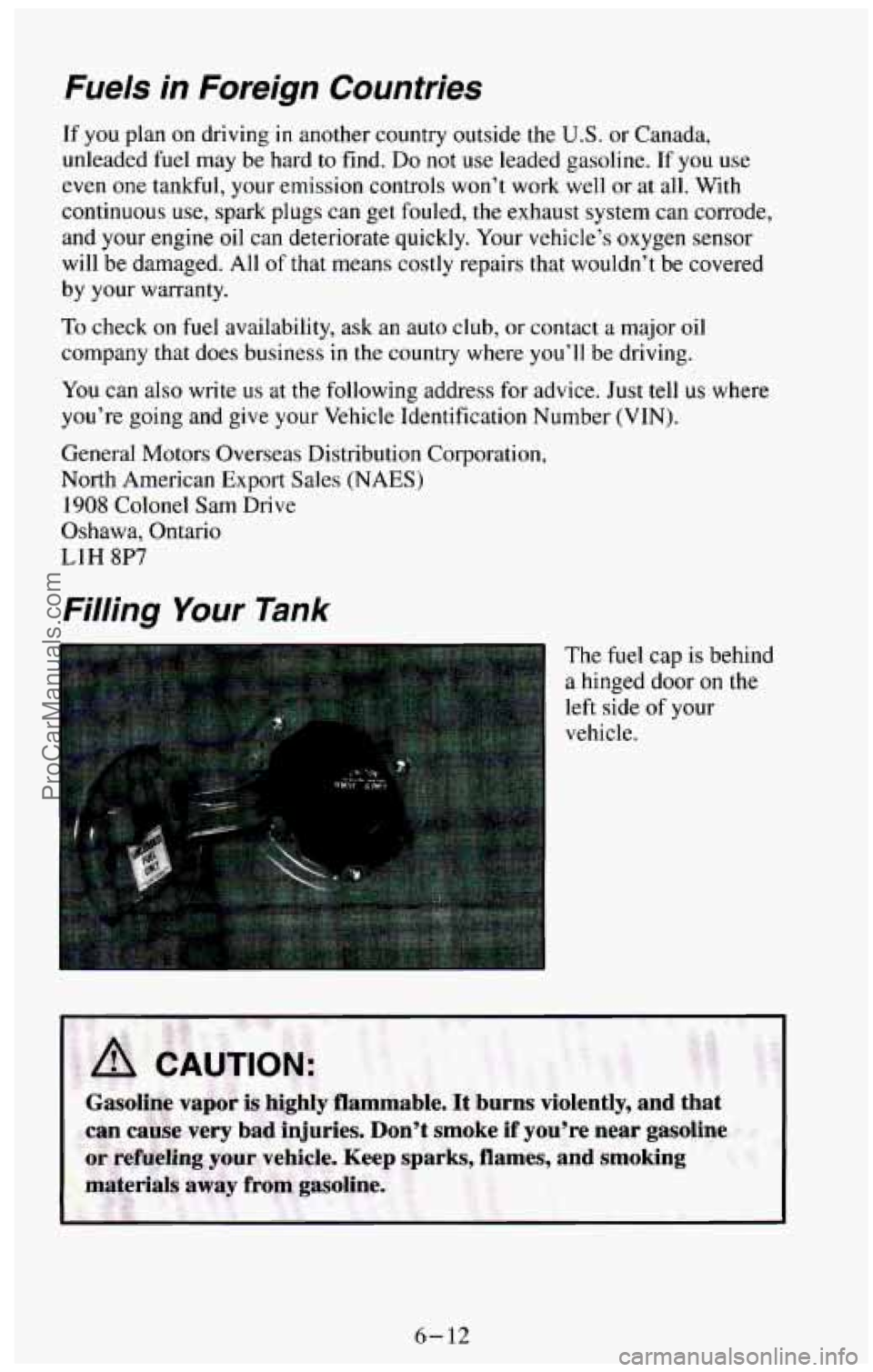
The fuel cap is behind
a hinged door on the
left side of your
vehicle.
6-12
ProCarManuals.com
Page 261 of 385
Engine Oil (Except Diesel)
It's a good idea to check your engine oil every time you get fuel. In order to
get an accurate reading, the oil must be warm and the vehicle must be on
level ground.
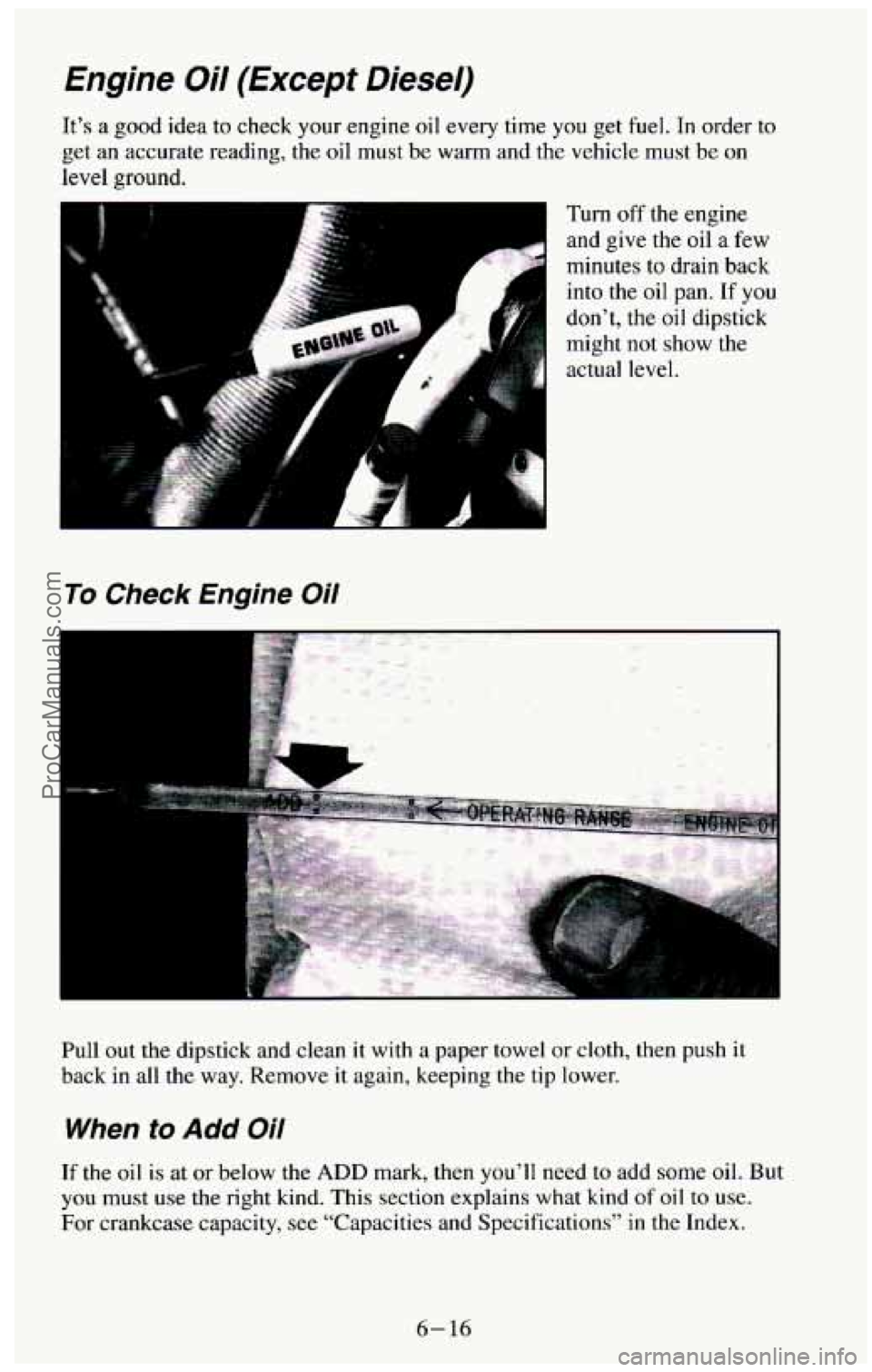
Turn
off the engine
and give the oil a few
minutes to drain
back r"' ' '
1 into the oil pan. If you
don't, the oil dipstick
might not show the
actual level.
To Check Engine Oil
I
Pull out the dipstick and clean it with a paper towel or cloth, then push it
back in all the way. Remove it again, keeping the tip lower.
When to Add Oil
If the oil is at or below the ADD mark, then you'll need to add some oil. But
you must use the right kind. This section explains what kind of oil to use.
For crankcase capacity,
see "Capacities and Specifications" in the Index.
6-16
ProCarManuals.com
Page 262 of 385
NOTICE:
Don’t add too much oil. If your engine has so much oil that the
oil level gets above the upper mark that shows the proper
operating range, your engine could be damaged.
P
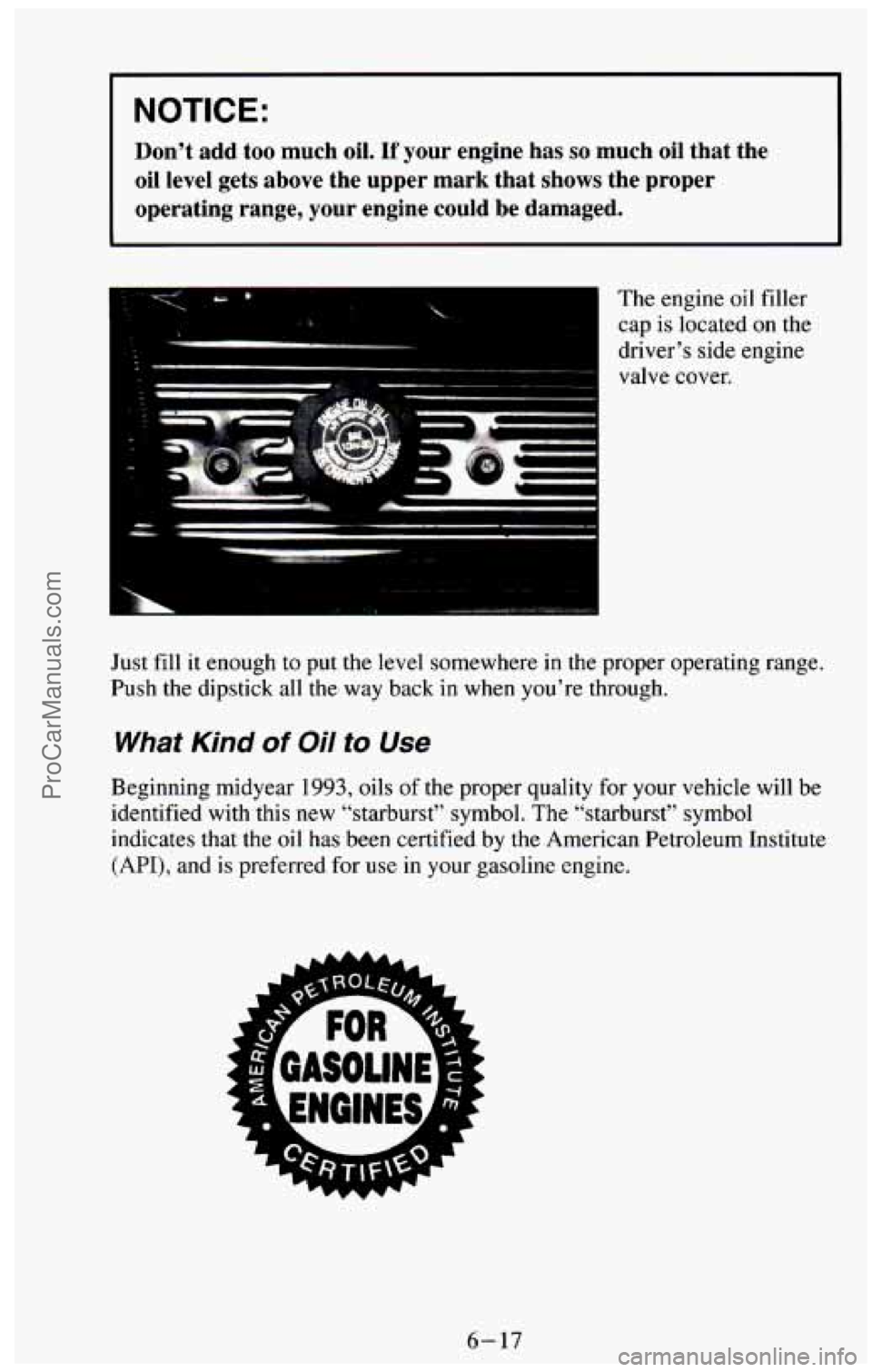
The engine oil filler
cap is located on the
driver’s side engine
valve cover.
Just fill it enough to put the level somewhere in the proper operating range.
Push the dipstick all the way back in when you’re through.
What Kind of Oil to Use
Beginning midyear 1993, oils of the proper quality for your vehicle will be
identified
with this new “starburst” symbol. The “starburst” symbol
indicates that the
oil has been certified by the American Petroleum Institute
(API), and is preferred for use in your gasoline engine.
6-17
ProCarManuals.com
Page 263 of 385
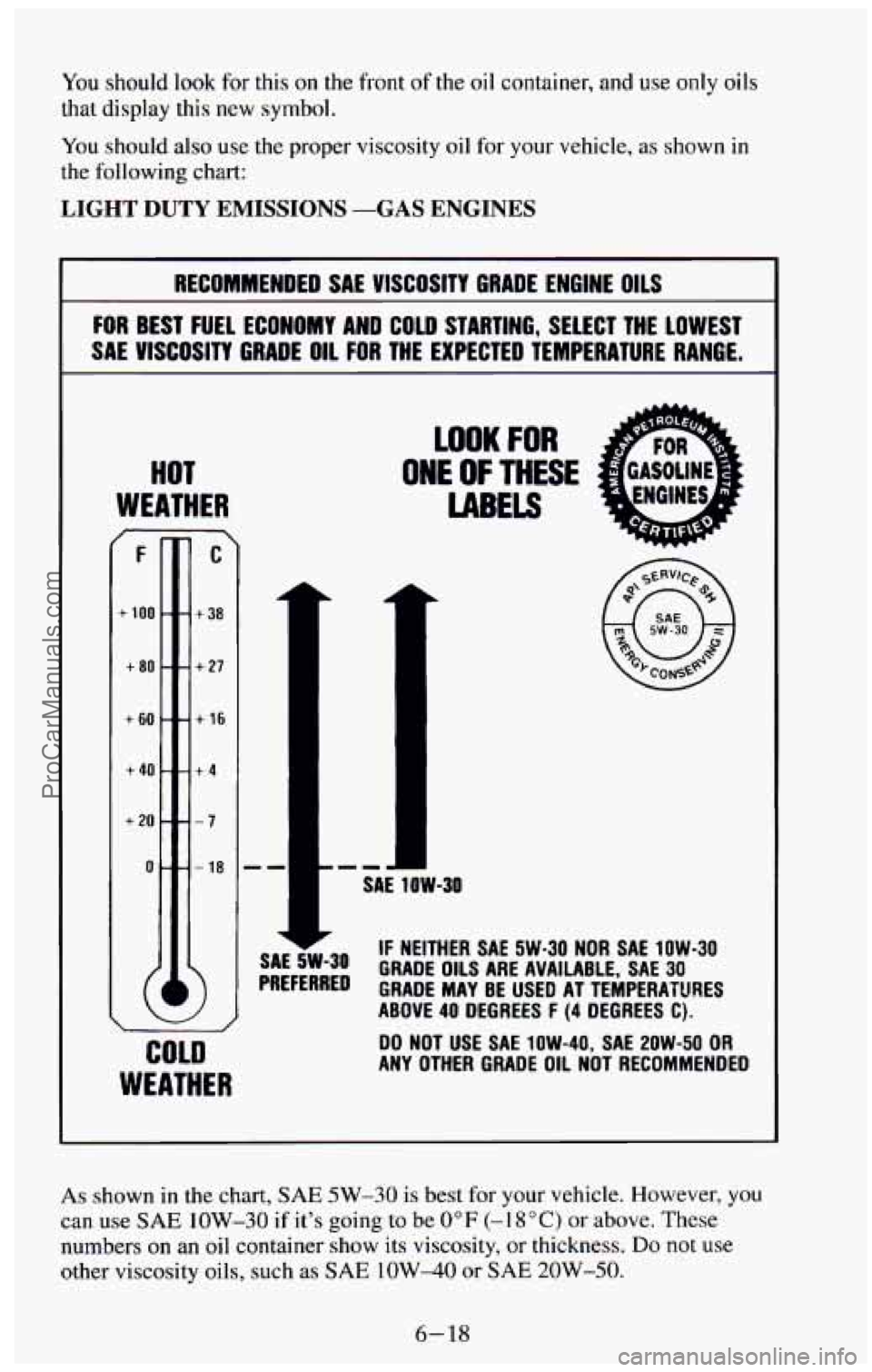
You should look for this on the front of the oil container, and use only oils
that display this new symbol.
You should also use the proper viscosity oil for your vehicle, as shown in
the following chart:
LIGHT DUTY EMISSIONS -GAS ENGINES
RECOMMENDED SAE VISCOSITY GRADE ENGINE OILS
FOR BEST FUEL ECONOMY AND COLD STARTING, SELECT THE LOWEST
SAL VISCOSITY GRADE OIL FOR THE EXPECTED TEMPERATURE RANGE.
HOT
WEATHER
F
+ 100 '
+80.
+60
+4a.
+20 -
0-
C
- +38
. +27
-+16
.+4
'-7
- 18
I
SAE SW-30
PREFERRED
LOOK FOR
ONE OF THESE
LABELS
SAE 1OW-30
IF NEITHER SAE 5W-30 NOR SAE 1OW-30
GRADE
OILS ARE AVAILABLE, SAE 30
GRADE MAY BE USED AT TEMPERATURES
ABOVE
40 DEGREES F (4 DEGREES C).
DO NOT USE SAE 1OW-40, SAE 2OW-50 OR
ANY OTHER GRADE OIL NOT RECOMMENDED
As shown in the chart, SAE 5W-30 is best for your vehicle. However, you
can use SAE 1OW-30 if it's going to be 0°F (- 1 8 O C) or above. These
numbers on
an oil container show its viscosity, or thickness. Do not use
other viscosity oils, such as SAE 1OW-40 or SAE 20W-50.
6-18
ProCarManuals.com
Page 264 of 385
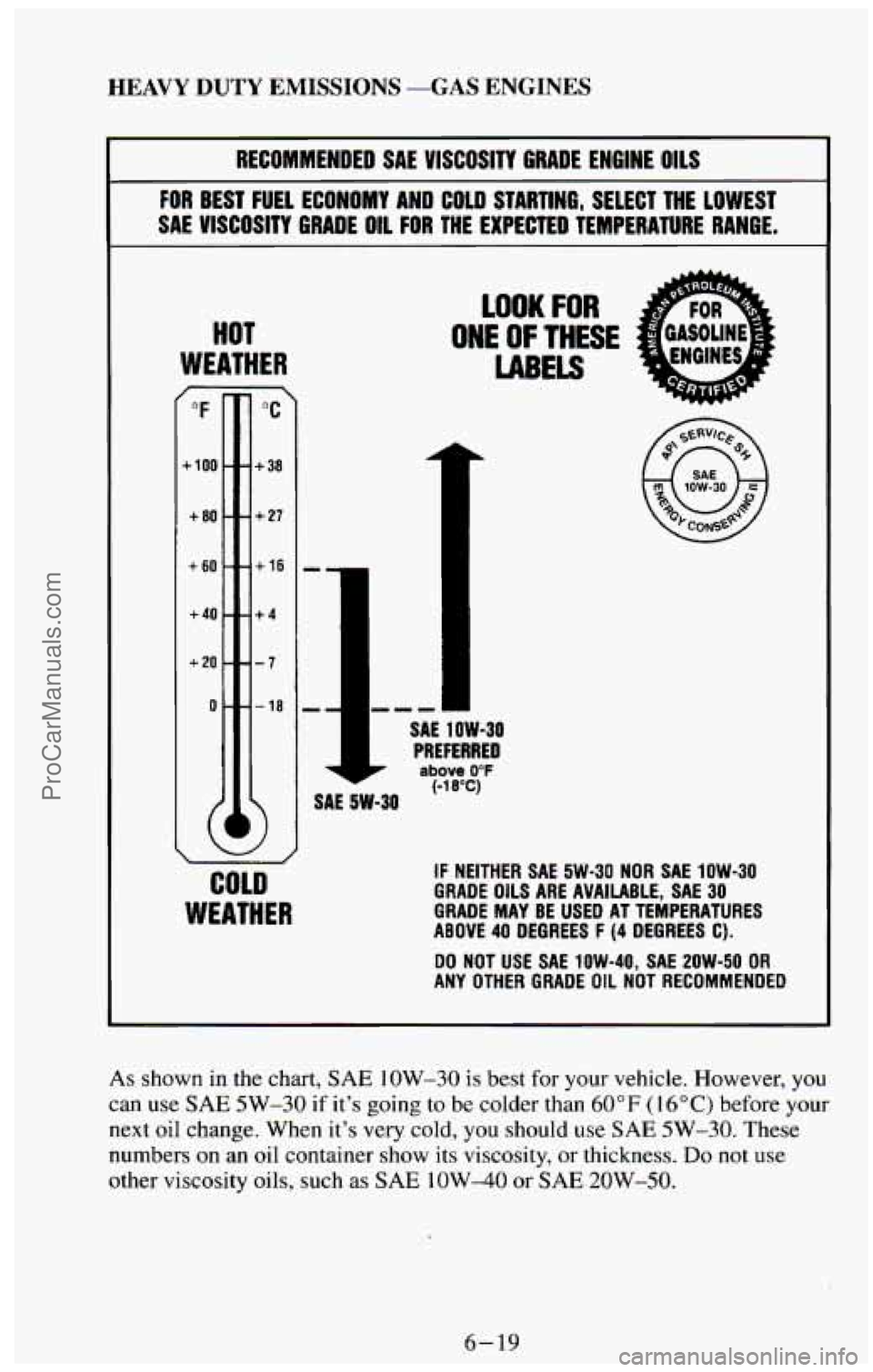
HEAVY DUTY EMISSIONS -GAS ENGINES
RECOMMENDED SAE VISCOSITY GRADE ENGINE OILS
FOR BEST FUEL ECONOMY AND COLD STARTING, SELECT THE LOWEST
SAE
VISCOSITY GRADE OIL FOR THE EXPECTED TEMPERATURE RANGE.
HOT
WEATHER
"F "C
+loo - - +38
+80 --+27
+60 - - +16
t40--+4
+20 ---I
0 - --18
LOOK FOR
ONE OF THESE
LABELS
I
I
SAE 1OW-30
PREFERRED
SAE
5W-30
COLD
WEATHER
IF NEITHER SAE 5W-30 NOR SAE 1OW-30
GRADE OILS ARE AVAILABLE, SAE 30
GRADE MAY BE USED AT TEMPERATURES
ABOVE
40 DEGREES F (4 DEGREES C).
ANY OTHER GRADE OIL NOT RECOMMENDED
DO
NOT USE SA€
1OW-40, SAE 2OW-50 OR
As shown in the chart, SAE IOW-30 is best for your vehicle. However, you
can use SAE 5W-30 if it's going to be colder than 60°F ( 16°C) before your
next oil change. When it's
very cold, you should use SAE 5W-30. These
numbers on
an oil container show its viscosity, or thickness. Do not use
other viscosity oils, such as SAE lOW-40 or SAE 20W-50,
6-19
ProCarManuals.com