check engine light CHEVROLET SUBURBAN 1994 User Guide
[x] Cancel search | Manufacturer: CHEVROLET, Model Year: 1994, Model line: SUBURBAN, Model: CHEVROLET SUBURBAN 1994Pages: 385, PDF Size: 19.88 MB
Page 250 of 385
Gasolines for Cleaner Air
Your use of gasoline with deposit control additives will help prevent
deposits from forming
in your engine and fuel system. That helps keep your
engine in tune and your emission control system working properly. It’s good
for your vehicle, and you’ll be doing your part for cleaner air.
Many gasolines are now blended with oxygenates. General Motors
recommends that you use gasolines with these blending materials, such as
MTBE and ethanol. By doing
so, you can help clean the air, especially in
those parts of the country that have high carbon monoxide levels.
In addition, some gasoline suppliers are now producing reformulated
gasolines. These gasolines are specially designed to reduce vehicle
emissions. General Motors recommends that you use reformulated gasoline.
By doing
so, you can help clean the air, especially in those parts of the
country that have high ozone levels.
You should ask your service station operators if their gasolines contain
deposit control additives and oxygenates, and
if they have been
reformulated to reduce vehicle emissions.
Diesel Fuel Requirements and Fuel System
Some states and provinces have restrictions on the purchase of diesel fuel
for light-duty vehicles and require you to
buy permits or pay special taxes.
Some of these restrictions apply only to residents, and others apply to both
residents and visitors. These restrictions can change.
To learn the current
restrictions
in any state or province, contact your auto club, the police or
other officials.
Fuel Requirements
NOTICE:
Diesel fuel or fuel additives not recommended in this manual
could damage your fuel system and engine, Your warranty
wouldn’t cover this damage, And:
0 Diesel fuel that has been mixed with engine oil could damage
your engine and emission controls. Always check with your
service station operator to make sure his diesel fuel has not
been mixed with engine oil.
If you ever run out of diesel fuel, it can be difficult to restart
your engine. “Running Out of Fuel,” later in this section,
tells
you how to get it started again. To avoid all this, try never to
let your tank get empty.
6-5
ProCarManuals.com
Page 252 of 385
Water in Fuel
Sometimes, water can be pumped into your fuel tank along with your diesel
fuel. This can happen if a service station doesn’t regularly inspect and clean
its fuel tanks, or if it gets contaminated fuel from its suppliers.
If this happens, a “WATER IN FUEL” light will come on. If it does, the
excess water
must be drained. Your dealer can do this for you.
This light
also should come on briefly when you start your engine, as a
check. If it doesn’t, have it fixed so it will be there to let you know if you
ever do get water
in your fuel.
If the light comes on at any other time, use this chart.
“WATER IN FUEL” LIGHT CHART
Problem
Light comes on intermittently.
Light stays on:
1. At temperatures above
freezing.
2. At temperatures below
freezing.
Recommended Action
Drain water from fuel filter.
Drain fuel filter immediately.
If no
water can be drained and light stays
on, see your dealer for assistance.
Drain fuel filter immediately. If no
water can be drained
- water may
be frozen. Open
the air bleed valve
to check for
fuel pressure. If no fuel
pressure
is present, replace the fuel
fi 1 ter.
3. Immediately after refueling - Fuel tank purging required. See
large amount
of water possibly your dealer for assistance.
pumped into fuel tank.
Hesitation or “flat” performance at
high speed or during hard acceleration
may be an indication of premature fuel filter plugging due to dirty or
contaminated
fuel. The filter element may need to be changed if this
happens. See your dealer for assistance.
If you drive when this warning light is on, you can damage your
fuel injection system and your engine.
If the light comes on right
after you refuel,
it means water was pumped into your fuel tank.
Turn
off your engine immediately. Then, have the water drained
at once.
6-7
ProCarManuals.com
Page 280 of 385
Front Axle
When to Check and Change Lubricant
Refer to the Maintenance Schedule to determine how often to check the
lubricant and when to change
it. See “Scheduled Maintenance Services” in
the Index.
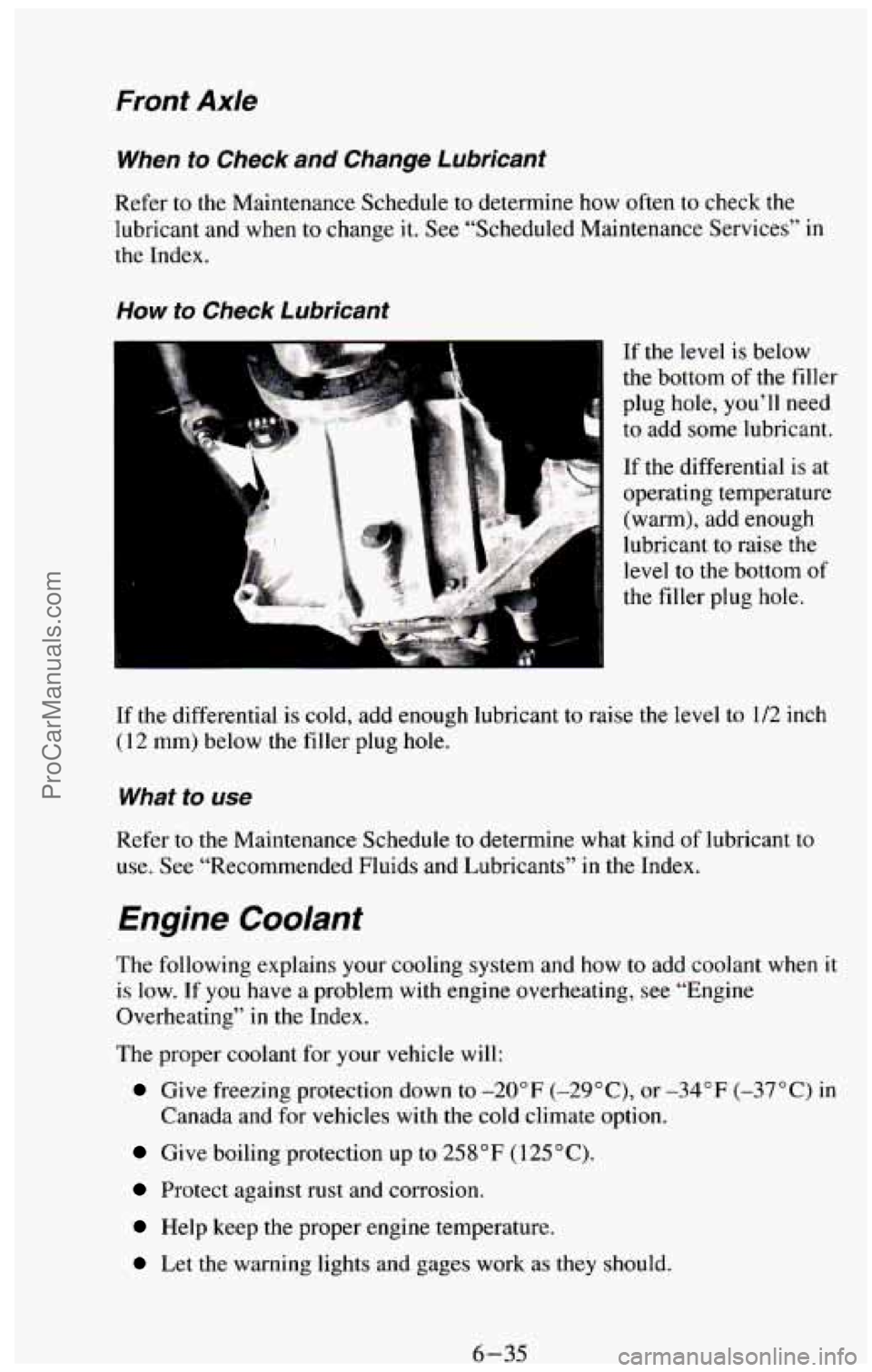
How to Check Lubricant
If the level is below
the bottom of the filler
plug hole, you’ll need
to add some lubricant.
If the differential is at
operating temperature
(warm), add enough
lubricant to raise the level
to the bottom of
the filler plug hole.
If the differential is cold, add enough lubricant to raise the level to
1/2 inch
(12 mm) below the filler plug hole.
What to use
Refer to the Maintenance Schedule to determine what kind of lubricant to
use. See “Recommended Fluids and Lubricants” in the Index.
Engine Coolant
The following explains your cooling system and how to add coolant when it
is low. If you have a problem with engine overheating, see “Engine
Overheating”
in the Index.
The proper coolant for your vehicle will:
Give freezing protection down to -20°F (-29”C), or -34°F (-37°C) in
Give boiling protection up to 258°F (1 25°C).
Protect against rust and corrosion.
Help keep the proper engine temperature.
Canada
and for vehicles with the cold climate option.
Let the warning lights and gages work as they should.
6-35 ProCarManuals.com
Page 283 of 385
Adding Coolant -Diesel Engines
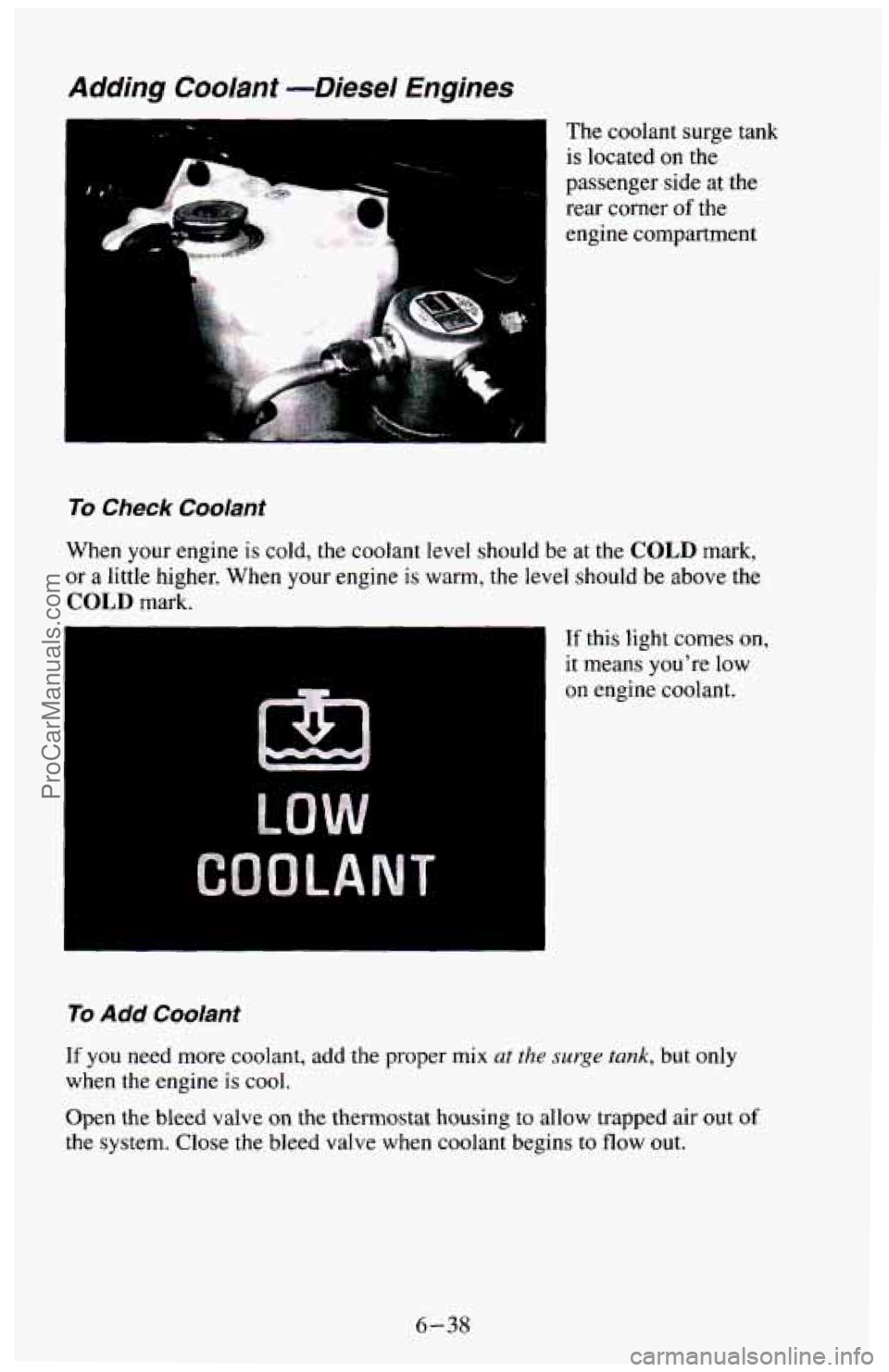
.. The coolant surge tank
is located on the
passenger side at the
rear corner
of the
engine compartment
To Check Coolant
When your engine is cold, the coolant level should be at the COLD mark,
or
a little higher. When your engine is warm, the level should be above the
COLD mark.
If this light comes on,
it means you're low
on engine coolant.
To Add Coolant
If you need more coolant, add the proper mix ut the surge tank, but only
when the
engine is cool.
Open the bleed valve
on the thermostat housing to allow trapped air out of
the system. Close the bleed valve when coolant begins to flow out.
6-38
ProCarManuals.com
Page 292 of 385
Wheel Nut Torque
For vehicles with dual wheels, when the vehicle, wheel or fasteners are new,
have the torque set at
the first 100, 1,000 and 6,000 miles (160, 1600 and
9600 km). Use the torque specified in the appropriate Specification Chart
later
in this section.
Single Belt Accessory Drive
If your new vehicle uses a serpentine belt, it is lighter, and more durable
than systems with several belts.
The belt
ruIl 'li'vkf br iir6und the pulleys or^ the engine. A tensione'r'n'iay be
used to keep the belt tight at all times. The tensioner also makes replacing
the belt easier
if you need to replace the belt, be sure to get the correct
replacement belt. Your dealership
or parts supplier can help you with this.
The Accessory Drive Belt Routing label on your vehicle will show you how
to route the belt your vehicle uses.
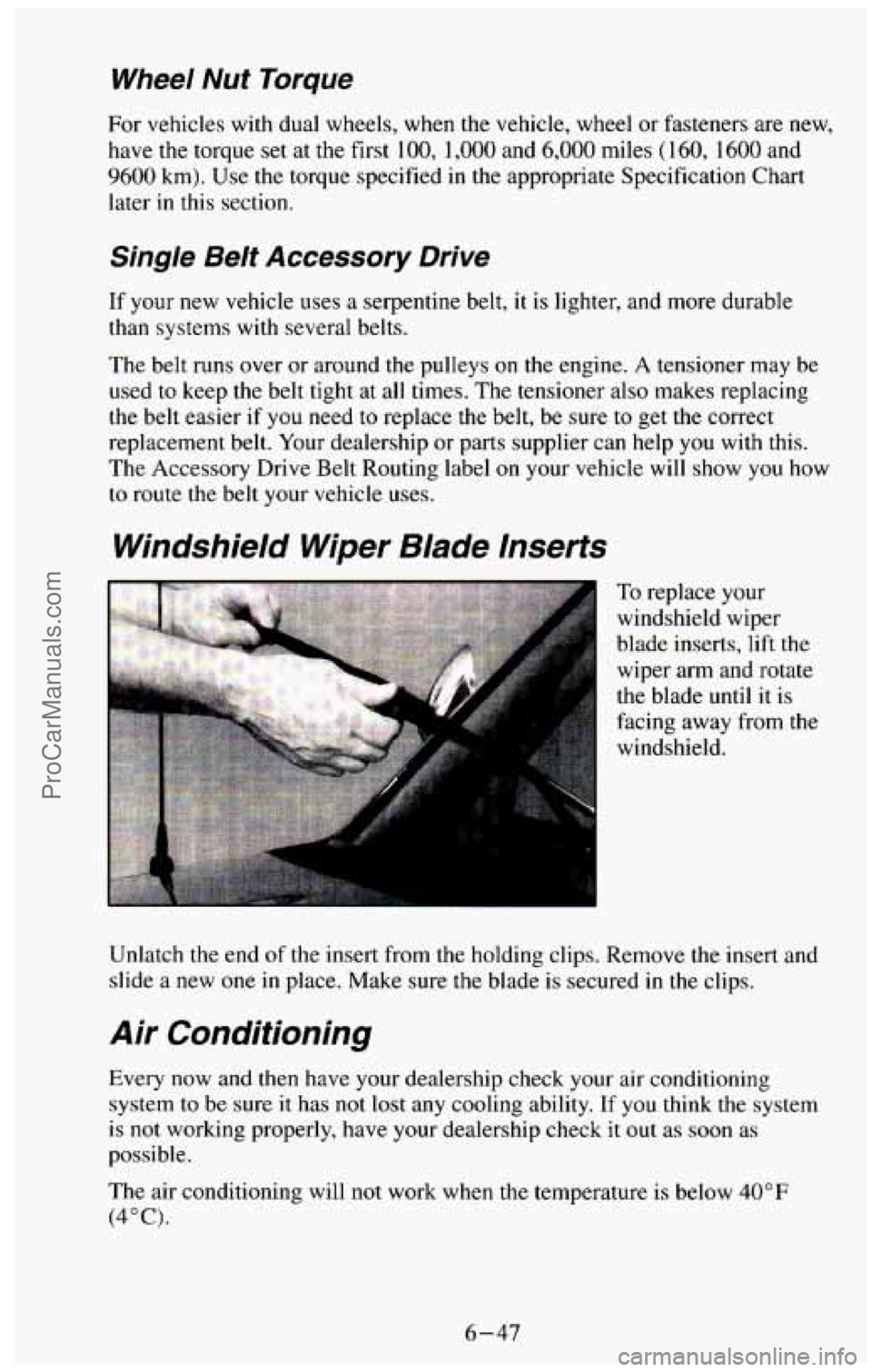
Windshield Wiper Blade lnserts
To replace your
windshield wiper
blade inserts, lift the
wiper arm and rotate
the blade until
it is
facing
away from the
windshield.
Unlatch the end
of the insert from the holding clips. Remove the insert and
slide
a new one in place. Make sure the blade is secured in the clips.
Air Conditioning
Every now and then have your dealership check your air conditioning
system to be sure
it has not lost any cooling ability. If you think the system
is not working properly, have your dealership check it out as soon as
possible.
The air conditioning will not work when the temperature
is below 40°F
(4°C).
6-47
ProCarManuals.com
Page 293 of 385
Fluid Leak Check
After the vehicle has been parked for a while, inspect the surface under the
vehicle for water, oil, fuel or other fluids. Water dripping from the air
conditioning system after it has been used is normal. If you notice fuel leaks
or fumes, the causes should be found and corrected at once.
Lubrication
Accelerator Control System
Your maintenance schedule will tell you how often the accelerator linkage
pivot points must be lubricated. See “Recommended Fluids and Lubricants”
in
the Index for the proper lubricant to use.
Accelerator cables and cruise control cables should not be lubricated. Any
cables that are worn or
are hard to pull should be replaced.
Hood Latches and Hood Hinge
Your maintenance schedule will tell you how often to lubricate the hood
latch and hood hinge assembly. See the Index under “Recommended Fluids
and Lubricants” for the proper lubricant to use.
Propeller Shaft Slip Splines
See your maintenance schedule to find out how often the slip splines must
be lubricated. See “Recommended Fluids and Lubricants” in the Index for
the proper lubricant to use.
Constant Velocity Joints
See your maintenance schedule to find out how often the constant velocity
joints must be lubricated. See “Recommended Fluids and Lubricants” in the
Index for the proper lubricant to use.
Normal
use of your vehicle will cause metal to metal wear at some points on
the cab and body if they are not lubricated.
For exposed surfaces, such
as door checks, door lock bolts, lock striker plates,
dovetail bumper wedges, etc., a thin
film of engine oil should be applied.
The seat adjusters and seat track should be lubricated
with chassis grease.
Door weather strips and rubber hood bumpers should be lightly coated with
a rubber lubricant.
Never use too much of any lubricant and be sure to wipe up any extra
lubricant when you are finished.
6-48
ProCarManuals.com
Page 332 of 385
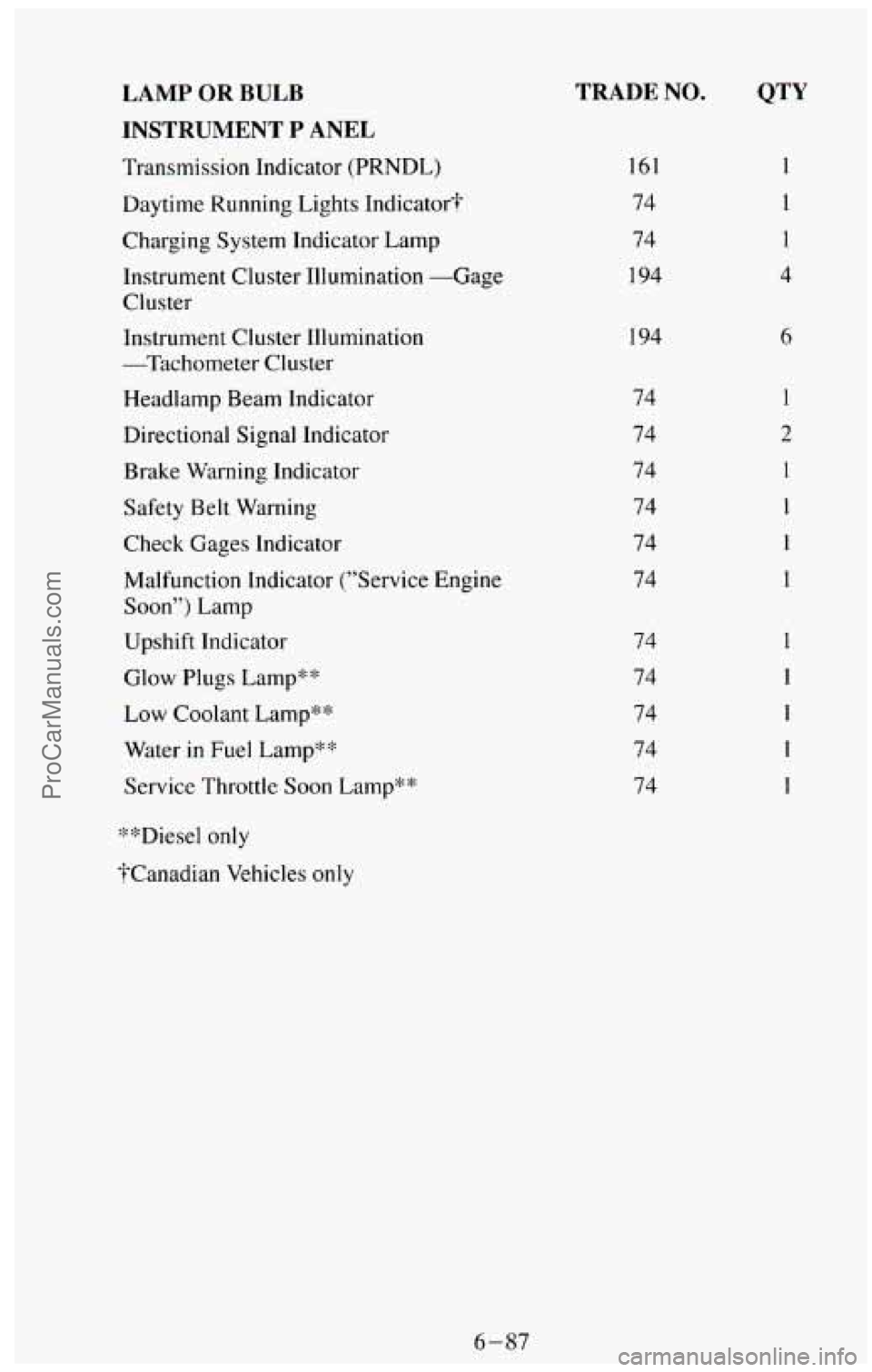
LAMP OR BULB
INSTRUMENT
P ANEL
Transmission Indicator (PRNDL)
Daytime Running Lights Indicator?'
Charging System Indicator Lamp
Instrument Cluster Illumination -Gage
Cluster
Instrument Cluster Illumination
-Tachometer Cluster
Headlamp Beam Indicator
Directional Signal Indicator
Brake Warning Indicator
Safety Belt Warning
Check Gages Indicator Malfunction Indicator ("Service Engine
Soon") Lamp
Upshift Indicator
Glow Plugs Lamp*:"
Low Coolant Lamp**
Water
in Fuel Lamp**
Service Throttle
Soon Lamp**
'k*Diesel only
'fCanadian Vehicles only
TRADE NO.
161 74
74
194
194 74
74
74
74
74 74
74
74 74
74
74
6
6-87
ProCarManuals.com
Page 334 of 385
Scheduled Maintenance Services
Section
This section covers the maintenance required for your General Motors
vehicle
. Your vehicle needs these services to retain it’s safety. dependability.
and emission control performance
.
A Word About Maintenance .................................. 7-3
Your Vehicle and
the Environment ............................. 7-3
Recording Maintenance Services
............................... 7-3
Scheduled Maintenance Services
............................... 7-4
Selecting Your Vehicle’s Maintenance Services ........ ..... 7-4
Maintenance Schedule I ................................ 7-6
Maintenance Schedule
I1 ..................... ......... 7-8
Maintenance Schedule
I .........................
Maintenance Schedule I1 ...... ...............
Maintenance Schedule I ............................... 7-14
Maintenance Schedule
I1 ............................... 7-16
Explanation
of Scheduled Maintenance Services ............... 7-18
Owner Checks and Services .................................. 7-22
Recommended Fluids
& Lubricants ........................... 7-25
Maintenance Record
....................................... 7-27
Service Sta.tion Checks
..................................... 7-28
Gasoline Engines with Light Duty Emissions .
Gasoline Engines with Heavy Duty Emissions .
Diesel Engines .
.... 7-10
...... 7-12
Protection
Plan
Have you purchased the GM Protection Plan? The Plan supplements
the new vehicle warranties
. See your GM dealer for details .
7-1
ProCarManuals.com
Page 380 of 385
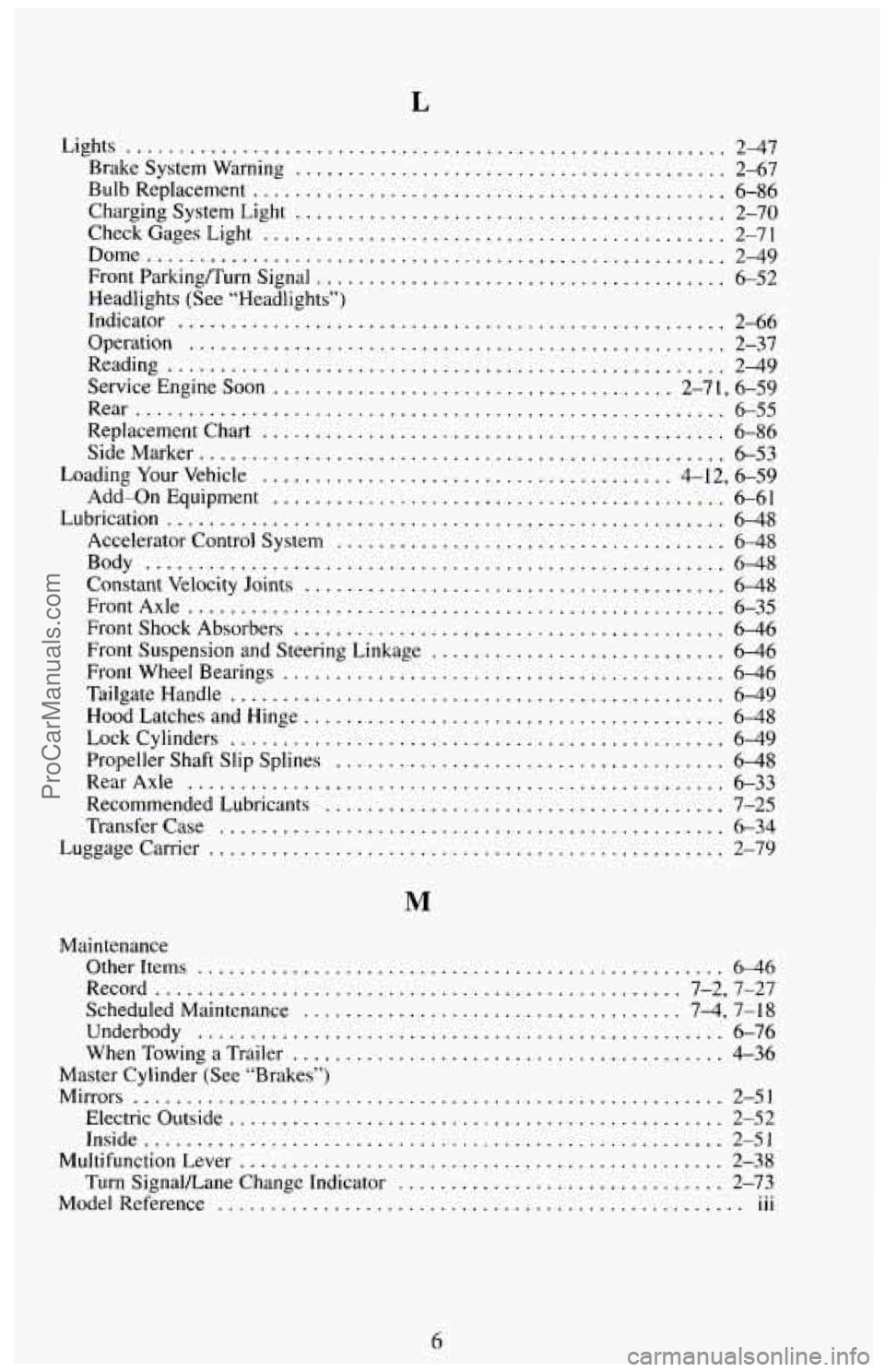
L
Lights ..................................................... 2-47
Brake System Warning ......................................... 2-67
Bulb Replacement
............................................. 6-86
Charging System Light
......................................... 2-70
Front Parking/Turn Signal
....................................... 6-52
CheckGagesLight
............................................ 2-71
Dome
....................................................... 2-49
Headlights (See “Headlights”)
Indicator
.................................................... 2-66
Operation
................................................... 2-37
Reading ..................................................... 2-49
Service Engine
Soon ...................................... 2-7 1. 6-59
Rear
........................................................ 6-55
Replacement Chart
............................................ 6-86
SideMarker .................................................. 6-53
Loading Your Vehicle ....................................... 4-12, 6-59
Add-on Equipment
........................................... 6-61
Accelerator Control System
..................................... 6-48
Constant Velocity Joints
........................................ 6-48
Front Shock Absorbers
......................................... 6-46
Front Suspension and Steering Linkage
............................ 6-46
Front Wheel Bearings .......................................... 6-46
TailgateHandle
............................................... 6-49
HoodLatchesandHinge ........................................ 6-48
Lockcylinders ............................................... 6-49
Propeller Shaft Slip Splines
..................................... 6-48
RearAxle ................................................... 6-33
Recommended Lubricants ...................................... 7-25
Transfercase ................................................ 6-34
Luggagecarrier ................................................. 2-79
Lubrication
..................................................... 6-48
Body
....................................................... 6-48
FrontAxle
................................................... 6-35
Maintenance Otherltems
.................................................. 6-46
Record .................................................. 7.2. 7.27
Scheduled Maintenance .................................... 747-1 8
When Towing
a Trailer ......................................... 4-36
Master Cylinder (See “Brakes”)
Mirrors
........................................................ 2-51
Electric Outside ............................................... 2-52
Inside ....................................................... 2-51
Multifunction Lever .............................................. 2-38
Turn SignalLane Change Indicator
............................... 2-73
Underbody
.................................................. 6-76
... ModelReference .................................................. 111
6
ProCarManuals.com
Page 382 of 385
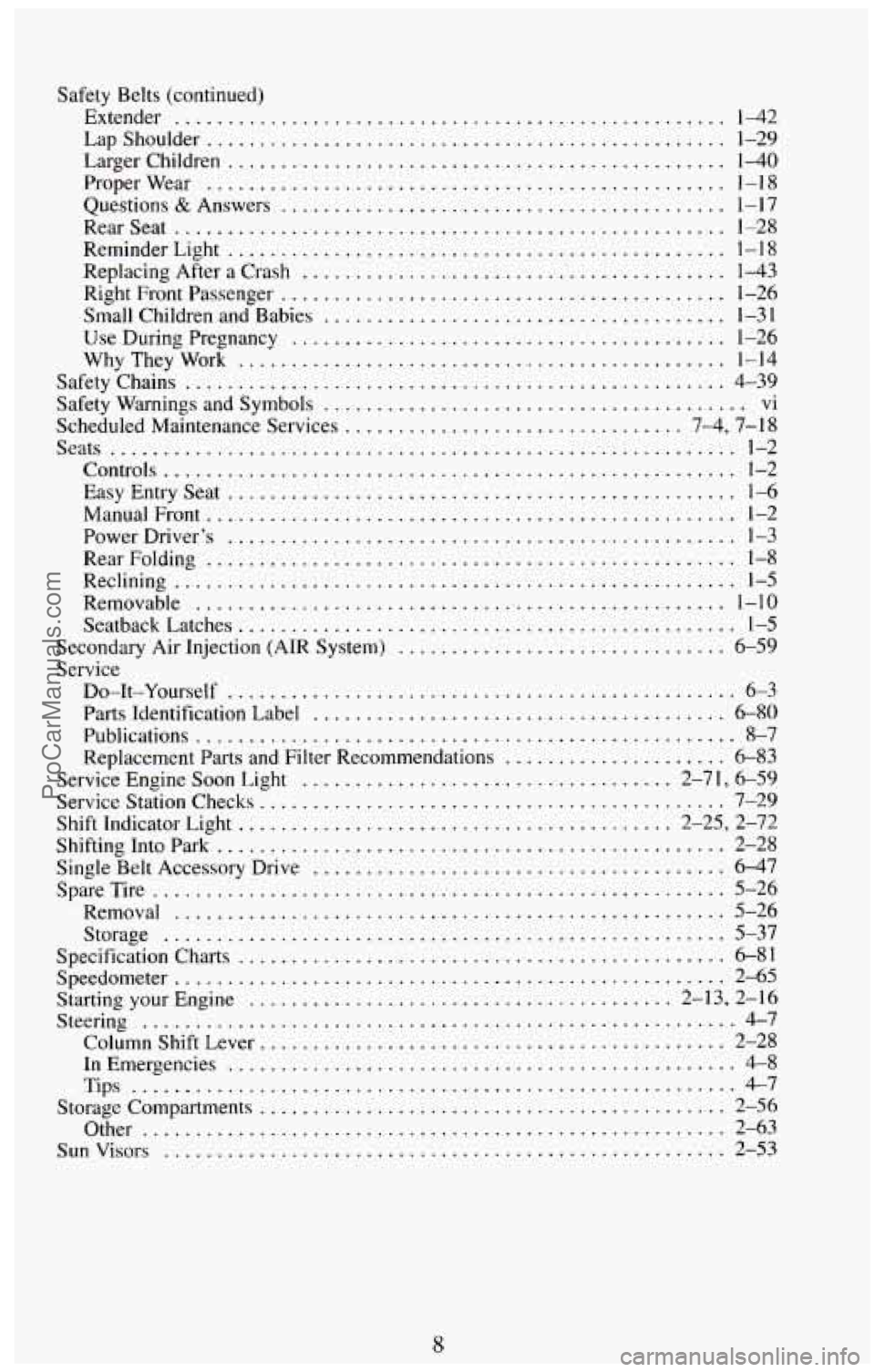
Safety Belts (continued)
Extender
.................................................... 1-42
Lapshoulder ................................................. 1-29
Larger Children
............................................... 1-40
Properwear ................................................. 1-18
Questions
& Answers .......................................... 1-17
RearSeat
.................................................... 1-28
ReminderLight
............................................... 1-18
Replacing After a Crash
........................................ 1-43
RightFrontPassenger
.......................................... 1-26
Small Children and Babies
...................................... 1-31
Use During Pregnancy ......................................... 1-26
Safety Chains
................................................... 4-39
Safety Warnings and Symbols
........................................ vi
Scheduled Maintenance Services
................................ 747-1 8
Seats
........................................................... 1-2
Controls
...................................................... 1-2
Easy Entry Seat
................................................ 1-6
ManualFront
.................................................. 1-2
PowerDriver’s
................................................ 1-3
RearFolding .................................................. 1-8
Reclining
..................................................... 1-5
Removable
.................................................. 1-10
SeatbackLatches ............................................... 1-5
Secondary Air Injection (AIR System) ............................... 6-59
Service Do-It-Yourself
................................................ 6-3
Parts Identification Label
....................................... 6-80
Publications
................................................... 8-7
Replacement Parts and Filter Recommendations
..................... 6-83
Service Engine Soon Light
................................... 2-7 1, 6-59
Service Station Checks
............................................ 7-29
Shift Indicator Light ......................................... 2-25, 2-72
Shifting Into Park
................................................ 2-28
Single Belt Accessory Drive
....................................... 6-47
SpareTire
...................................................... 5-26
Removal
.................................................... 5-26
Storage
..................................................... 5-37
Specification Charts
.............................................. 6-81
Speedometer
.................................................... 2-65
Starting your Engine
........................................ 2-13, 2-16
Steering ........................................................ 4-7
ColumnShiftLever
............................................ 2-28
In Emergencies
................................................ 4-8
Tips
......................................................... 4-7
Storage Compartments
............................................ 2-56
Other ....................................................... 2-63
Sunvisors
..................................................... 2-53
WhyTheyWork
.............................................. 1-14
b
ProCarManuals.com