Maintenance CHEVROLET SUBURBAN 1994 Owner's Manual
[x] Cancel search | Manufacturer: CHEVROLET, Model Year: 1994, Model line: SUBURBAN, Model: CHEVROLET SUBURBAN 1994Pages: 385, PDF Size: 19.88 MB
Page 293 of 385
Fluid Leak Check
After the vehicle has been parked for a while, inspect the surface under the
vehicle for water, oil, fuel or other fluids. Water dripping from the air
conditioning system after it has been used is normal. If you notice fuel leaks
or fumes, the causes should be found and corrected at once.
Lubrication
Accelerator Control System
Your maintenance schedule will tell you how often the accelerator linkage
pivot points must be lubricated. See “Recommended Fluids and Lubricants”
in
the Index for the proper lubricant to use.
Accelerator cables and cruise control cables should not be lubricated. Any
cables that are worn or
are hard to pull should be replaced.
Hood Latches and Hood Hinge
Your maintenance schedule will tell you how often to lubricate the hood
latch and hood hinge assembly. See the Index under “Recommended Fluids
and Lubricants” for the proper lubricant to use.
Propeller Shaft Slip Splines
See your maintenance schedule to find out how often the slip splines must
be lubricated. See “Recommended Fluids and Lubricants” in the Index for
the proper lubricant to use.
Constant Velocity Joints
See your maintenance schedule to find out how often the constant velocity
joints must be lubricated. See “Recommended Fluids and Lubricants” in the
Index for the proper lubricant to use.
Normal
use of your vehicle will cause metal to metal wear at some points on
the cab and body if they are not lubricated.
For exposed surfaces, such
as door checks, door lock bolts, lock striker plates,
dovetail bumper wedges, etc., a thin
film of engine oil should be applied.
The seat adjusters and seat track should be lubricated
with chassis grease.
Door weather strips and rubber hood bumpers should be lightly coated with
a rubber lubricant.
Never use too much of any lubricant and be sure to wipe up any extra
lubricant when you are finished.
6-48
ProCarManuals.com
Page 294 of 385
Your maintenance schedule will tell you how often to lubricate these items.
See “Recommended Fluids and Lubricants” in the Index for the proper
lubricant to use.
Lock Cylinders
To be sure your locks operate properly, they must be lubricated. Your
vehicle’s maintenance schedule will tell you how often to lubricate them.
See “Recommended Fluids and Lubricants” in the Index for the proper
lubricant to use.
You should not use penetrating oils because they could wash out the factory
installed lubricant and cause the lock to bind. De-icers which contain
alcohol could
also wash away the lubricant, so be sure to lubricate the lock
after using a de-icer of this type.
Tailgate Handle
The tailgate handle pivot points on your vehicle should be lubricated to keep
it working smoothly.
Your maintenance schedule will tell you how often to lubricate the handle.
See “Recommended Fluids and Lubricants” in the Index for the proper
lubricant to use.
Battery
Every new GM vehicle has a Delco Freedom@ battery. You never have to
add water to one of these. When it’s time for a new battery, we recommend
a Delco Freedom@ battery. Get one that has the catalog number shown on
the original battery’s label.
Vehicle Storage
If you’re not going to drive your vehicle for 25 days or more, take off the
black, negative
(-) cable from the battery. This will help keep your battery
from running down.
Contact your dealer to learn how to prepare your vehicle for longer storage
periods.
ProCarManuals.com
Page 309 of 385
Special Tire lnflation
If you have 16 inch tires on your vehicle, and:
- You’ll be driving for very long at speeds of 66 mph (105 kdh) to
75 mph (120 km/h) where legal, inflate tires to 10 psi (70 kPa)
more than the recommended cold inflation pressures.
- You’ll be driving for very long at speeds of 76 mph ( 120 kdh) to
85 mph (1 35 kdh) where legal, cold inflation pressures should be
increased by
10 psi (70 kPa) and you must also reduce axle load
capacity by 10%.
Do not drive over 85 mph (135 km/h) even if
it’s legal.
Inflation pressures should never exceed 10 psi (70 kPa) above the
inflation specified for the maximum load
of the tire.
Tire lnspection and Rotation
To make your tires last longer, have them inspected and rotated at the
mileages recommended
in the Maintenance Schedule. See “Scheduled
Maintenance Services” in the Index.
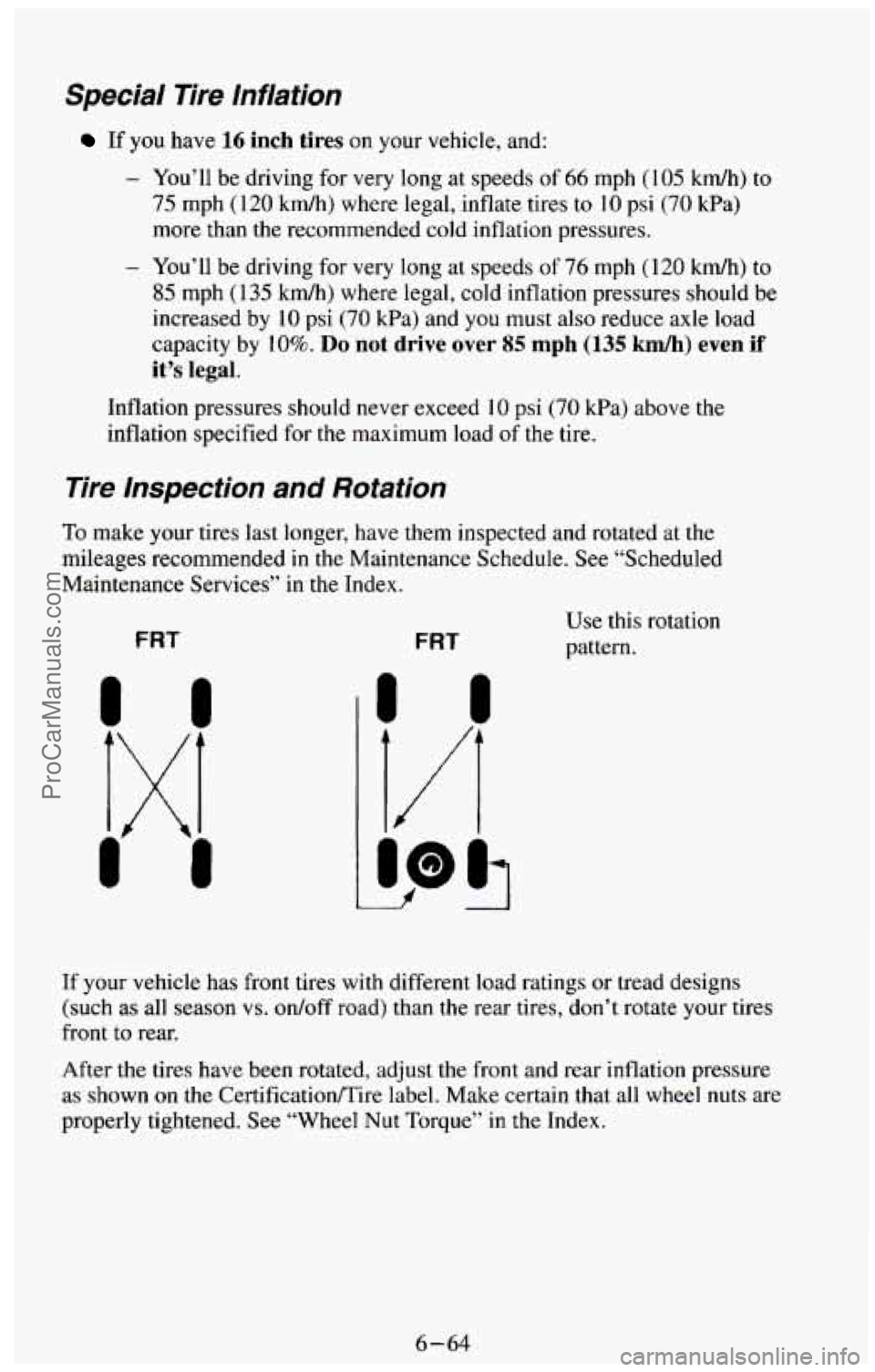
FRT FRT
Use this rotation
pattern.
If your vehicle has front tires with different load ratings or tread designs
(such
as all season vs. on/off road) than the rear tires, don’t rotate your tires
front
to rear.
After the tires have been rotated, adjust the front and rear inflation pressure
as shown on the Certificationmire label. Make certain that all wheel nuts are
properly tightened. See “Wheel Nut Torque” in the Index.
6-64
ProCarManuals.com
Page 321 of 385
Weatherstrips
Silicone grease on weatherstrips will make them last longer, seal better, and
not stick or squeak. Apply silicone grease with a clean cloth at least every
six months. During very cold, damp weather more frequent application may
be required. (See “Recommended Fluids
& Lubricants’’ in the Index.)
Sheet Metal Damage
If your vehicle is damaged and requires sheet metal repair or replacement,
make sure the body repair shop applies anti-corrosion material to the parts
repaired or replaced to
restore corrosion protection.
Foreign Material
Calcium chloride and other salts, ice melting agents, road oil and tar, tree
sap, bird droppings, chemicals from industrial chimneys, and other foreign
matter can damage your vehicle’s finish if they remain on painted surfaces.
Use cleaners that are marked safe for painted surfaces to remove foreign
matter.
Finish Damage
Any stone chips, fractures or deep scratches in the finish should be repaired
right away. Bare metal will corrode quickly and may develop into a major
repair expense.
Minor chips and scratches can be repaired with touch-up materials available
from your dealer or other service outlets. Larger areas of finish damage can
be corrected
in your dealer’s body and paint shop.
Underbody Maintenance
Chemicals used for ice and snow removal and dust control can collect on
the underbody. If these are not removed, accelerated corrosion (rust) can
occur
on the underbody parts such as fuel lines, frame, floor pan, and
exhaust system even though they have corrosion protection.
At least every spring,
flush these materials from the underbody with plain
water. Clean
any areas where mud and other debris can collect. Dirt packed
in closed areas of the frame should be loosened before being flushed. Your
dealer or an underbody vehicle washing system can do this for you.
Chemical Paint Spotting
Some weather and atmospheric conditions can create a chemical fallout.
Airborne pollutants can fall upon and attack painted surfaces on your
vehicle. This damage can take two
forms: blotchy, ringlet-shaped
discolorations, and small irregular dark
spots etched into the paint surface.
6-76
ProCarManuals.com
Page 334 of 385
Scheduled Maintenance Services
Section
This section covers the maintenance required for your General Motors
vehicle
. Your vehicle needs these services to retain it’s safety. dependability.
and emission control performance
.
A Word About Maintenance .................................. 7-3
Your Vehicle and
the Environment ............................. 7-3
Recording Maintenance Services
............................... 7-3
Scheduled Maintenance Services
............................... 7-4
Selecting Your Vehicle’s Maintenance Services ........ ..... 7-4
Maintenance Schedule I ................................ 7-6
Maintenance Schedule
I1 ..................... ......... 7-8
Maintenance Schedule
I .........................
Maintenance Schedule I1 ...... ...............
Maintenance Schedule I ............................... 7-14
Maintenance Schedule
I1 ............................... 7-16
Explanation
of Scheduled Maintenance Services ............... 7-18
Owner Checks and Services .................................. 7-22
Recommended Fluids
& Lubricants ........................... 7-25
Maintenance Record
....................................... 7-27
Service Sta.tion Checks
..................................... 7-28
Gasoline Engines with Light Duty Emissions .
Gasoline Engines with Heavy Duty Emissions .
Diesel Engines .
.... 7-10
...... 7-12
Protection
Plan
Have you purchased the GM Protection Plan? The Plan supplements
the new vehicle warranties
. See your GM dealer for details .
7-1
ProCarManuals.com
Page 335 of 385
A Word About Maintenance
We at General Motors want to help you keep your vehicle in good working
condition. But we don’t know exactly how you’ll drive
it. You may drive
very short distances
only a few times a week. Or you may drive long
distances
all the time in very hot, dusty weather. You may use your vehicle
in making deliveries. Or you may drive it to work, to do errands, or in many
other ways.
Because of all the different ways people
use their GM vehicles, maintenance
needs vary. You may even need more frequent checks and replacements than
you will find in the schedules in this section. So please read this section and
note how you drive. If
you have any questions on how to keep your vehicle
in good condition, see your GM dealer, the place many GM owners choose
to have their maintenance work done. Your dealer can be relied
upon to use
the proper parts and practices.
Your Vehicle and the Environment
Proper vehicle maintenance not only helps keep your vehicle in good
working condition, but
also helps the environment. All recommended
maintenance procedures are important. Improper vehicle maintenance or the
removal of important components can significantly affect the quality
of the
air we breathe. Improper fluid levels or even the wrong tire inflation can
increase the
level of emissions from your vehicle. To help protect our
environment, and
to help keep your vehicle in good condition, please
maintain your vehicle properly.
Recording Maintenance Services
The Maintenance Record near the end of this section provides a place for
you
to record the maintenance performed on your vehicle. Whenever any
maintenance
is performed, be sure to write it down in the Maintenance
Record.
This will help you determine when your next maintenance should
be done. In addition,
it is a good idea to keep your maintenance receipts.
They may be needed to qualify your vehicle warranty repairs.
7-2
ProCarManuals.com
Page 336 of 385
If you are skilled enough to do some work on your vehicle, you will
probably want
to get the service information GM publishes. For information
on how to obtain various service publications for your vehicle, see “Service
Publications”
in the Index. You will find a list of publications and an order
form
in the back of the book.
Scheduled Maintenance Services
This part tells you the maintenance services that you should have done and
the times you should schedule them. Your GM dealer knows your vehicle
best and wants
you to be happy with it. If you go to your dealer for your
service needs, you’ll know that GM-trained and supported service people
will perform the work using genuine GM parts.
These schedules are for vehicles that:
carry passengers and cargo within the recommended limits. You will
find these limits
on your vehicle’s Certification Label. See “Loading
Your Vehicle”
in the Index.
are driven on regular road surfaces, and within legal driving limits, as
described in Section 4 “Your Driving and the Road.”
are driven off-road in the recommended manner. See “Off Road
Driving With Your Four-wheel Drive Vehicle”
in the Index.
use the recommended fuel. See “Fuel” in the Index.
Selecting the Proper Maintenance Services
To find the proper maintenance schedule for your vehicle, you must know
two things. What engine your vehicle has, and
how you use your vehicle.
Your engine type will tell
you which chart to use, and your driving
conditions will tell
you which schedule to use. The charts are found later in
this section.
Selecting the Proper Maintenance Chart
Your engine type (Gasoline or Diesel) and its emissions classification (Light
Duty or Heavy Duty Emissions) will tell
you which maintenance chart to
use. Find your Vehicle Identification Number (VIN), and look at the eighth
character to see what your engine code
is. Then use the following Engine
Emissions Classifications tables
to find your emissions classification.
0 Your VIN is on the plate on the top left corner of your instrument
panel, the Certification Label and
on the Service Parts Identification
Label. See “Vehicle Identification Number” in the Index.
If your engine has more than one emissions classification, look at your
Certification Label to see what your Gross Vehicle Weight Rating
(GVWR)
is. See “Loading Your Vehicle” in the Index.
7-3 ProCarManuals.com
Page 338 of 385
Selecting the Proper Maintenance Schedule
Here is how to tell which schedule to follow once you find the proper
maintenance chart to
use.
MAINTENANCE SCHEDULE I
Is any one of these true for your vehicle?
Most trips are less than 4 miles (6 kilometers.)
Most trips are less than 10 miles (16 kilometers), and the outside
temperatures are below freezing.
The engine is at low speed most of the time (as in door-to-door
delivery, stop-and-go traffic, or commercial use).
0 You operate in dusty areas or off-road frequently.
You tow a trailer.
If
any one (or more) of these is true for your driving, follow Schedule I.
Schedule I is shown by a plus sign (+) on the chart.
MAINTENANCE SCHEDULE II
Follow Schedule I1 ONLY if none of the above conditions are true.
Schedule
I1 is shown by a dot (0) on the chart.
7-5 ProCarManuals.com
Page 339 of 385
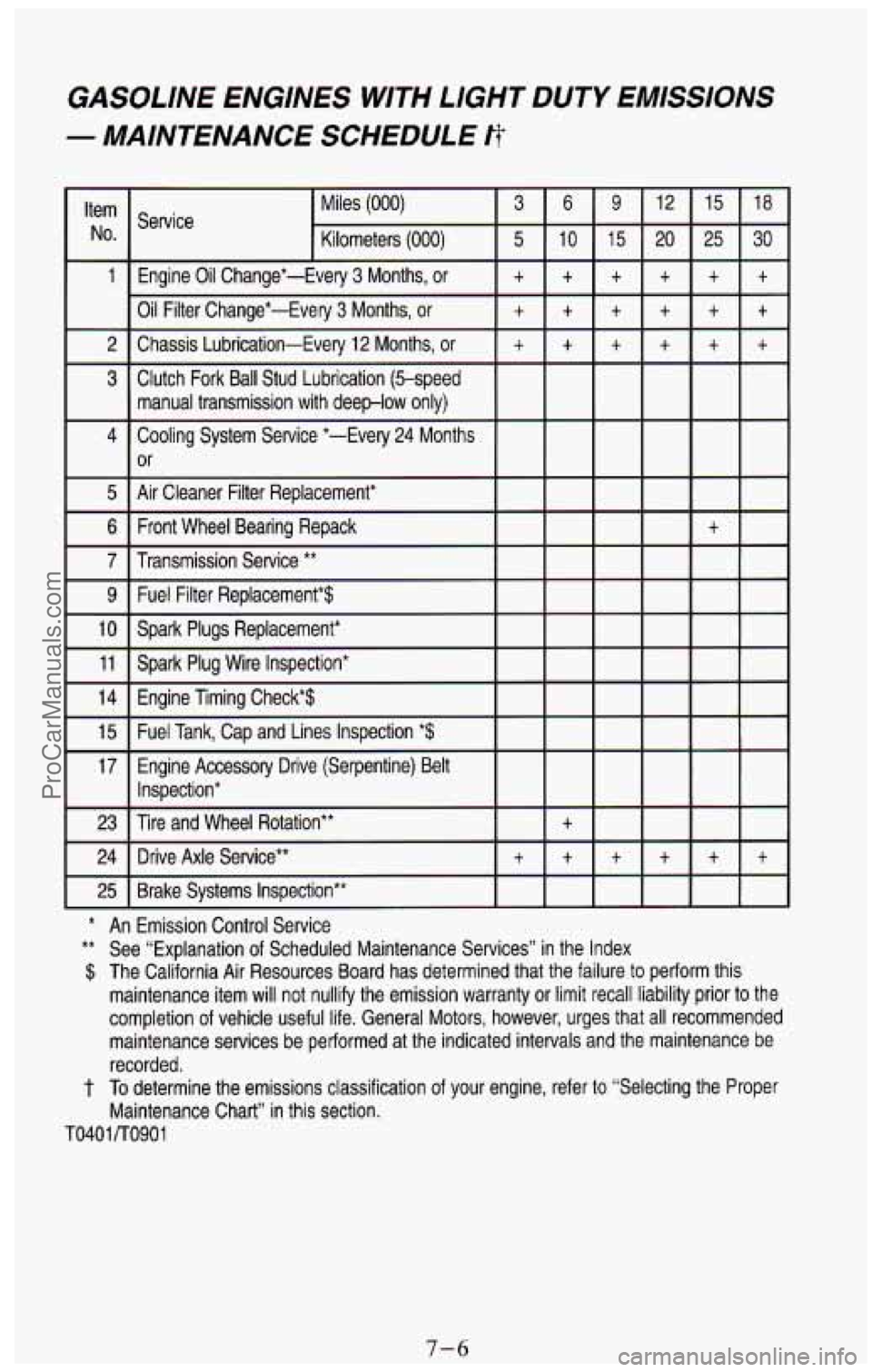
GASOLINE ENGINES WITH LIGHT DUTY EMISSIONS
- MAINTENANCE SCHEDULE tf
23
* An Emission Control Service Brake Systems Inspection**
25
ttttt-t Drive Axle Service** 24
t Tire and Wheel Rotation**
** See “Explanation
of Scheduled Maintenance Services” in the Index
$ The California Air Resources Board has determined that the fail\
ure to perform this
maintenance item will not nullify the emission warranty or limi\
t recall liability prior
to the
completion of vehicle useful life. General Motors, however, urges that all re\
commended
maintenance services be performed
at the indicated intervals and the maintenance be
recorded.
t To determine the emissions classification of your engine, refer to “Selecting the Proper
Maintenance Chart” in this section.
TO401 /TO90 1
7-6 ProCarManuals.com
Page 340 of 385
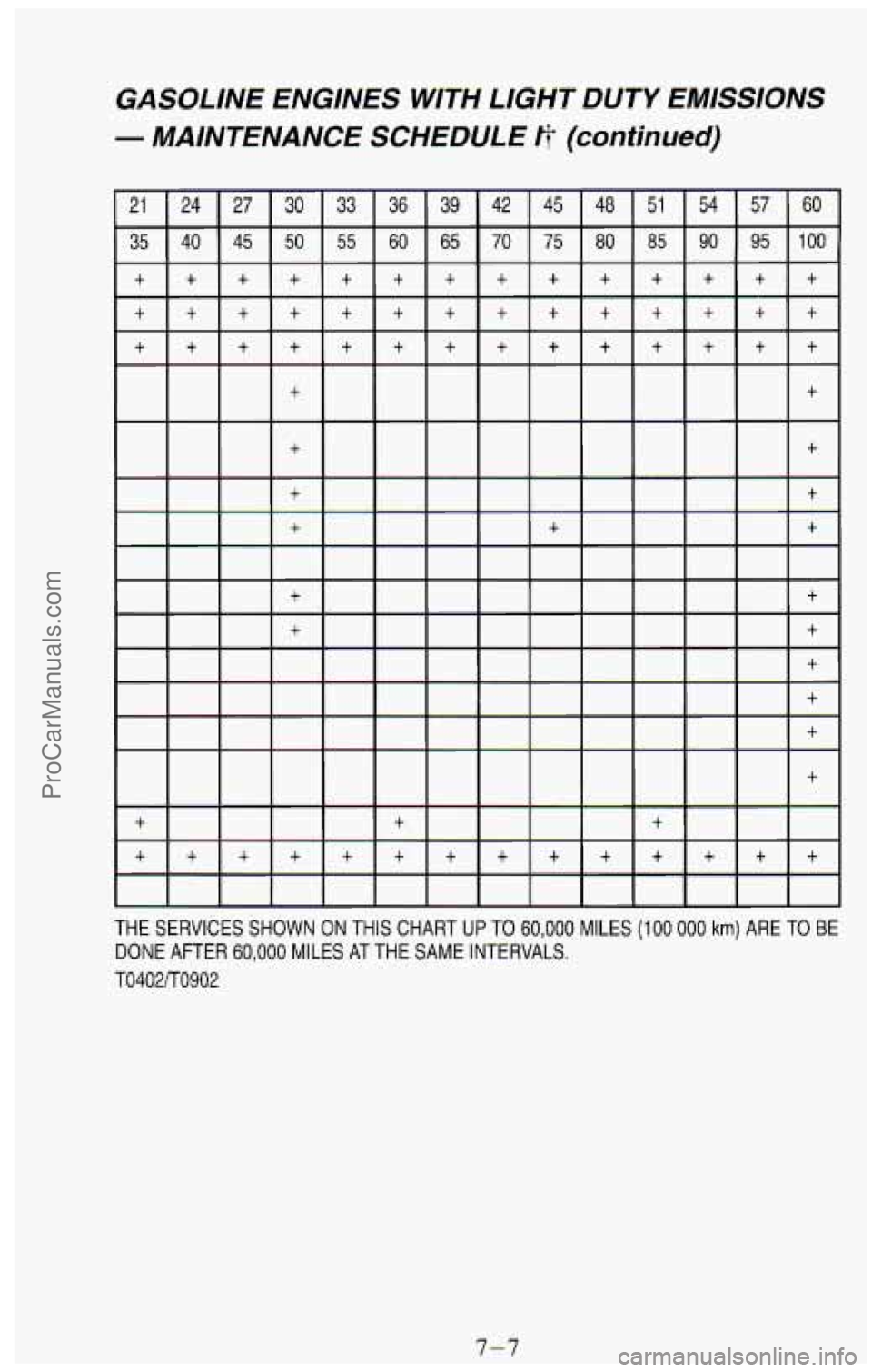
GASOLINE ENGINES WITH LIGHT DUTY EMlSSlONS
- MAINTENANCE SCHEDULE fi (continued)
THE SERVICES SHOWN ON THIS CHART UP TO 60,000 MILES (100 000 km) ARE TO BE
DONE AFTER 60,000 MILES AT THE SAME INTERVALS.
T0402/T0902
ProCarManuals.com