warning CHEVROLET SUBURBAN 1994 Owner's Manual
[x] Cancel search | Manufacturer: CHEVROLET, Model Year: 1994, Model line: SUBURBAN, Model: CHEVROLET SUBURBAN 1994Pages: 385, PDF Size: 19.88 MB
Page 205 of 385
Hazard Warning Flashers
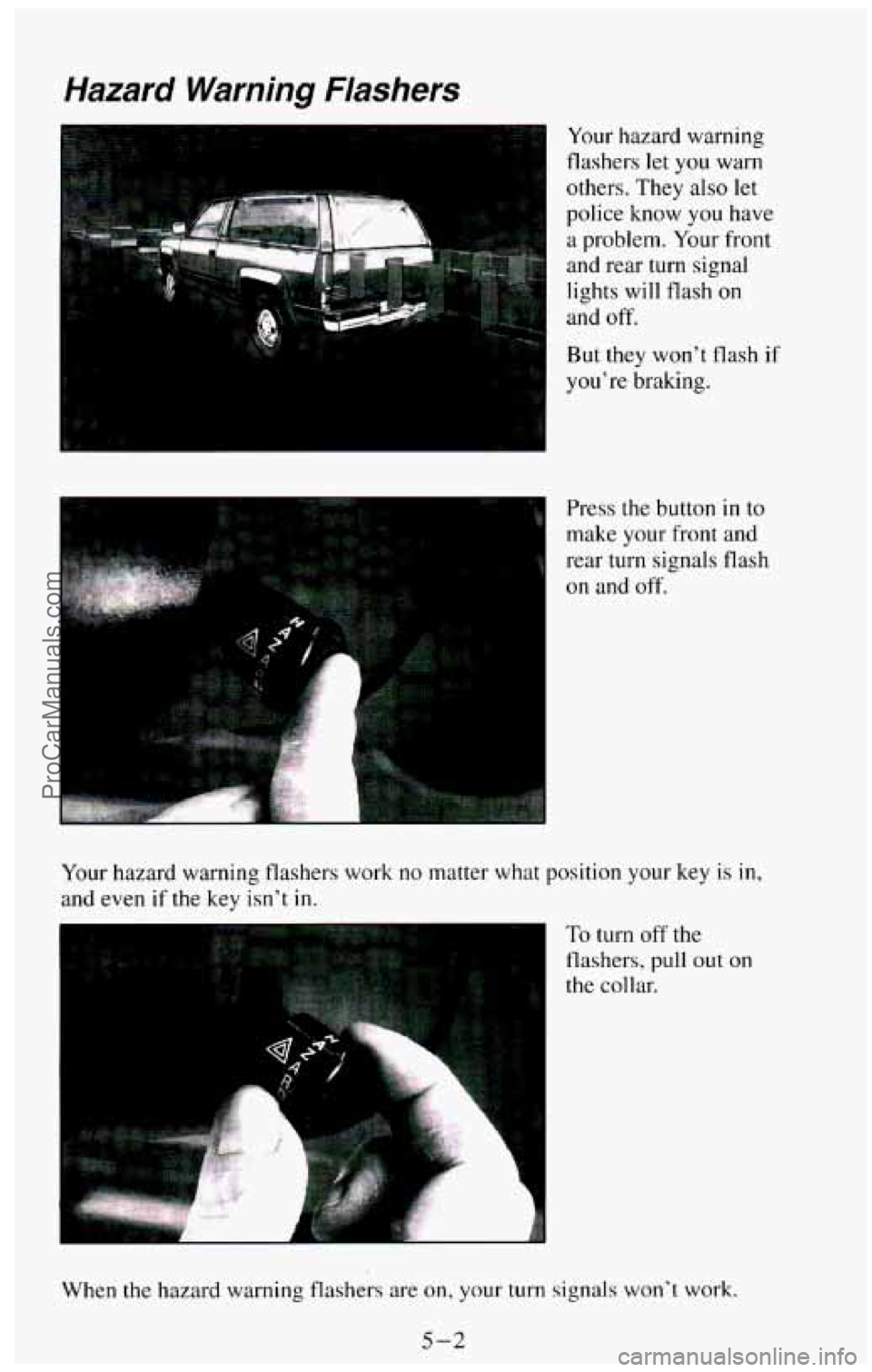
Your hazard warning
flashers let you warn
1
others. They also let
police know you have
a problem. Your front
and rear turn signal
lights will flash
on
and off.
But they won’t flash if
you’re braking.
Press the button
in to
make your front and
rear turn signals flash
on and
off.
Your hazard warning flashers work no matter what position your key is in,
and even if the key isn’t in.
PP . . lo turn orr me
flashers, pull out on
the collar.
When the
hazard warning flashers are on, your turn signals won’t work.
5-2
ProCarManuals.com
Page 206 of 385
Other Warning Devices
If you carry reflective triangles, you can use them to warn others. Set one up
at the side of the road about 300 feet (100 m) behind your vehicle.
Jump Starting
If your battery (or batteries) has run down, you may want to use another
vehicle and some jumper cables to start your vehicle.
But please follow the
steps below to do it safely.
NOTICE:
Ignoring these steps could result in costly damage to your
vehicle that wouldn’t be covered by your vehicle warranty.
Trying
to start your vehicle by pushing or pulling it could
damage your vehicle, even if you have
a manual transmission.
And if you have an automatic transmission, it won’t start that
way.
5-3
ProCarManuals.com
Page 210 of 385
9. Attach the cable at least 18 inches (45 cm) away from the dead battery,
but not near engine parts that move. The electrical connection
is just as
good there, but the chance of sparks getting back to the battery is much
less.
10. Now start the vehicle with the good battery and run the engine for
awhile.
1 1. Try to start the vehicle with the dead battery.
If it won't start after a few tries, it probably needs service.
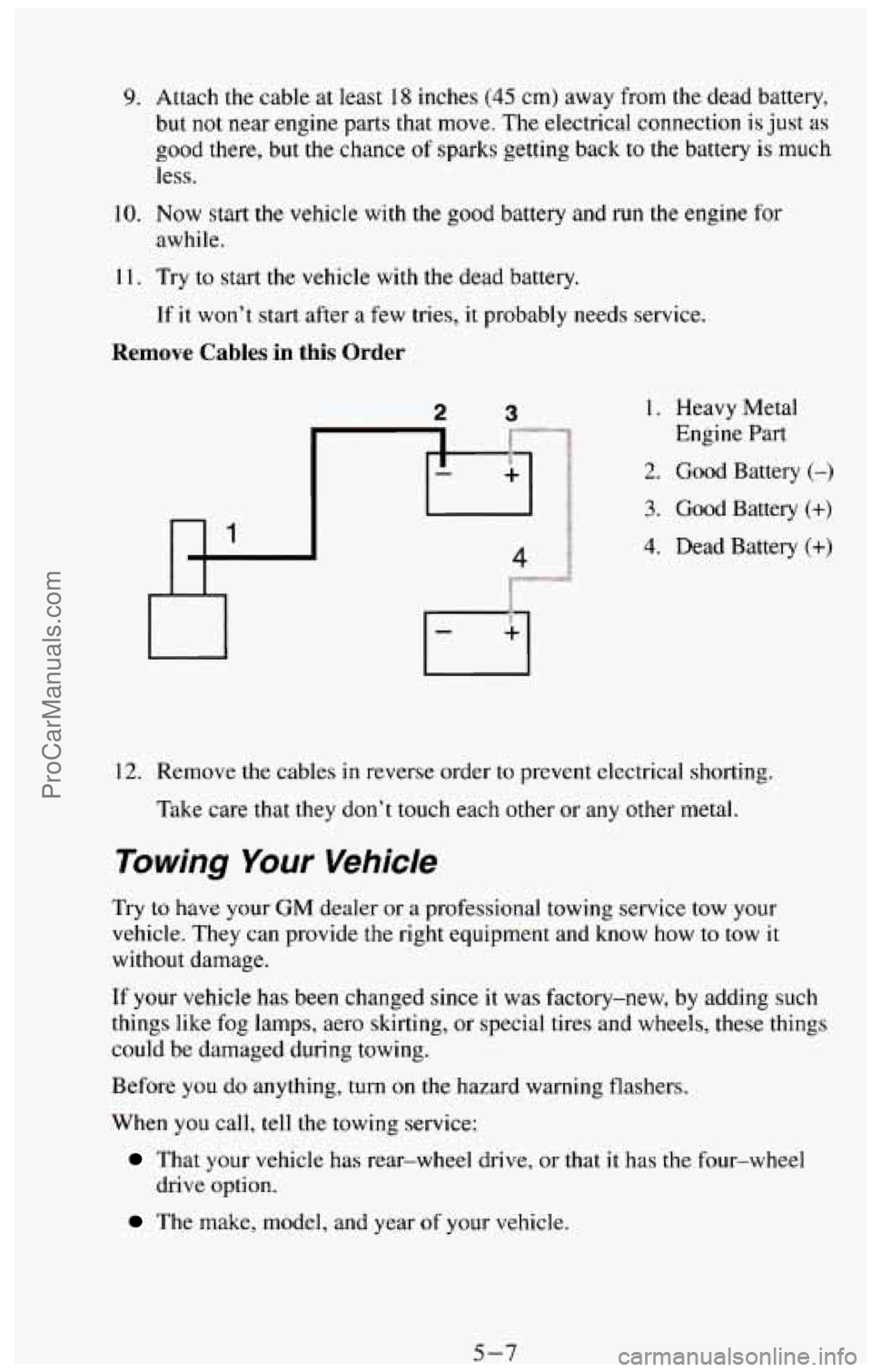
Remove Cables in this Order
1. Heavy Metal
Engine Part
2. Good Battery (-)
3. Good Battery (+)
4. Dead Battery (+)
12. Remove the cables in reverse order to prevent electrical shorting.
Take care that they don't touch each other
or any other metal.
Towing Your Vehicle
Try to have your GM dealer or a professional towing service tow your
vehicle. They can provide the right equipment and know how
to tow it
without damage.
If your vehicle has been changed since
it was factory-new, by adding such
things like fog lamps, aero skirting, or special tires and wheels, these things
could
be damaged during towing.
Before
you do anything, turn on the hazard warning flashers.
When you call,
tell the towing service:
That your vehicle has rear-wheel drive, or that it has the four-wheel
drive option.
The make, model, and year of your vehicle.
5-7 ProCarManuals.com
Page 215 of 385
If No Steam Is Coming From Your Engine
If you get the overheat warning but see or hear no steam, the problem may
not be too serious. Sometimes the engine can get a little too hot when you:
Climb a long hill on a hot day.
Stop after high speed driving.
Idle for long periods in traffic.
Tow a trailer.
If you get the overheat warning with no sign of steam, try this for a minute
or
so:
1. If you have an air conditioner, turn it off.
2. Turn on your heater to full hot at the highest fan speed and open the
3. If you’re in a traffic jam, shift to “N’ (Neutral).
window
as necessary.
If you
no longer have the overheat warning, you can drive. Just to be safe,
drive slower for about ten minutes. If the warning doesn’t come back on,
you can drive normally.
If the warning continues, pull over, stop, and park your vehicle right away.
If there’s still
no sign of steam, push the accelerator until the engine speed is
about twice as fast as normal idle speed. Bring the engine speed back to
normal idle speed after two or three minutes. Now see
if the warning stops.
But then, if
you still have the warning, TURN OFF THE ENGINE AND
GET EVERYONE OUT OF THE VEHICLE until it cools down.
You may decide not to lift the hood but to get service help right away.
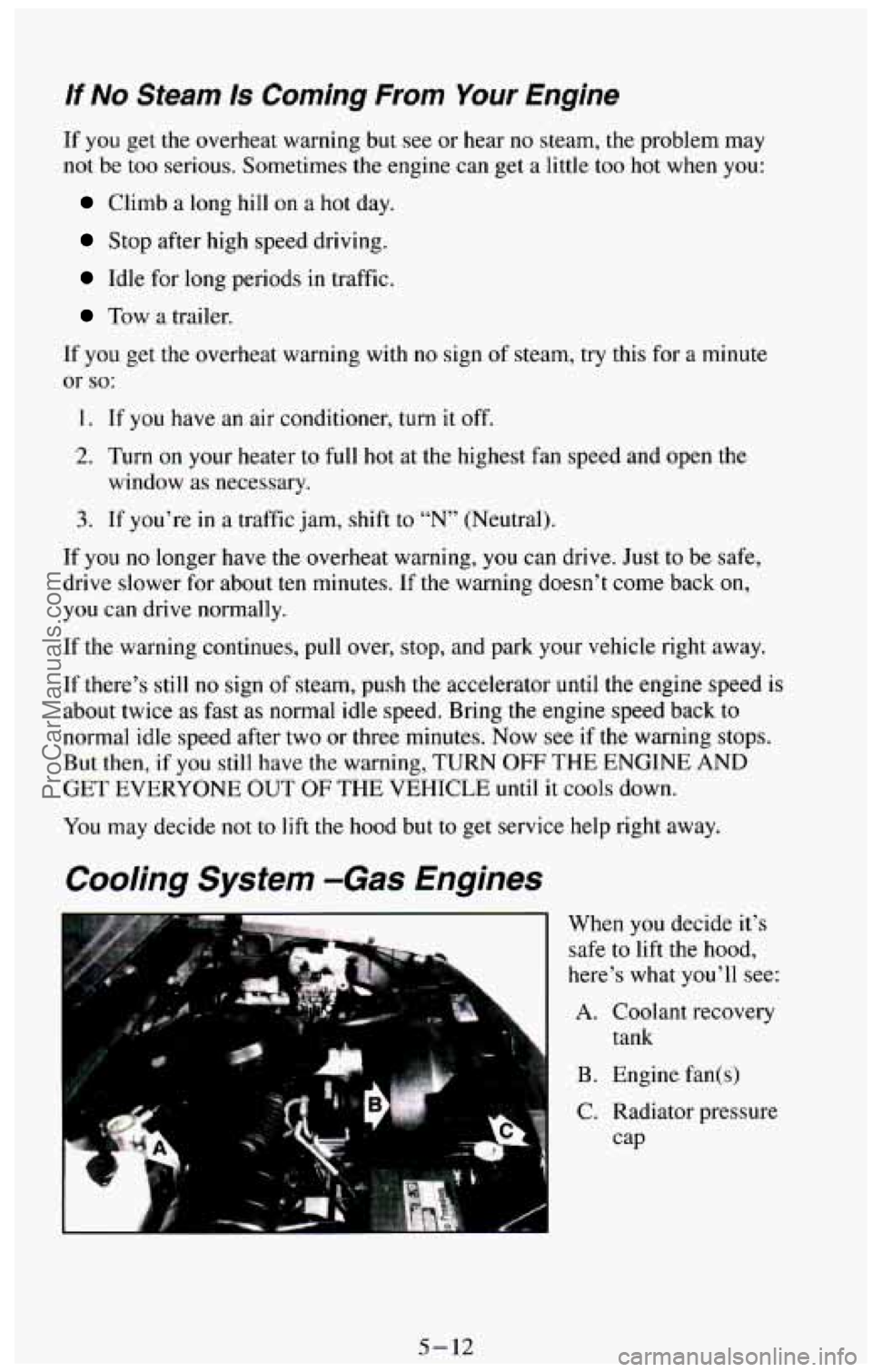
Cooling System -Gas Engines
When you decide it’s
safe to lift the hood,
here’s what you’ll see:
A. Coolant recovery
“I tank
B. Engine fan(s)
C. Radiator pressure
cap
5-12
ProCarManuals.com
Page 218 of 385
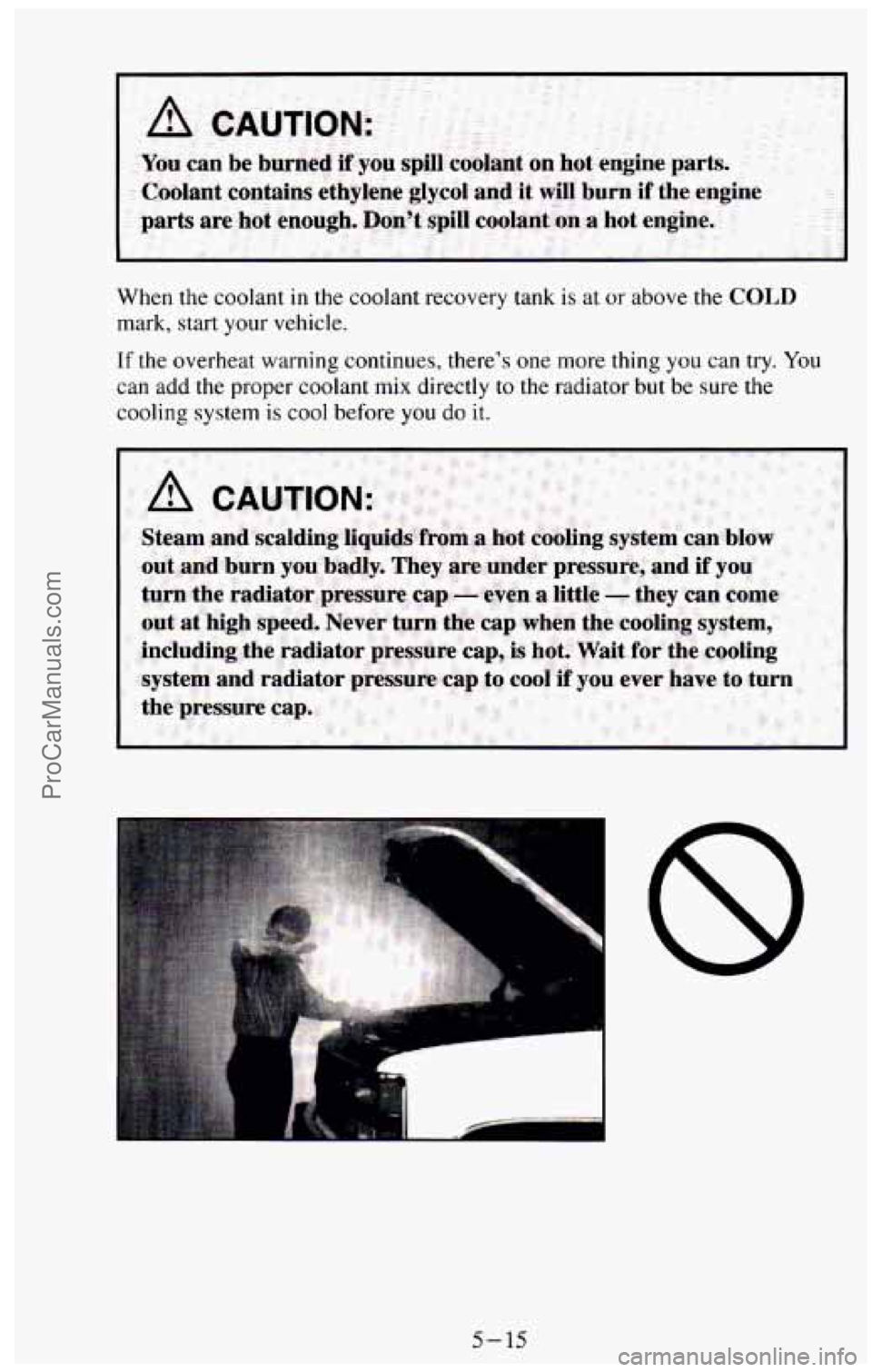
When the coolant in the coolant recovery tank is at or above the COLD
mark, start your vehicle.
If the overheat warning continues, there’s one more thing you can try. You
can add the proper coolant mix directly to the radiator but be sure the
cooling system
is cool before you do it.
”.
5-15
ProCarManuals.com
Page 228 of 385
Changing a Flat Tire
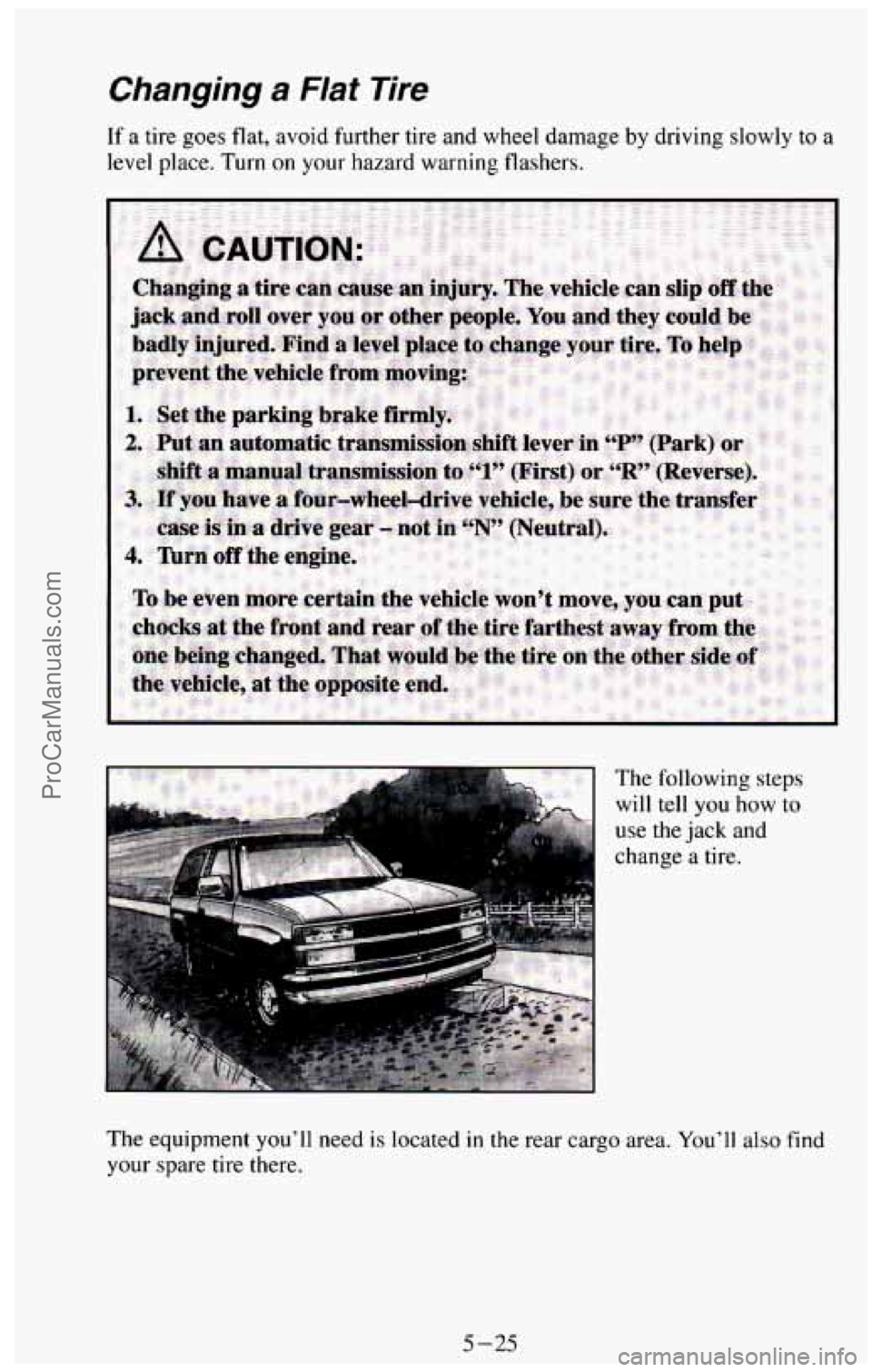
If a tire goes flat, avoid further tire and wheel damage by driving slowly to a
level place. Turn on your hazard warning flashers.
The following
steps
will tell you how to
use the jack and
change
a tire.
The equipment you’ll need is located
in the rear cargo area. You’ll also find
your spare tire there.
5-25
ProCarManuals.com
Page 252 of 385
Water in Fuel
Sometimes, water can be pumped into your fuel tank along with your diesel
fuel. This can happen if a service station doesn’t regularly inspect and clean
its fuel tanks, or if it gets contaminated fuel from its suppliers.
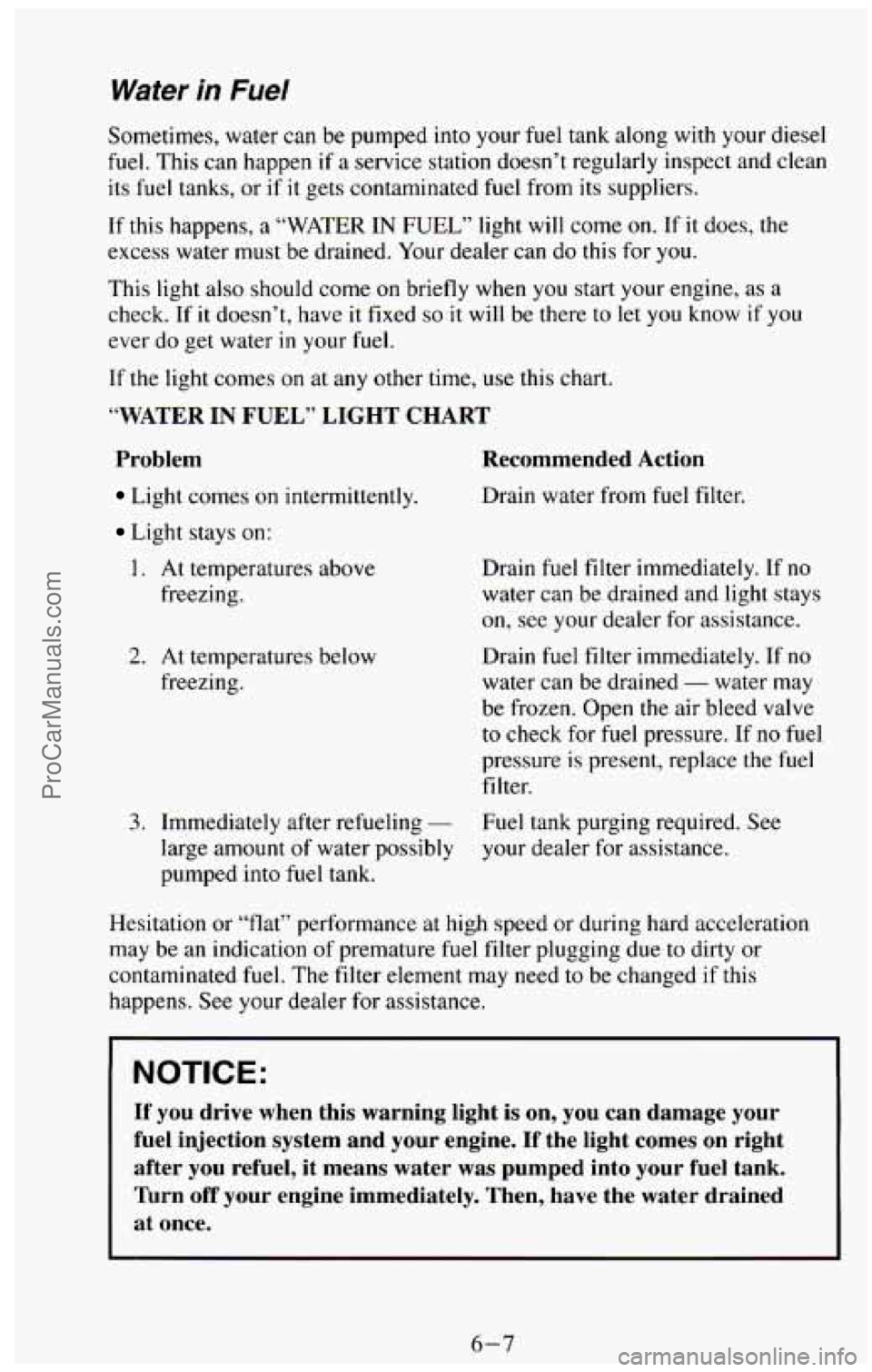
If this happens, a “WATER IN FUEL” light will come on. If it does, the
excess water
must be drained. Your dealer can do this for you.
This light
also should come on briefly when you start your engine, as a
check. If it doesn’t, have it fixed so it will be there to let you know if you
ever do get water
in your fuel.
If the light comes on at any other time, use this chart.
“WATER IN FUEL” LIGHT CHART
Problem
Light comes on intermittently.
Light stays on:
1. At temperatures above
freezing.
2. At temperatures below
freezing.
Recommended Action
Drain water from fuel filter.
Drain fuel filter immediately.
If no
water can be drained and light stays
on, see your dealer for assistance.
Drain fuel filter immediately. If no
water can be drained
- water may
be frozen. Open
the air bleed valve
to check for
fuel pressure. If no fuel
pressure
is present, replace the fuel
fi 1 ter.
3. Immediately after refueling - Fuel tank purging required. See
large amount
of water possibly your dealer for assistance.
pumped into fuel tank.
Hesitation or “flat” performance at
high speed or during hard acceleration
may be an indication of premature fuel filter plugging due to dirty or
contaminated
fuel. The filter element may need to be changed if this
happens. See your dealer for assistance.
If you drive when this warning light is on, you can damage your
fuel injection system and your engine.
If the light comes on right
after you refuel,
it means water was pumped into your fuel tank.
Turn
off your engine immediately. Then, have the water drained
at once.
6-7
ProCarManuals.com
Page 266 of 385
Engine Oil Additives
Don’t add anything to your oil. Your GM dealer is ready to advise if you
think something should be added.
When to Change Engine Oil
See if any one of these is true for you:
Most trips are less than 4 miles (6 km).
0 It’s below freezing outside and most trips are less than 10 miles (16 km).
The engine is at low speed most of the time (as in door-to-door
You tow a trailer often.
delivery,
or in stop-and-go traffic).
Most trips are through dusty places.
The vehicle is frequently operated off-road.
If any one
of these is true for your vehicle, then you need to change your oil
andfifilter every 3,000 miles (5 000 km) or 3 months - whichever comes
first
.
Light Duty Emissions:
If none of them is true, change the oil every 7,500 miles (12 500 km) or
12 months - whichever comes first. Change the filter at the first oil change
and at every other oil change after that.
Heavy Duty Emissions:
If none of them is true, change the oil every 6,000 miles ( 10 000 km) or
12 months - whichever comes first. Change the filter at the first oil change
and at every other oil change after that if mileage determines when you
change your oil.
If time determines when you change your oil, change the
filter each time you change your
oil.
Engine Coolant Heater (Engine Block Heater)
An engine coolant heater can be a big help if you have to park outside in
very cold weather,
0°F (-1 8 “C) or colder. If your vehicle has this option,
see “Engine Coolant Heater
” in the Index.
What to Do with Used Oil
Did you know that used engine oil contains certain elements that may be
unhealthy for your skin and could even cause cancer? Don’t let used oil stay
on your skin for very long. Clean your skin and nails with soap and water,
or
a good hand cleaner. Wash or properly throw away clothing or rags
containing
used engine oil. (See the manufacturer’s warnings about the use
and disposal of oil products.)
6-21
ProCarManuals.com
Page 271 of 385
This doughnut-shaped logo (symbol) is used on most oil containers to help
you select the correct oil.
You should look for this on the oil container, and use only those oils that
display the logo.
GM Goodwrench@ oil (in Canada, GM Engine Oil) meets all the
requirements for your vehicle.
Engine Oil Additives
Don’t add anything to your oil. Your GM dealer is ready to advise if you
think something should be added.
When to Change Engine Oil
See if any one of these is true for you:
Most trips are less than 4 miles (6 km).
0 It’s below freezing outside and most trips are less than 10 miles
0 The engine is at low speed most of the time (as in door-to-door
(16 km).
delivery,
or in stop-and-go traffic).
You tow a trailer often.
0 Most trips are through dusty places.
The vehicle is frequently operated off-road.
If any
of these is true for your vehicle, then you need to change your oil and
filter
every 2,500 miles (4 000 km) or 3 months - whichever comes first.
If none of them is true, change the oil and filter every 5,000 miles
(8 000 km) or 12 months - whichever comes first.
What to Do with Used Oil
Did you know that used engine oil contains certain elements that may be
unhealthy for your skin and could even cause cancer? Don’t let used oil stay
on your
skin for very long. Clean your skin and nails with soap and water,
or
a good hand cleaner. Wash or properly throw away clothing or rags
containing used engine
oil. (See the manufacturer’s warnings about the use
and disposal
of oil products.)
Used oil can be a real threat to the environment.
If you change your own oil.
be sure to drain all free-flowing oil from the filter before disposal. Don’t
ever dispose of oil by putting
it in the trash, pouring it on the ground, into
sewers, or into streams
or bodies of water. Instead, recycle it by taking it to
a place that collects used oil. If you have a problem properly disposing of
your used oil,
ask your dealer, a service station or a local recycling center
for help.
6-26
ProCarManuals.com
Page 280 of 385
Front Axle
When to Check and Change Lubricant
Refer to the Maintenance Schedule to determine how often to check the
lubricant and when to change
it. See “Scheduled Maintenance Services” in
the Index.
How to Check Lubricant
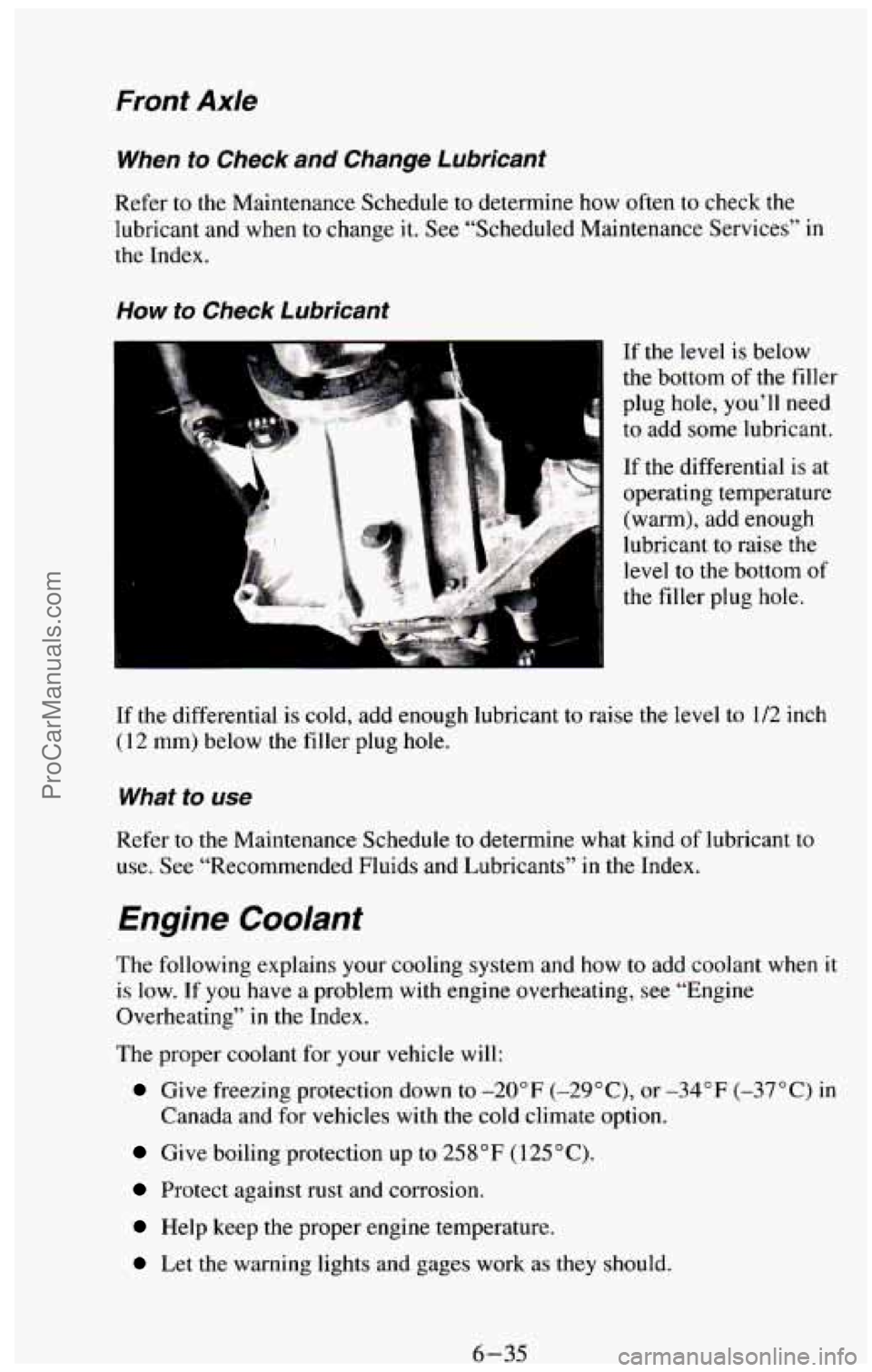
If the level is below
the bottom of the filler
plug hole, you’ll need
to add some lubricant.
If the differential is at
operating temperature
(warm), add enough
lubricant to raise the level
to the bottom of
the filler plug hole.
If the differential is cold, add enough lubricant to raise the level to
1/2 inch
(12 mm) below the filler plug hole.
What to use
Refer to the Maintenance Schedule to determine what kind of lubricant to
use. See “Recommended Fluids and Lubricants” in the Index.
Engine Coolant
The following explains your cooling system and how to add coolant when it
is low. If you have a problem with engine overheating, see “Engine
Overheating”
in the Index.
The proper coolant for your vehicle will:
Give freezing protection down to -20°F (-29”C), or -34°F (-37°C) in
Give boiling protection up to 258°F (1 25°C).
Protect against rust and corrosion.
Help keep the proper engine temperature.
Canada
and for vehicles with the cold climate option.
Let the warning lights and gages work as they should.
6-35 ProCarManuals.com