Electrical CHEVROLET SUBURBAN 1994 Owners Manual
[x] Cancel search | Manufacturer: CHEVROLET, Model Year: 1994, Model line: SUBURBAN, Model: CHEVROLET SUBURBAN 1994Pages: 385, PDF Size: 19.88 MB
Page 70 of 385
If your engine is already hot and then stalls, turn your ignition key to OFF.
Then turn your key to RUN and wait 20 seconds before you restart your
engine. When the engine starts, let
go of the key and the accelerator pedal.
NOTICE:
Your engine is designed to work with the electronics in your
vehicle. If you add electrical parts or accessories, you could
change the way the fuel injection system operates. Before adding
electrical equipment, check with your dealer.
If you don’t, your
engine might not perform properly.
If you ever have to have your vehicle towed, see the part of this
manual that tells how to do it without damaging your vehicle.
See “Towing Your Vehicle” in the Index.
Driving Through Deep Standing Water
NOTICE:
If you drive too quickly through deep puddles or standing water,
water can come in through your engine’s air intake and badly
damage your engine.
If you can’t avoid deep puddles or standing
water, drive through them very slowly.
Driving Through Water (Diesel Engines)
NOTICE:
Never drive through standing water more than 8 inches deep if
your vehicle has a diesel engine.
Also, don’t drive through any
standing water faster than
5 mph (8 km/h). If you do, water can
be drawn in through the air intake, and this can severely
damage your engine.
2-15
ProCarManuals.com
Page 73 of 385
To use the engine coolant heater, first turn off the engine. Then open the
hood, unwrap the electrical cord and plug it in. It uses normal house voltage
(1 10 volts), but:
NOTICE:
After you’ve used the coolant heater, be sure to store the \
cord in
the manner it was, to help keep it away from moving engine
parts.
If you don’t, it could be torn and damaged.
How long should you keep the coolant heater plugged in? The answer
depends
on the weather, the kind of oil you have, and some other things.
Follow this chart.
Engine Coolant Heater Usage
Viscosity/
Oil Grade
SAE
1 OW-30
SAE
15W-40
32°F to 0°F 0°F to -10°F Below -10°F
(o0C to -18°C) (-18°C to-23°C) Below
-23°C
Not
Required
Not
Required Two
Hours*
Two
Hours* Eight Hours*
or Overnight
Eight Hours* or Overnight
*The times listed are minimum times.
It will not harm either the coolant
heater or the vehicle to leave the coolant heater plugged
in longer than the
times stated.
For best results
in cold weather, use Number 1-D diesel fuel or a
“winterized” Number
2-D fuel.
2-18
ProCarManuals.com
Page 75 of 385
In very cold weather, 0°F (- 1 8 “C) or colder, the engine coolant heater can
help. You’ll get easier starting and better fuel economy during engine
warn-up. Usually, the coolant heater should be plugged in a minimum of
four hours prior to starting your vehicle.
To use the coolant heater:
1. Turn off the engine.
2. Open the hood and unwrap the electrical cord.
3. Plug it into a normal, grounded 1 10-volt outlet.
I
I
NOTICE:
After you’ve used the coolant heater, be sure to store the \
cord as
it was before
to keep it away from moving engine parts. If you
don’t, it could be damaged.
How long should you keep the coolant heater plugged in? The answer
depends on the weather, the kind of oil
you have, and some other things.
Instead
of trying to list everything here, we ask that you contact a GM
dealer in the area where you’ll be parking your vehicle. The dealer can give
you the best advice for that particular area.
2-20
ProCarManuals.com
Page 96 of 385
For a single wiping cycle, turn the band to MIST. Hold it there until the
wipers start, then let go.
The wipers will stop after one cycle. If you want
more cycles, hold
the band on MIST longer.
You can set the wiper speed for a long or short delay between wipes. This
can be very
useful in light rain or snow. Turn the band to choose the delay
time.
The closer to LO, the shorter the delay.
For steady wiping at low speed, turn the band to the LO position. For high
speed wiping, turn the band further, to
HI. To stop the wipers, move the
band to the off symbol.
Heavy snow or ice can overload your wipers.
The windshield wiper motor is
protected from overload by a circuit breaker and a
fuse. If the motor
overheats due to
heavy snow, etc., the wiper will stop until the motor cools.
Although
the circuit is protected from electrical overload, overload due to
heavy snow, etc. may cause wiper linkage damage. Always clear ice and
heavy snow from
the windshield before using your windshield wipers.
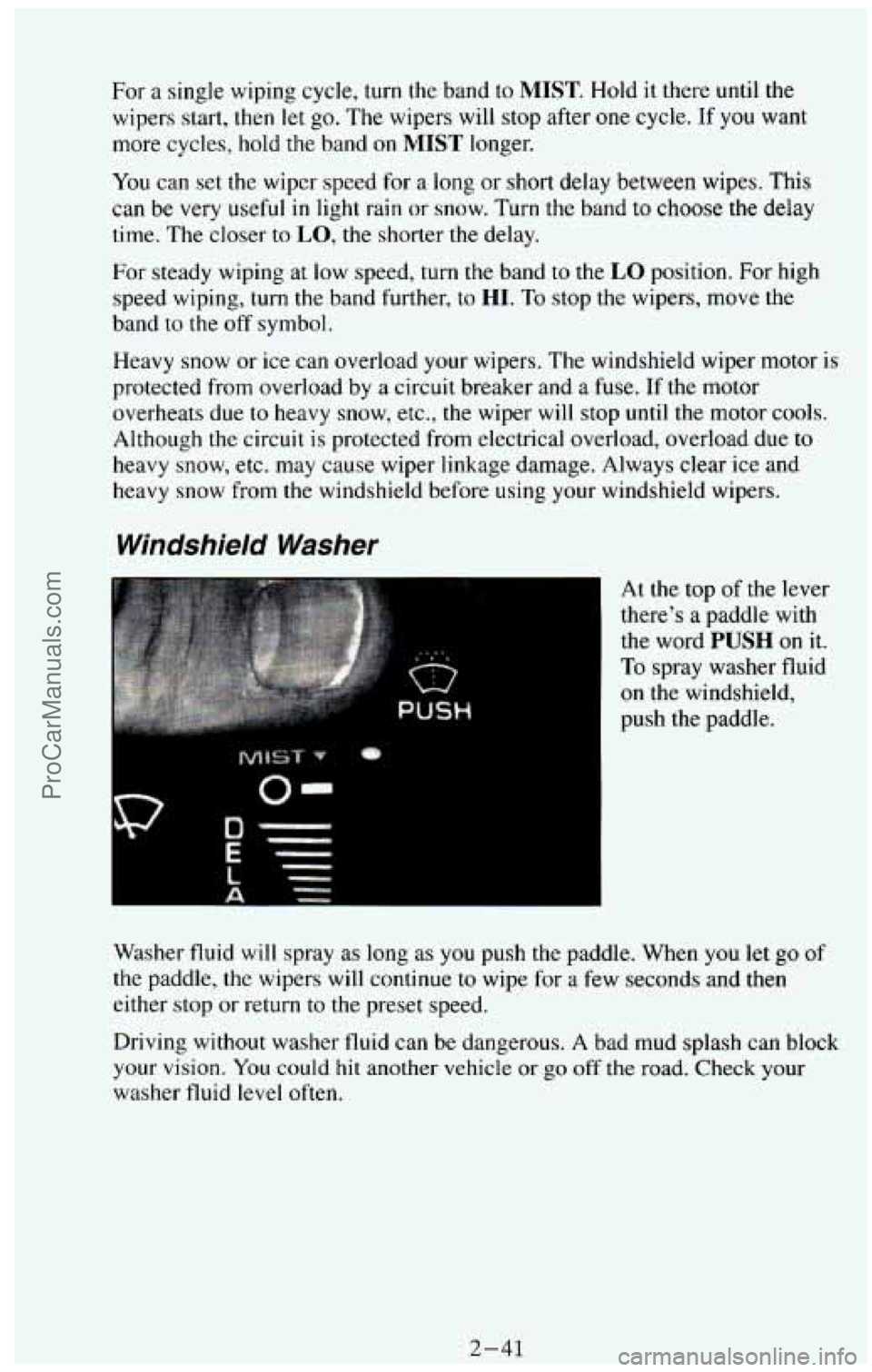
Windshield Washer
0-
At the top of the lever
there's
a paddle with
the word
PUSH on it.
To spray washer fluid
on the windshield,
push the paddle.
Washer fluid will spray as long
as you push the paddle. When you let go of
the paddle, the wipers will continue to wipe for a few seconds and then
either stop or return
to the preset speed.
Driving without washer fluid can be dangerous. A bad mud splash can block
your vision.
You could hit another vehicle or go off the road. Check your
washer fluid level often.
2-41 ProCarManuals.com
Page 102 of 385
Headlights and Vehicle Lighting
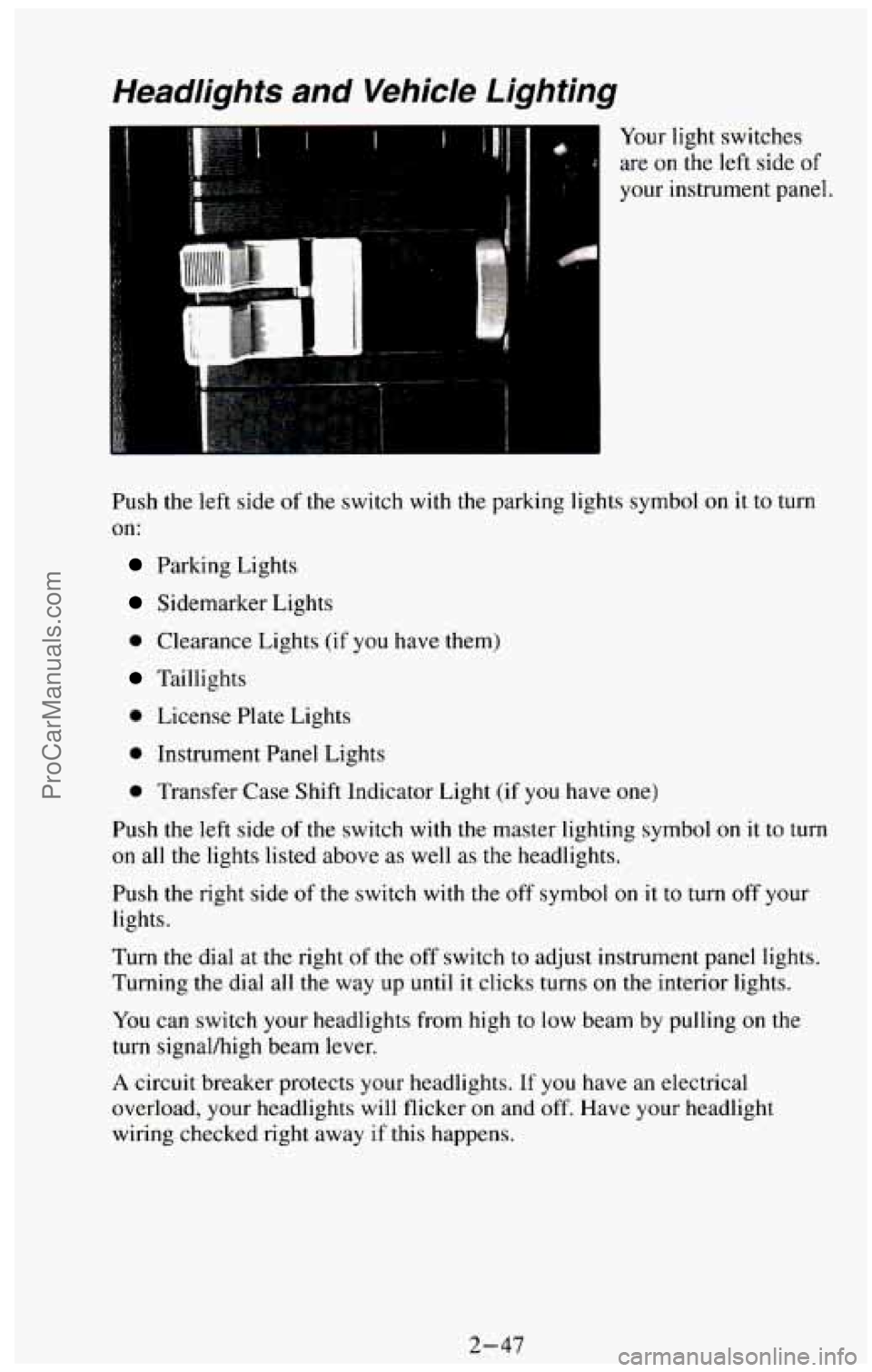
Your light switches
are
on the left side of
your instrument panel.
Push the left side of the switch with the parking lights symbol on it to turn
on:
Parking Lights
Sidemarker Lights
0 Clearance Lights (if you have them)
Taillights
0 License Plate Lights
0 Instrument Panel Lights
0 Transfer Case Shift Indicator Light (if you have one)
Push the left side of the switch with the master lighting symbol
on it to turn
on all the lights listed above as well as the headlights.
Push the right side
of the switch with the off symbol on it to turn off your
lights.
Turn the dial at
the right of the off switch to adjust instrument panel lights.
Turning the dial all the way up until it clicks turns
on the interior lights.
You
can switch your headlights from high to low beam by pulling on the
turn signal/high beam lever.
A circuit breaker protects your headlights. If you have an electrical
overload, your headlights will flicker
on and off. Have your headlight
wiring checked right away
if this happens.
2-47
ProCarManuals.com
Page 132 of 385
A reading in the low pressure zone may be caused by a dangerously low oil
level or other problem causing low oil pressure. Check your oil as soon as
possible.
I NOTICE:
Damage to your engine from neglected oil problems can be
costly and
is not covered by your warranty.
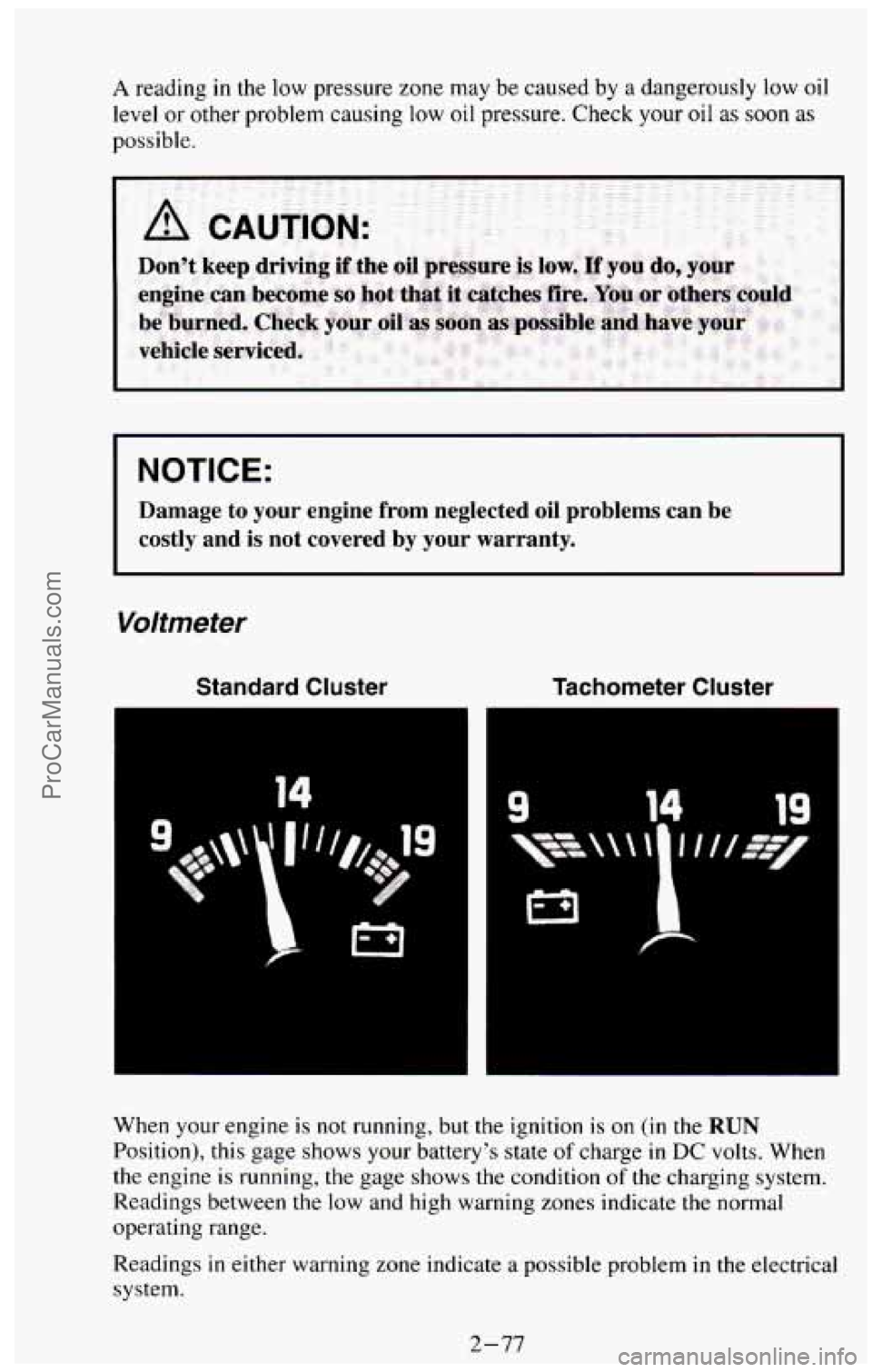
Voltmeter
Standard Cluster Tachometer Cluster
14
When your engine is not running, but the ignition is on (in the RUN
Position), this gage shows your battery’s state of charge in DC volts. When
the engine is running, the gage shows the condition
of the charging system.
Readings between the
low and high warning zones indicate the normal
operating range.
Readings
in either warning zone indicate a possible problem in the electrical
system.
2-77
ProCarManuals.com
Page 135 of 385
If you need to carry long items, move the cross rails as far apart as they
will go. Tie the load to the cross rails and the side rails or side rail
supports. Also tie
the load to the bumpers. Do not tie the load so tightly
that the cross rails or side rails are damaged.
After moving the cross rails, be sure to tighten all the slider screws.
Trailer Wiring Harness (Option)
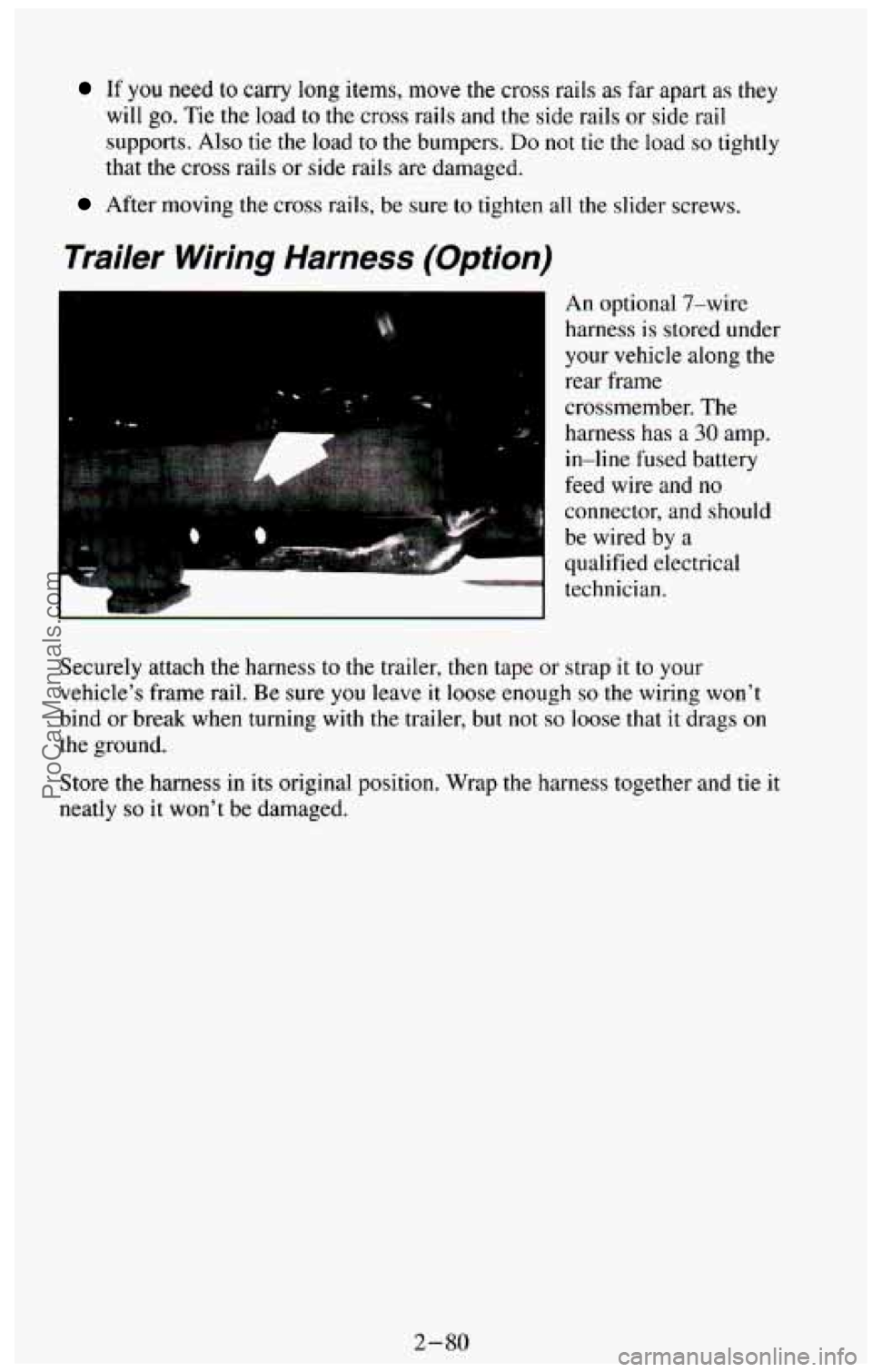
An optional 7-wire
harness
is stored under
your vehicle along the
rear frame
crossmember. The
harness has a
30 amp.
in-line fused battery
feed wire and no
connector, and should
be wired by a
qualified electrical
technician.
Securely attach the harness
to the trailer, then tape or strap it to your
vehicle’s frame rail. Be sure
you leave it loose enough so the wiring won‘t
bind or break when turning with the trailer, but
not so loose that it drags on
the ground.
Store the harness in its original position. Wrap the harness together and tie it
neatly so it won’t be damaged.
2-80
ProCarManuals.com
Page 149 of 385
A udia Systems
Your Delco@ audio system has been designed to operate easily and give
years
of listening pleasure. You will get the most enjoyment out of it if you
acquaint yourself with it first. Find out what your Delco@ system can do
and how to operate all its controls, to be sure you’re getting the most out of
the advanced engineering that went into it.
Be aware that hearing damage from loud noise is almost undetectable until
it is too late. Your hearing can adapt to higher volumes of
sound. Sound that
seems normal can be loud and harmful to your hearing. Take precautions by
adjusting the volume control on your radio to
a safe sound level before your
hearing adapts to it.
To help avoid hearing loss or damage:
0 Adjust the volume control to the lowest setting.
0 Increase volume slowly until you hear comfortably and clearly.
FM Stereo
FM stereo will give you the best sound. But FM signals can only reach
about 10 to
40 miles (16 to 65 km). And, tall buildings or hills can interfere
with FM signals, causing the sound
to come and go.
AM
The range for most AM stations is greater than for FM, especially at night.
The longer range, however, can cause stations to interfere with each other.
AM can pick up noise from things like electrical storms and power lines.
If
the noise interferes with your listening, try reducing the treble to lessen the
noise.
AM Stereo
This means the Delco@ system can receive C-QUAM@ stereo broadcasts.
Many
AM stations around the country use C-QUAM@ to produce stereo,
though some
do not. If your Delco@ system can get C-QUAM@, your
“STEREO” light will come on when you’re receiving it. (C-QUAM@ is a
registered trademark of Motorola, Inc.).
3-12
ProCarManuals.com
Page 199 of 385
Trailer Brakes
If your trailer weighs more than 1,000 pounds (450 kg) loaded, then it needs
its own brakes
- and they must be adequate. Be sure to read and follow the
instructions for the trailer brakes
so you’ll be able to install, adjust and
maintain them properly.
Your trailer brake system can tap into your vehicle’s hydraulic brake system,
but consider the following:
Will the trailer brake system use more than 0.02 cubic inch (0.3 cc) of
fluid from your vehicle’s master cylinder? If it will, don’t tap into your
vehicle’s brake system. Both braking systems
won’t work well, and you
could even lose your brakes altogether.
not, the trailer brake system must not be used with your vehicle.
If everything checks
out this far, make the brake tap at the port on the
master cylinder that sends the fluid to the rear brakes. But don’t use copper
tubing for this. if you do, it will bend and finally break
off. Use steel brake
tubing.
Will the trailer brake parts take 3,000 psi (20 650 kPa) of pressure? If
Driving with a Trailer
Towing a trailer requires a certain amount of experience. Before setting out
for the open road,
you’ll want to get to know your rig. Acquaint yourself
with the feel
of handling and braking with the added weight of the trailer.
And always keep
in mind that the vehicle you are driving is now a good
deal longer and not nearly so responsive as your vehicle is by itself.
Before
you start, check the trailer hitch and platform, safety chains,
electrical connector, lights, tires and mirror adjustment. If the trailer has
electric brakes, start your vehicle and trailer moving and then apply the
trailer brake controller by hand to be sure the brakes are working. This lets
you check your electrical connection at the same time.
4-40
ProCarManuals.com
Page 207 of 385
Tu Jump Start Your Vehicle;
1. Check the other vehicle. It must have a 12-volt battery with a negative
ground system.
I NOTICE:
I
If the other system isn’t a 12-volt system with a negative
ground, both vehicles can be damaged.
If you have a diesel engine vehicle with two batteries (or more), you
should know before you begin that, especially in cold weather, you may
not be able to get enough power from a single battery in another
vehicle to start your diesel engine.
If your vehicle has more than one battery, use the battery that’s on the
passenger side
of the vehicle - this will reduce electrical resistance.
2. Get the vehicles close enough so the jumper cables can reach, but be
sure the vehicle’s aren’t touching each other.
If they are, it could cause
a ground connection
you don’t want. You wouldn’t be able to start your
vehicle, and the bad grounding could damage the electrical systems.
You could be injured if
the vehicles roll. Set the parking brake firmly
on each vehicle. Put an automatic transmission in “P’ (Park) or a
manual transmission in “N’ (Neutral). If you have a four-wheel-drive
vehicle, be sure the transfer case is not in “N” (Neutral).
3. Turn off the ignition on both vehicles. Turn off all lights that aren’t
needed, and radios. This will avoid sparks and help save both batteries.
And it could save your radio!
NOTICE:
If you leave your radio on, it could be badly damaged. The
repairs wouldn’t
be covered by your warranty.
4. Open the hoods and locate the batteries. Find the positive (+) and
negative
(-) terminals on each battery.
5-4
ProCarManuals.com