mirror CHEVROLET SUBURBAN 1994 Owners Manual
[x] Cancel search | Manufacturer: CHEVROLET, Model Year: 1994, Model line: SUBURBAN, Model: CHEVROLET SUBURBAN 1994Pages: 385, PDF Size: 19.88 MB
Page 57 of 385
Parking Over Things That Burn ........................ ... 2-30
Running Your Engine While You’re Parked
..................... 2-31
EngineExhaust
........................................... 2-31
Four-WheelDrive
..................................... 2-32
Transfer Case
............................................. 2-33
Front Axle Locking Feature
.................................. 2-34
Windows
................................................ 2-35
Ho~ .................................................... 2-37
Tiltwheel
............................................. 2-37
Multifunction Lever
........................................ 2-38
Turn Signal and Lane Change Indicator
...................... 2-39
Windshield Wipers
......................................... 240
Headlight
High-Low Beam
................................ 2-40
Windshield Washer
........................................ 2-41
Cruise Control
........................................... 2-42
Headlights and Vehicle Lighting
.............................. 247
Mirrors
.................................................. 2-51
SunVisors
............................................... 2-53
Rear Window Wiper and Washer
.............................. 2-54
Storage Compartments
...................................... 2-56
Instrument Cluster
......................................... 2-64
Warning and Indicator Lights
.............................. 2-66
Luggagecarrier
........................................... 2-79
Trailer Wiring Harness
.................................... 2-80
Cigarette LightedAshtrays
............... ................ 2-55
Gages
................................................ 2-74
ProCarManuals.com
Page 106 of 385
When you are done
using the light, reel
the cord back into the
housing by turning the
handle.
Then, slide the light into the holder. Press
PUSH on the lever to hook the
light into the holder.
Mirrors
Inside Mirror
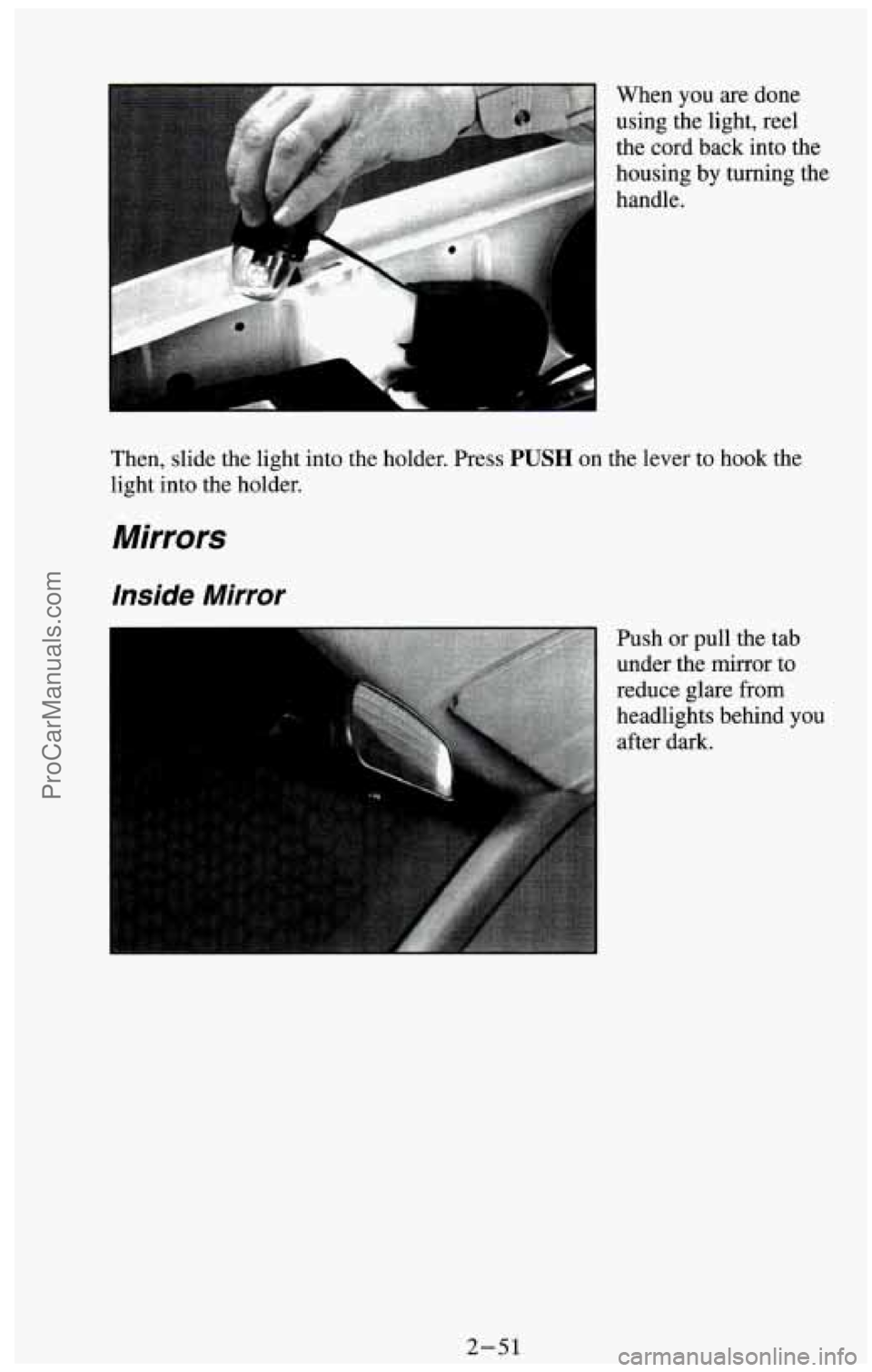
Push or pull the tab
under the mirror to
reduce glare from
headlights behind you
after dark.
2-51
ProCarManuals.com
Page 107 of 385
Outside Mirrors
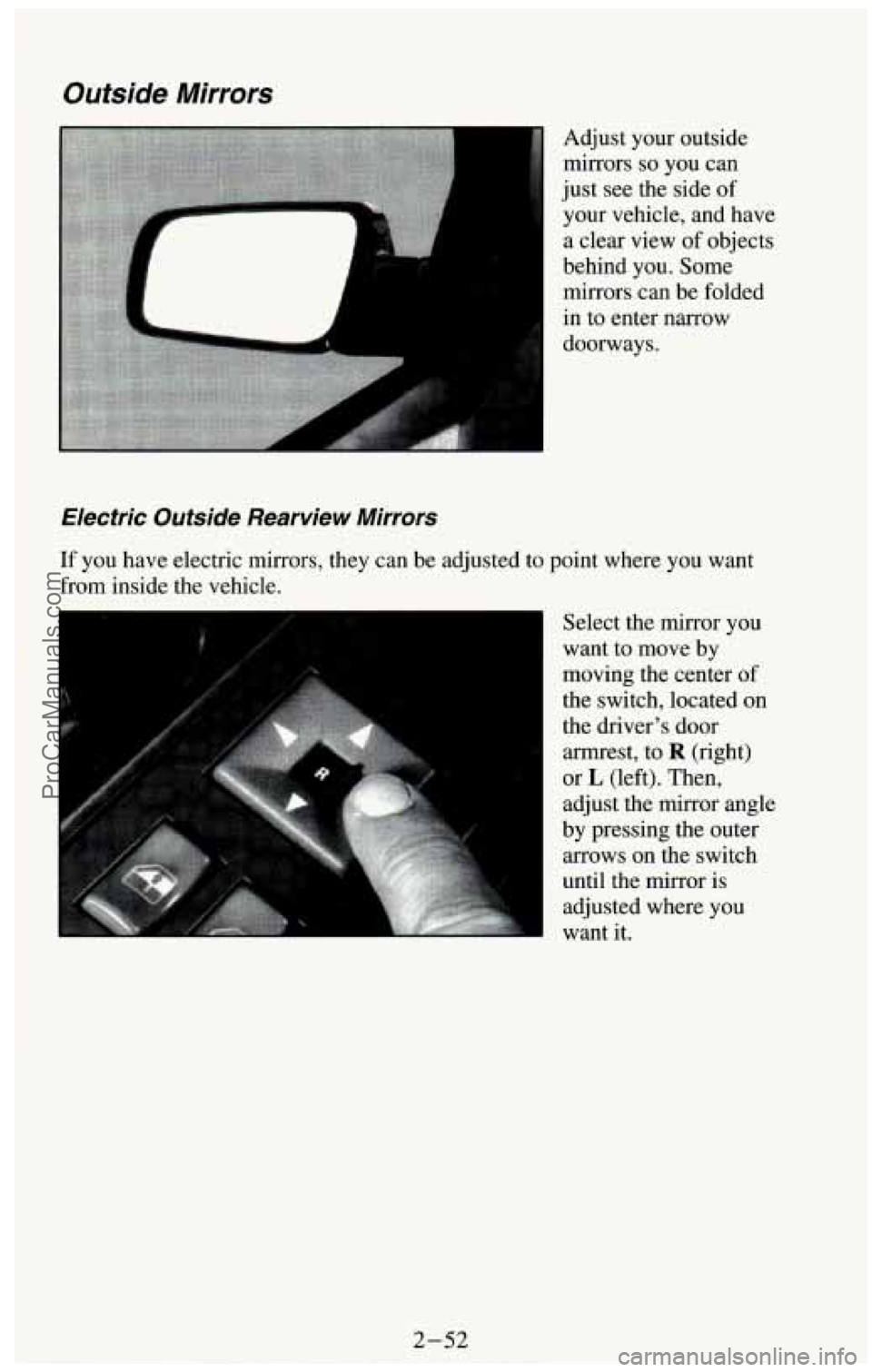
Adjust your outside
mirrors
so you can
just see the side of
your vehicle, and have
a clear view
of objects
behind you. Some
mirrors can be folded
in to enter narrow
doorways.
Electric Outside Rearview Mirrors
If you have electric mirrors, they can be adjusted to point where you want
from inside the vehicle.
Select the mirror you
want to move by
moving the center of
the switch, located on
the driver’s door
armrest, to
R (right)
or
L (left). Then,
adjust the mirror angle
by pressing the outer arrows on the switch
until the mirror is
adjusted where you
want
it.
2-52
ProCarManuals.com
Page 108 of 385
Convex Outside Mirror
Your right side mirror may be convex.
A convex mirror’s surface is curved so you can see more from the driver’s
seat.
Sun Visors
To block out glare, you can swing down the visors. You can also swing them
out to help block glare at the front
and side windows.
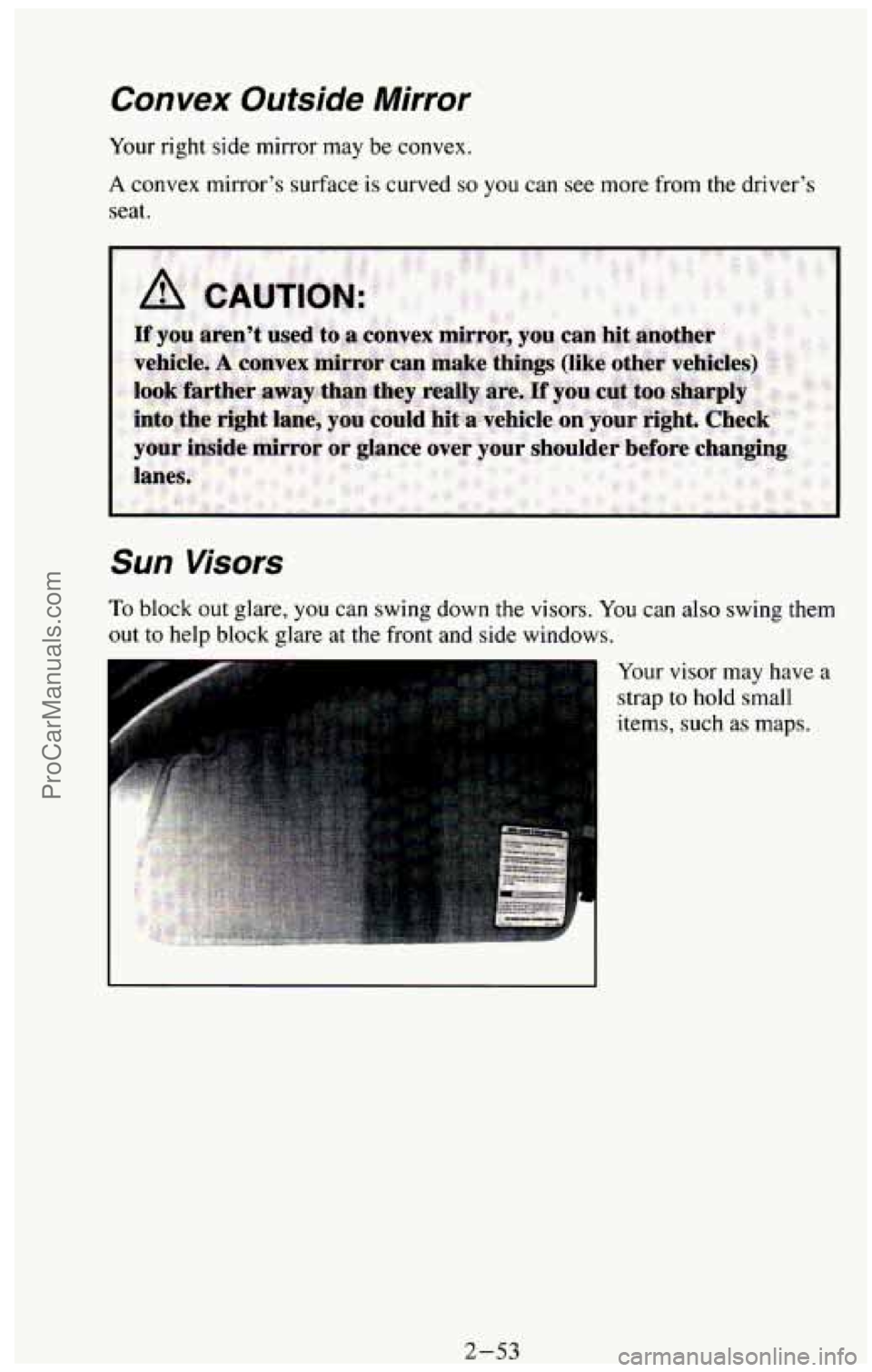
Your visor
may have a
I strap to hold small
items, such as maps.
2-53 ProCarManuals.com
Page 109 of 385
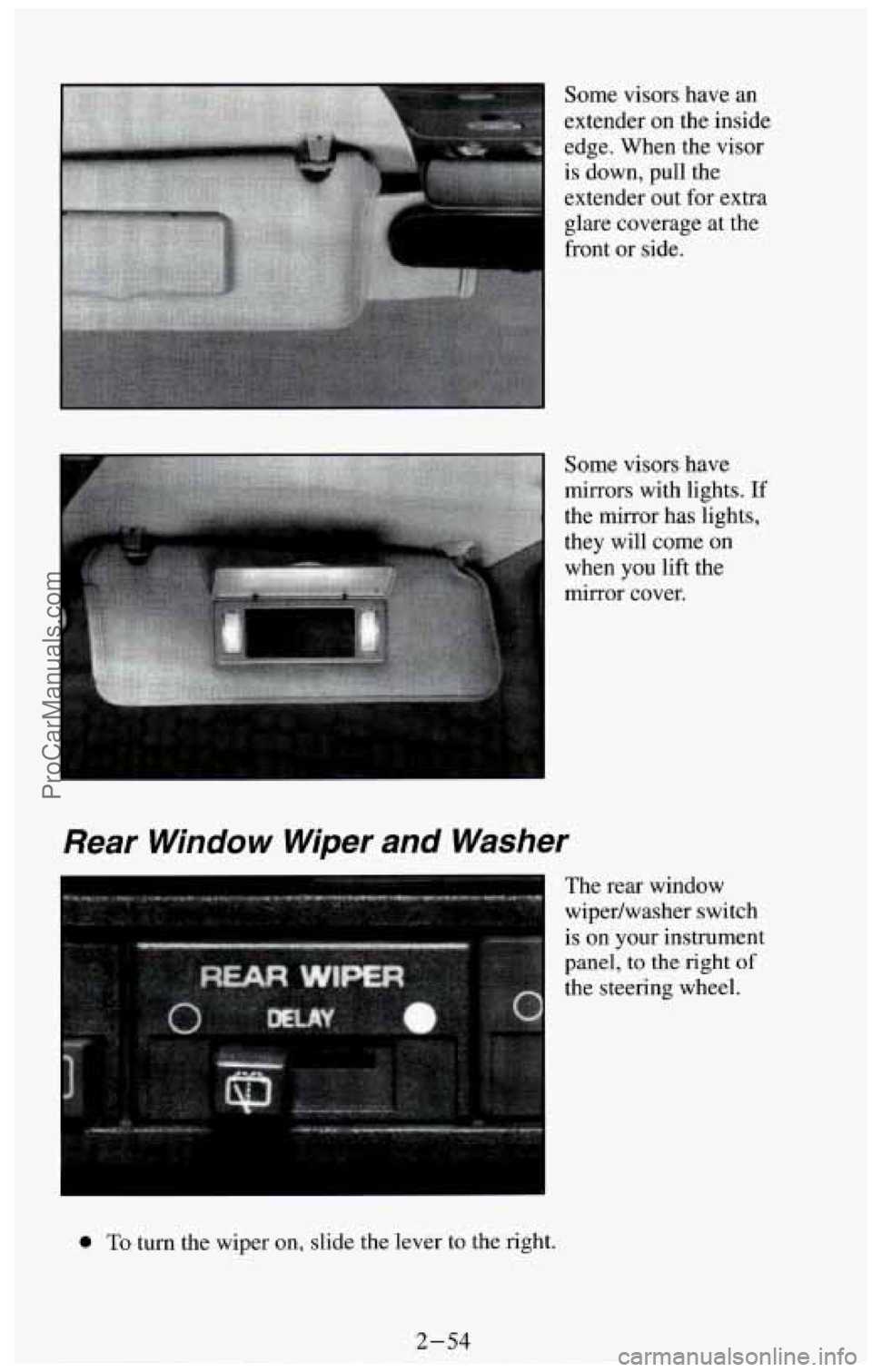
Some visors have an
extender on the inside
edge. When the visor
is down, pull the
extender out for extra
glare coverage at the
front or side.
Some visors have
mirrors with lights.
If
the mirror has lights,
they will come on
when you lift the
mirror cover.
Rear Window Wiper and Washer
The rear window
wipedwasher switch
is
on your instrument
panel,
to the right of
the steering wheel.
0 To turn the wiper on, slide the lever to the right.
2-54
ProCarManuals.com
Page 169 of 385
0
0
0
0
0
a
a
0
Watch for traffic signs, pavement markings, and lines. If you can see a
sign
up ahead that might indicate a turn or an intersection, delay your
pass. A broken center line usually indicates it’s all right to pass
(providing the road ahead is clear). Never cross a solid line on your
side of the lane or a double solid line, even if the road seems empty of
approaching traffic.
Do not get too close to the vehicle you want to pass while you’re
awaiting
an opportunity. For one thing, following too closely reduces
your area
of vision, especially if you’re following a larger vehicle.
Also, you won’t have adequate space if the vehicle ahead suddenly
slows or stops. Keep back a reasonable distance.
When it looks like
a chance to pass is coming up, start to accelerate but
stay in the right
lane and don’t get too close. Time your move so you
will be increasing speed as the time comes to move into the other lane.
If the way is clear to pass, you will have a “running start” that more
than makes up for the distance you would lose by dropping back. And
if something happens to cause
you to cancel your pass, you need only
slow down and drop back again and wait for another opportunity.
If other cars are lined up to pass a slow vehicle, wait your turn. But
take care that someone isn’t trying
to pass you as you pull out to pass
the slow vehicle. Remember
to glance over your shoulder and check
the blind spot.
Check your mirrors
, glance over your shoulder, and start your left lane
change signal before moving out of the right lane to pass. When
you
are far enough ahead of the passed vehicle to see its front in your inside
mirror, activate your right lane change signal and move back into the
right lane. (Remember that
if your right outside mirror is convex, the
vehicle you just passed may seem to be farther away from
you than it
really is.)
Try not
to pass more than one vehicle at a time on two-lane roads.
Reconsider before passing the next vehicle.
Don’t overtake a slowly moving
vehicle too rapidly. Even though the
brake lights are not flashing, it may be slowing down or starting to turn.
If you’re being passed, make it easy for the following driver to get
ahead
of you. Perhaps you can ease a little to the right.
Loss of Control
Let’s review what driving experts say about what happens when the three
control systems (brakes, steering and acceleration) don’t have enough
friction where the tires meet
the road to do what the driver has asked.
In any emergency, don’t give up. Keep trying to steer and constantly seek
an
escape route or area of less danger.
4-10
ProCarManuals.com
Page 170 of 385
Skidding
In a skid, a driver can lose control of the vehicle. Defensive drivers avoid
most skids by taking reasonable care suited to existing conditions, and by
not “overdriving” those conditions. But skids are always possible.
The three types
of skids correspond to your vehicle’s three control systems.
In the braking skid your wheels aren’t rolling. In the steering or cornering
skid, too much speed or steering
in a curve causes tires to slip and lose
cornering force. And
in the acceleration skid too much throttle causes the
driving wheels to spin.
A cornering skid and an acceleration skid are best handled by easing your
foot off
the accelerator pedal.
If your vehicle starts to slide, ease your foot off the accelerator pedal and
quickly steer the way you want the vehicle to
go. If you start steering
quickly enough, your vehicle may straighten out. Always be ready for a
second skid if it occurs.
Of course, traction is reduced when water, snow, ice, gravel, or other material
is on the road. For safety, you’ll want to slow down and adjust your driving
to
these conditions. It is important to slow down on slippery surfaces because
stopping distance will be longer and vehicle control more limited.
While driving on a surface
with reduced traction, try your best to avoid
sudden steering, acceleration, or braking (including engine braking by
shifting to a lower gear).
Any sudden changes could cause the tires to slide.
You may not realize the surface is slippery
until your vehicle is skidding.
Learn to recognize warning clues
- such as enough water, ice or packed
snow on the road to make a “mirrored surface”
- and slow down when you
have
any doubt.
Remember: Any anti-lock braking
system (ABS) helps avoid only the
braking skid.
Driving Guidelines
This multipurpose passenger vehicle is defined as a utility vehicle in
Consumer Information Regulations issued by the National Highway Traffic
Safety Administration (NHTSA) of the United States Department of
Transportation. Utility vehicles have higher ground clearance and a narrower
track to make them capable
of performing in a wide variety of off-road
applications. Specific design characteristics give them
a higher center of
gravity than ordinary cars.
An advantage of the higher ground clearance is a
better view of the road allowing you to anticipate problems. They are not
designed for cornering at the same speeds as conventional 2-wheel drive
vehicles any more than low-slung
sports cars are designed to perform
satisfactorily under off-road conditions.
If at all possible, avoid sharp turns or
abrupt maneuvers. As
with other vehicles of this type, failure to operate this
vehicle correctly may result in loss of control or vehicle rollover.
4-11
ProCarManuals.com
Page 182 of 385
After Off-Road Driving
Remove any brush or debris that has collected on the underbody, chassis or
under the hood. These accumulations can be a fire hazard.
After operation in mud or sand, have the brake linings cleaned and checked.
These substances can
cause glazing and uneven braking. Check the body
structure, steering, suspension, wheels, tires, and exhaust system for
damage. Also, check the fuel lines and cooling system for any leakage.
Your vehicle will require more frequent service due to off-road use. Refer
to the Maintenance Schedule for additional information.
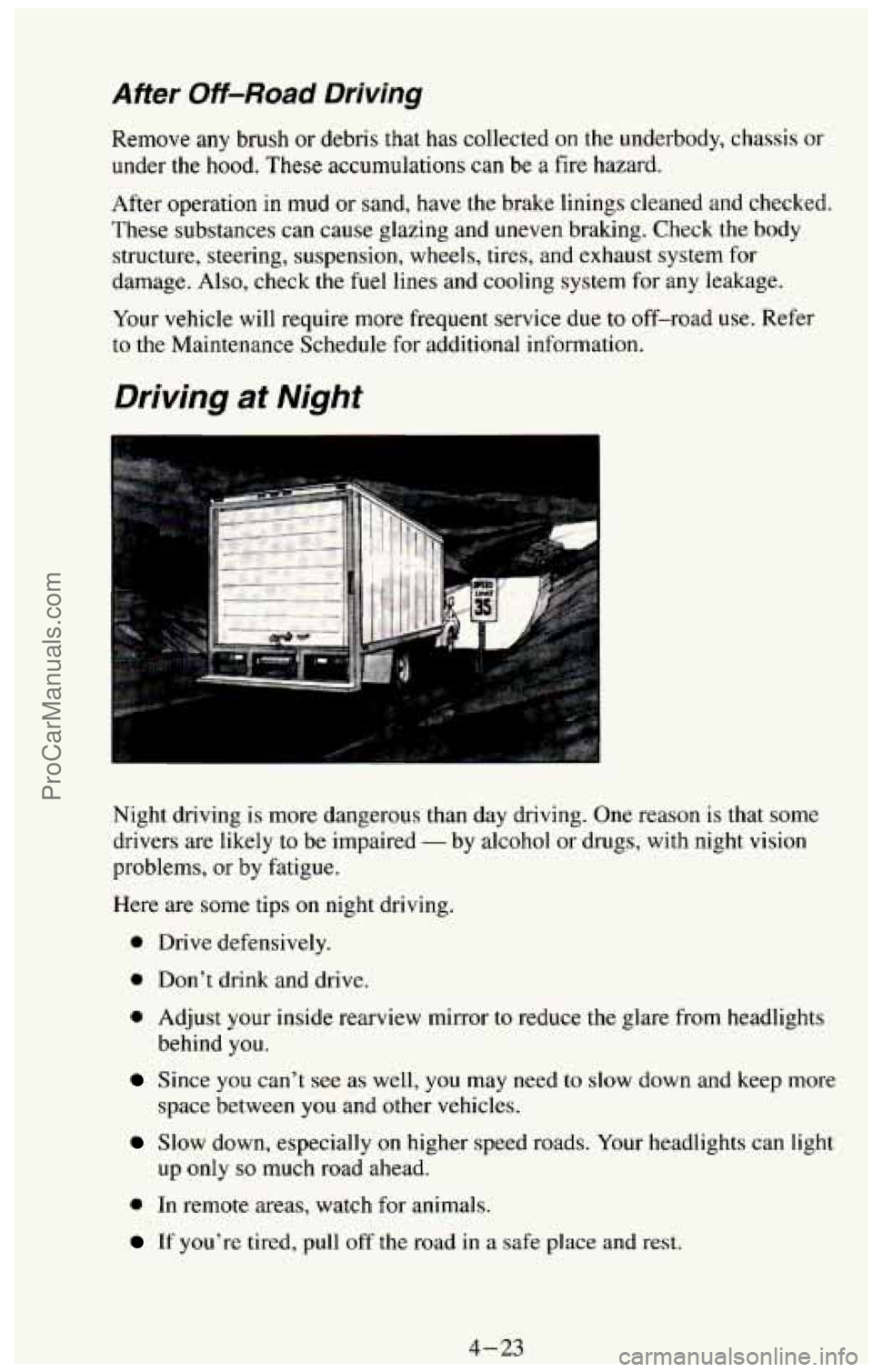
Driving at Night
Night driving is more dangerous than day driving. One reason is that some
drivers are likely
to be impaired - by alcohol or drugs, with night vision
problems, or by fatigue.
Here are some tips
on night driving.
0 Drive defensively.
0 Don't drink and drive.
0 Adjust your inside rearview mirror to reduce the glare from headlights
behind
you.
Since you can't see as well, you may need to slow down and keep more
space between you and other vehicles.
up
only so much road ahead.
Slow down, especially on higher speed roads. Your headlights can light
0 In remote areas, watch for animals.
If you're tired, pull off the road in a safe place and rest.
4-23 ProCarManuals.com
Page 186 of 385
e
e
e
Know the best way to get to where you are going. Get a city map and
plan your trip into an unknown part
of the city just as you would for a
cross-country trip.
Try to use the freeways that rim and crisscross most large cities. You’ll
save time and energy. (See the
next section, “Freeway Driving.”)
Treat a green light as a warning signal.
A traffic light is there because
the corner is busy enough to need
it. When a light turns green, and just
before you start to move, check both ways for vehicles that have not
cleared the intersection or may be running
the red light.
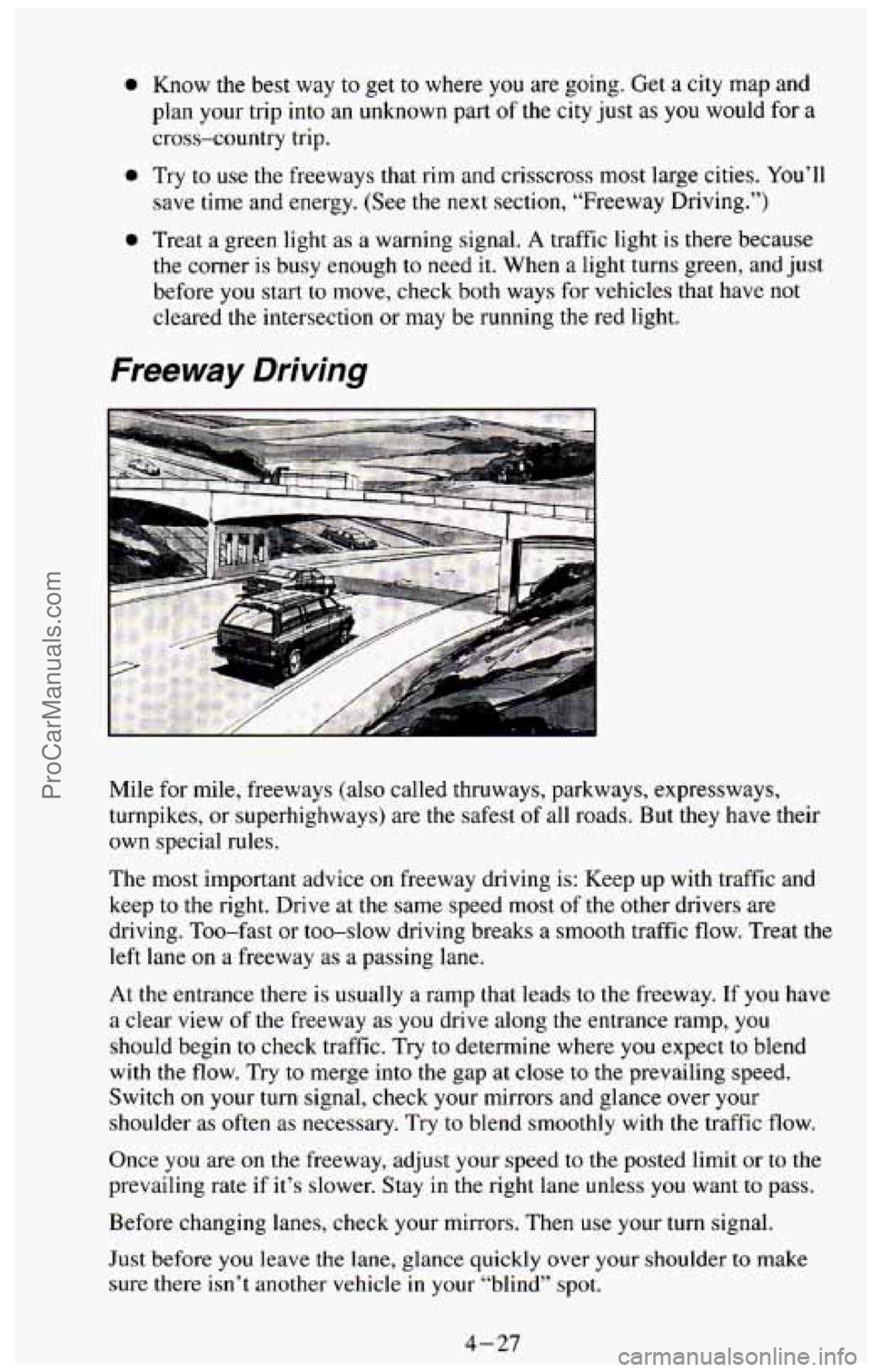
Freeway Driving
Mile for mile, freeways (also called thruways, parkways, expressways,
turnpikes, or superhighways) are
the safest of all roads. But they have their
own special rules.
The most important advice
on freeway driving is: Keep up with traffic and
keep to
the right. Drive at the same speed most of the other drivers are
driving.
Too-fast or too-slow driving breaks a smooth traffic flow. Treat the
left lane on a freeway as a passing lane.
At the entrance there is usually a ramp that leads to the freeway.
If you have
a clear view of the freeway as you drive along the entrance ramp, you
should begin to check traffic. Try to determine where you expect to blend
with the flow. Try to merge into the gap at close to the prevailing speed.
Switch
on your turn signal, check your mirrors and glance over your
shoulder as often as necessary.
Try to blend smoothly with the traffic flow.
Once you are on the freeway, adjust your speed to the posted limit or to the
prevailing rate
if it’s slower. Stay in the right lane unless you want to pass.
Before changing lanes, check your mirrors, Then use your turn signal.
Just before you leave the lane, glance quickly over your shoulder to make
sure there isn’t another vehicle
in your “blind” spot.
4-27
ProCarManuals.com
Page 188 of 385
Highway Hypnosis
Is there actually such a condition as “highway hypnosis”? Or is it just plain
falling asleep at the wheel? Call
it highway hypnosis, lack of awareness, or
whatever.
There is something about
an easy stretch of road with the same scenery,
along with the hum
of the tires on the road, the drone of the engine, and the
rush of the wind against the vehicle that can make you sleepy. Don’t let it
happen to you! If it does, your vehicle can leave the road in less than a
second, and you could crash and be injured.
What
can you do about highway hypnosis? First, be aware that it can happen.
Then here are some tips:
0 Make sure your vehicle is well ventilated, with a comfortably cool
interior.
0 Keep your eyes moving. Scan the road ahead and to the sides. Check
your mirrors and your instruments frequently.
If you get sleepy, pull off the road into a rest, service, or parking area
and take a nap, get some exercise, or both. For safety, treat drowsiness
on the highway
as an emergency.
Hill and Mountain Roads
Driving on steep hills or mountains is different from driving in flat or
rolling terrain.
If you drive regularly
in steep country, or if you’re planning to visit there,
here are some tips
that can make your trips safer and more enjoyable. (See
“Off-Road Driving”
in the Index for information about driving off-road.)
4-29
ProCarManuals.com