lights CHEVROLET SUBURBAN 1995 User Guide
[x] Cancel search | Manufacturer: CHEVROLET, Model Year: 1995, Model line: SUBURBAN, Model: CHEVROLET SUBURBAN 1995Pages: 486, PDF Size: 26.58 MB
Page 207 of 486
Night Vision
No one can see as well at night as in the daytime. But as we get older these
differences increase. A 50-year-old driver may require at least twice as
much light
to see the same thing at night as a 20-year-old.
What you do
in the daytime can also affect your night vision. For example,
if you spend the day
in bright sunshine you are wise to wear sunglasses.
Your eyes will have less trouble adjusting
to night. But if you’re driving,
don’t wear sunglasses at night. They may cut down
on glare from
headlamps, but
they also make a lot of things invisible.
You can be temporarily blinded by approaching lights. It can take a second
or two, or even several seconds, for your eyes to readjust to the dark. When
you are faced with severe glare (as from a driver who doesn’t lower the high
beams,
or a vehicle with misaimed headlamps), slow down a little. Avoid
staring directly into the approaching lights.
Keep your windshield and all the glass on your vehicle clean
- inside and
out. Glare at night is made much worse by dirt on the glass. Even the inside
of the glass can build up a film caused by dust. Dirty glass makes lights
dazzle and flash more than
clean glass would, making the pupils of your
eyes contract repeatedly.
Remember that your headlamps light
up far less of a roadway when you are
in
a turn or curve. Keep your eyes moving; that way, it’s easier to pick out
dimly lighted objects. Just as your headlamps should be checked regularly
for proper aim,
so should your eyes be examined regularly. Some drivers
suffer from night blindness
- the inability to see in dim light - and aren’t
even aware
of it.
Driving in the Rain
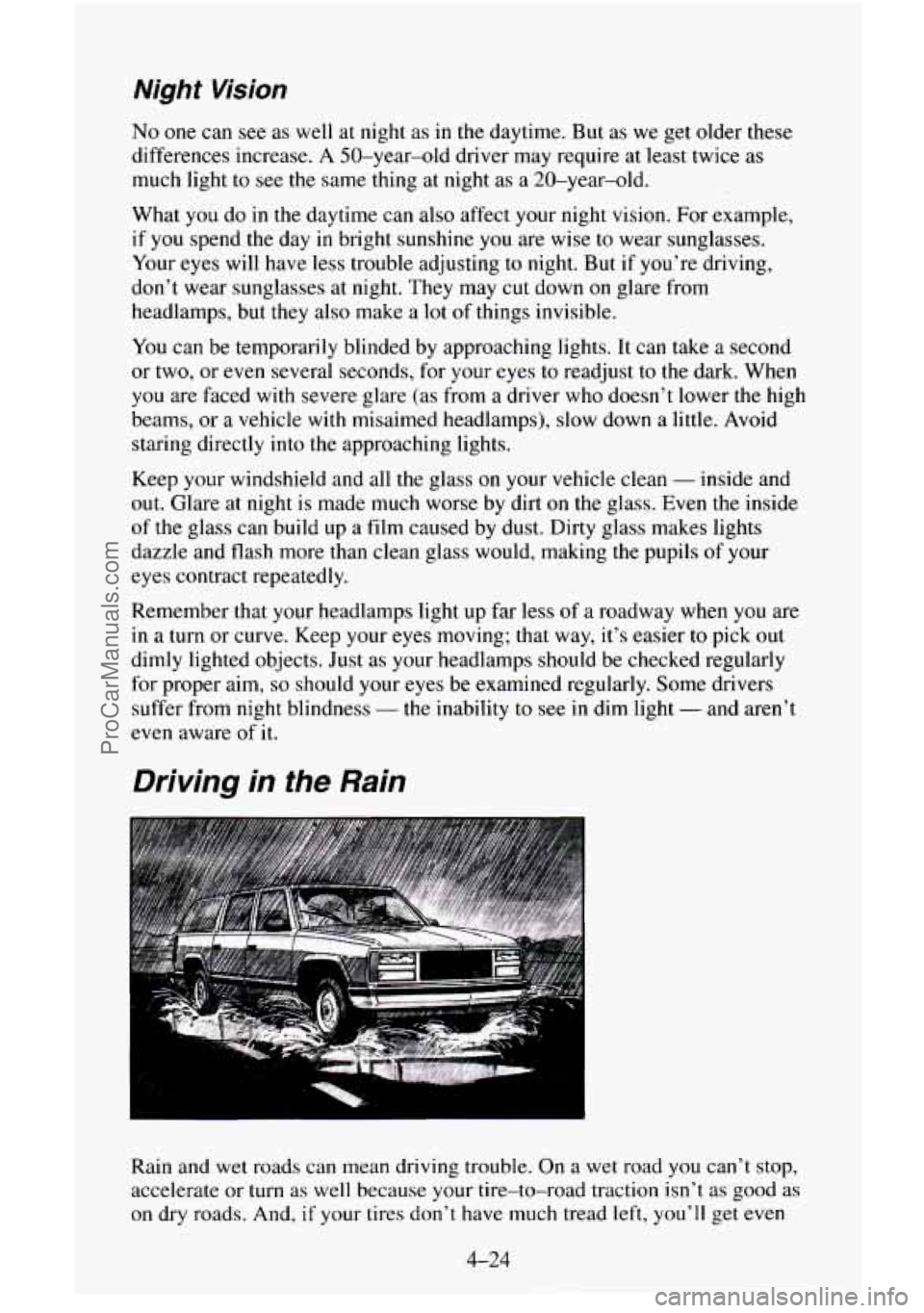
Rain and wet roads can mean driving trouble. On a wet road you can’t stop,
accelerate or turn as well because your tire-to-road traction isn’t as good as
on dry roads. And,
if your tires don’t have much tread left, you’ll get even
4-24
ProCarManuals.com
Page 209 of 486
Hydroplaning doesn’t happen often. But it can if your tires haven’t much
tread or if the pressure in one or more is low. It can happen if a lot of water
is standing on the road. If you can see reflections from trees, telephone
poles, or other vehicles, and raindrops “dimple” the water’s surface, there
could be hydroplaning.
Hydroplaning usually happens at higher speeds. There just isn’t
a hard and
fast rule about hydroplaning. The best advice is
to slow down when it is
raining.
Some Other Rainy Weather Tips
Turn on your low-beam headlights - not just your parking lights - to
Besides slowing down, allow some extra following distance. And be
help
make you more visible
to others.
especially careful when
you pass another vehicle. Allow yourself more
clear room ahead, and be prepared to have your view restricted by road
spray.
Have good tires with proper tread depth. (See “Tires” in the Index.)
City Driving
One of the biggest problems with city streets is the amount of traffic on
them. You’ll want to watch out for what the other drivers are doing and pay
attention to traffic signals.
Here are ways to increase your safety in city driving:
Know the best way to get to where you are going. Get a city map and
plan your trip into an unknown part
of the city just as you would for a
cross-country trip.
4-26
ProCarManuals.com
Page 217 of 486
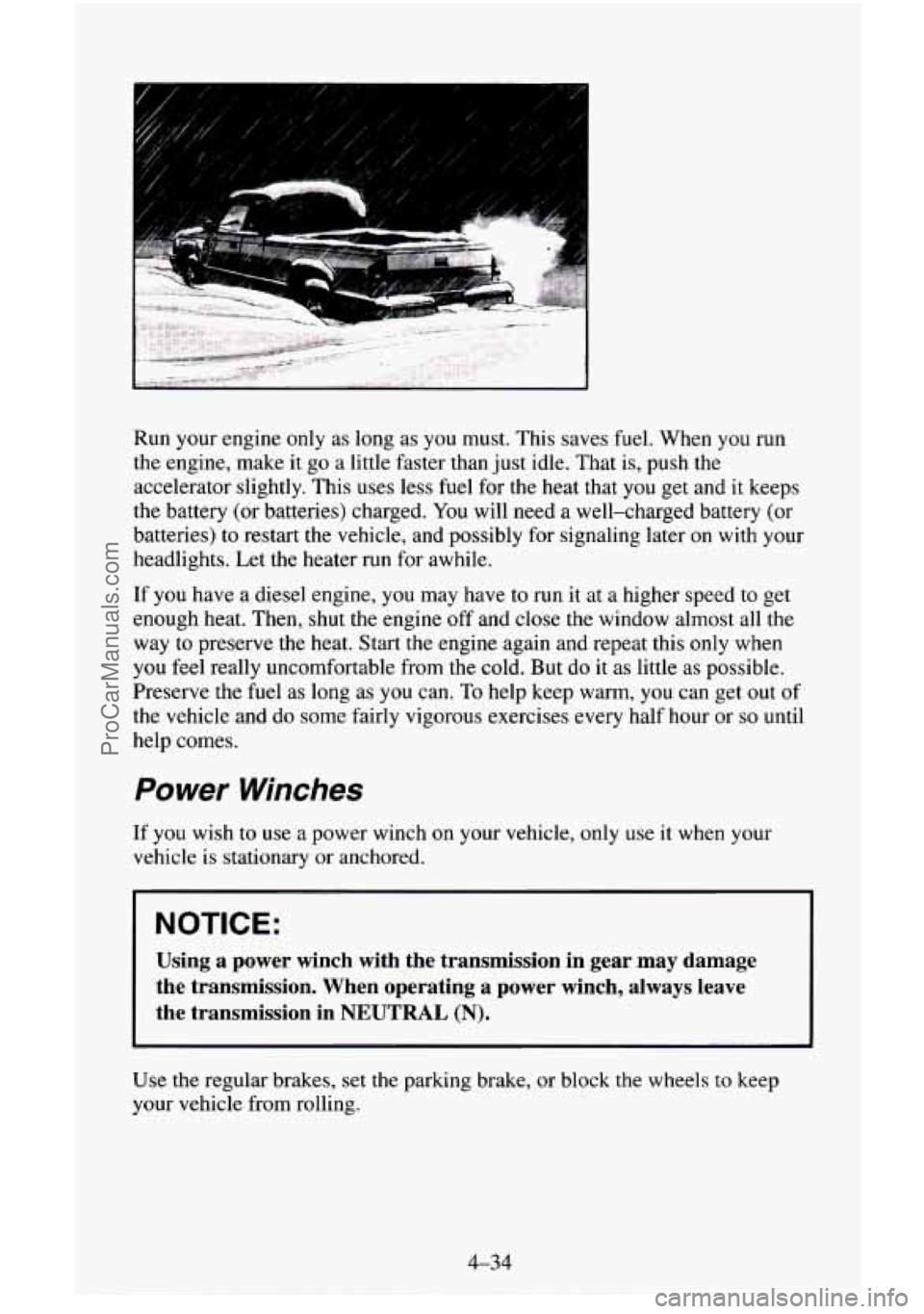
Run your engine only as long as you must. This saves fuel. When you run
the engine, make it
go a little faster than just idle. That is, push the
accelerator slightly. This uses less fuel for the heat
that you get and it keeps
the battery (or batteries) charged. You will need a well-charged battery
(or
batteries) to restart the vehicle, and possibly for signaling later on with your
headlights. Let the heater
run for awhile.
If you have a diesel engine, you may have
to run it at a higher speed to get
enough heat. Then, shut the engine off and close the window almost all the
way to preserve the heat. Start the engine again and repeat
this only when
you feel really uncomfortable from the cold. But do it as little as possible.
Preserve the fuel
as long as you can. To help keep warm, you can get out of
the vehicle and do some fairly vigorous exercises every half
hour or so until
help
comes.
Power Winches
If you wish to use a power winch on your vehicle, only use it when your
vehicle
is stationary or anchored.
I NOTICE:
Using a power winch with the transmission in gear may damage
the transmission. When operating a power winch, always leave
the transmission in NEUTRAL
(N).
Use the regular brakes, set the parking brake, or block the wheels to keep
your vehicle from rolling.
4-34
ProCarManuals.com
Page 237 of 486
Turn off the ignition on both vehicles. Turn off all lights that aren’t
needed, and radios. This will avoid sparks and help save both batteries.
And it could
save your radio!
I NOTICE:
If you leave your radio on, it could be badly damaged. The
repairs wouldn’t be covered by your warranty.
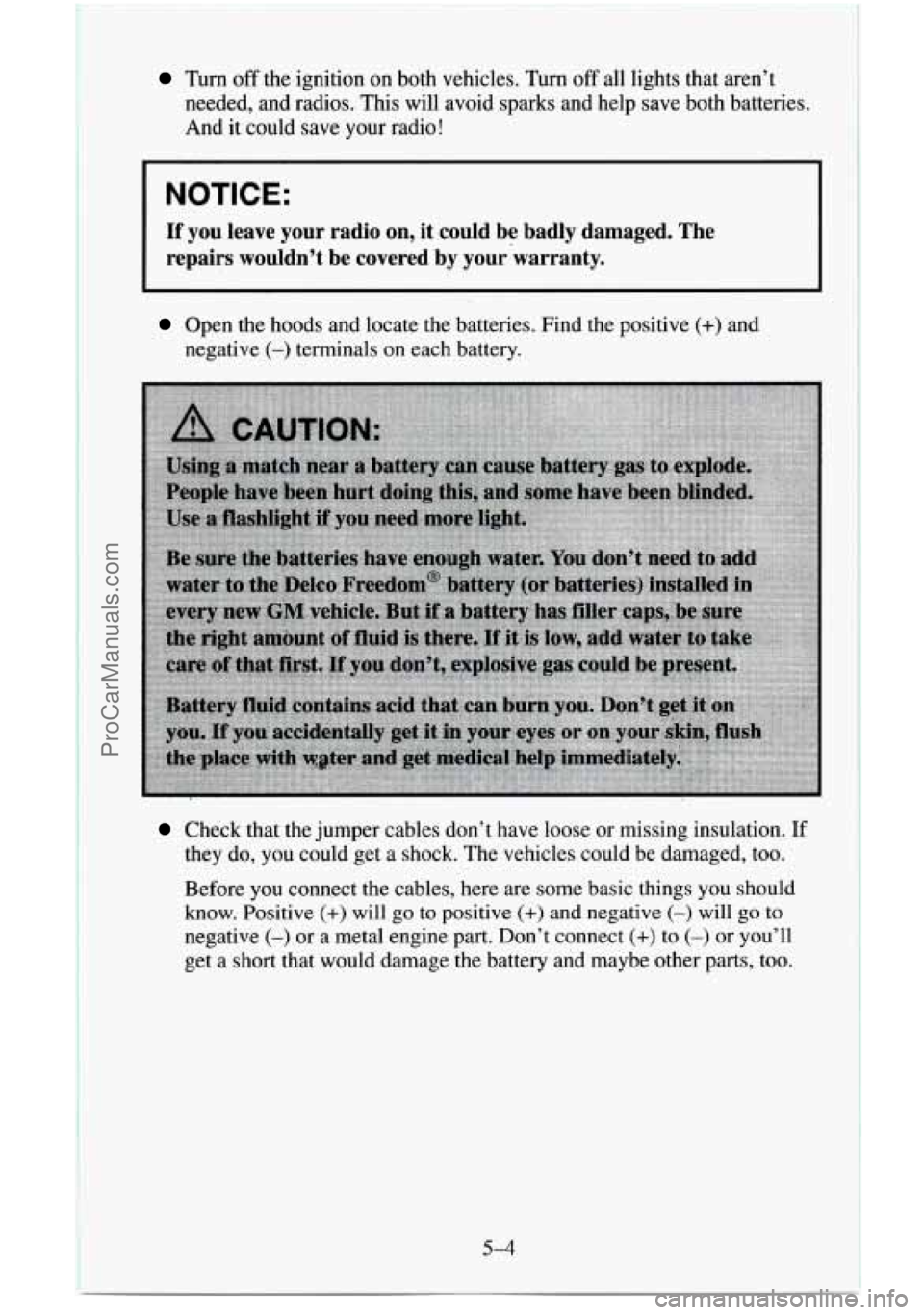
Open the hoods and locate the batteries. Find the positive (+) and
negative
(-) terminals on each battery.
Check that the jumper cables don’t have loose or missing insulation. If
they do, you could get a shock. The vehicles could be damaged, too.
Before
you connect the cables, here are some basic things you should
know. Positive
(+) will go to positive (+) and negative (-) will go to
negative (-) or a metal engine part. Don’t connect (+) to (-) or you’ll
get a short that would damage the battery and maybe other parts, too.
5-4
ProCarManuals.com
Page 310 of 486
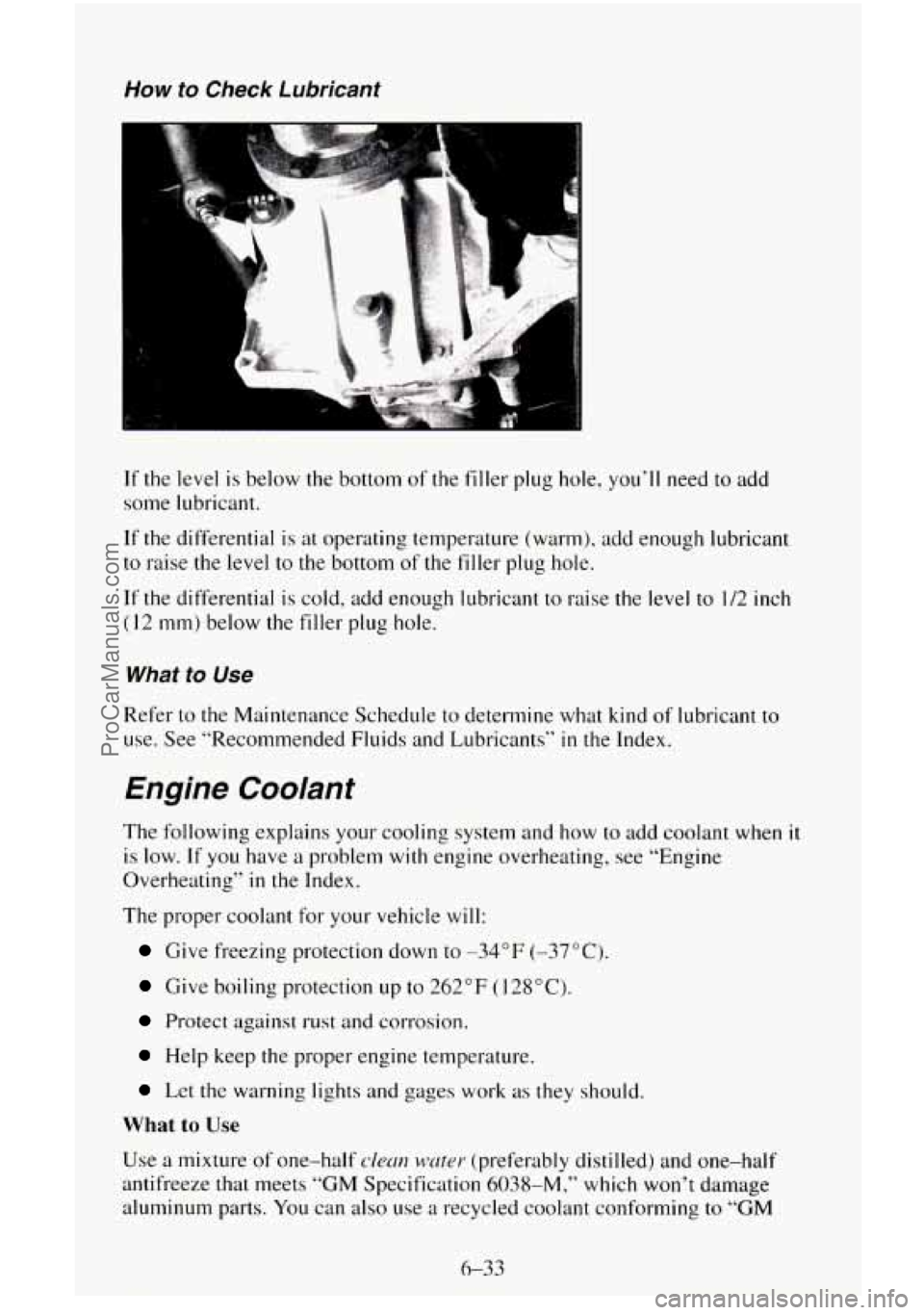
How to Check Lubricant
P
If the level is below the bottom of the filler plug hole, you’ll need to add
some lubricant.
If the differential is at operating temperature (warm), add enough lubricant
to raise the level to the bottom of the filler plug hole.
If the differential is cold, add enough lubricant to raise the level to 1/2 inch
(I 2 mm) below the filler plug hole.
What to Use
Refer to the Maintenance Schedule to determine what kind of lubricant to
use. See “Recommended Fluids and Lubricants” in the Index.
Engine Coolant
The following explains your cooling system and how to add coolant when it
is low. If you have a problem with engine overheating, see “Engine
Overheating”
in the Index.
The proper coolant for your vehicle will:
Give freezing protection down to -34°F (-37°C).
Give boiling protection up to 262°F (128°C).
Protect against rust and corrosion.
Help keep the proper engine temperature.
Let the warning lights and gages work as they should.
What to Use
Use a mixture of one-half chi? wcmr (preferably distilled) and one-half
antifreeze that meets
“GM Specification 6038-M,” which won’t damage
aluminum parts.
You can also use a recycled coolant conforming to “GM
6-33
ProCarManuals.com
Page 474 of 486
Index
A
Adding Equipment to Your Air Bag-Equipped Vehicle (See “Supplemental
Inflatable Restraint System (SIR)”) Air Bag (See “Supplemental Inflatable Restraint System (SIR)”)
Readiness Light (See “Lights”)
Air Cleaner (See “Engine-Air Cleaner”)
Air Conditioning (See “Heater/Air Conditioning Controls”)
Antenna
....................................................... 3-28
Anti-Lock Brakes (See “Brakes”)
Appearancecare
............. i .................................. 6-62
Materials Chart
............................................... 6-71
Arbitration Program (See “Better Business Bureau Mediation”)
Audiosystems
................................................... 3-9
Care of Your Cassette Player and Tape
............................. 3-27
Care of Compact Discs
......................................... 3-28
ETR@ AM-FM Stereo Audio Cassette System
...................... 3-12
ETR@ AM-FM Stereo Audio Cassette ATC System
.................. 3-14
ETR@ AM-FM Stereo Audio Compact Disc (CD) ATC System
......... 3-19
Remote Cassette Player
...................................... 3-25
ETR@’AM-FM Stereo Audio System
.............................. 3-10
THEFTLOCK Theft Deterrent Feature
........................ 3-17, 3-23
Understanding Radio Reception
.................................. 3-26
Automatic Transmission (See “Transmission”)
Axle Front (See “Four-wheel Drive”)
LockingRe ar
................................................. 2-25
Rear
........................................................ 6-31
B
Battery ........................................................ 6-45
Belts (See “Safety Belts”)
Better Business Bureau Mediation
.................................... 8-3
Blizzard (See “Driving-If You’re Caught in a Blizzard”)
Brakes Adjustment
.................................................. 643
Anti-Lock (ABS)
.............................................. 4-5
Anti-Lock Warning Light (See “Lights”)
Hydro-Boost Brake System (Hydraulic Pump)
...... ......... 6-39
Master Cylinder
.............................................. 6-41
Parking ..................................................... 2-26
PedalTravel ................................................. 6-43
Replacingparts
............................................... 6-44
System Warning Light (See “Lights”)
To Check Brake Fluid
........................................ 6-42
Trailer (See “Trailer-Brakes”)
Transmission Shift Interlock (BTSI)
............................... 2-21
Wear
....................................................... 6-43
Braking
......................................................... 4-5
In Emergencies
................................................ 4-7
Break-In. New Vehicle ............ .......................... 2-10
1
ProCarManuals.com
Page 476 of 486
ConvenienceNet ................................................ 2-84
Coolant (See “Engine”)
Cooling System Capacity
.......................................... 6-77
Courtesy Transportation
............................................ 8-7
Crankcase Capacity
.............................................. 6-78
Cruise Control (Option)
........................................... 2-43
OnHills ..................................................... 2-47
Passing Another Vehicle
........................................ 246
To Erase Speed Memory ........................................ 248
ToGetOutOf
................................................ 2-47
ToIncreaseSpeed
............................................. 245
ToReduceSpeed
.............................................. 2-46
ToResume
.................................................. 245
ToSet
...................................................... 244
Customer Assistance for the Hearing or Speech Impaired
................. 8-3
Customer Assistance Information
.................................... 8-1
Customer Satisfaction Procedure
................................... 8-1
Daytime Running Lamps (DRL) Indicator Light (See “Lights”)
Diesel Fuel Requirements and Fuel System (See “Fuel-Diesel”)
Differential (See “Axle”)
Doors .......................................................... 2-3
Locks
........................................................ 2-6
PanelDoors
................................................... 2-5
PowerDoorLocks
............................................. 2-7
SideDoors
.................................................... 2-3
Tailgate Glass and Tailgate
.................................. 2-4, 2-34
Drive Axle (See “Axle”)
Driving AtNight
.................................................... 4-23
City
........................................................ 4-26
Defensive
.................................................... 4-1
Freeway ..................................................... 4-27
Guidelines
................................................... 4-11
Hill and Mountain Roads
....................................... 4-29
Highway Hypnosis
............................................ 4-28
If You’re Caught in a Blizzard
................................... 4-33
SnoworIce
.................................................. 4-31
In Snow (Diesel Engines)
....................................... 2-15
IntheRain ................................................... 4-24
LossofControl
............................................... 4-10
Nightvision ................................................. 4-24
Off-Road Driving with Your Four-wheel Drive Vehicle
.............. 4-12
Before You
Go Off-Roading .................................. 4-12
After Off-Road Driving
...................................... 4-23
Passing
...................................................... 4-9
Through Deep Standing Water ................................... 2-15
Winter
...................................................... 4-31
DrunkenDriving
............................................... 4-2
3
ProCarManuals.com
Page 478 of 486
G
Gages Engine Coolant Temperature Gage
................................
FuelGage ...................................................
Oil Pressure Gage .............................................
Speedometer .................................................
Tachometer ..................................................
Tamper Resistant Odometer .....................................
Trip Odometer ................................................
Voltmeter ....................................................
2-79
2-78
2-80
2-68
2-69
2-68
2-68
2-81
Halogen Bulbs (See “Bulb Replacement”)
Hazard Warning Flashers
........................................... 5-1
Head Restraints (See “Seats”)
Headlamps and Vehicle Lighting
.................................... 2-48
Replacement (See “Bulb Replacement”)
High Beam Indicator Light (See “Lights”)
High-LowBeamChanger
...................................... 2-38
Reminder .................................................... 2-46
Heatercontrols .................................................. 3-1
RearHeater ................................................... 3-5
Heater/Air Conditioning Controls .................................... 3-2
Rear Air Conditioning ........................................... 3-4
Refrigerant Capacity ........................................... 6-79
Highway Hypnosis (See “Driving-Highway Hypnosis”)
Hitches (See “Towing-Hitches”)
Hood Checking Under, Hood Release
.................................. 6-13
Horn .......................................................... 2-38
Hydraulicclutch ................................................ 6-30
Howtocheck ................................................ 6-31
When to Check and What to Use ................................. 6-31
Hydroplaning (See “Driving in the Rain”)
If You’re Stuck in Sand. Mud. Ice. or Snow ........................... 5-41
Ignitionswitch .................................................. 2-12
Inflation-Tire Pressure (See “Tires”)
Instrument Cluster
............................................... 2-67
Instrumentpanel ................................................ 2-67
Jacking Equipment Storage ................................... 5.26. 5-40
Jump Starting .................................................... 5-2
.
ProCarManuals.com
Page 479 of 486
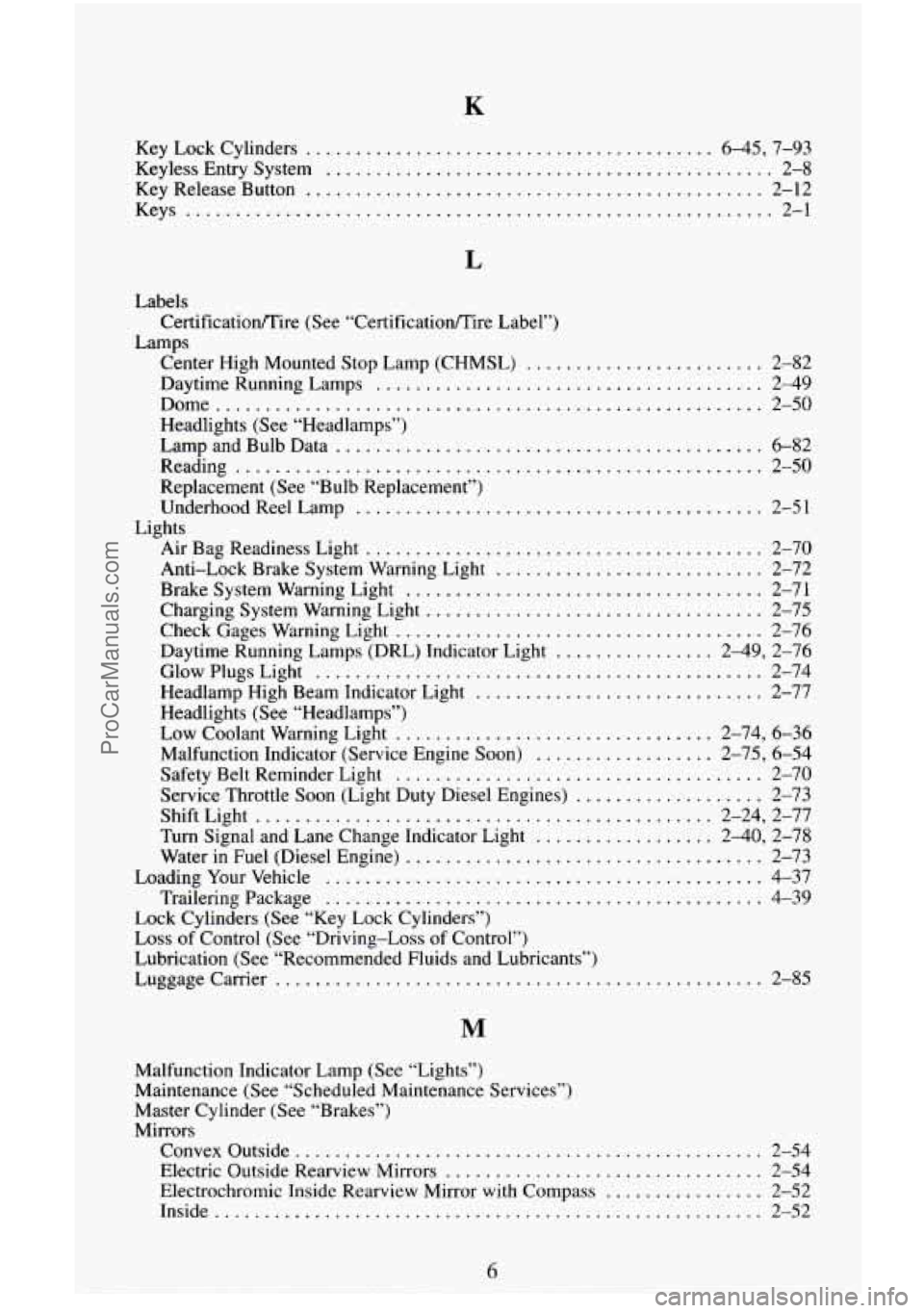
K
Key Lock Cylinders ......................................... 645. 7.93
Keyless Entry System
............................................. 2-8
Key Release Button
.............................................. 2-12
Keys
........................................................... 2-1
L
Labels
Lamps Certificationmire
(See “Certificatioflire Label”)
Center High Mounted Stop Lamp (CHMSL)
........................ 2-82
Daytime Running Lamps
....................................... 2-49
Dome
....................................................... 2-50
Headlights (See “Headlamps”)
Lamp and Bulb Data
........................................... 6-82
Reading
..................................................... 2-50
Replacement (See “Bulb Replacement”)
UnderhoodReelLamp
......................................... 2-51
Lights
Air Bag Readiness Light
........................................ 2-70
Anti-Lock Brake System Warning Light
........................... 2-72
Brake System Warning Light
.................................... 2-71
Charging System Warning Light
.................................. 2-75
Check Gages Warning Light
..................................... 2-76
Daytime Running Lamps (DRL) Indicator Light ................ 2-49, 2-76
Headlamp High Beam Indicator Light
............................. 2-77
Headlights (See “Headlamps”)
Low Coolant Warning Light ................................ 2-74, 6-36
Safety Belt Reminder Light
..................................... 2-70
Service Throttle Soon (Light Duty Diesel Engines)
................... 2-73
ShiftLight
.............................................. 2-24, 2-77
Turn Signal and Lane Change Indicator Light
.................. 2-40, 2-78
Water
in Fuel (Diesel Engine) .................................... 2-73
Loading Your Vehicle
............................................ 4-37
Lock Cylinders (See “Key Lock Cylinders”)
Loss of Control (See “Driving-Loss of Control”)
Lubrication (See “Recommended Fluids and Lubricants”)
Luggagecarrier
................................................. 2-85
GlowPlugsLight
............................................. 2-74
Malfunction Indicator (Service Engine Soon)
.................. 2-75, 6-54
TraileringPackage
............................................ 4-39
M
Malfunction Indicator Lamp (See “Lights”)
Maintenance (See “Scheduled Maintenance Services”)
Master Cylinder (See “Brakes”)
Mirrors
ConvexOutside
............................................. 2-54
Electric Outside Rearview Mirrors
................................ 2-54
Electrochromic Inside Rearview Mirror with Compass
................ 2-52
Znside
....................................................... 2-52
6
ProCarManuals.com
Page 481 of 486
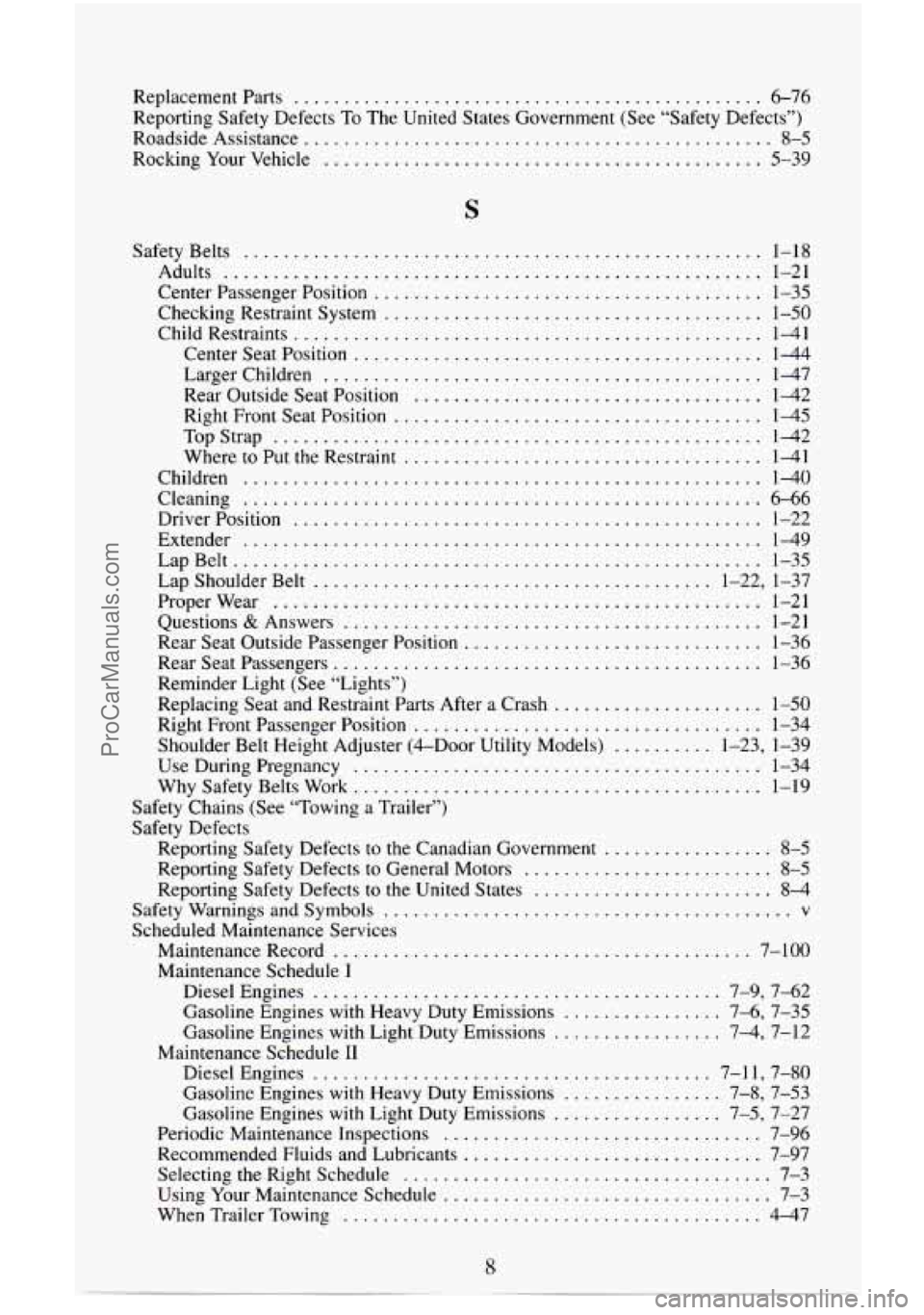
Replacementparts ............................................... 6-76
Reporting Safety Defects To
The United States Government (See “Safety Defects”)
Roadside Assistance
............................................... 8-5
RockingYourVehicle ............................................ 5-39
SafetyBelts
....................................................
Adults ......................................................
Center Passenger Position .......................................
Checking Restraint System ......................................
Child Restraints ...............................................
Center Seat Position .........................................
Rear Outside Seat Position ...................................
Right Front Seat Position .....................................
TopStrap .................................................
Where to Put the Restraint ....................................
Children ....................................................
Cleaning ....................................................
DriverPosition ...............................................
Extender ....................................................
LapBelt .....................................................
Larger Children ............................................
1-18
1-21
1-35
1-50 1-41
1-44
1-47
1-42
145
1-42
1-41
1-40
6-66 1-22
1-49
1-35
Lap Shoulder Belt
........................................ 1.22. 1-37
Properwear
................................................. 1-21
Questions
& Answers .......................................... 1-21
Rear Seat Outside Passenger Position .............................. 1-36
Rear Seat Passengers
......................................... 1-36
Reminder Light (See “Lights”)
Replacing Seat and Restraint Parts After a Crash
..................... 1-50
Right Front Passenger Position
................................... 1-34
Shoulder Belt Height Adjuster (&Door Utility Models)
.......... 1-23. 1-39
Use During Pregnancy
......................................... 1-34
Why Safety Belts Work
......................................... 1-19
Safety Chains (See “Towing a Trailer”)
Safety Defects
Reporting Safety Defects to the Canadian Government
................. 8-5
Reporting Safety Defects to General Motors ......................... 8-5
Reporting Safety Defects to the United States ........................ 8-4
Safety Warnings and Symbols ......................................... v
Scheduled Maintenance Services
Maintenance Record
.......................................... 7- 100
Maintenance Schedule
I
Diesel Engines ......................................... 7-9. 7-62
Gasoline Engines with Heavy Duty Emissions
................ 7-6. 7-35
Gasoline Engines
with Light Duty Emissions ................. 7-4. 7-12
Diesel Engines
........................................ 7-1 1. 7-80
Gasoline Engines with Light Duty Emissions
................. 7-5. 7-27
Periodic Maintenance Inspections
................................ 7-96
Recommended Fluids and Lubricants
.............................. 7-97
Selecting the Right Schedule
..................................... 7-3
Using Your Maintenance Schedule
................................. 7-3
When Trailer Towing
...................................... 4-47
Maintenance Schedule
I1
Gasoline Engines with Heavy Duty Emissions
................ 7-8. 7-53
ProCarManuals.com