manual transmission CHEVROLET SUBURBAN 1995 User Guide
[x] Cancel search | Manufacturer: CHEVROLET, Model Year: 1995, Model line: SUBURBAN, Model: CHEVROLET SUBURBAN 1995Pages: 486, PDF Size: 26.58 MB
Page 92 of 486
While you accelerate, it is normal for the light to go on and off if you
quickly change
the position of the accelerator. Ignore the SHIFT light when
you downshift.
Four-Wheel-Drive Vehicles Only: If your vehicle has four-wheel drive
and
is equipped with a manual transmission, disregard the SHIFT light
when the transfer case
is in 4-LOW.
Manual Transmission Shift Speeds
If your speed drops below 20 mph (32 km/h), or if the engine is not running
smoothly,
you should downshift to the next lower gear. You may have to
downshift two or more gears
to keep the engine running smoothly or for
good performance.
A CAUTION:
If you skip more ;than one gear when you downshift, you could
lose control of your vehicle. And you could injure yourself or
others. Don’t shift down more than one gear when you
downshift.
NOTICE:
If you skip more than one gear when you downshift, or if you
race the engine when you downshift, you can damage the engine,
clutch or transmission.
Locking Rear Axle
If you have this feature, your rear axle can give you additional traction on
snow, mud, ice, sand or gravel. It works like a standard axle most of the
time, but when
one of the rear wheels has no traction and the other does, the
locking feature will allow the wheel with traction to move the vehicle.
2-25
ProCarManuals.com
Page 94 of 486
Torque Lock
When parking, the weight of the vehicle may put too much force on the
parking pawl in the transmission. It may be difficult to pull the selector
lever out of
PARK (P). This is called “torque lock.” To find out how to
prevent torque lock,
see “Torque Lock” later in this section.
Shifting Into PARK (P) (Automatic
Transmission Models Only)
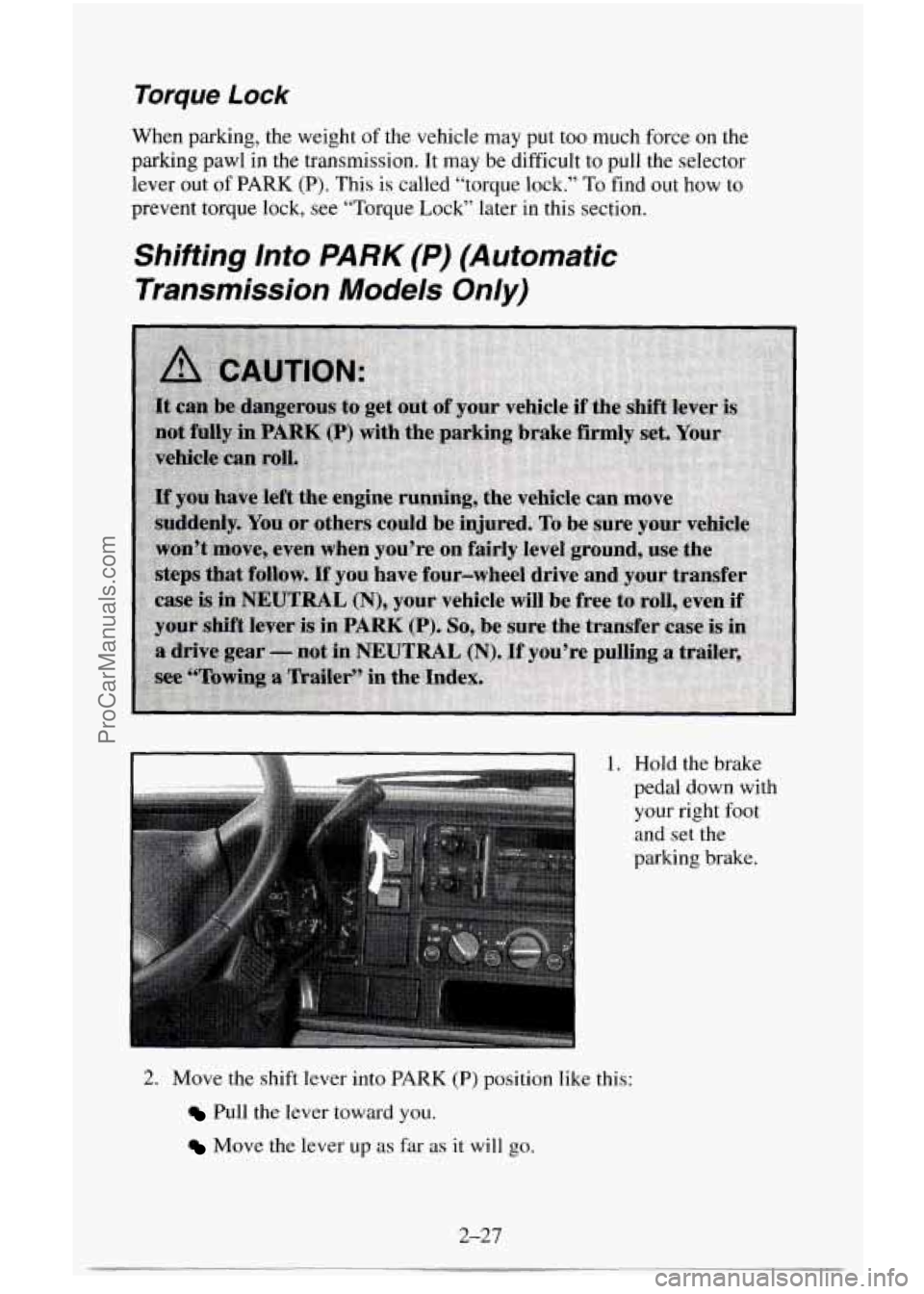
1. Hold the brake
pedal down with
your right foot
and set the
parking brake.
2. Move the shift lever into PARK (P) position like this:
Pull the lever toward you.
Move the lever up as far as it will go.
2-27
ProCarManuals.com
Page 95 of 486
3. If you have four-wheel drive, be sure the transfer case is in a drive gear
4. Move the ignition key to LOCK.
-not in NEUTRAL (N)
5. Remove the key and take it with you. If you can walk away from your
vehicle with the ignition key
in your hand, your vehicle is in PARK (P).
Shifting Out of PARK (P)
Your vehicle has a brake-transmission shift interlock system. You have to
fully apply your regular brakes before you can shift from PARK (P). See
“Automatic Transmission”
in the Index.
If
you cannot shift out of PARK (P), ease pressure on the shift lever and
push the shift lever all the way up into PARK
(P) as you maintain brake
application. Then, move the shift lever into the gear you want.
If
you ever hold the brake pedal down but still can’t shift out of PARK (P),
try this:
1. Turn the key to OFF.
2. Apply and hold the brake until the end of Step 4.
3. Shift to NEUTRAL (N).
4. Start the vehicle and then shift to the drive gear you want.
5. Have the brake-transmission shift interlock system fixed as soon as
you can.
Leaving Your Vehicle With the Engine Running
(Automatic Transmission
Models Only)
It can be dangerous to leave your vehicle with the engine
running. Your vehicle could move suddenly if the shift lever
is
not fully in PARK (P) with the parking brake firmly set. If you
have four-wheel drive with
a manual transfer case shift lever
and your transfer case
is in NEUTRAL (N), your vehicle will be
free to roll, even if your shift lever
is in PARK (P). So be sure the
transfer case is in
a drive gear - not in NEUTRAL (N). And, if
you leave the vehicle with the engine running, it could overheat
and even catch
fire. You or others could be injured. Don’t leave
your vehicle with the engine running unless you have to.
2-28
ProCarManuals.com
Page 96 of 486
Torque Lock (Automatic Transmission)
If you are parking on a hill and you don’t shift your transmission into PARK
(P)
properly, the weight of the vehicle may put too much force on the
parking pawl in the transmission.
You may find it difficult to pull the shift
lever out of
PARK (P). This is called “torque lock.” To prevent torque lock,
set
the parking brake and then shift into PARK (P) properly before you
leave
the driver’s seat. To find out how, see “Shifting Into PARK (P)” in the
Index.
When you are ready
to drive, move the shift lever out of PARK (P) before
you release the parking brake.
If “torque lock” does occur,
you may need to have another vehicle push
yours a little uphill
to take some of the pressure from the transmission, so
you can pull the shift lever out of PARK (P).
2-29
ProCarManuals.com
Page 97 of 486
Parking Your Vehicle (Manual Transmission
Models Only)
Before you get out of your vehicle, put your manual transmission in
REVERSE (R), turn off the engine, and firmly apply the parking brake.
If you have four-wheel drive, be sure your transfer case is in a drive gear.
Your vehicle could roll if it isn’t.
If you are parking on a hill, or if your pulling a trailer, see “Parking on
Hills” or “Towing a Trailer” in the Index.
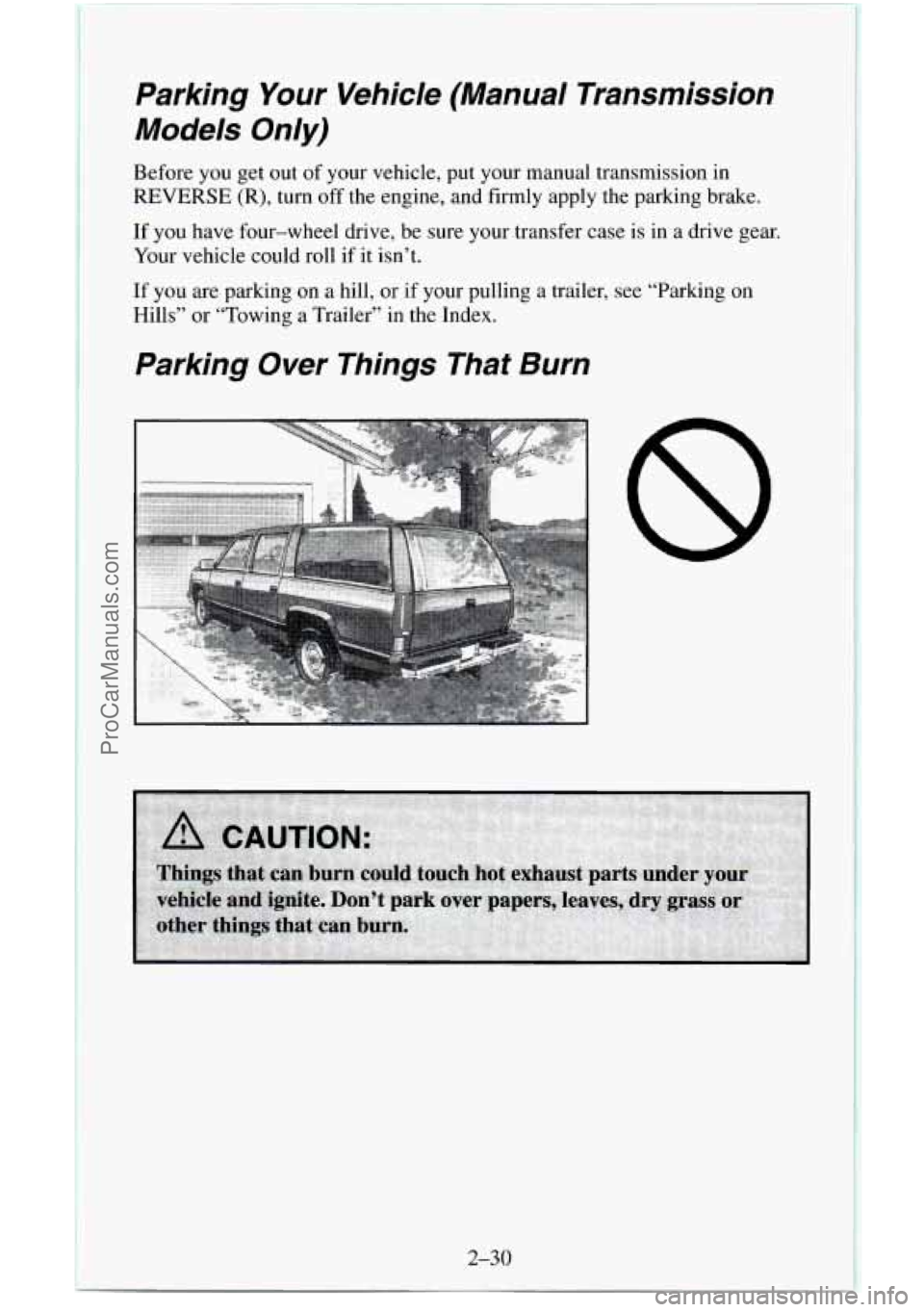
Parking Over Things That Burn
8
2-30
ProCarManuals.com
Page 99 of 486
Running Your Engine While You’re Parked
(Automatic Transmission)
It’s better not to park with the engine running. But if you ever have to, here
are some things to know.
If you have four-wheel drive and your transfer case is
in NEUTRAL (N),
your vehicle will be free
to roll, even if your shift lever is in PARK (P). So,
be sure the transfer case is in a drive gear - not in NEUTRAL (N). Always
set your parking brake. Follow the proper steps
to be sure your vehicle
won’t move. See “Shifting Into
PARK (P)” in the Index.
If you’re pulling a trailer, see “Towing a Trailer” in the Index.
2-32 I
ProCarManuals.com
Page 102 of 486
To shift into or out of 4-WHEEL LOW (4L)or NEUTRAL (N):
0 Slow the vehicle to a roll, about 1-3 mph (2-5 kdh) and shift an
automatic transmission into neutral, or with a manual transmission
press the clutch pedal.
Shift the transfer case shift lever in one continuous motion.
Don’t pause in NEUTRAL
(N) as you shift the transfer case into 4-WHEEL
LOW (4L), or your gears could clash.
Remember that driving in 4-WHEEL HIGH (4H) or 4-WHEEL LOW (4L)
may reduce fuel economy. Also, driving in four-wheel drive on dry
pavement could cause your tires to wear faster and make your transfer case
harder
to shift.
Front Axle Locking Feature
I ne front axle locks and unlocks automatically when you shift the transfer
case. Some delay for the axle to lock or unlock is normal. If the outside
temperature is very hot, or the vehicle has been used under hard driving
conditions, there may be a slight delay for the axle to unlock.
Windows
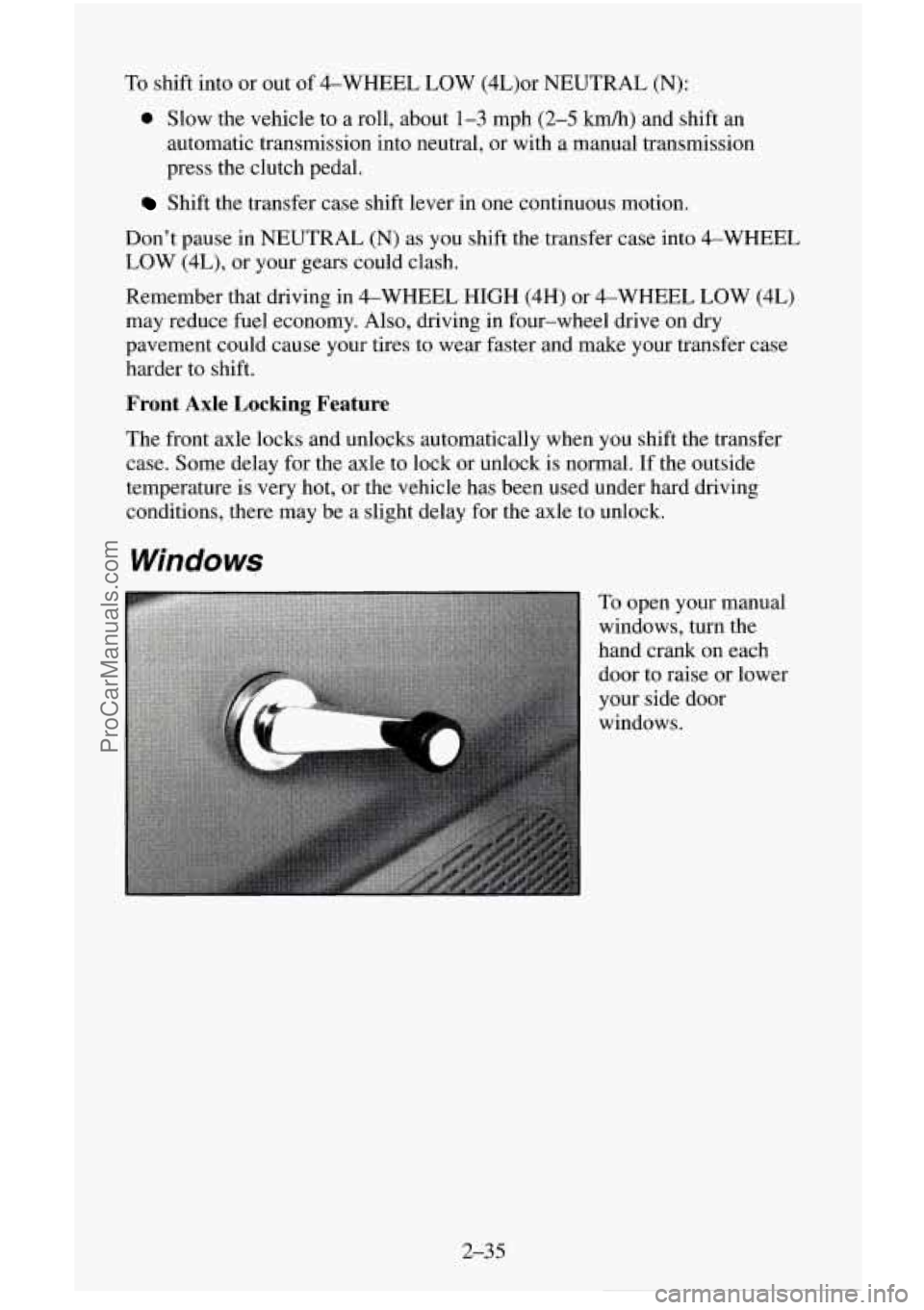
To open your manual
windows, turn the
hand crank on each
door to raise or lower
your side door
windows.
2-35
ProCarManuals.com
Page 104 of 486
Electric Tailgate Glass Release
Before operating your electric tailgate glass release, see the caution under
“Tailgate Glass, Tailgate and Rear Doors’’ in this section.
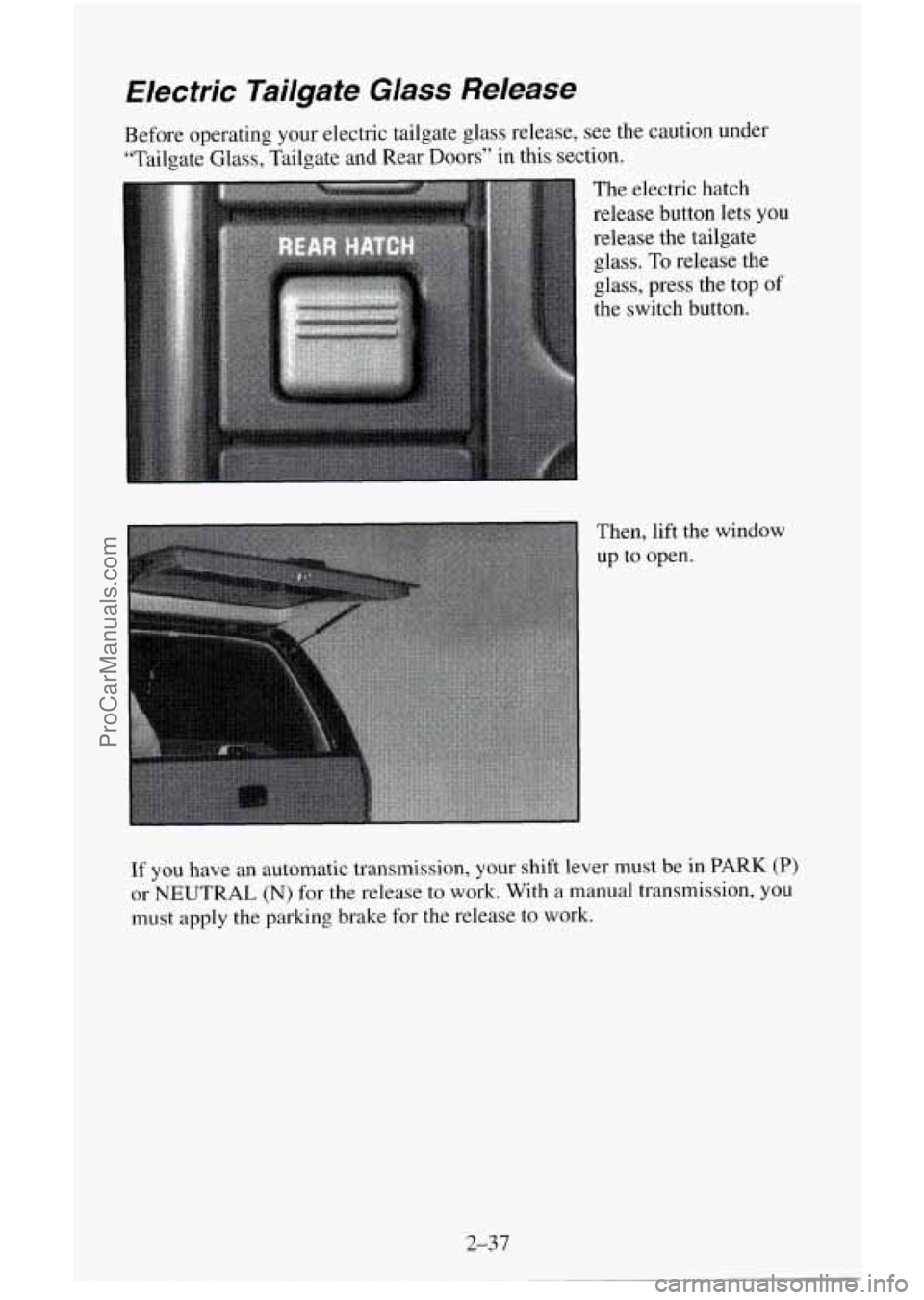
The electric hatch
release button lets
you
release the tailgate
glass. To release the
glass, press the top of
the switch button.
Then, lift the window
up
to open.
If you have an automatic transmission, your shift lever must
be in PARK (P)
or NEUTRAL (N) for the release to work. With a manual transmission, you
must apply the parking brake for the release to work.
2-37
ProCarManuals.com
Page 144 of 486
If your vehicle was first sold, when new, in Canada, you will have this green
light on
the instrument panel. It will light whenever the Daytime Running
Lamps
are on. For more details about DRL, see “Headlamps and Vehicle
Lighting’’
in this section.
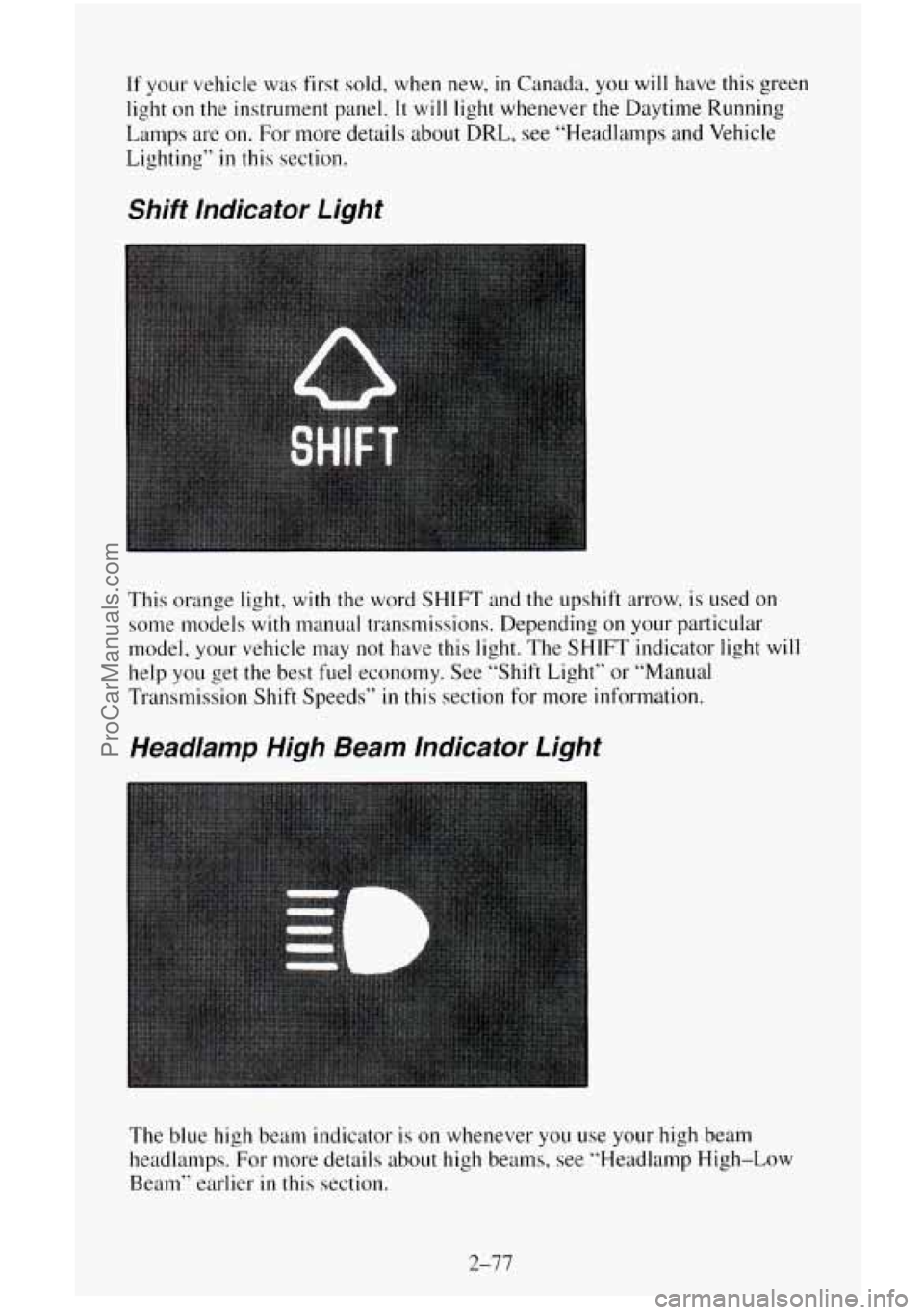
Shift lndicator Light
This orange light, with the word SHIFT and the upshift arrow, is used on
some models with manual transmissions. Depending on your particular
model, your vehicle may
not have this light. The SHIFT indicator light will
help you get the best fuel economy. See “Shift Light” or “Manual
Transmission Shift Speeds”
in this section for more information.
Headlamp High Beam lndicator Light
The blue high beam indicator is on whenever you use your high beam
headlamps. For more details about high beams, see “Headlamp High-Low
Beam” earlier in this section.
2-77
ProCarManuals.com
Page 200 of 486
Q: What should I do if my vehicle stalls, or is about to stall, and I
can’t make it up the hill?
A: If this happens, there are some things you should do, and there are
some things you must not do. First, here’s what you should do:
0 Push the brake pedal to stop the vehicle and keep it from rolling
0 If your engine is still running, shift the transmission into reverse,
backwards.
Also, apply the parking brake.
release the parking brake, and
slowly back down the hill in reverse.
If your engine has stopped running, you’ll need to restart it. With the
brake pedal depressed and the parking brake still applied, shift the
transmission to
PARK (P) (or, shift to NEUTRAL (N) if your vehicle
has a manual transmission) and restart the engine. Then, shift to
reverse, release the parking brake, and slowly back down
the hill as
straight
as possible in reverse.
0 As you are backing down the hill, put your left hand on the steering
wheel at
the 12 o’clock position. This way, you’ll be able to tell if your
wheels are straight and maneuver as you back down. It’s best that you
back down the
hill with your wheels straight rather than in the left or
right direction. Turning
the wheel too far to the left or right will
increase the possibility of a rollover.
Here are
some things you must not do if you stall, or are about to stall,
when going up
a hill.
0 Never attempt to prevent a stall by shifting into NEUTRAL (N) (or
depressing the clutch, if you have a manual transmission) to “rev-up”
the engine and regain forward momentum. This won’t work. Your
vehicle
will roll backwards very quickly and you could go out of
control.
4-17
ProCarManuals.com