parking brake CHEVROLET SUBURBAN 1995 User Guide
[x] Cancel search | Manufacturer: CHEVROLET, Model Year: 1995, Model line: SUBURBAN, Model: CHEVROLET SUBURBAN 1995Pages: 486, PDF Size: 26.58 MB
Page 116 of 486
Headlamps-On Reminder
A buzzer will sound when your headlamps are turned on and your ignition is
in OFF, LOCK or ACC. If you need to use your headlamps when the ignition
switch is
in OFF, LOCK or ACC, the buzzer can be turned off by turning the
thumb wheel next to the park/headlamp switch
all the way down.
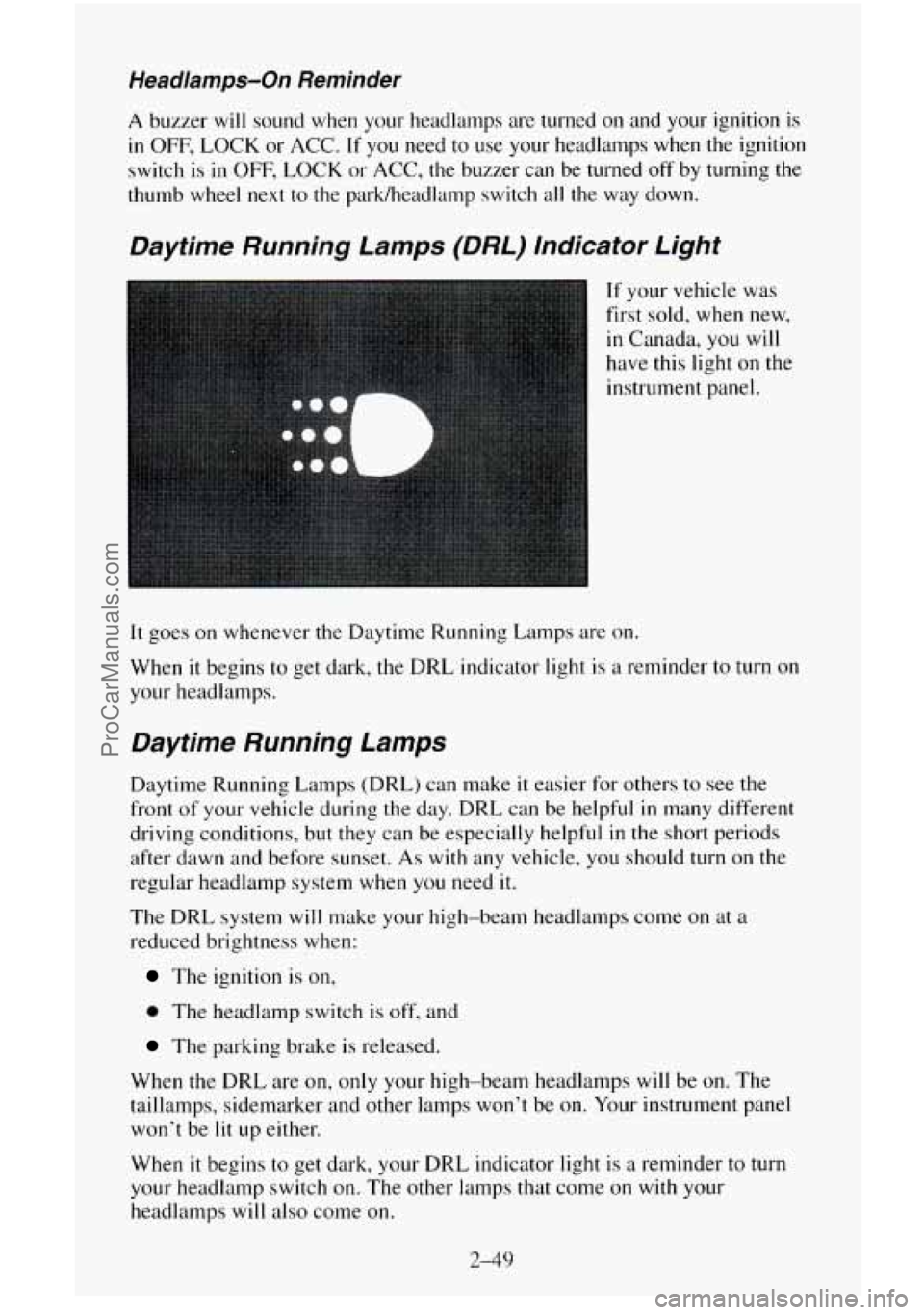
Daytime Running Lamps (DRL) Indicator Light
If your vehicle was
first sold, when new,
in Canada, you will
have this light on the
instrument panel.
It goes on whenever the Daytime Running Lamps are on.
When it begins to get dark,
the DRL indicator light is a reminder to turn on
your headlamps.
Daytime Running Lamps
Daytime Running Lamps (DRL) can make it easier for others to see the
front
of your vehicle during the day. DRL can be helpful in many different
driving conditions, but they can be especially helpful
in the short periods
after dawn and before sunset. As
with any vehicle, you should turn on the
regular headlamp system when you need it.
The DRL system will make your high-beam headlamps come
on at a
reduced brightness when:
The ignition is on,
0 The headlamp switch is off, and
The parking brake is released.
When the DRL are on, only your high-beam headlamps will be on. The
taillamps, sidemarker and other lamps won’t be
on. Your instrument panel
won’t be
lit up either.
When
it begins to get dark, your DRL indicator light is a reminder to turn
your headlamp switch on. The other lamps that come on with your
headlamps will also come on.
2-49
ProCarManuals.com
Page 117 of 486
When you turn the headlamp switch off, the regular lamps will go off, and
your high-beam headlamps will change to the reduced brightness
of DRL.
To idle your vehicle with the DRL off, set the parking brake. The DRL will
stay
off until you release the parking brake.
Dome Lamps
The dome lamps will come on when you open the doors.
You can also turn the dome lamps on by rotating the thumb wheel, located
next to the parkheadlamp switch knob, all the way up to the second notch.
In this position, the dome lamps will remain
on whether the doors are
opened or closed.
You can
use the dome lamp switch button, located below the parkheadlamp
switch knob, to set the dome lamps
to come on automatically when the doors
are open, or remain
off. To turn the lamps off, press the switch button once.
With the switch button in
this position, the dome lamps will remain off when
the doors are open. To return the lamps to automatic operation, press the switch
button again and return it to the “out” position. With the switch button in this
position, the dome lamps will come on when you open the doors.
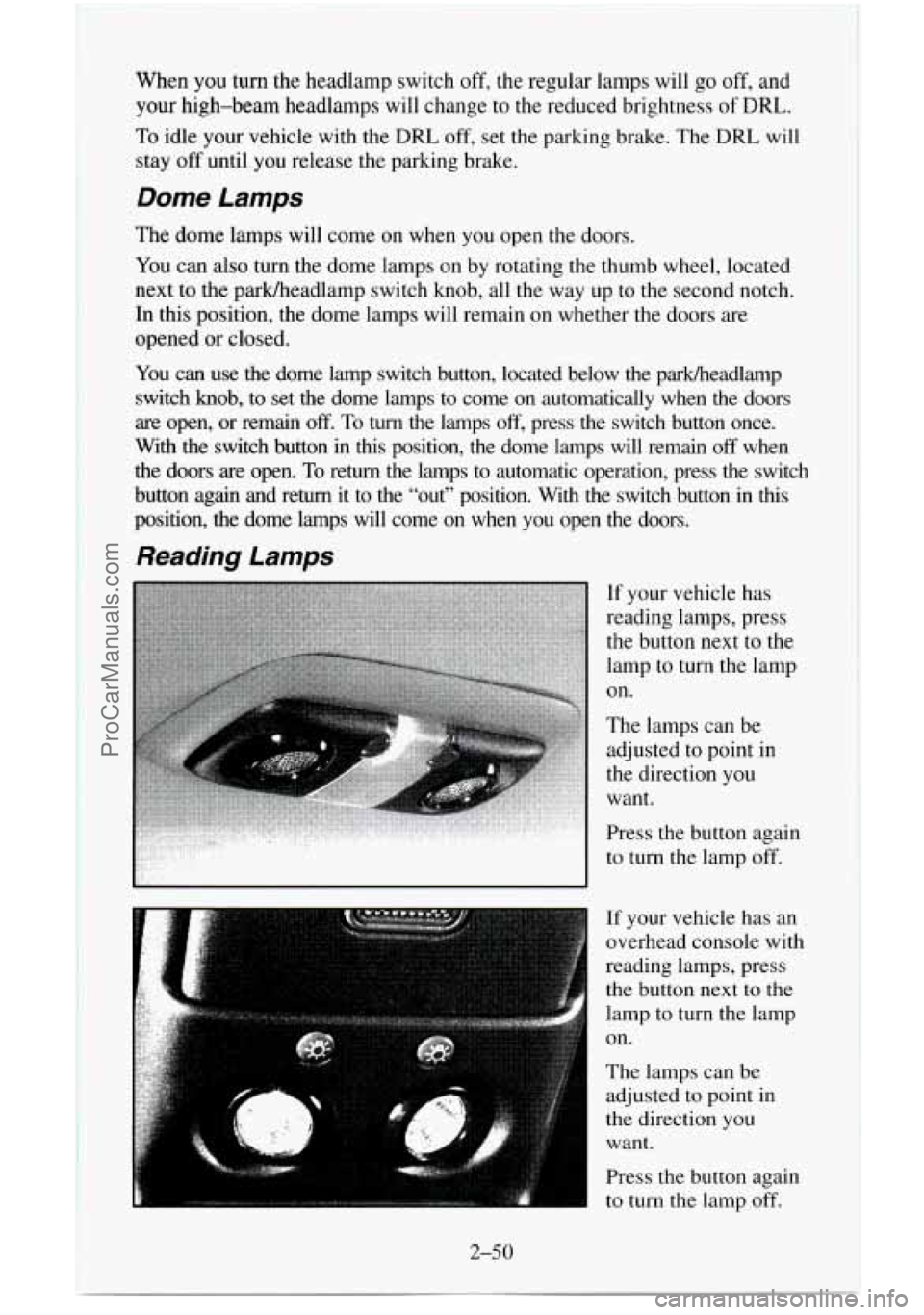
Reading Lamps
If your vehicle has
reading lamps, press
the button next to the
lamp to turn the lamp
on.
The lamps can be
adjusted to point
in
the direction you
want.
Press the button again
to turn the lamp
off.
If your vehicle has an
overhead console with
reading lamps, press
the button next
to the
lamp to turn the lamp
on.
The lamps can be
adjusted
to point in
the direction you
want.
Press the button again
to turn the lamp off.
2-50
ProCarManuals.com
Page 134 of 486
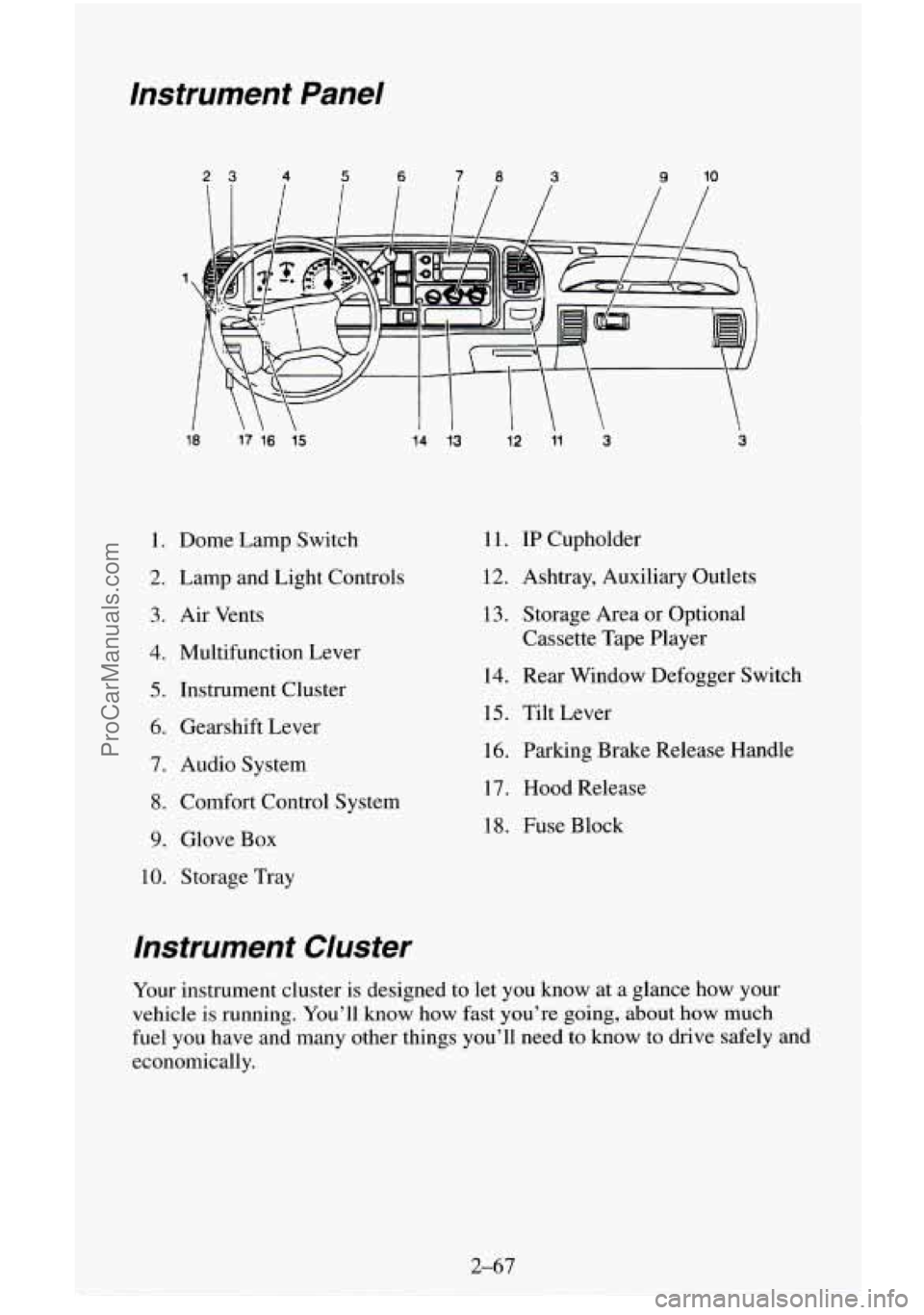
Instrument Panel
23 4 5 6 78 3 9 10
18
17 16 15
1. Dome Lamp Switch
2. Lamp and Light Controls
3. Air Vents
4. Multifunction Lever
5. Instrument Cluster
6. Gearshift Lever
7. Audio System
8. Comfort Control System
9. Glove Box
10. Storage Tray
14 13 12 11 3 3
1 1. IP Cupholder
12. Ashtray, Auxiliary Outlets
13. Storage Area or Optional
Cassette Tape Player
14. Rear Window Defogger Switch
15. Tilt Lever
16. Parking Brake Release Handle
17. Hood Release
18. Fuse Block
Instrument Cluster
Your instrument cluster is designed to let you know at a glance how your
vehicle
is running. You’ll know how fast you’re going, about how much
fuel you have and many other things you’ll need to know to drive safely and
economically.
2-67
ProCarManuals.com
Page 139 of 486
The brake system warning light will also come on when you set your
parking brake, and it will stay on if your parking brake doesn’t release fully.
If it stays on after your parking brake is fully released, it means you have a
brake problem.
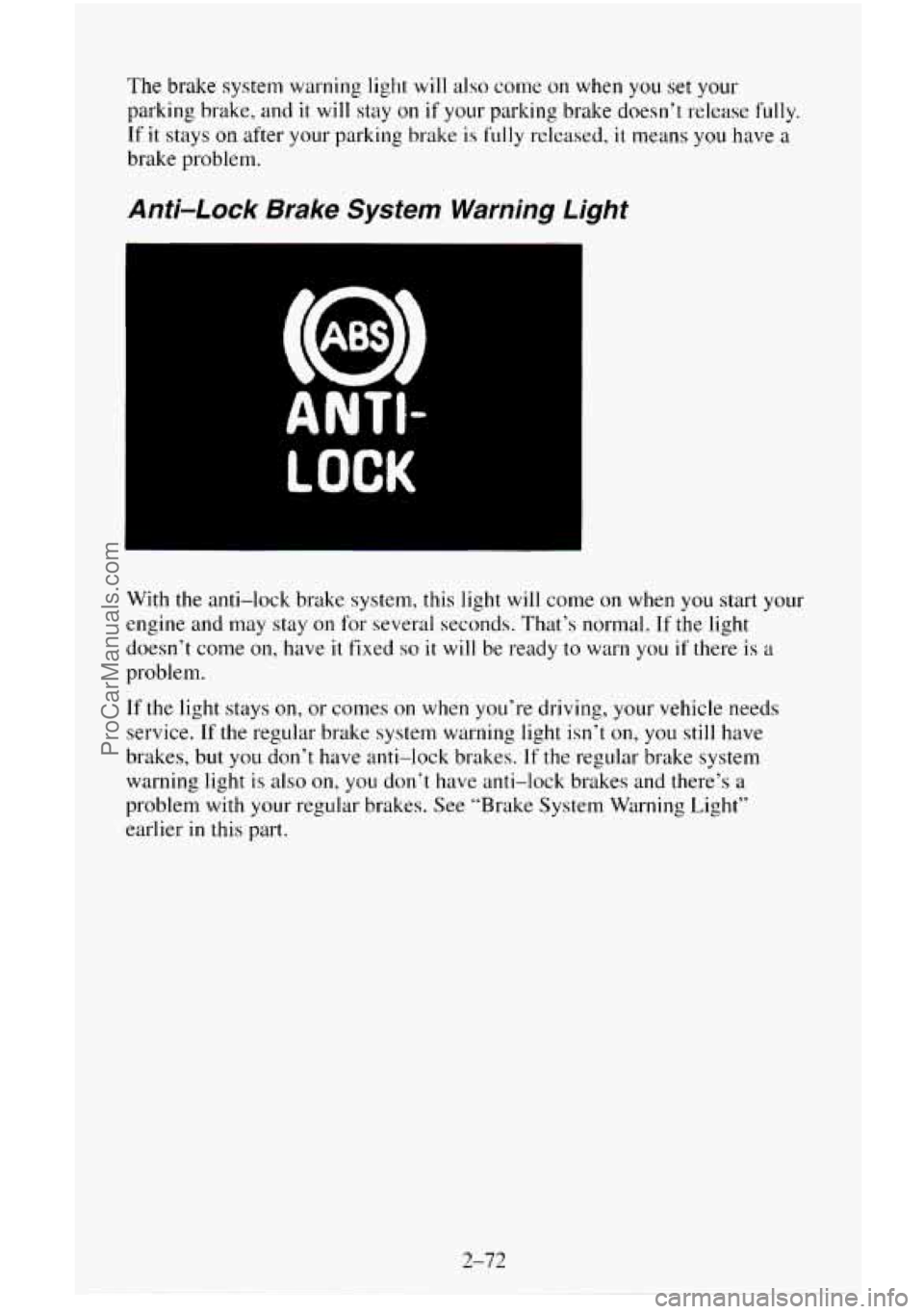
Anti4 ock Brake System Warning Light
ANTI-
LOCK
With the anti-lock brake system, this light will come on when you start your
engine and may stay on for several seconds. That’s normal.
If the light
doesn’t come on, have
it fixed so it will be ready to warn you if there is a
problem.
If the light stays on, or comes on when you’re driving, your vehicle needs
service.
If the regular brake system warning light isn’t on, you still have
brakes, but
you don’t have anti-lock brakes. If the regular brake system
warning light
is also on, you don’t have anti-lock brakes and there’s a
problem with your regular brakes. See “Brake System Warning Light”
earlier
in this part.
2-72
.~
ProCarManuals.com
Page 200 of 486
Q: What should I do if my vehicle stalls, or is about to stall, and I
can’t make it up the hill?
A: If this happens, there are some things you should do, and there are
some things you must not do. First, here’s what you should do:
0 Push the brake pedal to stop the vehicle and keep it from rolling
0 If your engine is still running, shift the transmission into reverse,
backwards.
Also, apply the parking brake.
release the parking brake, and
slowly back down the hill in reverse.
If your engine has stopped running, you’ll need to restart it. With the
brake pedal depressed and the parking brake still applied, shift the
transmission to
PARK (P) (or, shift to NEUTRAL (N) if your vehicle
has a manual transmission) and restart the engine. Then, shift to
reverse, release the parking brake, and slowly back down
the hill as
straight
as possible in reverse.
0 As you are backing down the hill, put your left hand on the steering
wheel at
the 12 o’clock position. This way, you’ll be able to tell if your
wheels are straight and maneuver as you back down. It’s best that you
back down the
hill with your wheels straight rather than in the left or
right direction. Turning
the wheel too far to the left or right will
increase the possibility of a rollover.
Here are
some things you must not do if you stall, or are about to stall,
when going up
a hill.
0 Never attempt to prevent a stall by shifting into NEUTRAL (N) (or
depressing the clutch, if you have a manual transmission) to “rev-up”
the engine and regain forward momentum. This won’t work. Your
vehicle
will roll backwards very quickly and you could go out of
control.
4-17
ProCarManuals.com
Page 201 of 486
Instead, apply the regular brake to stop the vehicle. Then apply the parking
brake. Shift into reverse, release the parking brake, and slowly back straight
down.
Never attempt to turn around if you are about to stall when going up a
hill. If the hill is steep enough
to stall your vehicle, it’s steep enough to
cause
you to roll over if you turn around. If you can’t make it up the
hill, you must back straight down the hill.
Q: Suppose, after stalling, I try to back down the hill and decide I just
can’t
do it. What should I do?
A: Set the parking brake, put your transmission in PARK (P) (or the
manual transmission
in first gear) , and turn off the engine. Leave the
vehicle and go get some help. Exit on the uphill side and stay clear
of
the path the vehicle would take if it rolled downhill. Do not shift the
transfer case to NEUTRAL
(N) when you leave the vehicle. Leave it in
some gear.
Driving Downhill
When off-roading takes you downhill, you’ll want to consider a number of
things:
How steep is the downhill? Will I be able to maintain vehicle control?
What’s the surface like? Smooth? Rough? Slippery? Hard-packed dirt?
Gravel?
Are there hidden surface obstacles? Ruts? Logs? Boulders?
What’s at the bottom of the hill? Is there a hidden creek bank or even a
river bottom with large rocks?
If
you decide you can go down a hill safely, then try to keep your vehicle
headed straight down, and use a low gear. This way, engine drag can help
4-18
ProCarManuals.com
Page 202 of 486
your brakes and they won’t have to do all the work. Descend slowly,
keeping your vehicle under control at all times.
0: Are there some things I should not do when driving down a hill?
A: Yes! These are important because if you ignore them you could lose
control and have a serious accident.
0 When driving downhill, avoid turns that take you across the incline of
the hill. A hill that’s not
too steep to drive down may be too steep to
drive across. You could roll over if you don’t drive straight down.
0 Never go downhill with the transmission in NEUTRAL (N), or with the
clutch pedal depressed in a manual shift
. This is called
“free-wheeling.” Your brakes will have to do all the work and could
overheat and fade.
Q: Am I likely to stall when going downhill?
A: It’s much more likely to happen going uphill. But if it happens going
downhill, here’s what to do.
0 Stop your vehicle by applying the regular brakes. Apply the parking
0 Shift to PARK (P) (or to Neutral with the manual transmission) and,
brake.
while still braking, restart the engine.
1, Shift back to a low gear, release the parking brake, and drive straight
down.
If the engine won’t start, get out and get help.
Driving Across an Incline
Sooner or later, an off-road trail will probably go across the incline of a hill.
If this happens, you have to decide whether to try to drive across the incline.
Here are some things to consider:
A hill that can be driven straight up or down may be too steep to drive
across. When you go straight up or down a hill, the length of the wheel
base (the distance from the front wheels to the rear wheels) reduces the
likelihood the vehicle will tumble end over end. But when you drive
4-19
ProCarManuals.com
Page 212 of 486
There is something about an easy stretch of road with the same scenery,
along with the hum
of the tires on the road, the drone of the engine, and the
rush of the wind against the vehicle that can make you sleepy. Don’t let it
happen to
you! If it does, your vehicle can leave the road in less than a
second,
and you could crash and be injured.
What can you do about highway hypnosis? First, be aware that it can
happen.
Then here are some tips:
0 Make sure your vehicle is well ventilated, with a comfortably cool
interior.
Keep your eyes moving. Scan the road ahead and to the sides. Check
your mirrors and your instruments frequently.
and take a nap, get some exercise, or both. For safety, treat drowsiness
If you get sleepy, pull off the road into a rest, service, or parking area
on the highway
as an emergency.
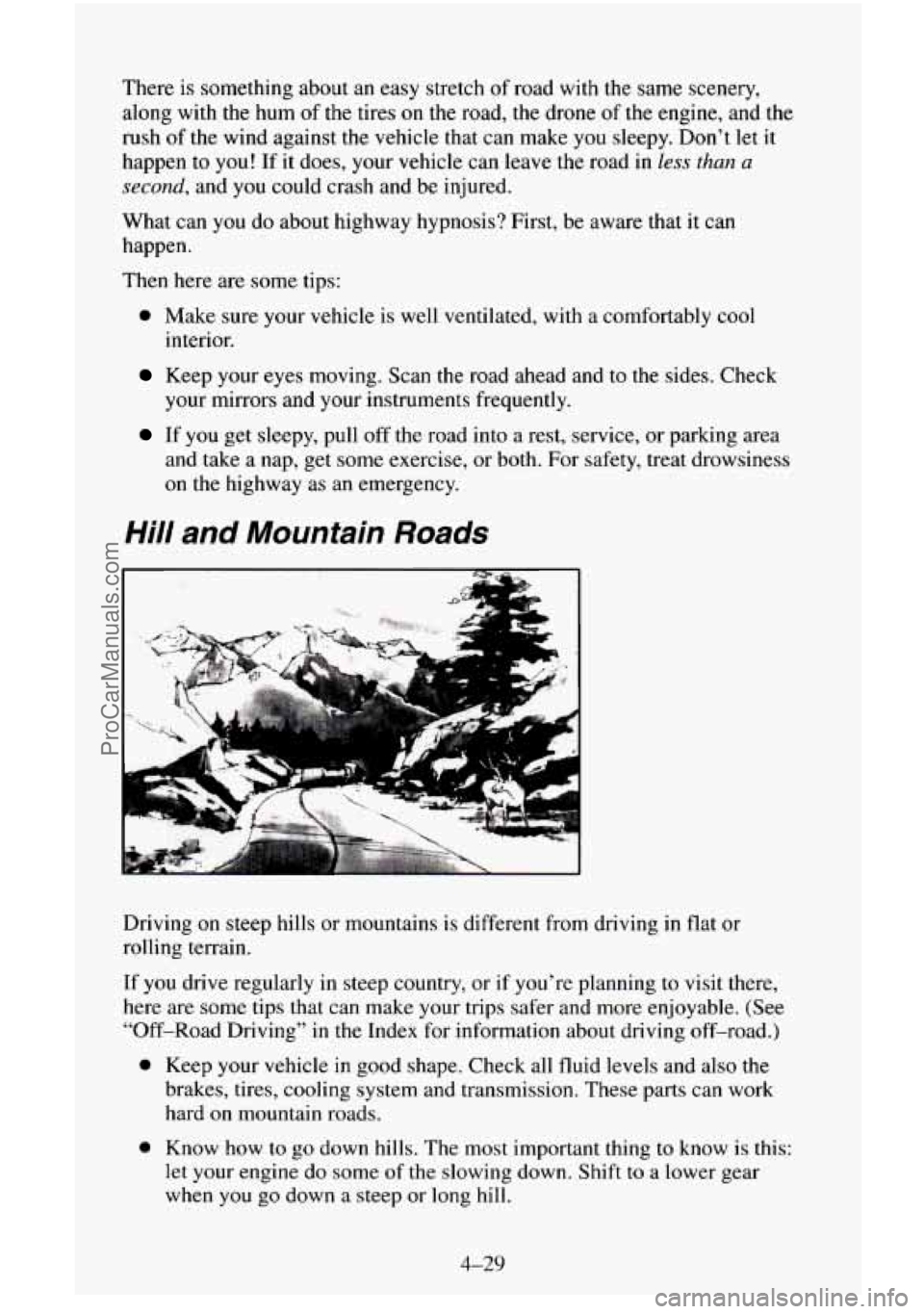
Hill and Mountain Roads
Driving on steep hills or mountains is different from driving in flat or
rolling terrain.
If you drive regularly in steep country, or if you’re planning to visit there,
here are some tips that can make your trips safer and more enjoyable. (See
“Off-Road Driving”
in the Index for information about driving off-road.)
0
0
Keep your vehicle in good shape. Check all fluid levels and also the
brakes, tires, cooling system and transmission. These parts can work
hard on mountain roads.
Know
how to go down hills. The most important thing to know is this:
let your engine
do some of the slowing down. Shift to a lower gear
when
you go down a steep or long hill.
4-29
ProCarManuals.com
Page 217 of 486
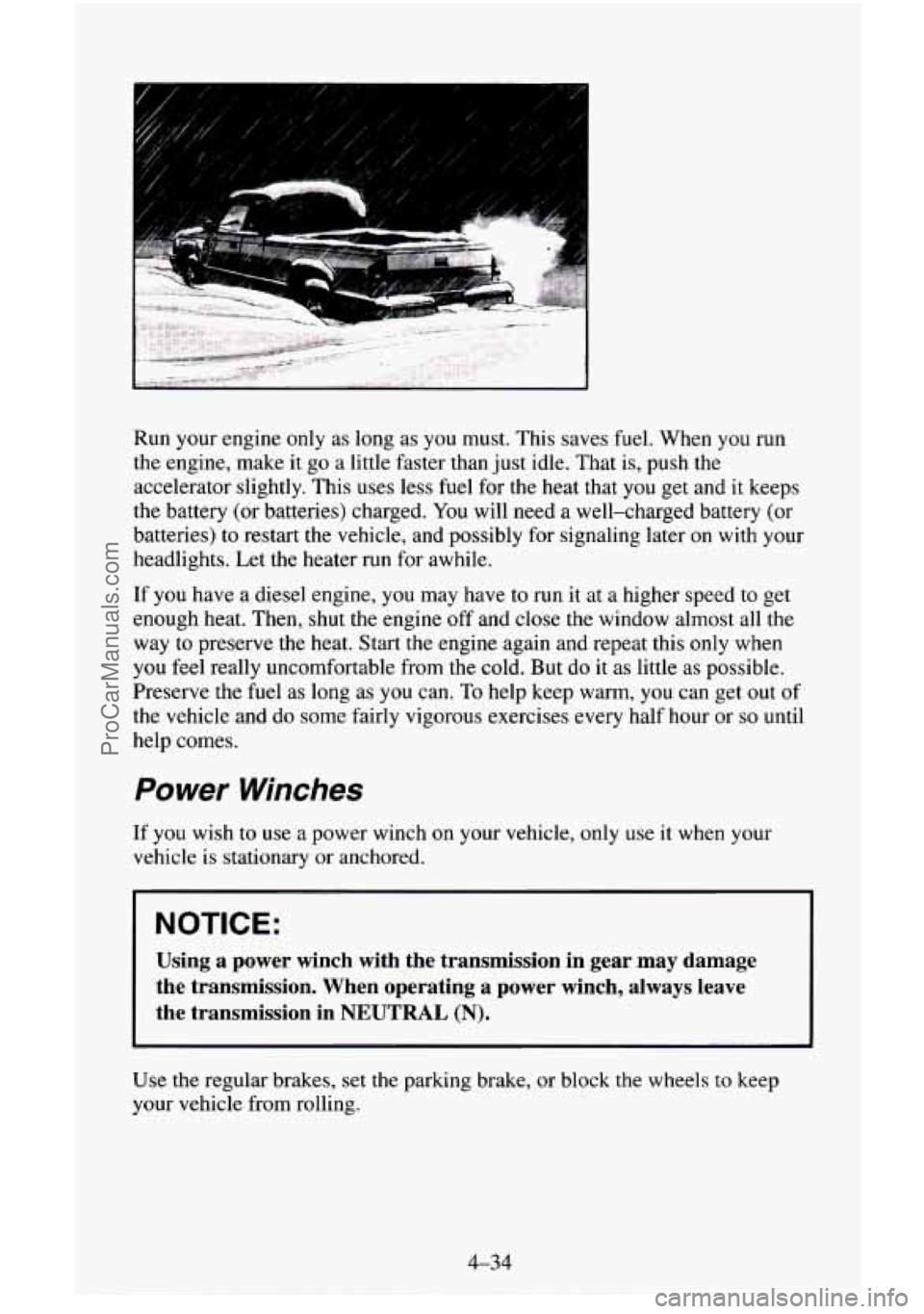
Run your engine only as long as you must. This saves fuel. When you run
the engine, make it
go a little faster than just idle. That is, push the
accelerator slightly. This uses less fuel for the heat
that you get and it keeps
the battery (or batteries) charged. You will need a well-charged battery
(or
batteries) to restart the vehicle, and possibly for signaling later on with your
headlights. Let the heater
run for awhile.
If you have a diesel engine, you may have
to run it at a higher speed to get
enough heat. Then, shut the engine off and close the window almost all the
way to preserve the heat. Start the engine again and repeat
this only when
you feel really uncomfortable from the cold. But do it as little as possible.
Preserve the fuel
as long as you can. To help keep warm, you can get out of
the vehicle and do some fairly vigorous exercises every half
hour or so until
help
comes.
Power Winches
If you wish to use a power winch on your vehicle, only use it when your
vehicle
is stationary or anchored.
I NOTICE:
Using a power winch with the transmission in gear may damage
the transmission. When operating a power winch, always leave
the transmission in NEUTRAL
(N).
Use the regular brakes, set the parking brake, or block the wheels to keep
your vehicle from rolling.
4-34
ProCarManuals.com
Page 218 of 486
Power Take-Off (PTO)
NOTICE:
If you have a PTO that will exceed 35 horsepower installed on
your vehicle, it could damage the transfer case or transmission.
When having a PTO installed on your vehicle, make sure that it
will not exceed
35 horsepower.
Before using a power take-off, refer to the manufacturer’s or installer’s
instructions.
NOTICE:
Using a PTO while operating in one place before the vehicle has
reached normal operating temperature can damage the transfer
case or transmission.
If you will be using the PTO while
operating in one place, drive and warm up the vehicle before
using the PTO.
To engage a power take-off
1. Set the parking brake.
2. Shift the transmission into NEUTRAL (N).
3. Hold the clutch pedal down and engage the power take-off.
NOTICE:
Using a PTO for more than four hours without driving your
vehicle can damage the transfer case or transmission.
If using a
PTO for more than four hours without driving your vehicle,
drive your vehicle for
a while to allow the transfer case and
transmission to cool.
If you are going to drive the vehicle, shift the transmission into the gear
you want. Then shift the transfer case into the range you want
(if you
have four-wheel drive), apply the regular brakes and release the
parking brake.
4. Release the clutch (and the regular brakes) as you normally would.
When
you release the clutch, the power take-off will start.
4-35
ProCarManuals.com