towing CHEVROLET SUBURBAN 1995 User Guide
[x] Cancel search | Manufacturer: CHEVROLET, Model Year: 1995, Model line: SUBURBAN, Model: CHEVROLET SUBURBAN 1995Pages: 486, PDF Size: 26.58 MB
Page 228 of 486
Turn Signals When Towing a Trailer
When you tow a trailer, your vehicle has to have extra wiring (included in
the optional trailering package). The green arrows
on your instrument panel
will flash whenever
you signal a turn or lane change. Properly hooked up,
the trailer lamps will
also flash, telling other drivers you’re about to turn,
change lanes or stop.
When towing a trailer, the green arrows on your instrument panel will flash
for turns even if the bulbs
on the trailer are burned out. Thus, you may think
drivers behind you are seeing your signal when they are not. It’s important
to check occasionally to be sure the trailer bulbs are still working.
Driving On Grades
Reduce speed and shift to a lower gear before you start down a long or steep
downgrade. If
you don’t shift down, you might have to use your brakes so
much that they would get hot and no longer work well.
On
a long uphill grade, shift down and reduce your speed to around 45 mph
(70 kdh) to reduce the possibility of engine and transmission overheating.
If
you have an automatic transmission you should use DRIVE (3) (or, as
you need to, a lower gear) when towing a trailer. Operating your vehicle in
DRIVE (3) when towing a trailer will minimize heat build-up and extend
the life
of your transmission.
If
you have a manual transmission and you are towing a trailer, it’s better
not to use FIFTH (5) gear. Just drive in FOURTH (4) gear (or, as you need
to,
a lower gear).
When towing at high altitude
on steep uphill grades, consider the following:
Engine coolant will boil at a lower temperature than at normal altitudes. If
you turn your engine off immediately after towing at high altitude on steep
uphill grades, your vehicle may show signs similar
to engine overheating.
To avoid this, let the engine run while parked (preferably on level ground)
with the automatic transmission
in PARK (P) (or the manual transmission
out of gear and the parking brake applied) for a few minutes before turning
the engine off.
If you do get the overheat warning, see “Engine
Overheating” in the Index.
Parking on Hills
You really should not park your vehicle, with a trailer attached, on a hill. If
something goes wrong, your rig could start to move. People can be injured,
and both your vehicle and
the trailer can be damaged.
But
if you ever have to park your rig on a hill, here’s how to do it:
1. Apply your regular brakes, but don’t shift into PARK (P) yet, or in gear
for a manual transmission.
ProCarManuals.com
Page 230 of 486
Maintenance When Trailer Towing
Your vehicle will need service more often when you’re pulling a trailer. See
the Maintenance Schedule for more on this. Things that are especially
important
in trailer operation are automatic transmission fluid (don’t
overfill), engine oil, axle lubricant, belt, cooling system, an\
d brake
adjustment. Each
of these is covered in this manual, and the Index will help
you find them quickly. If you’re trailering, it’s a good idea to review these
sections before you start your trip.
Check periodically to see
that all hitch nuts and bolts are tight.
Trailer Lighting Systems Wiring
See “Trailer Wiring Harness” in the Index.
ProCarManuals.com
Page 240 of 486
To wing Your Vehicle
Try to have your GM dealer or a professional towing service tow your
vehicle. They can provide the right equipment and know how
to tow it
without damage.
If your vehicle has been changed since it was factory-new, by adding such
things like fog lamps, aero skirting, or special tires and wheels, these things
could be damaged during towing.
Before you do anything, turn on the hazard warning flashers.
When you call, tell the towing service:
0 That your vehicle has rear-wheel drive, or that it has the four-wheel
drive option.
The make, model, and year of your vehicle.
0 Whether you can move the shift lever for the transmission and transfer
case, if you have one.
0 If there was an accident, what was damaged.
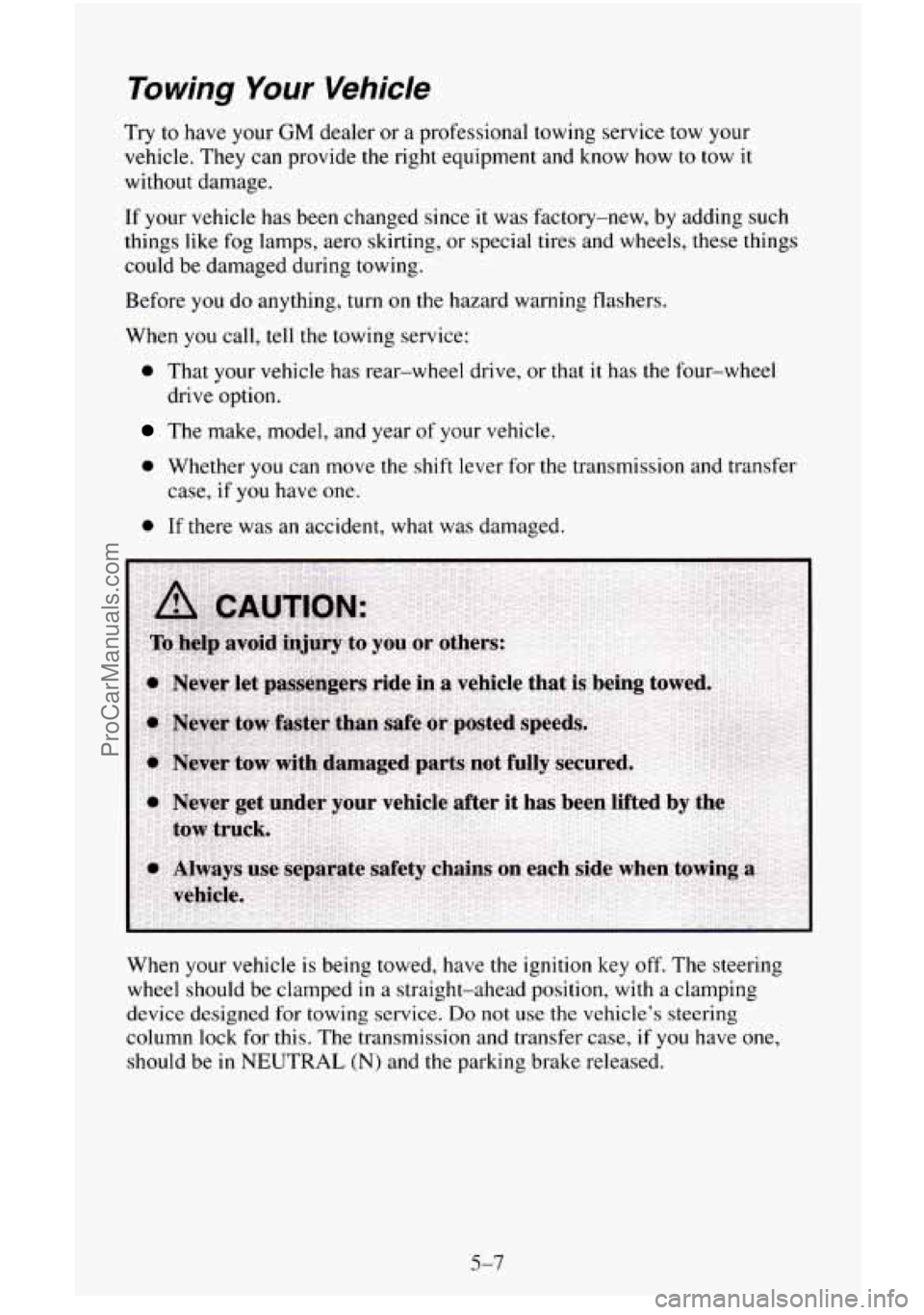
When your vehicle is being towed, have
the ignition key off. The steering
wheel should be clamped
in a straight-ahead position, with a clamping
device designed for towing service.
Do not use the vehicle’s steering
column
lock for this. The transmission and transfer case, if you have one,
should be in NEUTRAL (N) and the parking brake released.
5-7
ProCarManuals.com
Page 241 of 486
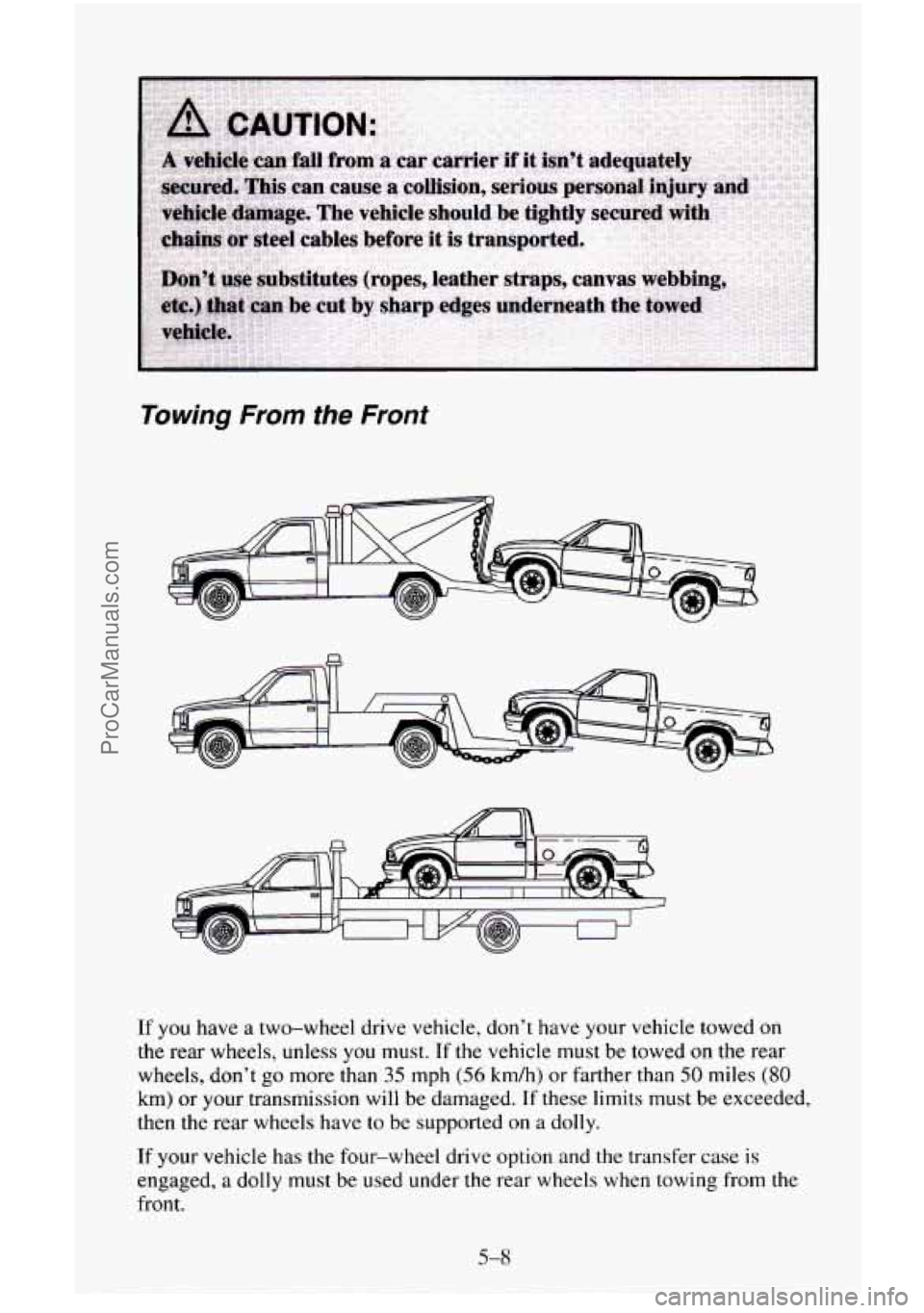
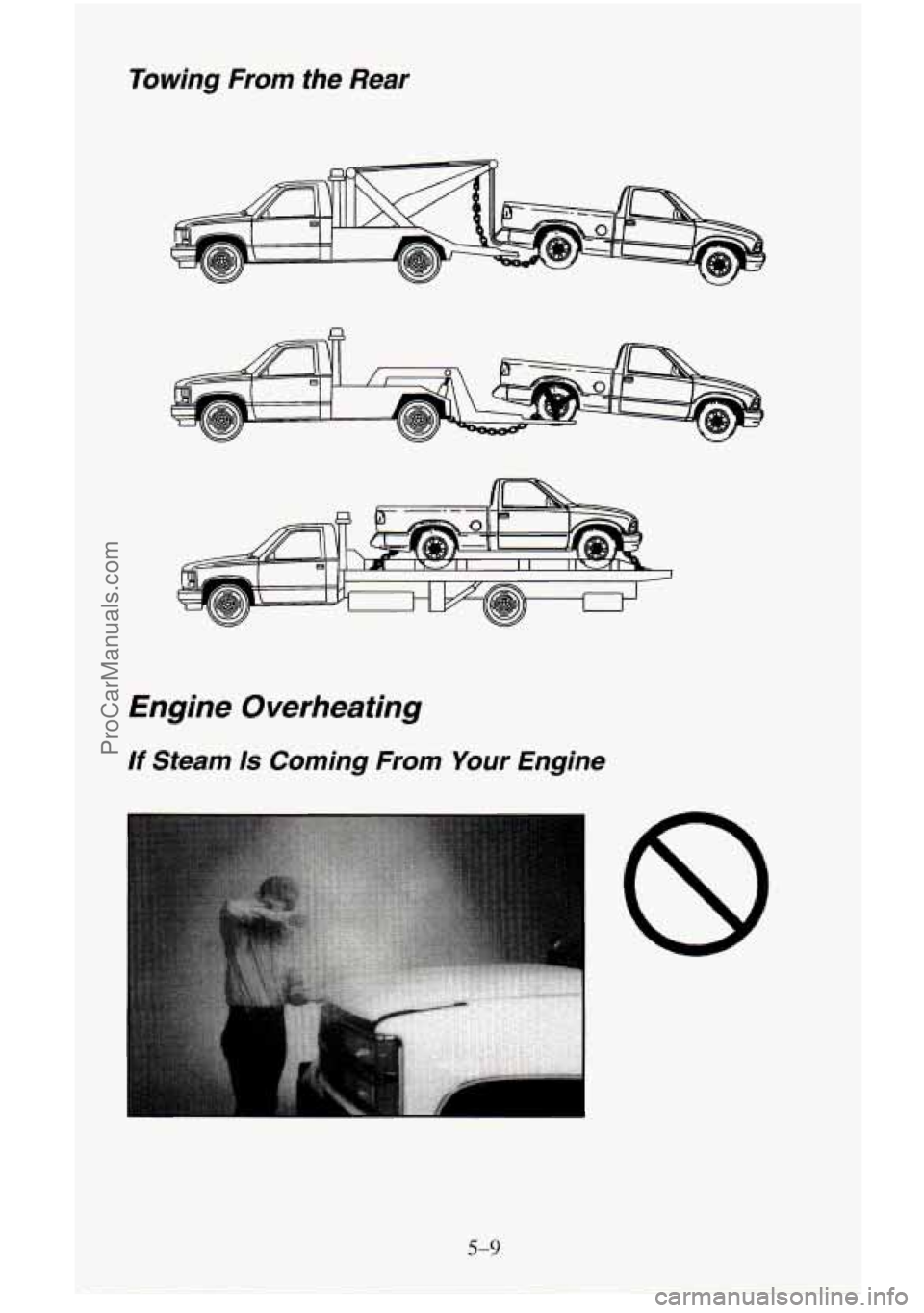
Towing From the Front
If you have a two-wheel drive vehicle, don’t have your vehicle towed on
the rear wheels, unless you must. If the vehicle must be towed
on the rear
wheels, don’t go more than
35 mph (56 km/h) or farther than 50 miles (80
km) or your transmission will be damaged. If these limits must be exceeded,
then
the rear wheels have to be supported on a dolly.
If your vehicle has the four-wheel drive option and the transfer case is
engaged, a dolly must be used under the rear wheels when towing from the
front.
5-8
.
ProCarManuals.com
Page 242 of 486
Towing From the Rear
Engine Overheating
If Steam Is Coming From Your Engine
5-9
ProCarManuals.com
Page 257 of 486
h
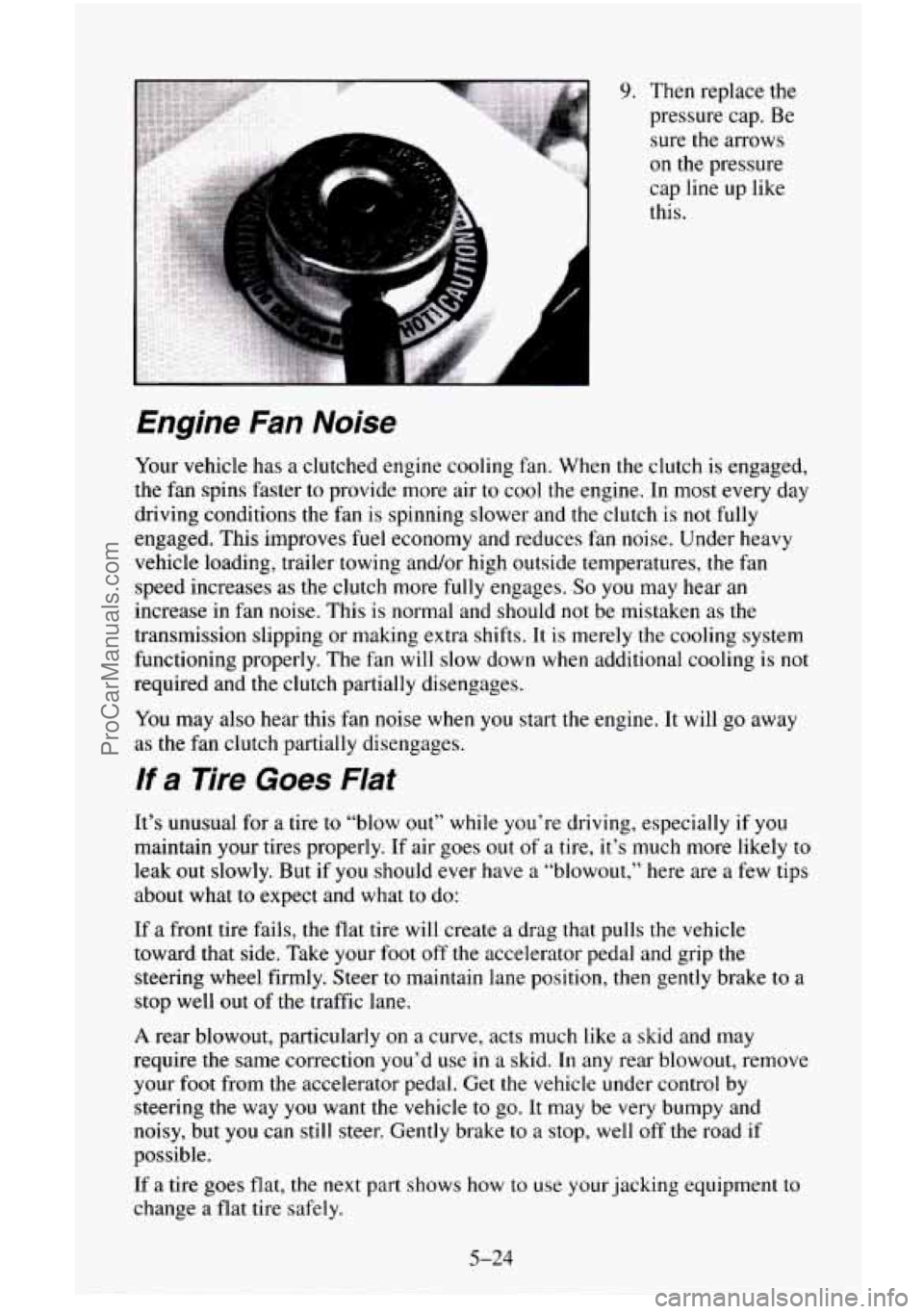
9. Then replace the
pressure cap. Be
sure the arrows
on the pressure
cap line up like
this.
Engine Fan Noise
Your vehicle has a clutched engine cooling fan. When the clutch is engaged,
the fan spins faster to provide more air to cool the engine. In most every day
driving conditions the fan
is spinning slower and the clutch is not fully
engaged. This improves fuel economy and reduces fan noise. Under heavy
vehicle loading, trailer towing and/or high outside temperatures,
the fan
speed increases as the clutch more
fully engages. So you may hear an
increase in fan noise. This is normal and should not be mistaken as the
transmission slipping
or making extra shifts. It is merely the cooling system
functioning properly. The fan will slow down when additional cooling is not
required and the clutch partially disengages.
You may also hear this fan noise when you start the engine. It will go away
as the fan clutch partially disengages.
If a Tire Goes Flat
It’s unusual for a tire to “blow out” while you’re driving, especially if you
maintain your tires properly. If air goes out of a tire, it’s much more likely to
leak out slowly. But if you should ever have a “blowout,” here are a few tips
about what
to expect and what to do:
If a front tire fails, the flat tire will create a drag that pulls the vehicle
toward that side. Take your foot off the accelerator pedal and grip the
steering wheel firmly. Steer
to maintain lane position, then gently brake to a
stop well out of the traffic lane.
A rear blowout, particularly on a curve, acts much like a skid and may
require the same correction you’d
use in a skid. In any rear blowout, remove
your foot from
the accelerator pedal. Get the vehicle under control by
steering the way
you want the vehicle to go. It may be very bumpy and
noisy, but you can still steer. Gently brake to a stop, well
off the road if
possible.
If a tire goes flat, the next part shows how to use your jacking equipment to
change a flat tire safely.
5-24
ProCarManuals.com
Page 273 of 486
Stowing the Tire - &Door Utility Model
For a under-body spare tire carrier, stow the flat tire under the rear of the
vehicle in
the spare tire carrier. To stow the flat tire:
1. Put the tire
on the ground at the rear of the vehicle with the valve stem
2. Pull the wheel retainer through the wheel opening.
pointed
down.
3. Attach the ratchet to the wheel wrench with the UP marking facing you.
4. Put the other end of the wheel wrench through the rear bumper access
hole, located at the passenger side edge of the license plate. Be sure the
wheel wrench connects into the hoist shaft.
5. Turn the ratchet clockwise to raise the tire. Keep turning the ratchet
until the tire
is all the way up. You will hear two “clicks” when the tire
is secure. Pull on the tire to make sure
it is tightly secured.
Stowing the Jack and Jacking Tools
Put the tools into the storage box and close it tightly. Fit the storage box on the
bracket with the bolt through the
box. Put the jack onto the box. Be sure the jack
points in
the right direction as shown in the illustrations earlier in this part. Secure the
emergency gloves, if your vehicle has them, to the jack using the provided strap.
Slide the retainer over the bolt onto the jack and put the wing
nut on. Turn
the nut clockwise until it is tight against the retainer.
Replace the jack storage cover, if your vehicle has one, by simply reversing
the removal procedure described earlier.
Stowing the Tire - 2-Door Utility Model and Suburban
Stow the flat tire in the cargo area of the vehicle secured in the tire carrier.
To stow the flat tire:
1. Put the cover back on the tire
if your vehicle has one.
2. Put the flat tire in the cargo area of the vehicle, over the retainer bolt.
3. Slide the adapter onto the bolt in the proper location for your model
4. Turn the wing nut clockwise until the adapter is tight and secure against
and
put
the wing nut on.
the wheel.
5. Close the tire cover, if you have one.
5-40
ProCarManuals.com
Page 274 of 486
If You’re Stuck: In Sand, Mud, /ce or Snow
What you don’t want to do when your vehicle is stuck is to spin your wheels
too fast. The method known as “rocking” can help you get out when you’re
stuck, but you must use caution.
I NOTICE:
Spinning your wheels can destroy parts of your vehicle as well as
the tires. If you spin the wheels too fast while shifting you\
r
transmission back and forth, you can destroy your transmission. \
For information about using tire chains on your vehicle, see “Tire Chains”
in the Index.
Rocking your vehicle to get it out:
First, turn your steering wheel left and right. That will clear the area around
your front wheels. Then shift back and forth between REVERSE (R) and a
forward gear (or with a manual transmission, between FIRST
(1) or
SECOND
(2) gear and REVERSE), spinning the wheels as little as possible.
Release the accelerator pedal while you shift, and press lightly on the
accelerator pedal when the transmission
is in gear. If that doesn’t get you
out after a few tries, you may need to be towed out. Or, you can use your
recovery hooks,
if your vehicle has them. If you do need to be towed out,
see “Towing Your Vehicle” in the Index.
5-41
ProCarManuals.com
Page 375 of 486
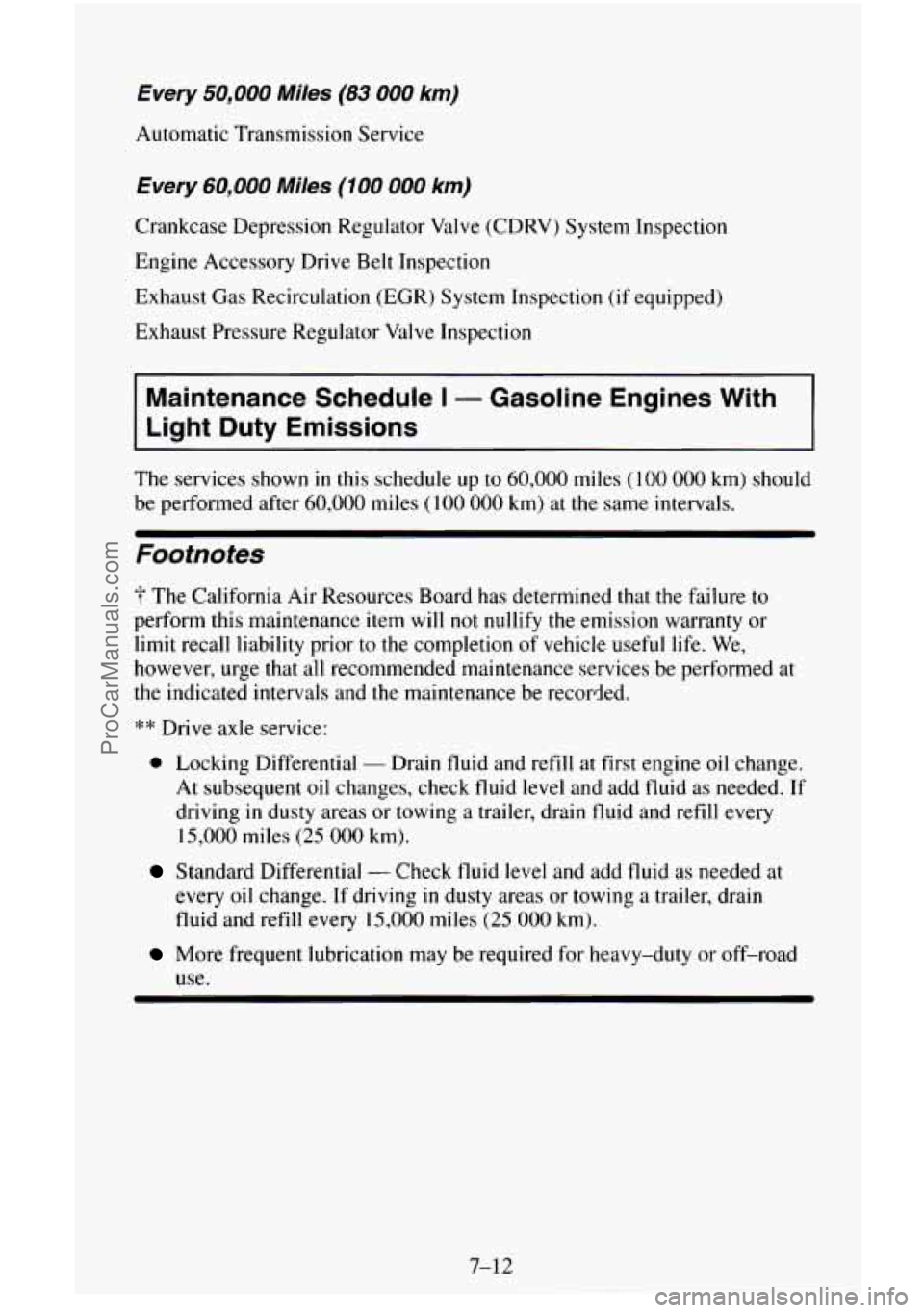
Every 50,000 Miles (83 000 km)
Automatic Transmission Service
Every 60,000 Miles (100 000 km)
Crankcase Depression Regulator Valve (CDRV) System Inspection
Engine Accessory Drive Belt Inspection
Exhaust Gas Recirculation (EGR) System Inspection
(if equipped)
Exhaust Pressure Regulator Valve Inspection
Maintenance Schedule I - Gasoline Engines With
Light Duty Emissions
The services shown in this schedule up to 60,000 miles (100 000 km) should
be performed after
60,000 miles (100 000 km) at the same intervals.
Footnotes
The California Air Resources Board has determined that the failure to
perform this maintenance item will
not nullify the emission warranty or
limit recall liability prior
to the completion of vehicle useful life. We,
however, urge that all recommended maintenance services be performed at
the indicated intervals and the maintenance be recorded.
** Drive axle service:
0 Locking Differential - Drain fluid and refill at first engine oil change.
At subsequent oil changes, check fluid level and add fluid as needed. If
driving
in dusty areas or towing a trailer, drain fluid and refill every
15,000 miles (25 000 km).
Standard Differential - Check fluid level and add fluid as needed at
every
oil change. If driving in dusty areas or towing a trailer, drain
fluid and refill every
15,000 miles (25 000 km).
More frequent lubrication may be required for heavy-duty or off-road
use.
ProCarManuals.com
Page 387 of 486
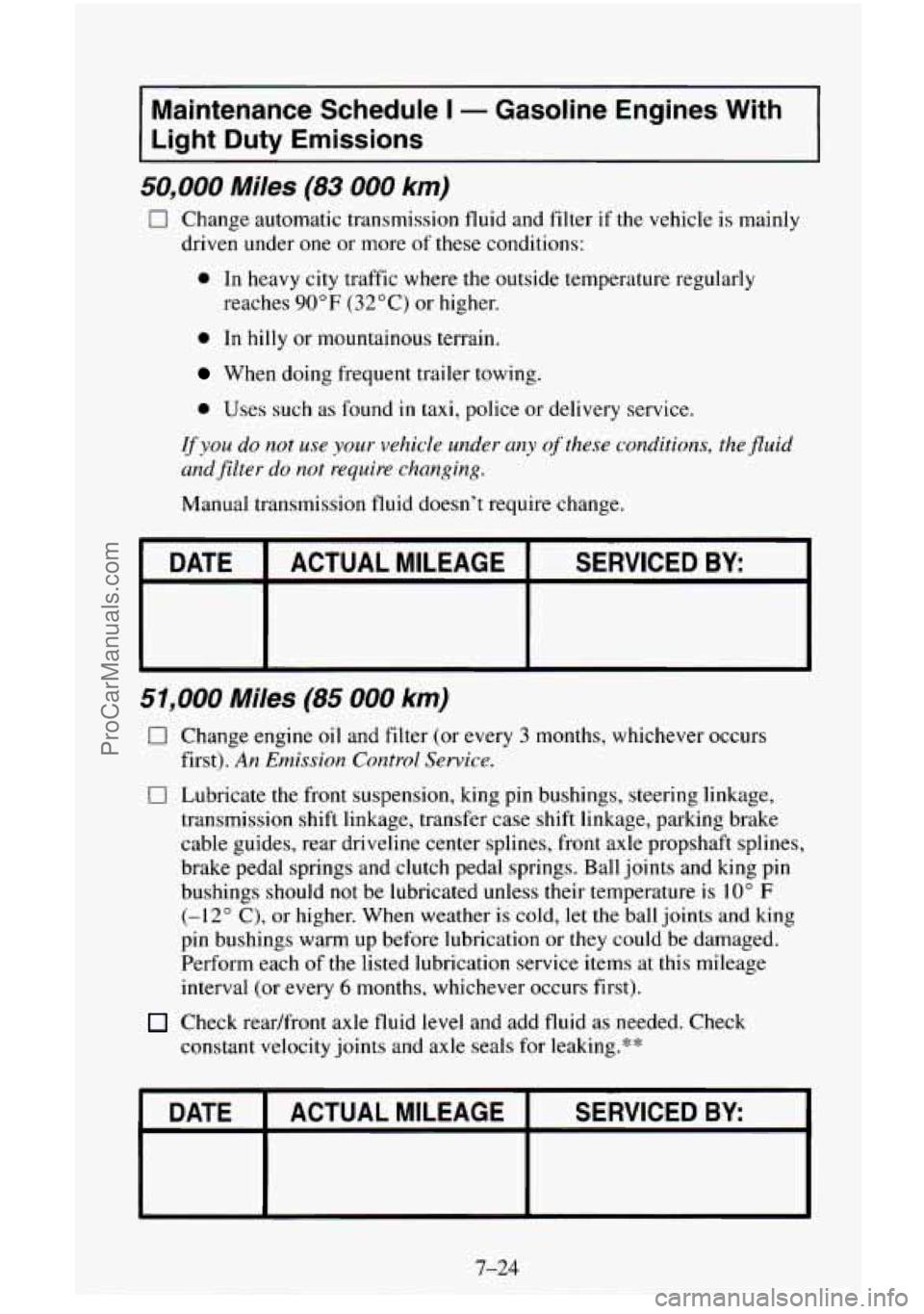
Maintenance Schedule I - Gasoline Engines With
Light Duty Emissions
50,000 Miles (83 000 km)
0 Change automatic transmission fluid and filter if the vehicle is mainly
driven under one or more
of these conditions:
0 In heavy city traffic where the outside temperature regularly
reaches
90°F (32°C) or higher.
0 In hilly or mountainous terrain.
When doing frequent trailer towing.
0 Uses such as found in taxi, police or delivery service.
Ifyou do not use your vehicle under any ofthese conditions, the fluid
andfilter do not require changing.
Manual transmission fluid doesn't require change.
DATE SERVICED BY: ACTUAL MILEAGE
51,000 Miles (85 000 km)
0
0 Change engine oil and filter (or every 3 months, whichever occurs
first).
An Emission Control Service.
Lubricate the front suspension, king pin bushings, steering linkage,
transmission shift linkage, transfer case shift linkage, parking brake
cable guides, rear driveline center splines, front axle propshaft splines,
brake pedal springs and clutch pedal springs. Ball joints and king pin
bushings should not be lubricated unless their temperature
is 10" F
(-12" C), or higher. When weather is cold, let the ball joints and king
pin bushings warm up before lubrication or they could be damaged.
Perform each
of the listed lubrication service items at this mileage
interval (or every
6 months, whichever occurs first).
Check readfront axle fluid level and add fluid as needed. Check
constant velocity joints and axle seals for leaking.**
I DATE I ACTUALMILEAGE I SERVICED BY: I
ProCarManuals.com