key CHEVROLET SUBURBAN 1995 Owner's Manual
[x] Cancel search | Manufacturer: CHEVROLET, Model Year: 1995, Model line: SUBURBAN, Model: CHEVROLET SUBURBAN 1995Pages: 486, PDF Size: 26.58 MB
Page 197 of 486
Controlling your vehicle is the key to successful off-road driving. One of
the best ways to control your vehicle is to control your speed. Here are some
things to keep
in mind. At higher speeds:
you approach things faster and you have less time to scan the terrain for
obstacles.
you have less time to react.
you have more vehicle bounce when you drive over obstacles.
you’ll need more distance for braking, especially since you’re on an
unpaved surface.
Scanning the Terrain
Off-road driving can take you over many different kinds of terrain. You
need to be familiar with the terrain and its many different features. Here are
some things to consider.
Surface Cunditiuns. Off-roading can take you over hard-packed dirt,
gravel, rocks, grass, sand, mud, snow or ice. Each
of these surfaces affects
the steering, acceleration, and braking of your vehicle in different ways.
Depending upon the kind
of surface you are on, you may experience
slipping, sliding,
wheel spinning, delayed acceleration, poor traction, and
longer braking distances.
Surface Obstacles . Unseen or hidden obstacles can be hazardous. A rock,
log, hole, rut, or bump can startle you if you’re not prepared for them. Often
these obstacles are hidden by grass, bushes, snow or even the rise and fall
of
the terrain itself. Here are some things to consider:
Is the path ahead clear?
Will the surface texture change abruptly up ahead?
Does the travel take you uphill or downhill? (There’s more discussion
of these subjects later.)
0 Will you have to stop suddenly or change direction quickly?
When you drive over obstacles or rough terrain, keep a firm grip
on the
steering wheel. Ruts, troughs, or other surface features can jerk the wheel
out
of your hands if you’re not prepared.
4-14
ProCarManuals.com
Page 235 of 486
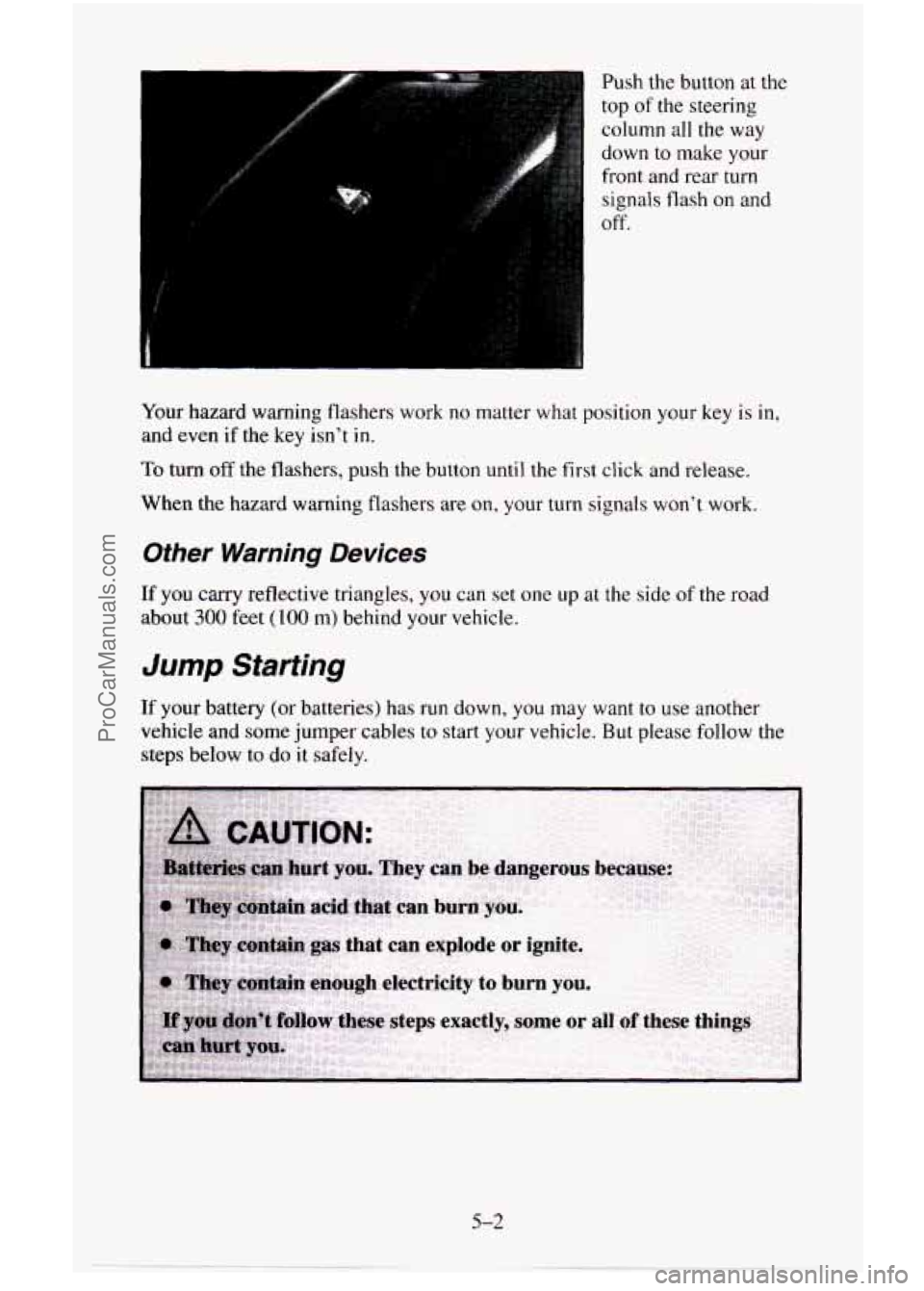
Push the button at the
top
of the steering
column all the way
down to make your
front and rear turn
signals flash on and
off.
Your hazard warning flashers work
no matter what position your key is in,
and even if the key isn’t
in.
To turn off the flashers, push the button until the first click and release.
When the hazard warning flashers are
on, your turn signals won’t work.
Other Warning Devices
If you carry reflective triangles, you can set one up at the side of the road
about 300 feet (100 m) behind your vehicle.
Jump Starting
If your battery (or batteries) has run down, you may want to use another
vehicle and some jumper cables
to start your vehicle. But please follow the
steps below to do it safely.
5-2
ProCarManuals.com
Page 240 of 486
To wing Your Vehicle
Try to have your GM dealer or a professional towing service tow your
vehicle. They can provide the right equipment and know how
to tow it
without damage.
If your vehicle has been changed since it was factory-new, by adding such
things like fog lamps, aero skirting, or special tires and wheels, these things
could be damaged during towing.
Before you do anything, turn on the hazard warning flashers.
When you call, tell the towing service:
0 That your vehicle has rear-wheel drive, or that it has the four-wheel
drive option.
The make, model, and year of your vehicle.
0 Whether you can move the shift lever for the transmission and transfer
case, if you have one.
0 If there was an accident, what was damaged.
When your vehicle is being towed, have
the ignition key off. The steering
wheel should be clamped
in a straight-ahead position, with a clamping
device designed for towing service.
Do not use the vehicle’s steering
column
lock for this. The transmission and transfer case, if you have one,
should be in NEUTRAL (N) and the parking brake released.
5-7
ProCarManuals.com
Page 285 of 486
NOTICE:
If there is water in your diesel fuel and the weather is warm or
humid, fungus and bacteria can grow in the fuel. They can
damage your fuel system. You’ll need
a diesel fuel biocide to
sterilize your fuel system. Your dealer can advise you if you ever
need this.
If your fuel tank needs to be purged to remove water,
see your
dealer or
a qualified technician. Improper purging can damage
your fuel system.
Running Out of Fuel (Diesel Engines)
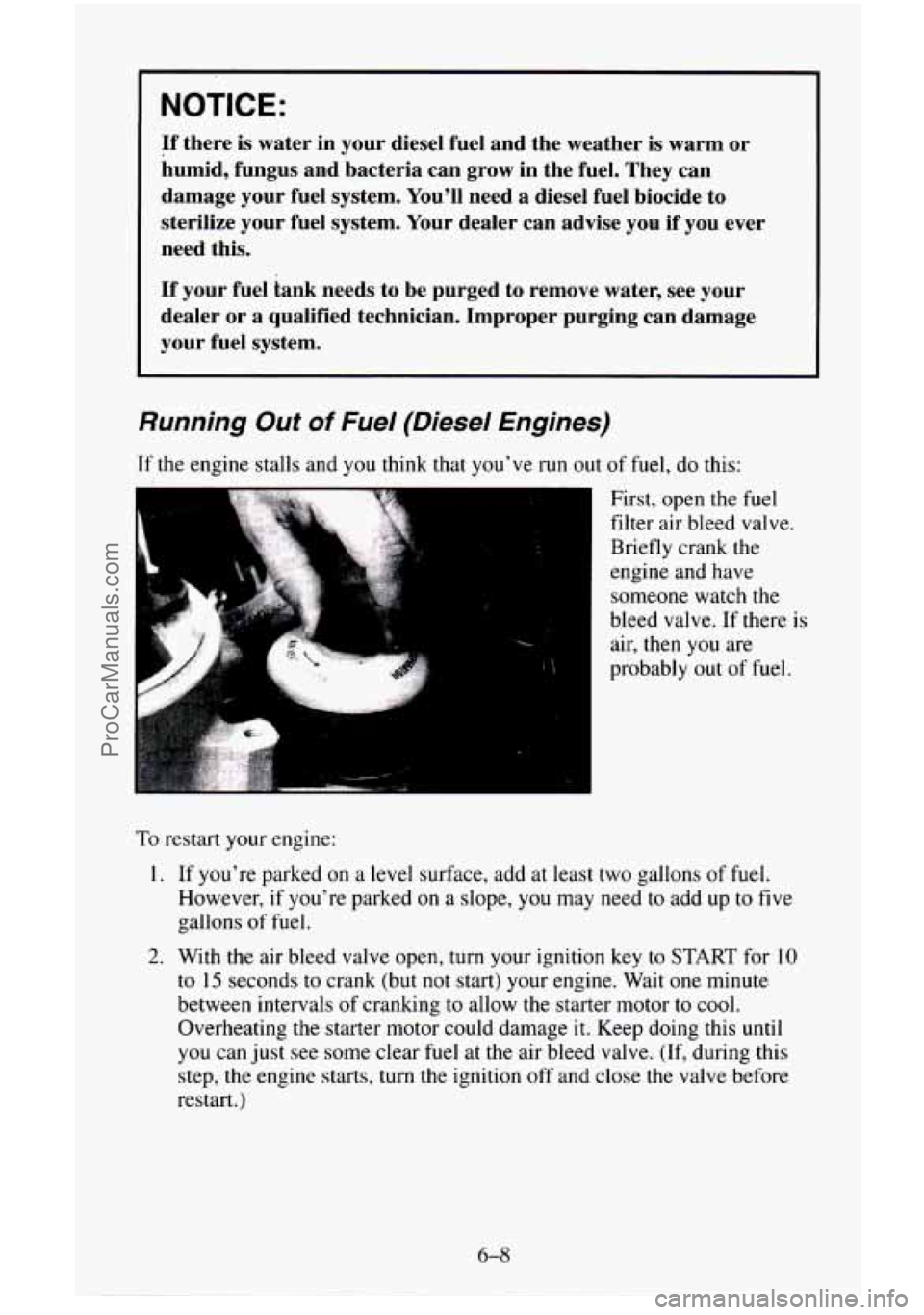
If the engine stalls and you think that you’ve run out of fuel, do this:
First, open the fuel
filter air bleed valve.
Briefly crank the
engine and have
someone watch
the
bleed valve. If there is
air,
then you are
probably
out of fuel.
To restart your engine:
1. If you’re parked on a level surface, add at least two gallons of fuel.
However, if you’re parked on a slope, you may need to add up to five
gallons of fuel.
2. With the air bleed valve open, turn your ignition key to START for 10
to 15 seconds to crank (but not start) your engine. Wait one minute
between intervals of cranking to allow the starter motor
to cool.
Overheating the starter motor could damage
it. Keep doing this until
you can just see some clear fuel at the air bleed valve. (If, during this
step, the engine starts, turn the ignition off and close the valve before
restart.)
ProCarManuals.com
Page 286 of 486
3. Close the air bleed valve.
4. Turn the ignition key to START for 10 to 15 seconds at a time until
your engine starts.
Fuel Filter Replacement (Diesel Engines)
If you want to change the fuel filter yourself, here's how to do it:
First, drain any water from the filter following the procedure for draining
water listed previously.
Your vehicle's engine should be off until the end of the following procedure.
r.
1. Apply the parking brake.
2. Take off the fuel tank cap. This releases vacuum in the tank.
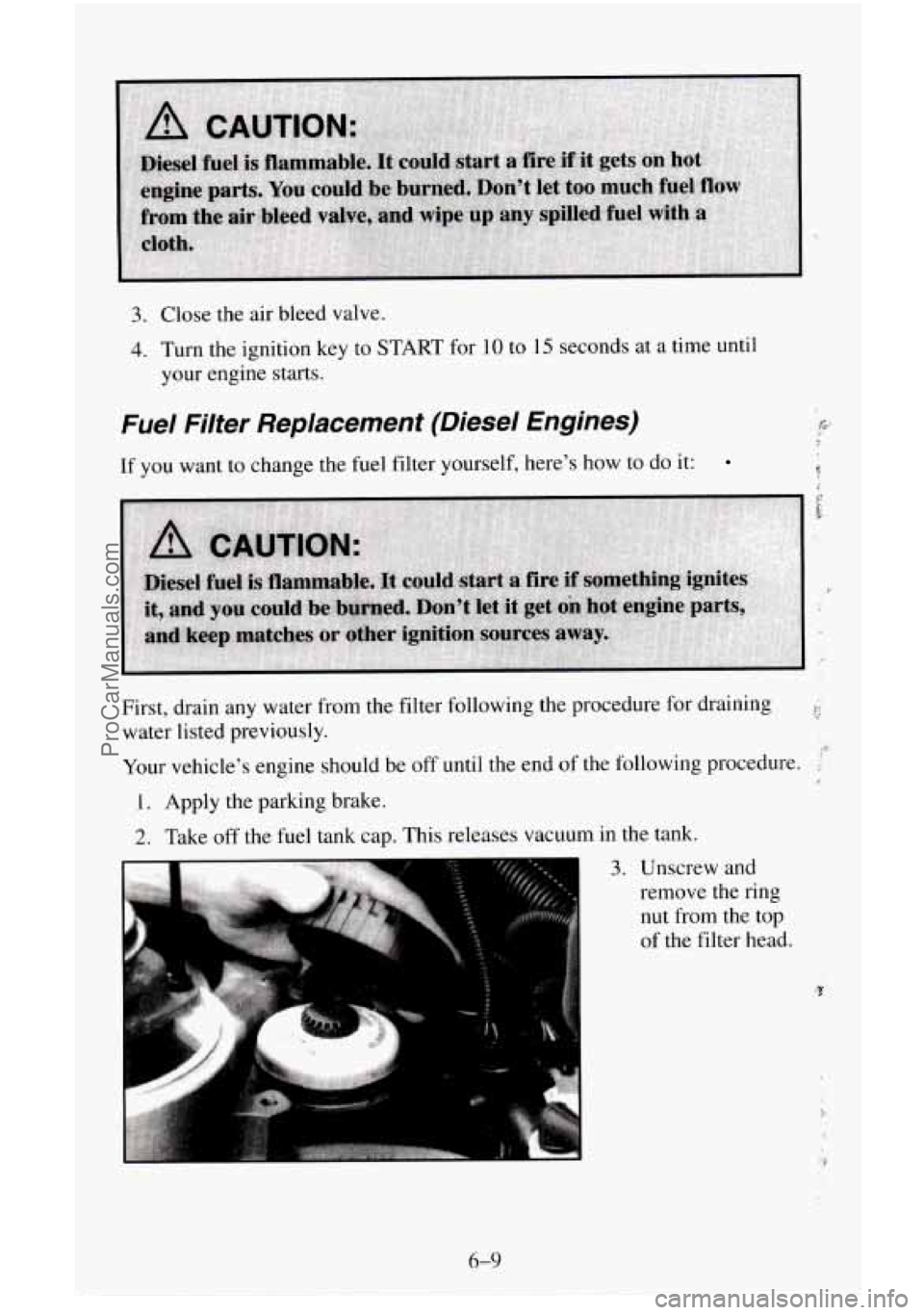
3. Unscrew and
remove the ring
nut from the top
of the filter head.
6-9
ProCarManuals.com
Page 287 of 486
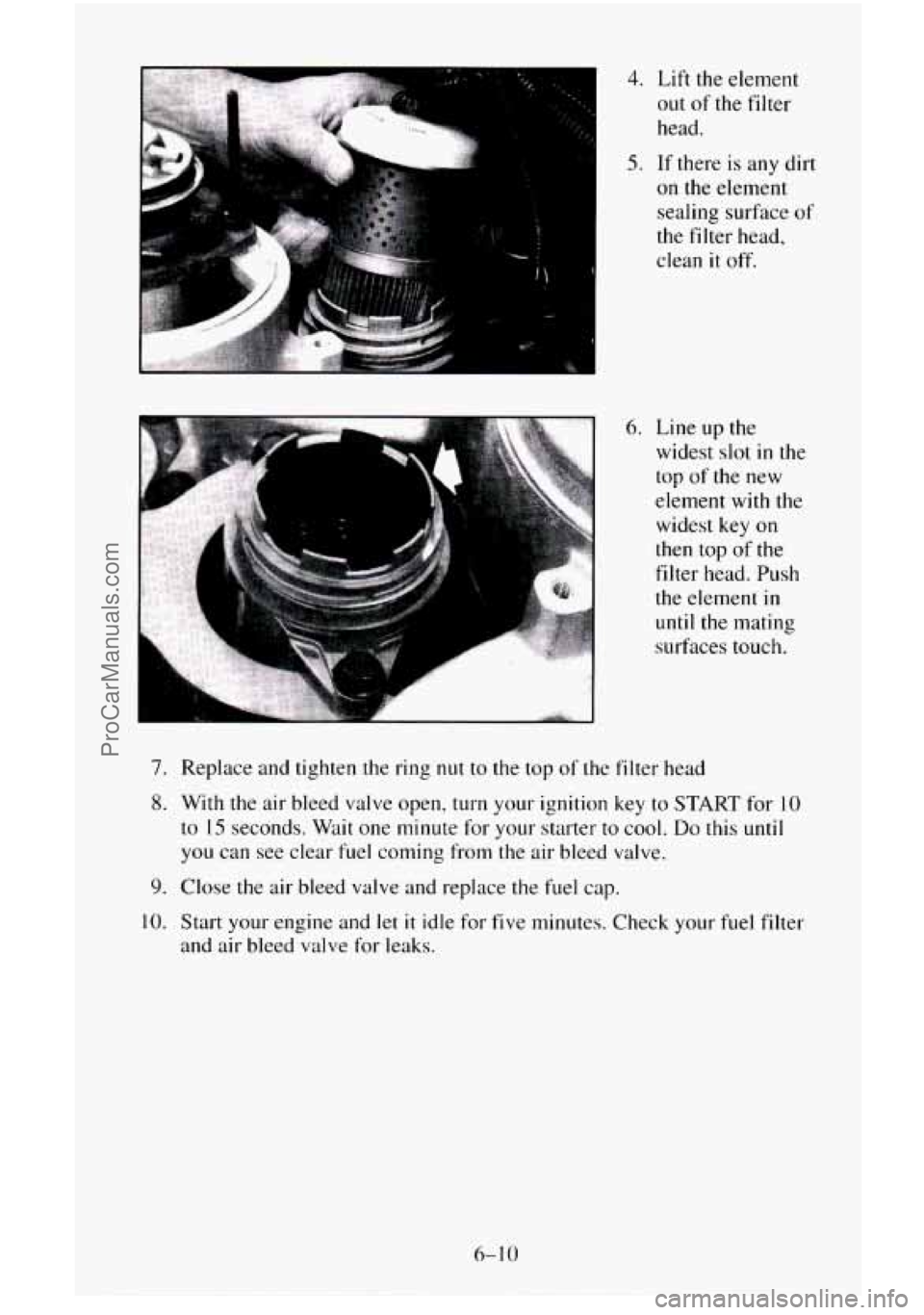
4. Lift the element
out
of the filter
head.
5. If there is any dirt
on the element
sealing surface
of
the filter head,
clean
it off.
6. Line up the
widest slot
in the
top
of the new
element with the
widest key on
then top of the
filter head. Push
the element
in
until the mating
surfaces touch.
7. Replace and tighten the ring nut to the top of'the filter head
8. With the air bleed valve open, turn your ignition key to START for 10
to 15 seconds, Wait one minute for your starter to cool. Do this until
you can see clear fuel coming from the air bleed valve.
9. Close the air bleed valve and replace the fuel cap.
10. Start your engine and let it idle for five minutes. Check your fuel filter
and air bleed valve for leaks.
6-10
ProCarManuals.com
Page 358 of 486
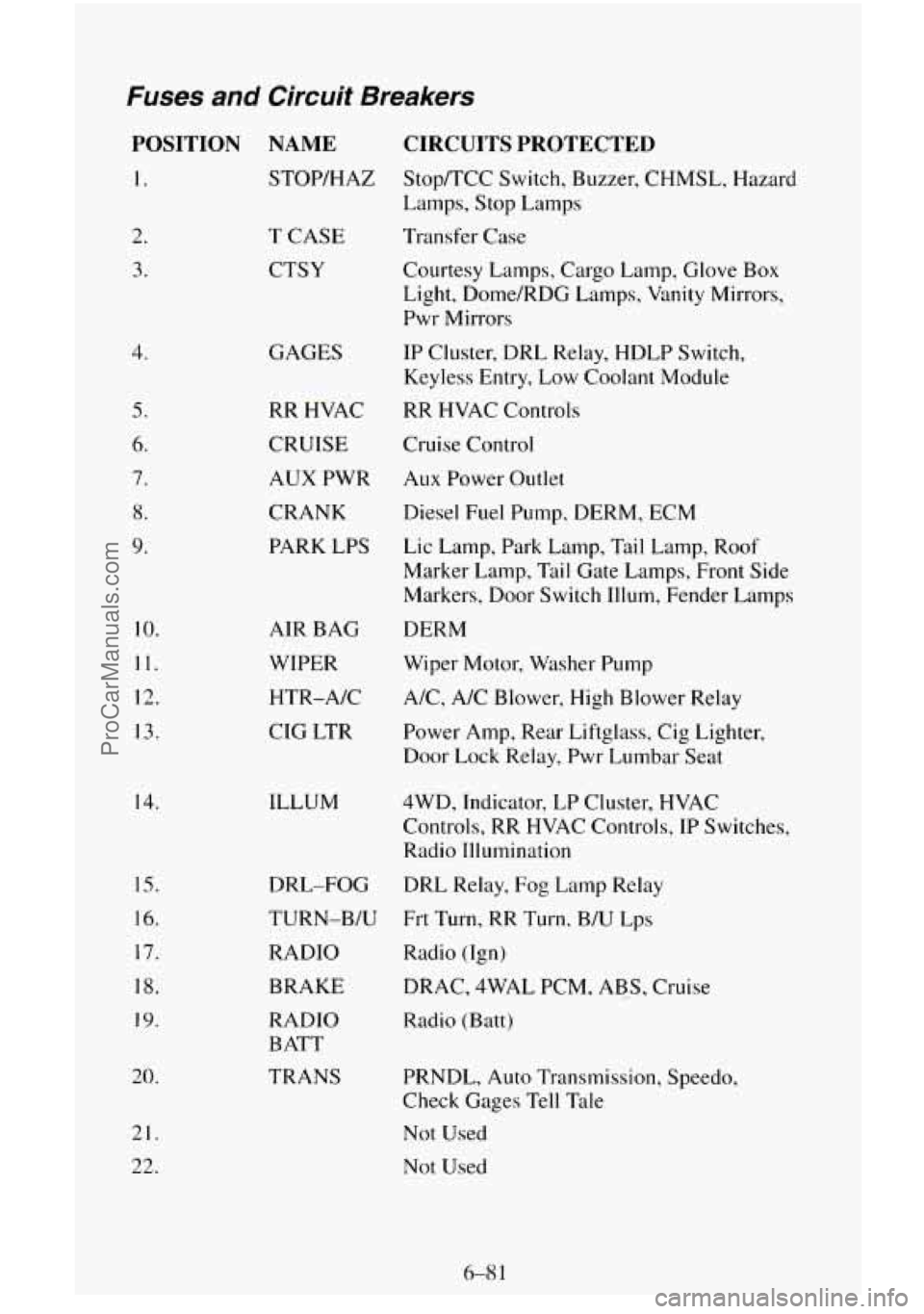
Fuses and Circuit Breakers
POSITION
1.
2.
3.
4.
5.
6.
7.
8.
9.
10.
11.
12.
13. 14.
15.
16.
17.
18.
19.
20.
21.
22.
NAME
STOP/HAZ
T CASE
CTSY
GAGES
RR WAC
CRUISE
AUX PWR CRANK
PARK LPS
AIR BAG
WIPER
HTR-A/C
CIG LTR
ILLUM
DRL-FOG
TURN-B/U
RADIO
BRAKE
RADIO
BATT
TRANS
CIRCUITS PROTECTED
Stop/TCC Switch, Buzzer, CHMSL, Hazard
Lamps, Stop Lamps
Transfer Case
Courtesy Lamps, Cargo Lamp, Glove Box
Light, Dome/RDG Lamps, Vanity Mirrors,
Pwr Mirrors
IP Cluster, DRL Relay, HDLP Switch,
Keyless Entry, Low Coolant Module
RR HVAC Controls
Cruise Control
Aux Power Outlet
Diesel Fuel Pump, DERM, ECM
Lic Lamp, Park Lamp, Tail Lamp, Roof
Marker Lamp, Tdi1 Gate Lamps, Front Side
Markers, Door Switch Illum, Fender Lamps
DERM
Wiper
Motor, Washer Pump
A/C, A/C Blower, High Blower Relay
Power Amp, Rear Liftglass, Cig Lighter,
Door Lock Relay, Pwr Lumbar Seat
4WD, Indicator, LP Cluster, HVAC
Controls,
RR HVAC Controls, IP Switches,
Radio Illumination
DRL Relay,
Fog Lamp Relay
Frt Turn, RR Turn, B/U Lps
Radio (Ign)
DRAC, 4WAL PCM. ABS,
... . Cruise
Radio (Batt)
PRNDL, Auto Transmission, Speedo,
Check Gages Tell Tde
Not Used Not Used
ProCarManuals.com
Page 359 of 486
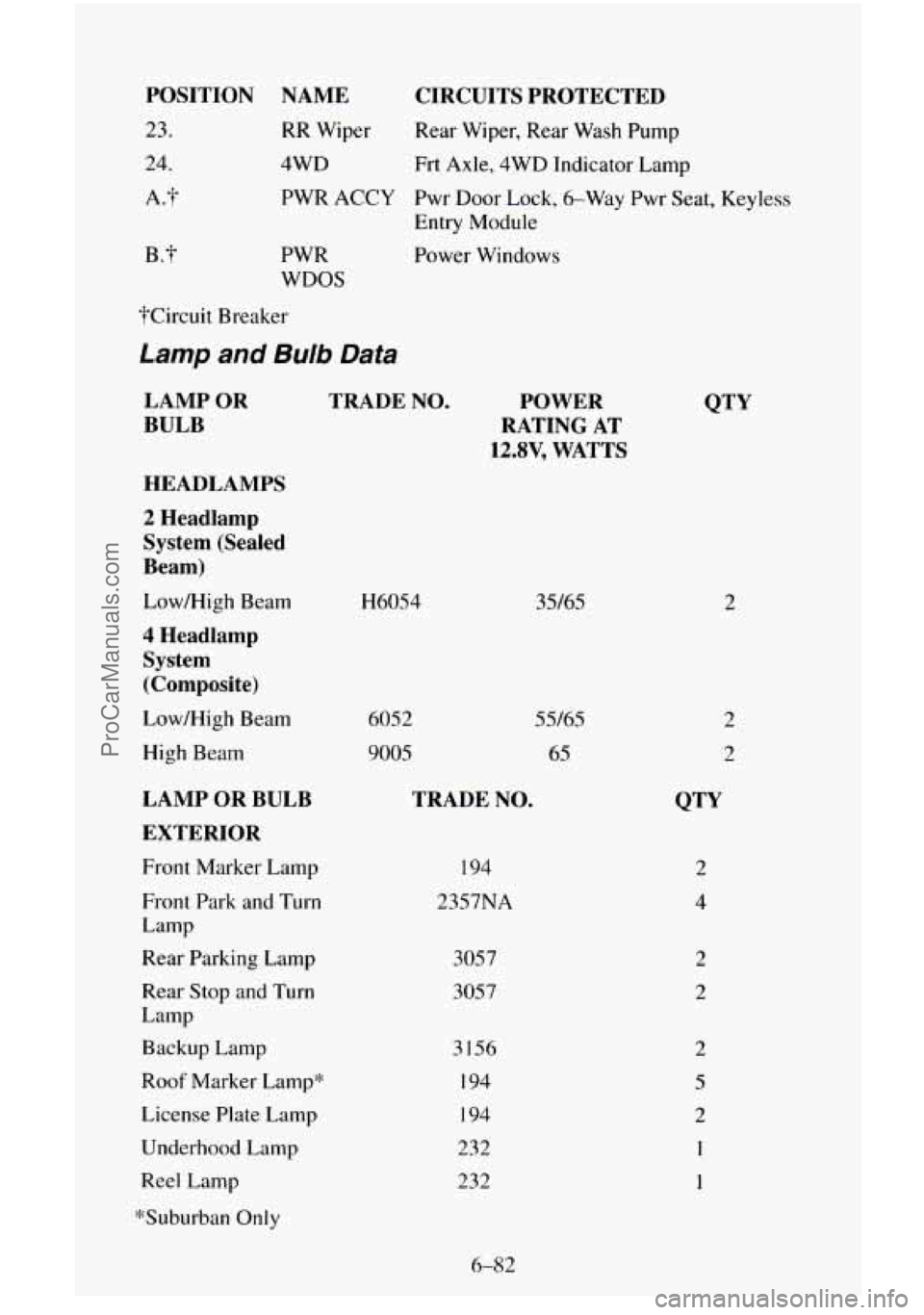
POSITION NAME CIRCUITS PROTECTED
RR Wiper Rear Wiper, Rear Wash Pump
4WD Frt Axle, 4WD Indicator Lamp
PWR ACCY Pwr Door Lock, 6-Way Pwr Seat, Keyless
Entry Module 23.
24.
A3
B.? PWR
WDOS Power Windows
?Circuit Breaker
Lamp and Bulb Data
LAMP OR
BULB TRADE NO. POWER
RATING AT
12.8V, WATTS
HEADLAMPS
2 Headlamp
System (Sealed
Beam)
H6054 35/65 2 Low/High Beam
4 Headlamp
System
(Composite)
Low/High Beam
High Beam 6052
9005 55/65
65 2 2
TRADE NO. LAMP
OR BULB
EXTERIOR
194
2357NA 2
4
Front
Marker Lamp
Front Park and Turn
Lamp
Rear Parking Lamp
Rear Stop and Turn
Lamp
Backup Lamp
Roof Marker Lamp"
License Plate Lamp
Underhood Lamp 3057
3057
2
2
3156
194
194
232
232
Reel
Lamp
*Suburban Only
ProCarManuals.com
Page 456 of 486
At Least Once a Year
Key Lock Cylinders
Lubricate the key lock cylinders with the lubricant specified in Part D.
Body Lubrication
Lubricate all fuel door, body hood and body door hinges, rear compartment
hinges, tailgate and tailgate handle pivot points, tailgate mounted spare tire
carrier pivot points, latches, locks, and folding seat hardware. Part
D tells
you what to use. More frequent lubrication may be required when exposed
to a corrosive environment.
Starter Switch
1. Before you start, be sure you have enough room around the vehicle. It
should be parked on a level surface.
2. Firmly apply both the parking brake (see “Parking Brake” in the Index
if necessary) and the regular brake.
NOTE:
Do not use the accelerator pedal, and be ready to turn off the
engine immediately
if it starts.
3. On automatic transmission vehicles, try to start the engine in each gear.
The starter should work only
in PARK (P) or NEUTRAL (N). If the
starter works
in any other position, your vehicle needs service.
On manual transmission vehicles, put the shift lever
in NEUTRAL (N),
push the clutch down halfway and try to start the engine. The starter
should work
only when the clutch is pushed down all the way to the
floor. If the starter works when the clutch isn’t pushed all the way
down, your vehicle needs service.
7-93
ProCarManuals.com
Page 457 of 486
Brake-Transmission Shift Interlock -= BTSI
1. Before you start, be sure you have enough room around the vehicle. It
should be parked on a level surface.
2. Firmly apply both the parking brake (see “Parking Brake” in the Index
if necessary).
NOTE: Be ready to apply the regular brake immediately if the vehicle
begins
to move.
3. With the engine off, turn the key to the RUN position, but don’t start the
engine. Without applying
the regular brake, try to move the shift lever
out of PARK (P) with normal effort. If the shift lever moves out of
PARK (P), your vehicle’s BTSI needs service.
Steering Column Lock
While parked, and with the parking brake set, try to turn the key to LOCK
in each shift lever position.
With an automatic transmission, the key should turn to LOCK only
when the shift lever is in PARK (P).
With a manual transmission, the key should turn to LOCK only when
the shift lever is in
REVERSE (R).
On vehicles with a key release button, try to turn the key to LOCK without
pressing the button. The
key should turn to LOCK only with the key button
depressed.
On vehicles with
a key release lever, try to turn the key to LOCK without
pressing the lever. The key should turn
to LOCK only with the key lever
depressed.
On all vehicles, the key should come
out only in LOCK.
7-94
ProCarManuals.com