trailer CHEVROLET SUBURBAN 1995 Owner's Manual
[x] Cancel search | Manufacturer: CHEVROLET, Model Year: 1995, Model line: SUBURBAN, Model: CHEVROLET SUBURBAN 1995Pages: 486, PDF Size: 26.58 MB
Page 304 of 486
Wait at least 30 minutes before checking the transmission fluid level if you
have been driving:
0 When outside temperatures are above 90°F (32°C j,
At high speed for quite a while.
In heavy traffic - especially in hot weather.
0 While pulling a trailer.
To get the right reading, the fluid should be at normal operating
temperature, which
is 180°F to 200°F (82°C to 93°C).
To check transmission fluid hot: Get the vehicle warmed up by driving
about
15 miles (24 km) when outside temperatures are above 50°F (1 0°C).
If it's colder than 50°F (10"C), drive
the vehicle in DRIVE (D) until the
engine temperature gage moves and then remains steady for ten minutes.
Then follow the
hot check procedures.
To check transmission fluid cold: A cold check is made after the vehicle
has been sitting for eight hours
or more with the engine off and is used only
as
a reference. Let the engine run at idle for five minutes if outside
temperatures are 50°F (10°C) or more. If it's colder than 50°F (IO'C), you
may have to idle
the engine longer. Should the fluid level be low during a
cold check,
you must perform a hot check before adding fluid. This will
give you
a more accurate reading of the fluid level.
lo check the fluid hot or cold
0 Park your vehicle on a level place. Keep the engine running.
With the parking brake applied, place the shift lever in PARK (P).
With your foot on the brake pedal, move the shift lever through each
gear range, pausing
for about three seconds in each range. Then,
position
the shift lever in PARK (P).
Let the engine run at idle for three minutes or more.
6-27
ProCarManuals.com
Page 352 of 486
Fuses and Circuit Breakers
The wiring circuits in your vehicle are protected from short circuits by a
combination of fuses, circuit breakers, and fusible thermal links
in the
wiring itself. This greatly reduces the chance
of fires caused by electrical
problems. See “Fuses and Circuit Breakers”
in the Index for more
information.
Headlamps
The headlamp wiring is protected by a circuit breaker in the lamp switch.
An electrical overload will cause
the lamps to flicker on and off, or in some
cases to remain off. If this happens, have your headlamp wiring checked
right away.
Windshield Wipers
The windshield wiper motor is protected by a circuit breaker and a fuse. If
the motor overheats due
to heavy snow, etc., the wiper will stop until the
motor cools. Although the circuit is protected from electrical overload,
overload due
to heavy snow, etc., may cause wiper linkage damage. Always
clear ice and heavy snow from the the windshield before using the
windshield wipers. If the overload
is caused by some electrical problem and
not snow, etc., be sure to get it fixed.
Power Windows and Other Power Options
Circuit breakers in the fuse panel protect the power windows and other
power accessories. When the current load is
too heavy, the circuit breaker
opens and closes. This protects the circuit
until the current load returns to
normal
or the problem is fixed.
Trailer Wiring Harness
The seven-wire trailer wiring harness is protected by an in-line fuse in the
battery feed wire. This fuse is near the junction block. See “Trailer Wiring
Harness”
in the Index for more information.
6-75
ProCarManuals.com
Page 367 of 486
If your engine has more than one emissions classification, the classification
is determined by the Gross Vehicle Weight Rating (GVWR) of your vehicle
as shown on the Certification Label. See “Loading Your Vehicle” in the
Index.
Once you’ve determined your engine type and,
if necessary, emissions
classification, you’ll need
to decide which of the two schedules is right for
your vehicle. See Definitions for Maintenance Schedule I and Maintenance
Schedule I1 following.
Schedule I Definition - Gasoline Engines With Light Duty
Emissions
Follow Maintenance Schedule I if any one of these is true for your vehicle:
0 Most trips are less than 5 to 10 miles (8 to 16 km). This is particularly
important when outside temperatures are below freezing.
stop-and-go traffic).
0 Most trips include extensive idling (such as frequent driving in
0 You operate your vehicle in dusty areas or off-road frequently.
You frequently tow a trailer or use a carrier on top of your vehicle.
Schedule
I should also be followed if the vehicle is used for delivery
service, police, taxi, or other commercial application.
Schedule I Intervals - Gasoline Engines With Light Duty
Emissions
Every
3,000 Miles (5 000 km) or 3 Months
Engine Oil and Filter Change
Chassis Lubrication
Drive Axle Service
At 6,000 Miles (10 000 km) - Then Every 12,000 Miles (25 000 km)
Tire Rotation
Every 15,000 Miles (25 000 km)
Air Cleaner Filter Inspection, if driving in dusty conditions
Front Wheel Bearing Repack (or at each brake relining)
(2WD Only)
7-4
ProCarManuals.com
Page 369 of 486
Every 30,000 Miles (50 000 km)
Cooling System Service (or every 24 months, whichever occurs first)
Spark Plug Replacement
Fuel Filter Replacement
Air Cleaner Filter Replacement Front Wheel Bearing Repack
Every 50,000 Miles (83 000 km)
Automatic Transmission Service (severe conditions only)
Every 60,000 Miles (100 000 km)
Spark Plug Wire Inspection
Engine Accessory Drive Belt Inspection
Fuel Tank, Cap and Lines Inspection
Engine Timing Check
Schedule 1 Definition - Gasoline Engines With Heavy Duty
Emissions
Follow Maintenance Schedule I if any one of these is true for your vehicle:
e
e
e
e
Most trips are less than 5 to 10 miles (8 to 16 km). This is particularly
important when outside temperatures are below freezing.
Most trips include extensive idling (such as frequent driving
in stop and
go traffic).
You operate
your vehicle in dusty areas or off-road frequently.
You frequently tow
a trailer or use a carrier on top of your vehicle.
Schedule
I should also be followed if the vehicle is used for delivery
service, police, taxi, or other commercial application.
Schedule I Intervals - Gasoline Engines with Heavy Duty
Emissions
Every
3,000 Miles (5 000 km)
Engine Oil and Filter Change (or every 3 months, whichever occurs first)
Chassis Lubrication (or every
3 months, whichever occurs first)
Drive Axle Service
7-6
ProCarManuals.com
Page 372 of 486
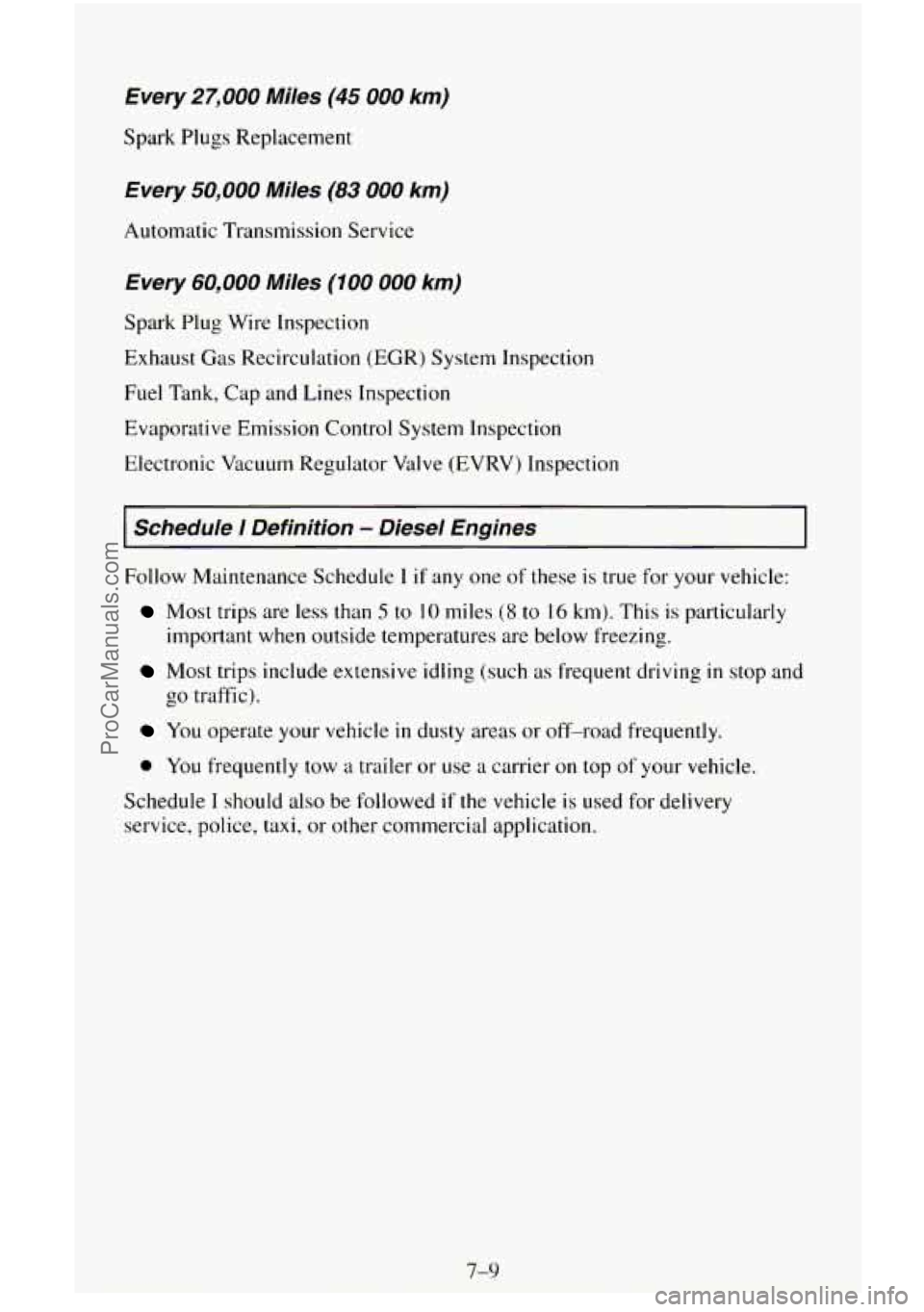
Every 27,000 Miles (45 000 km)
Spark Plugs Replacement
Every 50,000 Miles (83 000 km)
Automatic Transmission Service
Every 60,000 Miles (100 000 km)
Spark Plug Wire Inspection
Exhaust Gas Recirculation
(EGR) System Inspection
Fuel Tank, Cap and Lines Inspection
Evaporative Emission Control System Inspection
Electronic Vacuum Regulator Valve (EVRV) Inspection
1 Schedu/e I Definition - Diesel Engines I
Follow Maintenance Schedule I if any one of these is true for your vehicle:
Most trips are less than 5 to 10 miles (8 to 16 km). This is particularly
important when outside temperatures are below freezing.
Most trips include extensive idling (such as frequent driving in stop and
You operate your vehicle in dusty areas or off-road frequently.
go
traffic).
0 You frequently tow a trailer or use a carrier on top of your vehicle,
Schedule
I should also be followed if the vehicle is used for delivery
service, police, taxi, or other commercial application.
7-9
ProCarManuals.com
Page 375 of 486
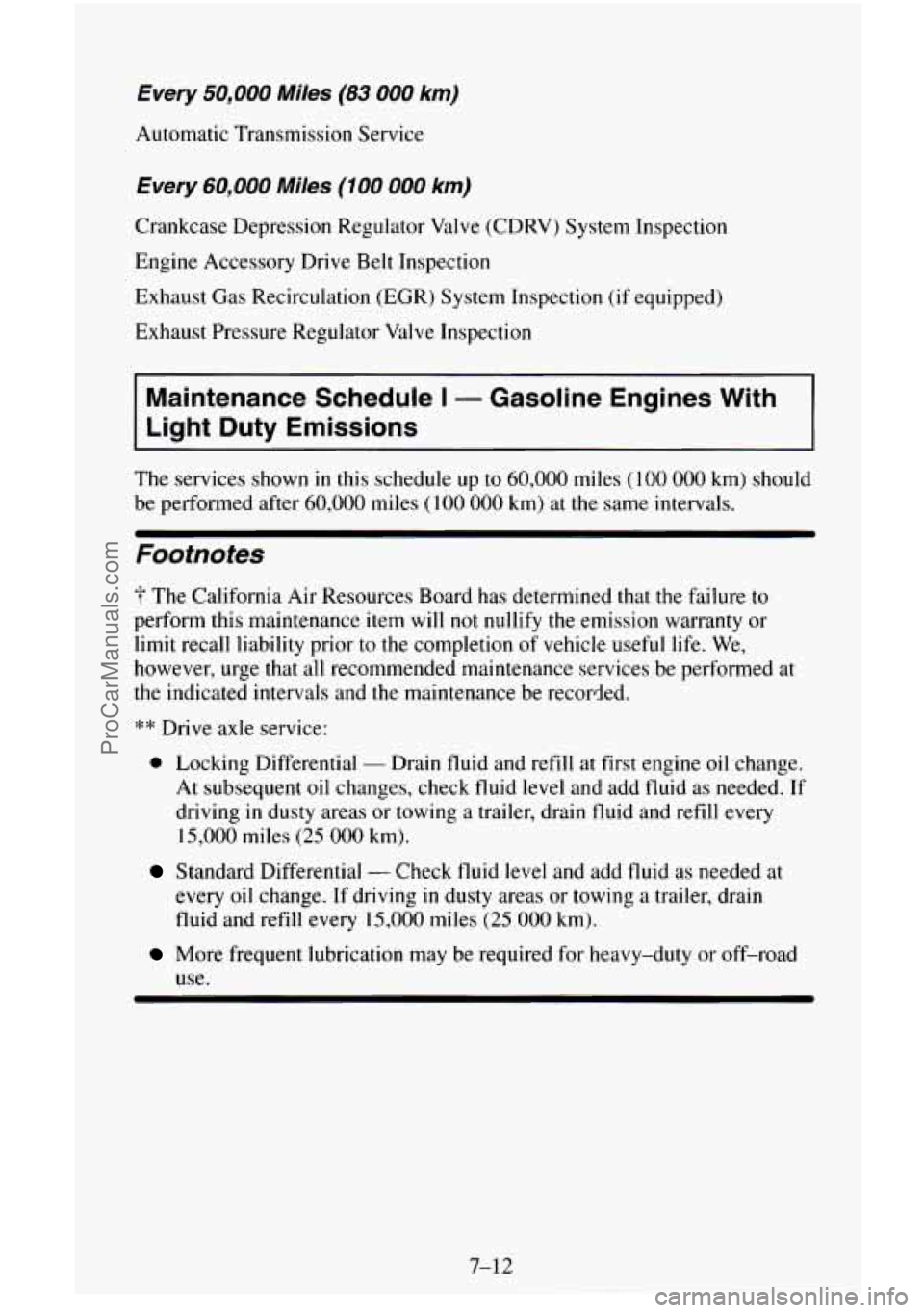
Every 50,000 Miles (83 000 km)
Automatic Transmission Service
Every 60,000 Miles (100 000 km)
Crankcase Depression Regulator Valve (CDRV) System Inspection
Engine Accessory Drive Belt Inspection
Exhaust Gas Recirculation (EGR) System Inspection
(if equipped)
Exhaust Pressure Regulator Valve Inspection
Maintenance Schedule I - Gasoline Engines With
Light Duty Emissions
The services shown in this schedule up to 60,000 miles (100 000 km) should
be performed after
60,000 miles (100 000 km) at the same intervals.
Footnotes
The California Air Resources Board has determined that the failure to
perform this maintenance item will
not nullify the emission warranty or
limit recall liability prior
to the completion of vehicle useful life. We,
however, urge that all recommended maintenance services be performed at
the indicated intervals and the maintenance be recorded.
** Drive axle service:
0 Locking Differential - Drain fluid and refill at first engine oil change.
At subsequent oil changes, check fluid level and add fluid as needed. If
driving
in dusty areas or towing a trailer, drain fluid and refill every
15,000 miles (25 000 km).
Standard Differential - Check fluid level and add fluid as needed at
every
oil change. If driving in dusty areas or towing a trailer, drain
fluid and refill every
15,000 miles (25 000 km).
More frequent lubrication may be required for heavy-duty or off-road
use.
ProCarManuals.com
Page 387 of 486
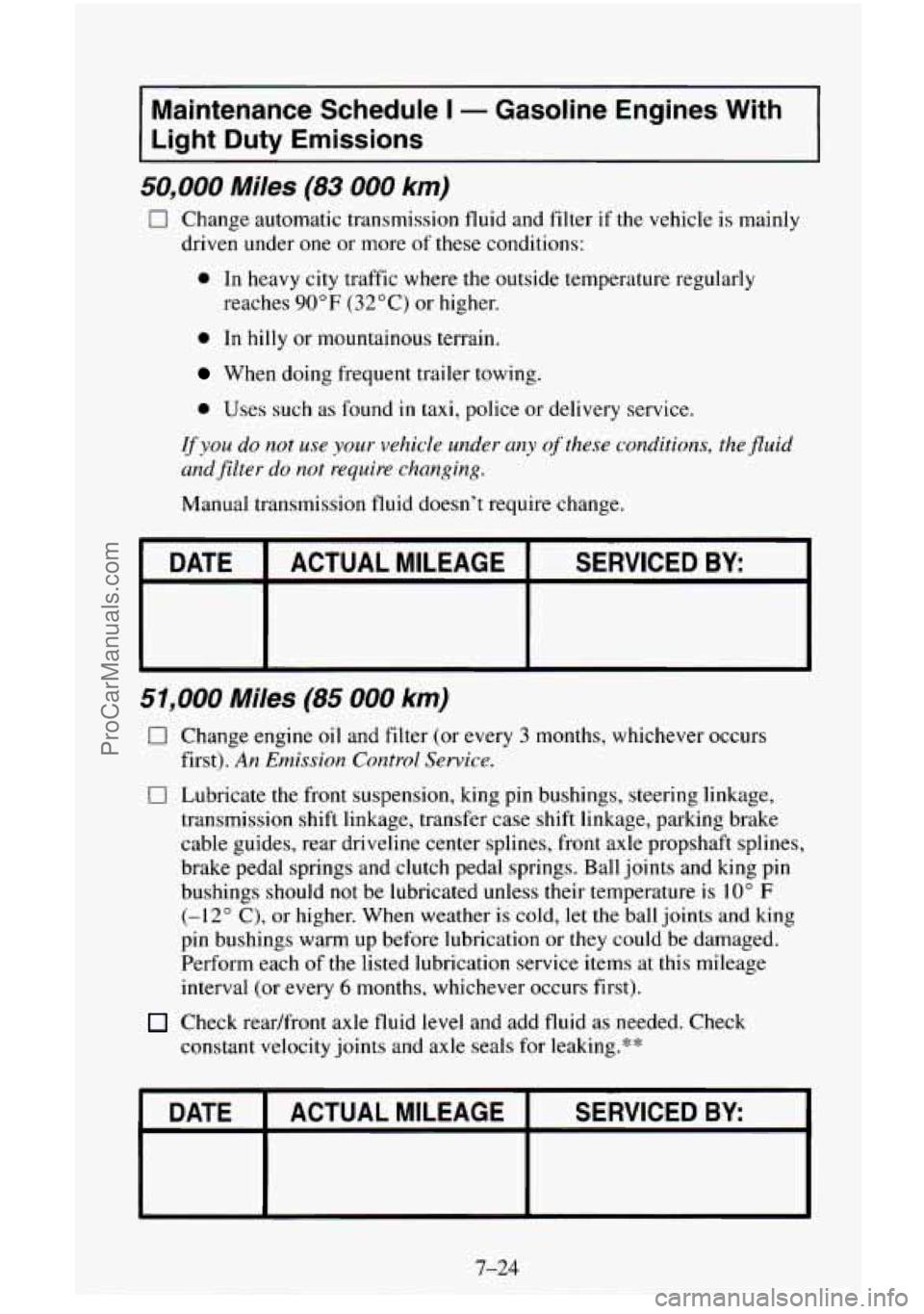
Maintenance Schedule I - Gasoline Engines With
Light Duty Emissions
50,000 Miles (83 000 km)
0 Change automatic transmission fluid and filter if the vehicle is mainly
driven under one or more
of these conditions:
0 In heavy city traffic where the outside temperature regularly
reaches
90°F (32°C) or higher.
0 In hilly or mountainous terrain.
When doing frequent trailer towing.
0 Uses such as found in taxi, police or delivery service.
Ifyou do not use your vehicle under any ofthese conditions, the fluid
andfilter do not require changing.
Manual transmission fluid doesn't require change.
DATE SERVICED BY: ACTUAL MILEAGE
51,000 Miles (85 000 km)
0
0 Change engine oil and filter (or every 3 months, whichever occurs
first).
An Emission Control Service.
Lubricate the front suspension, king pin bushings, steering linkage,
transmission shift linkage, transfer case shift linkage, parking brake
cable guides, rear driveline center splines, front axle propshaft splines,
brake pedal springs and clutch pedal springs. Ball joints and king pin
bushings should not be lubricated unless their temperature
is 10" F
(-12" C), or higher. When weather is cold, let the ball joints and king
pin bushings warm up before lubrication or they could be damaged.
Perform each
of the listed lubrication service items at this mileage
interval (or every
6 months, whichever occurs first).
Check readfront axle fluid level and add fluid as needed. Check
constant velocity joints and axle seals for leaking.**
I DATE I ACTUALMILEAGE I SERVICED BY: I
ProCarManuals.com
Page 390 of 486
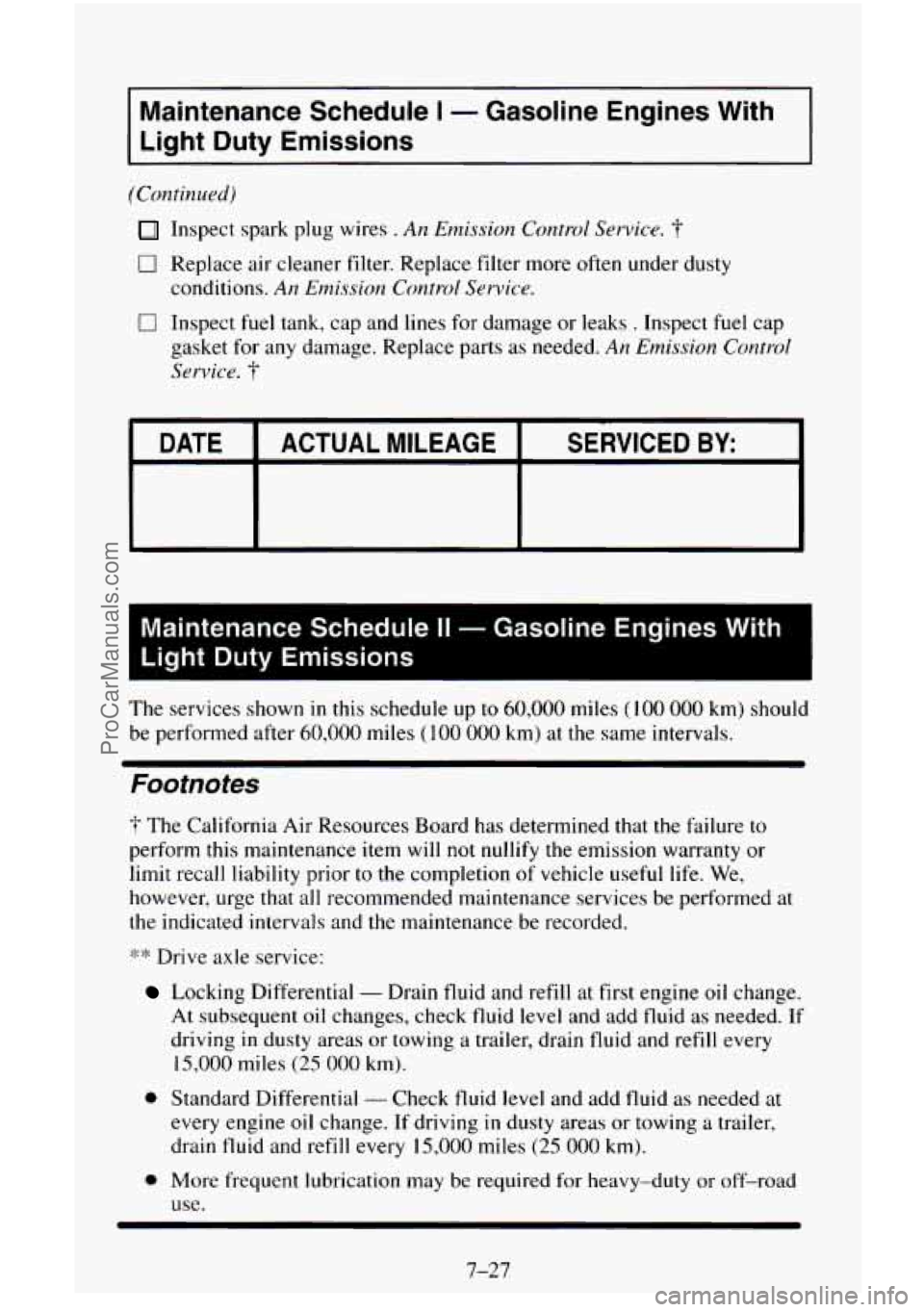
Maintenance Schedule I - Gasoline Engines With
Light Duty Emissions
~~
(Continued)
0
0
Inspect spark plug wires . An Emission Control Service.
Replace air cleaner filter. Replace filter more often under dusty
conditions.
An Emission Control Service.
Inspect fuel tank, cap and lines for damage or leaks . Inspect fuel cap
gasket for any damage. Replace parts as needed. An
Emission Control
Sewice.
T
DATE SERVICED BY: ACTUAL MILEAGE
-
Maintenance Schedule II - Gasoline Engines With
Light Duty
Emissions
The services shown in this schedule up to 60,000 miles ( 100 000 km) should
be performed after
60,000 miles (I 00 000 km) at the same intervals.
Footnotes
T The California Air Resources Board has determined that the failure to
perform this maintenance item will not nullify the emission warranty or
limit recall liability prior
to the completion of vehicle useful life. We,
however, urge that all recommended maintenance services be performed at
the indicated intervals and the maintenance be recorded.
*4: Drive axle service:
Locking Differential - Drain fluid and refill at first engine oil change.
At subsequent oil changes, check fluid
level and add fluid as needed. If
driving
in dusty areas or towing a trailer, drain fluid and refill every
15,000 miles (25 000 km).
0 Standard Differential - Check fluid level and add fluid as needed at
every engine oil change. If driving in dusty areas or towing a trailer,
drain fluid and refill every
15,000 miles (25 000 km).
0 More frequent lubrication may be required for heavy-duty or off-road
use.
7-27
- . ProCarManuals.com
Page 395 of 486
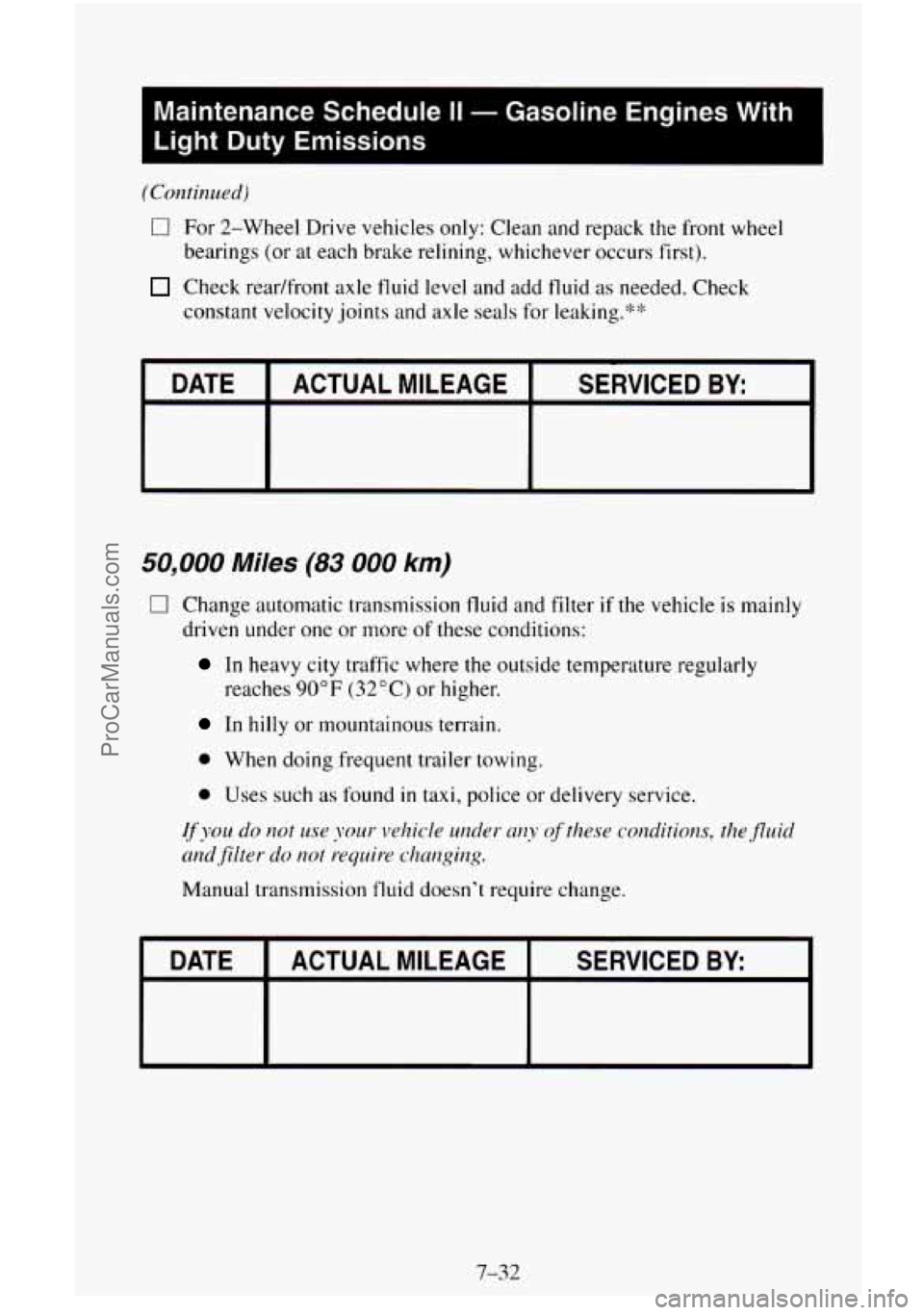
Maintenance Schedule II - Gasoline Engines With
Light Duty Emissions
(Continued)
0 For 2-Wheel Drive vehicles only: Clean and repack the front wheel
bearings (or at each brake relining, whichever occurs first).
Check readfront axle fluid level and add fluid as needed. Check
constant velocity joints and axle seals for leaking.**
50,000 Miles (83 000 km]
0 Change automatic transmission fluid and filter if the vehicle is mainly
driven under one or more
of these conditions:
In heavy city traffic where the outside temperature regularly
reaches
90°F (32°C) or higher.
In hilly or mountainous terrain.
0 When doing frequent trailer towing.
0 Uses such as found in taxi, police or delivery service.
IJ' you do not use your vehicle under any of these conditions, the>fZuid
and filter do not require changing.
Manual transmission fluid doesn't require change.
ACTUAL MILEAGE I SERVICED BY I
7-32
ProCarManuals.com
Page 398 of 486
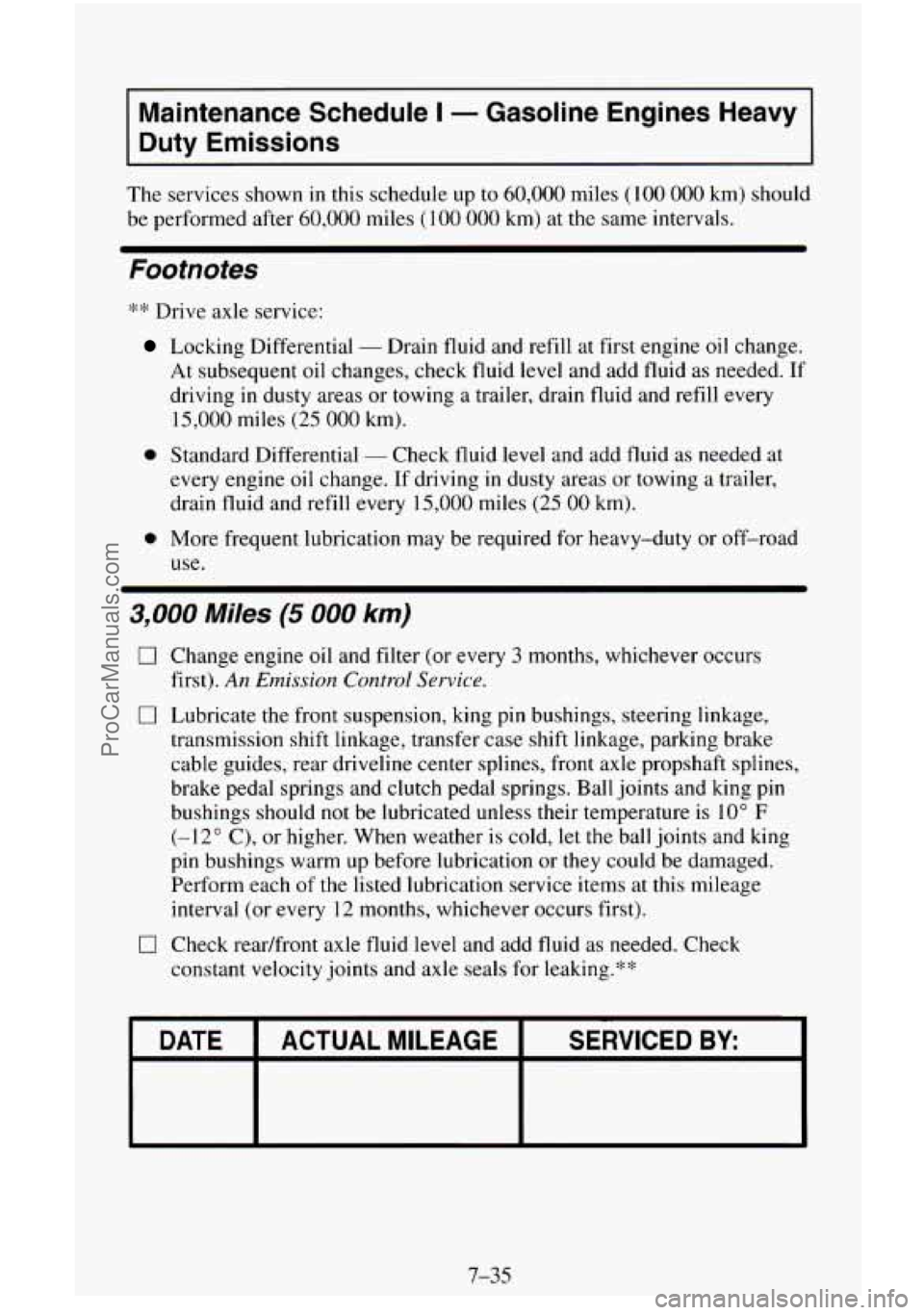
Maintenance Schedule I - Gasoline Engines Heavy
Duty Emissions
The services shown in this schedule up to 60,000 miles (100 000 km) should
be performed after
60,000 miles (100 000 km) at the same intervals.
Footnotes
** Drive axle service:
Locking Differential - Drain fluid and refill at first engine oil change.
At subsequent oil changes, check fluid
level and add fluid as needed. If
driving
in dusty areas or towing a trailer, drain fluid and refill every
15,000 miles (25 000 km).
0 Standard Differential - Check fluid level and add fluid as needed at
every engine oil change. If driving in dusty areas or towing
a trailer,
drain fluid and refill every
15,000 miles (25 00 km).
0 More frequent lubrication may be required for heavy-duty or off-road
use.
3,000 Miles (5 000 km)
0 Change engine oil and filter (or every 3 months, whichever occurs
0 Lubricate the front suspension, king pin bushings, steering linkage,
transmission shift linkage, transfer case shift linkage, parking brake
cable guides, rear driveline center splines, front axle propshaft splines,
brake pedal springs and clutch pedal springs. Ball joints and king pin
bushings should
not be lubricated unless their temperature is 10" F
(-1 2" C), or higher. When weather is cold, let the ball joints and king
pin bushings warm up before lubrication or they could be damaged.
Perform each
of the listed lubrication service items at this mileage
interval (or every 12 months, whichever occurs first).
first).
An Emission Control Service.
0 Check
readfront axle fluid level and add fluid as needed. Check
constant velocity joints and
axle seals for leaking.**
DATE SERVICED BY ACTUAL MILEAGE
7-35
ProCarManuals.com