air filter CHEVROLET SUBURBAN 1995 Owners Manual
[x] Cancel search | Manufacturer: CHEVROLET, Model Year: 1995, Model line: SUBURBAN, Model: CHEVROLET SUBURBAN 1995Pages: 486, PDF Size: 26.58 MB
Page 283 of 486
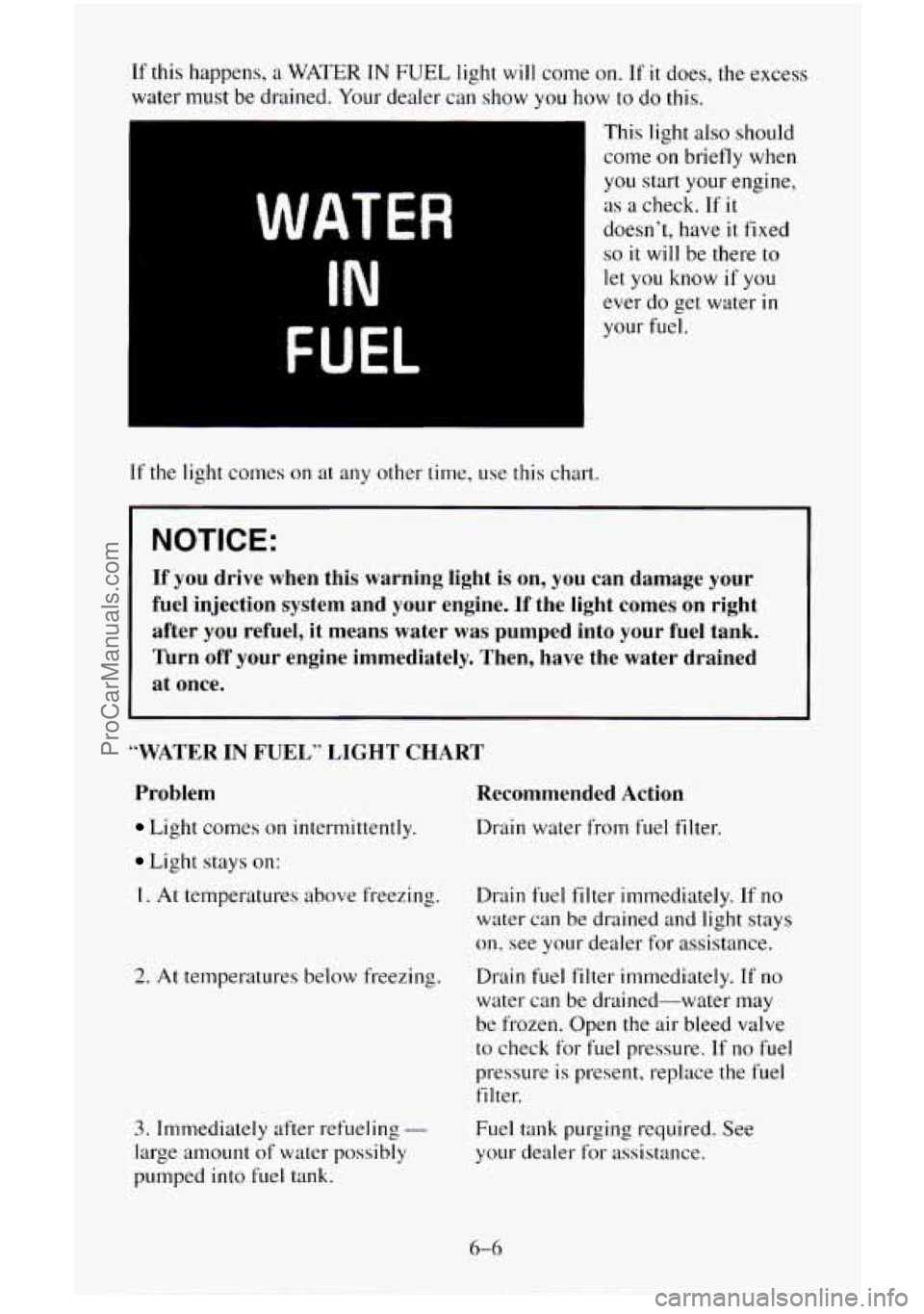
If this happens, a WATER IN FUEL light will come
water must be drained. Your Cfpder can show you
hc
I
WATER
IN
FUEL
If the light comes on at any other time, use this chart.
! on. If it does, the excess
3w to do this.
This light
also should
come
on briefly when
you start your engine,
as a check. If it
doesn’t, have it fixed
so it will be there to
let you know if you
ever do get water
in
your fuel.
NOTICE:
If you drive when this warning light is on, you can damage your \
fuel injection system and your engine. If the light comes on \
right
after you refuel,
it means water was pumped into your fuel tank.
Turn off your engine immediately. Then, have the water drained \
at once.
“WATER IN FUEL” LIGHT CHART Problem
Light comes on intermittently.
Light stays on:
Recommended Action
Drain water from fuel filter.
1. At temperatures above freezing. Drain fuel filter immediately. If no
water can be drained and light stays
on, see your dealer for assistance.
2. At temperatures below freezing. Drain fuel filter immediately. If no
water can be drained-water may
be frozen. Open the air bleed valve
to check for fuel pressure. If
no fuel
pressure is present, replace the fuel
filter.
3. Immediately after refueling -
large amount of water possibly
pumped into fuel tank. Fuel tank
purging required. See
your dealer for assistance.
6-4
ProCarManuals.com
Page 285 of 486
NOTICE:
If there is water in your diesel fuel and the weather is warm or
humid, fungus and bacteria can grow in the fuel. They can
damage your fuel system. You’ll need
a diesel fuel biocide to
sterilize your fuel system. Your dealer can advise you if you ever
need this.
If your fuel tank needs to be purged to remove water,
see your
dealer or
a qualified technician. Improper purging can damage
your fuel system.
Running Out of Fuel (Diesel Engines)
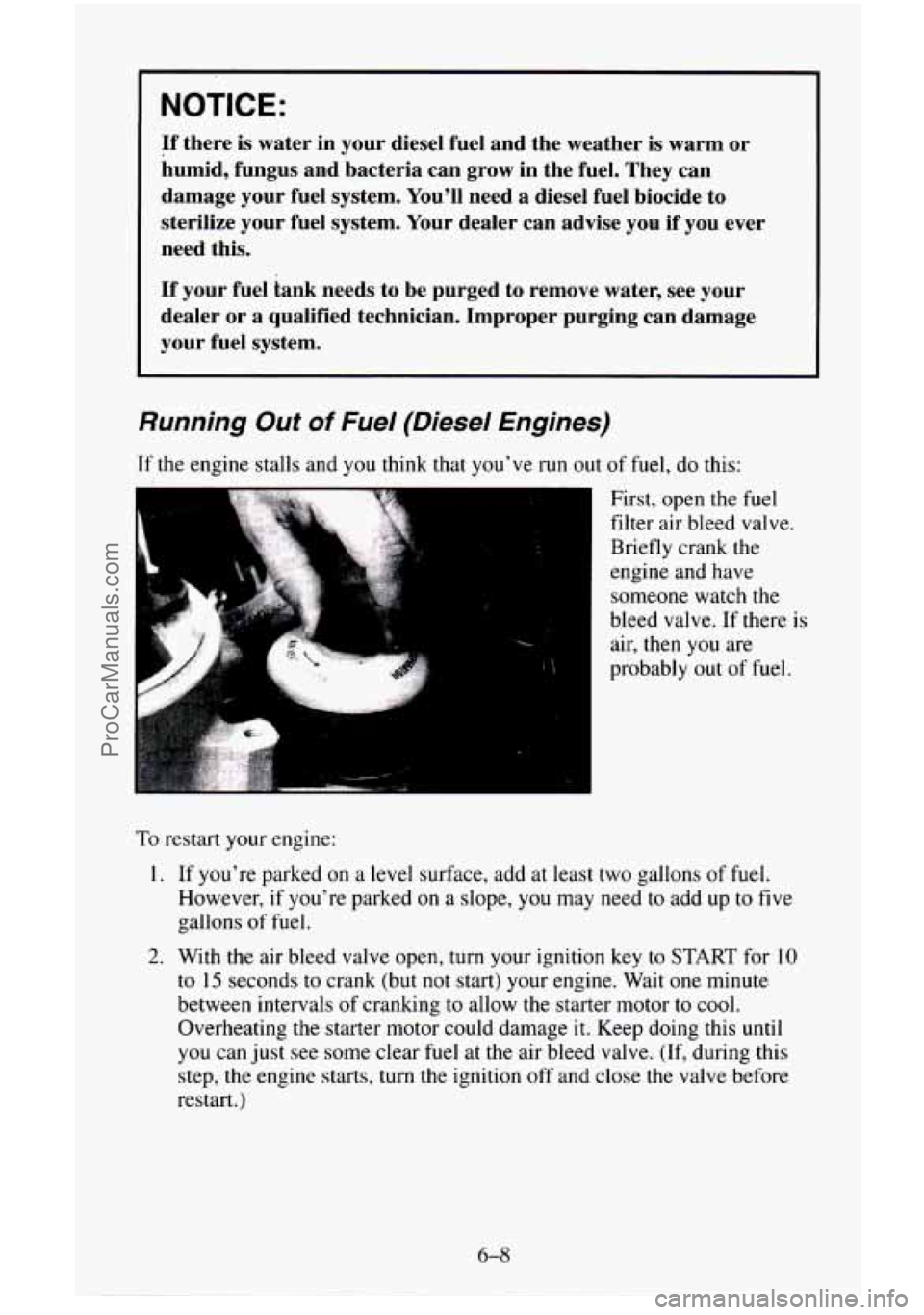
If the engine stalls and you think that you’ve run out of fuel, do this:
First, open the fuel
filter air bleed valve.
Briefly crank the
engine and have
someone watch
the
bleed valve. If there is
air,
then you are
probably
out of fuel.
To restart your engine:
1. If you’re parked on a level surface, add at least two gallons of fuel.
However, if you’re parked on a slope, you may need to add up to five
gallons of fuel.
2. With the air bleed valve open, turn your ignition key to START for 10
to 15 seconds to crank (but not start) your engine. Wait one minute
between intervals of cranking to allow the starter motor
to cool.
Overheating the starter motor could damage
it. Keep doing this until
you can just see some clear fuel at the air bleed valve. (If, during this
step, the engine starts, turn the ignition off and close the valve before
restart.)
ProCarManuals.com
Page 286 of 486
3. Close the air bleed valve.
4. Turn the ignition key to START for 10 to 15 seconds at a time until
your engine starts.
Fuel Filter Replacement (Diesel Engines)
If you want to change the fuel filter yourself, here's how to do it:
First, drain any water from the filter following the procedure for draining
water listed previously.
Your vehicle's engine should be off until the end of the following procedure.
r.
1. Apply the parking brake.
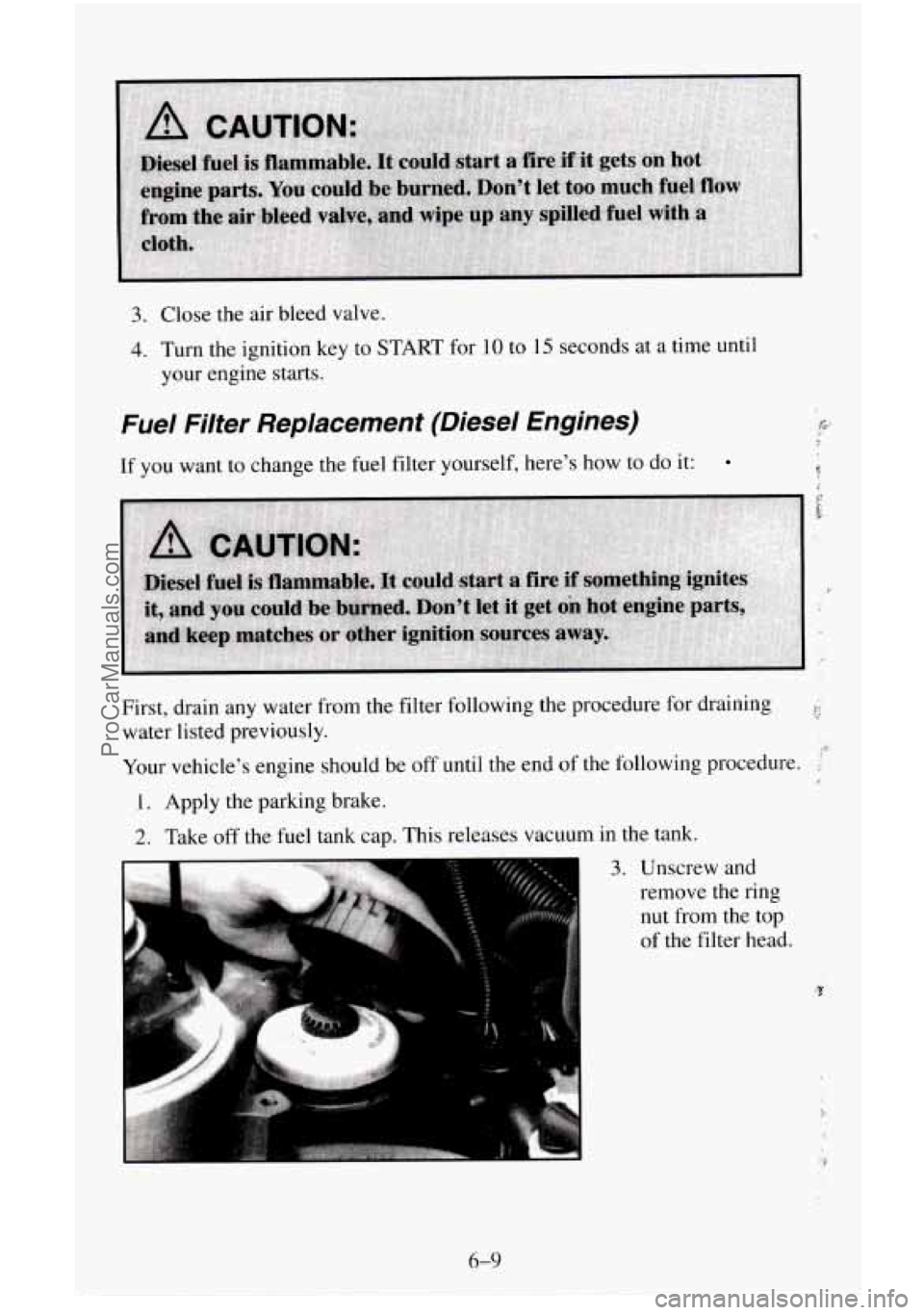
2. Take off the fuel tank cap. This releases vacuum in the tank.
3. Unscrew and
remove the ring
nut from the top
of the filter head.
6-9
ProCarManuals.com
Page 287 of 486
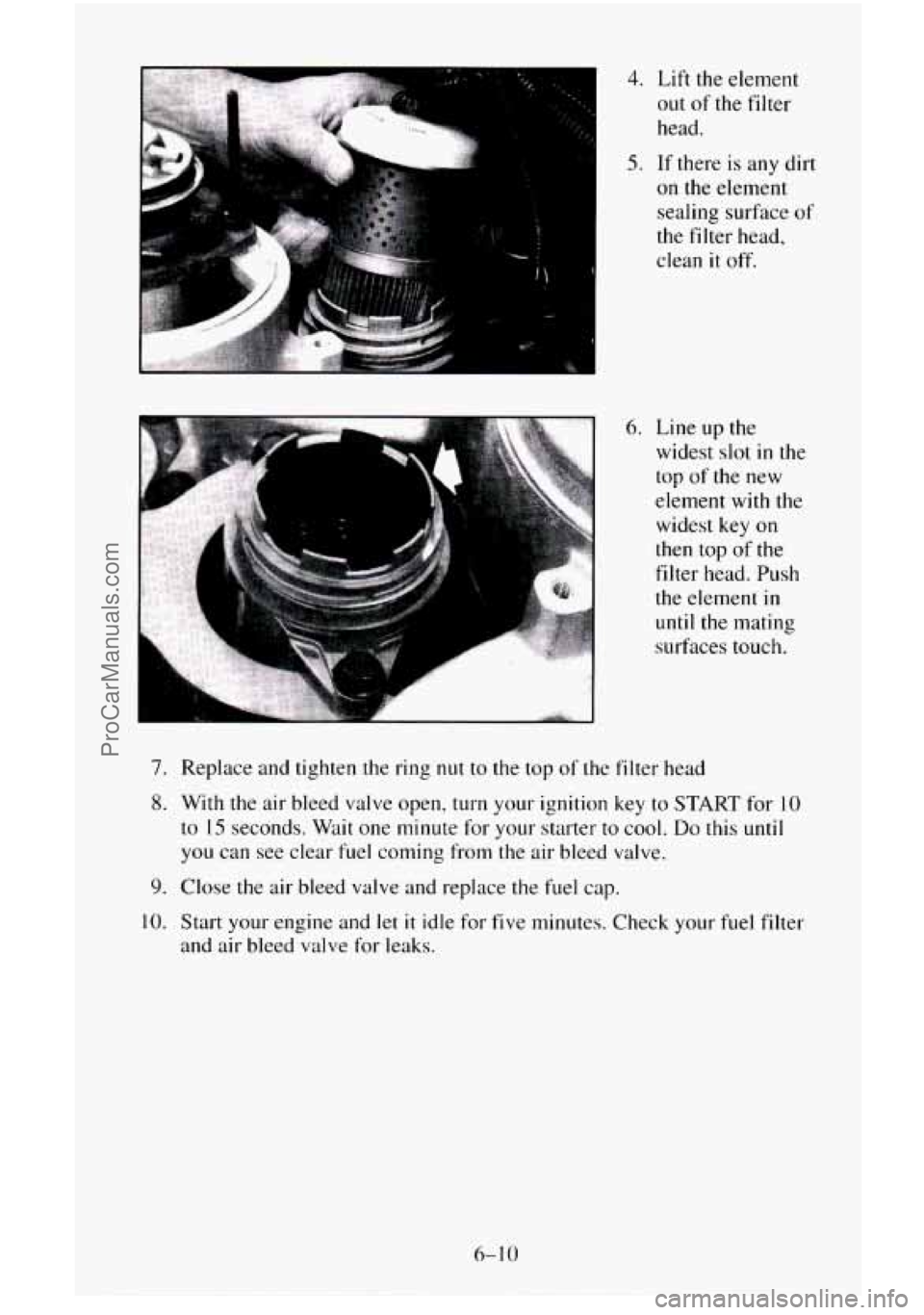
4. Lift the element
out
of the filter
head.
5. If there is any dirt
on the element
sealing surface
of
the filter head,
clean
it off.
6. Line up the
widest slot
in the
top
of the new
element with the
widest key on
then top of the
filter head. Push
the element
in
until the mating
surfaces touch.
7. Replace and tighten the ring nut to the top of'the filter head
8. With the air bleed valve open, turn your ignition key to START for 10
to 15 seconds, Wait one minute for your starter to cool. Do this until
you can see clear fuel coming from the air bleed valve.
9. Close the air bleed valve and replace the fuel cap.
10. Start your engine and let it idle for five minutes. Check your fuel filter
and air bleed valve for leaks.
6-10
ProCarManuals.com
Page 302 of 486
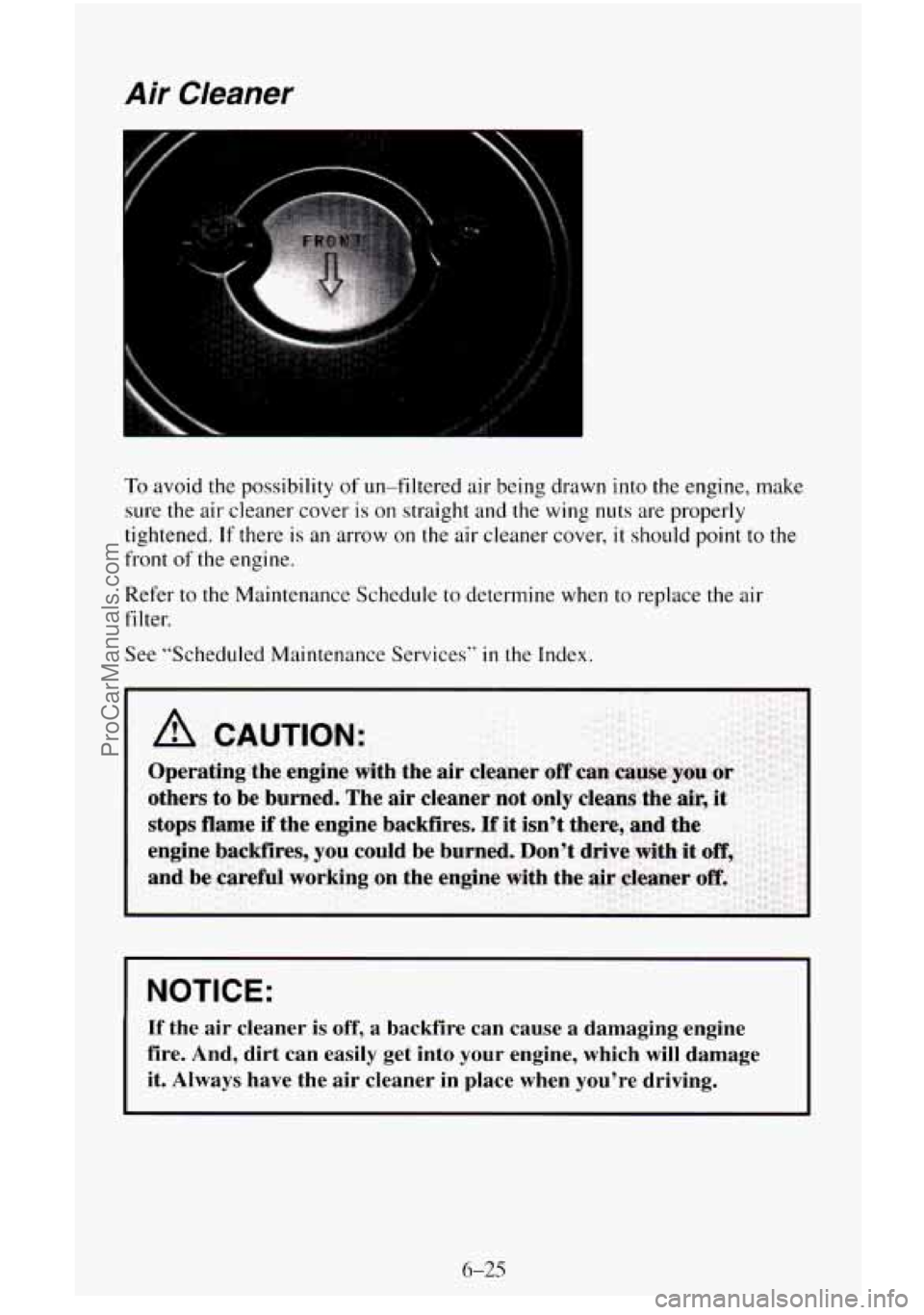
Air Cleaner
To avoid the possibility of un-filtered air being drawn into the engine, make
sure the air cleaner cover
is on straight and the wing nuts are properly
tightened.
If there is an arrow on the air cleaner cover, it should point to the
front
of the engine.
Refer to the Maintenance Schedule
to determine when to replace the air
fi 1 ter.
See “Scheduled Maintenance Services”
in the Index.
NOTICE:
If the air cleaner is off, a backfire can cause a damaging engine
fire. And, dirt can easily get into
your engine, which will damage
it. Always have the air cleaner in place when you’re driving.
6-25
ProCarManuals.com
Page 303 of 486
To remove the air cleaner filter on a gasoline engine or a 6.5 liter naturally
aspirated diesel engine, turn the wing nuts
to the left. Remove the cover and
change
the filter.
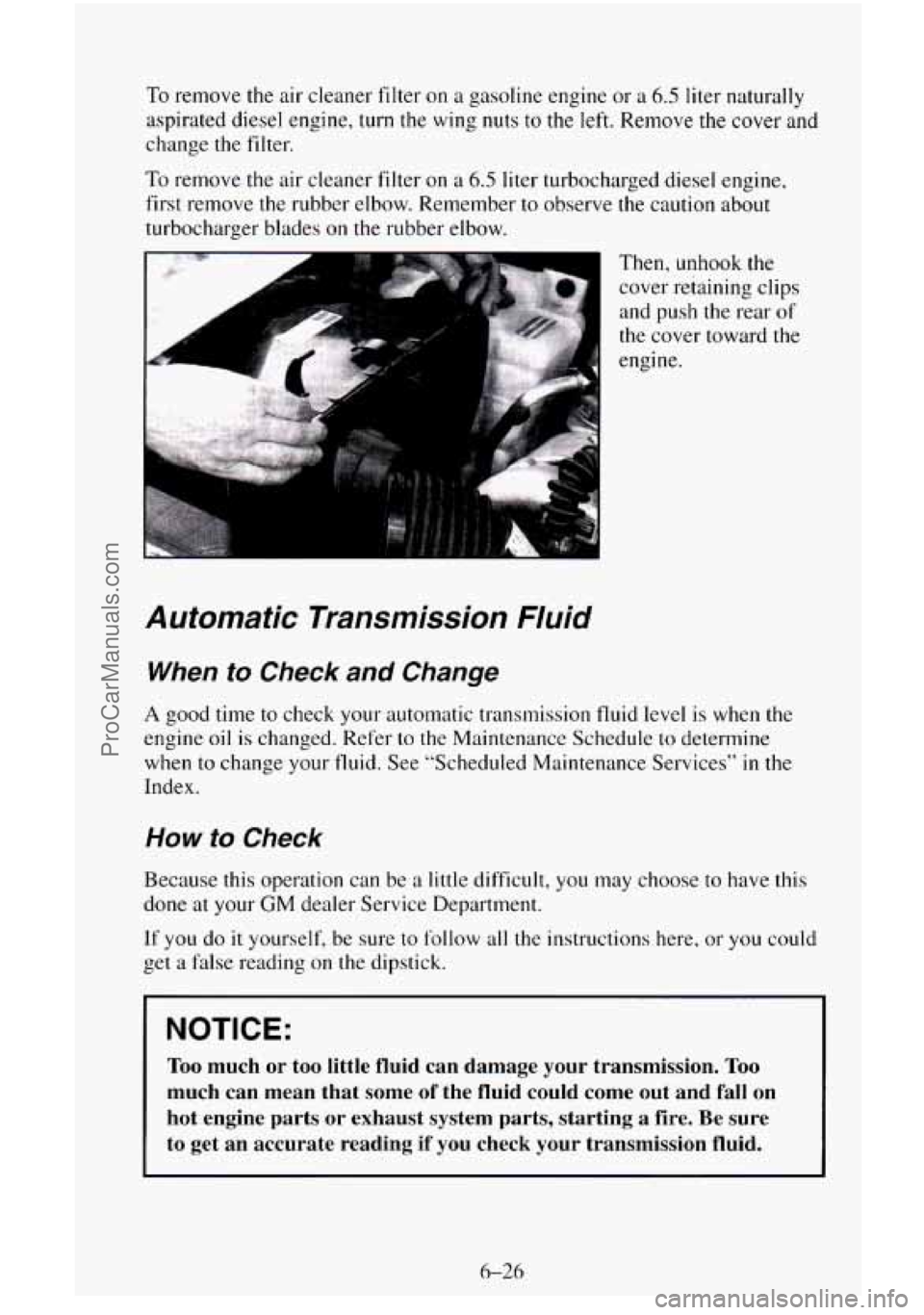
To remove the air cleaner filter on a 6.5 liter turbocharged diesel engine,
first remove the rubber elbow. Remember to observe the caution about
turbocharger blades
on the rubber elbow.
Then, unhook the cover retaining clips
and push the rear
of
the cover toward the
engine.
Automatic Transmission Nuid
When to Check and Change
A good time to check your automatic transmission fluid level is when the
engine
oil is changed. Refer to the Maintenance Schedule to determine
when to change your
fluid. See “Scheduled Maintenance Services” in the
Index.
How to Check
Because this operation can be a little difficult, you may choose to have this
done
at your GM dealer Service Department.
If you do
it yourself, be sure to follow all the instructions here, or you could
get a false reading on the dipstick.
NOTICE:
Too much or too little fluid can damage your transmission. Too
much can mean that some of the fluid could come out and fall on
hot engine parts or exhaust system parts, starting a fire. Be \
sure
to get an accurate reading
if you check your transmission fluid.
6-26
ProCarManuals.com
Page 355 of 486
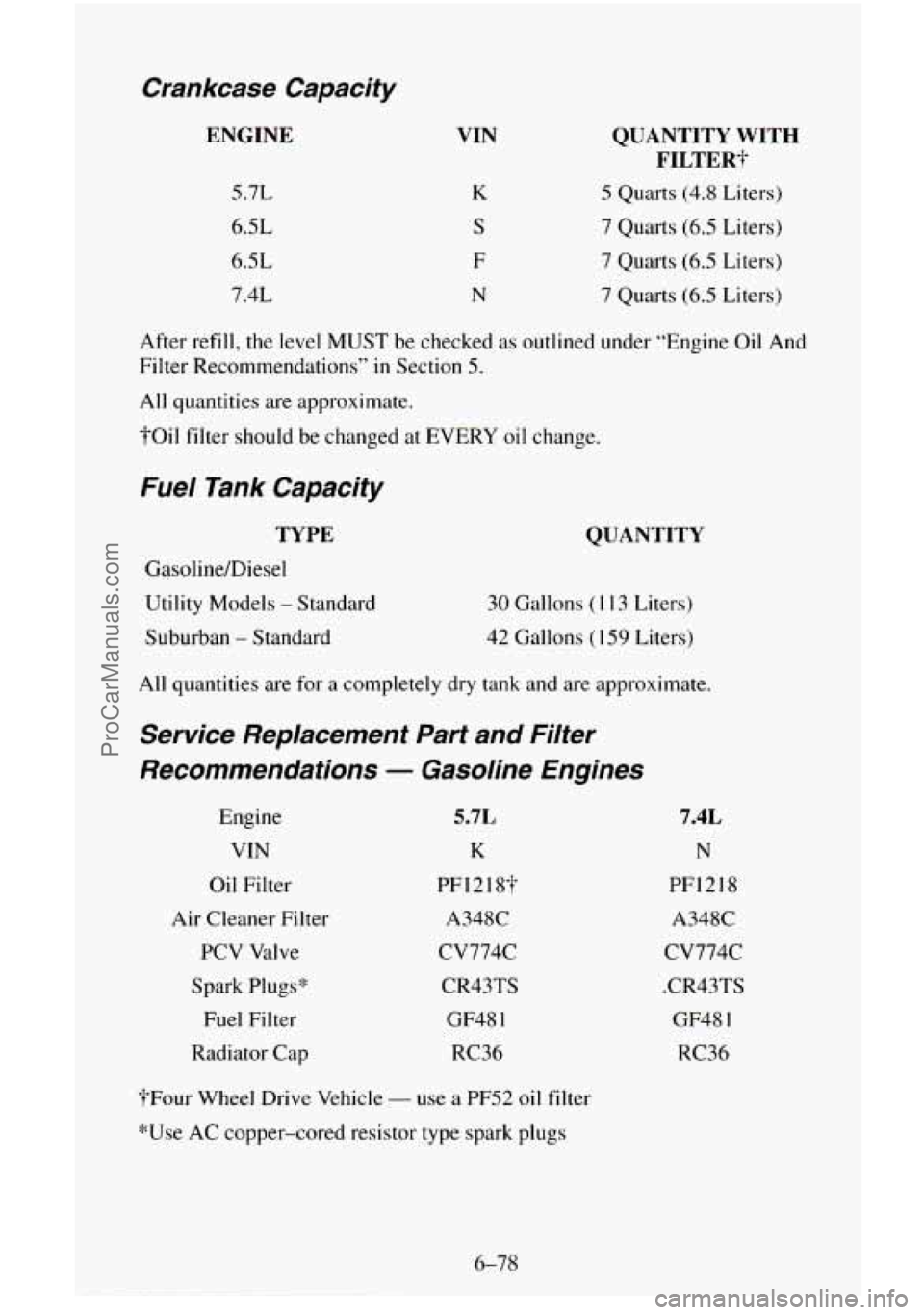
Crankcase Capacity
ENGINE
5.7L
6.5L
6.5L
7.4L
VIN
K
S
F
N
QUANTITY WITH
FILTER?
5 Quarts (4.8 Liters)
7 Quarts (6.5 Liters)
7 Quarts (6.5 Liters)
7 Quarts (6.5 Liters)
After refill, the level
MUST be checked as outlined under “Engine Oil And
Filter Recommendations”
in Section 5.
All quantities are approximate.
?Oil filter should be changed at EVERY oil change.
Fuel Tank Capacity
TYPE
Gasoline/Diesel
Utility Models - Standard
Suburban
- Standard
QUANTITY
30 Gallons ( I 1 3 Liters)
42 Gallons
( I59 Liters)
All quantities are for a completely dry tank and are approximate.
Service Replacement Part and Filter
Recommendations
- Gasoline Engines
Engine
VIN
Oil Filter
Air Cleaner Filter
PCV Valve
Spark Plugs”
Fuel Filter
Radiator Cap
5.7L
K
PF1218T A348C
cv774c
CR43TS
GF48 1
RC36
?Four Wheel Drive Vehicle
- use a PF52 oil filter
*Use AC copper-cored resistor type spark plugs
7.4L
N
PF1218
A348C
cv774c
.CR43TS GF48
1
RC36
ProCarManuals.com
Page 356 of 486
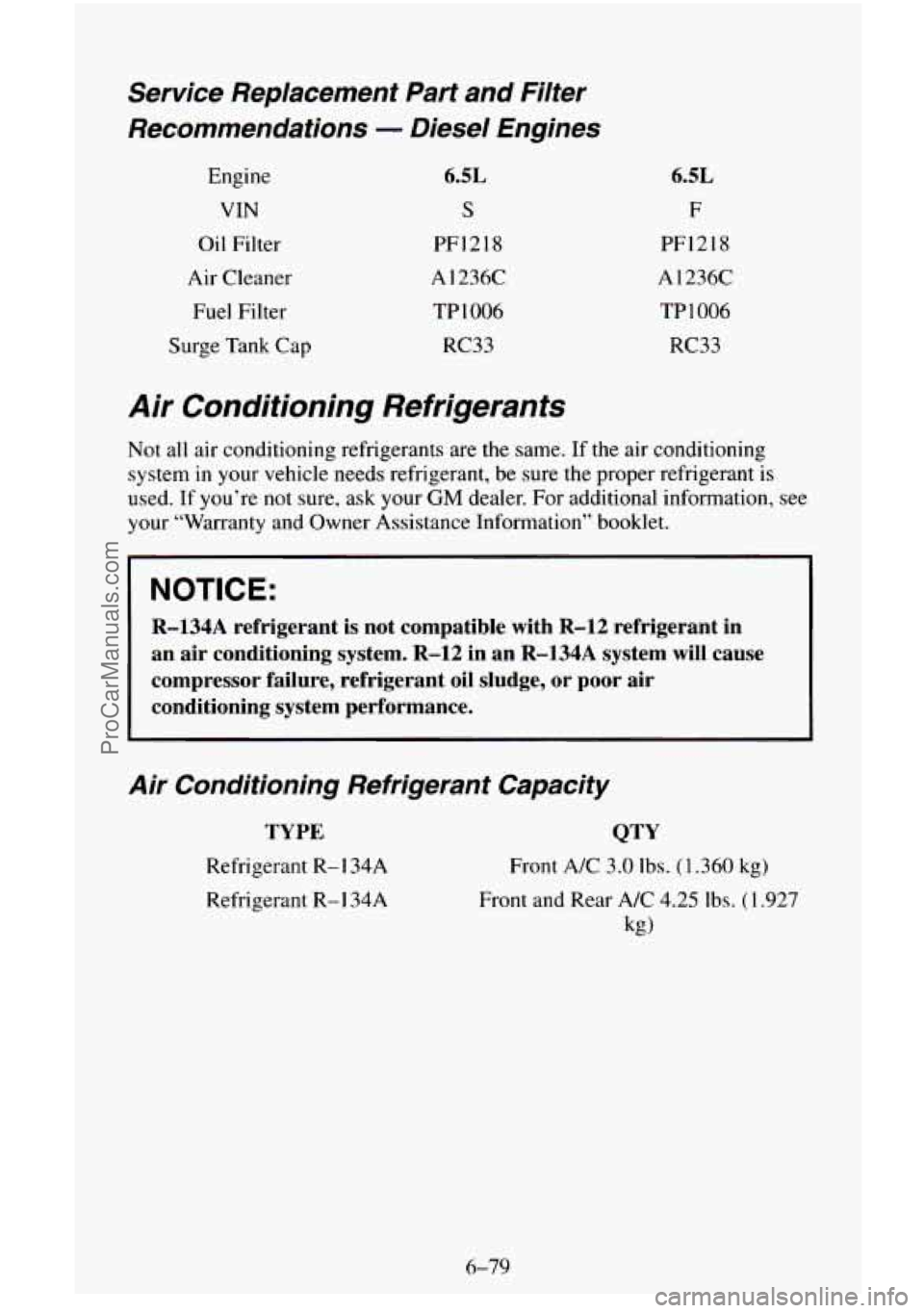
Service Replacement Part and Filter Recommendations
- Diesel Engines
Engine
VIN
Oil Filter
Air Cleaner
Fuel Filter
Surge Tank
Cap
6SL
S
PF1218
A1236C
TP 1006
RC33
6.5L
F
PF1218
A 1236C
TP 1 006
RC33
Air Conditioning Refrigerants
Not all air conditioning refrigerants are the same. If the air conditioning
system
in your vehicle needs refrigerant, be sure the proper refrigerant is
used.
If you’re not sure, ask your GM dealer. For additional information, see
your “Warranty and Owner Assistance Information’’ booklet.
NOTICE:
R-134A refrigerant is not compatible with R-12 refrigerant in
an air conditioning system. R-12 in an R-134A system will cause
compressor failure, refrigerant oil sludge, or poor air
conditioning system performance.
Air Conditioning Refrigerant Capacity
TYPE
Refrigerant R-134A
Refrigerant
R- 134A
QTY
Front A/C 3.0 lbs. (1.360 kg)
Front and Rear A/C 4.25 Ibs. (1.927
kg)
6-79
ProCarManuals.com
Page 367 of 486
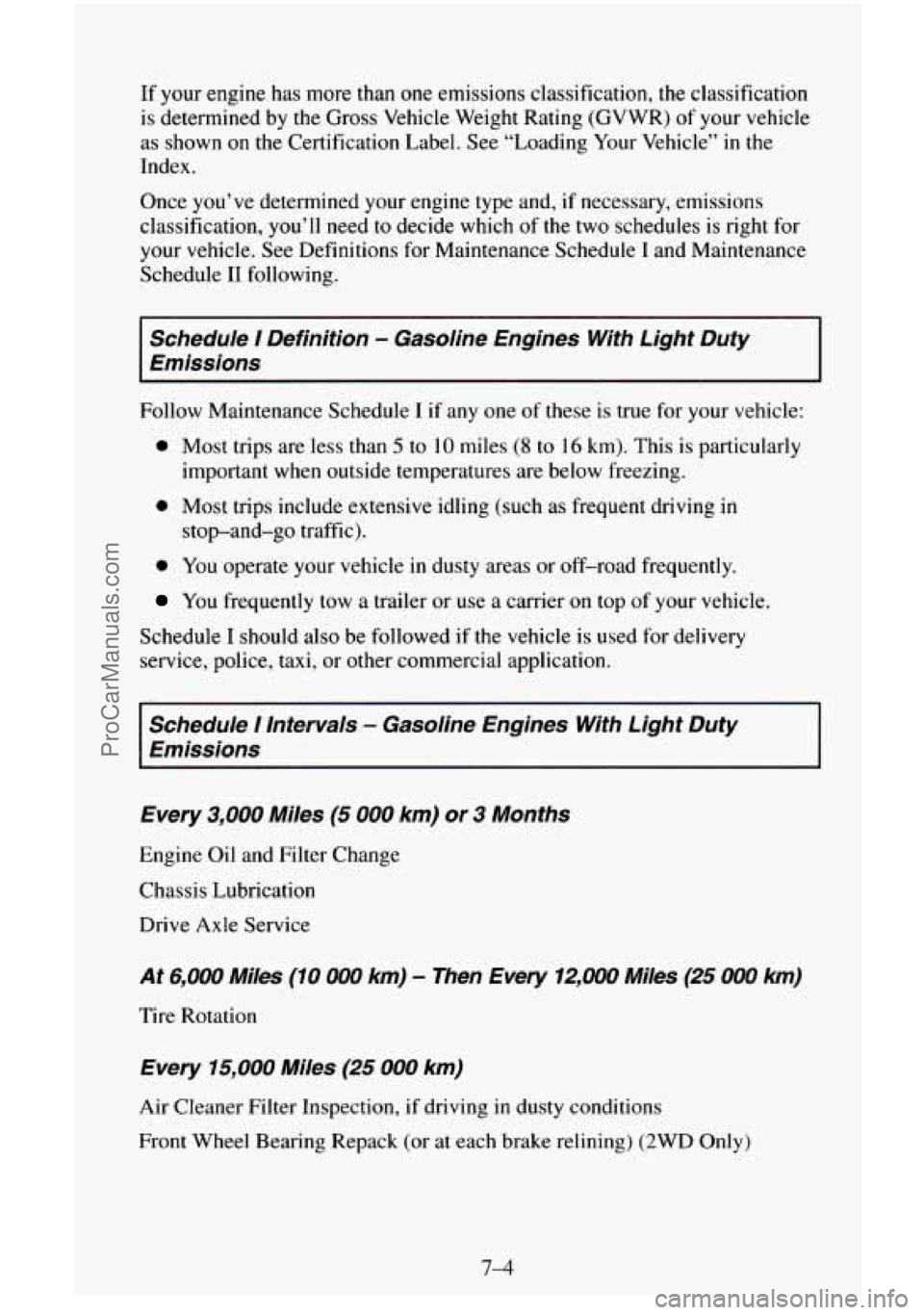
If your engine has more than one emissions classification, the classification
is determined by the Gross Vehicle Weight Rating (GVWR) of your vehicle
as shown on the Certification Label. See “Loading Your Vehicle” in the
Index.
Once you’ve determined your engine type and,
if necessary, emissions
classification, you’ll need
to decide which of the two schedules is right for
your vehicle. See Definitions for Maintenance Schedule I and Maintenance
Schedule I1 following.
Schedule I Definition - Gasoline Engines With Light Duty
Emissions
Follow Maintenance Schedule I if any one of these is true for your vehicle:
0 Most trips are less than 5 to 10 miles (8 to 16 km). This is particularly
important when outside temperatures are below freezing.
stop-and-go traffic).
0 Most trips include extensive idling (such as frequent driving in
0 You operate your vehicle in dusty areas or off-road frequently.
You frequently tow a trailer or use a carrier on top of your vehicle.
Schedule
I should also be followed if the vehicle is used for delivery
service, police, taxi, or other commercial application.
Schedule I Intervals - Gasoline Engines With Light Duty
Emissions
Every
3,000 Miles (5 000 km) or 3 Months
Engine Oil and Filter Change
Chassis Lubrication
Drive Axle Service
At 6,000 Miles (10 000 km) - Then Every 12,000 Miles (25 000 km)
Tire Rotation
Every 15,000 Miles (25 000 km)
Air Cleaner Filter Inspection, if driving in dusty conditions
Front Wheel Bearing Repack (or at each brake relining)
(2WD Only)
7-4
ProCarManuals.com
Page 368 of 486
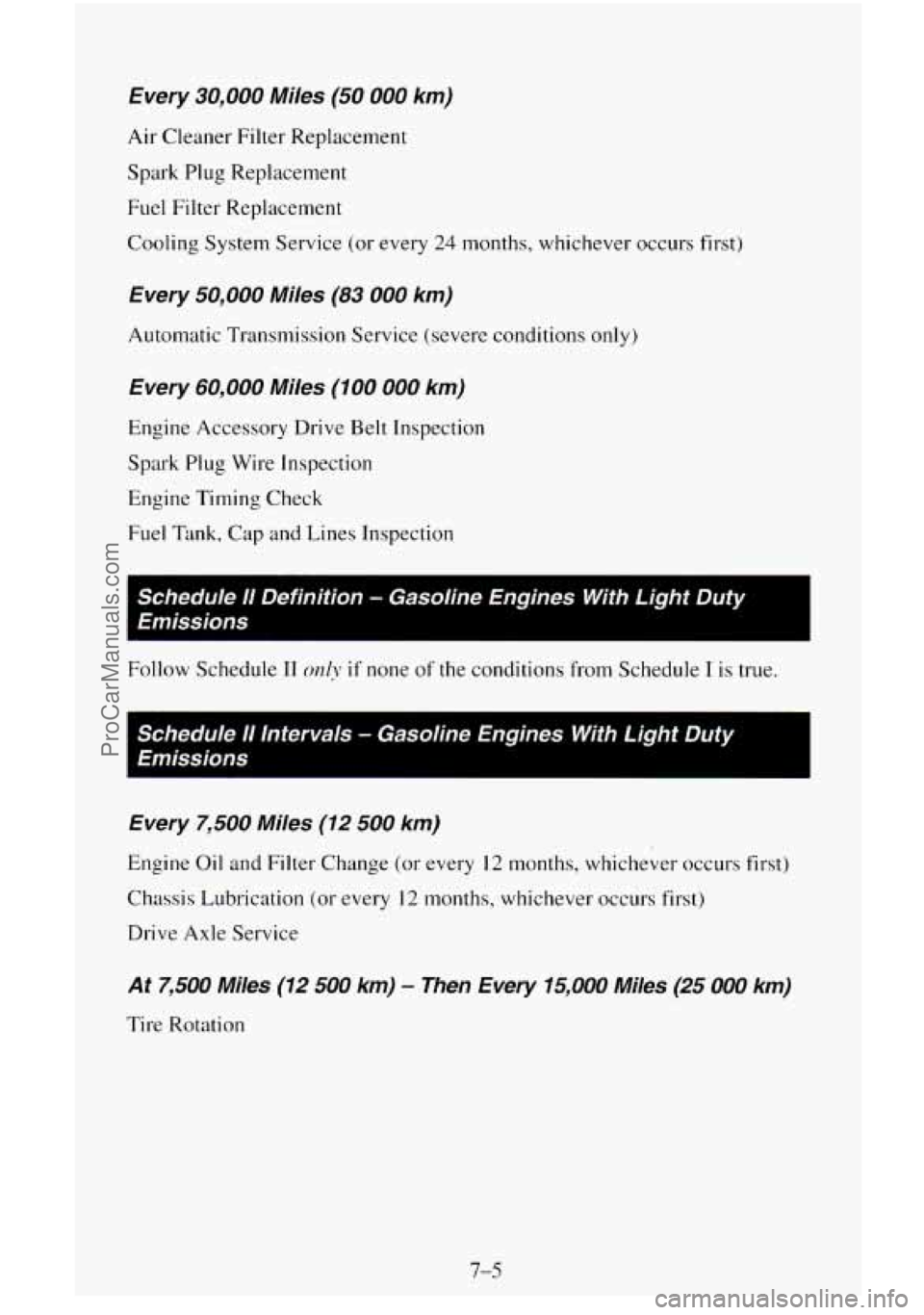
Every 30,000 Miles (50 000 km)
Air Cleaner Filter Replacement
Spark Plug Replacement
Fuel Filter Replacement
Cooling System Service (or every
24 months, whichever occurs first)
Every 50,000 Miles (83 000 km)
Automatic Transmission Service (severe conditions only)
Every 60,000 Miles (100 000 km)
Engine Accessory Drive Belt Inspection
Spark Plug Wire Inspection
Engine Timing Check Fuel Tdnk, Cap and Lines Inspection
I
Schedule lI Definition - Gasoline Engines With Light Duty
Emissions
Follow Schedule 11 orzly if none of the conditions from Schedule I is true.
Every 7,500 Miles (12 500 km)
Engine Oil and Filter Change (or every 12 months, whichever occurs first)
Chassis Lubrication (or every
12 months, whichever occurs first)
Drive
Axle Service
At 7,500 Miles (12 500 km) - Then Every 15,000 Miles (25 000 km)
Tire Rotation
7-S
ProCarManuals.com