starter CHEVROLET SUBURBAN 1995 Owners Manual
[x] Cancel search | Manufacturer: CHEVROLET, Model Year: 1995, Model line: SUBURBAN, Model: CHEVROLET SUBURBAN 1995Pages: 486, PDF Size: 26.58 MB
Page 81 of 486
Automatic transrnissiox
Move your shift lever to PARK (P) or NEUTRAL (N). Your engine won’t
start in any other position
- that’s a safety feature. To restart when you’re
already moving, use NEUTRAL
(N) only.
NOTICE:
Don’t try to shift to PARK (P) if your vehicle is moving. If you
do, you could damage the transmission. Shift
to PARK (P) only
when your vehicle is stopped.
Manual transmission:
The gear selector should be in Neutral (N). Hold the clutch pedal to the
floor and start the engine. Your vehicle won’t start
if the clutch pedal is not
all the way down
- that’s a safety feature.
To start your 5.7 Liter (Code K) or 7.4 Liter (Code N) V8 engine:
1. Without pushing the accelerator pedal, turn your ignition key to
START. When the engine starts, let
go of the key. The idle speed will
go down
as your engine gets warm.
NOTICE:
Holding your key in START for longer than 15 seconds at a time
will cause your battery to be drained much sooner. And the
excessive heat can damage your starter motor.
2. If it doesn’t start right away, hold your key in START. If it doesn’t start
in three seconds, push the accelerator pedal about one-quarter of the
way down for 12 more seconds, or
until it starts.
flooded with too much gasoline. Try this:
3. If your engine still won’t start (or starts but then stops), it could be
4. Wait 15 seconds to let the starter motor cool down. Then push your
accelerator pedal all
the way to the floor. Hold it there. Then hold the
key in START for
no more than ten seconds. This clears the extra
gasoline from the engine. If the engine still doesn’t start, wait another
15 seconds and do Step 4 again.
Hot Engine Restart (Vehicles With 5.7L LO5 Engine and Over 8500 lbs.
GVWR):
If your engine is already hot and then stalls, turn your ignition key to OFF.
Then turn your key to RUN and wait 20 seconds before you restart your
engine. When the engine starts, let
go of the key and the accelerator pedal.
2-14
ProCarManuals.com
Page 83 of 486
NOTICE:
Don’t try to shift to PARK (P) if your vehicle is moving. If you
do, you could damage the transmission. Shift to PARK
(P) only
when your vehicle is stopped.
Turn your ignition
key to RUN.
Observe the GLOW PLUGS light. (This light may not come on if the
engine is hot.)
NOTICE:
If the GLOW PLUGS light stays on, it means that your vehicle
could have one
of several problems, so you should have it
serviced right
away.
2. As soon as the GLOW PLUGS light goes off, IMMEDIATELY turn the
ignition key to START. When the engine starts, let go of the key. (The
longer you wait to start after the light goes off, the harder it will be to
start the engine.)
NOTICE:
Holding your key in START for longer than 15 seconds at a time
will cause your battery to be drained much sooner. And the
excessive heat can damage your starter motor.
3. If the engine does not start after 15 seconds of cranking, turn the
ignition key
to OFF. Wait one minute for the starter to cool, then try the
same steps again.
If you’re trying to start your engine after you’ve run out of fuel, follow the
steps
in “Running Out of Fuel” (see “Diesel Fuel Requirements and Fuel
System”
in the Index).
When your engine is cold, let it
run for a few minutes before you move your
vehicle. This lets oil pressure build up. Your engine will sound louder when
it’s cold.
2-16
ProCarManuals.com
Page 285 of 486
NOTICE:
If there is water in your diesel fuel and the weather is warm or
humid, fungus and bacteria can grow in the fuel. They can
damage your fuel system. You’ll need
a diesel fuel biocide to
sterilize your fuel system. Your dealer can advise you if you ever
need this.
If your fuel tank needs to be purged to remove water,
see your
dealer or
a qualified technician. Improper purging can damage
your fuel system.
Running Out of Fuel (Diesel Engines)
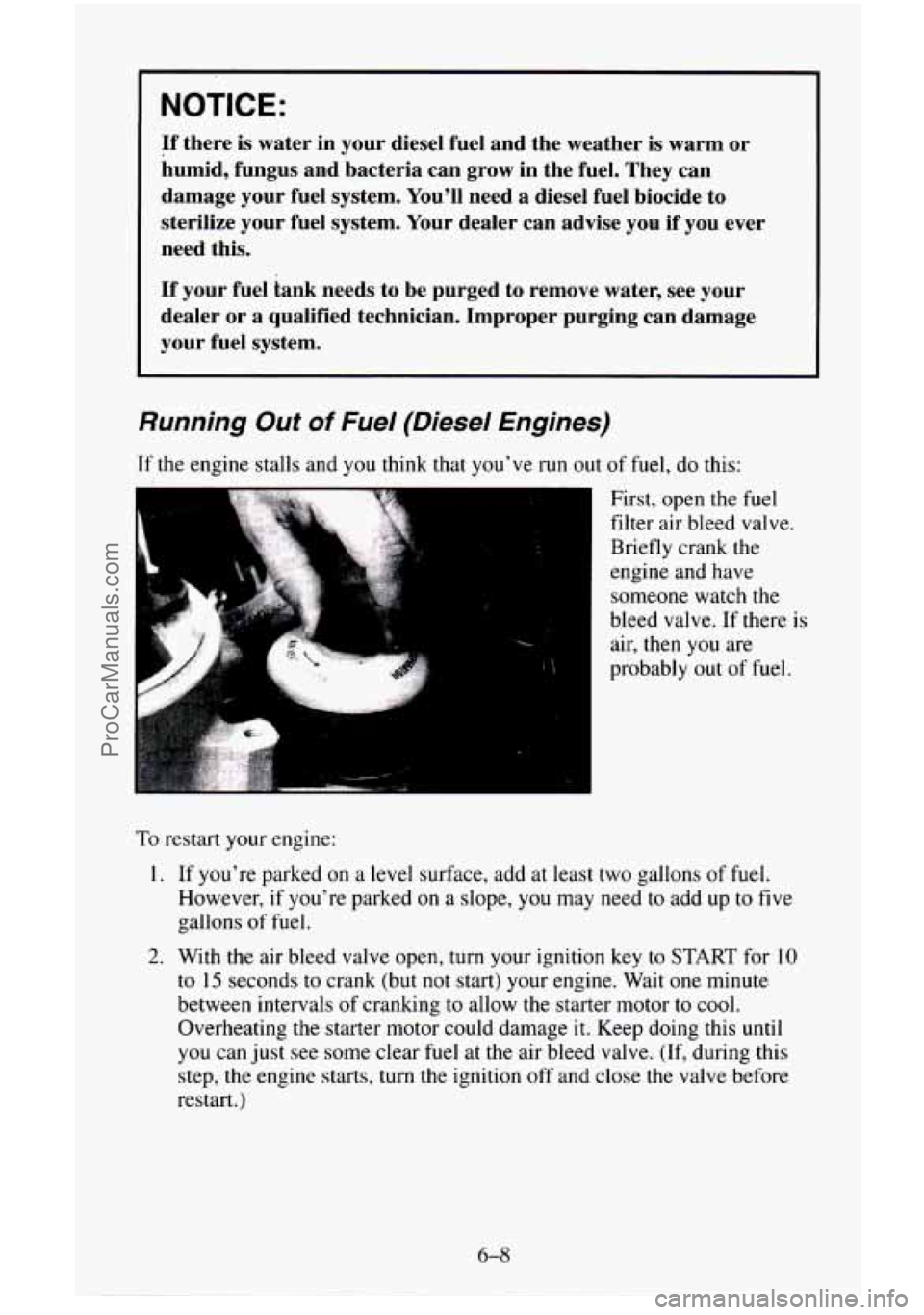
If the engine stalls and you think that you’ve run out of fuel, do this:
First, open the fuel
filter air bleed valve.
Briefly crank the
engine and have
someone watch
the
bleed valve. If there is
air,
then you are
probably
out of fuel.
To restart your engine:
1. If you’re parked on a level surface, add at least two gallons of fuel.
However, if you’re parked on a slope, you may need to add up to five
gallons of fuel.
2. With the air bleed valve open, turn your ignition key to START for 10
to 15 seconds to crank (but not start) your engine. Wait one minute
between intervals of cranking to allow the starter motor
to cool.
Overheating the starter motor could damage
it. Keep doing this until
you can just see some clear fuel at the air bleed valve. (If, during this
step, the engine starts, turn the ignition off and close the valve before
restart.)
ProCarManuals.com
Page 287 of 486
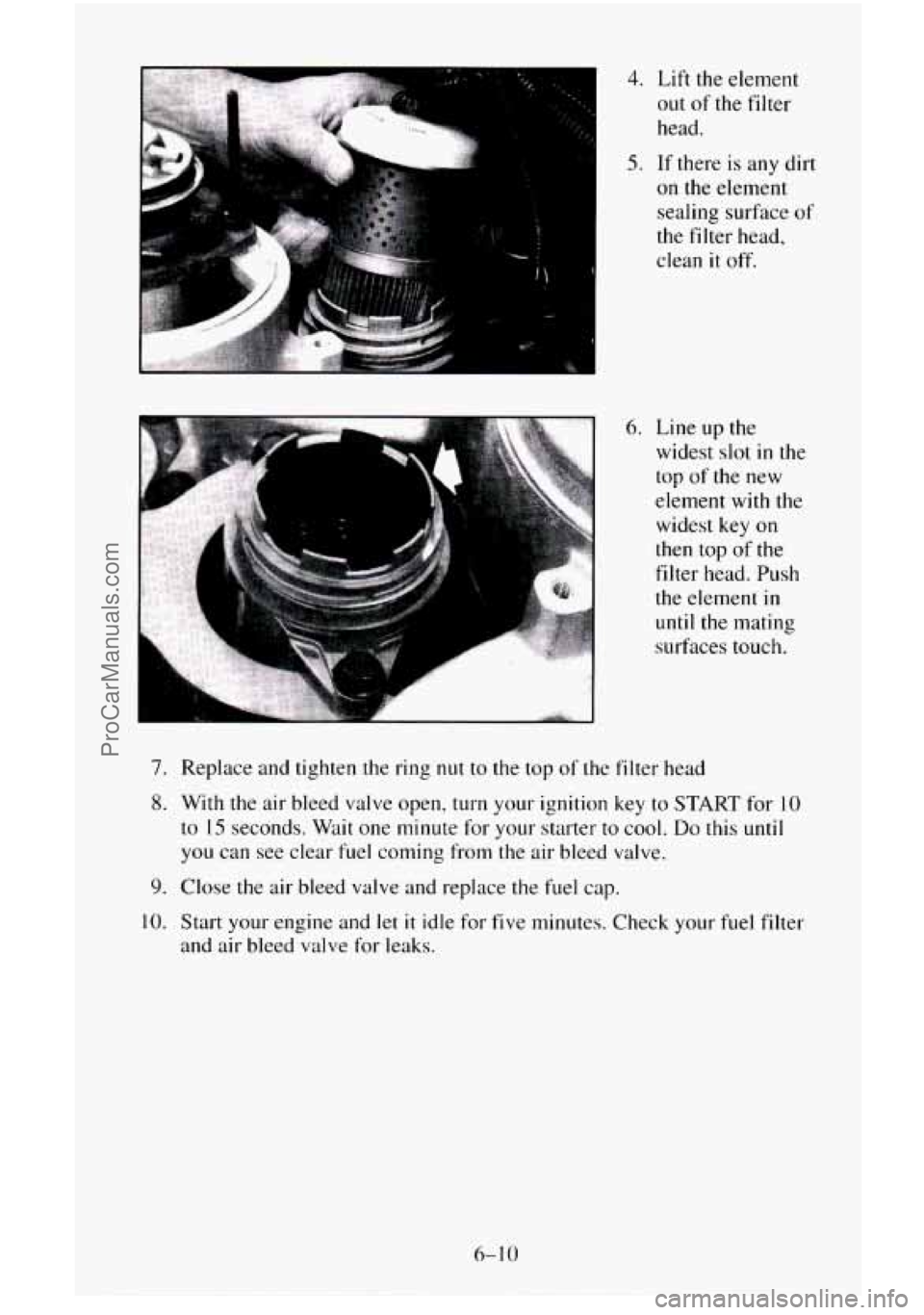
4. Lift the element
out
of the filter
head.
5. If there is any dirt
on the element
sealing surface
of
the filter head,
clean
it off.
6. Line up the
widest slot
in the
top
of the new
element with the
widest key on
then top of the
filter head. Push
the element
in
until the mating
surfaces touch.
7. Replace and tighten the ring nut to the top of'the filter head
8. With the air bleed valve open, turn your ignition key to START for 10
to 15 seconds, Wait one minute for your starter to cool. Do this until
you can see clear fuel coming from the air bleed valve.
9. Close the air bleed valve and replace the fuel cap.
10. Start your engine and let it idle for five minutes. Check your fuel filter
and air bleed valve for leaks.
6-10
ProCarManuals.com
Page 456 of 486
At Least Once a Year
Key Lock Cylinders
Lubricate the key lock cylinders with the lubricant specified in Part D.
Body Lubrication
Lubricate all fuel door, body hood and body door hinges, rear compartment
hinges, tailgate and tailgate handle pivot points, tailgate mounted spare tire
carrier pivot points, latches, locks, and folding seat hardware. Part
D tells
you what to use. More frequent lubrication may be required when exposed
to a corrosive environment.
Starter Switch
1. Before you start, be sure you have enough room around the vehicle. It
should be parked on a level surface.
2. Firmly apply both the parking brake (see “Parking Brake” in the Index
if necessary) and the regular brake.
NOTE:
Do not use the accelerator pedal, and be ready to turn off the
engine immediately
if it starts.
3. On automatic transmission vehicles, try to start the engine in each gear.
The starter should work only
in PARK (P) or NEUTRAL (N). If the
starter works
in any other position, your vehicle needs service.
On manual transmission vehicles, put the shift lever
in NEUTRAL (N),
push the clutch down halfway and try to start the engine. The starter
should work
only when the clutch is pushed down all the way to the
floor. If the starter works when the clutch isn’t pushed all the way
down, your vehicle needs service.
7-93
ProCarManuals.com