check engine CHEVROLET SUBURBAN 1996 User Guide
[x] Cancel search | Manufacturer: CHEVROLET, Model Year: 1996, Model line: SUBURBAN, Model: CHEVROLET SUBURBAN 1996Pages: 486, PDF Size: 26.58 MB
Page 211 of 486
When you want to leave the freeway, move to the proper lane well in
advance. If you miss your exit do not, under any circumstances, stop and
back up. Drive on to the next exit.
The exit ramp
can be curved, sometimes quite sharply.
The exit speed
is usually posted.
Reduce your speed according to your speedometer, not to your sense of
motion. After driving for any distance at higher speeds, you may tend
to
think you are going slower than you actually are.
Before Leaving on a Long Trip
Make sure you’re ready. Try to be well rested. If you must start when you’re
not fresh
- such as after a day’s work - don’t plan to make too many
miles that first part of the journey. Wear comfortable clothing and
shoes you
can easily drive in.
Is your vehicle ready for a long trip? If you keep it serviced and maintained,
it’s ready to go. If
it needs service, have it done before starting out. Of
course, you’ll find experienced and able service experts in
GM dealers all
across
North America. They’ll be ready and willing to help if you need it.
Here are some things you can check before
a trip:
0 Windshield Washer Fluid: Is the reservoir full? Are all windows clean
inside and outside?
Wiper Blades: Are they in good shape?
Fuel, Engine Oil, Other Fluids: Have you checked all levels?
Lamps: Are they all working? Are the lenses clean?
Tires: They are vitally important to a safe, trouble-free trip. Is the tread
good enough for long-distance driving? Are the tires all inflated to the
recommended pressure?
Should you delay your trip a short time to avoid a major
storm system?
Weather Forecasts: What’s the weather outlook along your route?
Maps: Do you have up-to-date maps?
Highway Hypnosis
Is there actually such a condition as “highway hypnosis”? Or is it just plain
falling asleep
at the wheel? Call it highway hypnosis, lack of awareness, or
whatever.
ProCarManuals.com
Page 212 of 486
There is something about an easy stretch of road with the same scenery,
along with the hum
of the tires on the road, the drone of the engine, and the
rush of the wind against the vehicle that can make you sleepy. Don’t let it
happen to
you! If it does, your vehicle can leave the road in less than a
second,
and you could crash and be injured.
What can you do about highway hypnosis? First, be aware that it can
happen.
Then here are some tips:
0 Make sure your vehicle is well ventilated, with a comfortably cool
interior.
Keep your eyes moving. Scan the road ahead and to the sides. Check
your mirrors and your instruments frequently.
and take a nap, get some exercise, or both. For safety, treat drowsiness
If you get sleepy, pull off the road into a rest, service, or parking area
on the highway
as an emergency.
Hill and Mountain Roads
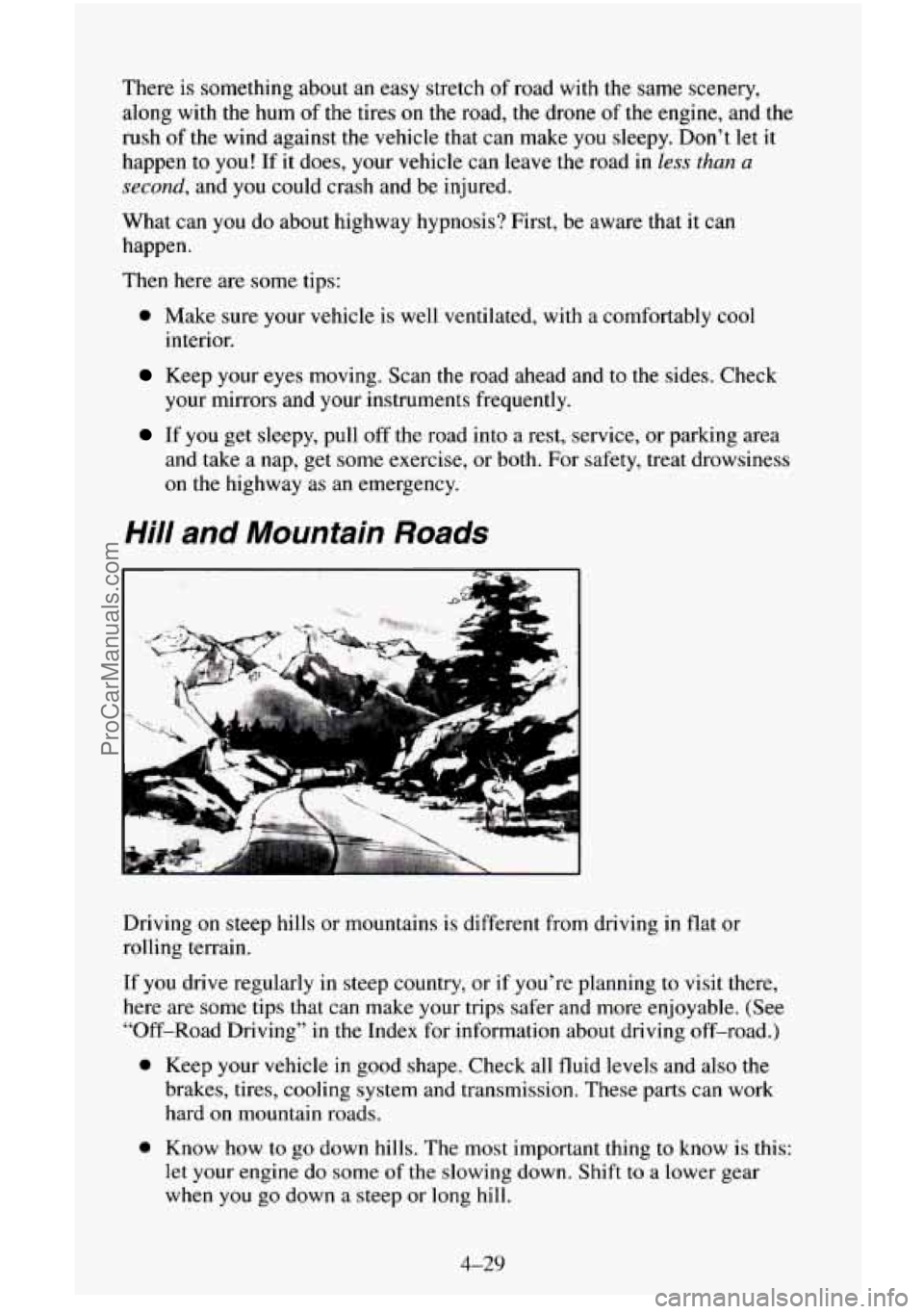
Driving on steep hills or mountains is different from driving in flat or
rolling terrain.
If you drive regularly in steep country, or if you’re planning to visit there,
here are some tips that can make your trips safer and more enjoyable. (See
“Off-Road Driving”
in the Index for information about driving off-road.)
0
0
Keep your vehicle in good shape. Check all fluid levels and also the
brakes, tires, cooling system and transmission. These parts can work
hard on mountain roads.
Know
how to go down hills. The most important thing to know is this:
let your engine
do some of the slowing down. Shift to a lower gear
when
you go down a steep or long hill.
4-29
ProCarManuals.com
Page 228 of 486
Turn Signals When Towing a Trailer
When you tow a trailer, your vehicle has to have extra wiring (included in
the optional trailering package). The green arrows
on your instrument panel
will flash whenever
you signal a turn or lane change. Properly hooked up,
the trailer lamps will
also flash, telling other drivers you’re about to turn,
change lanes or stop.
When towing a trailer, the green arrows on your instrument panel will flash
for turns even if the bulbs
on the trailer are burned out. Thus, you may think
drivers behind you are seeing your signal when they are not. It’s important
to check occasionally to be sure the trailer bulbs are still working.
Driving On Grades
Reduce speed and shift to a lower gear before you start down a long or steep
downgrade. If
you don’t shift down, you might have to use your brakes so
much that they would get hot and no longer work well.
On
a long uphill grade, shift down and reduce your speed to around 45 mph
(70 kdh) to reduce the possibility of engine and transmission overheating.
If
you have an automatic transmission you should use DRIVE (3) (or, as
you need to, a lower gear) when towing a trailer. Operating your vehicle in
DRIVE (3) when towing a trailer will minimize heat build-up and extend
the life
of your transmission.
If
you have a manual transmission and you are towing a trailer, it’s better
not to use FIFTH (5) gear. Just drive in FOURTH (4) gear (or, as you need
to,
a lower gear).
When towing at high altitude
on steep uphill grades, consider the following:
Engine coolant will boil at a lower temperature than at normal altitudes. If
you turn your engine off immediately after towing at high altitude on steep
uphill grades, your vehicle may show signs similar
to engine overheating.
To avoid this, let the engine run while parked (preferably on level ground)
with the automatic transmission
in PARK (P) (or the manual transmission
out of gear and the parking brake applied) for a few minutes before turning
the engine off.
If you do get the overheat warning, see “Engine
Overheating” in the Index.
Parking on Hills
You really should not park your vehicle, with a trailer attached, on a hill. If
something goes wrong, your rig could start to move. People can be injured,
and both your vehicle and
the trailer can be damaged.
But
if you ever have to park your rig on a hill, here’s how to do it:
1. Apply your regular brakes, but don’t shift into PARK (P) yet, or in gear
for a manual transmission.
ProCarManuals.com
Page 230 of 486
Maintenance When Trailer Towing
Your vehicle will need service more often when you’re pulling a trailer. See
the Maintenance Schedule for more on this. Things that are especially
important
in trailer operation are automatic transmission fluid (don’t
overfill), engine oil, axle lubricant, belt, cooling system, an\
d brake
adjustment. Each
of these is covered in this manual, and the Index will help
you find them quickly. If you’re trailering, it’s a good idea to review these
sections before you start your trip.
Check periodically to see
that all hitch nuts and bolts are tight.
Trailer Lighting Systems Wiring
See “Trailer Wiring Harness” in the Index.
ProCarManuals.com
Page 236 of 486
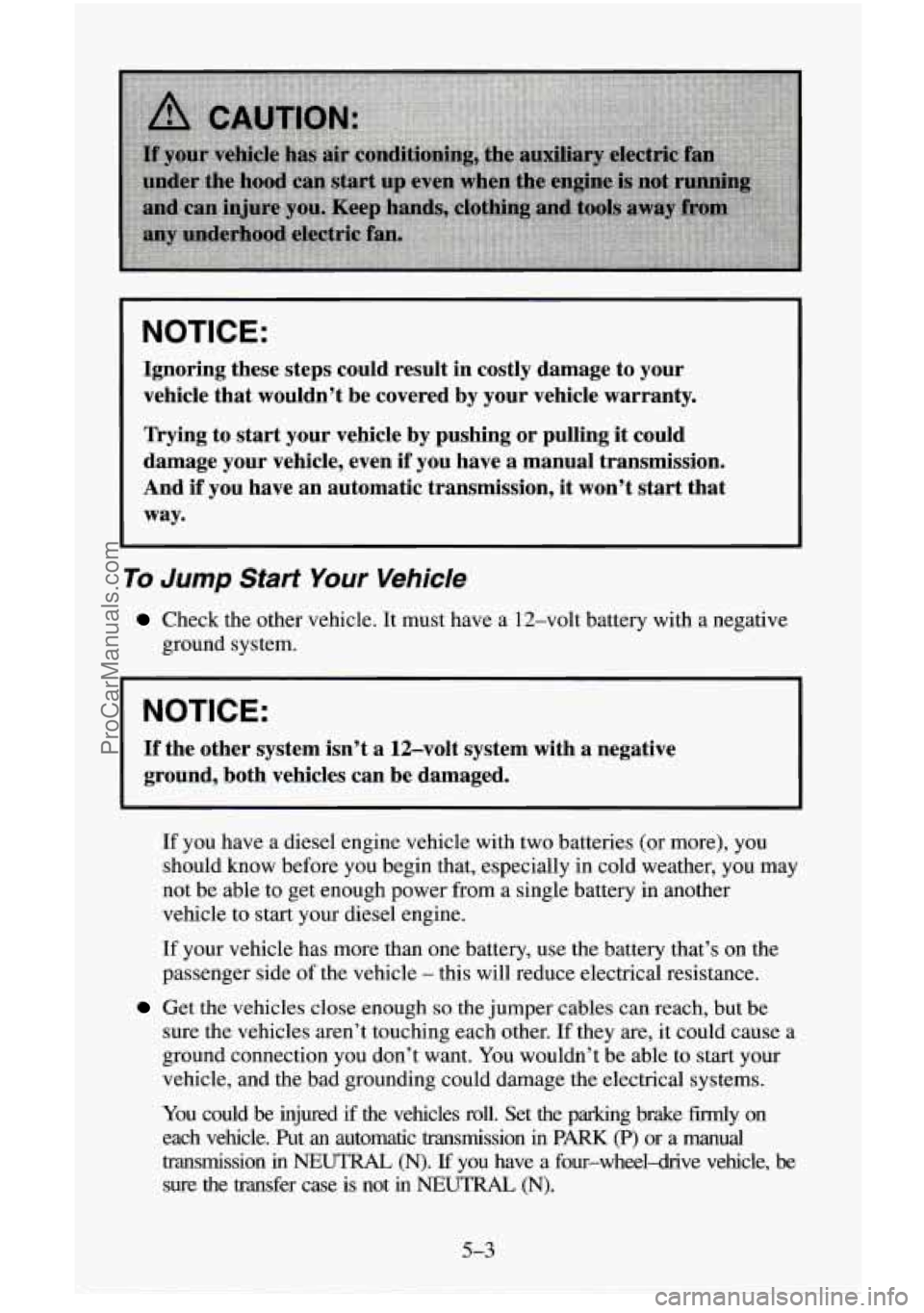
NOTICE:
Ignoring these steps could result in costly damage to your
vehicle that wouldn’t be covered by your vehicle warranty.
Trying to start your vehicle by pushing or pulling it could
damage your vehicle, even if you have a manual transmission.
And if you have an automatic transmission, it won’t start that
way.
To Jump Start Your Vehicle
Check the other vehicle. It must have a 12-volt battery with a negative
ground system.
NOTICE:
If the other system isn’t a 12-volt system with a negative
ground, both vehicles can be damaged.
If you have a diesel engine vehicle with two batteries (or more), you
should know before you begin that, especially
in cold weather, you may
not be able to get enough power from a single battery in another
vehicle
to start your diesel engine.
If your vehicle has more than one battery, use the battery that’s on the
passenger side
of the vehicle - this will reduce electrical resistance.
Get the vehicles close enough so the jumper cables can reach, but be
sure the vehicles aren’t touching each other. If they are, it could cause a
ground connection you don’t want. You wouldn’t be able to start your
vehicle, and the bad grounding could damage the electrical systems.
You could
be injured if the vehicles roll. Set the parking brake firmly on
each vehicle. Put
an automatic transmission in PARK (P) or a manual
transmission in NEUTRAL (N). If you have a four-wheel-drive vehicle, be
sure the transfer case is not in NEUTRAL (N).
5-3
ProCarManuals.com
Page 237 of 486
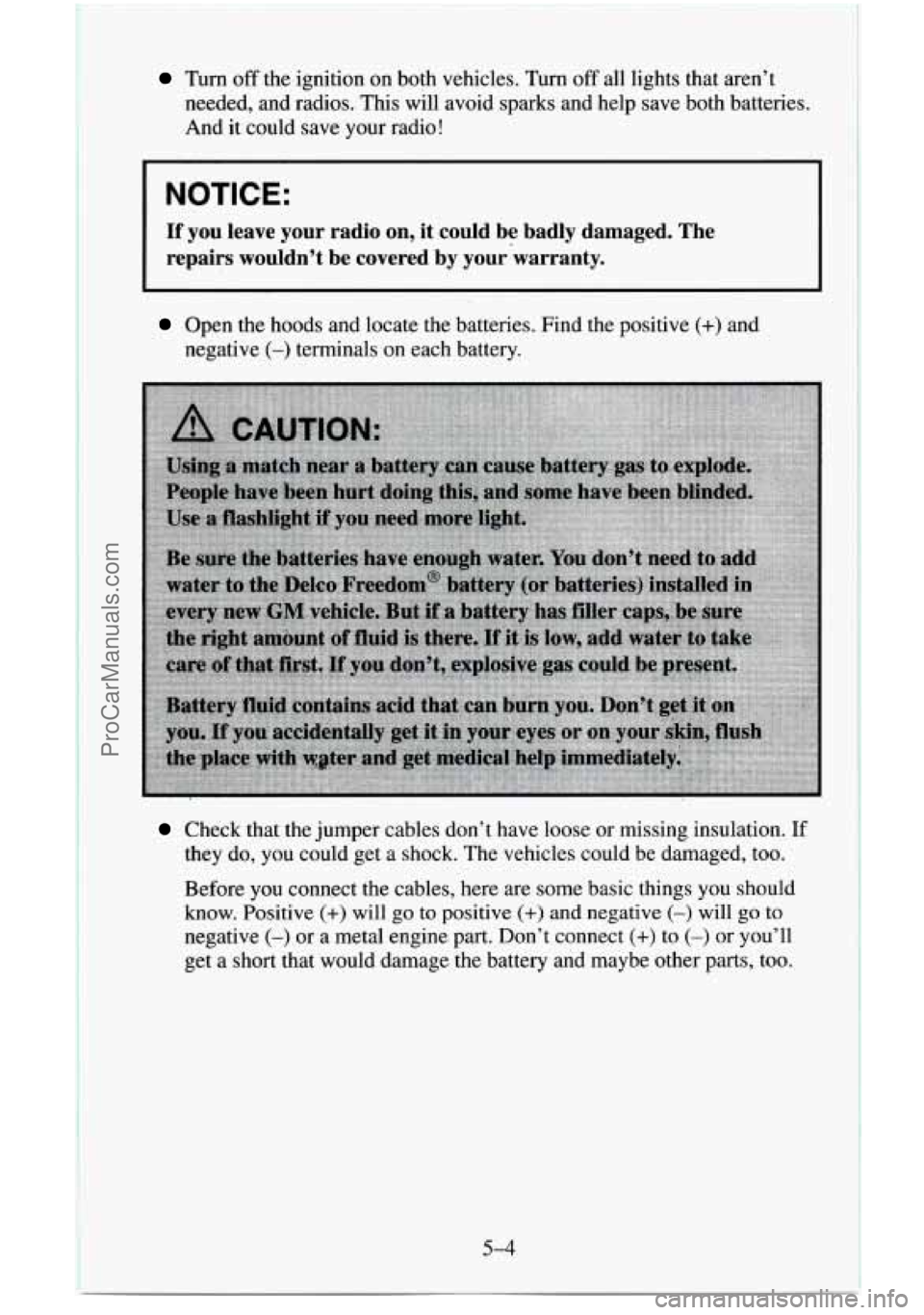
Turn off the ignition on both vehicles. Turn off all lights that aren’t
needed, and radios. This will avoid sparks and help save both batteries.
And it could
save your radio!
I NOTICE:
If you leave your radio on, it could be badly damaged. The
repairs wouldn’t be covered by your warranty.
Open the hoods and locate the batteries. Find the positive (+) and
negative
(-) terminals on each battery.
Check that the jumper cables don’t have loose or missing insulation. If
they do, you could get a shock. The vehicles could be damaged, too.
Before
you connect the cables, here are some basic things you should
know. Positive
(+) will go to positive (+) and negative (-) will go to
negative (-) or a metal engine part. Don’t connect (+) to (-) or you’ll
get a short that would damage the battery and maybe other parts, too.
5-4
ProCarManuals.com
Page 281 of 486
You should ask your service station operators if their gasolines contain
deposit control additives and oxygenates, and
if they have been
reformulated
to reduce vehicle emissions.
Diesel Fuel Requirements and Fuel System
Some states and provinces have restrictions on the purchase of diesel fuel
for light-duty vehicles and require you
to buy permits or pay special taxes.
Some
of these restrictions apply only to residents, and others apply to both
residents and visitors. These restrictions can change.
To learn the current
restrictions
in any state or province, contact your auto club, the police or
other officials.
Fuel Requirements
NOTICE:
Diesel fuel or fuel additives not recommended in this manual
could damage your fuel system and engine. Your warranty
wouldn’t cover this damage. And:
Diesel fuel that has been mixed with engine oil could damage
your engine and emission controls.
Always check with your
service station operator to make sure his diesel fuel has not \
been mixed with engine oil.
If you ever run out of diesel fuel, it can be difficult to restart
your engine. “Running Out
of Fuel,” later in this section, tells
you how to get it started again.
To avoid all this, try never to
let your tank get empty.
What Fuel to Use
For best results, use Number 2-D diesel fuel year-round (above and below
freezing conditions) as
oil companies blend Number 2-D fuel to address
climate differences. Number 1-D diesel fuel may be used
in very cold
temperatures (when it stays below
0°F or -1 8°C); however, it will produce
a power and fuel economy
loss. The use of Number 1-D diesel fuel in warm
or hot climates may result in stalling, poor starting when the engine
is hot
and may damage the fuel injection system.
Diesel fuel may foam when you fill your tank. This can cause the automatic
pump nozzle
to shut off, even though your tank isn’t full. If this happens,
just wait for the foaming
to stop and then continue to fill your tank.
6-4
ProCarManuals.com
Page 283 of 486
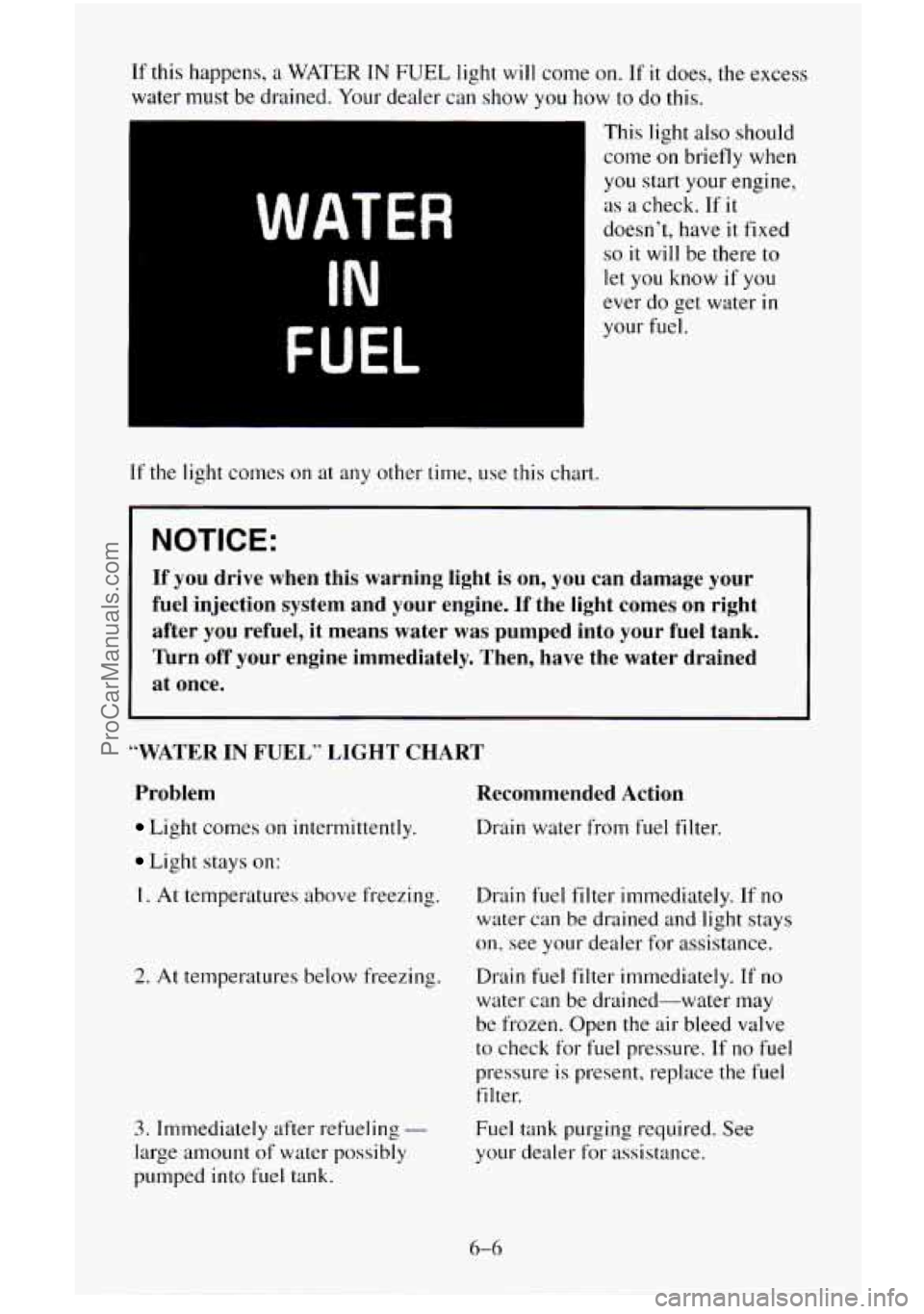
If this happens, a WATER IN FUEL light will come
water must be drained. Your Cfpder can show you
hc
I
WATER
IN
FUEL
If the light comes on at any other time, use this chart.
! on. If it does, the excess
3w to do this.
This light
also should
come
on briefly when
you start your engine,
as a check. If it
doesn’t, have it fixed
so it will be there to
let you know if you
ever do get water
in
your fuel.
NOTICE:
If you drive when this warning light is on, you can damage your \
fuel injection system and your engine. If the light comes on \
right
after you refuel,
it means water was pumped into your fuel tank.
Turn off your engine immediately. Then, have the water drained \
at once.
“WATER IN FUEL” LIGHT CHART Problem
Light comes on intermittently.
Light stays on:
Recommended Action
Drain water from fuel filter.
1. At temperatures above freezing. Drain fuel filter immediately. If no
water can be drained and light stays
on, see your dealer for assistance.
2. At temperatures below freezing. Drain fuel filter immediately. If no
water can be drained-water may
be frozen. Open the air bleed valve
to check for fuel pressure. If
no fuel
pressure is present, replace the fuel
filter.
3. Immediately after refueling -
large amount of water possibly
pumped into fuel tank. Fuel tank
purging required. See
your dealer for assistance.
6-4
ProCarManuals.com
Page 287 of 486
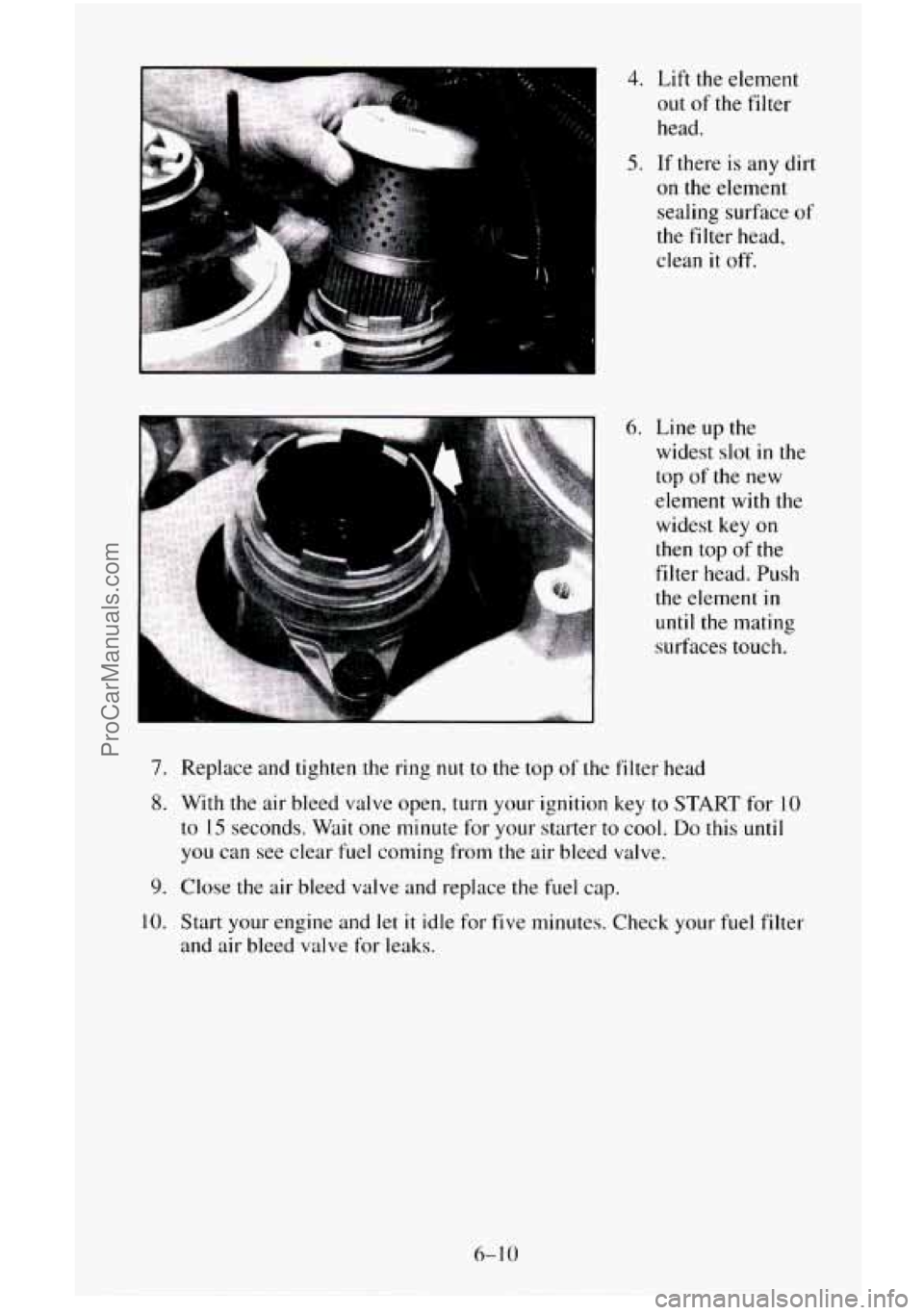
4. Lift the element
out
of the filter
head.
5. If there is any dirt
on the element
sealing surface
of
the filter head,
clean
it off.
6. Line up the
widest slot
in the
top
of the new
element with the
widest key on
then top of the
filter head. Push
the element
in
until the mating
surfaces touch.
7. Replace and tighten the ring nut to the top of'the filter head
8. With the air bleed valve open, turn your ignition key to START for 10
to 15 seconds, Wait one minute for your starter to cool. Do this until
you can see clear fuel coming from the air bleed valve.
9. Close the air bleed valve and replace the fuel cap.
10. Start your engine and let it idle for five minutes. Check your fuel filter
and air bleed valve for leaks.
6-10
ProCarManuals.com
Page 288 of 486
Fuels in Foreign Countries (Gasoline
Engines)
If you plan on driving in another country outside the U.S. or Canada,
unleaded
fuel may be hard to find. Do not use leaded gasoline. If you use
even one tankful, your emission controls won’t work well or at all. With
continuous use, spark plugs can get fouled, the exhaust system can corrode,
and your engine oil can deteriorate quickly. Your vehicle’s oxygen sensor
will be damaged. All of that means costly repairs that wouldn’t be covered
by your warranty.
To check on fuel availability, ask an auto club, or contact a major oil
company that does business
in the country where you’ll be driving.
You can
also write us at the following address for advice. Just tell us where
you’re going and give your Vehicle Identification Number
(VIN).
General Motors Overseas Distribution Corporation,
North American Export Sales
(NAES)
1908 Colonel Sam Drive
Oshawa, Ontario
LIH 8P7
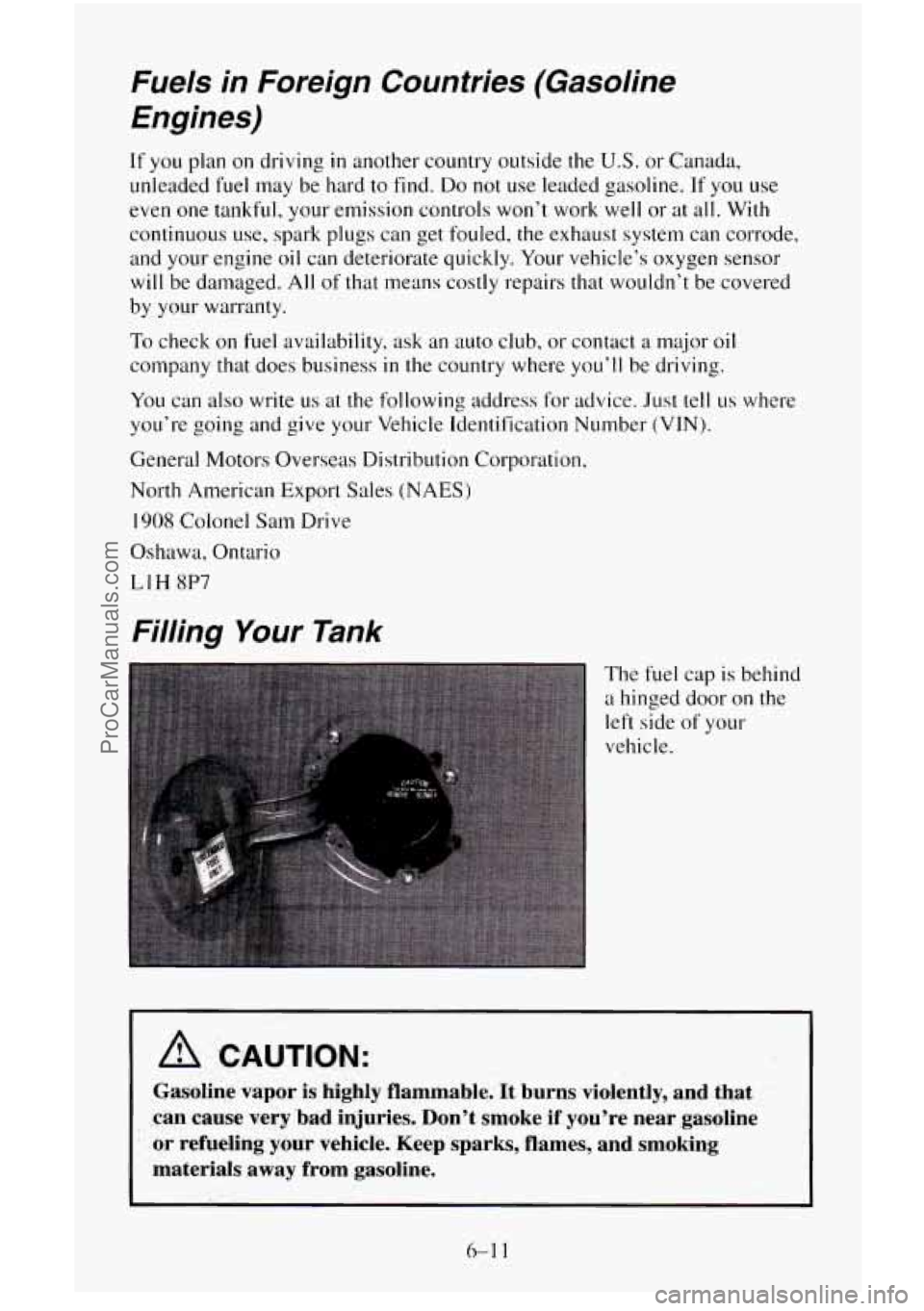
Filling Your Tank
The fuel cap is behind
a hinged door on the
left side of your
vehicle.
A CAUTION:
Gasoline vapor is highly flammable. It burns violently, and that
can cause very bad injuries. Don’t smoke if you’re near gasol\
ine
or refueling your vehicle.
Keep sparks, flames, and smoking
materials away from gasoline.
6-1 1
ProCarManuals.com