heater CHEVROLET SUBURBAN 1996 User Guide
[x] Cancel search | Manufacturer: CHEVROLET, Model Year: 1996, Model line: SUBURBAN, Model: CHEVROLET SUBURBAN 1996Pages: 486, PDF Size: 26.58 MB
Page 163 of 486
You can turn the defogger off at any time by pressing the button again. The
defogger will shut itself off after several minutes,
so that the glass does not
get too hot. If the defogger shuts off, and the window still isn’t clear, turn on
the defogger again.
Ventilation System
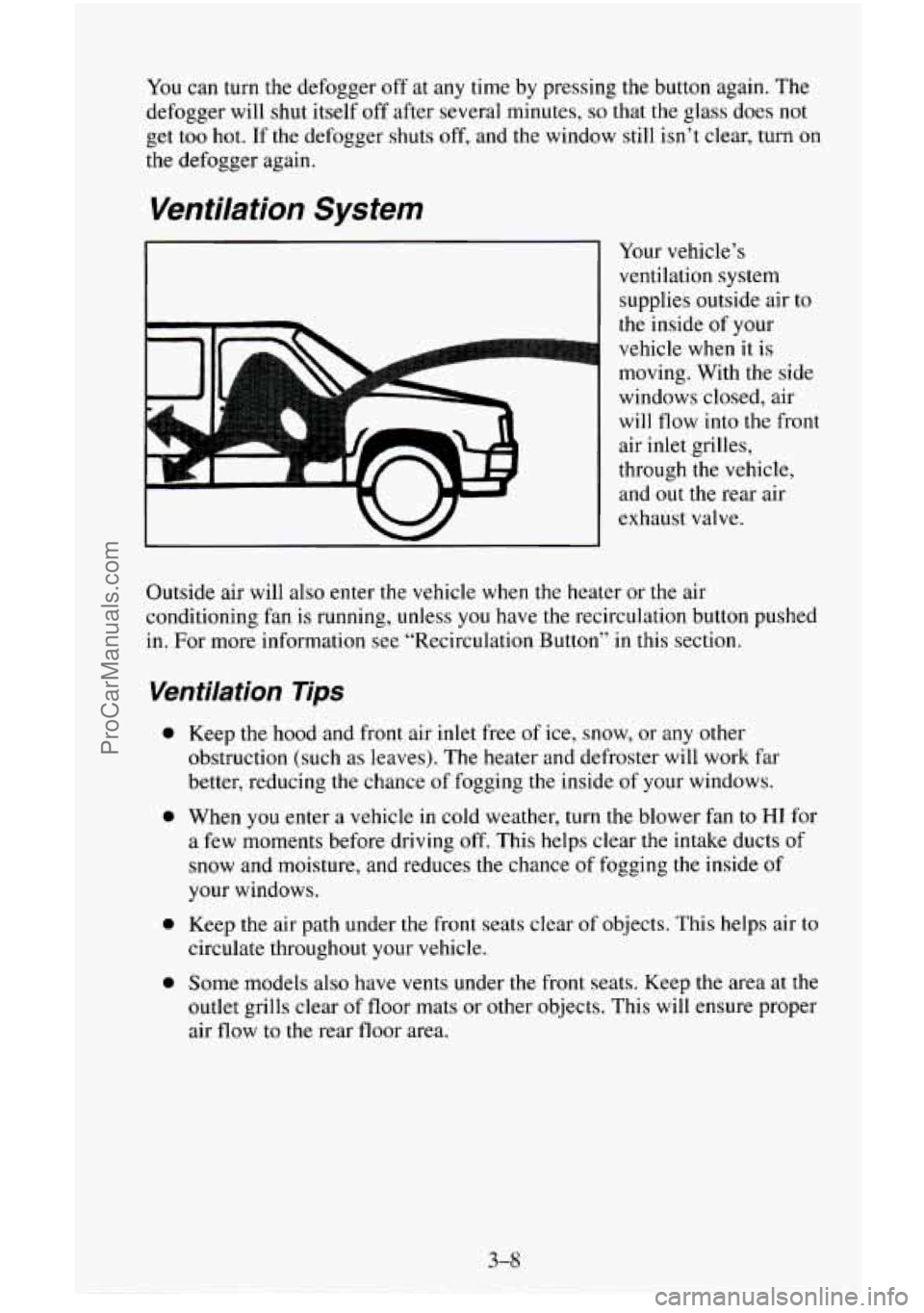
Your vehicle’s
ventilation system
supplies outside air
to
the inside of your
vehicle when it is
moving. With the side
windows closed, air
will flow into the front
air inlet grilles,
through the vehicle,
and
out the rear air
exhaust valve.
Outside air will also enter the vehicle when the heater or the air
conditioning fan is running, unless
you have the recirculation button pushed
in. For more information see “Recirculation Button” in this section.
Ventilation Tips
0
0
0
0
Keep the hood and front air inlet free of ice, snow, or any other
obstruction (such as leaves). The heater and defroster will work far
better, reducing the chance
of fogging the inside of your windows.
When you enter a vehicle in cold weather, turn the blower fan to
HI for
a few moments before driving off. This helps clear the intake ducts of
snow and moisture, and reduces the chance of fogging the inside
of
your windows.
Keep the air path under the front seats clear
of objects. This helps air to
circulate throughout your vehicle.
Some models also have vents under the front seats. Keep the area at the
outlet grills clear
of floor mats or other objects. This will ensure proper
air
flow to the rear floor area.
3-8
ProCarManuals.com
Page 217 of 486
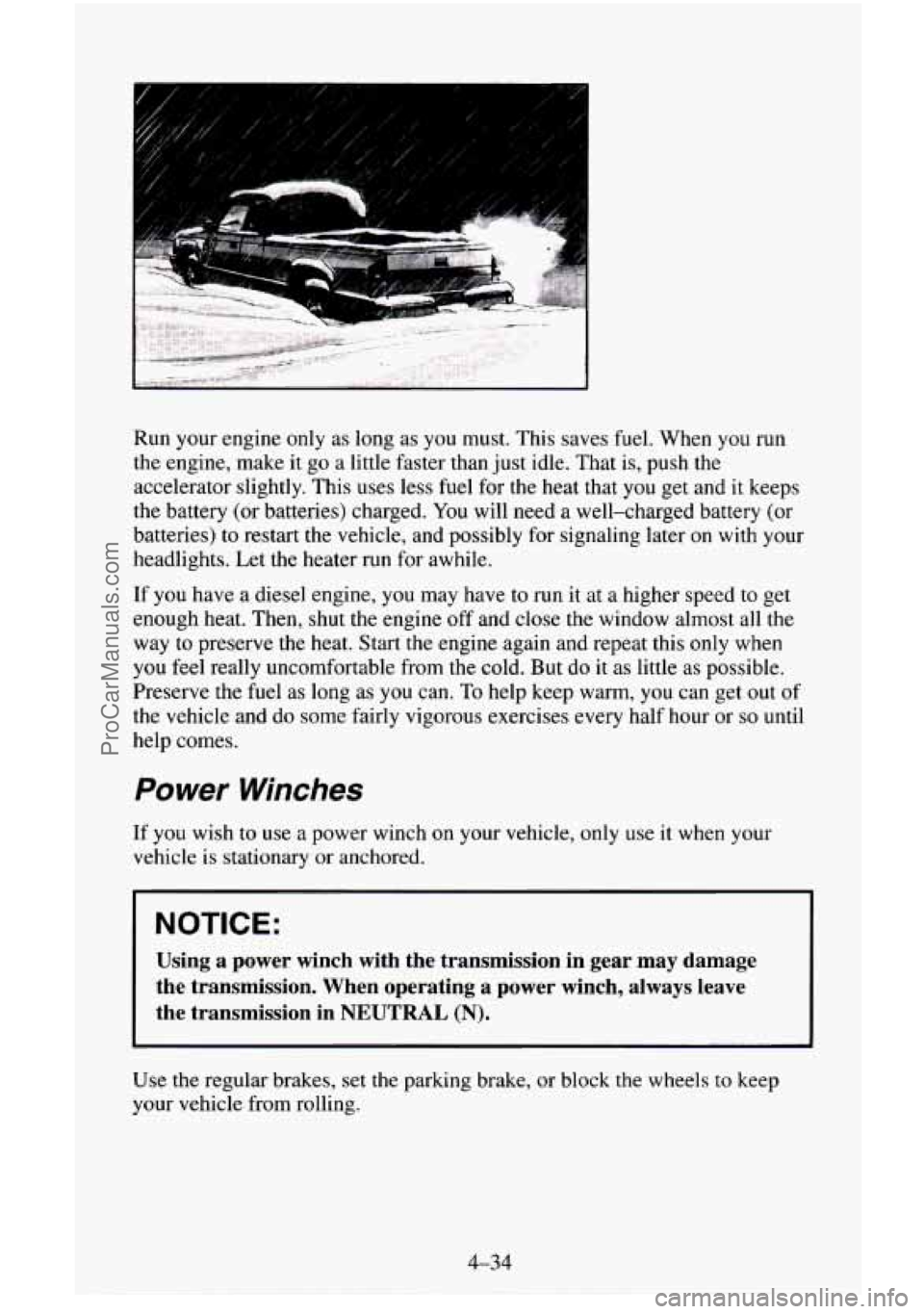
Run your engine only as long as you must. This saves fuel. When you run
the engine, make it
go a little faster than just idle. That is, push the
accelerator slightly. This uses less fuel for the heat
that you get and it keeps
the battery (or batteries) charged. You will need a well-charged battery
(or
batteries) to restart the vehicle, and possibly for signaling later on with your
headlights. Let the heater
run for awhile.
If you have a diesel engine, you may have
to run it at a higher speed to get
enough heat. Then, shut the engine off and close the window almost all the
way to preserve the heat. Start the engine again and repeat
this only when
you feel really uncomfortable from the cold. But do it as little as possible.
Preserve the fuel
as long as you can. To help keep warm, you can get out of
the vehicle and do some fairly vigorous exercises every half
hour or so until
help
comes.
Power Winches
If you wish to use a power winch on your vehicle, only use it when your
vehicle
is stationary or anchored.
I NOTICE:
Using a power winch with the transmission in gear may damage
the transmission. When operating a power winch, always leave
the transmission in NEUTRAL
(N).
Use the regular brakes, set the parking brake, or block the wheels to keep
your vehicle from rolling.
4-34
ProCarManuals.com
Page 243 of 486
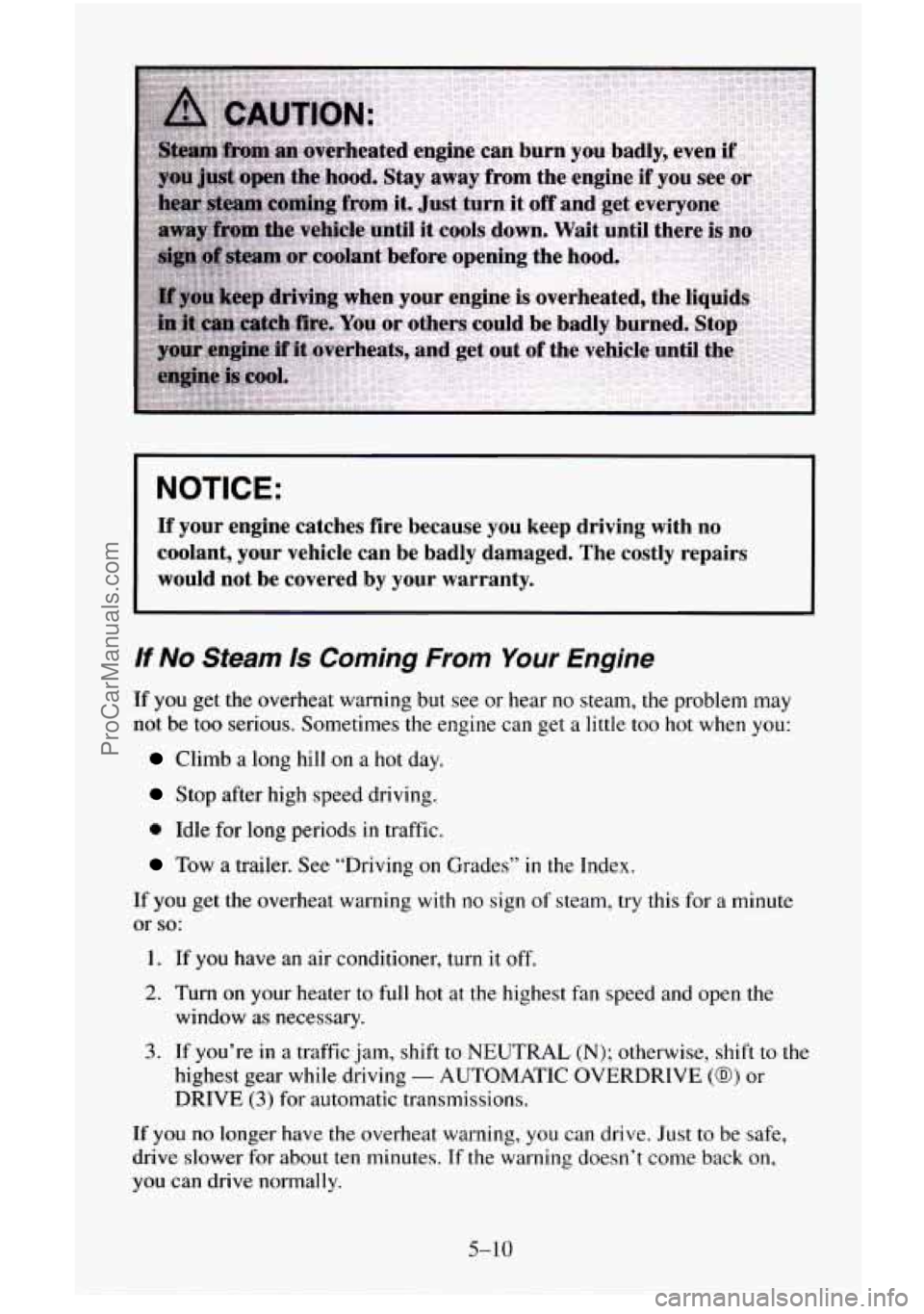
NOTICE:
If your engine catches fire because you keep driving with no
coolant, your vehicle can be badly damaged. The costly repairs
would not be covered by your warranty.
If No Steam Is Coming From Your Engine
If you get the overheat warning but see or hear no steam, the problem may
not be too serious. Sometimes the engine can get a little too hot when you:
Climb a long hill on a hot day.
Stop after high speed driving.
0 Idle for long periods in traffic.
Tow a trailer. See “Driving on Grades” in the Index.
If you get the overheat warning with
no sign of steam, try this for a minute
or
so:
I. If you have an air conditioner, turn it off.
2. Turn on your heater to full hot at the highest fan speed and open the
window as necessary.
3. If you’re in a traffic jam, shift to NEUTRAL (N); otherwise, shift to the
highest gear while driving
- AUTOMATIC OVERDRIVE (a) or
DRIVE (3) for automatic transmissions.
If you no longer have the overheat warning, you can drive. Just to be safe,
drive slower for about ten minutes. If the warning doesn’t come back on,
you can drive normally.
5-10
ProCarManuals.com
Page 245 of 486
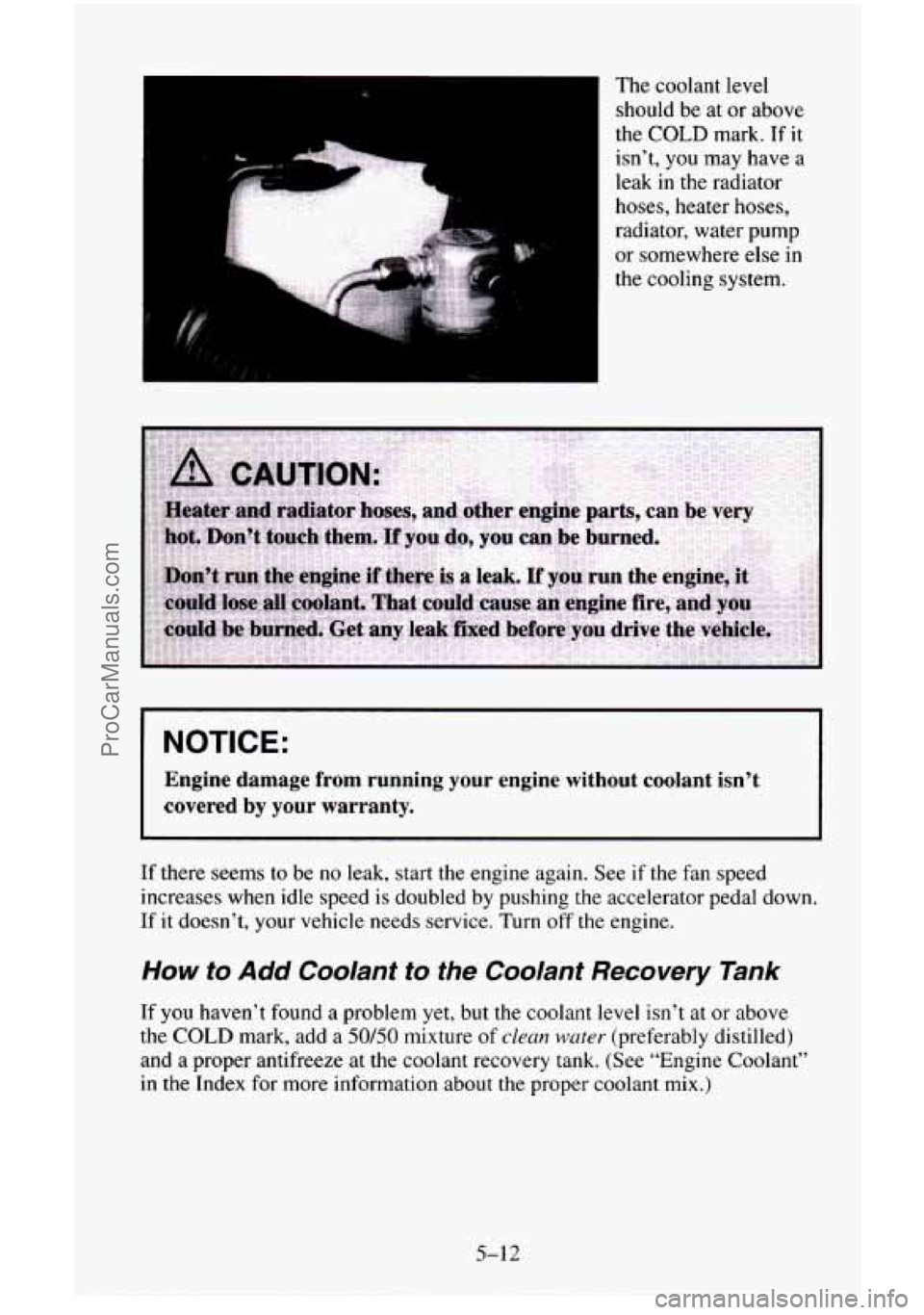
The coolant level
should be
at or above
the
COLD mark. If it
isn’t, you may have a
leak in the radiator
hoses, heater hoses,
radiator, water pump
or somewhere else in
the cooling system.
NOTICE:
Engine damage from running your engine without coolant isn’t \
covered
by your warranty.
If there seems to be no leak, start the engine again. See if the fan speed
increases when idle speed
is doubled by pushing the accelerator pedal down.
If it doesn’t, your vehicle needs service. Turn
off the engine.
How to Add Coolant to the Coolant Recovery Tank
If you haven’t found a problem yet, but the coolant level isn’t at or above
the
COLD mark, add a 50/50 mixture of clean water (preferably distilled)
and a proper antifreeze at the coolant recovery tank. (See “Engine Coolant”
in the Index for more information about the proper coolant mix.)
ProCarManuals.com
Page 246 of 486

NOTICE:
In cold weather, water can freeze and crack the engine, radiat\
or.
heater core and other parts. Use the recommended coolant.
E
When the coolant in the coolant recovery tank is at or above the COLD
mark, start your vehicle.
5-13
ProCarManuals.com
Page 251 of 486
Cooling System - Diesel Engines
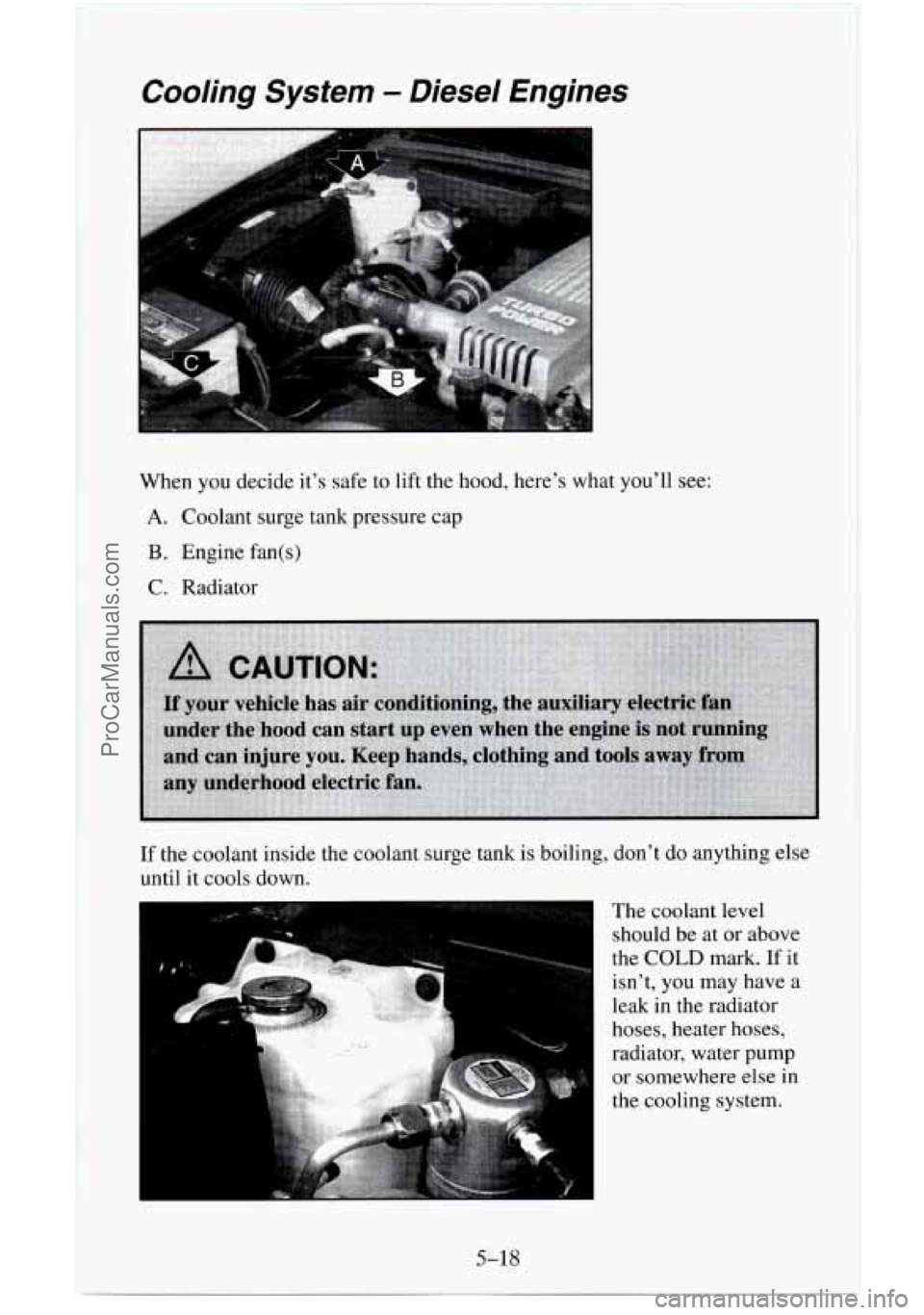
When you decide it’s safe to lift the hood, here’s what you’ll see:
A. Coolant surge tank pressure cap
B. Engine fan(s)
C. Radiator
If the coolant inside the coolant surge tank is boiling, don’t do anything else
until
it cools down.
The coolant level
should be at or above
the
COLD mark. If it
isn’t,
you may have a
leak in the radiator
hoses, heater hoses,
radiator, water pump
1 or somewhere else in
the cooling system.
5-18
ProCarManuals.com
Page 254 of 486

NOTICE:
In cold weather, water can freeze and crack the engine, radiat\
or,
heater core and other parts.
So use the recommended coolant.
1. You can remove the coolant surge tank pressure cap when the cooling
system, including the coolant surge tank pressure cap and upper
radiator hose, is no longer hot. Turn the pressure cap slowly to the left
until
it first stops. (Don’t press down while turning the pressure cap.)
If you hear a hiss, wait for that
to stop. A hiss means there is still some
pressure left.
5-21
ProCarManuals.com
Page 296 of 486

NOTICE:
Use only engine oil with the American Petroleum Institute
Certified For Gasoline Engines “Starburst” symbol. Failure \
to
use the proper oil can result in engine damage not covered by
your warranty.
GM Goodwrench@ oil (in Canada, GM Engine Oil) meets all the
requirements for your vehicle.
Engine Oil Additives
Don’t add anything to your oil. Your GM dealer is ready to advise if you
think something should be added.
When to Change Engine Oil
See if any one of these is true for you:
Most trips are less than 5 to 10 miles (8 to 16 km). This is particularly
important when outside temperatures are below freezing.
0 Most trips include extensive idling (such as frequent driving in stop and
go traffic).
Most trips are through dusty areas.
You operate your vehicle in dusty areas or off-road frequently.
0 You frequently tow a trailer or use a carrier on top of your vehicle.
If any one of these
is true for your vehicle, then you need to change your oil
and filter every 3,000 miles (5 000 km) or 3 months - whichever comes
first.
Light Duty Emissions:
If none of them is true, change the oil and filter every 7,500 miles (1 2 500
km) or 12 months - whichever comes first.
Heavy Duty Emissions:
If none of them is true, change the oil and filter every 6,000 miles (10 000
km) or 12 months - whichever comes first.
Engine Coolant Heater
An engine coolant heater can be a big help if you have to park outside in
very cold weather, 0°F (- 18OC) or colder. If your vehicle has this option,
see “Engine Coolant Heater” in the Index.
ProCarManuals.com
Page 311 of 486
Specification 6038-M.” Use GM Coolant Supplement (Sealer) with a
complete coolant flush and refill. If
you use this mixture, you don’t need to
add anything else.
NOTICE:
If you use an improper coolant mix, your engine could overheat
and be badly damaged. The repair cost wouldn’t be covered by
your warranty.
Too much water in the mix can freeze and crack
the engine, radiator, heater core and other parts.
Some conditions, such
as air trapped in the cooling system, can affect the
coolant level
in the radiator. Check the coolant level when the engine is cold
and follow the steps under “Adding Coolant”
for the proper way to add
coolant.
If you have to add coolant more than four times
a year, have your dealer
check
your cooling system.
I NOTICE:
If you use the proper coolant, you don’t have to add extra
inhibitors or additives which claim to improve the system. These
can be harmful.
6-34
ProCarManuals.com
Page 354 of 486
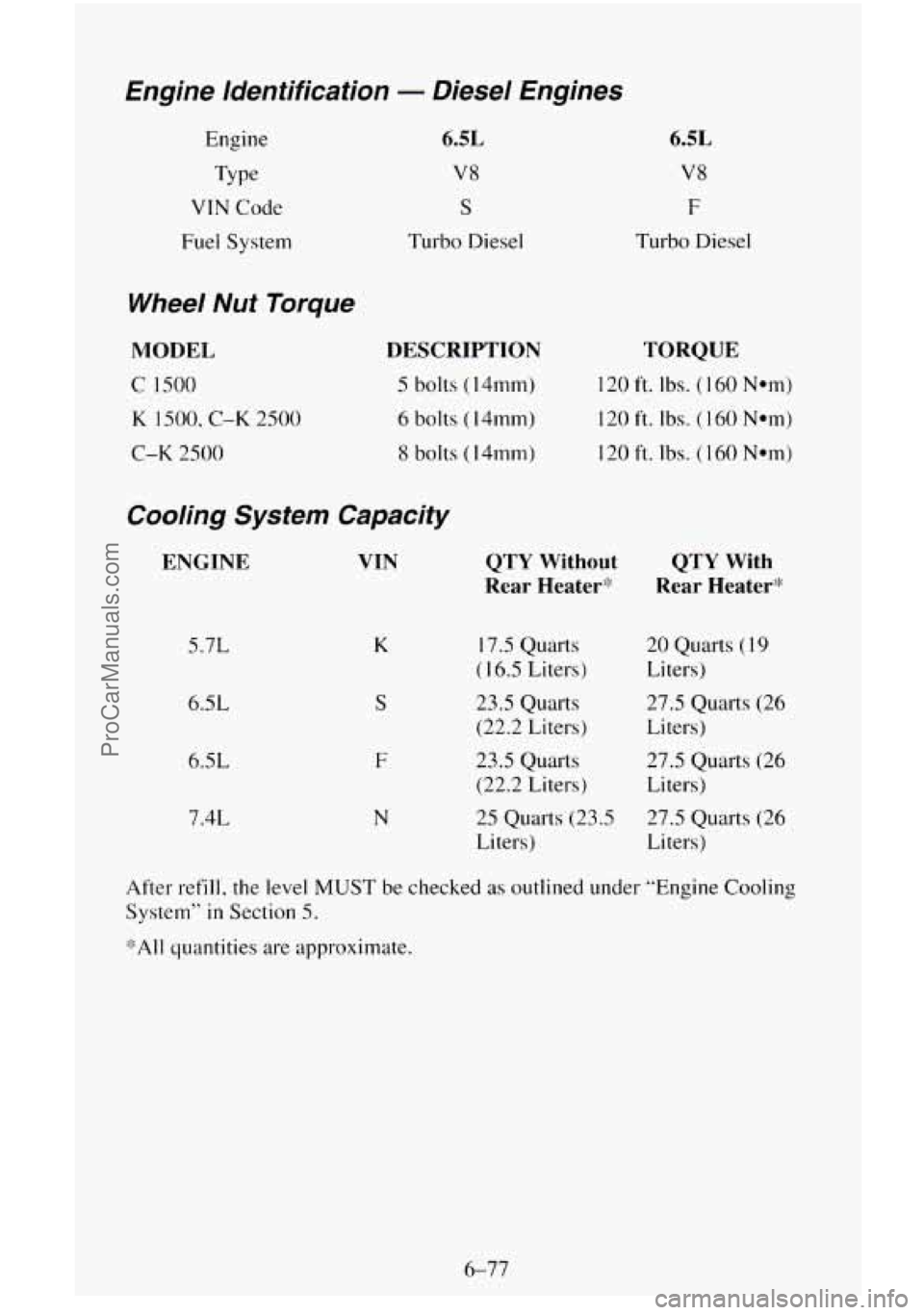
Engine Identification - Diesel Engines
Engine Type
VTN Code
Fuel System
Wheel Nut Torque
MODEL
C 1500
K 1500, C-K 2500
C-K 2500
6.5L
V8
S
Turbo Diesel
DESCRIPTION
5 bolts (14mm)
6 bolts
(1 4mm)
8 bolts ( 14mm)
Cooling System Capacity
ENGINE
5.7L
6.5L
6.5L 7.4L
VIN
K
S
F
N
6.5L
V8
F
Turbo Diesel
TORQUE
120 ft. Ibs. ( 160 N*m)
120 ft. Ibs. (1 60 Nom)
I20
ft. lbs. ( 160 Nom)
QTY Without
Rear Heater*
1 7.5 Quarts
( 16.5 Liters)
23.5 Quarts (22.2 Liters)
23.5 Quarts
(22.2 Liters)
25 Quarts
(23.5
Liters)
QTY With
Rear Heater4’
20 Quarts (1 9
Liters)
27.5 Quarts (26
Liters)
27.5 Quarts (26
Liters)
27.5 Quarts (26
Li ters)
After refill. the level MUST be checked
as outlined under “Engine Cooling
System” in Section 5.
‘$All quantities are approximate.
6-77
ProCarManuals.com