radiator CHEVROLET SUBURBAN 1996 User Guide
[x] Cancel search | Manufacturer: CHEVROLET, Model Year: 1996, Model line: SUBURBAN, Model: CHEVROLET SUBURBAN 1996Pages: 486, PDF Size: 26.58 MB
Page 311 of 486
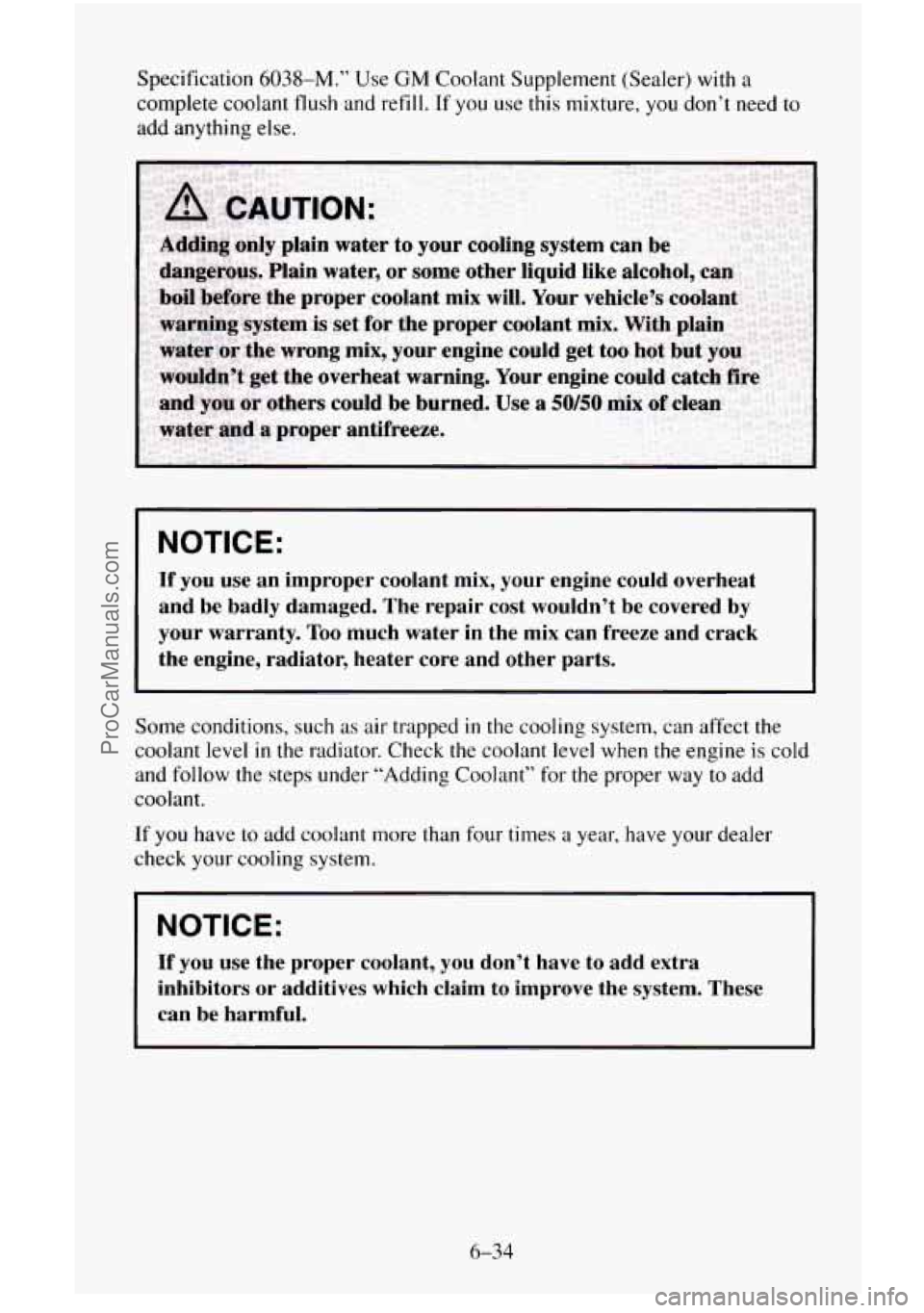
Specification 6038-M.” Use GM Coolant Supplement (Sealer) with a
complete coolant flush and refill. If
you use this mixture, you don’t need to
add anything else.
NOTICE:
If you use an improper coolant mix, your engine could overheat
and be badly damaged. The repair cost wouldn’t be covered by
your warranty.
Too much water in the mix can freeze and crack
the engine, radiator, heater core and other parts.
Some conditions, such
as air trapped in the cooling system, can affect the
coolant level
in the radiator. Check the coolant level when the engine is cold
and follow the steps under “Adding Coolant”
for the proper way to add
coolant.
If you have to add coolant more than four times
a year, have your dealer
check
your cooling system.
I NOTICE:
If you use the proper coolant, you don’t have to add extra
inhibitors or additives which claim to improve the system. These
can be harmful.
6-34
ProCarManuals.com
Page 313 of 486
Adding Coolant - Diesel Engine
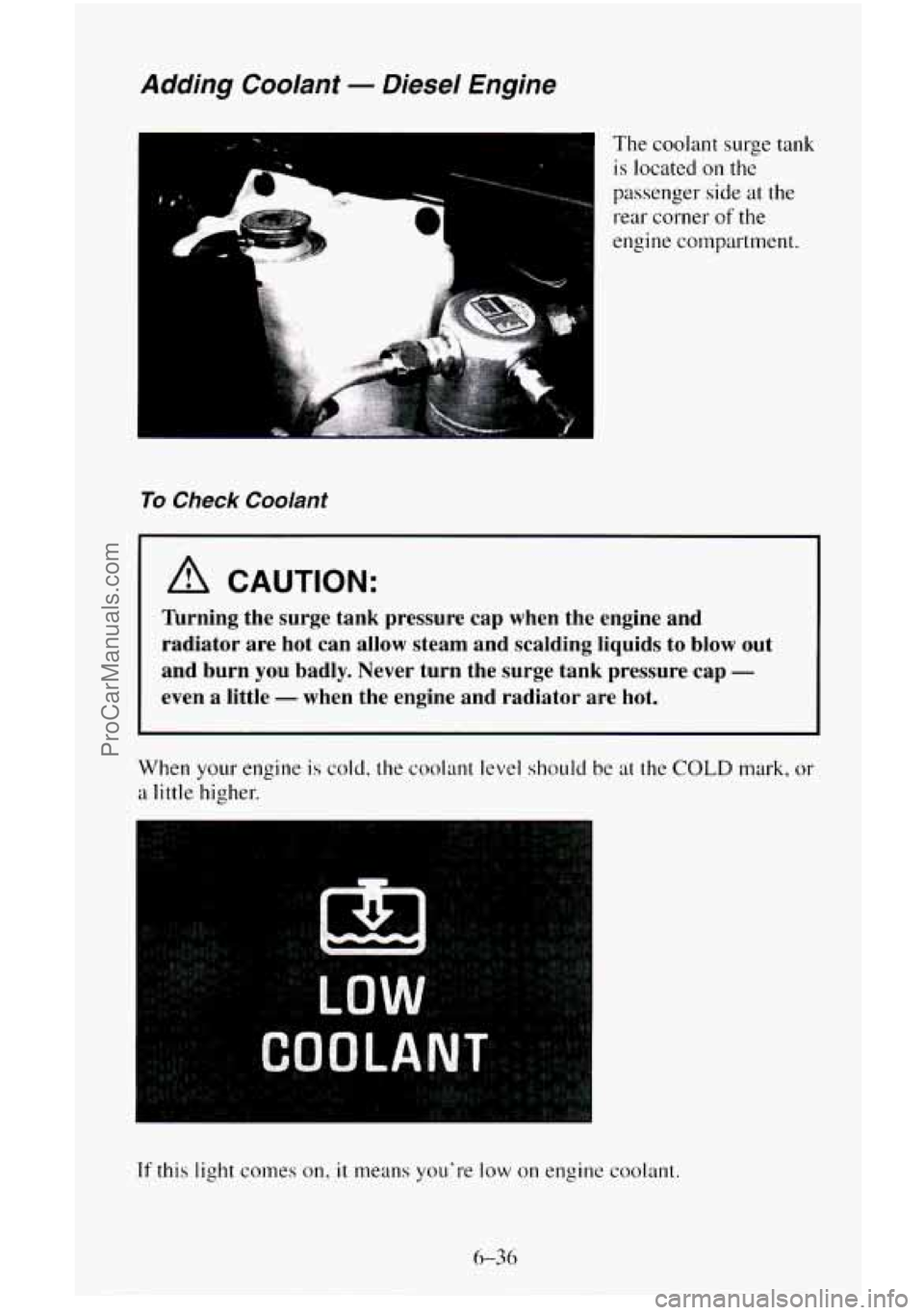
x " The coolant surge tank is located on
the
passenger side at the
rear corner of the
engine compartment.
To Check Coolant
A CAUTION:
lbrning the surge tank pressure cap when the engine and
radiator are hot can allow steam and scalding liquids to blow \
out
and burn you badly. Never turn the surge tank pressure
cap -
even a little - when the engine and radiator are hot.
When your engine is cold, the coolant level should be at the COLD mark. or
a little higher.
If this light comes on, it means you're low on engine coolant.
6-36
ProCarManuals.com
Page 314 of 486
To Add Coolant
If you need more coolant, add the proper mix crt the surge tunk, but only
when the engine
is cool. If the surge tank is empty, see “Engine
Overheating”
in the Index for the proper fill procedure.
A CAUTION:
You can be burned if you spill coolant on hot engine parts.
Coolant contains ethylene glycol, and
it will burn if the engine
parts are hot enough. Don’t spill coolant on
a hot engine.
When replacing the pressure
cap, make sure it is tight.
Radiator Pressure Cap - Gasoline Engine
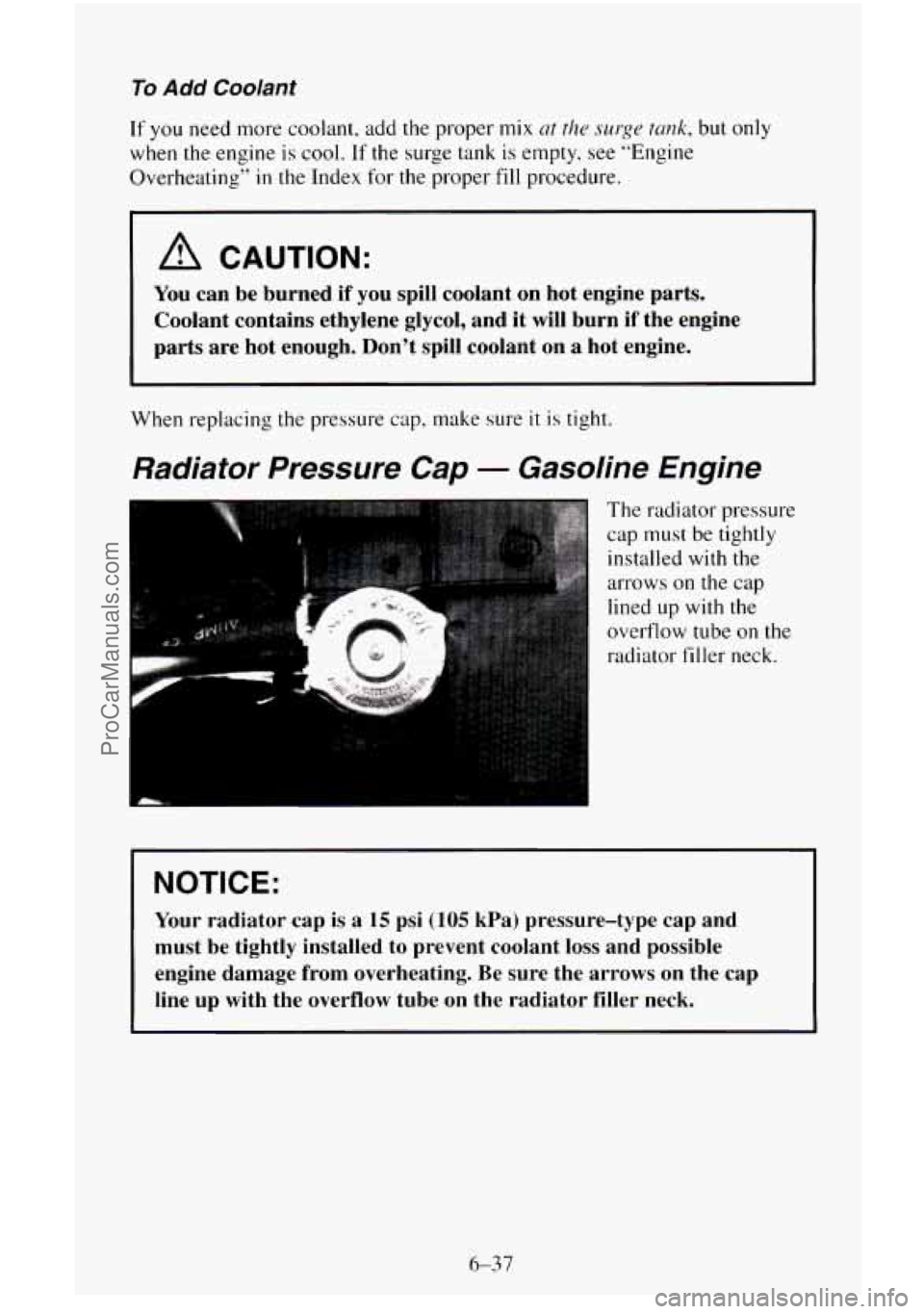
The radiator pressure
cap
must be tightly
installed
with the
arrows on the cap
lined up with the
overflow tube
on the
radiator filler neck.
U
NOTICE:
Your radiator cap is a 15 psi (105 kPa) pressure-type cap and
must be tightly installed to prevent coolant
loss and possible
engine damage from overheating. Be sure the arrows on the cap
line up with the overflow tube on the radiator filler neck.
ProCarManuals.com
Page 315 of 486
Surge Tank Pressure Cap - Diesel Engine
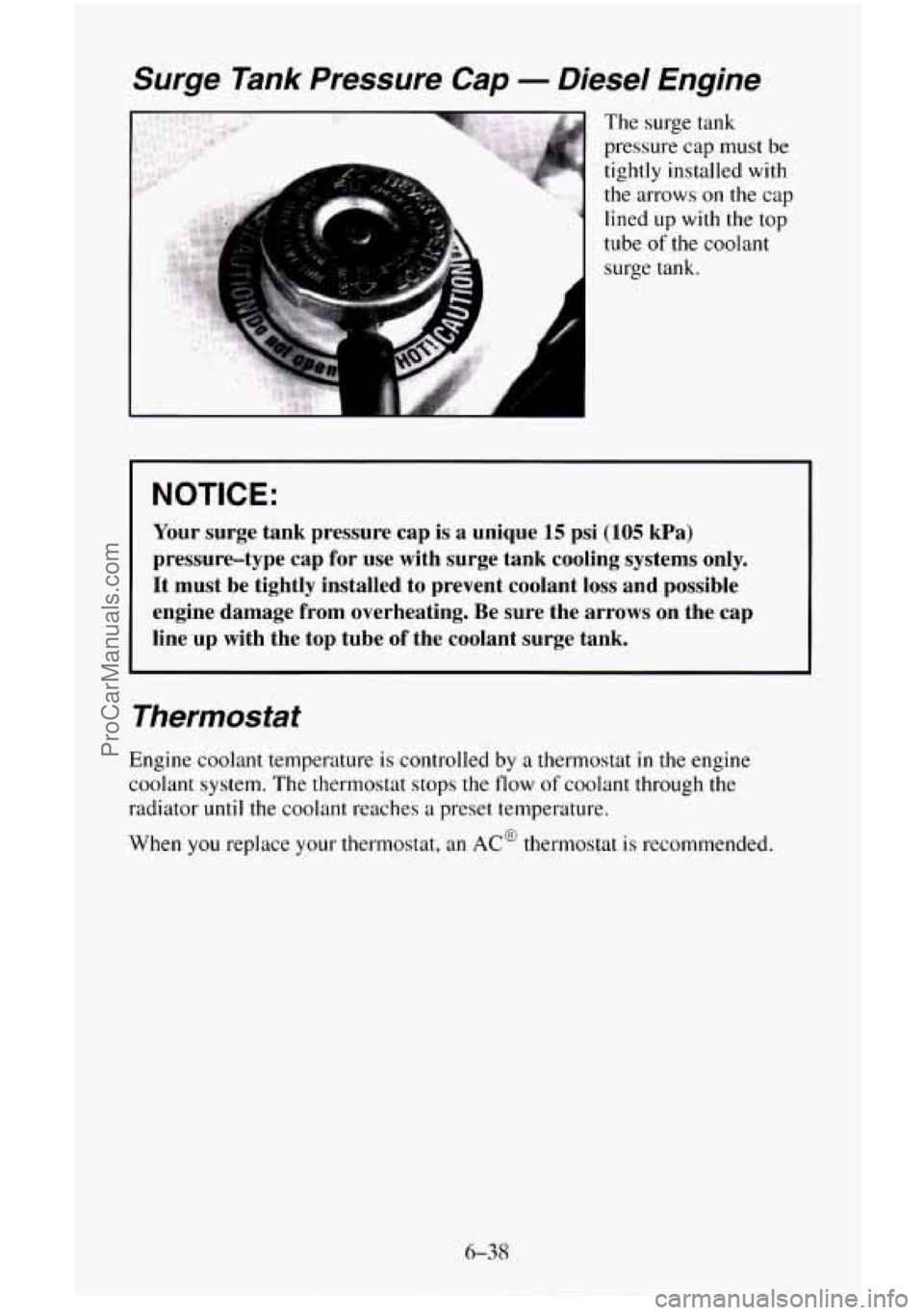
The surge tank
pressure cap must
be
tightly installed with
the arrows on the cap
lined up with the top
tube
of the coolant
surge tank.
NOTICE:
Your surge tank pressure cap is a unique 15 psi (105 kPa)
pressure-type cap for use with surge tank cooling systems only.
It must be tightly installed to prevent coolant
loss and possible
engine damage from overheating. Be sure the arrows on the cap
line up with the top tube of the coolant surge tank.
Thermostat
Engine coolant temperature is controlled by a thermostat in the engine
coolant system. The thermostat stops the flow
of coolant through the
radiator
until the coolant reaches a preset temperature.
When you replace your thermostat, an
AC@ thermostat is recommended.
6-38
ProCarManuals.com
Page 317 of 486
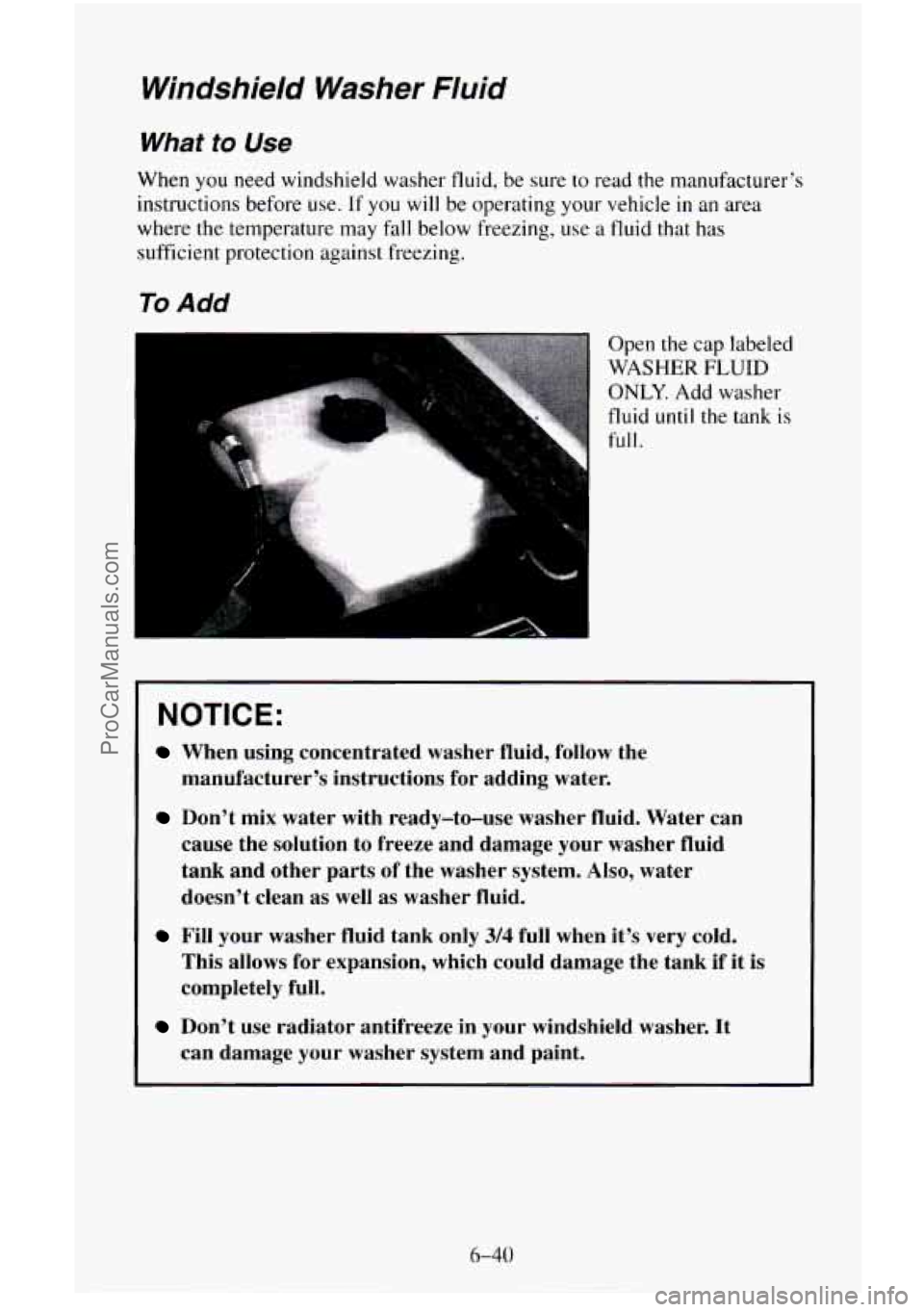
Windshield Washer Fluid
What to Use
When you need windshield washer fluid, be sure to read the manufacturer’s
instructions before use.
If you will be operating your vehicle in an area
where the temperature may fall below freezing, use
a fluid that has
sufficient protection against freezing.
To Add
Open the cap labeled
WASHER
FLUID
ONLY. Add washer
fluid
until the tank is
full.
NOTICE:
When using concentrated washer fluid, follow the
manufacturer’s instructions
for adding water.
Don’t mix water with ready-to-use washer fluid. Water can
cause the solution to freeze and damage your washer fluid
tank and other parts of the washer system.
Also, water
doesn’t clean as well as washer fluid.
Fill your washer fluid tank only 3/4 full when it’s very cold.
This allows for expansion, which could damage the tank if it is
completely full.
Don’t use radiator antifreeze in your windshield washer. It
can damage
your washer system and paint.
6-40
ProCarManuals.com
Page 324 of 486
Halogen Bulbs
I A CAUTION:
Halogen bulbs have pressurized gas inside and can burst if you
drop
or scratch the bulb. You or others could be injured. Take
special care when handling
and disposing of halogen bulbs.
NOTICE:
Avoid touching the bulb or letting it come in contact with
anything damp.
Oil from your skin or moisture on the bulb can
cause the bulb to explode when it
is turned on. If either comes in
contact with the bulb, clean it with alcohol or a suitable
degreaser and wipe
the bulb dry.
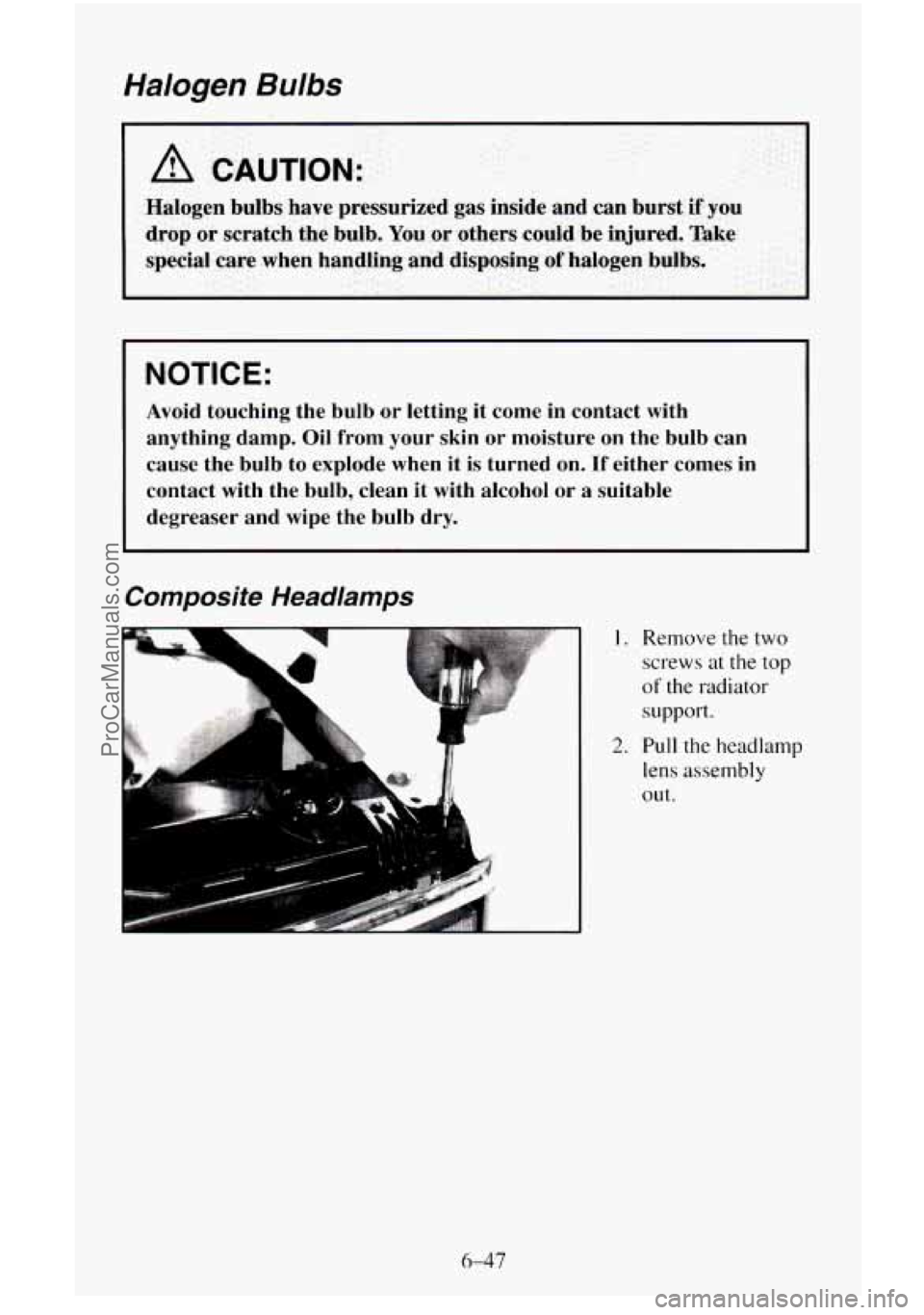
Composite Headlamps
I. Remove the two
screws at the top
of the radiator
support.
2. Pull the headlamp
lens assembly
out.
ProCarManuals.com
Page 355 of 486
Crankcase Capacity
ENGINE
5.7L
6.5L
6.5L
7.4L
VIN
K
S
F
N
QUANTITY WITH
FILTER?
5 Quarts (4.8 Liters)
7 Quarts (6.5 Liters)
7 Quarts (6.5 Liters)
7 Quarts (6.5 Liters)
After refill, the level
MUST be checked as outlined under “Engine Oil And
Filter Recommendations”
in Section 5.
All quantities are approximate.
?Oil filter should be changed at EVERY oil change.
Fuel Tank Capacity
TYPE
Gasoline/Diesel
Utility Models - Standard
Suburban
- Standard
QUANTITY
30 Gallons ( I 1 3 Liters)
42 Gallons
( I59 Liters)
All quantities are for a completely dry tank and are approximate.
Service Replacement Part and Filter
Recommendations
- Gasoline Engines
Engine
VIN
Oil Filter
Air Cleaner Filter
PCV Valve
Spark Plugs”
Fuel Filter
Radiator Cap
5.7L
K
PF1218T A348C
cv774c
CR43TS
GF48 1
RC36
?Four Wheel Drive Vehicle
- use a PF52 oil filter
*Use AC copper-cored resistor type spark plugs
7.4L
N
PF1218
A348C
cv774c
.CR43TS GF48
1
RC36
ProCarManuals.com
Page 382 of 486
Maintenance Schedule I - Gasoline Engines With
Light Duty Emissions
30,000 Miles (50 000 km)
0
0
0
0
0
0
0
0
Change engine oil and filter (or every 3 months, whichever occurs
first).
An Emission Control Service.
Lubricate the front suspension, king pin bushings, steering linkage,
transmission shift linkage, transfer case shift linkage, parking brake
cable guides, rear driveline center splines, front axle propshaft splines,
brake pedal springs and clutch pedal springs. Ball joints and king pin
bushings should
not be lubricated unless their temperature is 10” F
(-12” C), or higher. When weather is cold, let the ball joints and king
pin bushings warm
up before lubrication or they could be damaged.
Perform each of the listed lubrication service items at this mileage
interval (or every
6 months, whichever occurs first).
Check redfront axle fluid level and add
fluid as needed. Check
constant velocity joints and axle seals for leaking.‘$*
Drain, flush and refill cooling system (or every
24 months, whichever
occurs first). See “Engine Coolant’’
in the Index for what to use.
Inspect hoses. Clean radiator, condenser, pressure cap and neck.
Pressure test the cooling system and pressure cap.
An Emission Control
Service.
For 2-Wheel Drive vehicles only: Clean and repack the front wheel
bearings (or
at each brake relining, whichever occurs first).
Replace spark plugs.
An Emission Control Service.
Replace air cleaner filter. Replace filter more often under dusty
conditions.
An Em.ission Control Service.
Rotate tires. See “Tire Inspection and Rotation” in the Index for proper
rotation pattern and additional information.
DATE SERVICED BY: ACTUAL MILEAGE
L
7-1 9
ProCarManuals.com
Page 389 of 486
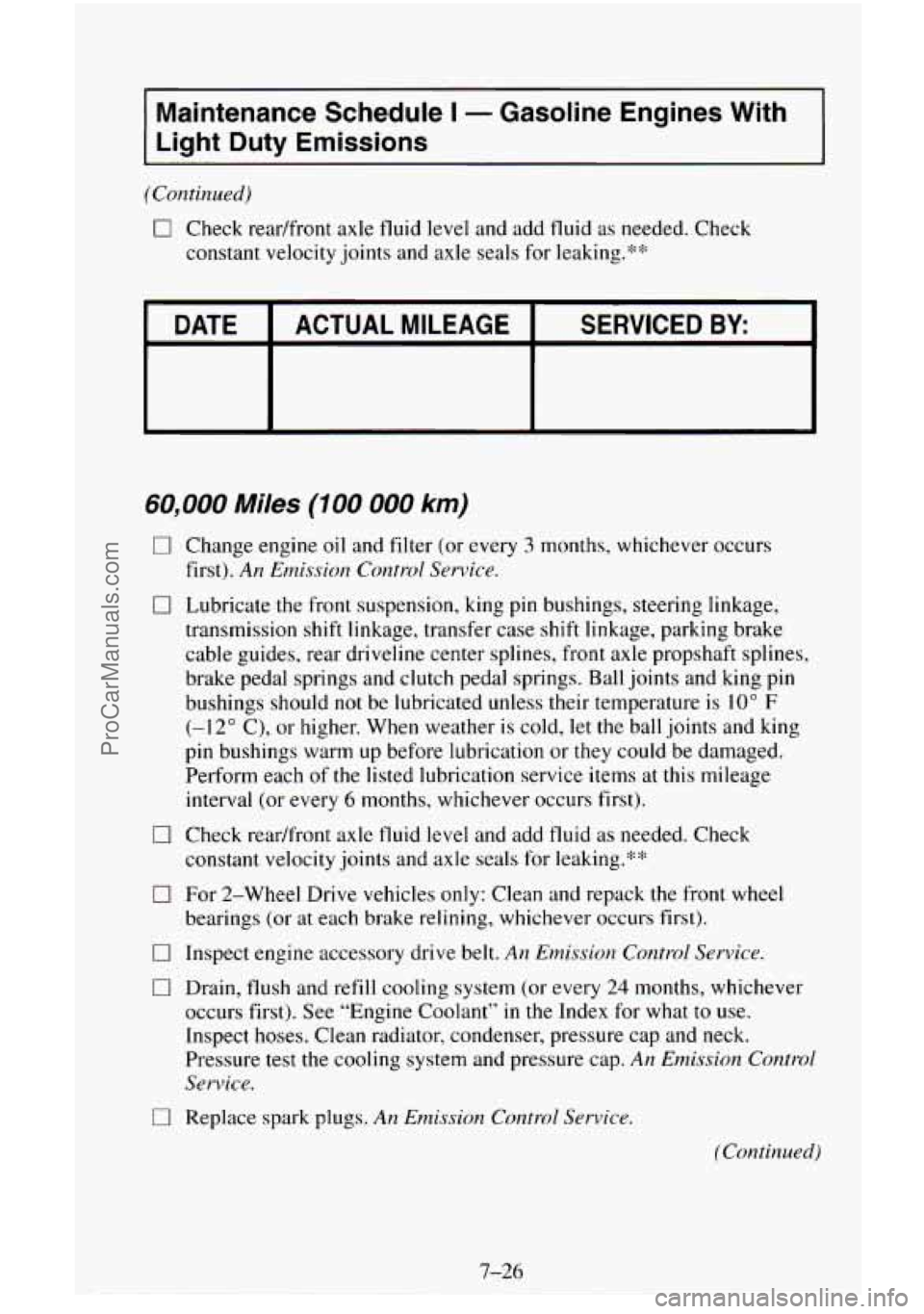
Maintenance Schedule I - Gasoline Engines With
Light Duty Emissions
(Continued)
0 Check readfront axle fluid level and add fluid as needed. Check
constant velocity joints and axle seals for leaking.*:$
I DATE I ACTUALMILEAGE I SERVICED BY: I
60,000 Miles (100 000 km)
0 Change engine oil and filter (or every 3 months, whichever occurs
first).
An Emission Control Service.
0 Lubricate the front suspension, king pin bushings, steering linkage,
transmission
shift linkage, transfer case shift linkage, parking brake
cable guides, rear driveline center splines, front axle propshaft splines,
brake pedal springs and clutch pedal springs. Ball joints and king pin
bushings should
not be lubricated unless their temperature is 10” F
(-12” C), or higher. When weather is cold, let the ball joints and king
pin bushings warm up before lubrication or they could be damaged.
Perform each of the listed lubrication service items at this mileage
interval (or every
6 months, whichever occurs first).
17 Check readfront axle fluid level and add fluid as needed. Check
constant velocity joints and axle seals for leaking.**
0 For 2-Wheel Drive vehicles only: Clean and repack the front wheel
bearings (or at each brake relining, whichever occurs first).
0 Inspect engine accessory drive belt. An Emission Control Service.
0 Drain, flush and refill cooling system (or every 24 months, whichever
occurs first). See “Engine Coolant”
in the Index for what to use.
Inspect hoses. Clean radiator, condenser, pressure cap and neck.
Pressure test the cooling system and pressure cap.
An Emission Control
Service.
0 Replace spark plugs. An Emission Control Service.
(Continued)
7-26
ProCarManuals.com
Page 393 of 486
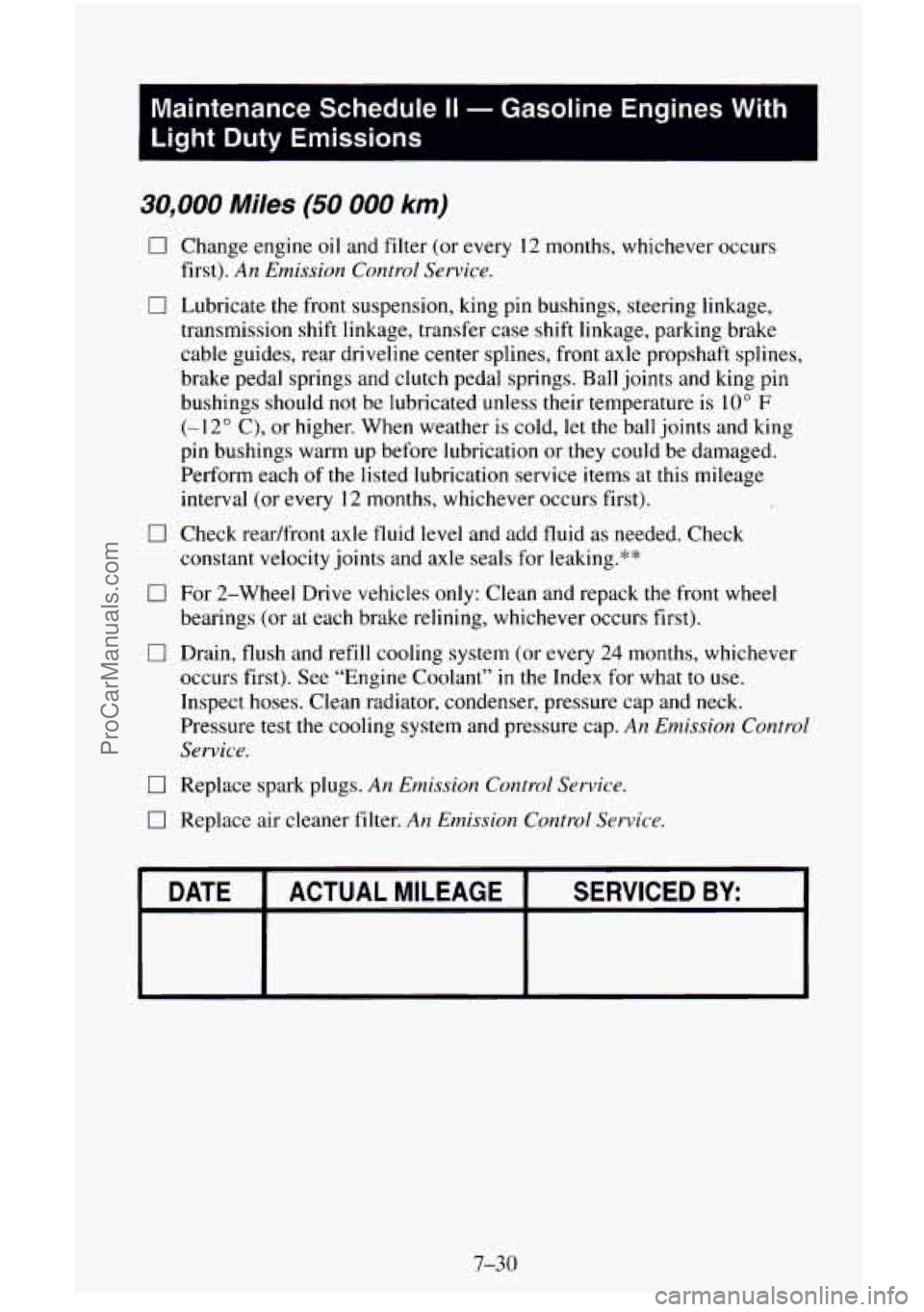
I
Maintenance Schedule II - Gasoline Engines With
Light Duty Emissions
30,000 Miles (50 000 km)
0
0
0
0
0
0
0
Change engine oil and filter (or every 12 months, whichever occurs
first).
An Emission Control Service.
Lubricate the front suspension, king pin bushings, steering linkage,
transmission shift linkage, transfer case shift linkage, parking brake
cable guides, rear driveline center splines, front axle propshaft splines,
brake pedal springs and clutch pedal springs. Ball joints and king pin
bushings should
not be lubricated unless their temperature is 10" F
(-12" C), or higher. When weather is cold, let the ball joints and king
pin bushings warm up before lubrication
or they could be damaged.
Perform each
of the listed lubrication service items at this mileage
interval (or every
12 months, whichever occurs first).
Check readfront axle
fluid level and add fluid as needed. Check
constant velocity joints and axle seals for leaking.**
For 2-Wheel Drive vehicles only: Clean and repack the
front wheel
bearings (or at each brake relining, whichever occurs first).
Drain,
flush and refill cooling system (or every 24 months, whichever
occurs first). See "Engine Coolant" in the Index for what
to use.
Inspect hoses. Clean radiator, condenser, pressure cap and neck.
Pressure test the cooling system and pressure cap.
An Emission Control
Service.
Replace spark plugs. An Emission Control Service.
Replace air cleaner filter. An Emission Control Service.
I DATE I ACTUALMILEAGE I SERVICED BY:
ProCarManuals.com