ECU CHEVROLET SUBURBAN 1997 Owner's Manual
[x] Cancel search | Manufacturer: CHEVROLET, Model Year: 1997, Model line: SUBURBAN, Model: CHEVROLET SUBURBAN 1997Pages: 433, PDF Size: 21.49 MB
Page 171 of 433
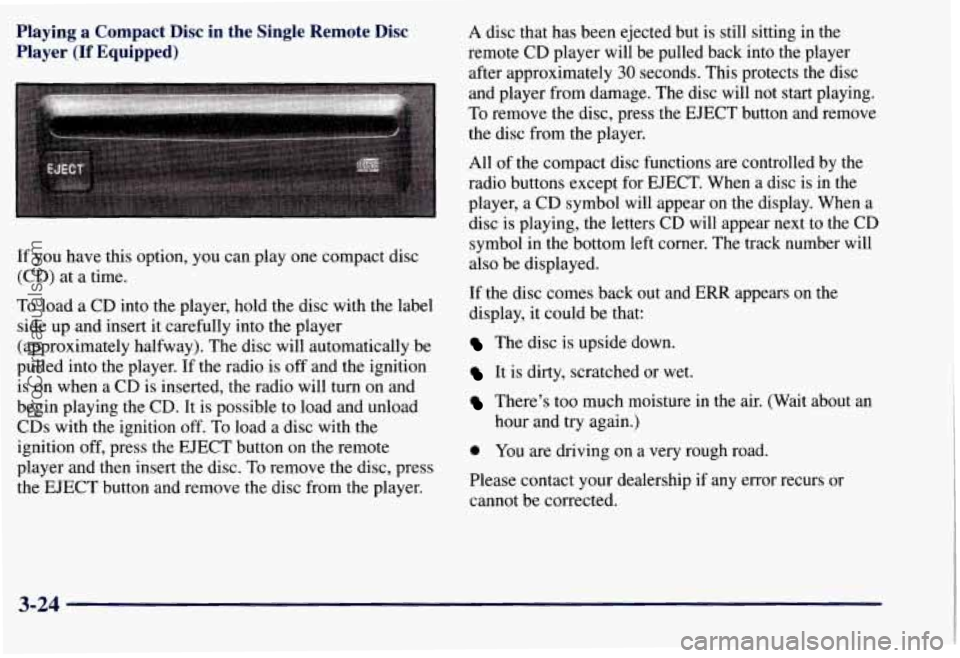
Playing a Compact Disc in the Single Remote Disc
Player
(If Equipped)
If you have this option, you can play one compact disc
(CD) at a time.
To load
a CD into the player, hold the disc with the label
side up and insert it carefully into the player
(approximately halfway). The disc will automatically be
pulled into the player. If the radio is off and the ignition
is on when a CD is inserted, the radio will turn on and
begin playing the CD. It is possible to load and unload
CDs with the ignition off.
To load a disc with the
ignition off, press the EJECT button on the remote
player and then insert the disc. To remove the disc, press
the EJECT button and remove the disc from the player. A
disc that has been ejected but is still sitting in the
remote CD player will be pulled back into the player
after approximately
30 seconds. This protects the disc
and player from damage. The disc will not start playing.
To remove the disc, press the EJECT button and remove
the disc from the player.
All of the compact disc functions are controlled by the
radio buttons except for EJECT. When a disc is in the
player, a CD symbol will appear on the display. When a
disc is playing, the letters
CD will appear next to the CD
symbol in the bottom left corner. The track number will
also be displayed.
If the disc comes back out and
ERR appears on the
display,
it could be that:
The disc is upside down.
It is dirty, scratched or wet.
There’s too much moisture in the air. (Wait about an
hour and try again.)
0 You are driving on a very rough road.
Please contact your dealership
if any error recurs or
cannot be corrected.
3-24
ProCarManuals.com
Page 173 of 433
Theft-Deterrent Feature
THEFTLOCK" is designed to discourage theft of your
radio. It works by using a secret code to disable all radio
functions whenever battery power is removed.
The THEFTLOCK feature for the radio may be used or
ignored. If ignored, the system plays normally and the
radio is not protected
by the feature. If THEFTLOCK is
activated, your radio will not operate if stolen.
When THEFTLOCK is activated, the radio will display
LOC to indicate a locked condition anytime battery
power is removed. If your battery loses power for any
reason, you must unlock the radio with the secret code
before it will operate.
Activating the Theft-Deterrent Feature
The instructions which follow, explain how to enter your
secret code to activate the THEFTLOCK system. It is
recommended that you read through all nine steps
before starting the procedure.
NOTE: If you allow more than
15 seconds to elapse
between any steps, the radio automatically reverts to
time and you must
start the procedure over at Step 4.
1. Write down any three or four-digit number from
000 to 1999 and keep it in a safe place separate from
the vehicle.
2. Turn the ignition to ACCESSORY or RUN.
3. Turn the radio off.
4. Press the 1 and 4 buttons together. Hold them down
until
--- shows on the display. Next you will use the
secret code number which you have written down.
5. Press MN and 000 will appear on the display.
6. Press MN again to make the last two digits agree
with your code.
7. Press HR to make the first one or two digits agree
8. Press AM-FM after you have confirmed that the
with
your code.
code matches the secret code you have written down.
The display will show REP to let you know that you
need to repeat Steps
5 through 7 to confirm your
secret code.
9. Press AM-FM and this time the display will show
SEC to let you know
that your radio is secure. The
indicator by the volume control will begin flashing
when the ignition is turned off.
ProCarManuals.com
Page 174 of 433
Unlocking the Theft-Deterrent Feature After a
Power
Loss
Enter your secret code as follows; pause no more than
15 seconds between steps:
1.
LOC appears when the ignition is on.
2. Press MN and 000 will appear on the display.
3. Press MN again to make the last two digits agree
with your code.
4. Press HR to make the first one or two digits agree
with your code.
code matches the secret code you have written down.
The display will show SEC, indicating the radio is
now operable and secure.
5. Press AM-FM after you have confirmed that the
If you enter the wrong code eight times, INOP will
appear on the display.
You will have to wait an hour
with the ignition on before you can try again. When you
try again, you will only have three chances to enter the
correct code before
INOP appears.
If you lose or forget your code, contact your dealer.
Disabling the Theft-Deterrent Feature
Enter your secret code as follows; pause no more than
15 seconds between steps:
1. Turn the ignition to ACCESSORY or RUN.
2. Turn the radio off.
3. Press the 1 and 4 buttons together. Hold them down
until SEC shows on the display.
4. Press MN and 000 will appear on the display.
5. Press MN again to make the last two digits agree
with your code.
6. Press HR to make the first one or two digits agree
with your code.
7. Press AM-FM after you have confirmed that the
code matches the secret code you have written down.
The display will show
---, indicating that the radio is
no longer secured.
If the code entered is incorrect, SEC will appear
on the
display. The radio will remain secured until the correct
code is entered.
When battery power is removed and later applied to a
secured radio, the radio won’t turn on and LOC will
appear on the display.
To unlock a secured radio, see “Unlocking the
Theft-Deterrent Feature After a Power
Loss” earlier in
this section.
3-27
ProCarManuals.com
Page 194 of 433
Before You Go Off-Roading
There are some things to do before you go out. For
example, be sure to have all necessary maintenance and
service work done. Check to make sure all underbody
shields
(if so equipped) are properly attached. Be sure
you read all the information about your
four-wheel-drive vehicle in this manual.
Is there enough
fuel? Is the spare tire fully inflated? Are the fluid levels
up where they should be? What are the local laws that
apply
to off-roading where you’ll be driving? If you
don’t know, you should check with law enforcement
people in the area. Will you be on someone’s private
land? If
so, be sure to get the necessary permission.
Loading Your Vehicle for Off-Road Driving
There are some important things to remember about
how to load your vehicle.
The heaviest things should be on the load floor and
forward of your rear axle. Put heavier items as far
forward as you can.
0 Be sure the load is secured properly, so driving on
the off-road terrain doesn’t toss things around.
0
0
0
Cargo on the load floor piled higher than
the seatbacks can be thrown forward
during a sudden stop. You or your
passengers could be injured. Keep cargo
below the top of the seatbacks.
Unsecured cargo on the load floor can be
tossed about when driving over rough terrain.
You or your passengers
can be struck by flying
objects. Secure the cargo properly.
Heavy loads on the roof raise the vehicle’s
center of gravity, making it more likely to
roll over. You can be seriously or fatally
injured
if the vehicle rolls over. Put heavy
loads inside the cargo area, not on the roof.
Keep cargo in the cargo area as far forward
and low as possible.
You’ll find other important information in this manual.
See “Vehicle Loading,” “Luggage Carrier” and “Tires”
in the Index.
4-15
ProCarManuals.com
Page 217 of 433
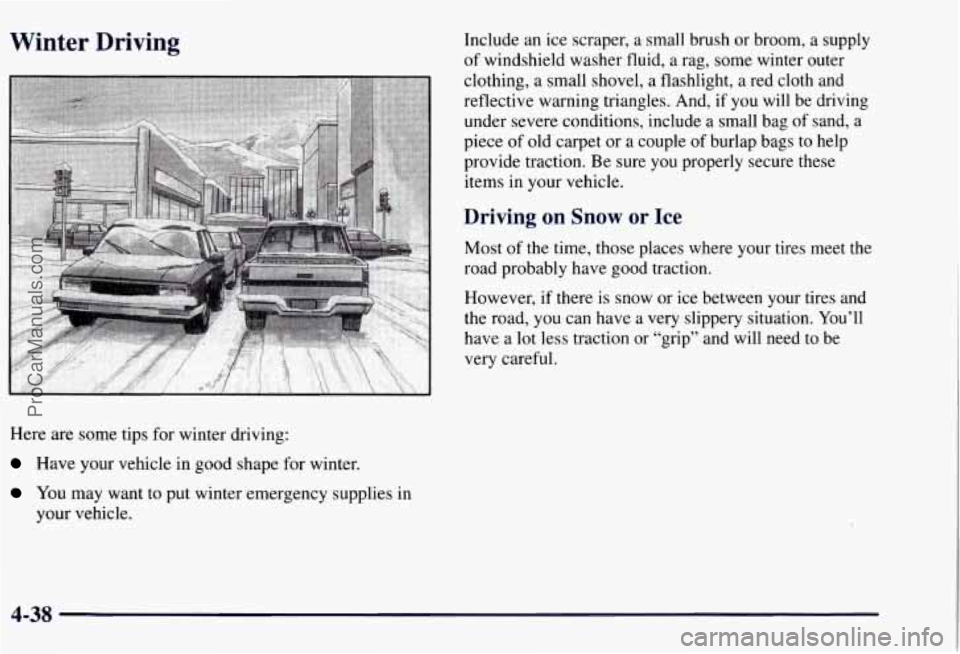
Winter Driving Include an ice scraper, a small brush or broom, a supply
of windshield washer fluid, a rag, some winter outer
clothing, a small shovel,
a flashlight, a red cloth and
reflective warning triangles. And, if you will be driving
under severe conditions, include a small bag of sand, a
piece of old carpet or a couple of burlap bags to help
provide traction. Be sure you properly secure these
items in your vehicle.
Driving on Snow or Ice
Most of the time, those places where your tires meet the
road probably have good traction.
However,
if there is snow or ice between your tires and
the road, you can have a very slippery situation. You’ll
have a lot less traction or “grip” and will need to be
very careful.
Here are some tips
for winter driving:
Have your vehicle in good shape for winter.
You may want to put winter emergency supplies in
your vehicle.
4-38
ProCarManuals.com
Page 222 of 433
A CAUTION:
-
Do not load your vehicle any heavier than the
GVWR, or either the maximum front
or rear
3AWR.
If’ you do, parts on your vehicle can break,
or it can change the way your vehicle handles.
These could cause you to lose control. Also,
overloading can shorten the life of your vehicle.
Using heavier suspension components to get added
durability might not change your weight ratings. Ask
your dealer to help you load your vehicle the right way.
I
NOTICE:
Your warranty does not cover parts or
components that fail because of overloading.
If you put things inside your vehicle -- like suitcases,
tools, packages, or anything else
-- they go as fast as the
vehicle goes. If you have to stop or turn quickly, or
if
there is a crash, they’ll keep going.
IT CAUTION: -
Things you put inside your vehi,,,! can strike and
injure people in
a sudden stop or turn, or in
a crash.
0 Put things in the cargo area of your vehicle.
Never stack heavier things, like suitcases,
Try to spread the weight evenly.
inside the vehicle
so that some of them are
above the tops of the seats.
0 Don’t leave an unsecured child restraint in
your vehicle.
0 When you carry something inside the
vehicle, secure it whenever you can.
0 Don’t leave a seat folded down unless you
need to.
There’s also important loading information for off-road
driving in this manual. See “Loading
Your Vehicle for
Off-Road Driving” in the Index.
4-43
ProCarManuals.com
Page 230 of 433
Towing a trailer requires a certain amount of experience.
Before setting out for the open road, you’ll want to get
to know your rig. Acquaint yourself with the feel of
handling and braking with the added weight of the
trailer. And always keep
in mind that the vehicle you are
driving is now a good deal longer and not nearly as
responsive as your vehicle is by itself.
Before you start, check the trailer hitch and platform
(and attachments), safety chains, electrical connector,
lamps, tires and mirror adjustment. If the trailer has
electric brakes, start your vehicle and trailer moving and
then apply the trailer brake controller by hand to be sure
the brakes are working. This lets
you check your
electrical connection at the same time.
During your trip, check occasionally to be sure that the
load
is secure, and that the lamps and any trailer brakes
are still working.
Following Distance
Stay at least twice as far behind the vehicle ahead as you
would when driving your vehicle without a trailer. This
can help you avoid situations that require heavy bralung
and sudden turns.
Passing
You’ll need more passing distance up ahead when
you’re towing a trailer. And, because you’re a good deal
longer,
you’ll need to go much farther beyond the
passed vehicle before
you can return to your lane.
Backing Up
Hold the bottom of the steering wheel with one hand.
Then, to move the trailer to the left, just move that hand
to the left.
To move the trailer to the right, move your
hand to the right. Always back up slowly and, if
possible, have someone guide you.
4-51
ProCarManuals.com
Page 233 of 433
When You Are Ready to Leave After
Parking
on a Hill
1. Apply your regular brakes and hold the pedal down
while you:
Start your engine;
0 Shift into a gear; and
0 Release the parking brake.
2. Let up on the brake pedal.
3. Drive slowly until the trailer is clear of the chocks.
4. Stop and have someone pick up and store the chocks.
Maintenance When Trailer Towing
Your vehicle will need service more often when you’re
pulling a trailer. See the Maintenance Schedule for more
on this. Things that are especially important in trailer
operation are automatic transmission fluid (don’t
overfill), engine oil, axle lubricant, belt, cooling system
and brake adjustment. Each
of these is covered in this
manual, and the Index will help you find them quickly.
If you’re trailering, it’s a good idea to review these
sections before you start your trip.
Check periodically to see that all hitch nuts and bolts
are tight.
Trailer Wiring Harness
A seven-wire harness is stored under the rear of your
vehicle, between the frame rails. An electrical connector
will need to be added at the trailer end
of the harness, by
a qualified electrical technician. For additional trailer
wiring and towing information, please consult your
dealer. Securely attach the harness to the trailer, then
tape or strap it to your vehicle’s frame rail. Be sure you
leave it loose enough
so the wiring won’t bind or break
when turning with the trailer, but not
so loose that it
drags on the ground. Store the harness in its original
position. Wrap the harness together and tie it neatly
so it
won’t be damaged. If you tow a trailer, your Center
High-Mounted Stoplamp (CHMSL) may not be
properly visible from behind. You should select a trailer
with a CHMSL
on it or, if one is not available, have one
installed. See your GM dealer about how to connect
your vehicle’s wiring to
a trailer CHMSL.
4-54
ProCarManuals.com
Page 245 of 433
Towing Your Vehicle
Try to have your GM dealer or a professional towing
service tow your vehicle. See “Roadside Assistance” in
the Index. They can provide the right equipment and
know-how to tow it without damage.
If
your vehicle has been changed since it was
factory-new, by adding such things as
fog lamps, aero
skirting,
or special tires and wheels, these things could
be damaged during towing.
Before you
do anythmg, turn on the hazard warning flashers.
When you call, tell the towing service:
That your vehicle has rear-wheel drive, or that it has
The make, model and year of your vehicle.
Whether you can move the shift lever for the
If there was an accident, what was damaged.
the
four-wheel-drive option.
transmission and transfer case,
if you have one. When
the towing service arrives, let the tow operator
know that this manual contains these towing
instructions. The operator may want to see them.
To help avoid injury to you or others:
0 Never let passengers ride in a vehicle that is
0 Never tow faster than safe or posted speeds.
being
towed.
~ 0 Never tow with damaged parts not
’ 0 Never get under your vehicle after it has
~ been lifted by the tow truck.
fully
secured.
0 Always use separate safety chains on each
side when towing a vehicle.
ProCarManuals.com
Page 246 of 433
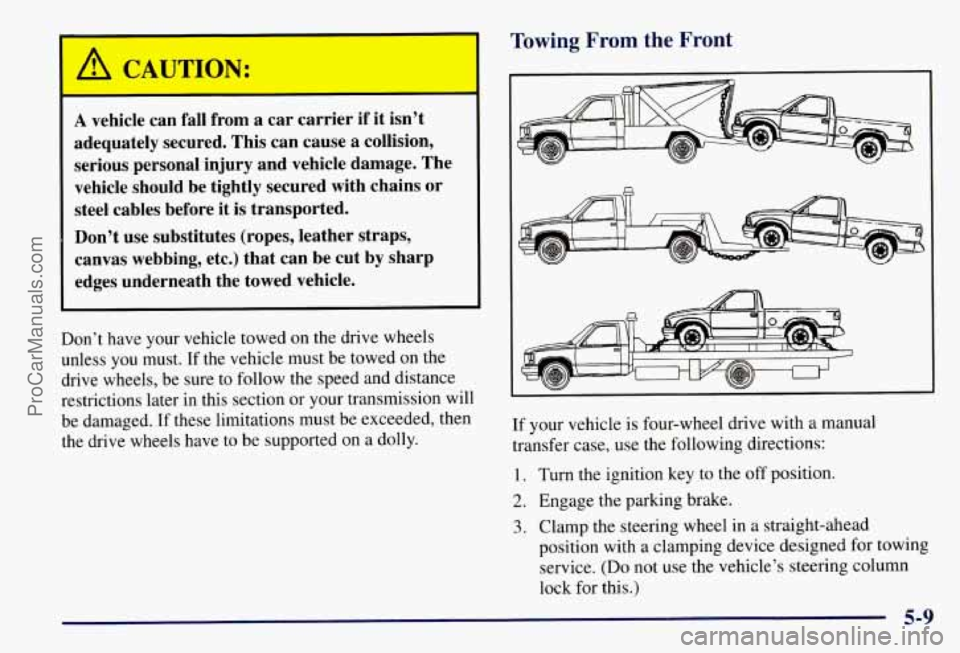
Towing From the Front
A vehicle can fall from a car carrier if it isn’t
adequately secured. This can cause a collision,
serious personal injury and vehicle damage. The
vehicle should be tightly secured with chains or
steel cables before it is transported.
Don’t use substitutes (ropes, leather straps,
canvas webbing, etc.) that can be cut by sharp
edges underneath the towed vehicle.
Don’t have your vehicle towed on the drive wheels
unless you must. If the vehicle must be towed
on the
drive wheels, be sure to follow the speed and distance
restrictions later in this section or your transmission will
be damaged.
If these limitations must be exceeded, then
the drive wheels have to be supported on a dolly. If
your vehicle is four-wheel drive with a manual
transfer case, use the following directions:
1. Turn the ignition key to the off position.
2. Engage the parking brake.
3. Clamp the steering wheel in a straight-ahead
position with a clamping device designed for towing
service. (Do not use the vehicle’s steering column
lock for this.)
5-9
ProCarManuals.com