belt CHEVROLET SUBURBAN 1997 Repair Manual
[x] Cancel search | Manufacturer: CHEVROLET, Model Year: 1997, Model line: SUBURBAN, Model: CHEVROLET SUBURBAN 1997Pages: 433, PDF Size: 21.49 MB
Page 288 of 433
Hood Release
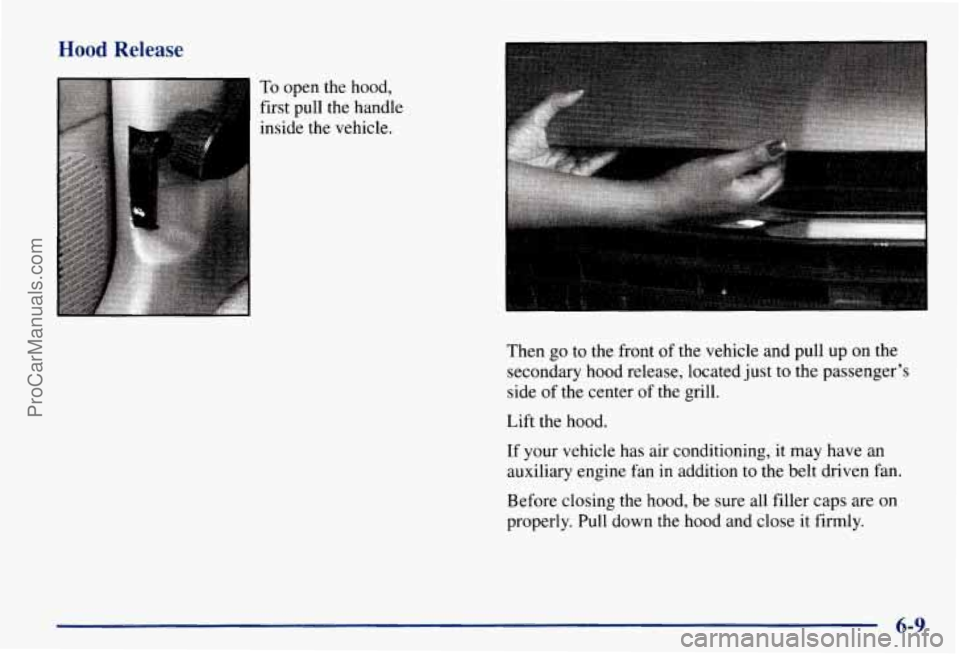
To open the hood,
first pull the handle
inside the vehicle.
I
Then go to the front of the vehicle and pull up on the
secondary
hood release, located just to the passenger’s
side
of the center of the grill.
Lift the hood.
If your vehicle has air conditioning, it may have an
auxiliary engine fan in addition to the belt driven fan.
Before closing the hood, be sure all filler caps are on
properly. Pull down the hood and close it firmly.
6-9
ProCarManuals.com
Page 327 of 433
When It’s Time for New Tires
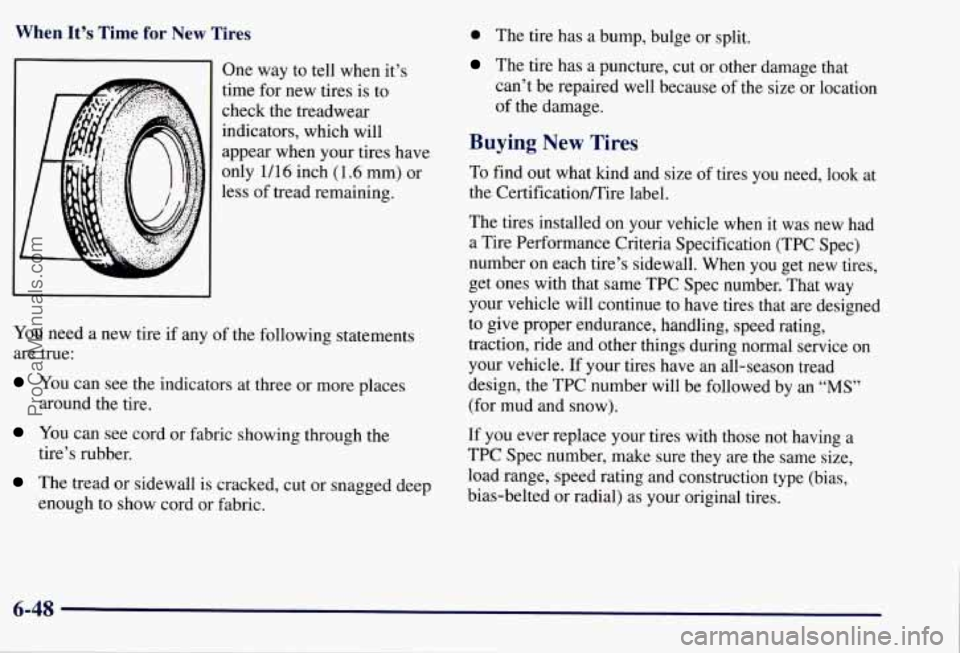
One way to tell when it’s
time for new tires is to
check the treadwear
indicators, which will
appear when your tires have
only 1/16 inch (1.6 mm) or
less of tread remaining.
YOU need a new tire if any of the following statements
are true:
You can see the indicators at three or more places
You can see cord or fabric showing through the
around
the tire.
tire’s rubber.
The tread or sidewall is cracked, cut or snagged deep
enough to show cord or fabric.
0 The tire has a bump, bulge or split.
The tire has a puncture, cut or other damage that
can’t be repaired well because of the size or location
of the damage.
Buying New Tires
To find out what kind and size of tires you need, look at
the Certificatioflire label.
The tires installed on your vehicle when it was new had
a Tire Performance Criteria Specification (TPC Spec)
number on each tire’s sidewall. When
you get new tires,
get ones with that same TPC Spec number. That way
your vehicle will continue to have tires that are designed
to give proper endurance, handling, speed rating,
traction, ride and other things during normal service on
your vehicle. If your tires have an all-season tread
design, the TPC number will be followed by an
“MS”
(for mud and snow).
If you ever replace your tires with those not having a
TPC Spec number, make sure they are the same size,
load range, speed rating and construction type (bias,
bias-belted or radial) as your original tires.
ProCarManuals.com
Page 328 of 433
Mixing tires could cause you to lose control while
driving.
If you mix tires of different sizes or types
(radial and bias-belted tires), the vehicle may not
handle properly, and you could have a crash.
Using tires
of different sizes may also cause
damage to your vehicle. Be sure to
use the same
size and type tires on all wheels.
Uniform Tire Quality Grading
The following information relates to the system developed
by the United States National Highway Traffic Safety Administration, which grades tires by treadwear, traction
and temperature performance.
(This applies only to
vehicles sold in the United States.) The grades are molded
on the sidewalls of most passenger car tires. The Uniform
Tire Quality Grading system does not apply to deep tread,
winter-type snow tires, space-saver or temporary use spare
tires, tires with nominal rim diameters of 10 to 12 inches
(25 to
30 cm), or to some limited-production tires.
While the tires available on General Motors passenger
cars and light trucks may vary with respect to these grades,
they must also conform to Federal safety
requirements and additional General Motors Tire
Performance Criteria (TPC) standards.
Treadwear
The treadwear grade is a comparative rating based on
the wear rate of the tire when tested under controlled
conditions on a specified government test course. For
example,
a tire graded 150 would wear one and a half
(1 1/2) times as well on the government course as a tire
graded
100. The relative performance of tires depends
upon the actual conditions
of their use, however, and
may depart significantly from the norm due to variations
in driving habits, service practices and differences in
road characteristics and climate.
Traction -- A, B, C
The traction grades, from highest to lowest, are A, B, and
C, and they represent the tire’s ability to stop on wet
pavement as measured under controlled conditions on
specified government test surfaces of asphalt and concrete.
A tire marked C may have poor traction performance.
Warning: The traction grade assigned to this tire
is based
on braking (straightahead) traction tests and does not
include cornering (turning) traction.
6-49
ProCarManuals.com
Page 335 of 433
Cleaning the Top of the Instrument Panel
Use only mild soap and water to clean the top surfaces
of the instrument panel. Sprays containing silicones or
waxes may cause annoying reflections in
the windshield
and even make it difficult
to see through the windshield
under certain conditions.
Care of Safety Belts
Keep belts clean and dry.
Do not bleach or dye safety belts. If you do, it
may severely weaken them. In a crash, they
might not be able to provide adequate protection.
Clean safety belts only with mild
soap and
lukewarm water.
Don’t use abrasive cleaners on glass, because they may
cause scratches. Avoid placing decals on the inside rear
window, since they may have to be scraped off later.
If
abrasive cleaners are used on the inside of the rear
window, an electric defogger element may be damaged.
Any temporary license should not be attached across the
defogger grid.
Cleaning the Outside of the Windshield,
Backglass and Wiper Blades
If the windshield is not clear after using the windshield
washer, or
if the wiper blade chatters when running, wax,
sap or other material may be on the blade or windshield.
Clean the outside of the windshield with
GM
Windshield Cleaner, Bon Ami@ Powder (non-scratching
glass cleaning powder),
GM Part No. 105001 1 or
equivalent. The windshield is clean
if beads do not form
when you rinse it with water.
Grime from the windshield will stick to the wiper blades
and affect their performance. Clean the blade by wiping
vigorously with a cloth soaked in full-strength windshield
washer solvent. Then rinse the blade with water.
Check the wiper blades and clean them as necessary;
replace blades that look worn.
Glass should
be cleaned
often. GM Glass Cleaner (GM
Part No. 1050427) or a liquid household glass cleaner
will remove normal tobacco smoke and dust films on
interior glass.
6-56
ProCarManuals.com
Page 358 of 433
Maintenance Schedule
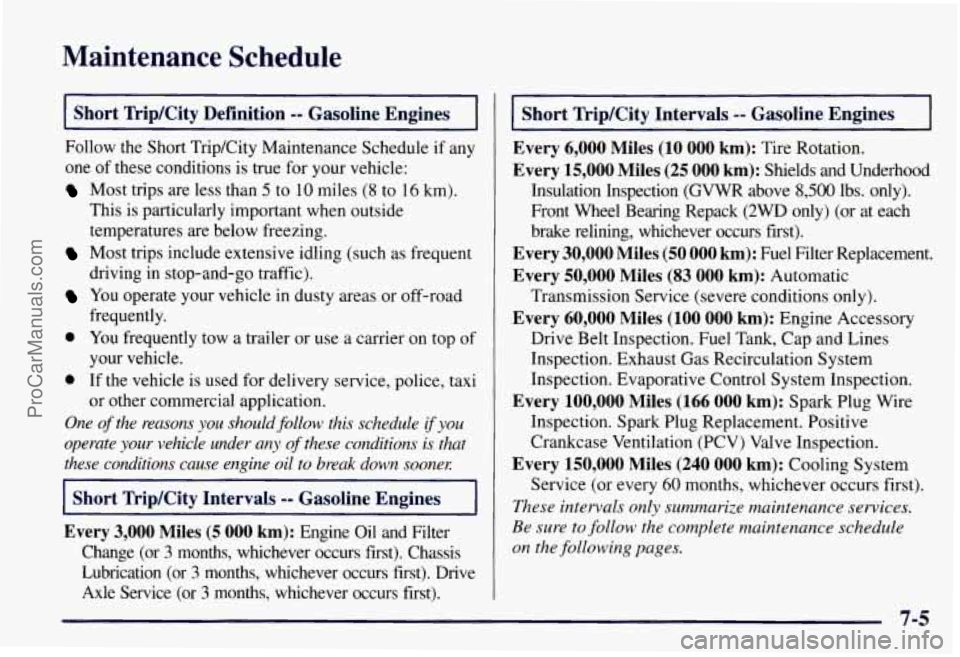
Short Trip/City Definition -- Gasoline Engines .
Follow the Short Trip/City Maintenance Schedule if any
one of these conditions is true for your vehicle:
Most trips are less than 5 to 10 miles (8 to 16 km).
This is particularly important when outside
temperatures are below freezing.
driving in stop-and-go traffic).
frequently. your vehicle.
or other commercial application.
Most trips include extensive idling (such as frequent
You operate your vehicle in dusty areas or off-road
0 You frequently tow a trailer or use a carrier on top of
0 If the vehicle is used for delivery service, police, taxi
One of the reasons you should *follow this schedule if you
operate your vehicle under any of these conditions is that
these conditions cause engine oil to break down soonez
Short Trip/City Intervals -- Gasoline Engines
Every
3,000 Miles (5 000 km): Engine Oil and Filter
Change (or
3 months, whichever occurs first). Chassis
Lubrication (or
3 months, whichever occurs first). Drive
Axle Service (or
3 months, whichever occurs first).
Short Trip/City Intervals -- Gasoline Engines
Every 6,000 Miles
(10 000 km): Tire Rotation.
Every 15,000 Miles (25 000 km): Shields and Underhood
Insulation Inspection
(GVWR above 8,500 lbs. only).
Front Wheel Bearing Repack
(2WD only) (or at each
brake relining, whichever occurs first).
Every 30,000 Miles (50 000 km): Fuel Filter Replacement.
Every 50,000 Miles (83 000 km): Automatic
Transmission Service (severe conditions only).
Every 60,000 Miles (100 000 km): Engine Accessory
Drive Belt Inspection. Fuel Tank, Cap and Lines
Inspection. Exhaust Gas Recirculation System
Inspection. Evaporative Control System Inspection.
Every 100,000 Miles (166 000 km): Spark Plug Wire
Inspection. Spark Plug Replacement. Positive
Crankcase Ventilation
(PCV) Valve Inspection.
Service (or every 60 months, whichever occurs first).
Every 150,000 Miles (240 000 km): Cooling System
These intervals only summarize maintenance services.
Be sure to follow the complete maintenance schedule
on the following pages.
7-5
ProCarManuals.com
Page 359 of 433
Maintenance Schedule
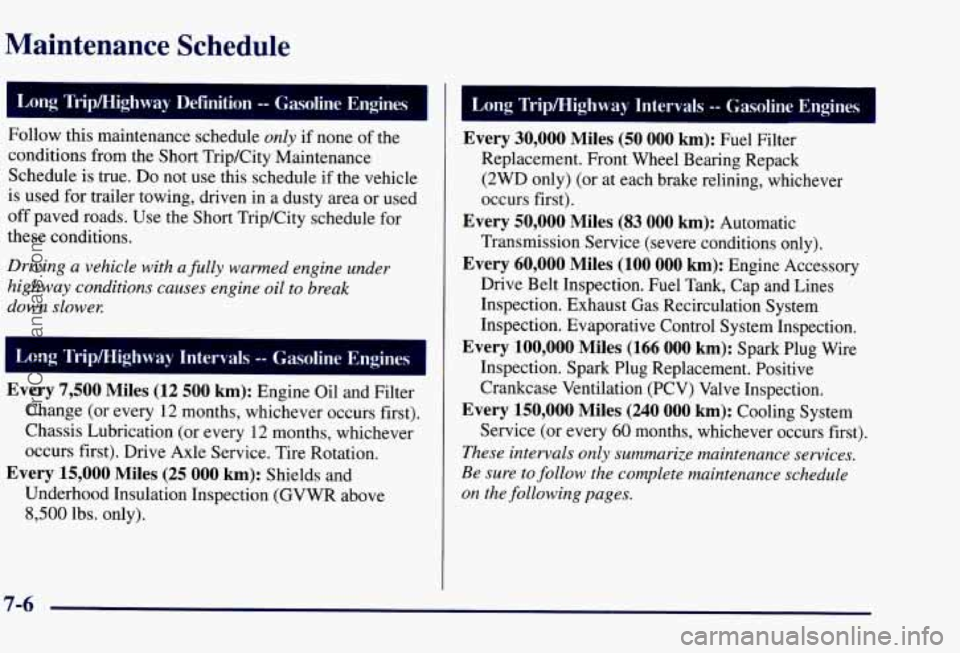
I Long Trip/Highway Definition -- Gacoline Engines
Follow this maintenance schedule only if none of the
conditions from the Short Trip/City Maintenance
Schedule is true. Do not use this schedule if the vehicle
is used for trailer towing, driven in a dusty area or used
off paved roads. Use the Short Trip/City schedule for
these conditions.
Driving a vehicle with a fully warmed engine under
highway conditions causes engine oil to break
down slowel:
1 Long TripMighway Intervals -- Gasoline Engines I
Every 7,500 Miles (12 500 km): Engine Oil and Filter
Change (or every
12 months, whichever occurs first).
Chassis Lubrication (or every 12 months, whichever
occurs first). Drive Axle Service. Tire Rotation.
Underhood Insulation Inspection (GVWR above
8,500 lbs. only).
Every 15,000 Miles (25 000 km): Shields and
Long TripMighway Intervals -- Gasoline Engines
Every
30,000 Miles (50 000 km): Fuel Filter
Replacement. Front Wheel Bearing Repack
(2WD only) (or at each brake relining, whichever
occurs first).
Every 50,000 Miles (83 000 km): Automatic
Transmission Service (severe conditions only).
Every 60,000 Miles (100 000 km): Engine Accessory
Drive Belt Inspection. Fuel Tank, Cap and Lines
Inspection. Exhaust Gas Recirculation System
Inspection. Evaporative Control System Inspection.
Every 100,000 Miles (166 000 km): Spark Plug Wire
Inspection. Spark Plug Replacement. Positive
Crankcase Ventilation (PCV) Valve Inspection.
Every 150,000 Miles (240 000 km): Cooling System
Service (or every
60 months, whichever occurs first).
These intervals only summarize maintenance services.
Be sure to
follow the complete maintenance schedule
on the following pages.
7-6
ProCarManuals.com
Page 373 of 433
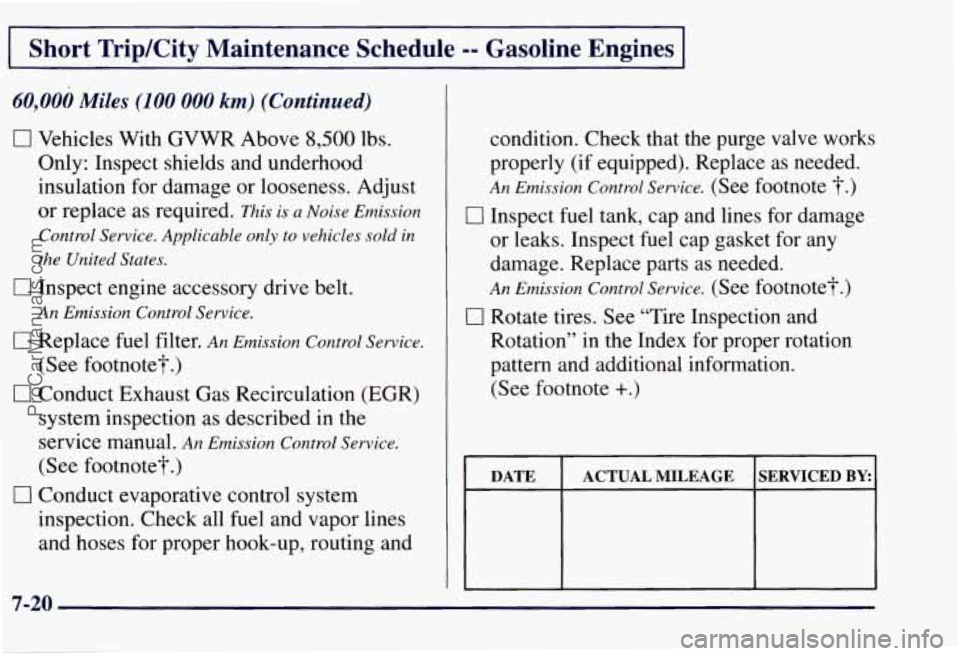
Short TripKity Maintenance Schedule -- Gasoline Engines
60,000 Miles (100 000 km) (Continued)
0 Vehicles With GVWR Above 8,500 lbs.
Only: Inspect shields and underhood
insulation for damage or looseness. Adjust
or replace as required.
This is a Noise Emission
Control Service. Applicable only to vehicles sold in
the United States.
0 Inspect engine accessory drive belt.
0 Replace fuel filter. An Emission Control Service.
(See footnote?.)
0 Conduct Exhaust Gas Recirculation (EGR)
system inspection as described
in the
service manual.
An Emission Control Service.
(See footnoteJf.)
inspection. Check all fuel and vapor lines
and hoses for proper hook-up, routing and
An Emission Control Service.
0 Conduct evaporative control system condition.
Check that the purge
val .ve worl CS
properly (if equipped). Replace as needed.
An Emission Control Service. (See footnote ?.)
Cl Inspect fuel tank, cap and lines for damage
or leaks. Inspect fuel cap gasket for any
damage. Replace parts as needed.
An Emission Control Service. (See footnote?.)
0 Rotate tires. See “Tire Inspection and
Rotation” in the Index
for proper rotation
pattern and additional information.
(See footnote
+.)
DATE SERVICED BY ACTUAL MILEAGE
7-20
ProCarManuals.com
Page 390 of 433
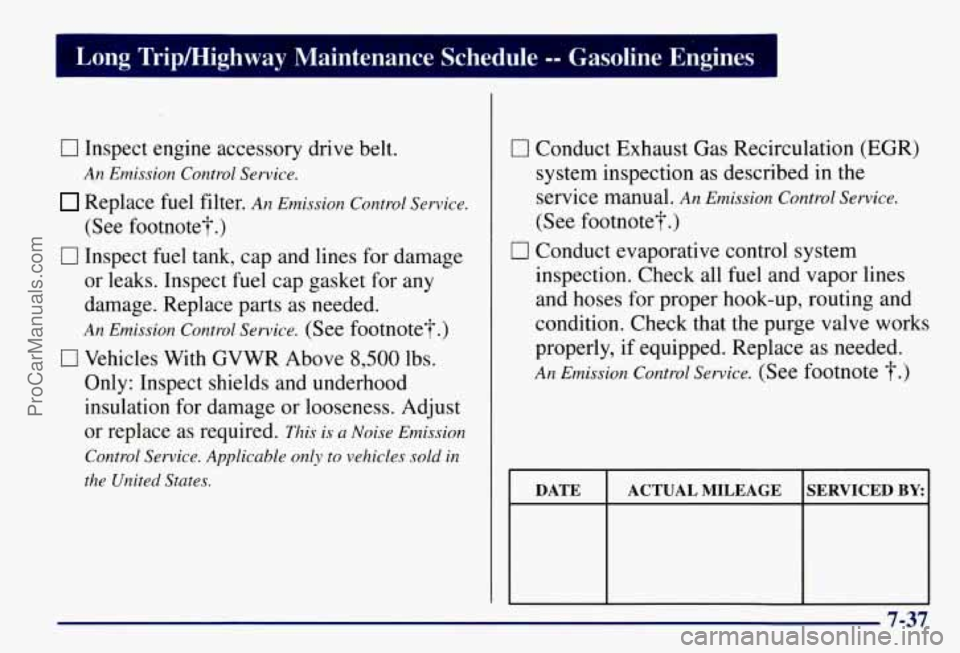
Long Tripmighway Maintenance Schedule -- Gasoline Enginc3
0 Inspect engine accessory drive belt.
An Emission Control Service.
Replace fuel filter. An Emission Control Service.
(See footnote?.)
0 Inspect fuel tank, cap and lines for damage
or leaks. Inspect fuel cap gasket for any
damage. Replace parts as needed.
An Emission Control Service. (See footnote?.)
0 Vehicles With GVWR Above 8,500 lbs.
Only: Inspect shields and underhood
insulation for damage or looseness. Adjust
or replace as required.
This is a Noise Emission
Control Service. Applicable only
to vehicles sold in
the United States.
0 Conduct Exhaust Gas Recirculation (EGR)
system inspection as described in the
service manual.
An Emission Control Service.
(See footnote?.)
inspection. Check all fuel and vapor lines
and hoses for proper hook-up, routing and
condition. Check that the purge valve works
properly, if equipped. Replace as needed.
An Emission Control Service. (See footnote ?.)
Cl Conduct evaporative control system
7-37
ProCarManuals.com
Page 397 of 433
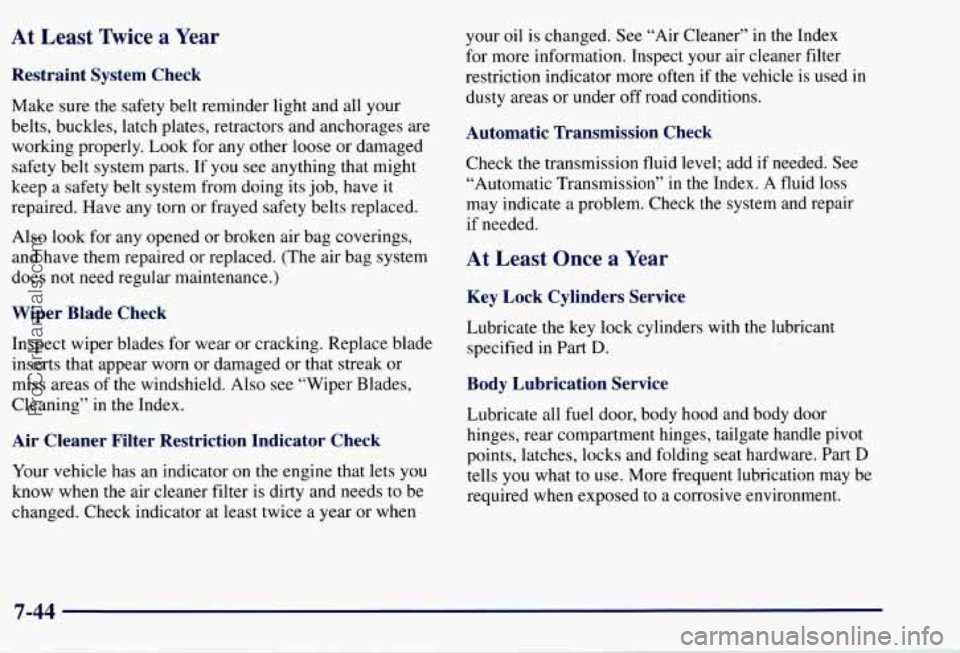
At Least %ice a Year
Restraint System Check
Make sure the safety belt reminder light and all your
belts, buckles, latch plates, retractors and anchorages are
working properly. Look for any other loose or damaged
safety belt system parts. If you see anything that might
keep a safety belt system from doing its job, have it
repaired. Have any torn or frayed safety belts replaced.
Also look for any opened or broken air bag coverings,
and have them repaired or replaced. (The air bag system
does not need regular maintenance.)
Wiper Blade Check
Inspect wiper blades for wear or cracking. Replace blade
inserts that appear worn or damaged or that streak or
miss areas of the windshield. Also
see “Wiper Blades,
Cleaning” in the Index.
Air Cleaner Filter Restriction Indicator Check
Your vehicle has an indicator on the engine that lets you
know when the air cleaner filter is dirty and needs to be
changed. Check indicator at least twice a year or when your
oil is changed. See
“Air Cleaner’’ in the Index
for more information. Inspect your air cleaner filter
restriction indicator more often if the vehicle is used in
dusty areas or under
off road conditions.
Automatic Transmission Check
Check the transmission fluid level; add if needed. See
“Automatic Transmission” in the Index. A fluid loss
may indicate a problem. Check the system and repair
if needed.
At Least Once a Year
Key Lock Cylinders Service
Lubricate the key lock cylinders with the lubricant
specified in Part
D.
Body Lubrication Service
Lubricate all fuel door, body hood and body door
hinges, rear compartment hinges, tailgate handle pivot
points, latches, locks and folding seat hardware.
Part D
tells you what to use. More frequent lubrication may be
required when exposed to a corrosive environment.
ProCarManuals.com
Page 424 of 433
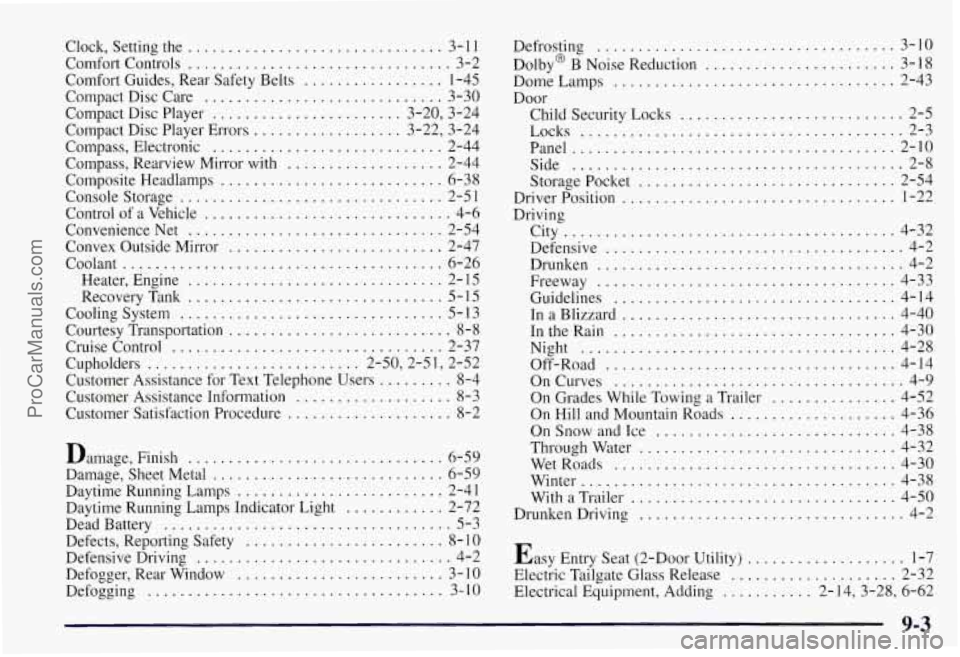
Clock. Setting the ............................... 3- 1 1
Comfort Controls ................................ 3-2
Comfort Guides. Rear Safety Belts
................. 1-45
Compact Disc Care
............................. 3-30
Compact Disc Player
....................... 3.20. 3.24
Compact Disc Player Errors
.................. 3.22. 3.24
Compass. Electronic
............................ 2-44
Compass. Rearview Mirror with
................... 2-44
Composite Headlamps
........................... 6-38
Console Storage
................................ 2-5 1
Control of a Vehicle .............................. 4-6
ConvenienceNet
............................... 2-54
Convex Outside Mirror
.......................... 2-47
Coolant
....................................... 6-26
Heater. Engine
............................... 2- 15
RecoveryTank
............................... 5-15
Cooling System
................................ 5- 13
Courtesy Transportation
........................... 8-8
Cruise Control ................................. 2-37
Cupholders
.......................... 2-50.2-51. 2-52
Customer Assistance for Text Telephone Users
......... 8-4
Customer Assistance Information
................... 8-3
Customer Satisfaction Procedure
.................... 8-2
Damage. Finish
............................... 6-59
Damage. Sheet Metal
............................ 6-59
Daytime Running Lamps
......................... 2-41
Daytime Running Lamps Indicator Light
............ 2-72
Dead Battery
................................... 5-3
Defects. Reporting Safety
........................ 8- 10
Defensive Driving ............................... 4-2
Defogger. Rear Window
......................... 3- IO
Defogging .................................... 3- 10
Defrosting ..................... ........... 3-10
Dolby
8 B Noise Reduction ....................... 3-18
Dome Lamps
................................ 2-43
Door Child Security Locks
........... ............ 2-5
Locks
..................................... 2-3
Panel
....................................... 2-10
Side
........................ ............ 2-8
Storagepocket
............................... 2-54
Driver Position
................................. 1-22
Driving City
........................................ 4-32
Defensive
.................................... 4-2
Drunken
..................................... 4-2
Freeway
.................................... 4-33
Guidelines
.................................. 4-14
InaBlizzard
................................. 4-40
IntheRain
.................................. 4-30
Night
...................................... 4-28
Off-Road
................................... 4-14
OnCurves
................................... 4-9
On Grades While Towing
a Trailer ............... 4-52
On Hill and Mountain Roads
.................... 4-36
On Snow and Ice
............................. 4-38
Through Water
............................... 4-32
WetRoads
.................................. 4-30
Winter
...................................... 4-38
With
a Trailer ................................ 4-50
Drunken Driving
................................ 4-2
Easy Entry Seat (2-Door Utility)
................... 1-7
Electric Tailgate Glass Release
.................... 2-32
Electrical Equipment. Adding
........... 2-14. 3.28. 6-62
9-3
ProCarManuals.com